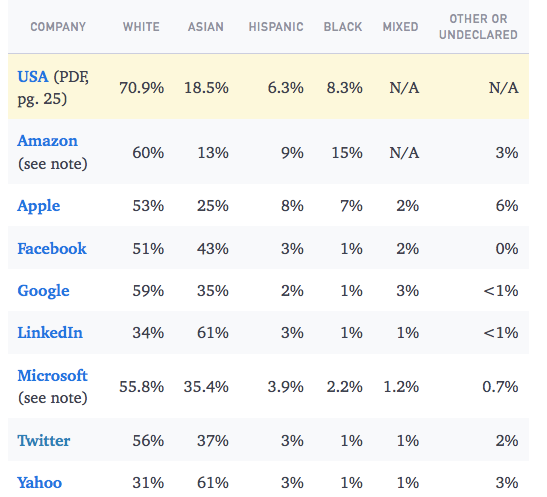
I don't believe this is due to any sort of racism, but rather due to the education system in general. Trying to solve the diversity issue at the hiring end, when the number of qualified candidates is so small, is not the right way to solve the problem. The only way you will hit higher-than-normal diversity numbers is to reduce hiring standards, which is wrong.
The real way to solve it is at the bottom of the funnel, at the elementary, middle and high school levels. By getting more children of all races involved and interested in tech is the only way we truly increase diversity.
And that is on us, those of us that have experience in tech. My goal is to try to volunteer to teach young children in economically disadvantaged areas about technology. Of course, I have no idea how to start doing this, and would love suggestions or pointers.
You might consider reading the excellent paper, "Are Emily And Greg More Employable Than Lakisha And Jamal? A Field Experiment On Labor Market Discrimination": http://www.nber.org/papers/w9873
My take is that if tech really, truly has no race or gender discrimination problems, that would be remarkably different than a lot of other US industries. One quick way to check is to ask your friends in those groups whether that's case. The ones I've talked to mostly disagree with you.
> The real way to solve it is at the bottom of the funnel [...]
I am strongly opposed to the notion that there is one real way to solve this problem. That you believe you have a plausible solution that might help is great. Definitely do it. But that's no reason to discourage people from trying other solutions.
I gave my opinion. This is what a discussion consists of. Nowhere did I discourage people from trying other solutions.
Now, I'm biased toward capability. I think progress is made almost entirely by people who possess both talent and will to power. But that's innate, and evenly distributed across racial and gender lines. So differences in outcomes are, broadly, due to privilege (specifically, resources). If someone has access to education and support, they'll do better than someone who does not, all other things being equal. Racist and sexist results are because of our failure as a society, not racial or gender inadequacy.
But anyway, about role models. For an ambitious child, the limits of "success" are the limits of what they see. That's what they see in their parents and their parents' friends, their neighborhood, etc. Their role models. If the most successful people you see growing up are doctors and lawyers and engineers, you imagine your own success as being a doctor or lawyer or engineer. If the most successful people you see are drug dealers and slumlords... well.
There are very few black engineers in this country. They're underrepresented. Because of this, smart and ambitious young black kids don't get "engineer" as a role model. They may have never met an adult who makes software or hardware for a living. So they have no frame of reference, no concept that this is "success". It's a big problem.
I've once saw of glimpse of this first hand and it was really depressing. Knew a waiter at a restaurant my family frequented. One day he was making chit-chat with us and talking about his son (who would have been rather young, 4-8) and that his dream for his son was to be a restaurant manager or a supervisor at a lawn care business or something like that. That was how high that family was dreaming, I guess that was as high as they could see being reasonable (unless they kid was a genius/pro-athlete).
From hearing stories of women in the industry seeing that one person that looks like them that shows the 'you can be this too' seems like it's often a huge help or an important moment.
Definitely. I'm probably in tech because my dad was. He started programming in the late 60s. How did he get the job? His dad was an executive at an insurance company; they'd just gotten a computer and didn't really know what to do with it. Not that my dad had any experience, but he was a quick study.
I'm sure that wasn't an option open to black people at the time. Their city still had segregated pools.
Women didn't have power because they were oppressed by men for centuries. Black people don't have "as good an education" because they've been systematically abandoned by the most powerful parts of society for centuries.
You could spend 100 million on a program just in my city alone to try to give disadvantaged kids tech lessons. You know what would happen?
Nothing, because you haven't addressed the fact that they have to sell dope, hustle or work multiple jobs just to put food on their family's table; that they're watching their baby sibling while mom and dad go out to score junk; that their friends need them to join the local gang to protect their neighborhood; that they don't have access to transportation to get to the classes; that the rest of the city needs money and will steal from the education fund as it always does, because why try to teach the kids when they're not going to learn anyway; and of course, because their parents gave up on their future a long time ago and give zero shit about trying to help them make something of themselves.
WOW. Haven't time to unpack all that is wrong with your response but mainly: Black people in the US can be found across all strata of society, including top/good schools. The implication that they must all be poor and in inadequate schools is ludicrous.
Part of why the diversity issue is so aggravating is because the # of qualified candidates may be relatively small, but it still significantly exceeds the # of Black candidates hired.
Likewise, stating that the only way to improve diversity is by lowering of standards is wrong. It communicates your obviously flawed perspective that Black candidates in tech are inferior.
I agree there is a diversity problem, and my proposed solution is to increase investment in education in disadvantaged areas. And somehow I'm vilified as a closet, biased racist. It's hilarious.
It's responses like this that make any discussion on increasing diversity completely impossible and futile.
I'd like to see how minority owned or run small to mid size enterprises even large have fared in hiring minorities (their own, as well as outside their own) in the "tech" field. If they can who higher rates, then it may indicate that non minority owned and run are to some extent racist, or at least not actively seeking minorities.
It's absolutely necessary to kill the myth of tech hiring as a perfect meritocracy. It is not, it's far from it. It's a dirty and incredibly flawed process that barely even works, let alone represents any pretense of egalitarian perfection.
The way I see it, the biggest beneficiaries of "affirmative action" aren't the people getting jobs because of diversity policies. It's younger, impressionable kids who get to benefit from role models in their likeness.
"Forced diversity" may be the best hack possible to foster persistent diversity down the line, and fix vicious cycles.
What they should look to do is recruit people who got to programming or designing through paths other than MIT or Stanford. Hire the guy that was a painter and then started building website UIs when he saw how those skills transferred. Hire the guy that graduated from the small state school and spent all of his free time web programming. That - at least to me - is the kind of diversity that comes at problems from various angles.
The VP idea with names was stupid, but if I walked away from a job every time one guy had a stupid idea i'd be locked in a closet somewhere howling at the world's stupidity.
My 2 cents. I got to get back in my closet.
"Twitter as a platform has empowered underserved and underrepresented people. It has fomented social movements and..."
Sounds like twitter is killing it for people of all ethnic groups. It's as if a bunch of White/Asian dudes can actually design algorithms that work for everyone. So, um, why do we need a non-Asian engineer?
It's also worth questioning how a black person would think differently from the (apparently highly effective) white/Asian workforce. I've seen very few meaningful examples of this and I've never experienced it (I'm usually the only person of my race). My current job is mostly Punjabi's, no techies of my ethnic group, and my unique perspective is "lets all be Bayesian cause Frequentism is ass backwards" and "stop the multiple fucking comparisons!"
A naughty question: suppose I'm wrong, and black people actually do think differently. Given that whites/Asians seem to be doing such a great job, why do we think that "different" is actually better or even useful? In statistics terms, given two different functions f and g which are estimators for some truth t, it's unlikely that |f(x)-t(x)| = |g(x)-t(x)|. One of them is probably better.
I idiotically misread the chart posted in the post. I originally thought the chart under ( https://cdn-images-1.medium.com/max/800/1*F9MLGQLTU2HZD4In6o... ) wasn't normalized to anything; but upon rereading i found that the top row is the comparison row and represents the percentages of working force age us citizens in the tech industry, which Twitter with its 1% falls far below.
I'm sorry for my mistake.
My original post below for context for the replies made to it, but which is otherwise useless.
------------------------------
It's alway a little confusing when people bring up diversity reports that aren't normalized to an appropiate comparison metric. (Possibly local demographics, or any number of more in-depth metrics. I also earlier suggested applicant demographics, but justizin pointed out those are not feasible.)
Also see: https://xkcd.com/1138/
To bring it into contrast with the article, he says:
"<5% make up engineering and product management combined."
According to this census report: http://www.bayareacensus.ca.gov/counties/SanFranciscoCounty....
Race - Black or African American 48,870 6.1%
The twitter numbers are thus a little below average, but not necessarily unexpected given where Twitter's headquarter is located.
Edit:
According to this, Twitter has roughly 30% asians: https://blog.twitter.com/2014/building-a-twitter-we-can-be-p...
Which seems to fit the census as well:
Race - Asian 267,915 33.3%
Another Edit:
To clarify, i am not saying that there is no problem. I'm merely saying that in order to solve a problem, one must both set appropiate goals, as well as correctly identify the root cause. Both of these can only be done usefully by applying statics correctly.
So maybe the bar is right, in that it selects the most high-performing asset to execute the requisite keystrokes in a cost-effective manner. But maybe the world we should strive for is not one where people spend their lives in anxiety honing their resumes, getting into the right schools, the right clubs, getting the right internships, and having the right connections through daddy. God forbid there are any complications in your life along the way, or if you were born in a place which set you up for failure from the get-go.
I think one great thing about tech is that you can learn it, if you're intelligent and you get shit done. Maybe all you need is somebody to give you a shot to set you off on a trajectory toward the moon.
Capital should be blind to all these qualitative descriptors like race, biological gender, age etc. Successful capitalists are always looking to maximize the return on their investment and they don't subscribe to these inconsequential notions, all what they care for is making money for them. If you're a Martian and are capable of doubling their profits every two years or so, they would be all over you and discard any prejudices toward you.
Money $$$ talks after all esp with the capitalists.
Granted, that isn't by the author, but it shows a company trying to dodge the diversity issue.
That's a problem. Hiring corps not only need to screen more applicants in order to find more applicants above their quality bar, but they also need to engage the community to get more kids interested in their fields and encouraged through school.
It's the long view, the generation long kind. Public corp cost accounting idiotry will not support investment like that, so it's up to the private corps.
This sums up my issue with this piece: at best, not all his wishes are necessarily shared by other people of color; at worst, some of the things he wants could actually be construed as racist("Just because I'm black doesn't mean I'm interested in Jesse Jackson" my friend often says.)
All that lobbying for people who did not meet the technical criteria, that getting upset at the idea of someone not noticing his differentiating blackness.
He might have a point in the part about how many minorities are using the service, but I don't see how the tech department should be concerned at all with that. Community relations, marketing, sure. Not tech.
Also, I'd like to point that this fellow engineer comes across as bit pushy with his agenda (It's very obvious that has one). He's treating Twitter as a political organization where he's using his position as a conduit to further his goals as an activist advocating for change which is in my opinion very troubling and unhealthy for any business.
Also, it is worrisome that he didn't perform his duties as a diversity officer[?] efficiently as it seems to me that he was only concerned about his own people, African Americans. (What about other francophone Africans? Foreigners? People of other ethnicities and regions like MENA ..etc?) He didn't seem impartial to me at all and all what he cared about was lobbying for his own group only and this is not really commendable. You don't join a company and start lobbying for certain outside groups like that and expect a smooth sailing. If you're turning the company into a political battle field, you should be ready to face the consequences of your actions.
This brings to another equally important point which is the apparent feud or problem with the VP of Engineering regarding recruitment decisions. This activist engineer was very ambitious and at the same time shortsighted in his plans to make political gains in the organization and not expect opponents to show resistance or experience friction throughout the process. He clearly wanted to influence the decision making process if not tow and subordinate the whole department to his department which in my opinion is very naive thing of him to do and clearly revealed his motives that what he's after is more power in the organization and not reaching a more egalitarian system or environment.
It was all a power play for from the get go and he wasn't very good at it because you don't expect to encroach on someone's turf and not face a backlash or pushback. Even the most level-headed and good tempered person would turn territorial in these situations of adversity and things get ugly that could lead to tensions and strenuous relations between department within the organization.
Finally, his quitting and cop out sealed it for me as to my assessment of his account because no activist worth his salt would bail out and leave the cause he's fighting for like this. Change doesn't happen overnight and you gotta invest heavily and believe truly in your cause to start seeing progress. So, maybe he's more suited to work inside a political organization that's aligned well with his worldview and affiliation where they favor more chip on the shoulder type but he's certainly not a good material or asset and to have on your pro team or in your business.
At companies I've worked at I've seen the leadership cheerleading race & gender diversity, but not interfering with engineering management's hiring practices. I assume that the leadership is just playing the Public Relations game, because being seen as a proponent for diversity is good press, but not letting it actually change anything. If I'm being even more cynical, then leadership is just clueless, and is also clueless that they shouldn't be averaging engineering with marketing in order to say that we have a good gender ratio.
I'm surprised that you're surprised.
Why is it needless to say that?
Tisk. Tisk. It's been well documented that these tools are used to weed out ethnicities.
That doesn't mean they'll give different answers to a question on how to traverse a linked list. But they'll give different answers on how to build a content moderation feature, how to prevent abuse, how to protect freedom of expression on the platform.
The way people look at you, talk to you (or ignore you), talk about you, extend invites, etc..that ALL changes with your race.
The differences between their experiences is smaller than the differences between that black individual (sidenote: I was recently told by a black guy that African American is worse than black when used as an identifier) and someone of the same race who grew up in a significantly different socioeconomic class. If we want to increase diversity, the best would be to do so by class first, gender second, and race third.
However, none of this would help the white person build a content moderation feature or prevent abuse or protect freedom of expression better than the black person.
May I ask specifically how a person's belief that their name was the cause of failing to get a job leads them to create a better content moderation feature?
I don't think it's the tech department's job to define those.
You are implying that those negative experiences are a product of racism and not of simple statistics.
Maybe, only maybe, people _dont have_ as many problems with white guys wandering down a dark street wearing a hoodie as they have with black guys wandering down a dark street wearing a hoodie, so they dont call the cops on the former and call the cops on the latter.
Youre implicitely ruling out the mere _possibility_ that there maybe, only maybe, _might_ be a problem with blacks, that isnt a problem with whites, asians, indians or hispanics.
Come on. At under 5% basically ANYTHING ELSE is diversity.
Also, he does touch on this in the article. He says that Twitter relies heavily on a few schools for hiring so even if they get 'diverse' candidates from those schools they've still had a very similar experience compared to people from geographically diverse schools. That alone would add one form of diversity. He said he's seen this resulting in group think, and I can believe that.
But really? You want people to define diversity in this situation? That seems like a 'no true scotsman' setup to me.
Having a different skin color makes a HUGE impact on the way you experience life, especially in America. Holding all other things equal, that alone will give you a different outlook on life, and likely different ideas too.
If a diversity quota decides about you gettnig a job or not getting a job, then it is indistinguishable from a race quota, i.e. racism.
I assume he (or she, don't remember the name) is looking for any kind of diversity, although their experience (and the chart posted) clearly talk about ethnic diversity, which may be what they have the most direct experience with.
It's just ethocentrism or more specifically in his case Afro-centrism. Racism as a condemnation shouldn't be bandied about this lightly. The US media already devalued it and made it a joke by their excessive and irresponsible use of the term.
If we're going to blame the employers, can someone show me that there's a disproportionately large number of unemployed minority engineers that are seeking work but not getting it?
Makes sense, but I'd say it should be a disproportionately large per-capita fraction of minority engineers with similar degrees, experience, geographic location, etc, relative to white engineers with the same characteristics.
For example, if minority engineers with Stanford degrees with 7-10 years experience and living in zip codes [A, B, C, ...] are 10% unemployed and their white classmates have a 5% unemployment rate, that could be evidence of deliberate discrimination. It's important to compare like to like, otherwise you can wind up with all sorts of weird conclusions.
The arguments for diversity usually say that organizations improve when people from different backgrounds are part of them. This is the argument for increasing diversity along gender, orientation, and ethnic lines. If different points of view help then we should be trying for ideological diversity directly.
The fact that Twitter enables diversity doesn't mean that they have or understand diversity. It may be that they simply haven't accidentally stepped on it.
If they don't know why what they're doing is working then they can't successfully improve it further, or avoid squashing it unintentionally and irreparably.
Honestly your comment reads very racist to me. "why do we need a non-Asian engineer?", "suppose I'm wrong, and black people actually do think differently. [if twitter is doing good] why do we think that "different" is actually better or even useful?"
So Twitter is doing great, and you've basically reduced it to either 'race/perspective never matters' or 'non white/asians are inferior'. I'm sure you'll say it's the former.
Wow.
(Now that I've re-read your comment, I'm happy with my down vote).
But yes, if different races do behave differently, it's valid question to ask whether you actually want that different behavior. As a silly hypothetical to illustrate the point, humans and leopards behave differently. Turns out one of them is a lot worse for the office environment than the other.
If you want to argue that A != B, you are explicitly allowing for the possibility that A < B. So some argument is necessary why that isn't the case.
But again - I think A == B, which I guess makes me racist.
Different experiences yield different points of view yield different ideas
Lets be concrete here, rather than appealing to vague platitudes.
That analysis assumes that the hiring base is predominately drawn from local people. Speaking anecdotally, I know many people who graduated from college and headed to the Bay Area to look for a job. I myself moved to Mountain View for a job, then later moved away.
A more complete analysis along the lines you took would look at where people in engineering and product management were, say, 1 or 5 years previous. That are would likely better characterize the relevant population statistics.
As an obviously contrived example, suppose people in engineering and product management are only in the Bay Area for 4 years, burn out, and leave, and suppose the companies offer free relocation from anywhere in the US. Then it doesn't make sense to look at the local demographics.
As a more real-world case, consider a place like Los Alamos National Labs, which has a large number of people from around the world working there, with a relatively high turnover rate partially due to interns, post-docs, and visiting professors. Los Alamos county was carved out for the lab, so the demographics of the county reflect the lab, but most of the people working at the lab are not from Los Alamos.
I do not have access to these sorts of numbers, merely pointing out how it's not easy to interpret the numbers you gave, or the certainty of your conclusion that it's a "not unexpected" result. I suspect the uncertainty is actually very high, and a shot-in-the-dark/back-of-the-envelope estimate isn't likely to be useful.
If you (try to) eliminate race from hiring, you don't lower the bar. You raise it, because suddenly there's a group of so-so engineers who now can't get a job just because they're white.
If that feels uncomfortable, replace "white" with "MIT student". Or any other in-group.
If you almost exclusively hire from a single group, at some point just being part of that group makes it easier for you to get a job.
As far as I can tell, nobody is asking for hiring quotas based on profile. What people are asking for is an equal chance.
For pretty much any group that's not white/asian male, tech has an issue. The percentage of the minority group in the general demographic is higher than the percentage of people in that group graduating. The percentage of graduates is higher than the percentage of people hired. The percentage of people hired is higher than the percentage of people promoted.
All this diversity thing is asking for is that we take a look why the percentages are decreasing.
E.g. for black people: They're 12% of the general work force. 4.5% of CS bachelors are black. 2% of SV tech employees are black. 1% of Fortune-500 CEOs are black.
There's constant attrition going on, while the number of the main demographic increases as you go up the ladder. (This general relationships hold for other minorities as well, but I don't have numbers handy right now)
That's what diversity asks for - stop the steady attrition of anybody who's not in the majority group.
Anyway. Are you sure it's a good idea to compare numbers like recent grad percentages and Fortune-500 CEOs? These two in particular strike me as separated by several decades in which society has changed. Perhaps not the most useful comment on current society.
1. Assuming hiring a more diverse workforce would lower the bar.
The statement precludes that a more diverse workforce would implicitly lower the bar. This makes no sense. Increased diversity means increasing the many ways one can look at a problem, which improves problem solving and improves creativity. If the very first thing this guy thinks about is that hiring more women or black people would lower the bar, that's fucked up.
2. Assuming non-diverse workforce would not lower the bar.
If you hire shitty people, you lower the bar. There's plenty of white male tech workers who could lower the bar; keeping your workforce from being more diverse does not guarantee you won't hire a bar-lowering white male.
So at the very least it's inaccurate and misleading, and at the worst it is classist, racist, and sexist.
> Some people criticize that that statement is racist, but they aren't thinking about the context.
People who haven't had the advantages of white males have a harder time getting the same job, so an attempt is made to 'level the playing field' for someone who probably has exactly the same job competency but not the same socioeconomic advantages. That's the actual context.
> When people ask companies to do something about diversity, they're normally asking to carve out more quota for certain minority group, just like how universities carve out certain portion of their student quota for people who donate large amount of money to get in.
It is illegal in the United States for any employer, university, or other entity to have a quota for a certain race. Furthermore you're also assuming that donations preclude acceptance, which it doesn't inherently. The fact that the kid's parents could afford to pay for the best education up to that point gets them farther than the money alone.
The implicit assumption in that statement is that the current hiring process is not discriminatory, therefore the only way to hire more people of <group X> would be to lower hiring standards. Many people believe the hiring process is discriminatory - and, indeed, there are studies which support that claim.
Leaving aside the issue of discrimination, though, what's curious is that it's widely accepted that hiring in tech is broken. Companies complain that it's extremely difficult to identify talent. Larger companies are willing to risk turning away many qualified candidates if it reduces their risk of a poor hire. It turns out that it's very difficult to reliably identify who is above "the bar" and who is not. There are startups out there trying to solve this problem right now. It's a problem that effects everyone in the industry, too, not just individuals from <group X>.
So, if we lack a reliable way to determine if someone's above "the bar," how on Earth can we say that the reason we don't have more employees in <group X> is because there aren't enough applicants from <group X> who are above the bar? We can't.
Unintentional sampling bias, I guess.
I can't see what one has to do with the other.
It is the legacy of the famous Griggs vs Duke Power case.
Requiring IQ tests to filter employees was found to have "disparate impact" with respect to different identifiable groups.
Silicon Valley does a lot of different IQ test proxies in order to filter their prospective employees in a hopefully-not-racist way: programming tests, seeking college degrees, etc.
But if they use an IQ test, suddenly there's a slippery slope: Why is the cutoff 130? The error range on IQ tests is non-zero, so what if a black candidate with 129 comes in? How do you defend that disparate impact in court? You can't.
As an aside, I ran the names Miles Davis, Ray Charles, Morgan Freeman, Ben Carson, and Charlie Rangel against one the tools the author mentioned [1] and also got no correct answers.
    George Washington	GreaterEuropean, British
    John Smith	GreaterEuropean, British
    Barack Obama	GreaterAfrican, Africans
    Mike Brown	GreaterEuropean, British
    Tamir Rice	GreaterEuropean, Jewish
    Eric Garner	GreaterEuropean, British
    John Crawford	GreaterEuropean, British
    Akai Gurley	GreaterEuropean, British
    Ezell Ford	GreaterEuropean, British
Cynical Oogaboogoo Asian, IndianSubContinentMost Black Americans are descended from slaves. And their slave owners forced their family name on them. Slave owners were white. So these names will register as white names.
Completely destroys any accuracy concerning Black people.
Today, I've shook the hands of multiple billionaires. I could not have even imagined that as a child. But I'm lucky. I'm very intelligent, talented, lack major health issues, and I'm white, male, and American. The combination of innate talent and privilege opened a lot of doors for me.
All it takes is one hiring manager to read this thread, realize their unconscious bias, and then realize that focusing on diversity does not compromise employee standards. Then a black person gets hired.
I really don't understand how this racial hiring quota stuff works...
Edit: Downvotes are nice, but refutations are better.
But I can only go by the arguments the poster who was in the meeting made, and he seemed insistent that Dorsey is sincere about diversity, and decided to focus on why the "tech visionary" VP's idea was notionally sensible but had practical limitations rather than lambast their general attitude. And it's not an idea that ranks particularly high on an ignorance scale, or particularly shocking that a "tech visionary" not expected to have any particular expertise in the area of diversity might gravitate towards a tech solution. Ironically, it sounds like precisely the sort of misguided suggestion a VP is likely to propose after reading articles about name-based studies of hiring biases and being shocked by their findings them rather than the sort of idea that gets proposed out of ignorance or dismissive attitudes towards diverse hiring policies. Certainly sounds like a better response than "go and talk to HR about it. After finishing your work, obviously" that he might find all too common a response elsewhere...
Normally when we're discussing quitting over straws that broke the camel's back it's allegations of subtle workplace bullying rather than not thinking an engineer's idea would work...
As a Bayesian, I can certainly tell you how my perspective differs from folks like Leonid Pekelis or Evan Miller. As a person who leans towards parametric statistics and modelling, I can tell you how my perspective differs from the machine learning types.
Why is it so difficult to provide the (alleged) black perspective?
But software development is not just about CS theory. You're selling a product to people, and thus you introduce the human factor. If say, Facebook one day realizes they need to appeal to female users more to promote growth, does it not make sense that having female team members would be useful? That if Apple sees China as a growth market having Chinese team members will help them better target that userbase?
Obviously, there is no binary tree that is more friendly to the Chinese market, or black, or gay markets etc. But you can definitely change the UI, or messaging, or features that better speak to a specific culture. When architecting a feature in Facebook, a hispanic engineer could suggest a family-focused feature since she knows that family is very important in her culture. That's not to say a white male team of devs couldn't do a great job of satisfying a Hispanic user, but that a more diverse team might do an even better job.
That's a very business-centric take on the issue. Another, more noble side to it is that there's very likely a lot of people from underrepresented minorities who could be high quality software devs but because of their socio-economic status they were discouraged from pursing that career. A more diverse workforce, won't lead to quick results, but it helps.
If this director has a more human and compassionate perspective, she might help push back on all feature requests to give her team ample time to fix the fail whale during the day because she sees how unfair and stressful it is that they are getting paged at night.
This is hyperbole, but another director with a more analytical bent he might push his staff to work more hours, work harder and smarter, to rewrite the problematic systems.
Perspective of leadership is extremely important.
But this applies to all teams that work collaboratively on solving problems.
Personally i was thinking along the lines of: Maybe the real problem is whichever property of the area they are headquartered in prevents higher amounts of black people from living there. Which may, among others, turn out to be: Companies there are biased against black people, so they're relocated less often. However without looking at the situation closely, any conclusions drawn are premature.
But how does it affect me on the job? I write quantitative software, and spend lots of time thinking about bayesian hierarchical models and multiple comparisons. You are suggesting I have some unique power. I'd really like to know how I can use this power.
But ok, lets say I'm a typical software engineer, building a CRUD app used by banks to set up a new customer with an HSA. What's my unique non-Indian perspective on that?
I can understand how there might be a useful purpose for token diversity on the UX teams for some consumer products. That's an exceedingly small part of the tech world.
As far as how it affects you on the job.... well, in the subject under discussion, they candidates are not even considered for the job because of their race. We have not got to the point where they are even 'on the job'. Per the article, when a diverse candidate was bought in, they performed well.
Perhaps I misread and misunderstood your response and my reply just builds on the confusion.
The article and the comments here don't even begin to support the claim "candidates are not even considered for the job because of their race".
Yeah it's hard to start learning how to program and become efficient at it, but there is no reason that we can't attack the issue at later stages in the pipeline.
But supposing these affinity effects are real, and extend beyond consumer products, then if your customer base doesn't contain these minorities then their presence on your product team might be harmful. I.e., MongoDB or Washington Square Tech should NOT hire a black guy, since a black guy's experience is significantly different from the (white/Asian) rockstar ninjas and banksters making up the customer base. Is this also a conclusion you would endorse?
Interestingly, the 30% number seems to indicate that twitter actually does pretty good user-wise.
This shows a very poor understanding of both the history of racism and modern-day racism.
> Nowhere did I discourage people from trying other solutions.
When you say "X is not the right way to solve the problem" and "The real way to solve the problem is Y" you are definitely saying other solutions are less legitimate than yours.
Given that this is a topic where you know little and admittedly aren't doing anything yet, maybe you could try listening to the people who have spent their lives studying and working on the problem?
> This is what a discussion consists of.
Not really. You making a series of bold, uninformed assertions doesn't make for much of a discussion. Indeed, your assumed mantle of superior insight harms the discussion.
Half my current team at a well-known company doesn't even have CS degrees. The youngest one never went to college, but he's one of the smartest members of our team. I was recently hired, and I'm in my 40s and there's another guy who's older than me. My boss was a high school teacher, and he was one of the instrumental programmers in the entire company for the last several years.
Over the last several years, I've been intimately involved in hiring, and I can tell you straight up that no one looks at schools, and anyone who has half a chance at passing a phone screen will get a call. People might get more excited if they have a good name on the resume, but we called everyone that seems like a decent candidate.
Given the number of Asians in tech, it appears white racism is lacking.
1. http://www.npr.org/2015/05/17/407478606/often-employees-rare...
You know lots of people who won't say they base decisions on race, and who think they're not basing decisions on race, but I bet if you double blind tested them with fake resumes you'd find bias.
1. The system is unjust due to institutional racism. 2. Blacks are inherently more violent and criminal than whites.
You seem to be arguing the latter.
Even with non-violent drug use, rates are similar across all races yet blacks are measurably discriminated against in searches, arrests, and sentencing.
Just looking at murder, blacks accounted for 52.5% of homicide offenders from 1980 to 2008. Looking at offenders per 100,000, it is 34.4 for blacks versus 4.5 for whites. http://www.bjs.gov/content/pub/pdf/htus8008.pdf
There have been many studies, not just from the arrest, sentencing, and imprisonment side. There are studies in which random people are polled and asked whether they have been victimized. It is not poverty alone. Homicide among impoverished whites is nowhere near the levels seen among blacks.
There was not any really good reason to try to arrest Garner at the point they tried to restrain him. Chokeholds are banned by that police department, so when they did try to arrest him they went about it in the wrong fashion.
The Garner case raises lots of questions, including whether or not he would have been treated the same way had he been white.
Brown, on the other hand, was walking down the middle of the street with goods he just stole moments ago. Police had good reason to stop him. A white kid doing the same would have been stopped.
Brown attacked the officer and tried to take his gun. A white kid doing the same would have been shot. And a white kid who fled after being shot, then turned around and continued approaching rather than obeying an order to get down would get shot more, just like Brown was.
The forensic evidence combined with the eyewitness accounts provides a pretty clear picture that Brown got what pretty much anyone would get in those circumstances, regardless of their race.
Lumping Garner in with Brown is very disrespectful to Garner and his family.
In both cases, there was misbehavior by the suspect and misconduct by the officer, but the more important unifying circumstance was the fact that officers on routine patrol in both cases were armed with lethal weapons, so that hand-to-hand conflict was almost guaranteed to escalate instantaneously to deadly force.
He didnt "deserve" to die, but the fact that he violently robbed a store minutes before he died, maybe, _only maybe_, contributed to his violent death, dont you agree?
I think their point was that passive racial biases lead to class differences that can't be summed up in a hypothetical comparison.
The study is in "Can We All Get Along", by McClain and Stewart. Really interesting book that does a good job of making you think.
>(sidenote: I was recently told by a black guy that African American is worse than black when used as an identifier)
For some - it's putting the `African` before the `American`. For others, it is putting `African` at all (not all blacks identify or hail from Africa). Ultimately, offense is taken and not given. You'll also find people who take offense at being called `black` over `African American`.
Either way - I don't think you need to justify your use of calling them `black`, at least in this context.
One potential example would be that someone who has unfairly been targeted by the police may have higher privacy concerns and also be more aware of possibilities for the government to abuse information and even violate rights; things that can happen with regards to social media profiles.
For a more concrete example, a gay individual who grew up somewhere where being gay was punished (either codified in law or where the law turns a blind eye to the discrimination) is likely to be far more concerned about systems that can leak sexual orientation, for example an eye tracker/pupil measurer that makes an attempt to determine who a subject finds attractive or not. The average heterosexual may understand that leaking this information could be embarrassing for some, but they may not be as aware it could be life threatening.
Yes, an aware individual not of that background could develop the same concerns after thinking long enough, but they will not have the same immediate concern about any system that interrupts a person's ability to 'pass'.
Unfortunately I'm not able, in good faith, to take a stand for or against your argument. Consider this conceding the argument, but not being entirely convinced (allow me to explain).
Initially, I would like to reject it. Because as a libertarian-leaning trans, I fall under both examples you cited. Concern over potential abuse of PII, government overreach, and sexual identity (the concern over gender identity is similar in that regards). But I also fall under the "white, male" label.
However, I do understand the argument that a more targeted individual may be more capable of identifying potential issues. I feel this is contextual and often results in too many "maybes", "potentials", and "possibilities" to be entirely convincing.
"They maybe might have the potential to maybe see a possibility for something that might have the potential to maybe have the possibility of being abused." is not something I find convincing. Though it is technically correct and I have to concede that.
You do realize that both of those descriptors are immensely subjective, right? How you assess "smart" is different from how I do, and there's no guarantee that the environment you create will allow me to contribute quickly compared to another one.
Non-violent drug use - it's in the same sentence, come on.
Unlike drug use, violence is tied heavily to socioeconomic status and environment [1], which is only correlated with race, not caused by it [2]. You do know what cognitive dissonance is, right?
[1] http://www.ncbi.nlm.nih.gov/pmc/articles/PMC1449156/
[2] http://ajph.aphapublications.org/doi/abs/10.2105/AJPH.74.8.8...
What it really boils down to is this: "As a beneficiary of privilege, it makes me uncomfortable when people point out that racism and sexism exist. I can't say they're factually wrong, so I'll talk about the tone instead. If they would just stop being so uppity and find a way to solve the problems of racism and sexism that do not make white men uncomfortable or take any action, everything would be fine. But they haven't, and it's their fault."
Does that seem like a "concrete, non-racist criticism" to you? Sorry if I can't magically remove race as a factor in the tone argument, but reality interferes. The tone argument is made almost exclusively by whites. You can call it "racist", but you can't change the fact. Calling it racist is a cop-out, a convenient dismissal of a valid and problematic point.
For what it's worth (i.e. not much) I didn't get the same sense from jonesb6's comment that you did. It would have been nice if jonesb6 went into a little more detail about the supposed misrepresentations, but talking about misrepresentations of facts and statistics (should they actually exist) is a far cry from complaining of tone.
Finally:
> Is it ad hominem if it's true?
Definitely. Most ad hominem arguments are true -- that's not what's wrong with them.
But for the rest, the complaining about misrepresentations felt like rationalization to support the tone argument (much like making it a question rather than a statement). It's a very common pattern. My bluntness was a vent of frustration with that style of argument. If he'd wanted to make a substantial criticism, he'd have pointed to specific examples of misleading or incorrect statistics. He did not.
More to the point, quibbling about the numbers doesn't change the fundamental truths of the original article - first, that black engineers are badly underrepresented at Twitter, and second, that Twitter's attempts to address the issue have been misguided and ineffective. If the core point doesn't change, then why the quibble?
Which brings us back to tone. Which in turn brings us back to privilege.
Such as the privilege of being the majority race in the local neighborhood even if you are a minority at the national level or the privilege off being the majority of the voting population.
What bothers me the most about conversations dealing with privilege is that the louder someone talks about others, the greater their denial and downplay of their own.
That's a lot of concentration of power.
Discounting the value of culture is a huge mistake. Humans work best when they are not treated as replaceable units of quantified productivity.
Diverse cultures can attack problems with a broader perspective than homogenous cultures.
I have talented co-workers of many different races (specifically including black), but even without visiting our office, you could guess the percentage breakdown and you wouldn't be far off.
I can't hire applicants that don't exist and I can't hire applicants that aren't qualified.
You can hire junior engineers and mentor and train them to be successful.
Then you can proactively advertise your positions to programs and organizations that have more minority participation.
Of course this takes more work for you, the hiring manager, in sourcing and on boarding. But there should be a burden on every hiring manager to correct the systemic diversity problems.
A success will be extremely impactful for the individuals you hire and for the overall health of the team.
- It's hard to get hired by white companies, so a lot of black people stay within black-owned companies and communities.
- There are a lot of ways to search for and hire applicants; waiting for people to come to you will not necessarily result in the best candidate.
- Transportation is not as easy or available for poor or rural communities. It may be necessary to hire remote, or pay for relocation, or in the extreme cases open remote offices.
- The 'qualifications' may need to be revisited. What are you requiring as a qualification? Is it something a poor black person would have significantly more difficulty in achieving compared to a white person, due to socioeconomic disparities? Is it possible you could find other qualities that work as similar qualifications that black people might be more likely to have?
In order for there to be more black applicants, we need to help there to be more black applicants. This can mean many things, such as contacting local black communities and asking them what your company can do to help adults achieve a job at your company, or helping to improve the roadblocks for young kids to get a good education.
I know, I know; actually trying to help people can be a burden. But it will help people who continue to be oppressed by a society that does not care about them. You could continue to just wait for black people to work around the huge pitfalls society has set up for them, or you could help work to remove those pitfalls. It's up to you. Unfortunately.
The problem exists in parts of the society that technology can't fix, but law and education might. It doesn't help that the criminal justice system is statistically racist and that lack of cohesive families due to the consequences of povertous conditions causes children from those families to perform less well in school.
If you want better diversity in better-paying fields, the most impactful change would be to end the war on drugs, which contributes the most to poverty and incarceration. I don't see how the tech community can do that by themselves and the full effect won't even be measurable in the tech community until a generation later.
First, we have to get people like you to understand what the problem is, which apparently is difficult to do. Then, we have to build empathy for the problems facing black people so you want to actually help them. Then we have to invest in developing social and economic equality within disadvantaged communities.
And hiring more diversely will not lower hiring standards. Please try to understand that.
The explanation tech companies have for not having a more diverse workforce is that the applicants are just not out there to hire. Of course, any good tech worker could take an additional five minutes to think about the problem and discover that there are ways to create the applicants, by improving the communities that will grow the applicants.
But that takes time, and money, it's hands-on and it's not easy. And overseas workers are cheap.
This means I get to throw out your entire point, right? /s
>That's a lot of concentration of power.
Depends if you are talking race or sex. For sex, you just need to look at areas like the Duluth model of domestic violence or the disparity in sentencing favoring women even when adjusted for the same crime to see that this doesn't do a thing for the average male.
Compared this to how the rich, regardless of race or gender, have an unfair advantage within the legal system to see that sex/gender doesn't matter much.
I can think of a ton of reasons a hiring manager would say "I can't do that." Not about race, but about remote and time zones.
So kudos to you for trying something that opened you up to far more candidates, finding them, making them successful, and sharing this example for others to learn from.
You mean the one that has been shown to not exist?
- U.S. Department of Labor
- Any attributes not accounted for in part or in full. (Of which there are quite a lot.)
- Past sexism which impacts income in the modern day. (Sexism 30 years ago would have impacted starting incomes of people, which would have reflected up til today because one's initial compensation greatly impacts future compensation through many different factors.)
- Modern day sexism.
Given evidence such as looking at just the youngest generation and what they earn, you begin to see women not only equalizing with men in earnings, but out pacing them. This means that 5 to 7% gap is far more likely to be the first and second. And once you compare pay gaps to things like danger of the jobs chosen, you see there are many more factors that are hard to account for because people differ so much in how they view the worthiness of these factors.
Also some things often aren't accounted for. Consider that many studies looking at the pay gap compare full time work to full time work, not differentiating the difference between 37.5 hours a week (full time in government) and 80 hours a week (or even worse at a startup). BUT... even in the studies that do try to compare these, they don't compare the relevant experience gains (the person working 60 hours a week average will gain 1.5 times the experience of someone working 40 hours a week, to say nothing of the potential differences in those who go home and work on related not-work projects).
In short, once you account for all of these and look at those entering the work force, it turns out the pendulum has already swung the other way.
On a side note, there are even reports coming out that this may be impacting the dating market due to social pressures on both men and women to pair up in specific patterns (namely that the man should be making no less than the woman that he is dating and that he should be no less educated than her). While these social pressures are definitely weakening compared to past generations, they are not by any means gone yet.
Personally, at the current time, I see too many problems with quotas for them to be useful. Namely is the perception problem, where people (including the one hired) will think that their race/gender/etc. had more to do with them getting hired than their skill, causing all sorts of problems. At the same time, I do see merit in fighting against known biases and issues that push out minorities.
I dislike both the over PC nature that leads to Donglegate and the bro-culture that leads to common inappropriate comments and behavior.
I consider myself the "Milo" of transexuals and have a large disconnect with most people who consider themselves part of the "LGBT Movement". Many of which are right up there with PC culture (e.g telling me I can't use the word "tranny", even when referring to myself? Fuck off.)
While I do see the problem and in many places agree - I do not agree with the proposed methods of solving it. That especially includes "quotas" - unofficial or official. Nobody wants to be the "token black guy" (even if there are "40 token black guys") just to improve a diversity number. Which unfortunately is how many tech companies seem to be trying to resolve the "wow that company isn't diverse" criticisms being flung at them.
"If I weren't homosexual, I'd be the largest homophobe." - Milo Yiannopoulos
Of course the comment is a tad tongue-in-cheek. It is speaking more that he is against much of the LGBT movement in which he should be a part of. Falling under the "G" and by not conforming to the widely held beliefs he is homophobic. I fall under the "T" but I'm disgusted with half of what the LGBT movement pushes for and have on many occasions been called a transphobe. Especially in regards to my usage of "tranny", as I stated.
A bit tongue-in-cheek myself: If I weren't a transexual I'd be one of the largest transphobes I know. Largely because I refuse to let people police my speech.
We do hire at all experience levels and several of our successful squad leads are original college hires (having only worked with us), so we have some demonstrated track record of mentoring and retention.
Even in college recruiting (where I'd expect the greatest diversity of candidates), I can't recall any recent black applicants, and except for a somewhat higher ratio of women to men than the industry average, the ratios of college grads seem to track the industry ratios reasonably closely.
I concede that there is a bias towards college grads in industry and stated above, and that nothing is legally barring me from crafting some kind of Cinderella program to seek out possibly qualified candidates who avoided college or who failed to graduate. There would no doubt be some successful candidates that emerged from such a program.
The practical bar to that is my belief that any such single-company program would be utterly uncompetitive versus other efforts I could make in staffing. Opening an out of country office, while hard, is probably much less work per successful candidate, has a higher success rate, and often presents much more compelling economics.
If the above is remotely true, the shortest path to better prospects for minorities is to increase their college attendance, STEM majors, and graduation rates. It also has the practical advantage of having a high level of self-determination and influence; rather than waiting for me to fix their problem (where I necessarily have many competing priorities), they can take initiative to address their problem (where they naturally have more focus and vested interest in the specific outcome).
There is unlikely to emerge a single-company Cinderella type program that will markedly change the industry. The overhead costs are too much and the successes too few. A regional (or even national) charitable or educational institution may be able to move the needle (but even there, the shorter path might well be "encourage college and STEM participation rates")
My direct experience here is working with Hackbright Academy to meet more women than I was getting through the standard job application channels.
Hackbright works attracts women from all backgrounds, science but no computer science, college drop outs, and junior CS. It teaches practical programming skills in the 3 months class, then helps connect the women to companies.
The program works. Smart women can learn programming and be successful at any subsequent job in the industry with adequate time, mentorship and training.
This is of course true for people of all genders, race and college background.
There are many similar programs that cater to diverse hiring pipelines. Dev Bootcamp for first time web developers, Jopwell for black, latino, hispanic and native american candidates.
But all these still depend on a hiring manager valuing mentorship over "pre-qualified".
Of all the things in my career, I am most proud of helping engineers be successful at tasks that they weren't "qualified" to do. This has been hiring junior candidates for roles beyond their current experience (with clear discussions on both sides about how it will be challenging), and rotating and promoting engineers into new roles and responsibilities.
Until you pointed it out, I hadn't even considered the gender-specificity of Cinderella herself. Thanks and upvoted for pointing that out; it's obvious in retrospect, but wasn't intended.
I could be wrong, but i'm pretty sure I just read that your company intentionally avoids hiring disadvantaged black people in your own country because hiring minorities overseas is cheaper and easier.
You first claimed that there is no gender wage gap, and in the face of the evidence you're creating hypotheticals to say it's not a true gender wage gap (i.e. no true scotsman). Do you know what confirmation bias is?
[1] http://www.consad.com/content/reports/Gender%20Wage%20Gap%20...
>Do you know what confirmation bias is?
Thinking that because a small list of factors account for ~70% of the gap that the rest of it must be sexism.
CONSAD, Pew, and the U.S. Dept. of Labor have provided strong statistical evidence from research that the 4.5-7 percent gender wage gap exists. Your fixation on accounted-for factors and unwillingness to accept the facts is textbook confirmation bias.