In the future this will get better when VIRGO in Italy and KAGRA [2] in Japan come online. Then we will have 4 independent detectors which will be able to verify that same signal is observed at the same time.
Obviously of course given the transient nature of what is being observed once the merger has occurred it will very rapidly stop producing gravitational waves so we will not be able to measure the same event again.
https://dcc.ligo.org/public/0122/P150914/014/LIGO-P150914_De...
[0] http://journals.aps.org/prl/abstract/10.1103/PhysRevLett.116...
Was he indeed always right on his theories for phenomenons before they could be proved by experiments; or is that the case that we only hear about when he is proved right?
Or, put another way, is the speed of light only a constant because we measure it in constant gravity?
Any effect of gravitational fluctuations in spacetime on the speed of light is a bit like a car driving on a race track that has treadmills scattered around it pointing in various directions and speeds. The car's speedometer will always read the same value because it's measuring the speed of its tires on whatever it's driving on.
Whatever they have detected or calculated is something else.
And here's more detailed from PBS Space: https://www.youtube.com/watch?v=gw-i_VKd6Wo
" On 14 September 2015, while Drago was on the phone with a LIGO colleague in Italy, his pipeline sent him an email alert—of which he receives about one each day—telling him that both LIGO detectors had registered an “event” (a nonroutine reading) 3 minutes earlier, at 11:50:45 a.m. local time. It was a big one. “The signal-to-noise ratio was quite high—24 as opposed to [the more typical] 10,” he says."
The coalescing holes pumped 50 times more energy into space this way than the whole of the rest of the universe emitted in light, radio waves, X-rays and gamma rays combined.
Actually, in each transformation there is an explosion and part of the mass goes away (try to not be very close). So the total mass in the final black hole is smaller than the mass in the initial stars, the rest are debris forming a nebula or something around the black hole.
(And, as the other commenter said, gravity is too weak.)
Consider that major galaxies (apparently all of them?) have a massive black hole at the center, yet those galaxies aren't collapsing in on themselves.
That is one of the more routine feats of engineering involved.
Does this mean an actual truck, a vehicle? Did they accidentally hurt someone?
I liked this quote: The future for the dark side looks bright.
Could someone explain ?
Basically, I want to understand how it's possible to measure a distance change on the femtometer scale.
Of course, being Einstein, he was again on the right side of the argument when the universe was much later discovered to be accelerating, again requiring a cosmological constant (or some similar fudge factor).
Today, most physicists accept the spooky action at a distance rather than the idea that QM is incomplete.
Bohr's argument in the discussion was a bit of a mess and I couldn't pull anything out of his rebuttal to EPR other than an assertion that QM behaves the way it does and not to pay any attention to the man behind the curtain. Its a very philosophical argument with very little scientific content and he just proposes that the QM math is correct because its correct, as far as I can tell.
EPR made a logical cogent argument. It was based on the philosophical principle of the locality of physics. They translated that into the mathematics of Quantum Mechanics and proposed a simple experimental test. Later that was refined by Bell and tested experimentally by Aspect and others. It was the Einstein-Podolsky-Rosen paper that laid the groundwork of how to test the non-locality/hidden-variables of QM though.
EPR moved the scientific discussion forwards much more than Bohr did, but it turns out the test they proposed showed that the position they favored was incorrect.
Also Einstein was arguing first and foremost that physics must be _local_. That's in opposition to the "spooky action at a distance" bit that he didn't like. Since local hidden variables are ruled out then he really was proven "wrong".
TL;DR I think Bohr's argument is rubbish, and Einstein's is solid, but the Universe is a bitch and doesn't care...
I don't think Eistein would've liked those much either due to 'spooky action at a distance'.
http://gmunu.mit.edu/sounds/sounds.html has a bit more info on why scientists tend to use the sound analogy when talking about gravitational waves.
[1] Maybe not entirely true, we have convincing evidence of some extra-solar dust reaching earth too..
This device just acts like a gigantic hearing device. Except it's not pressure waves, but the fabric of the universe which reverbates.
Note that the frequency of the signal is indeed in the audible range.
Anyway, I was a bit irritated of this same phrase, but because I tought radio astronomers had been listening to skies for quite some time now.
Radio waves are light too though. Or at least they're photons.
The amazing thing is they detected gravitational waves, not that they hooked up a speaker to the data.
I think a proper analogy would be if back when someone created the first function generator they connected it to a speaker. Then in an interview the main message they delivered was that you could now "hear electricity."
It just seems like they are focusing on an afterthought.
I also have no idea why I am so fixated on this. :-p
For comparison, the wave that was detected is claimed to be "four one-thousandths of the diameter of a proton". That's about 7e-18 meters, on a baseline arm length of 4 km, so about one part in 6e20 -- about 175,000 times stronger than the waves Earth's orbit produces. And that was about 40x as strong as minimal sensitivity on LIGO, according to the article ("can detect changes in the length of one of those arms as small as one ten-thousandth the diameter of a proton").
Obviously if we were closer to the black hole collision we'd see much stronger waves. But you really do need very massive bodies accelerating very much (or equivalently orbiting very fast) to produce something that's detectable by LIGO over interstellar distances at all. The key part from this article is that the orbital period was about 1/250 of a second at the end; compare to Earth's orbital period. Going back to the formula given in the above Wikipedia entry, the frequency dependence is hiding in the "1/r" factor for the amplitude. 1/r is proportional to w^{2/3} (though it's not clear to me whether that's still true in a general-relativistic treatment; it's true enough for the Earth's orbit), which tells you how the wave amplitude scales with frequency...
As others have said, intensity (power per unit area) decreases according to the same inverse square law that governs most effects due to localized sources in three dimensions of space. In this case, you're looking at a distance of over a billion light years, and then squaring it: that's a pretty enormous "per unit area"!
But gravity itself is also a tremendously weak force compared to the others. That may seem surprising at first, but it becomes pretty clear when I point out that a cheap little refrigerator magnet exerts enough force to overcome the gravitational pull of an entire planet right beneath it. Gravitational waves are pretty much just ripples on the top of that already tiny force.
Distance. A billion light-years is a very long distance, and the inverse-square law applies.
I don't think anyone has combined them as you suggest though!
I naively assume that shorter distances would require less energy.
"The collision unleashed the energy of a billion trillion Suns in a fraction of a second."
Well, if you observe a meaningful, non-natural gravity wave signal, you know that you've discovered not merely another technical situation (which you'd know if you detected the same thing in radio waves), but a phenomenally advanced one.
So, if not an advantage, there is at least a meaningful difference.
[0]http://curious.astro.cornell.edu/about-us/137-physics/genera...
[1]https://physics.stackexchange.com/questions/78118/quantum-en...
We've known gravity waves existed since the Hulse-Taylor pulsar, so just observing them for the first time is not nearly as interesting as the science to come in the next decade. Advanced LIGO is a powerful new tool that will open up exciting new observations.
This is just understanding at present. That, in itself is worth it.
As that understanding develops, and our tech advances, engineering may be able to apply it in useful ways, maybe object detection above a specified mass? New ways to visualize things?
One "application" is to serve as a ruler to measure out tech with. The limits are there, putting these observations just within reach.
Now that we have some confirmation, we also have the metrics as well as the compelling new science that may arise from all of this as a strong motivation to advance.
It's like being able to detect color for the first time. At first we understand what color is, then we refine, and after iterations, engineering, experiments, we get to a place where we see it all in color.
Applications will follow.
These waves being confirmed are like a new sense. Crude, but real. We can now follow this new perception to its conclusion, just as we have many other things.
We don't always know what that conclusion will be, or the form an application may take, but we do know we won't actualize any of it if we don't do the basic, hard, expensive work needed first.
Indirectly from the technology they had to develop to measure this, possibly something specially due to the precision they needed to measure this.
But that's the NYT I guess.
Iirc the idea would be that inferometers would be used to test things like that.
I don't think we (humanity) will achieve warp drives, though, I do support the attempt.
Actual paper here: http://journals.aps.org/prl/abstract/10.1103/PhysRevLett.116...
Oh no you didn't.
1. Theory predicts gravitational waves when massive objects collide and that the gravitational waves would have an effect that could be measured by the experimental instruments.
2. The experimental instruments measure something.
3. This is considered proof that massive objects collided.
4. Therefore gravitational waves exist.
To reframe my skepticism, the experiment measures something. The conclusion as to what it measures, however, is unsupported by statistical inference or direct experience of a causal phenomenon. That's not to say that what the phenomena measured -- the earth resonating -- is uninteresting or unimportant or even inconsistent with the theory of gravitational waves.
Yet, I don't find the possibility of a geophysical cause -- i.e. that the earth maintains consistent dimensions at a sub-atomic scale -- the many orders of magnitude less likely than gravitational waves necessary to reach a conclusion. In particular, I find natural fluctuation to be more likely because the experiment acknowledges its existence.
For a point of comparison, consider the Perihelion precession of Mercury that provides evidence in support of general relativity. The theory was used to predict the results of an observable event. The experimenters trained their telescopes at a particular location and particular time and observed phenomena consistent with a prediction based on the theory. The same is true of the Higgs. In both cases the experiment is of the form "when X, I will observe Y."
The reasoning here is:
  If X, then Y.
  Y, therefore X.
Why are we surprised at gravitational waves when 2 black holes collided?
This is less "wow, look at what an unexpected result we found!" and more that we finally managed to measure something we've been looking for.
Not really. Portable computers were envisioned quite a long time ago.
There are many possible paths to rebutting my statement, which to be clear is idle morning musing, but your objection doesn't hold water.
(1) It simply fails to understand the scientific method, which is empiricism, not mathematical/logical proof. Scientific evidence is essentially failed disproof, not logical proof.
(2) It mischaracterizes the nature of the prediction, which includes not merely that something will be measured, but that a particular pattern will be measured.
(3) It proposes unspecified "geophysical causes" as an alternate explanation, but there was no pre-existing geophysical model which predicted the pattern observed. (Any after-the-fact geophysical -- or other -- alternative explanation which explains the observed pattern would also need to perform differently on some other test to be verifiably different, and then we could do the test to distinguish the source.)
(4) It misstates the reasoning to contrast it with other experiments, this is exactly "when X, I will observe Y" (where X is "I construct detectors of a particular type in more than one location" and Y is "I will periodically detect particular patterns of signals on those detectors -- not just one of them alone -- which the model predicts will be produced by collisions of massive, distant objects.")
That there is not a geophysical theory, doesn't have a bearing on the correctness of the gravitational wave theory one way or the other...anymore than the absence of a helio-centric model for the solar system made the geocentric model more correct or the absence of a theory of oxygen made the theory of pholgiston more correct. More importantly, both these incorrect theories had reasonable explanatory power to the point that they were useful.
The reason they were useful theories is because they were predictive, pholgiston allowed a person to calculate the weight of ashes after burning and the geocentric solar model made the prediction of the location of stars possible with reasonable precision. On the other hand, theories that offer conclusions about unfalsifiable propositions are what Carnap and the Vienna circle termed "metaphysics".
The conclusion that the experiment justifies is that the Earth resonates. There is no external event to which the measurements can be correlated to establish causality. There's no confidence interval. It's a case where the observations confirm a pre-existing world view under the same human cognitive structures by which seashells on mountain tops confirm a world-wide flood. It assumes that because we live on the Earth we know everything about it.
Anyway, it's a case of over-reaching with the conclusions. It's an argument from design.
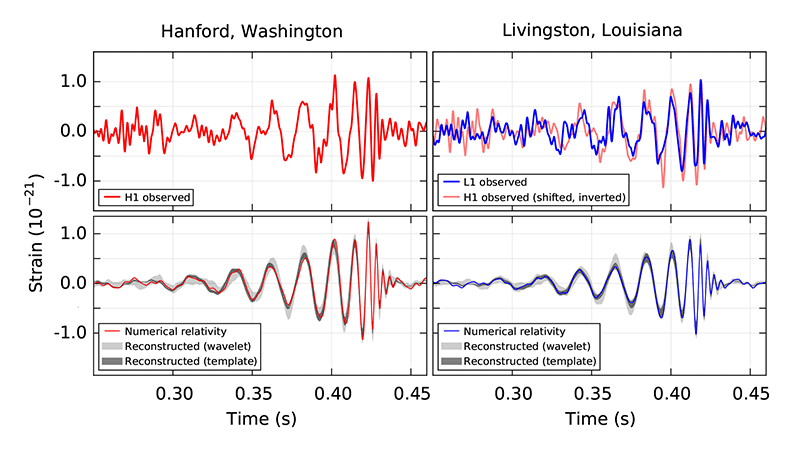
Lower two graphs are predicted waveform in event of binary system coalescence. Upper waveform left and right are observed events at each LIGO facility.
Consider furthermore that the event was observed at each facility with the appropriate lightspeed time offset, and that the wave directionality of the event was lateral and not radial from the center of the earth or some other point as would be expected from a "geophysical" cause.
Furthermore I find it highly unlikely that multiple theoretical and applied physicists would come to apparently total agreement on the significance of these findings and simply overlook the gaping logical fallacy you imply.
As Jack Friday used to say, "Just the facts, mam."
That said, it sounds like they did a lot more work to eliminate sources of error than you may be aware of. OTOH if seismic resonance was causing the correlation, there would probably be more time between the events at the two facilities.
Scientists will try to poke holes in these results while further experiments will try to corroborate them. Meanwhile laypeople will be introduced to more oversimplified and counterproductive ways to think about this stuff. Business as usual.
What the experiment indicates is that the Earth varies in size. Roughly:
  measured distance of 10^-20 meters
  4km is 10^-5 of earth circumference.
  delta Earth's circumference 10^-25
  total distance change in earth's diameter = 10^-18 meters
[1]: I'm old enough to have been introduced to platetechonics as a distuptive theory.
1. Theory predicts a very specific and recognizable class of gravitational wave patterns for likely sources, whose details are determined by a small number of parameters that correspond to meaningful physical quantities (specifically, two masses and a distance; I don't know if there are any more than that).
2. Two independent experimental instruments measure a wave pattern that (apart from some low-level noise) is an excellent match to one of the predictions. Fitting the model to match the specific data, the resulting parameters have entirely plausible astrophysical values.
3. This is considered an example of a theory making a specific, novel prediction that is later confirmed by experiment: pretty close to the classic definition of the scientific method.
4. Therefore, the experimental data has provided strong support for the premises of the theory being tested: both its prediction of gravitational waves and its detailed dynamical predictions for the source scenario matching the observations.
Maybe I'm misunderstanding something in your argument, but I don't see any circularity here. What about this process isn't precisely the way that science is supposed to work?
Someone comes up with a theory that's mathematically simple, beautiful, and consistent. That's great, but we don't consider it "correct" until it actually predicts something novel and we verify the prediction holds experimentally.
That's your "Y, therefore X".
The core idea is plausible, if circular at present. That's OK. Now, we take that and run with it to expand on what we think we understand and hopefully, confirm and even more hopefully, crack open some new physics.
Seems like Einstein nailed it.
But, questions remain. Any of those could yield insights of similar potency and, ahem... gravity.
In this case I don't know if your skepticism is warranted.
1st: Paper said that the waves are redshifted to a certain degree (it's in the abstract) [1], ergo 1.3 billion light-years away in space-time. I'm not thinking you want to be so fundamentally skeptical.
2nd: It's in Wikipedia now https://en.wikipedia.org/wiki/Binary_black_hole#Observation so it's pretty much fact.
You may choose to believe 1st or 2nd piece of evidence.
---
[1] https://dcc.ligo.org/public/0122/P150914/014/LIGO-P150914_De...
That's not what the detector measures. RTFA.
Please don't be rude like that here. It breaks the HN guidelines:
https://news.ycombinator.com/newsguidelines.html
Your comment would be fine without that bit, and better still if it stated briefly what the detector does measure.
( ) technical ( ) legislative ( ) market-based ( ) vigilante (X) Physics-based
approach to fighting spam. Your idea will not work. Here is why it won't work. (One or more of the following may apply to your particular idea, and it may have other flaws which used to vary from state to state before a bad federal law was passed.)
(X) The amount of energy involved would likely destroy the planet.
(X) Many email users cannot afford to lose business or alienate potential employers
Specifically, your plan fails to account for
(X) The relative sparseness of non-dark energy in our vicinity
(X) Huge existing software investment in SMTP
and the following philosophical objections may also apply:
(X) Incompatiblity with open source or open source licenses
(X) I don't want the government reading my email
Furthermore, this is what I think about you:
(X) Sorry dude, but I don't think it would work.
(I'm sorry, but I couldn't resist)
Implicit in the detection claim is that the signal does not originate from earth motion.
Yes, there is: if the predicted kind of observations did not occur, it would imply one of two things:
(1) the model of gravity waves and their generation and propagation on which the prediction was based was incorrect, or
(2) the expectation of large-object collisions on which the prediction was also based is incorrect.
Now, were that the case, distinguishing which of those assumptions was false would require coming up with a new set of experiments that would have different results if the first was correct and the second false than if those were flipped, and yet a different set of results if both were false.
> That there is not a geophysical theory, doesn't have a bearing on the correctness of the gravitational wave theory one way or the other
Science isn't about correctness, its about continuous refinement of models which better predict observations. The absence of a better alternative model doesn't "prove" that a given model is "correct", but science deals with neither proof (except in the negative sense) nor correctness. (Further, the model of gravity waves being tested here is an implication of broader models whose other implications have also withstood attempts to falsify them.)
Based on what level of civilization you are. Rubbing two black holes in for a ping, might be the same as rubbing two stones for a spark. Advanced civilization go really advanced, to a point their activities would be undetectable to us or would appear to us the nature of reality itself.
This is science fiction, not an argument. We have no rational reason at the moment to believe this is the case, or even possible.
What we do in fact have is an increasing trend towards efficiency. Projecting that out along crazy growth curves suggests that advanced aliens are likely to be more horrified by such a waste of negentropy than we are. What can we do with that much negentropy? Nothing, basically. What can they do? Simulate many millions/billions/whoknows of human-level civilizations?
They're not more likely to be indifferent about such waste, they're more likely to prosecute you, for mass civilizational murder.
I've often thought that if civilization could advance to that point in the future, that I'd have a difficult time explaining to my great-great-great-X grandchildren that when ol' great-great-great-X-grandpa was young, you know, pouring a tank of gasoline into the car got me from point A to point B and that was it, despite it being enough energy in that one tank of gas to, say, simulate an entire human's life time. Well, kids, we didn't have that option! The tech didn't exist. So stop trying to put ol' Greats on trial for things he couldn't control, OK?
There are not only rational reasons, but even evidences to support what I'm trying to say.
Look at any insect colony or bacteria, they don't even recognize our presence, let alone our technology.
>>What we do in fact have is an increasing trend towards efficiency. Projecting that out along crazy growth curves suggests that advanced aliens are likely to be more horrified by such a waste of negentropy than we are.
We the advanced aliens to ants, are indulging waste and plastic pollution like never before. And ants the aliens to bacteria might appear the same.
Efficiency and waste are very relative terms based on what level of abundance or austerity on is supposed to live on.
My tone here is rather curt as it's clear your skepticism is unfounded and that you didn't look at even the layman explanations put out by the scientists who made these claims. For example, the video announcement talks about the construction of the equipment in question: https://www.youtube.com/watch?v=aEPIwEJmZyE&feature=youtu.be... and specifically t=3310 talks directly about how they worked to avoid detecting the motion of the earth.
To be clear, I am not denying the possibility of the earth expanding in and contracting in what passes for space time. I am skeptical of the proposition that the instruments are measuring the collisions of black holes is methodologically sound.
The careful preparation and engineering that occurred before LIGO was constructed resulted in an instrument that ran from 2002 to 2010 without detecting gravitational waves. The consequence of this $400 million experiment was not reexamining the theory, but sinking another $200 million into an instrument that created good tweetable data. That's the way careers and politics and human nature works.
There are three components to the theory. Spatial change, gravitational waves, and colliding massive bodies. The reason I am skeptical is that the scientists are inferring two of them: gravitational waves and colliding black holes from the component most likely to have other causes. If I had the mountaintop shells and the flood, god would be more plausible. If I have the shells and god, the flood is. Two outta three is my threshold for reasonable scientific inference in this case.
If you're not denying the possibility, then what exactly are you trying to say here? That you're skeptical that the experiment detected anything, or that the "anything" it detected is what they are saying it is?
Clearly the first can and will be found out over time as other detectors are being built to replicate these findings. However, I believe there is enough scrutiny of their claims that this kind of skepticism can likely be ruled out.
The second, that their story doesn't fit the data, is kind of odd to me. Gravity is so weak and the detectors they are creating are still so new that it seems likely that colliding massive bodies would be the first kinds of things they would pick up. Just as with early telescopes where objects that were very close or very bright were the first ones to yield useful data.
If you have another explanation that you believe fits the data better, put it forward and try and find a way to test it. That's how science works. But this is not the kind of thing that is going to collapse in a heap of logic. Data and the scientific method doesn't work like that.
I would say one obstacle that stands in the way of "spying" on objects moving on the Earth's surface is that the gravitational wave energy emitted by accelerating objects on Earth would be "too small" for current detectors. Not to mention that there would be the issue of how to filter gravitational wave noise, and/or isolate frequencies. However, if it possible to build an amplifier or filter to resolve these issues, that remains to be seen - or maybe somebody else could chime in.
edit: typos, clarity
Funny choice of words. Screens were "on the radar" systems which prompted the development of one of the earliest forms of computer memory. https://en.wikipedia.org/wiki/Delay_line_memory
(I don't know if anyone envisioned shrinking those vats of mercury down to pocket size, however.)
Submarines already do this to detect other vessels AFAIK.
Oscillations show up everywhere in nature, and even a pattern as specific as a frequency sweep with ringdown could be the result of many different phenomena. Even if in this case many possible sources have been ruled out, there must be others that we do not know about. Since the only observation we have to go on is the signal (so far), we should remember that the cause implied by the model is contingent on the signal not being one of these unknown sources.
Some commentary: Imagining alternative explanations is only half of the work that comes next. Once more of these alternatives are found, we also need new experiments that will be designed to rule them out. It sounds like the space-based interferometers will go a long way toward ruling out potential "terrestrial" factors. And if the same signal is detected in both ground-based and space-based systems that is an even greater step forward.
Unambiguous detection of individual gravitons, though not prohibited by any fundamental law, is impossible with any physically reasonable detector. The reason is the extremely low cross section for the interaction of gravitons with matter. For example, a detector with the mass of Jupiter and 100% efficiency, placed in close orbit around a neutron star, would only be expected to observe one graviton every 10 years, even under the most favorable conditions. [...]
However, experiments to detect gravitational waves, which may be viewed as coherent states of many gravitons, are underway (such as LIGO and VIRGO). Although these experiments cannot detect individual gravitons, they might provide information about certain properties of the graviton. For example, if gravitational waves were observed to propagate slower than c (the speed of light in a vacuum), that would imply that the graviton has mass [...].
Fascinating! I take it that the question of whether the graviton could have mass is now considered to be well answered in the negative.
"Gravity is a weak force, in the sense that the gravitational force between two protons is about 10^33 times weaker than the electric force between them. And I'm using protons rather than electrons here to make the gravity stronger - with electrons gravity would be almost 10^40 times weaker.
This has various consequences, but one is that gravitational waves are absorbed by matter much less than electromagnetic waves. It would be fun to estimate the amount of energy absorbed by the Earth as this particular gravitational wave came through, but it would be absurdly small. Gravitational waves make neutrinos look like rampaging gorillas."
Rephrasing, and assuming waving commutes with rampaging, gravitons make neutrinos look like WAVES of rampaging gorillas. I'm no physicist but to answer the original question I'd hazard a guess: quite far!
Imho whatever is carrying gravity between masses cannot itself have a mass.
I can't think of an obvious reason the Higgs mechanism wouldn't work for gravitons, but I could be mistaken, it's not exactly the most intuitive area of physics.
Also, keep in mind that the strong force transmits the force between colour charges while also having a colour charge itself, so it isn't entirely inconceivable for the force transmitting the attraction between masses to have a mass.
No clue if a massive graviton would allow for black holes, but it's not entirely sure what black holes even are (especially quantum mechanically). At the very least it's presumably possible for some particles to escape it (e.g. as Hawking radiation).
Forget gravitons, this already exists in pure general relativity. Spacetime is curved around a massive object, and that curvature contains energy. That's just another word for mass, so the curvature itself exerts gravity. This creates more curvature (...etc etc). This is one of the reasons as to why Einstein's equations are nonlinear.
Note that the concept of having mass is separate from the gravity force. Interaction with the Higgs field gives rise to mass, whereas gravitons are the force carrying particle for gravity.
By the way, this is why the strong nuclear force has such a short range. Gravity has infinite range as far as we can tell, so that makes it unlikely that the graviton, if it exists, has mass.
Surely we create gravitons whenever we move a mass just like we create photons whenever we move a body that interacts electromagnetically? Isn't the point that we're constantly exchanging gravitons with all matter as they mediate gravitational attraction.
This also means that between LIGO and ATLAS/CMS, the last few years have screwed in the final screws on two of the big physics advances of the 20th century: quantum field theory and general relativity are now both experimentally complete, and both look nearly unassailed in their correctness. The next steps for physics look increasingly abstruse: understanding the exceptional cases, like black holes, holography, and the fundamentally computational form of the universe. It's an exciting time, and it looks more and more like we're close to the very bottom, since we have to look so far now to find anything outside our models.
Am I reading this correctly, that shortly after the detector came online we just happened to observe the exact moment a billion years ago that two black holes collided?
Was that extremely coincidental? Or do these events happen all the time, and so if it wasn't those two black holes it would be two others?
Possibly stupid question: Given how far away it was, and that the inverse square law applies, would the effect of these waves be visible on the human scale if we were closer? We can see the effects of the compression of spacetime with LIGO after all, so presumably we could?
H-----L-------s
       s
      /|\
     / | \
    L-----H
Let's say a gravitational wave compresses space. To someone inside that compressed space, there should be no noticeable difference. Light will still flow the same way through the compressed space at the same speed relative to the compression. Matter will behave identically, because both light and matter are part of the fabric of that space. As I understand it, the only way the mirror lengths could change is if space is created or destroyed.
If that doesn't make sense, consider the 2d analogy of drawings living on paper. Assume also that light moves only along the surface of the paper. If you bend the paper, the light will bend with it. But when you bend the paper, the creatures living on the paper can't know it's bent. The fabric of the paper is still identical. Even if some of the paper gets compressed in one direction, it will still have the same amount of particles, so any light travelling through there will hit the same amount of resistance. And stretching the paper, even if you're a drawing on the part being stretched, would have no effect. A 2d creature looking at something 1 foot away, even if the paper is stretched to 10 feet, won't see any difference, because the fabric light travels through is also stretched.
The only way I can see this making sense is if light travels independent of the fabric of space, but it's my understanding that light travels through it, not independent of it?
At first glance, I'd guess that this discovery only strengthens that conclusion: even a small deviation from GR might well change the detailed behavior of an immensely high curvature situation like a black hole merger, and what we saw seems to have been a spot on match for the GR-based models.
I am unfamiliar with modern alternatives to comment.
The system is quite complex and full of exotic objects, so ordinary real world intuition is a poor guide. And the laws are couched in a mathematical language that is also foreign to our everyday world.
Yet, predictions can be made and tested. It's an intellectual puzzle like "what does this very tight loop do?", or "how does the Y combinator work?" -- but in a different arena.
Now, as a full-time software engineer and part time jack of all trades, I appreciate stuff like this experiment and the work of Space X and others much as I appreciate good engineering. It's a difficult problem to solve. So many disciplines had to cooperate to grant us some small insight into the inner workings of our universe. It's marvelous, and makes me feel like a kid again.
We (as in, species) just observed a phenomenon that's related on a fundamental way to any form of matter, doesn't matter(no pun intended) if it is space or not.
... and I shudder to think that more often than not, anything I code in C/C++ will segfault on first run.
http://journals.aps.org/prl/abstract/10.1103/PhysRevLett.116.061102
I'd say the true importance of this discovery is in successfully creating an experimental apparatus to detect what was previously almost universally agreed to probably exist but thought to be nearly impossible to detect. What's truly exciting isn't proving Einstein right, but the possibilities of what we'll be able to to detect with this apparatus in the future. So it's the team that built the apparatus which truly deserves the credit today.
But what happens to them? Is there any way to turn them back into matter? If not, then at some point, will all matter in the universe end up as gravitons?
Also, if an object moving through space creates gravitational waves, doesn't that violate the law that states that a non-accelerating object will not lose/gain any energy? Because if you have to emit gravitons as you move in space, and emitting them requires energy or matter expenditure, then an object moving through space will slowly lose all it's mass?
In other words, if two bodies are moving relative to one another, one emits G-Waves, and one detects them. Are the waves at the detector doppler shifted in frequency by the relative velocities?
Beautiful.
If this happened in the centre of the Milky Way, we're about 25k light years away.
Let's say 2 1 million solar masses black holes merged there... and they also gave off about 3/60 of their mass as radiation, that's about 100'000 solar masses being radiated 25k light years away.
Using my calculation in the other post, we're talking 10^52 Joules. Across a distance of 25'000 light years, or about 10^20 metres, that's then decreased by 10^40 (inverse square) so we're left with about 10^12 Joules...
Which is good news! If that happened in the Milky Way, we would probably survive it - though we'd definitely notice some strange atmospheric effects...
Sorry I am not vary knowledgeable on the topic.
Beyond that, I guess I'd say that this particular signal doesn't feel like that much of a surprise: we were already pretty confident that if a black hole binary were to merge, a signal more or less like this would be an expected result. The scientists were evidently surprised that their very first signal was so strong (this one was even borderline detectable by the previous version of LIGO), which may teach us something, but it's not revolutionary.
On the other hand, there is now a way to see dark matter. That could enable a lot of new astronomy.
Dark matter (about 25%) seems to only interact gravitationally, which means that we've just, today, proven that we have an instrument that could possibly observe it directly. To date, all our evidence for dark matter is indirect--observing the otherwise unexplained behavior of normal matter. Today is the gravitational equivalent to Galileo pointing his first telescope at the night sky.
Dark energy (about 70%) still seems to be a total mystery.
And of course there is our inability to reconcile quantum mechanics with gravity. With each further proof of the correctness of each of those theories, the mystery of their apparent incompatibility deepens.
All of these factors lead me to believe that we may still have a long way to go in our understanding of the physical universe. I hope I'm right.
This is also why I believe it is so important to pursue nuclear energy. If we do invent further theories and experiments, it's likely that they will require even greater energy levels than we can create now, and potentially imply even greater dangers. If we can't learn to manage nuclear physics in a practical, routine way, we'll never have a hope of going beyond it (if indeed there is a "beyond.")
For what it's worth we thought the same thing a little over 100 years ago. We just had to figure out a few pesky things like blackbody radiation and physics would be all wrapped up.
You forgot about dark matter.
And the devices required to probe Plank length/mass/energy are way beyond even our imagination.
But yes, it's the fringes that we'll find new physics. It's not unlike the late 19th century when newtonian + E&M seemed to account for all there was to know.
There hardest thing in fundamental physics right now is to know what questions to ask. We've got answers that work for a lot of the biggest ones that the last 100 years have been spent developing and exploring.
That's been going on for a few hundred years now.
Well, we know that both theories are "wrong" in the sense that they give nonsense answers if you ask them the wrong questions. It's just that all of those questions are well beyond our ability to test experimentally.
I should add that there are lots of selection biases and educated guesses in all of this, too. The signal from BH-BH mergers is louder and easier to detect from larger distances. At the same time, NSs are probably more common than BHs, but it's not really clear whether there are more NS-NS binaries than BH-BH binaries because NSs receive kicks from the supernova when they are born but BHs (probably) do not. This may have the effect of blowing apart many nascent NS-NS binaries but leaving the BH-BH binaries intact.
I guess you could count one looong wave as a series of one-time events/measurements, but it could as well be a loooong interference.
Also, have read today that this discovery backs inflationary theory, how so?
It seems highly unlikely that they could say a specific bh-bh merger was the cause. It seems implied they are triangulating the source, with two detectors?
Interested to know what they were shooting for when they spun this experiment up.
Counterintuitive, but yes. Because it happened billions of years ago, it happened a long long way away. The sphere of objects billions of years away/ago is far larger than those closer to us. So such a detector should be detecting exponentially more very old objects than new ones. Given the rarity, I would expect nearly all detected events to have happened long long ago in galaxies far far away.
Also, models point to such events being more common in the distant past where there were more black holes (primordials) floating around than there are now.
The volume of a constant-thickness spherical shell is O(r^2).
The article makes it sound like the detection of these waves is just a quick one-time blip though. I'd expect something as big as black holes merging to generate more longer lasting waves than just a quick blip. What is the period of these waves?
No they don't. There is a law known as [Huygens' principle](https://en.wikipedia.org/wiki/Huygens%E2%80%93Fresnel_princi...) which says that when a disturbance at a particular point creates a wave, that wave only propagates on an outwards-expanding sphere that is centered at that point of disturbance, and does not produce any effect on the interior of that sphere. This was originally formulated for light waves, but it also holds for other kinds of waves, such as sound waves or, in this case, gravitational waves. What this means is that when you look at something that's far away you see a sharp image of exactly what happened there a short time ago (the time it had taken the light to reach you), whereas if the principle did not hold, each light source would have a small "echo" after it which would blur the image.
However, one of the reasons Huygens' principle holds is that the waves are propagating over three dimensions. In contrast, water waves only propagate over two dimensions, so Huygens' principle fails. That is why ripples continue to emanate from a spot even long after the disturbance there is over. More generally, Huygens' principle holds whenever the number of dimensions is odd and fails whenever the number of dimensions is even.
[Note: I may be wrong on why Huygens' principle fails for water waves. Water waves are actually pretty complicated compared to other kinds of waves and I am not knowledgeable in all the subtleties.]
From the article, no one knows: "Black holes, the even-more-extreme remains of dead stars, could be expected to do the same, but nobody knew if they existed in pairs or how often they might collide. If they did, however, the waves from the collision would be far louder and lower pitched than those from neutron stars."
Here's a better article:
http://www.newyorker.com/tech/elements/gravitational-waves-e...
This is right. Soon we'll have a much more precise value for "all the time!"
LIGO measures wave amplitude, as far as I can tell, which goes down linearly with distance (unlike wave energy, which goes down quadratically, since it's proportional to square of the amplitude). So we could expect to see an effect about a billion times bigger.
The detected effect was a change in metric of one part in 6e20 if I'm not mistaken: (4e-3 * (diameter of proton))/4km based on the article's claim of "four one-thousandths of the diameter of a proton". So at one light year distance we could expect an effect of one part in 6e11.
Not really visible on the human scale, seems to me. You could detect it easily with something like the Mössbauer effect, I expect. Your typical lab bench laser interferometer has errors on the order of 1 in 1e6 as far as I can tell, so probably wouldn't be able to pick this up.
Disclaimer: I could be totally off on what a lab bench laser interferometer can do. I'm pretty confident in the rest of the numbers above.
So, inverse square that explosion... 1 light year is about 10^16m, so we square that and get 10^32m, so we're now talking about ... 10^15 J.
So, unless my maths is all off (which is possible), if this happened about a light year away, whoever's on the side facing towards the blast wouldn't get to observe very much because they'd feel as if a 1kt nuke just went off above their head. Not a great way to start the day.
Chances are it would wipe out life on Earth too, through the ensuing side-effects like lighting the atmosphere on fire, sterilising half the planet, significantly heating up the oceans, possibly even stripping part of the atmosphere away, etc.
For a great novel based around a strikingly similar premise to what was just observed (and the main reason I even bothered to calculate this), Diaspora by Greg Egan is a fantastic book.
Which was the order of predictions I'd read, years back, but egads. Considering how much larger that is than a supernova, I'd be concerned to have such an event happen in this galaxy...
Too bad, you had me excited for a moment at the thought of faster than light travel.
"According to the equations physicists have settled on, gravitational waves would compress space in one direction and stretch it in another as they traveled outward."
LIGO is two sets of 2 L-shaped antennas spread far apart on the globe, so that we can compare the compression of space in orthogonal directions and measure the very short delay between the gravitational wave hitting the first detector followed by the second. In this case, that difference was 7 milliseconds, which is also consistent with the speed of gravitational waves (also the speed of light)
To my mind, it'd be roughly like trying to triangulate an earthquake in France with three sensors in a 1mm^3 cube in NYC (scale is probably way off, I definitely didn't do the math).
However, the error ellipse will probably be quite larg, and given that they come from cosmological distances it's unlikely that they would be anything but isotropically distributed (like gamma ray bursts are).
Now estimating the distance is a different matter.
There is a third one (VIRGO) near Pisa, Tuscany - a French/Italian collaboration.
Unfortunately it was not online for this event.
There is also one being built in Tokyo, and another being planned in India.
https://en.wikipedia.org/wiki/Evolved_Laser_Interferometer_S...
One is to compare the arrival time at each of the detectors and infer direction from the speed-of-light delay.
Another option is to measure the difference in relative strength between each of the detectors. I'm assuming the detectors aren't uniformly sensitive; perhaps they're most sensitive to waves travelling in a direction parallel to one arm of the detector and perpendicular to the other, and completely insensitive to waves that are perpendicular to both (i.e. it would affect them both the same and cancel out, or perhaps not affect either of them at all). With multiple detectors at right angles to each other, you can get a pretty good idea which way it came from.
Combining the two methods could give you greater accuracy, and also help to rule out spurious signals that are not gravity waves.
This makes me wonder what you would see if you had a sufficiently accurate directional gravity wave detector and let it run for a long time. Sooner or later, you'd get an actual image, like a telescope.
Maybe it's the psychology of how we (fail to) deal with different scales. Discovering new, larger, more wonderful places in the Universe doesn't make the Earth any smaller or less wonderful than it is. Our brains might "zoom out" our mental map to fit these new places in, which makes us appear smaller, but in fact it's our horizons that have grown.
According to https://en.wikipedia.org/wiki/Books_published_per_country_pe... there were nearly 200,000 books published in the UK in 2011. That doesn't make the works of Shakespeare insignificant.
On the other hand, it's nice to know the world really does appear to be boundless. I mean in terms of the possible.
We aren't much, but we are here and it's a pretty awesome experience.
Maybe we need to be here, otherwise what is the point?
I like to think there are others too, thinking thoughts like we are. Maybe that is necessary too. Maybe nobody has reached a point in their development for more, or contact to make sense.
I find our time here and now bittersweet. So much is yet to be experienced and understood. But, then again, here and now isn't all bad. We have great science, new frontiers opening up all the time. Our stories of the future are fantastic, and there is still a lot of magic and wonder about us, the world, reality...
We may not see the best. In fact, I say none of us will, but right now is never dull.
I feel like we are just beginning to get a real grasp on reality. That seems powerful and exciting. We could have lived in much darker, harder, ignorant times.
These times may be seen that way too, or they may be a peak, with a decline to come. Nobody knows, and I like it that way.
It depends on how you look at it. You are taking a pessimist's view on things that the universe is so large and we are so small that we don't matter. If you take an optimists's view on things you'll discover that we do matter and learning new things increases our significance.
Also I wonder, in this form as humans, can anyone really comprehend what this all means, beyond the Math and experimental confirmations?
What if we are living in a simulation, and just being played?
Wherever we went on earth we've colonized quickly. If we can do that to space, universe might be our backyard.
Best example: the Hydrogen atom is supposedly quantum, but if it is quantum, where are the photons? the q^2/r potential is a mean field that one finds from classical electrodynamics, it isn't formed by the summation of photons. [Another mental poker, photons are momentum eigenstates, so how can potential be described in position space? You'd need to sum up an infinite number of them! (For EM students, recall how to represent 1/r in spherical harmonics or in terms of sines and cosines)]
What happens, as I understand it, is with strong fields, one tends to use a semi-classical description because in the strong field limit, one deals with many photons, which should approach the classical limit.
Basically, quanta are like "pertubations" of the fields from their "free" solutions, as they are in GR (linearization of the GR field eqns) and as they are in EM. Free essentially means in the absence of sources, like charges, or masses for GR. So trying to explain general phenomena in terms of "pertubations", which are basically the solutions for "free" fields, is not always fair.
One doesn't always face this in high energy physics because in HEP, most of the incoming and outgoing states in a problem are these "free" solutions. For example when doing scattering off a hydrogen atom, the incoming states are "free" (a free nuclei, a free electron), so one can use photons for that phenomena, and one finds that the scattering is like scattering against a (mean) 1/r potential.
But in the case where the strong fields don't turn off, like when you are bound to a Hydrogen atom, or when considering nucleons in nuclei in the low energy limit, one turns away from the pertubative, photon/gluon model and either solving the problem numerically or treats the fields as semi-classical, as with the Hydrogen atom. For my field of laser-plasma physics, this shows up in the so-called "Volker-state", rather than treating the strong laser field as a sum of innumerable (ie., not-simulatable) photons, one treats the Laser field as a semi-classical background for the quantum guys (electrons, ions).
I think lensing is like strong static fields in EM. One wouldn't really think of them in terms of quanta of the field.
All massive particles get their mass from the Higgs field.
* http://physics.stackexchange.com/questions/64232/your-mass-i... * https://en.wikipedia.org/wiki/Proton#Quarks_and_the_mass_of_...
Ps/Pw = 10^(SNR/10) = 10^(20/10) == 100
A signal 20db above the noise, you could put your eye out with it.
db is confusing, when you're talking voltage it's 20log(Vs/Vw) And in absolute terms engineers talk about the power over 1mW.
Myself I get miffed a bit because people have been conditioned to think in terms of trying to pull facts out of crappy data sets using poorly thought out statistics. However in a lot of engineering and physics fields the data is often really good. Often good enough that you can work off a single measurement.
IIRC we do know where protons get their mass. The internal color field has some energy, thus some mass, which comes from that field interacting with Higgs.
And maybe real hover boards
Maybe we could make orbital graviton beam generator that could literally suck an object off the face of the Earth.
This is an interesting concept. As far as I'm aware, we have ways of measuring weight, but no way of measuring mass. How would you know whether something weighed more than it "should", based on its "mass"?
Which would make space travel a lot easier - no more worrying about bone density loss!
The answer is that we have a ruler that doesn't get stretched in this way: light. The speed of light is a constant dictated by the laws of physics; stretching out our flashlight to twice its normal size wouldn't make the light it emits go twice as fast. So if you just measure the time it takes for a light ray to go from one point to another, you can compute the distance that it must have traveled, and if that distance changes, then you know that the space in between must have been stretched.
Because if the ruler you are using to measure is expanding at rate x, the measured speed of light would be different than when the ruler is expanding at rate y?
So, during the deflationary period of the universe, the speed of light would be significantly smaller, correct? In fact, would it be "negative" due to the universe expanding faster than light?
Can we compute the strength of a static gravity field we are inside, by measuring the time that light takes to propagate through it?
What happens instead is that the speed that an object moves through space-time changes dependent upon gravity. Using an atomic clock, we've actually measured the effect of gravity to show that time moves more slowly down on earth than it does in an orbiting satellite.
Another way to look at it is to change your reference to be internal to the experiment. You can imagine the experiment moving through space-time at a constant rate of speed. When the gravitational wave hits the experiment its movement through space-time changes an infinitesimal amount (faster than slower as the wave passes, or vice-versa). Since the speed of the light passing through space-time has not changed (due to special relativity), the difference between its start and end points can be used to measure the amount of change caused by the gravitational wave, essentially in the same way you can use a laser to measure the speed of a moving object relative to a stationary object. Only you are basically "bouncing" the laser off of the experiment itself to determine the change.
I'm surprised I haven't heard that light travels independent of 3d space compression before. That would also imply that if you enter a black hole with your feet at the bottom, you would see them visibly stretched far away from you (noticeably? I'm not sure) because light would take longer in the distortion to reach your eyes.
Some points which might be helpful. We have a way, using the concept of a manifold, for ants on a surface like a sphere or a dougnut to figure this out without appealing to a third dimension. One could imagining say ant geographers making maps of portions of the surface, and noting how common regions covered in two different maps have different labels/coordinates. One can then figure out a definition of when two collections of maps(called an atlas) are equivalent and then show that an atlas for a plane, sphere, doughnut are mutually nonequivalent.
But all this is topology and involves global considerations. What is relevant here is local curvature. We can also do this appealing to an extra dimensions. Now, you used the example of a folded paper and you are correct that for an ant on the surface, the curvature is indetectable. The curvature of the paper is extrinsic and not intrinsic. We say that is isometric to flat space, and its curvature tensor is 0.
On the other hand, if the ant was on the surface of a ball, it could figure out this curvature intrinsically, for instance, by measuring sum of the angles of a triangle or the distance between parallel lines keeps shrinking. Not only is this intrinsic, but it is locally measurable. One cant have maps, even for a small area of the earth's surface, without some kind of distortion because of this intrinsic curvature.
An additional complexity - in GR, spacetime is curved rather that just space. Also, dont take 'curvature' too literally, it is just a way of measuring deviation from numbers that you would get in the flat scenario.
For more read up on manifolds, riemann curvature. John Baez had some essays on the geometric meaning of the curvature tensor in terms of the volume of a ball relative to the usual flat Euclidean case.
What I am trying to ask is if these behave like concentric water ripples, where from a single event you get first one peak of a wave, followed by many more repeated concentric peaks gradually getting smaller in amplitude? It sounds like there is just a single momentary wavefront without any residual secondary waves? Why is that?
Note that this is a _very_ rough estimate, but it should give you an idea of the order of magnitude for the settling time.
If your 1 billion light years from earth, you are still effected by the Earth's gravity (well its likely smaller then experimental error but never mind that it still exist).
So there needs to be gravitons from Earth flooding the entire sphere of space for 1 billion light years around the Earth. All these gravitons have mass, and are emitting their own gravitons. Which all have mass and energy! Where is this mass and energy coming from? It really can't, it violates the laws of thermodynamics. But so does Dark Energy so who knows.
Photons don't have mass. If they had mass they couldn't travel at the speed of light.
Suppose you have two quarks and you start to pull them apart. The gluons that transmit the force between the two quarks tend to "bunch" together because they have their own charge. You can think of it roughly like a rope of gluons trying to pull the quarks back together.
If you keep pulling on the quarks, you might expect the gluons to eventually "break". But this doesn't happen, because the gluons act on each other. If there were ever a break, more gluons would join in, tugging the break back together. Eventually, you end up with so much energy density in all these gluons that they start forming new quarks and other particles. These new particles will bind with your quarks and each other to form color-neutral particles.
So I spoke a little imprecisely. Gluons, being massless, have infinite range. But you won't ever see the strong force acting over any large distance because anytime you try to get color-charged particles far enough apart, you'll end up making more particles.
Wikipedia has a brief write-up that provides an illustration. https://en.wikipedia.org/wiki/Color_confinement
https://en.wikipedia.org/wiki/Alternatives_to_general_relati...
> Just recall how Kopernik's theory of solar system got accepted. It had worse predictions than Ptolemy's scheme at the time it was introduced
Yes, and it wasn't accepted at the time it was introduced. Actually, Copernicus' theory in its original form was never really "accepted"; what was accepted was Kepler's reformulation using elliptical orbits, based on Brahe's more accurate observations. Kepler's model was more accurate than Ptolemy's, and that was a key factor in its acceptance.
With LIGO there is an extra set of mirrors within the arms this allows the light from the laser to bounce between them ~100 times or so increasing the effective path length greatly.
[1] https://www.nsf.gov/news/speeches/colwell/rc03_ligo/img009.j...
And from the paper: "The source lies at a luminosity distance of 410+160-180 Mpcc corresponding to a redshift z=0.09+0.03-0.04.". (https://dcc.ligo.org/LIGO-P150914/public) Which corresponds to 1.337+0.522-0.587 billion ly (or between 750.2 million and 1.859 billion ly).
Looks like there are roughly three million galaxies within a billion light years. Seems like lots of space for black hole pairs to live in. I suppose over the coming years, these gravity wave observatories will nail down just how common they are.
That's some serious range!
For example, the edge of the observable universe is about 46.5 lightyears away, while the universe is thought to be 13.8 billion years.
https://en.wikipedia.org/wiki/Observable_universe#Misconcept...
Just on the back of an envelope: If we assume the percentages in my post above apply to an individual galaxy, then there has to be 5x as much dark matter mass as lit mass. There's no way you could have 5x as much gas and dust in a galaxy as stars, and not see it.
For comparison, the sun makes up about 99.8% of the Solar System mass (500x as much mass as all the planets, dust, etc. combined).
https://www.wolframalpha.com/input/?i=mass+of+the+solar+syst...
A bit of Googling tells me that the current estimate of its mass is in the order of 5-10 Earth masses--not nearly enough to explain dark matter.
That leaves just 0.2% for all the planets, dust, Oort cloud, Kuiper belt, etc. So ... no.
Don't look at the current theory of dark matter (weakly interacting massive particles) as some hare-brained scheme that scientists thought up, instead look at it as the hard-fought victor of numerous observational challenges. Dark matter is the theory that survived. We tried explaining things a zillion other ways (gas clouds, compact objects, neutrinos) and those theories just didn't match the observations. There are also a few exceptional circumstances (such as the bullet cluster) that indicate very strongly that dark matter is something different than either gas clouds or stuff like stars and planets, because in the bullet cluster we can observe the gas and the stars and planets and the mass, and each of them are in different places because each of them follow different rules when it comes to interacting during a galactic cluster collision.
You mean like ether?
In reality, it's something we have no idea what it is, except that it's not visible and a big source of gravity.
In case you'd like to dig deeper, the 85 and 86 mentioned are:
[85] K. Cannon et al., Astrophys. J. 748, 136 (2012).
[86] S. Privitera, S. R. P. Mohapatra, P. Ajith, K. Cannon, N. Fotopoulos, M. A. Frei, C. Hanna, A. J. Weinstein, and J. T. Whelan, Phys. Rev. D 89, 024003 (2014),
To put it another way, you need a single black swan to prove that black swans exists (to whatever sigma).
I may have pushed the analogy too far!
A massive ripple in the very fabric of reality?
Hawking, for instance, believes that the Hawking Radiation from a black hole encodes the information that went into creating the hole.
https://en.wikipedia.org/wiki/Black_hole_information_paradox...
This theoretical device could make things weight more than with just Earth's gravity... but it wouldn't help your spaceship. Your engine is still pushing out the same amount of matter, so thrust remains unchanged.
I, the spaceship, would like to accelerate through space. I take up some fuel and hurl it in the opposite direction, which requires me to apply force to the fuel I'm ejecting. It goes off into space at some rate determined by the impulse I applied and the mass of fuel I applied it to.
Newton's third law means that when I hurl the fuel, it applies a symmetrical impulse to me, accelerating me in the opposite direction.
In this model, the acceleration I get from the fuel doesn't depend in any way on the mass of the fuel I eject, only on the force I apply to it. What's wrong with the model?
Just to be clear here; that's because there is no theory for a multiverse. Not yet, anyways. Nobody has put one forth yet. When you hear "multiverse" come out of physicist's mouth, it's because it's a concept indirectly related to other theories. The current popular theory which involves a multiverse is string theory. When string theorists do the math, there is some evidence that a multiverse is possible.
However, that doesn't mean much. Even if string theory was correct and little strings are really the fundamental component of everything in the universe, the multiverse part of string theory could still be wrong. The theory isn't reliant on it, it just doesn't forbid it.
I also wouldn't say that it's entirely untestable. There are a couple things that could be indicative of a multiverse that some physicists have looked for: http://phys.org/news/2010-12-scientists-evidence-universes.h...
The source isn't the greatest, but it shows that we can look at the CMB for indirect evidence. With higher resolution scanning years in the future, such a theory may be testable. I only mention this because the way your comment reads, it sounds like you're saying a multiverse would be inherently untestable.
Or if spacetime folds back onto itself?
Analogy: it could happen that tomorrow Jesus Christ descends from the heavens and brings the day of reckoning. That would prove Christianity to be true, but the fact that this could happen does not make Christianity a falsifiable theory.
A falsifiable theory is a theory that predicts something that we can (in theory) measure today (possibly requiring infinite resources etc).
Your second example (which is not a multiverse theory at all) is actually a good example of a falsifiable theory. People have calculated [1] that if spacetime was folded back onto itself at even just a single point, it would leave a distinct signature in the cosmic microwave background. We do not observe this signature, so we are pretty sure spacetime does not fold back onto itself.
I agree that 3 solar masses worth of electromagnetic radiation at 1 light year distance would feel like a nuke going off. What I don't know is to what extent the energy of the equivalent gravitational waves (which _would_ have a lot of energy I agree) would actually get transferred to things we care about, like the atmosphere and us. If it's a few percent, say, we'd clearly be in trouble. If it's more like what neutrinos do, it would probably be detectable but probably not by unaided human senses.
I tried doing some quick looking around for estimates of gravitational wave coupling and energy transfer and didn't find anything so far...
The difference in terms of detection is that the wave does this in a time-varying, periodic fashion.
For something like LIGO, we're trying to measure length changes on the order of 1e-18 meters. We're not actually measuring the lengths of LIGO's arms to that accuracy, though. What we're measuring is the difference between the times light takes to travel down those arms. And even that's hard to measure on an absolute scale, so what we really measure is how that difference changes in time.
Or put another way, the effect of Earth's gravitational well is not really distinguishable from inaccuracies in making the two legs of the interferometer equal length to start with, and is a much smaller effect than those inaccuracies. Again, if I understand this right...
Inside a charged black hole there is a second horizon. Beyond this point the black hole is gravitationally repulsive. http://casa.colorado.edu/~ajsh/rn.html
> The Universe at large appears to be electrically neutral, or close to it. Thus real black holes are unlikely to be charged. If a black hole did somehow become charged, it would quickly neutralize itself by accreting charge of the opposite sign.
> It is not clear how a gravitationally repulsive, negative-mass singularity could form.
So it falls under the same sort of category as negative- or imaginary-mass 'exotic matter': not ruled out, but there's nothing suggesting that it actually exists.
I vaguely recall other weird edge cases where gravity is repulsive, but I can't find any links right now.
I have no intuition for this. Maybe it's valid, but your other two examples raise grave doubts about this one.
> Or you throw it at something of known mass and measure the speed it imparts onto the known object.
Blind application of the principle of conservation of momentum does indeed tell us that we can measure the mass of one object by colliding it at known velocity with another object of known mass and measuring the resulting velocities. But I tend to worry that the mechanism for transferring velocity from one object to another object in a collision is the force it exerts during the collision, and that that force might be determined by the object's weight (also a force) rather than mass (a platonic concept). But, I'm not sure here either.
This ties in to the "fun factoid" that physics has no explanation for inertial mass and gravitational mass being the same quantity. If they in fact aren't necessarily the same thing, momentum transfer, measuring inertial mass, would solve this problem. If there is a reason they coincide, this approach will be confounded by that reason.
> Or you hang the a known mass and the unknown mass on strings and measure the force of gravity between them
I'm absolutely certain this wouldn't work to distinguish the mass and weight of an object that has extra weight because it's emitting extra gravity. The measured force of gravity is going to include the extra gravity you're trying to ignore.
Then we are speaking of different things. I understand 'weight' as how heavy something is within particular gravity field (ie on a bathroom scale on earth) whereas mass is independent of local gravity. The schemes I suggest measure mass without resort to weight.
>>I have no intuition for this. Maybe it's valid, but your other two examples raise grave doubts about this one.
The motion of the more massive pair will describe a smaller circle than the lighter one. The ratios of the two circles/motions allows you to calculate the unknown mass from the known.
Tell someone to hold it. Turn it off. Watch them struggle with the sudden weight. Turn it back on.
So we might be here only because our solar system is surrounded by an unusual amount of nothing.
Consider that we can currently detect differences in luminosity small enough to tell whether an Earth-size planet is passing between us and the star. A 5x mass Oort cloud would be thousands of times more mass than that. It would have noticeable effect on luminosity.
And, while our sun has an Oort cloud, there are a lot of stars out there that probably don't--too small, too big, too hot, too young, too old, etc.
Yes, it does. Do you know how the classical limit of quantum theory works? That limit is what allows us to use classical physics in the domain where it works. If that limit didn't work, we would have a serious problem with consistency.
> It only gives probabilities of results of specified experiments of certain kinds; it does not reproduce the old predictions (like definite trajectories, Moon phases or solar eclipses)
Are you aware that all of those "old predictions" can indeed be derived from quantum theory, using the classical limit I described above? The reason that works is that, in the classical limit, quantum theory predicts a probability of 1 for one result--the classical result.
> It is natural to expect of any new theory to bring new results, but demanding that it reproduces all the old ones along is too much.
You appear to have a mistaken understanding of how new theories get accepted. New theories that don't reproduce all of the predictions of the theory they replace, in the domains where the old theory is verified by experiment, are not accepted. If general relativity had not reproduced all of the predictions of Newtonian gravity in the weak field, slow motion limit, it would not have been accepted. And if quantum theory had not reproduced all of the predictions of classical physics in the classical limit, it would not have been accepted.
Measuring the force of gravitation between two objects definitely doesn't measure the mass of those objects without resorting to weight; the weight is the quantity you're measuring. Similarly, the fact that the center of gravity for a two-objects-attached-by-a-string system will lie closer to the massier object relies on the massier object also being heavier. If the massier object weighs less, why do you believe the center of gravity would still be closer to it?
> I understand 'weight' as how heavy something is within particular gravity field (ie on a bathroom scale on earth) whereas mass is independent of local gravity. The schemes I suggest measure mass without resort to weight.
Yes, those are the definitions of weight and mass. We can measure weight directly, because it's a force and we have tools to measure those. All of our methods of determining the mass of something, as far as I know, rely on the assumption that if you know the gravitational field at a point, all objects with the same mass would, if located at that point, have the same weight. The most common method of determining an object's mass involves measuring the gravitational attraction between the object and the earth (colloquially known as the object's "weight"), and then imputing a mass to it based on that weight.
In the spinning example, I could say that two objects attached by a string and set spinning around each other will spin around a point that balances the torque from each object (this might not be, strictly speaking, correct, but it's close enough that I think it's suggestive). But torque is defined by force, not mass -- if one of the objects gets heavier without becoming massier, that should draw the center of rotation closer to that object, shouldn't it?
Or phrased yet another way: if one of the two attached objects is heavier than it "should be" according to its "true mass", then the two-objects-and-a-string system will have the center of mass and the center of gravity in different places. Those terms are currently synonymous, but if we had a novelty object such as undersuit described they would be distinct. Is there any reason to believe that the two-objects-and-a-string system would, if spinning, rotate around the center of mass rather than the center of gravity?
Please don't just disagree when you don't know what you are talking about.
> That always confused me. We have an Oort cloud, whose members we cannot resolve very well/at all. Why do we assume only our star has such a thing? If all stars did, that isn't enough mass to explain dark matter?
No, that isn't enough mass to explain dark matter, since it's only 0.1% to 0.2% of the mass of the solar system.
The text I quoted was in complete agreement with what you and others have posted. I was pointing out that the questioner's point had already been answered.
But back in 1916, Einstein also theorised, as part of his general theory of gravitation, that there would be such things as gravity waves, caused by very massive objects moving through spacetime making 4-dimensional ripples appear in spacetime. Until today, that was just an unproven theory, though everyone believed it was likely to be true. There is now solid evidence to back it.
It's more about understanding what the measurable effects of a gravitational well on earth has on the LIGO experimental setup (or a similar one with infinite precision), in the absence of gravitational waves.
(1) We should see this as some inconsistency in how gravity scales with the mass of a black hole. The larger ones would have proportionately greater 'drag' on leaving gravitrons, pulling more in.
(2) If they are massive, and therefore subject to slowing, shouldn't gravity waves leaving a black hole be subject to some sort of doppler effect? Should we be looking for red/blueshifts in these waves?
(3) If gravitrons have mass and are subject to gravity, what brings that gravity? What sub-gravitron particle regulates gravity going in/to/out of the gravitron? This would require a new set of particles be created by non-gravitron massive objects (ie black holes) alongside the gravitrons. Like I said, too strange to exist.
> If the massive gravitron was leaving a black hole it would be slowed by the black hole's gravity.
A graviton wouldn't be able to escape a black hole. A photon can't, and it's massless. The gravity of a black hole is actually a self-sustaining effect of the curvature of the spacetime around the black hole.
> (1) We should see this as some inconsistency in how gravity scales with the mass of a black hole. The larger ones would have proportionately greater 'drag' on leaving gravitrons.
We don't know details of the gravitational field around black holes and the mass that created it, because none have been observed close up. To an extent, the mass of a black hole is defined by its gravity.
> (2) If they are massive, and therefore subject to slowing, shouldn't gravity waves leaving a black hole be subject to some sort of doppler effect? Should we be looking for red/blueshifts in these waves?
Again, photons are massless and subject to the doppler effect. Gravitons, massless or not, will be too.
> (3) If gravitrons have mass and are subject to gravity, what brings that gravity? What sub-gravitron particle regulates gravity going in/to/out of the gravitron? This would require a new set of particles be created by non-gravitron massive objects (ie black holes) alongside the gravitrons. Like I said, too strange to exist.
Force carying particles can interact with themselves, c.f. gluons in QCD. In fact, GR is a non-linear theory so there will be non-linear interactions (as far as you can describe them in the weak limit).
But isn't the curvature of spacetime around the black hole supposed to be the effect of its interaction with the graviton??
Is this where the translation from GR -> QM breaks down?
This inconsistency is a part of general relativity (even though gravitons themselves aren't). A black hole does not follow the GM/r^2 gravity law.
> If they are massive, and therefore subject to slowing, shouldn't gravity waves leaving a black hole be subject to some sort of doppler effect? Should we be looking for red/blueshifts in these waves?
Yes, there is a doppler effect.
> If gravitrons have mass and are subject to gravity, what brings that gravity? What sub-gravitron particle regulates gravity going in/to/out of the gravitron? This would require a new set of particles be created by non-gravitron massive objects (ie black holes) alongside the gravitrons. Like I said, too strange to exist.
Gravitons. Every now and then a pair of gravitons may exchange more gravitons (these are also virtual particles, so it's fine). This is why Feynman diagrams exist, so that you can not only calculate the interaction between two particles through a graviton, but also calculate the contribution of the lower-probability situations where more gravitons magically appear to transmit gravity between gravitons.
This is nothing new. Gluons (the carrier for the color/strong force) do basically the same thing. They are also bound by the force they carry, and thus gluons can interact with each other with more gluons.
Because these are virtual particles and only exist as a probability, this doesn't lead to infinite recursion. The secondary gravitons are improbable, and the tertiary gravitons more so, and so on, and the final series converges.
Or not, and we yell "look behind you!" and then dump the infinities out the window.
Perhaps, no clue how a quantum mechanical gravity would interact with a black hole.
>(2) If they are massive, and therefore subject to slowing, shouldn't gravity waves leaving a black hole be subject to some sort of doppler effect? Should we be looking for red/blueshifts in these waves?
The Doppler effect happens even for light, which isn't massive at all (that we know of).
>(3) If gravitrons have mass and are subject to gravity, what brings that gravity? What sub-gravitron particle regulates gravity going in/to/out of the gravitron?
There's no reason they couldn't interact with themselves, in fact I guess that's probably the most likely case.
The particles leave the event in a smooth wave. Then they run into other waves, or each other, or just the background gravity fields. This perturbation should cause them to clump together. So in short order the smooth wave would become large blobs of gravitrons more akin to raindrops than waves. And without anything holding them apart, might not some of these clumps condense into some sort of ... I don't have the words for such an object. I wouldn't want to get in its way.
(i.e., anti-gravitons and gravitons are the same thing, just as anti-photons and photons are the same thing).
There are a variety of other theories of gravitation with gravitons, but as far as I know, there are none in which gravitons are not their own antiparticles. (There may be such theories available in universes with a very different cosmological constant or with different numbers of dimensions than the one we are in).
I like the idea of anti-gravitons being the inside of a graviton, or inside of a black hole. Given the inside of a black hole is essentially the end of time, coming out of a black hole or coming out of an anti-graviton, could equal going back to the beginning of time.
Massless particles don't have energy. Massless and energyless particles have no speed. I have no interest in massless and energyless particles that stand still.
Joseph Larmor, LXIII, On the theory of the Magnetic Influence on Spectra ; and on the Radiation from moving Ions, Philosophical Magazine Series 5 Vol. 44, Iss. 271, 1897
Erwin Schrodinger, Quantisierung als Eigenwertproblem. Annalen der Phys. 384 (4) (1926)
This was not a "new theory" that was competing with any "old theories". It was a tentative model in a regime where no previous theory existed, and it was never claimed to cover anything outside that limited regime. It wasn't competing with any other theories, because there were no other theories to compete with. The question of whether or not Schrodinger's model reproduced the predictions of the "old" theory never arose, because there was no "old" theory. (Technically, there was a sort of "old" theory of the hydrogen atom--Bohr's model--but Schrodinger's model did reproduce all of its correct predictions, plus it added more correct predictions of things that the Bohr model got wrong.)
The position with regard to gravitational waves is very different; we already have a comprehensive, fundamental theory--General Relativity--that explains them. Any alternative theory that only explained GWs, and didn't also explain all the other experimental results that GR explains, would be a nonstarter.
> Larmor's older theory (1897)
This wasn't a separate "theory" at all; it was just a derivation of a particular formula using an already known theory, Maxwell's Equations.
When I first learned about renormalization formally (i.e., with equations) I realized it wasn't that bad. But still, pretty sneaky :P
Sort of, to get a graviton you introduce perturbations on a background metric. (Basically small wiggles of spacetime around an 'average.') You don't do anything like that when you solve the Einstein equations. Consequently, the background spacetime ( that is, the black hole) is not really made of gravitons. (At least in some sense.)
Because if so, and assuming you have some reason for believing this i.e. you can prove it, I would urge you to forward these findings to a physics journal of your choice posthaste, as this basically represents a total refutation of much of physics of the last century or so. You will easily win a Nobel Prize.
Of course Schrodinger's model didn't reproduce the results of classical EM with regard to the atom. It wasn't supposed to, because those results of classical EM were wrong. In other words, there wasn't a correct "old theory" that covered the regime the Schrodinger model covered (the atom)--there was only a wrong "old theory".
As far as using Schrodinger's model plus classical EM theory to get results like emission line intensities, there also there was no correct "old theory"; there was only a wrong "old theory" (classical EM by itself, which did not predict emission lines at all, let alone their intensities--it predicted a continuous emission spectrum). Also, this hybrid classical-quantum model was known to be incomplete at the time; it was only used because nobody had yet figured out how to quantize the EM field.
> It is the new benefit that the theory brings, not reproduction of every single result of the previous theories
Once again, this is not the situation under discussion in this thread (gravitational waves). In the case you describe, the results of the previous theories were wrong in the regime the new model covered, so there was nothing to reproduce; there was no correct "old theory" for the new theory to compete with.
In the case of gravitational waves, we have a correct "old theory"--General Relativity--so any new theory that did not match that correct old theory would be a nonstarter. I am not aware of any case where a new theory was accepted as interesting when there was a correct old theory covering the same regime and the new theory did not reproduce its results.
You're badly mistaken. Although nobody succeeded in obtaining the emission line frequencies of gases out of the classical EM theory, the theory did correctly give other results consistent with observations. One of them is the formula for emission intensity that connects energy radiated with second derivative of electric moment; it goes back to Larmor's work. This was the result the new theory would preferably reproduce or at least be consistent with. Wave mechanics wasn't consistent with it - the hydrogen atom oscillates indefinitely in wave mechanics. Schroedinger himself viewed this as a deficiency and planned to get back to it - check the ending part of his seminal papers on wave mechanics. The classical formula is taught to this day both in macroscopic EM theory and quantum optics courses, although there are some deficiencies and problems about the formula that Larmor did not know.
> In the case of gravitational waves, we have a correct "old theory"--General Relativity--so any new theory that did not match that correct old theory would be a nonstarter.
I do not think any physics theory could even be "correct" in the sense of Platonic ideals, but I do not know what you mean by "correct". I do not claim a new theory could completely replace the old one before it could deliver the same or better results. I claim theory has value and is accepted based on its new benefits, not its superiority in every aspect the old theory was superior before. Calling incomplete theory non-starter makes no sense to me, as all theories, including General Relativity, are incomplete.
No, I'm not; you're just mistaken about which classical results I was referring to. I meant the results of classical EM that predicted that atoms could not exist--because the electrons would radiate until they fell into the nucleus. And what classical formula tells you how much the electrons will radiate because of their acceleration due to responding to the electric field of the nucleus? Larmor's formula.
In other words, Larmor's formula was not a "theory"--it was a particular result derived within a theory. The particular result happened to be correct, within a particular limited domain; but the underlying theory that was used to derive it could not explain why it was correct--because the same theory, and indeed the same particular result--the same formula--made other predictions that were obviously egregiously wrong (like predicting that atoms would collapse).
> nobody succeeded in obtaining the emission line frequencies of gases out of the classical EM theory
You're drastically understating the failure of classical EM here. It's not that classical EM couldn't predict the particular frequencies of emission lines. It's that classical EM couldn't predict the existence of emission lines at all. Classical EM predicted that atoms would emit a continuous spectrum of radiation--not radiation sharply peaked at particular frequencies.
> The classical formula is taught to this day both in macroscopic EM theory and quantum optics courses
Sure, because within its domain of validity, it works fine as an approximation. But that's all it is--an approximation. And we explain why the approximation works, and why it works only within a particular domain of validity, by reference to the more complete underlying theory--quantum electrodynamics.
> I do not know what you mean by "correct".
I mean "makes predictions that match the results of experiments".
I agree; but there's a big difference between:
- A theory that is incomplete because it doesn't cover absolutely everything, including where we haven't tested yet and won't be able to for the foreseeable future, but makes correct predictions everywhere we can actually test it; and
- A theory that is incomplete because it makes predictions about some things that are obviously at variance with observation, even though it makes correct predictions about others.
GR is an incomplete theory in the former sense; and theories that are incomplete in that sense can still be used to safely rule out competing theories that don't match their predictions in regimes where those predictions have been extensively confirmed.
However, classical electromagnetism is an incomplete theory in the latter sense; it made obviously wrong predictions, like the ultraviolet catastrophe and the instability of atoms. And even the correct predictions it made, like using the Larmor formula to predict radiative properties of atoms, were only obtained by using the theory inconsistently: by first assuming, contrary to the classical EM prediction, that atoms could be stable at all, and then working out what classical EM said about how these impossible objects (impossible according to classical EM) could radiate.
In a situation like that, you can't safely use the theory to rule out other theories, because the theory contradicts itself, and you can prove anything from contradictory assumptions. That's why classical EM physicists couldn't say "well, the Schrodinger theory can't be right, because I can't use it to derive the Larmor formula". You can't consistently use classical EM to derive the Larmor formula either; you have to sweep certain things under the rug and wave your hands that somehow or other it's ok.
In a situation like the latter, yes, you're right that anything that can give some handle on making predictions is going to be at least tried. But that's a very different situation from the former situation, where we have a correct theory that, within its domain of validity, doesn't have any of those issues. The only issue with GR is that it's not a quantum theory, which means, in the eyes of many physicists, that it's incomplete; but that incompleteness has no practical consequences whatsoever. It certainly is not a reason to entertain alternative theories of gravitational waves that get other predictions wrong that GR gets right.