Introducing Safari Technology Preview(webkit.org) |
Introducing Safari Technology Preview(webkit.org) |
I know the expectation is that most Macs are up to date but if you can't install it on Yosemite, they should let people know.
https://developer.apple.com/safari/download/
"Compatible with OS X 10.11.4 or later"
Edit: As it is now, it doesn't look very different from what already existed as OSX-side-loadable Webkit Nightlies https://webkit.org/nightly/ or building from source (which even supports iOS simulator!) https://webkit.org/building-webkit/
> You may already be familiar with the WebKit Nightly, which serves a purpose similar to that of Safari Technology Preview. For most people, we think Safari Technology Preview is a more convenient and stable way to live on recent WebKit changes. Unlike the nightlies, Safari Technology Preview supports the full set of iCloud-based Safari features, including iCloud History and iCloud Tabs. And we’ll use the time between Safari Technology Preview releases to curate and test updates to a point where we think developers will find it practical to use as their primary browser.
I shouldn't have to wait for 3 months for awful rendering issues that entirely prevent me from viewing important websites to be fixed!
Obviously it's unpopular to complain about Apple and their dreadful fix timeframes, but there are often thousands of affected websites and often Apple have a fix already checked in and tested. But Apple being Apple, they consider web rendering bugs to be part of their iOS update process, and not just an issue with an app so we all must wait for three months for them to roll it into a major update.
I'm seriously considering setting up a seperate website to track iOS bugs. Apple are hardly willing to be open and transparent about bugs, so perhaps it should be taken from their hands?
I'll keep commenting on their three month timeframe on relevant stories. I don't mind that you don't like me making the point that it's unreasonable. Especially as you agree!
Edit: I'll review my comment history:
* The comment you are responding to, I feel is relevant
* I write a reply to this comment that says that Apple's Safari development is getting better, to which I disagree - https://news.ycombinator.com/item?id=11391186
Entirely relevant to that thread. It's funny watching my comment scores bounce up and down though. I'm not the only one annoyed with Apple I see, there appear to be as many people who agree with me as who are annoyed I point out Apple's Safari issues :-)
Don't assume that just because you think I'm unreasonable that I am unreasonable. My comments are downvoted and you are annoyed with my seeming unreasonableness, but plenty feel the opposite.
I guess all these developers would disagree with you:
(Incidentally, just went to Booking.com on iOS Safari. Works fine here.)
Yes, it is.
Pretty horrid really that you assumed such bad faith. I've been commenting on plenty of stories lately, I've hardly been focussed on this one issue. And I've never used a swear word (well, I once used "bloody", but in my culture that's not a swear word).
http://money.cnn.com/2016/03/28/technology/iphone-safari-bug...
http://techcrunch.com/2016/03/28/its-not-just-you-clicking-o...
http://www.news.com.au/technology/gadgets/mobile-phones/new-...
http://www.theregister.co.uk/2016/01/27/apple_safari_bug/
http://m.nzherald.co.nz/business/news/article.cfm?c_id=3&obj...
http://www.independent.co.uk/life-style/gadgets-and-tech/new...
http://www.express.co.uk/life-style/science-technology/63841...
http://milwaukee.suntimes.com/mil-news/7/121/284320/glitch-o...
http://betanews.com/2016/03/24/ios-9-3-os-x-10-11-4-el-capit...
http://www.techshout.com/macintosh/2016/28/ios-9-3-link-bug-...
http://www.mactechnews.de/news/article/Link-Crash-Apple-kuen...
Your criticism seems doubly odd now. Should Apple pause all Safari development whenever a bug is encountered? What are you proposing?
edit: Since I can't reply:
> Any app with a link association file that had too many links can cause Safari to totally stop working.
Yes, there's apparently a bug, triggered by the rare apps that pad out the file to enormous sizes. Not sure why you felt the need to spend ten minutes updating your post with every mention of it you could find (along with unrelated stuff from 2015).
> This has been discussed to death already, you are very late to the party here.
I'm extremely sorry I missed a bit of tech news about an edge-case bug that doesn't affect me. I'll try harder in the future.
> It's totally within the realms of possibility that Apple can do more frequent bug fixes and develop new features.
OK, but from the looks of the dates on those articles, this bug has been known about for about a week. Do you always fix every reported bug in a week or less, or do they sometimes take a little while to fix and QA? iOS has a bit of a larger user footprint to consider, too. Given there's a workaround - patch the apps with bloated link associations - I'm dubious of the need to rush an update here.
edit 2:
> edit: you can reply, press the link that takes you to my direct comme t and hit reply.
No, I can't. "Submitting too quickly".
I also never said that Apple should pause development. Not once. It's totally within the realms of possibility that Apple can do more frequent bug fixes and develop new features. I work on LibreOffice and have back ported bug fixes frequently into old versions. If LO can do it, then so can Apple.
Your assumption of bad faith reflects badly on you, not me.
edit: you can reply, press the link that takes you to my direct comment and hit reply.
I spent the time giving you so many links because I went to Google News and typed in "Safari link crashing Apple" and literally hundreds of news sites were reporting it. It would have taken you a few moments to check this yourself. You can't complain that I've provided lots of links to the issue. Now you know.
And yes, it is Apple's problem that Safari stops working because of a bug in their link association file processing. You state that it is caused "by the rare apps that pad out the file to enormous sizes", except that is a very popular app, so popular that there were so many users that got bitten by this bug that pretty much every news site on the planet reported the issue.
So it wasn't an "edge-case" bug that only affected a few people - it seems to have affected tens or hundreds of thousands of people. Possibly millions. And yes, if there was a security issue the fix would be fine pretty quickly. But you miss the point - even nasty non-security related issues are fixed quicker than a three month time frame. Normally within a month, month and a half. And we maintain at least two versions of LO, unlike Apple who only maintain one version of their OS at any point in time.
As for you putting words in my mouth, please stop doing that. Thanks.
Also: there's a chance you've been rate limited. That message indicates that. Email hn@ycombinator.com to request it be removed and have them explain why it occurred.
Edit 2: I've emailed to request your rate limit be removed - given it is as much my fault as anyone's this got do heated.
http://arstechnica.com/information-technology/2010/10/ie9-pr...
This entire episode is just a rinse and repeat of what MSFT did years ago in response to negative developer sentiment.
That (Safari adopting "developer previews" now) doesn't mean much regarding whether Safari is the new IE. When people say that phrase they don't mean their both trying (or having tried) developer previews. They mean whether Safari is as backwards and holding the web back as IE6 was for ages.
Which is not. IE9 was years behind Safari at the time you talk about (6 years ago) --and really first version of IE that started to really compete at all for the modern web--, while Safari was, and still is (the preview) at the top of the heap regarding ES6 compliance, etc.
And while much smaller in userbase, Safari grew along with the modern web, introducing major new features that IE hasn't done since 2000 or so (Canvas, CSS animations, etc), being the basis for Chrome, and getting the JIT treatment right along the 2 other modern browsers (Chrome, FF).
As for the mobile space, Safari has been lagging in some features (compared to desktop browsers), but was always ahead of the pack in lots of areas, to the point one cannot say mobile Chrome is that better. In fact, maybe the opposite:
https://blog.runspired.com/2016/03/25/the-chrome-distortion-...
In that respect, it's much more like Chrome's Dev Channel or Canary, or Firefox's Developer Edition, then like these old preview builds.
Edit: Again, I write a very unpopular opinion. Yet there are hundreds of regressions that have bit developers. Some of those bugs require workarounds that would be otherwise unnecessary on any normal environment with rapid updates - like Chrome or Firefox. That increases developer effort, and there have been cases that Apple have entirely missed their update and so folks wait for 6 or more months for a fix!
People can be unhappy with my comment (the score is bouncing up and down like a yo-yo!), I really don't care - but having been one of quite a few website maintainers that have had to work around Apple's bugs, it's very frustrating for both the end user and the developer.
OP posited: “Apple's been taking a number of steps over the last few months to show that they take Safari/WebKit development seriously. This is another positive step in the right direction.”
You basically responded, “They're still not as good as I want them to be!” It's a point that has nothing to do with the original comment, which was about improvement, not perfection, and about how seriously they take Safari/Webkit development, not about their release process (which remains roughly the same as it has been for the past many years).
Additionally, regarding the workarounds you mention: they are unnecessary in a “normal environment with rapid updates” only when those developers decide to fix your bug. Again: rapid updates are only useful if your bug is being addressed. I've got workarounds in my code for issues in Firefox that probably won't be fixed anytime soon, and features that Firefox and Chrome support poorly that they won't support well for a while, etc, etc.
I'm not saying Apple couldn't be releasing bug fixes for Safari on any platform faster—they certainly could. But you made an unrelated complaint as a reply to a specific comment, and your argument seems suspect to boot.
So? There are open bugs, including VERY annoying/visible ones, for Chrome that languish for half a decade on its bug page, despite tons of votes...
These features aren't really part of HTML5 though. And while some web apps really need these features, most would not use them at all. So I'm curious why this in particular is your litmus test.
I think an even wider range of web apps will benefit from our IndexedDB revamp, Shadow DOM, ES6, fast tap, font-feature-settings, picture element, CSS Variables, and other cool stuff we shipped recently or have in the works.
Chrome was using WebKit a long time, Blink is a WebKit fork. Both run on Windows.
---
:'( - So much pain erased in a single stroke!
Bummed to not see WebRTC on here though.
That the STP bears the "Safari" name and will be updated through MAS[0] and is featured on their developer site and has access to all the cloud features and shit from standard Safari is a much, much stronger signal as to what future version of Safari will contain.
It looks very much like an apple-official dev channel (chrome) or developer edition (firefox) for Safari, TFA even claims an update frequency about halfway between the Chrome Dev Channel (0.5/1 week) and the Firefox Developer Edition (6 weeks)
[0] despite not even being installed through MAS
As an end user, I really don't want the result of following a link to a website (or 'web app' if you must, because app all the things) to be a progressive web app that a) consumes 100s of MB of my mobile device storage, b) runs in the background draining my battery and using my limited cell data plan, and c) send who know what information to god knows where. All because I clicked on a link and hit OK on an innocuous prompt...
Some of the capabilities presumed by service workers aren't even available to native apps on iOS because of these very same issues - why would Apple grant them to random websites?
I've always felt the WebKit/Safari team is just understaffed. IIRC there was graph posted here a while back showing the number of contributors on the major open source browser platforms and Google has a frightening amount of developers working on Chrome.
On the other hand, i18n API support: http://kangax.github.io/compat-table/esintl/ not done yet, but at >90% it's way better than Safari's 50% and most of the failures seem to be accepting values it should throw errors for in i18n API.
WebKit nightly builds run your system version of Safari with an updated version of the WebKit frameworks. This means that the application you're running is your normal version of Safari. The WebKit nightlies do some shenanigans to convince the system to do things like display a different Dock icon, for instance, but for the most part they just let Safari be Safari.
It's weird lapse for Safari to lag in certain situations. I hope they continue to iteratively improve the performance of the general UI and improve the general behavior of the developer tools in addition to adding these new techs.
I just wish one thing: that it would remember the zoom level on a per website basis.
It's incredible that it's still impossible to do so. Don't the devs use Safari? Or maybe they all have perfect vision and the most expensive displays.
http://www.cerimorgan.com/products/zoombysite/ https://safari-extensions.apple.com/details/?id=com.stefanvd...
Also, chrome gives you a 5px^2 area of "chrome" to drag the window around which is seriously annoying.
Edge(nee IE) and Firefox are committed to support and active in the standards discussions, and I believe allocating people to work on it, if not working on it already. Support across all the major browsers will arrive before we know it.
We also have polyfills for Shadow DOM and the other Web Components standards, and are updating them for the v1 spec: https://github.com/webcomponents/webcomponentsjs
The Shadow DOM polyfill is a bit slow, but soon it'll only be necessary on older browsers, so some properties might be able to adopt full Shadow DOM within the year.
If you use Polymer, we have a fast Shadow DOM-like shim called Shadey DOM, and you can pretty seamlessly opt-in to full Shadow DOM where available.
Firefox -> Firefox Developer Edition
Safari -> Safari Technology Preview
Am I getting that right? What about Edge?
Chrome -> Chrome Dev Channel. Chromium is a different product than Chrome.
> What about Edge?
Edge Previews? https://developer.microsoft.com/en-us/microsoft-edge/platfor...
    fetch("...");
    Promise {status: "rejected", result: "Fetch is not yet implemented"} = $1
It has somewhat more restrictive CORS requirements than other browsers which not every 360 player has addressed. There's also the issue that Safari on iPhone can't play 360 videos because of the media player taking over fullscreen playback.
Wow, this is huge.
If you want that, you might as well keep using WebKit Nightly, which reuses your Safari stuff.
I must have missed something. Are you saying it's possible to run these Safari previews on any platform, not just on OS X?
https://bugs.webkit.org/show_bug.cgi?id=66630
https://bugs.chromium.org/p/chromium/issues/detail?id=346613
I've been dealing with this stuff for the last week.
Edit: added webkit reference
https://developer.mozilla.org/en-US/docs/Web/API/ClipboardEv...
Clipboard events are already supported by safari (which the page you've linked to notes) and they've got nothing to do with execCommand, they are about hooking and reacting to user-triggered clipboard operations e.g. the user pastes (via contextual menu or shortcut), the software can know about it and alter the content before it's pasted.
execCommand is about programmatically triggering clipboard events e.g. the user clicks a button in the page and the application translates that to a copy or paste event.
[Edit: A brief look makes it appear that native OS X apps can, not sure about Safari extensions. But a native app could be sufficient.]
Did you consider taking your own advice?
> leaving behind something that lifts up the conversation?
What are you talking about? There is no conversation, and what this subthread needs is not uplifting is euthanising.
WebKit != Safari or Chrome or anything else.
Safari has quirks that you cannot experience without using Safari itself, which you still cannot run without a Mac. When you've wasted hours trying to track down one of these issues and realise it's a Safari quirk you'll understand my annoyance.
> It's not Apple's task to package it nicely for you.
I'm not sure where you get this idea from given that it contradicts the article: "Safari Technology Preview is a standalone application that can be used side-by-side with Safari or other web browsers... It’s a great way to test upcoming WebKit features and give feedback to the people building them when it’s most useful." I'm pointing out my opinion that they cannot meaningfully achieve that result without a Windows implementation.
However, this same problem exists outside of just web browsers. I help create native Android apps in Java. I wish every hardware manufacturer created a nice emulator for me to test the specific kinks out on their device. If Google enforced this policy, even better.
But that's not happening.
I guess the question is: should we expect / demand it to happen?
To make software that runs well on an Android device, my best bet is to have that device in my hand, just like having a Mac in hand (or one into which you can remote) is the situation today. It's not great, but it's not isolated to Apple and Safari.
Thankfully both mobile devices and browsers have services online where we can get screenshots of an app or website running on a real device or driver, without us laying out cash to buy them all.
Safari is holding back the mobile web the exact same way IE held back the desktop web for the exact same reason: native apps.
> while Safari was... at the top of the heap
Lol? I know very few (none?) web developers who uses Safari as their primary target browser. ES6 support or not.
> cherry picked pro-Safari blog post
That's a classic tinfoil theory, but with absolutely no substance.
First, Apple sells hardware, first and foremost, not apps (it's the inverse with Microsoft). Their app store profits are negligible compared to all else.
Second, Apple has consistently made the best mobile web browser for many years -- Android had the horrible crippled Android Browser which was not even competing, before Chrome became competitive there.
That's not what you do when you want to cripple mobile apps -- which few users care about anyway, the money (for developers) and the convenience (for users) are at native apps.
Do you see "mobile apps" thriving in Android or MS Phone compared to native apps? Because I do not.
>Lol? I know very few (none?) web developers who uses Safari as their primary target browser. ES6 support or not.
What Lol? Safari's engine is what Chrome has been based on, and for most of its life it has been one and the same codebase.
Developers just don't prefer Safari's developer tools compared to Chrome's -- and of course Chrome is more popular (and cross platform), so it makes sense to use what most users use. Back in the day all developers used FF and its dev tools too, for similar reasons.
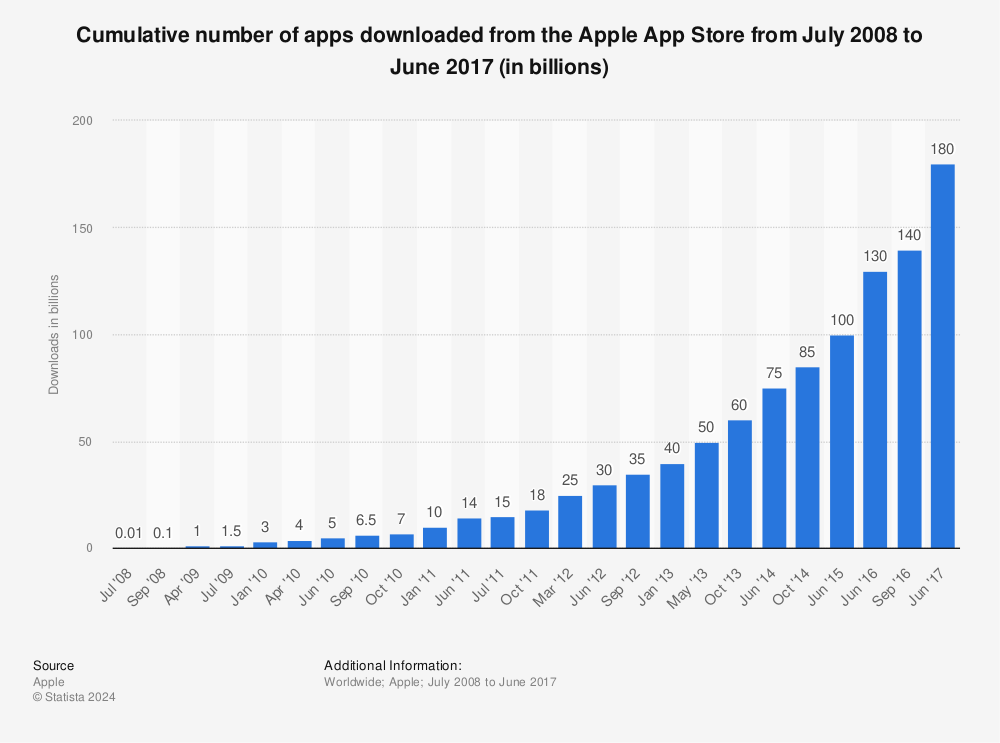
If you think that consumers are purchasing iPhones so that they can rock out on Safari and Mail, you are mistaken. A year ago over the App Store hit 100B cumulative app downloads:
http://www.statista.com/graphic/1/263794/number-of-downloads...
Native apps drive hardware purchase decisions for consumers. That's the lesson of Windows Phone.
> Safari's engine is what Chrome has been based on, and for most of its life it has been one and the same codebase.
You misunderstand how a browser is constructed. Browsers are much more than just a rendering engine like Webkit. Chrome and Safari have different JavaScript engines, support different web standards (no WebRTC for Safari!) and are architected in completely different ways. You might find this a helpful place to start:
http://arstechnica.com/information-technology/2013/04/does-w...
Off topic tip: I've had success with the Safari dev tools on some issues that I couldn't debug on chrome. Sometimes it's worth trying both.
It was very painful to read.
As iPhones and iPads became ubiquitous (as well as the popularity of Macs with developers) that didn't seem to be enough reason to keep it going.
I don't think Apple ever intended to win the browser war, I assume it was a means to an end. Maybe I'm wrong and someone was somewhat delusional. As a Mac lover who had a strong PC at the time it was quite pokey to try to use.
Also note that Google Chrome wasn't released until September 2008, so there was a year+ where Safari was the most prominent WebKit-based browser on Windows.
(I do often skip testing on Windows and iOS for hobbyist stuff since I don't normally use them, but I don't blame other people for it.)
The basic issue we were encountering is that when selecting text via force touching and then dragging the selection, the text selection object was empty. (Though you can still hit Copy in the Safari UI.)
There wasn't any issue when selecting text via regular press or long press.
https://developer.mozilla.org/en-US/docs/Web/API/Document/ex...
Most websites irritate their users, actually.
For example most ES2015 features have been available in Chrome, Edge and Firefox for over 6 months now, but Safari still doesn't support any of it (other than this tech preview) because it's development time is shared with the rest of Apple's ecosystem.
Unless Apple dedicates more resources to Safari in order to keep pace with the rest of the browsers, they'll be playing catch-up ad infinitum.
Now with Safari Technical Preview, if you want access to all of it in a more accessible package than the WebKit Nightlies, you can have it.
BTW, Apple has been doing what appears to be a amazingly good work on JavaScript Core lately, extending their performance lead: https://webkit.org/blog/5852/introducing-the-b3-jit-compiler....
You might actually have a leg to stand on when Safari 9.1, released 10 days ago, gets its ES6 state tested and uploaded to the compatibility table. Or it might be more embarrassment about Apple's slow release cycle. It's also unclear as to whether Safari Tech Preview will contain the majority of ES6 code in Webkit or if it will be "curated" into a significantly less compliant and useful state. Once again, tests will tell. What is certain for now is that six months of Safari have left it at 53%, which, among many other examples, has been Safari dragging everyone else down.
Just because they have untested, unsupported code in a development branch doesn't mean that their main browser with a completely different name and a glacial release cycle gets a pass for holding up the class. The Tech Preview is a good starting step, but until these things have a clear release cycle that shows current WebKit ES6 feature support making its way into a release build before the end of the year, we'll continue to be upset at them with cause.
And Safari saves like 20% to 30% of your battery life over Chrome...
http://bgr.com/2015/08/05/google-chrome-vs-safari-battery-li...
http://www.theverge.com/2015/4/10/8381447/chrome-macbook-bat...
And both are due to Apple's own JIT engine...
I feel like that claim needs a source. I'd be amazed if the JS engine had anywhere near such a substantial effect on battery life.
I personally feel that Apple are still not as good as not only I want them to be, but pretty much anyone who uses or develops for iOS. But yes, you categorize my comments and opinions well - Apple are indeed not very responsive, and yes Apple need to do a hell of a lot better. As I say, the votes are bouncing up and down, so I'm not the only one who has holds this opinion.
And no, it's not off-topic. As an end user, I now have to incorporate workarounds that no normal user should have to make to get around their issues - I'm literally running Charles proxy (until iOS 9.3 fixed their issue) and a rewrite rule to get around their ridiculous bug. And I had to run it for 3 months. Firefox and Chrome has an issue like this one fixed within their next cycle - in other words, in no time at all.
All of which means I'm not afraid, ashamed or worried about downvotes from folks like yourself. I've not said anything offensive, sexist, racist or even all that terribly controversial. You've finally come out of the woodwork to make your comment, which I appreciate. If only you had made it sooner, eh?
My only comment was that my score was going up and down like a yo-yo, and only because I was being accused of making off-topic comments. That's pretty tedious, no? Surely that's against HN guidelines?
Apple has been clear from the moment they released Safari Technology Preview: Get a preview of the latest advances in Safari web technologies, including HTML, JavaScript, and CSS. Safari Technology Preview includes the most recent version of WebKit, the rendering engine that powers Safari.
This is from https://developer.apple.com/safari/technology-preview/
Short answer: Safari Technology Preview also scores 98% on the ES6 test.
The phrase "most recent version" could mean pulling from a dev branch, using the last successful build, pulling from a release branch, pulling from a testing branch, assigning arbitrary numbers and tags to commits and pulling from there, or even working from a staging repo where they cherrypick commits. These are all separate sources that could hve their own version series, and "most recent version" is a very relative statement. Anyone who's seen the divide between development and sales knows that phrase has enough wiggle room to fit a Challenger disaster inside, and marketing is Apple's specialty.
I really hope they start to pull the changes from WebKit. Safari sorely needs it. But Apple's not the kind of company you just take at their word unless it's independently verified. I get it if you want to believe. That's sweet. But I'd rather wait for the tests.
Even then, monthly builds are still not a public release schedule for Safari. It was six months with only minor fixes between 9.0 and 9.1. We're far more interested in a public stable release with usable ES6 support than builds with unstable features that won't be usable on sites this year. If preview builds were what would solve the problem, then the WebKit Nightlies would have been enough.
Being a good HN commenter in the long run means learning to eat provocation, which admittedly sucks, but is true community service.
When loading webpages, one of the most important factors to saving power is reaching an idle state as quickly as possible. For many pages, that requires being fast at executing JS that runs only once or only a few times. Safari dominates on this, thanks to WebKit and JavaScriptCore. You can see this on JSBench, which runs JS modeled on real page loads and interactions: http://plg.uwaterloo.ca/~dynjs/jsbench/
I applaud Chrome's recent work on battery life. But I think it would be fair to say that safari is still the best in this area. And also that our excellent results have inspired Chrome and others to do better, much as in an earlier era Chrome inspired other browsers to get more serious about JS performance.
Windows itself has worse battery life than OS X on identical hardware, so it's hard to compare Mac browsers to Windows browsers. Safari on OS X is the best laptop browsing power efficiency you can get, and likely the best battery life barring laptops with super huge batteries.