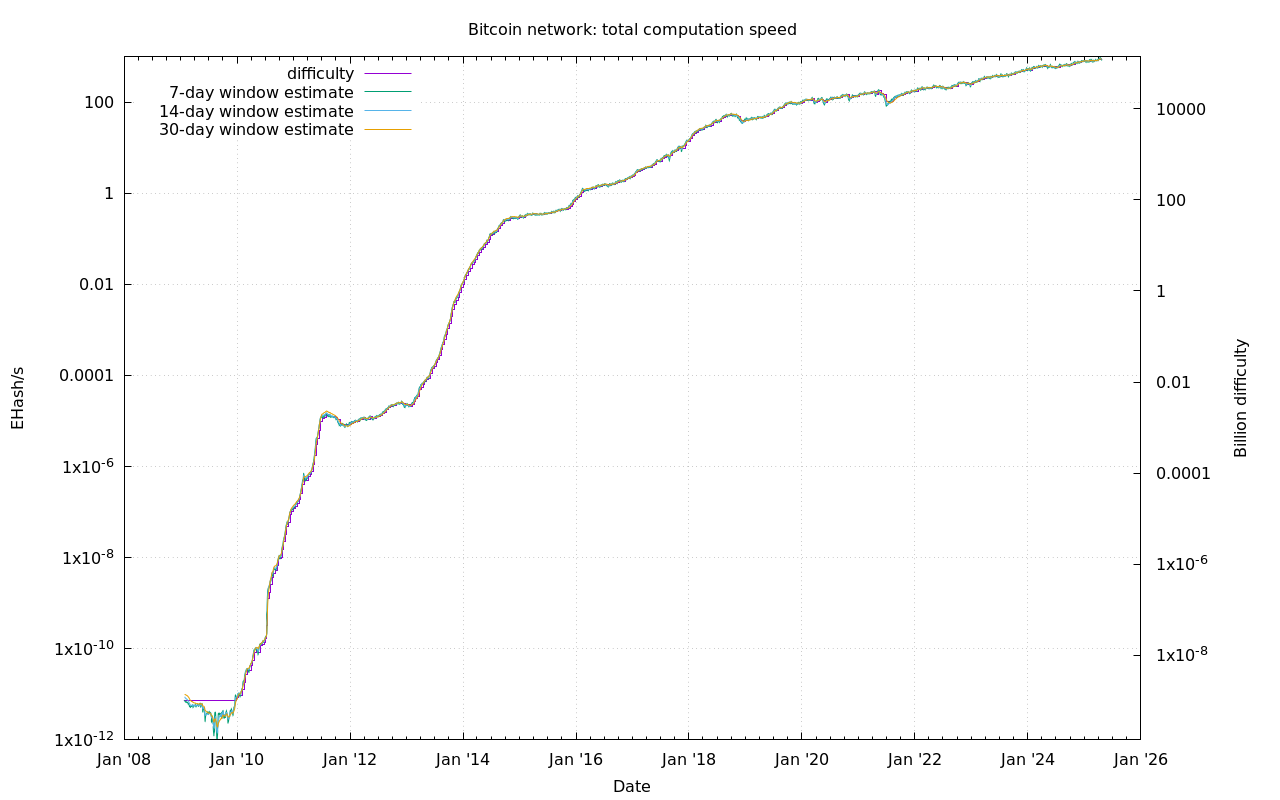
Hash rate is about 1,200 PH now. The most efficient ASIC miner today is the AntMiner S7 [1], which does 4.86 TH at 1.21 KW. This gives us a power consumption of the entire Bitcoin network of at least 300 MW. Actual power will easily be double that, given that not everybody is using the latest miner. So let's say total power consumption is about 600 MW. This is the output of a small power plant.
Therefore the hashing chips must be considerably more efficient than the latest commercially available products. I think the major players get hashing chips manufactured at scale on smaller nodes for significant power savings.
First of all, 28% could almost entirely be attributed to noise.
Second, the fastest hash rate increase recently observed occurred between Nov 2015 and Feb 2016, not during the last month.
See alltime log scale: https://kaiko.com/statistics/hash-rate?logscale=true&range=1...
The gain just plateaued out after the mid 2013 to mid 2014 rush. The current rate is note even half of that.
I know that sounds snarky, but it's how proof-of-work systems like bitcoin work: "miners" all attempt to generate a specific hash which just means lots and lots of computation. The number of transactions per second the bitcoin protocol can handle is essentially capped and completely unrelated to hash rate as the difficulty of producing a correct hash is adjusted based on the hash rate.
You're assuming hashrates and electricity consumption are 1:1, ignoring improvements in efficiency.
> The number of transactions the bitcoin protocol can handle is essentially capped and completely unrelated to hash rate as the difficulty of producing a correct hash is adjusted based on the hash rate.
That is true, but one must also consider that transactions & value transfer is not necessarily 1:1 either. A transaction can carry information which refers to multiple transactions, or is a transaction for a billion dollars. So value transfer is not necessarily capped, although in practice of course it is right now.
Further, to say there's no relation isn't true, either. Transactions are not dependent, but they are related to hash rates to some extent, and by virtue of the protocol this will increasingly become so, as transactions will be the main source of income that funds hash rates, there is indeed a relation.
Not true at all. The total hash rate has gone up a factor of 10^11 since the early days of Bitcoin, but total electricity consumption certainly hasn't gone up by that much. Data here: http://bitcoin.sipa.be/speed-ever.png
Most of that can be attributed to efficiency gains. More efficient miners are coming on the market all the time, and in any given year, the vast majority of increased hash rate can be explained by better hardware, not another 100-1000X in electricity consumption.
This latest hash rate increase is most likely caused by the release of the latest batch of mining hardware, see, e.g., Antminer: https://bitmaintech.com/productDetail.htm?pid=00020150827084...
The relevant number is bitcoin's price*the block reward. That's exactly how much one block is worth, and so that's how much it should cost to mine one block. If it diverges from that number then either miners will turn off or new miners will turn on.
For more information about mining, you can refer to this description: https://kaiko.com/learn/mining-blockchain
This isn't totally accurate. You need a lot of different miners and a high hash rate for security. The least secure place bitcoin can be is when a single miner controls most of the hash rate.
You're right, but since the price of bitcoin has risen over the past month the increase in hash rate could be due to miners turning back on less efficient equipment that wasn't profitable at lower prices.
It's really impossible to know, but since the price is rising I think it's likely additional hash power would mean more mining equipment coming online -- therefore using additional power -- while leaving existing mining hardware but still profitable hardware running.
oh dear... the rest of the article was good, though.
> And contrary to commonly-repeated assertions, a monopolist can engage in subtle attacks that are hard to detect.
http://hackingdistributed.com/2014/06/16/how-a-mining-monopo...
No, people mine because a global contest was the only way to create a self synchronized global database. Why a global database? To avoid the problem of double spending that all other electronic money initiatives had. But this is a distributed instead of a centralized database.
The process of mining is a way to make all miners maintain the blockchain in working order. Every miner has a copy of the full blockchain DB and all these copies are in sync. In fact, a mined block is a list of transactions between accounts, with their corresponding digital signatures.
The incentive of giving a token size of bitcoins to the first miner that finds the correct hash signature was to make mining something that people would like to do, instead of a burden for everyone.
If you can find another way to make a group of very diverse people, with possibly diverse interests in the game, to maintain a distributed networked database in sync, welcome to the community.
In fact, some groups are starting to test one alternative to mining, called Proof of Stake. If it is better for everyone, then another currency instead of Bitcoin will take the crown.
Other solutions: issue more value to those already holding more value. Issue more value to those holding less value. Issue more value in the form of credit transactions within the community.
In fact, since imaginary value points are real numbers, just revalue what's there? Its not like we'll run out of fractions. Imagine if you will that only 1 bitcoin was ever issued. Folks trade around ever-decreasing fractional numbers (milli-coins? nano-coins?).
But then again, I'd rather replace a furnace with a more productive set of hardware anyway.
1) With electric heat you have to account for the energy production and grid transmission being around 30% efficient. Even though an electric heater or bitcoin miner is converting electricity to heat 100% efficiently, a majority of the thermal energy released in the power plant was already thrown out as waste.
2) Even using electricity, a heat pump beats the electric heaters. They're 2-3x as "efficient" in terms of how much heat it pushes into the house vs how much electricity it takes to do it. Technically this is measured as "coefficient of performance" instead of efficiency, since it's a ratio of heat transferred / energy consumed, rather than energy released / energy consumed (and efficiency >100% wouldn't make much sense).
3) Gas furnaces can be >90% efficient, which also beats the bitcoin miners. Even the lowest efficiency allowed by law (78%) is better than resistive electric.
4) There's more "embodied energy" in building a bitcoin miner than an electric heater, and it has a very short life as a useful miner before it's obseleted by newer chips.
Resistive electric heating only makes sense if you're looking for a low cost solution in a climate with a very minor cold season. And I highly doubt anybody's going to buy a bitcoin miner with the intent to only run it 3 weeks a year when it gets chilly outside.
Bitcoin is basically a giant scheme to extract as much value for the miners by dumping a bunch of externalities on everyone else in the form of fossil fuel subsidies and greenhouse gas production. Not a fan.
How is that different from any other of thousands of energy-intensive services?
Presumably mining zinc, copper, aluminum, etc must have pretty big costs to the environment? Paper is mostly paper but isn't it also some special silk? At least here in the US.
Those seem slightly more renewable for paper. But yea, creating an extra power plants worth of fumes is pretty shitty over time.
I believe there's one currency which at the very least does some sorts of scientific calculations with the processing power? Maybe we should at least encourage those types of coins.
EDIT: Unless you live somewhere where the ambient temp goes below ~0F, get a heat pump.
But in general, I agree with you. :)
Bitcoin could be hugely beneficial for fledgling financial systems, and robust financial systems can be hugely beneficial for billions of people.
Our energy crisis was not created by, and will not be solved by, Bitcoin. Numerous monetary crises could be addressed in serious ways by it, though.
The price is based on utility of the commodity and speculation about its future utility, not mining costs. Put another way: more hash power does not raise the value but more value may raise the hash power (by making it profitable for less efficient miners to mine).
> how a structure on top could be created to leverage bitcoin without mining.
There's lots of activity around alternatives to bitcon's proof-of-work based mining: proof of stake, proof of activity, etc. Just search "proof of work alternatives"
Bitcoin is not necessary. The environment is. Easier solution is stop operating a power plant to play speculator on play money.
As for the transactions vs hashes correlation, while technically true, in practice the two are inevitably linked, as the currency must be protected proportionally to the sums it manages. As more value is stored and transacted, so the incentive to attack it increases, and so an increase in the cost of attacking it is required. Though it might trail off at some point, Bitcoin's history has shown this relation to exist.
In practice ACH transfers within the United States are free and clear within a few days(giving you time to catch fraud). There's also very little technical barrier to transferring money abroad, although there is risk to the bank.
Credit cards are a different matter. They have to clear instantly so the merchant is guaranteed payment(excepting a chargeback). Bitcoin (usually) clears in an hour, or at least 10 minutes, so it's unsuitable for realtime financial transactions unless you build a financial industry on top of it to mitigate risk.
Bitcoin mining is still vastly more efficient and sustainable than gold mining.
Edit: dear downvoters, rebuttals are welcome
And, other digital currency implementation don't require 'mining' at all; just the paranoid ones.
Nonsense. No one will burn more energy to create bitcoins than those bitcoins are worth, the limit is market price. And if you think bitcoin is burning more energy than the existing banking system, well then you're just not in touch with reality my friend.
> And, other digital currency implementation don't require 'mining' at all; just the paranoid ones.
Which is why all of those other coins are little more than failed experiments; lacking proof of work, you lose the main feature of bitcoin, trust-less transactions. None of the other ideas work to achieve the actual goal of a digital currency, trust-less transactions.
Plus they still manage to destroy economies with hyperinflation. They're more wasteful in providing a worse product.
Actually I'm happy to have a chance to say this:
Fuck the planet.
The latter part is true, but BTC cannot provide that. It's nothing more than a nifty hack. It kind of works, which is impressive, but it is horrible inefficient and impossible to scale due to its inherent limitations. So far the only solutions that have been proposed were to tack on even more complexity. To make matters worse, all of these solutions have remained vapourware for quite some time.
> Numerous monetary crises could be addressed in serious ways by it, though.
How? It would have not prevented the Dotcom Bubble. It would have not prevented the Subprime Mortgage Crisis. It would have not kept Argentina or Greece from borrowing way too much money. It's a libertarian pipe dream that Bitcoin will magically solve all of the world's economic problems. In fact, it would make matters worse due to unpredictable volatility and its lack of scalability. It would only drag any country trying to adopt it into a deflationary death spiral. There is a reason why the gold standard has been abolished.
It is not a given that Bitcoin cannot scale, even though a select few in the ecosystem repeat this as if it is a fundamental truth.
Bitcoin is proposed by many in the ecosystem to scale as it has been before: By scaling up transactions on the chain. See http://www.bitcoinclassic.com/
To give an example of this, Bitcoin appears to be growing in popularity in Greece:
http://www.ibtimes.co.uk/rollout-1000-bitcoin-atms-planned-g...
http://www.coindesk.com/has-the-greek-crisis-increased-bitco...
That may be true, however, every time we've replaced one currency with another there have been unforeseen consequences decades or centuries later.
One dead-simple example: A bitcoin can be divided down to 8 decimal places and there is a limited supply. It is deflationary. No, that isn't a good thing (ignoring short-term greed). What happens when we either mine all the bitcoins, or mining more becomes computationally impossible? How do you run a business when the minimum possible amount of currency increases by $1 every day? You have a piece of bread worth $3, but the minimum amount someone can give you is $5 (then $6, then $7). Suddenly this deflationary currency that was supposed to fix everything has resulted in global hyperinflation.
"So we'll just switch to a new system at that point." We can't get countries to drive on the same side of the road, use the same measurement system or even upgrade to IPv6. How on earth are you going to roll out a global currency change overnight? Bitcoin stakeholders can't even agree on much smaller changes at the moment.
Call it a commodity, sure. It is not a viable long-term currency.
Encryption makes it difficult for the government to make certain kinds of decisions as well.
The bitcoin network's integrity basically boils down to "Waste so much energy that a single adversary couldn't possibly waste more energy than everyone else." It then rewards individual actors for wasting more energy to make sure that stays true.
EDIT: If you're in a colder climate, in-ground coolant loops are preferred over an air transfer heat pump.
Oh but they are not. People wish it so but it just ain't so.
> Mining is just one solution to minting
Yes, the only successful one. Every other solution that tries to remove mining comes with bigger flaws which why no other coin has taken off. Every alt coin that exists today is a failed experiment.
> Other solutions exist.
Other failed solutions that have prevented any other coin from being able to process payments of the scale Bitcoin processes.
Mining is core to Bitcoins success as it's the only solution that actually works well enough to have gained traction.
You don't even need a fork, you can just use off chain middlemen that add extra units, or if it's done as a sidechain then no agreement is needed and it's all on chain.
It's a system to distribute scarce tokens as fairly as possible. At the beginning, you could just do it on your own computer device. Now the space is much more specialized, the barriers to entry is much higher, but anyone can still participate.
> issue more value to those already holding more value
Again, how should the initial units be distributed fairly? Besides, this system is not attractive to latecomers and will end even more centralized that the current system.
> Issue more value to those holding less value.
So I just create free new identities out to get the scarce tokens? Then the tokens are not that scarce, are they?
> Issue more value in the form of credit transactions within the community.
Not sure what you even mean here.
> Imagine if you will that only 1 bitcoin was ever issued.
A Bitcoin already is divisible into 100 million Satoshis. Mining is a solution to the question who gets the tokens.
Same amount for everybody. One weekly/monthly payment for everybody. Like basic income. I am just guessing, I haven't thought about it deeply.
An idea like this was also often brought up in spam prevention, which interestingly is also the origin of proof-of-work: https://en.wikipedia.org/wiki/Hashcash
Only on the black market, realistically.
I'm sure the leaders will do a much better job if they know the populace has alternatives to switch to.
> Not be locked into a limited child's toy tool set just because their predecessors were less than competent.
Bitcoin isn't taking away anyones money printing machine. It just makes pushing the lever less attractive.