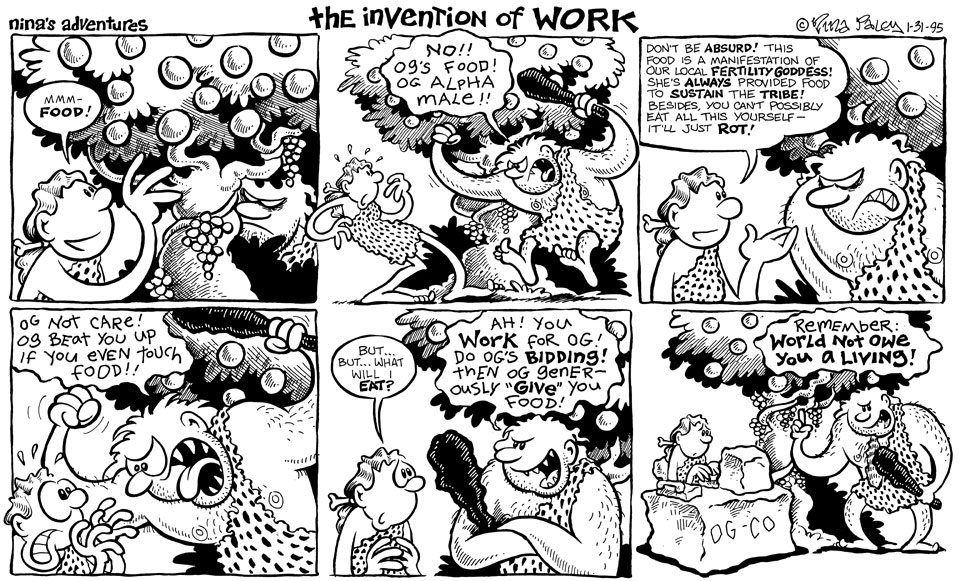
Italy has just admitted that it can't take care of its citizens' basic needs. I'm not saying it's time to eat crow, but I am saying it's time to realize that both systems have flaws and there's no reason to get righteous about one approach over another.
OK, I have an anti-agenda agenda.
Maybe he was drunk or slept during the food lines, or he just didn't give a fuck that day? Poor people can decide not to receive any help they are provided. It's not like we can throw them into a prison for being poor.
Somewhat doubtful that Mr Ostriakov is Italian, or from an EU member country. Very likely that Mr. Ostriakov had to illegally go to Italy to find work after Biden & co decided it was time to "liberate" Ukraine. Just a theory.
Not quite, a homeless person could invade an empty home and sleep in that bed. This is done all the time, and is somewhat covered by squatter's rights. It's currently assumed that greater than 15% of the world's population are squatters. [1]
Squatting is the action of occupying an abandoned or unoccupied area of land–or a building, usually residential–that the squatter does not own, rent or otherwise have lawful permission to use.
Author Robert Neuwirth suggested in 2004 that there were one billion squatters globally. He forecasts there will be two billion by 2030 and three billion by 2050.
For example, on release of a blockbuster movie - the distributor will do blanket advertising saturating every channel trying to manufacture a demand - tv, internet, sides of buses, roadside-hoardings, in taxis, talk shows, newspaper native ads etc. You just can't escape even in your own home eating your breakfast cereal when the box is smeared with adverts.
If a demand has been manufactured by a catastrophic pollution of our environment, I can't blame anyone for satisfying it without paying the maker. They didn't really have a choice.
No one is saying this guy isn't responsible for stealing food, the court is saying he ought not to be punished for it given his particular circumstances.
EDIT: I'll concede this may not apply to toddlers.
Only if they have IQ below the level which is considered minimum to be responsible for your actions.
> Italy has just admitted that it can't take care of its citizens' basic needs.
Maybe you don't, but you are implying that this somehow is a failure of social safety nets.
As someone else in this thread mentioned, the italian justice system is based on civil law, not on precedent (common law) so this ruling doesn't have the repercussions many seem to think. I'm not a lawyer however, so don't quote me on this.
Anyway, my point is: theft is always theft. One may get lighter punishment because of the motives, but still should be punished. It's really hard to die of starvation in modern society.
How does it address professional thieves who steal to order, now they can just argue that they were hungry. Frozen meat is often stolen as it has a high value to weight ratio.
Many small business owners are far from rich, can they steal from their suppliers to make up for the losses?
>>Stealing small quantities of food to satisfy a vital need for food did not constitute a crime, the court wrote.
What about the loss sustained by the owner? Or perhaps if the "not-so-rich clerk" at the supermarket was in charge of the goods and had to pay for the losses? Whose going to give that "not-so-rich clerk" the lost money?
Tomorrow if a thousand "hungry" people stole "small quantities of food to satisfy a vital need for food" then what?
I mean, such "populist" rulings are ultimately antithetical to democracy based society.
I find that an utterly ludicrous claim given that the court was applying the law, and that parliament is free to change the law if they believe it is being misinterpreted.
Others would find it ultimately antithetical to society overall to threaten people with prison for a theft like in this case. I certainly would.
> Tomorrow if a thousand "hungry" people stole "small quantities of food to satisfy a vital need for food" then what?
Then society would need to decide whether to deal with that by tightening up this law, or find other ways of treating the poor with some degree of dignity.
Consider such laws a recognition that life has greater value than property, and an incentive to ensure society keeps that in mind when deciding how to structure itself.
This I agree. In fact, I am of the strong opinion that there should be very hard limits set on the ownership of certain types of properties (e.g. land, water, food). No one should be allowed to own any of such properties beyond a certain limit. [1] But once a person who owns whatever is allowed by the laws, then the law should protect the ownership of that person of that property and in case any person (needy or not-so-needy) steals such a property of other person, the law must not then take a populist u-turn to tell us grandiose sounding principles like "life has greater value than property". If the judge wants to show he/she is so "humane", he/she should pay for the loss of the owner and allow the "needy" poor to keep the food.
Some other better ways the judge could have taken: The judge could have ordered the officials overseeing the welfare matters and could have ordered them to compensate for the losses sustained by the owner. In fact, the judge had a very good opportunity to bring to the notice of that poor hungry person some of the welfare schemes that are set in place by the society.
But saying that a theft, which has caused damage to other law abiding citizen, is not a crime is not only ludicrous but is also dangerous.
>>Others would find it ultimately antithetical to society overall to threaten people with prison for a theft like in this case. I certainly would.
I am not against the society helping the needy people to survive but there are other "not-so-antithetical-to-democracy" ways of helping the needy people than just ignoring the thefts carried out by the needy people.
What was wrong on the part of the owner? Why he/she was punished? These are some very important issues here. We must not fall prey to sentiments like "thefts of food by poor hungry is okay and anyway the shop owner is always that dirty-rich person who needs to be punished".
[1] Note about private property: please note that I am not saying/suggesting that we should embrace the communist style anti-people tyrannical systems which prohibit "most"* people from owing any private property. Of course, the communists allow only the "more equal people" [2] (e.g. party chairman and his cronies in polit-bureau and few of their cronies in turn) to own almost all of the property. The "party-people" are allowed to have as much fun as they want and at whatever troubles such fun-acts of the party-people cause to other "less equal" people, the communists just ignore.
Edit: With appreciation to lorenzhs
It is a more enlightened philosophy of justice to acknowledge that saying 'you should have known better' won't make people know better. As the concept of morality progresses from a simple Hammurabian ear-for-an-ear justice game to a nuanced empirically-founded optimization problem, it will be interesting to see whether or not people continue to take pleasure in exerting it. That the latter problem tends to be incredibly engrossing to the technically literate means many of us will respond to this quite positively.
Postscript: If morality were a solved problem, would there be as many Effective Altruists?
[1] http://www.apa.org/monitor/julaug03/rehab.aspx [2] http://www.pewtrusts.org/en/research-and-analysis/reports/00... [3] https://www.researchgate.net/profile/Adriana_Foster/publicat... | relevant quote : estimation of mood disorders at "12% to 30% in various homeless samples".
Ironically, this is going to hurt the working poor the most who work at low margin restaurants, retail shops, etc as people just grab whatever they want because there is no more law protecting them. It also seems like a good way to get into beatings or even knife fights as small business owners and workers get fed up with thieves and now have an apathetic police that won't protect them. Those in high volume areas like food stands at train stations will feel the brunt of this, meanwhile I suppose the kinds of restaurants an Italian judge dines at won't even notice. If Italy wants to expand its welfare state benefits, then it should do that through its legislature via taxation, not via judiciary decree attacking its poorest workers. If the Italian poor can't find these socialized benefits then someone needs to ask by the welfare state is so inefficient and find a way to fix that.
More than likely the unintended consequences will be chasing out 'poor looking' people from various shops as retailers fear legal theft. Now the poorest won't be able to buy things they need and they won't have the resources to fight this discrimination via a lawsuit. On top of that, there's no Hollywood style theft where you just steal bread cooling itself on the window sill. It will involve breaking and entering, fights with the shop owner, collateral damage (a child trampled during a chase), tempers leading to weapons use, incentivizing snatching expensive food to be sold on the black market, and other issues.
Its obvious no one thought this through. What if a hungry person decided to smash up a €5,000 vending machine to get a sandwich or a coffee? Does the Italian government pay for the repairs? I imagine it won't. This is a bad ruling for Italian small business.
The inferential gap between EA and Objectivism is obviously huge, so it's not worth giving a full argument here. For the intellectually curious, though, I'll simply say that the two schools of thought fromthemorning cites both assume that the purpose of morality is to maximise the greater good (rather than, say, teaching individuals principles to maximise their own long-term personal happiness).
On the off chance that someone on the fringes of the EA movement reads this, someone who shares the concerns I once had - the ultimate issue with EA is that it's hyper-empiricist: EAs love evidence but are highly distrustful of theoretical arguments. This is an understandable position, but ultimately a mistake, because you end up unable to synthesise the vast amounts of data you gather. All truths are simplifications - what you need are rules to form correct simplifications.
Objectivism isn't taken seriously in mainstream intellectual circles but it should be, because it shows how to avoid the pitfalls of both empiricism and rationalism. (See Introduction to Objectivist Epistemology for details).
As a side note, grammatically "le miserable" is more wrong than "la miserable", as the latter is the right gender but lacking pluralization, while the former gets both wrong :)
Did they legalize smashing up $5000 vending machines if you're hungry too?
> Does the Italian government pay for the repairs?
Do Governments usually pay for repairs to private property?
In this context, it's clear you are both in agreement.
While I agree with you in principle, placing the burden on an entity far removed from the local context will always leave people underserved or forgotten entirely, in which case their instinct to survive will hurt the local business owners regardless of whether they would have helped voluntarily or not.
Unless it really is a true basic income.
I agree, basic income is the answer. But this judgement isn't logical or sound.
If its the effect of the law and legal system, it is not unlawful for the burden to be placed there, even if the individual takings are unlawful. Whether its unethical or not is debatable; its basically equivalent to the government taxing sales of food and using it to fund feeding the indigent (since the grocers costs of doing business are recouped in the prices charged to customers), which (while rarely explicitly done with food) is actually a not-uncommon model for providing goods or services deemed essential (that is, taxing sales to those who can afford it, and using the proceeds to subsidize those who can't.)
  * Stealing something back
  * Stealing Hitler's secret plans
  * Stealing a portion of everybody's property/income, but providing vital protection, infrastructure and social services in return.
  * Stealing the heart of a girl from a guy who abuses her.
  * Stealing land from the commons to efficiently put it to work
  * Stealing land at market value to create a public works project that benefits the rest of society
Property rights is a critically important idea that helps to serve a society. It's not an end unto its own, nor is it an unimpeachable moral imperative.
"A Scottish miner was walking home one night with a bunch of pheasants he had poached from a local landowner's estate when the landowner appeared and demanded that the miner hand over the pheasants. "Why should I hand them over to you?", asked the miner. "Because this is my land and those are my pheasants", the landowner replied.
"OK", said the miner, "where did you get the land from?" "From my father", said the landowner. "So where did your father get it?", the miner asked. The landowner replied: "From his father, who got it from his father, and so on. This land has belonged to my family for 500 years!"
"Well", the miner continued, "how did your family get it 500 years ago?" "Oh, they fought for it", answered the landowner. "OK then", the miner said, "take off your jacket and I'll fight you for it!"
NB I first read this in The Poor had No Lawyers - described as "how this country was stolen from its people":
Say someone says "let me search your car, what have you got to hide?" What argument can you use against it? The problem is that we've been manipulated to believe privacy has no real moral claim. In reality, you should be able to just say "it's private" and not feel compelled to provide further explanation.
It's not so different from being punched in the stomach. You aren't going to die, so what's the problem? You heal and everything is fine. So why won't you let me punch you in the stomach?
Theft is, similarly, a moral issue. If I make something, and someone takes it, I will feel bad. Much worse than if I had to sell it to pay taxes (even if I disagree with the tax policy).
Virtue of Selfishness puts the case succinctly:
"The right to life is the source of all rights—and the right to property is their only implementation. Without property rights, no other rights are possible. Since man has to sustain his life by his own effort, the man who has no right to the product of his effort has no means to sustain his life. The man who produces while others dispose of his product, is a slave.
Bear in mind that the right to property is a right to action, like all the others: it is not the right to an object, but to the action and the consequences of producing or earning that object. It is not a guarantee that a man will earn any property, but only a guarantee that he will own it if he earns it. It is the right to gain, to keep, to use and to dispose of material values."
"The right to life means that a man has the right to support his life by his own work (on any economic level, as high as his ability will carry him); it does not mean that others must provide him with the necessities of life.
The right to property means that a man has the right to take the economic actions necessary to earn property, to use it and to dispose of it; it does not mean that others must provide him with property.
There is no such thing as “a right to a job”—there is only the right of free trade, that is: a man’s right to take a job if another man chooses to hire him. There is no “right to a home,” only the right of free trade: the right to build a home or to buy it. There are no “rights to a ‘fair’ wage or a ‘fair’ price” if no one chooses to pay it, to hire a man or to buy his product. There are no “rights of consumers” to milk, shoes, movies or champagne if no producers choose to manufacture such items (there is only the right to manufacture them oneself). There are no “rights” of special groups, there are no “rights of farmers, of workers, of businessmen, of employees, of employers, of the old, of the young, of the unborn.” There are only the Rights of Man—rights possessed by every individual man and by all men as individuals."
> If a situation forced you to choose between compassion and property rights (Maybe you're asked to steal a life saving medicine for someone else in dire need), which do you choose?
The Objectivist answer is that sickness (like hunger) is not a sudden emergency but a predictable element of human life. Because of this, people invest in researching and manufacturing medicines, or studying to become doctors. They own the products of their labour, and are entitled to trade them (or donate them) as they see fit.
Many people would say they agree with this, but that there are some situations where rights should be compromised. The thing to understand is that rights are principles. In Objectivism, principles essentially encapsulate long-term pragmatism: principles are concepts you should always follow if you want good long-term results. (Rights, for example, encapsulate the principles to follow in the social realm). There will always be bad effects to violating principles, even if there appears to be a short-term gain.
If you say that one group of people (e.g., drug companies) should have their rights violated based on the needs of another group of people (e.g., sick and poor people), you establish the principle that anyone's rights can be violated for the needs of anyone else. You end up with different pressure groups and lobbyists pushing for government handouts and favourable legislation (i.e., the current situation). Linking back to the field of medicine, one practical outcome of the push to prevent "greedy drug companies hoarding medicine" has been that medical innovation has increasingly focused on things like viagra and plastic surgery, since if they develop life-saving innovations their intellectual property rights may well be violated.
> Judges overturned a theft conviction against Roman Ostriakov after he stole cheese and sausages worth €4.07 (£3; $4.50) from a supermarket.
> Mr Ostriakov, a homeless man of Ukrainian background, had taken the food "in the face of the immediate and essential need for nourishment", the court of cassation decided.
> Therefore it was not a crime, it said.
(...)
> In 2015, Mr Ostriakov was convicted of theft and sentenced to six months in jail and a €100 fine.
Italian judicial system "does not try anybody by a jury of peers: everyone is judged by professional judges or by a panel of judges" [1]. Thus, the compassion reserved to the jury of peers (in the form of Jury Nullification) in systems like the american one would be absent from the Italian one if not for actions like the one by this judge.
Not going to enter in the merit of the cause itself (as it's very subjective and personal experience can affect the judgement) but I agree that the judicial system can and must apply discretion in its judgements.
[1] https://en.wikipedia.org/wiki/Italian_Code_of_Criminal_Proce...
It IS a crime, however one that court could rule to not punish the convicted. At least that is how it would probably work in my country.
It's quite simple when you think about it would you rather die in the streets from lack of food or go into a supermarket and take some to live another day hell even if you get caught you go to prison where you get fed.
There's no point in punishing these people the punishment is actually better then their current situation and any fines etc that you give them they will never be able to pay anyway all that does it prevent them from improving their situation since whenever they will start recovering a bit the debt collectors will show up to knock them down.
Besides being a cruel and unusual punishment for someone trying to better their lives it's not good for the economy either.
If you want to feel moral, go feed a poor person today. You'll feel much better. Don't assault the basic pillars of the civil society that is what has left you rich enough to be able to afford that without a second thought for a quick hit on the virtue pipe.
(Preempting one of the lines of attack I can forsee coming here, the crime is also minor and the penalty should be minor correspondingly. I would happily support some sort of very compassionate enforcement; perhaps a sentence of a few days' service at a soup kitchen which will also feed him or something. But there is still an important difference between enforcing the law even in this minor way, and declaring that certain people lack Privilege and therefore, ironically, have the privilege of being above the law, which is the sort of caustic poison that can dissolve civil society entirely.)
It is never, ever ok to steal. Stealing from a supermarket is stealing from a person or people. Just because you cannot name who is affected doesn't mean it isn't people. It is black and white. The morality and legality are in alignment in this regard. This whole "shades of grey" leads to the blackness that destroys people and civilizations.
The whole point of government social programs is to provide for survival. There are organizations that provide and places to go.
Yes, well they're stealing from someone, aren't they? But of course, it's ok if someone steals from the heartless grocery store owner, isn't it? I feel as if you would have a different opinion if anybody was allowed to walk into your house without your permission and ransack your fridge (and anything else they felt that they "need").
The moral problem with theft isn't that it is illegal. The problem is that one person expended their own personal resources to create the good. The person has spent their own time, money, and/or intelligence to create some good that now has value. The thief, who has expended zero effort to create nothing, takes the fruit of the producer's labor for no work, on the basis of his "need". What kind of society does this produce, where you can take things from others solely on your basis of need?
You seem to be making the cliche mistake of associating morality with need. I hope one day you don't need to learn this isn't always correlated...
Am I not privileged enough to have an opinion that theft, as such, should not be tolerated?
I still think that we should collectively help people who are in risk of starvation.
Black and white thinking can, sure, be a result of privilege, but it can also be a product of its absence. Aside from being fallacious to attack a speaker for your presumption of what in their background might be the motivation for their ideas rather than addressing the ideas themselves, you'll also quite often be wrong on that presumption.
The Catholic Church would agree: stealing is intrinsically evil, and thus wrong always and everywhere. The way they handle situations like this is by defining "stealing when starving" as "not stealing at all, but reappropriating things according to God's design for them." They call this the "universal destination of goods":
§2408 The seventh commandment forbids theft, that is, usurping another's property against the reasonable will of the owner. There is no theft if consent can be presumed or if refusal is contrary to reason and the universal destination of goods. This is the case in obvious and urgent necessity when the only way to provide for immediate, essential needs (food, shelter, clothing . . .) is to put at one's disposal and use the property of others.
In other words, the right to private property does not trump the right to life.
When thou comest into thy neighbour's vineyard, thou mayst eat grapes thy bellyful at thine own pleasure: but thou shalt put none in thy bag.
Quite the opposite, I'd say. Italy is a catholic country, and it is, I think, common opinion that the very forgiving Italian attitude is due to it. Protestantism and Calvinism in particular are much more strict in considering everybody responsible for their actions. Catholics can always go the the nearest priest, confess their sins and be immediately absolved from them. They don't have to deal with their conscience.
(They clearly do not agree with user stronglikedan.)
are in no position to lecture anyone on morals. Read "The God Delusion" if this isn't abundantly apparent to you from studying history and/or reading the news.
https://en.wikipedia.org/wiki/Pikuach_nefesh
According to one source:
...The dominant view in Jewish law ... allows a person to steal or damage property of another to save his own life. Thus, one may break in to the house of another, or steal insulin if that was necessary to save his life. However, such a person must compensate the owner of the property.
http://www.jlaw.com/Articles/ch_stealsavelife.html
This source also says about American law:
The issue is not whether a person can steal or destroy property to save his life or the life of others since it is accepted in American law that such an action is permissible. The issue is whether such a person must compensate the owner if he did not create the danger. There are few cases directly on point but the weight of such cases conflict with the position taken by sections 197 and 263 of the Restatements. These cases and the doctrines of admiralty law support the contention that when neither the actor nor those whose lives are saved are legally at fault for placing themselves in the perilous position from which they can only be saved by destroying the property of another, they bear no legal liability for destroying that property.
and consider what the consequences are for the theft. maybe they get a fine. they won't pay it, of course, because they can't even pay for food. then the fines accumulate, which has no immediate effect on the thief and does nothing to stop them thieving, because if they can't pay for food then they can't pay a fine, no matter how much they owe. on the other had, they may, eventually, be thrown in prison for their crimes, where they'll get fed on the regular, which is practically encouragement to commit crimes. you could also kill them, but i feel that's problematic.
if you don't punish the thief at all then, in the off chance they have the chance to get back on their feet, they won't have a pile of debt keeping them down, they won't have a criminal record because they were starving, and they won't be dead.
So, never been homeless, poor and hungry, I presume?
Here's some Brecht for you:
You gentlemen who think you have a mission To purge us of the seven deadly sins Should first sort out the basic food position Then start your preaching, that's where it begins
You lot, who preach restraint and watch your waist as well Should learn, for once, the way the world is run However much you twist, or whatever lies that you tell Food is the first thing, morals follow on
You've got to have something to eat and a little love in your life before you can hold still for any damn body's sermon on how to behave.
We should provide aid for people who are in danger of starvation, but it does not give anybody right to steal from fellow human.
I have a personal experience with possible abuse.
I saw a man, probably a foreign (so he is probably not supposed to be familiar with local aid system), with a sign that he needs money for food because he is starving and he indeed did not look alright.
After considering the situation (well, to be honest he can be pretending), I decided to give the man 10 euros because if he really is starving, he should not stay there to collect small coins, but also as a test, such that he could be given further directions when he really is in need.
So, he took the money, hid it and continued his act.
Not much experience with being poor/homeless, have we?
For those not faking it (which can happen too), a "starving" sign doesn't mean "I'm literally starving right now, I just need a few dollars for a burger and I'll be on my way".
It means I can't support myself, I'm dead-poor, and probably homeless, and can use all the money thrown at me to get by for a few days.
By definition the only people playing the game, are those willing to hold their nose and wade into the cesspool anyway. Nobody currently in the cesspool can seriously convince anyone that they really thought they were wading into a Randian utopian swimming pool, they knew what they were getting into. Given that intentional acceptance of the situation they're voluntarily a part of, a bag of crackers isn't much of an additional theft. Deal with it.
What is likely to happen, is when I was a kid cigarette cartons were like $10 and out on shelves for anyone to steal, but why would anyone steal a $10 carton of cigs? Now they're like $80 per carton and locked up in closets until after payment is made. So there will be changes in supermarket operations. Oh well, disruption happens.
I find it impossible to reconcile the two parts of this sentence. To me, there is nothing compassionate about even prosecuting a case like this.
I understand that people don't want to be stolen from. Of course not. Nobody wants that. We all want better alternatives.
But the world isn't perfect.
To me saying there is "never a reason to steal" is equivalent to saying you value property over someones life.
To me, that is cold and callous.
No, that does not mean I think it would be good for hordes of starving people to descent on shops. But if the alternative if starvation, then society has a problem. And theft is the smaller part of that problem.
This is a case of economics. The courts are ruling they no longer want to foot the bill, send the homeless man back to the streets and let him beg, feed, and steal from the businesses.
There is room in a justice system to convict a person of a crime without punishing that person in any meaningful way.
We certainly complete eliminate the criminality of intentional homicide when there is sufficient need. Seems to me, that the case for doing so for mere theft of chattels is much stronger. (Also, note that this is separate from the issue of whether or not conversion of chattels ought always to be a tort creating a debt for compensation from the taker to the one deprived, which should be resolved through whatever system a jurisdiction has for the resolution of debts and which may requiring repayment when the taker is capable, with interest, unless the debt is qualified for discharge, e.g., through bankruptcy or similar proceedings. But that's a different issue than criminality.)
Criminal Code, article 54 – State of necessity: “A person is not punishable for having committed an act that he was forced to do in order to save himself or others from an existing risk of severe harm, a risk not voluntarily caused by him, nor otherwise avoidable, always provided that the act is proportional to the risk”.
There are cases of homeless people who stole a pint of milk from a doorstep, and who left some money, being prosecuted for theft.
What this doesn't do is fix the problem though, it just recognizes a symptom. Why are these people forced to resort to stealing?
Nearly 50% of bank loans are non-performing (in default). The EBC is conducting a stealth bailout via Target2. Just look at the major Italian bank stocks. They are trading at deep, deep discounts. Maybe the market knows something the EBC and others don't want to admit?
> If you go into your neighbor’s vineyard, you may eat your fill of grapes, as many as you wish, but you shall not put any in your bag. 25 If you go into your neighbor’s standing grain, you may pluck the ears with your hand, but you shall not put a sickle to your neighbor’s standing grain.
Stealing food is okay sometimes. There's even a word in German for it Mundraub.
Proverbs 6:30-31
[1]https://books.google.co.id/books?id=ZRqe3iPwsTkC&pg=PA36&lpg...
I can't help but be concerned about this growing trend of governments slowly pushing off the burden of general welfare onto businesses. You see it in the US with health care being the responsibility of the employer, affordable housing mandates on real estate developers, and minimum wage increases in expensive areas. All of these "solutions" to poverty have huge unintended consequences, even if they partially address the problem. The problem of poverty isn't solved by forcing businesses to be compassionate, it is solved by governments doing their fucking job and taxing everybody equitably to do so.
Legalising stealing is basically abolishing property rights.
It's not hard to find videos on the web where a mob of shopkeepers beat the crap out of (or even shooting) someone caught shoplifting. We don't have cops to protect us from criminals. We have cops to protect people accused of crime from summary judgement.
Helping hungry people is a fine thing to do, as long as it's optional.
The first judge clearly messed up. A suspended sentence would have been ideal in this case.
When thou comest into the standing corn of thy neighbour, then thou mayest pluck the ears with thine hand; but thou shalt not move a sickle unto thy neighbour's standing corn.
Deuteronomy 23, 24-25
  Ci hanno insegnato la meraviglia
  verso la gente che ruba il pane
  ora sappiamo che è un delitto
  il non rubare quando si ha fame
  They taught us the wonder
  for the people who steal bread.
  Now we know that it’s a crime,
  not stealing when one is hungry.
But applied widely in real world, it's just won't work. There are too many people who would exploit such a system and cause chaos.
It's not what some people imagine, though: when you break out of jail you will still be wanted for your original crime, and when caught have to continue your sentence. And while the act of breaking out isn't punishable by itself, theft, property damage, assault etc committed in order to break out is still punishable.
The human desire to be free is acknowledged and not punished, but that doesn't interfere with the punishment of crimes.
The law argues that one cannot punish a person for loving freedom, even though the same law has put him behind bars.
And thirst being even more basic than hunger, is it excusable to steal beer when desperately dehydrated or just bottled water?
If food is deemed an inalienable right, then a tax to feed the hungry seems like a better way to avoid legal inconsistency.
The tax, or charity for that matter, to feed the poor is something that works quite well in many areas of the world, even in the evil capitalistic systems.
e: That's probably exactly what you meant. Whoops.
Why would this not work?
For example "People do not despise a thief if he steals to satisfy his appetite when he is hungry, but if he is caught, he will pay esevenfold; he will give all the goods of his house."
e: Previously I claimed that olives don't need preparation which is false. Sorry.
Wikipedia has a good article [1] with a map showing the different legal systems in use throughout the world.
[1]: https://en.wikipedia.org/wiki/List_of_national_legal_systems
But if you stab someone in self-defence you can still expect to be arrested and possibly put on trial. The onus is on you to prove you did it in self-defence.
Surely this could be treated the same? It doesn't mean that stealing food has been decriminalised. You'll still be arrested if caught, and you have to prove you were truly desperate.
The risk of this approach, I fear, is that it could be exploited by clever lawyers as a loophole for people who aren't really all that poor. The truly poor won't be able to afford a lawyer.
How in the world would that work? The amount stolen would have to be only sufficient satisfy your hunger, and presumably they would need to not have obvious other means. Such as funds for a lawyer.
It might be different in Italy, though.
But what a collosal waste of resources. What does a trial cost the state? It would probably be cheaper to just... feed the hungry people.
Or even petition the government to set one up paid by their taxes.
Consumption in the absence of real production is not sustainable.
At some point the reduction in margins means the shop worker/repairman/etc that would be paid for his work no longer can be supported/afforded, adding to the poor. At some point shop owners, current and would be, would choose not to do business in then-marginal districts of town: the underserved and marginally poor would be more likely to be further underserved and see the balance tip towards poverty.
All things being equal, there is nothing wrong with compassion. But there are other, better ways. This ruling is neither compassionate, moral, nor ultimately effective. When one considers the unseen consequences of this sort of thinking, along with the abandonment of a legitimate purpose of government, in this myopic ruling, one can only marvel at the direction of Italian society.
I mean, the production means are far more than enough to accomplish that and in the western world, only a society where wealth distribution is deeply unbalanced can have people going hungry, so that's the problem we need to address.
> the production means are far more than enough to accomplish that
Theft is commonplace in markets and supermarkets. It's calculated into the cost of doing business. Back when I was a teenager working in a supermarket, one store claimed 15% of its revenue was lost to theft every year. (Its prices were also among the highest for any food store, so i'm sure they still did well)
I doubt they'll just let people ransack their stories, but they may decide to be more lenient in terms of calling the cops when they catch them.
Fun anecdote: Working in front of the store, you would sometimes notice people trying to pull scams. The best scam I ever witnessed was over chicken nuggets. There was one guy finishing paying for some food, one cashier, and me bagging the food. Right as this first guy was paying for his food, another came up right behind me and barked in my ear that he couldn't find something in the frozen food aisle. I turned and tried to explain where to find his item. When I turned back around, the last item for the current customer - a box of frozen chicken nuggets - had.... disappeared. Just gone off the counter. The customer was still there, though, and the cashier hadn't seen anything. So we had to get him a new item. It wasn't until he and the distracting guy left that we realized they were working together.
I'm sure their prices could have been lower if they didn't have up to 15% shrinkage as well.
And, having known several people who worked in loss prevention, it is well-established that the lion's share of that theft -- both of cash and goods -- is by employees.
Lets say, I'm an Italian businessman. I have a vending machine that costs 5,000 euros. Your feel good ruling told all the drug addicts they could smash it for the snacks inside. You arrest them and whether or not you convict them doesn't matter to me because I'm out 5,000 euros now and the government isn't going to reimburse me. I can't sue them because they have no assets.
So yes, there are social consequences here that are not address by the court system.
1) Originally the law exists so if you cut your finger you won't go to jail for "stealing" a bandaid from the first aid cabinet or other weird trivialities. I had a bad reaction to some taco bell and "stole" an entire roll of toilet paper in the bathroom by flushing it. For unusual situations not as a way of life to eat three meals a day.
2) Another intent is very short term survival. So if you are about to collapse in a low blood sugar diabetic coma, if you realize it and immediately slam a corn syrup soda, even if you can't pay for the soda its not a crime, because the overall cost to society of a collapsed or dead person in the aisle enormously exceeds the cost of a mere can of soda. But this dude paid for some needed food and snuck out with more food for later in his pocket. If his defense was he was feeling faint and ate it right there in the aisle as a sudden unpredictable (LOL) medical need, and said he was sorry but no wallet, that would be a realistic application of the law, but filling one's pockets for later use is pretty slippery slope.
3) The financial impact of the trial exceeds the cost of the crime by many magnitudes, and all the cost comes from the taxpayer. Thats fine when its something obscure like "policeman takes bicycle to chase down a criminal" or "earthquake hits store and customer steals bandages to save lives until the EMTs arrive". I stole a hundredth of a penny of water from the public water fountain because I was thirsty. However the financial impact of having to feed every homeless person is going to be a bit high and it makes no sense not to prosecute a common crime like food theft.
4) Proportionate punishment is an issue. So for me jail would be a ridiculous punishment for a couple pieces of food, but for a homeless dude, its like an all inclusive vacation.
Edited to add 5
5) Police punishment as non-judicial punishment. Sure the judge won't convict, but stealing a pack of chips means the cops will throw you in jail for a couple days. Much like political protesting is not illegal and you won't get a conviction for it, but the cops WILL let you cool your heels in jail for hours/days. Likewise maybe the appropriate legal level of punishment for stealing a cookie is sitting in jail and explaining yourself to a judge who lets you walk. Its not a crime you can be convicted of, but its not exactly government encouraged either. This is a likely outcome of the whole situation. There are parts of the country that "enforce" marijuana laws in a similar manner, or at least there used to be.
I mean that's a lovely headline and all, but in startups lingo, it doesn't scale.
While the first sentence is true, the second captures neither the spirit nor the fine print of the ritual. I would agree with the general statement on differing temperaments, though would phrase it differently: there is a built-in accommodation and acknowledgement that human weakness can result in failure to be the best you can be, but to nevertheless continue to strive towards that goal, even after failing.
EDIT: In theory... I willingly acknowledge it doesn't always look like this in practice.
If you choose not to then the changes are that you were actually not starving.
Of course, like I told, this is a case of possible abuse. I have no idea what was actually going on.
What kind of environment do you partake in discourse in that this kind of condescending contribution is acceptable? It sounds like you're taking your cues from the Comic Guy from The Simpsons. "Tu quoque? yawn".
"Organization X is wrong about A, therefore they are wrong about B," is never a logically valid proposition. In fact, nothing about organization X is relevant when determining if their propositions are correct.
Presumably, any legal finding of necessity by a judge is based on an awareness of an existence of these programs, such as they may be in the applicable jurisdiction, and a determination that they were not, in fact, sufficient to meet the need in the specific circumstance at issue.
The existence of a government program intended in theory as a general solution to a problem does not logically imply (and, in fact, often falls very short in practice) that the problem is, in fact, adequately and sufficiently addressed in all concrete cases.
> but we do all pay taxes for the specific purpose of having a better society (including things like food banks, soup kitchens, etc for people in need).
And also including judges that review the specific circumstances of particular cases brought before them.
You don't actually have to provide income information when you first sign up for commodities programs these days (it is required later), and EBT provides a fair amount.
Shelter is the bigger concern than food for US poor. We really need to look at the whole idea of housing. Training money is there, but its pretty useless without proper shelter and transportation systems.
I'm reminded of the quote by Eisenhower: "Every gun that is made, every warship launched, every rocket fired signifies, in the final sense, a theft from those who hunger and are not fed, those who are cold and not clothed."
Olives cannot be eaten raw.
There are reasons to make it private, but it's quite different from, say, a sculpture. Clay is nearly worthless, so if an artist turns it into a valuable sculpture, that value was created. Obviously, there's a spectrum here. Even land typically requires an investment to make it useful for anything.
Food is largely created; especially something like sausages or cheese. So the tale of the miner above doesn't really apply. It may not even apply well in that case, if the pheasants were feeding on crops cultivated by the landowner.
Ownership of something you worked to create is different from ownership of something due to luck of being born in the right crib.
I don't have the numbers, but it seems like a lot of the rich people that come to mind made most of their money during their lifetime.
Also, wealth naturally dissipates pretty quickly over generations. One reason is simple fan out. Another reason is that the children are likely to be less frugal, and there's s high chance that some descendants are downright reckless financially.
I was really replying to the excellent comment by steego about property rights being a "sacrosanct moral imperative" - I sort of think that if you do believe that then you surely have to agree with those who argue that "taxes are theft" - not that I think this but at least they have a degree of logical consistency on their side.
> The problem is that we've been manipulated to believe privacy has no real moral claim.
I agree. We've also been manipulated to behave as if we believed property rights automatically trump other morals.
My point isn't that we should ignore the morality of these issues. My point is the morality of these issues can't be talked about in isolation because moral values aren't orthogonal to each other. Morality also shouldn't be discussed without taking pragmatic realities into account. You have to balance the two. Not everything is cut and dry.
How about, "A 2 year old was kidnapped 10 minutes ago from the apartment complex you are leaving from. We need to be sure the child is not in your trunk."
Good luck getting society to give you a free pass in that situation.
I have... maybe I'm missing something here. Aren't steego and I saying the same thing - he's saying it explicitly and I'm saying it by example?
Maybe what I'm missing is what you were trying to say with the "search your car" analogy. Is it that privacy has a moral component to it? If so I can agree with that. I thought that "What argument can you use against it?" was meant to rhetorically imply that there is no counter-argument.
You still need to weigh them against conflicting values, but if someone doesn't agree with you that issue X has a moral component at all (or if you disagree whether it's positive or negative), then you are bound to disagree forever.
When an officer asks "why? What have you got to hide?", they've turned it into a practical issue and removed the moral component that I believe exists. That's as ridiculous (to me) as asking why someone doesn't want to be punched in the stomach ("why? Did you just have abdominal surgery or something?").
Tell it to the ghost of Houdini.
What history has to say is that, at many points, society has failed to provide help for the poor on a volunteer basis, and that said people have died of starvation and/or violated the law to avoid it.
If you expect that the normal order of things is for people to voluntarily donate in order to avoid hunger problems, then you have to admit that law and order will be broken on occasions, because the nominal food-providing mechanism occasionally fails.
Who cares about hypotheticals that don't apply to the current situation? Well, philosophers, sure, but it's a completely different question than what we're actually faced with here.
So, this isn't that odd.
Or even shoot someone, as long as you could reasonably expect that your or someone else life was in danger. Even if it turns out that there was no real danger, for instance you where threatened with an unloaded or even a fake gun.
If you are very hungry, and steel a sausage, the crime compared to the need is very low.
* you are allowed to drive under the influence of alcohol and endager other people's lives * you are allowed to kill another as long as they weren't 100% obviously harmless * stealing food is worse than threatening or terminating others' lives
For the sake of my blood pressure I won't go into the similarly strange attempts to solve what systemic failures (almost always the ones that minorly inconvenience the privileged, isn't that strange?) folks of this mindset do deign to recognize, but...yeah.
Anyway, I do not think that this was the case you are describing. The guy acted like he was really starving. So perhaps he was, I really do not know, I am just describing what happened.
Well, beggars and homeless people rarely have dictionaries at hand.
>The guy acted like he was really starving. So perhaps he was, I really do not know, I am just describing what happened.
Well, he might very well be very hungry. Often people in those situations can have 2-3 days between a decent eat.
But it's not necessary that they'd go buy something immediately as soon as they get a donation. Lots of factors can be involved, from waiting to gather some more (maybe with a few more they can even book in somewhere for the night and have a bed and a shower), down to and including some kind of perverse pride.
I have had experience with people you are describing (these are usually local people), I have seen people who can by classified as amateur level professional beggars (usually foreign) and the guy did not really fit into none of such classifications.
It felt odd. So I would guess that he was either a higher level professional beggar or a man in despair. Given his reaction, I would put my wager on the first guess. But like I told, I do not know the truth.
But that is not the moral of my story.
What I wanted to point out is that there are people who possible do not hesitate to pretend.
When given supportive legal framework, these people can then develop a lifestyle that is based on the shoplifting.
When caught, they can then pretend that they are in desperate need and given such court decisions, people may let them go without involving the authorities.
I think that in this case the court made a right decision in general, but it should not become a common practice applied without though due diligence.
But the better you avoid authorities the worse the prison you get sent to. High security prisons are typically much less pleasant than low security prisons.
There are many unintended consquences here you're obviously not thinking through. The reality is that this ruling is a game-changer and many will interpret it in different ways. There's no hollywood style theft where you just steal bread cooling itself on the window sill. It will involve breaking and entering, fights with the shop owner, collateral damage (a child trampled during a chase), tempers leading to weapons use, etc.
I don't think you've thought through these extra cases you're worried about. They all involve extra crimes, which they would be convicted for, because the decision in this case was very specific. Judges do actually think about these things before they make decisions.
Yes, that's what I said.
I find it interesting that in one sentence you admit something with no proof is not a given but the other part with no proof, that supports your negativity towards this store, IS a given.
They already dominate their market at the current prices. They have no need to lower the prices - doing so would only create a backlash if they ever needed to raise the prices again. Keeping them artificially high is part of how you have sales anyway, which drive consumer interest.
Yes, it would be nice if they didn't have theft, and had extra money (were you looking for that as a kind of admission of compassion?). But the ability to lower prices does not at all imply that they would.
How long this wealth lingers van vary a lot. If it gets divided among multiple children, it dillutes pretty quickly, but those children are still far richer than average children. You need either many generations of dillution or some really terrible mismanagement to restore this aristocracy back to regular people. And all those generations in between do wield power and wealth they never earned.
Of course an economic revolution like the internet is giving us, creates a lot of new millionaires and billionaires, and if they let their children inherit their entire wealth, that would create a fresh new aristocracy. Though I'm glad to see that a lot of new billionaires put their money to more philantropic uses. Not all of them, though.
But if we're going to limit property rights, we should do so systematically by redistribution, not by allowing ad hoc violations. Predictability is the most important economic benefit of the rule of law.
Further, it is an exception based on a principle that has historical roots that pre-dates every modern legal system. It is totally unsurprising that some of them have codified principles that can be used in this manner. Especially given that e.g. the principle of necessity in many jurisdictions can be used to justify far worse abrogations of property right than petty theft.
Additionally you'd create a pressure in society to increase wealth equality / charity and opportunities for the needy / poor, since nobody likes to be stolen from all the time.
Right now the poor are an abstract problem for many, especially the rich, if you ran the risk of being stolen from directly maybe you'd have a stake in increasing wealth equality. Or maybe you'd just hire private security.
It might actually be a better system, or it might not, who knows?
Unless you're suggesting everyone be allowed to steal, you're going to spend as much effort (if not more) working out which thefts were legitimate as you are working out who is allowed welfare.
Not to mention you're replacing a predictable system with ad hoc chaos. (Maybe insurance can smooth it a little, but then that's just further overhead.)
>Or maybe you'd just hire private security.
Private security is largely toothless if they can't hand people over to the police. Even if they throw you out, you can just come back the next day and try again.
My dad works at grocery store and initially, they were allowed to bring the food home once it expires for a symbolic cost (10% of the price or something). Soon after that, the employees started to hide food so that they can take it home almost for free. So it didn't last long.
As the saying goes, "This is why we can't have nice things."
Nah, it's just basic human nature. Would be really naive to expect something different.
Expired food in many countries ends up in food pantries as the date for canned and dried food has more to do with freshness/taste than actual health issues. So its already being socialized.
I do know of a handful of shops that donate, though. They tend to be much smaller.
Steeling food for a small amount when you are out of means and you are starving is not a crime.
It seems as this is the law here in Sweden. The factors in play are that you could reasonably be expected to be helped out of danger by the government, at least here.
Um, yes? Most businesses actually work that way in an attempt to maintain customer loyalty. I'm not saying every business works that way, but that doesn't mean there are none at all.
>> Do you understand how capitalism works?
Yes.
>> They already dominate their market at the current prices.
That does not mean they wouldn't want to offer the best value to their customers. Just because a business dominates a market doesn't mean a competitor couldn't move in to undercut their artificially high prices to gain market share. Unless they have a monopoly provided to them by law, a business is at its best offering the best value to their customer while maintaining a decent profit. As free market capitalism suggests.
>> Keeping them artificially high is part of how you have sales anyway, which drive consumer interest.
I think you misunderstand the point of sales for many stores. Some unethical places may keep their prices artificially high so they can have "sales" to bring in customers. These types of businesses are run by stupid people. The traditional and proper use of sales is to have loss leader items that bring people into the store in hopes they will purchase something else at regular prices while they happen to be in the store to get the sales items they came for. Loss leader items in terms of items sold at near cost or even maybe below costs. Wal-Mart and many other grocery stores do this very well, as an example. Black Friday in the US as another.
>> were you looking for that as a kind of admission of compassion?
I honestly don't understand the point of this comment.
>> But the ability to lower prices does not at all imply that they would.
This is totally true, I never claimed anything different. They are free to set their prices at anything they want and their customers are free to react to it in any way they want. That is the whole point behind the usage of the word "could" that was used by both of us.
A great example of the point-and-splutter method of argumentation.
In a greedy capitalist system, the traditional answer to "why in God's name would they lower their prices??!?" is "to sell more stuff". You can reverse the question: why in God's name don't they raise their prices now?!??!?
The closest thing would be say primitive hunter gatherer societies. Ever since we started having specialists that paid for their decreased production by providing greater fitness for society as a whole benefit from society has only been tangentially related to utility provided.
The creation of such a society wherein value is so related would be such a profound improvement over every society in existence wherein value seems to derive from leverage not value that it not ethical implications would surely be the primary topic of discussion.
In a bizarrely unfair real society arguing that you have the right to maximally leverage whatever value you your dad and your grandpa managed to drag away and coral seems greedy and disingenuous.
Devoting a minority of societies resources to ensure everyone has something so that they can find their own way to contribute seems to be the only sane solution to an otherwise broken system.
Secondly you mention drug companies and specifically their intellectual property in the same breath as speaking of protecting a man's ability to freely go about providing value to society but ip is a wholly artificial construct and designed to shape how value is distributed disproportionately not to empower creation of value but to empower others to extract rent from society something that seems antithetical to your own desires.
You are concerned with the government taxing and spending on handouts but not about enabling monopolies that have no basis in reality or the notion of property rights. If I have a right to my chemistry set surely if I make the right molecule my property doesn't become yours.
Basically Objectivism is a great way for those who have historically controlled the Lions share of a societies resources while providing minimal value to society in return to justify their greed.
You're arguing against aristocracy, not capitalism. In 19th century America (the most free society in history) there was a phrase "from shirtsleeves to shirtsleeves in three generations." In the absence of state-protected income, inherited wealth never lasts long.
The most influential enlightenment philosopher was Kant, who was ostensibly pro-liberty but whose work paved the way for Hegel and Marx.
I might sound like a fanatic but if you actually read Rand it becomes clear how revolutionary her philosophy actually was. She's a system-builder, something unknown in modern philosophy (since Kant). Modern-day libertarianism is mostly a creation of Rothbard's, a one-time student of Rand's who later put all his energy into discrediting her while plagiarising her philosophy. (Just one example: the initiation of force as the basic social evil is an original concept of Rand's).
> I might sound like a fanatic
Quite.
> but if you actually read Rand it becomes clear how revolutionary her philosophy actually was.
I've read little of Rand and regret devoting time to doing even that; reading more isn't really something that seems worthwhile. But, certainly, nothing you've pointed to about her philosophy is revolutionary, or even novel (I'm sure there are some things in it that are at least the latter, though you haven't identified any.)
> She's a system-builder, something unknown in modern philosophy (since Kant).
Really? You can't swing a stick in a gathering of modern philosophers (and particularly those concerned with political/economic philosophy) without hitting a half-dozen system-builders. Rawls would be one notable example (from a radically different orientation than Rand.)
> Modern-day libertarianism is mostly a creation of Rothbard's, a one-time student of Rand's who later put all his energy into discrediting her while plagiarising her philosophy.
Rothbard (and Rand directly) are clearly influential in modern libertarianism, and particularly American right-libertarianism, but you have to take a pretty narrow view of what "modern libertarianism" is to see it all grounded in Rand (whether via "plagiarism" by Rothbard or not.)
> Just one example: the initiation of force as the basic social evil is an original concept of Rand's
No, actually, that's also found in (among other places) Locke's Second Treatise.
I have a great capacity to become an asshole when I'm being glib. I would like to add that there's nothing impressive with how well casual prejudice becomes internalized because that is literally the easiest and laziest thing a brain can do.
Thank you. It made my day incrementally better.
Every once in a while I need a reminder that my loose tongue can make people feel marginalized. What you do is thankless and I know people resent you because they feel like you're trying to censor everybody. I know you're just trying to protect people who don't have a thick skin. Not everyone can have a thick skin, so somebody should look out for them.
I almost responded differently but I'm really glad I didn't. The world doesn't need more distance between people.
If you don't understand why this is a misogynistic statement, I think the best advice I can offer you is to research why it might be considered as such. Ask a feminist you know and trust more than me, as a suggested start.
I think my degree of investment was entirely appropriate given the new turn of the discourse. But! But but but! As you were kind to me, I have paid it forward as well! I've actually offered an explanation.
Investigation of who I am talking to leads me to believe my first suggestion might still have more impact on their thinking though.
But also, I was on the bus and felt a prompt response was more useful than an exhaustive one.
E.g., I didn't go into details of my view on Locke because they weren't central to my point. After I became an Objectivist, I did some research on Enlightenment thinkers precisely because people dismiss Objectivists for being ignorant of past philosophy, and what I found tallied with what I'd heard from well-informed Objectivists. Locke is an empiricist and holds that certain knowledge is generally impossible outside of areas like geometry. This skepticism subtly undermines any philosophy built on top of it; Rand's epistemology, in contrast, shows how certain knowledge can be possible (within a particular context), which gives her the framework to build an entire system of integrated principles, basing politics and aesthetics on ethics, and ethics on metaphysics and epistemology.
Likewise, I didn't list what I think is novel in Rand's philosophy as I assumed honest readers could research it for themselves. Here's some: her solution to the is-ought problem, her solution to the problem of universals, her theory of the nature of romantic art, and, obviously, a complete moral code justified via rational self-interest. Locke and other writers did talk about the evils of force (and I often enjoy telling people that "life, liberty, and the pursuit of happiness" was originally Locke's "life, liberty, property, and the pursuit of happiness"). However, it was Rand who first coined the phrase "initiation of force", and Rand who first argued that reason and force were essentially the only two means of dealing with men, making non-initiation of force the fundamental social principle.
(For said honest readers, the books which persuaded me were The Romantic Manifesto and Introduction to Objectivist Epistemology, though Virtue of Selfishness is probably the easiest starting point. Once I studied Nozick's famous criticism of Rand, I concluded that he was someone very smart making a deliberate attempt to misunderstand her argument, and I was pretty much soured permanently on 20th century analytic philosophy, "libertarian" or otherwise).
Also, judges are not perfect and are known to make mistakes.
So now a homeless guy reads "Food is free if you're hungry!". He goes... really?? Walks into store. Right away, the store security is eyeballing him, because he's homeless, and the store owner reads the news, too. So now the homeless guy has a decision: since he's being watched even closer now, does he give up early, or make a brazen attempt? He makes the attempt... now the security catches him. "I'm hungry!" he says. "Too bad", security says. They take the food back and call the cops. One court case later, the guy is released. The store still has their goods.
There is plenty of recourse to cover theft (that which already exists and resulted in the guy getting caught the first time), food is not free, insurance doesn't go up. And pricing is already adjusted to offset theft, like I mentioned in another thread. The effect on the bottom-line for markets is nearly zero. Everything is the same as before this judgement, except the prison isn't full of homeless people who can't pay their fines.
Like someone else mentioned, either homeless people will be banned from stores, or they will be scrutinized more, and outdoor markets may retain some new form of controls or increased security. Or their culture will simply adapt to this new way of life, since not every person who can steal will steal (a weird idea for the US, but many foreign cultures work this way).
But there will not be roving gangs of hungry homeless trampling children and busting down stores. Business will not decline from the ravages of the hungry. And in a weird twist of the judgment, if they stole to have food, they'd no longer be hungry, and therefore would be committing crimes again. The judgement's language is very specific about the nature in which this took place and what it means.
Some people thought a similar thing a few years back in the US. The thought was that since sometimes innocent people are injured due to police chases that there should be restrictions on such chases, most of them involved giving up. The leading argument against was that you are essentially telling criminals to always run because the police will break off. I believe cooler heads prevailed that instituted new policies that did not allow such nonsense.
As for your example; do you think the store just returns the attempted stolen item to be placed back on the shelf to sell to another customer? Even if the thief is caught, there is a form of loss due to the product likely being useless to them.
Finally, yes the guy was caught but not punished. That is not necessarily a recourse for the owner of the stolen property, they are still out the stolen property. It's not like the neighbor's kid stealing your bike that can be returned, they can't sell food handled by a thief, security, and or police. If the effect on the bottom-line is nearly zero then why bother trying to prevent theft at all?
1. The concept that you can "steal a woman's heart from a man" implies a concept of ownership of the woman's heart by the man. Even metaphorically, this is a very toxic sort of thinking.
2. Implying that you should be able to "take possession" of a woman's affection from a man if you find him less worthy only doubles own on the woman's lack of agency in this scenario. That this language is old and from "a different time" is no defense.
3. Implying that this is in fact a good thing because "he abuses her," is a double whammy because it invokes a very negative cognitive resonance with "Why don't those bitches see I am a nice guy" reddit psychology (made famous by the UCSB incident) but also implies that a woman would need rescuing from what the third party man views as abusive because she's not capable of such an escape herself and needs a man to effect said escape.
We can talk about how co-dependency makes 3's secondary point more debatable if you're an expert in that subject matter, because it's morbidly fascinating.
But yes, ultimately "because feminism." Inasmuch as this sort of talk is at least as "offensive" as implying a man "only thinks with his small head." And while equally offensive, it has far more pernicious effects for women in a society that has so much inertia directed towards removing their autonomy (both of body and mind).
Ultimately, I think the author did this by accident. And that accidental misogyny is what I was commenting on. That's what we mean by "internalized". It's so natural that you can use loaded language and actively perpetuate stereotypes without even realizing you're doing it.
What I was embarrassed about was callously invoking domestic abuse and mixing it with a cheesy heroism cliche to make that point.
There certainly is such a law. It's not something to be proud of.
> In US law, public accommodations are generally defined as facilities, both public and private, used by the public. Examples include retail stores
> Under United States federal law, public accommodations must be accessible to the handicapped and may not discriminate on the basis of "race, color, religion, or national origin."
And US law, using the theory of disparate impact, treats discrimination on basically any category at all as discrimination by race. Barring entry by poor people would be prosecuted as anti-black discrimination seconds after a store tried to do it.
Careful with online lawyering, its illegal not to bake a marriage cake for a gay couple, to cite a recent famous example.
If you have questions about the basis for the claim about Finland, you should as the poster several posts upthread who made it.
We can describe two different acts with the same word:
> A guy stole a sandwich from a super market because he was starving > A guy stole a Ferrari because he always wanted to drive a Ferrari
These two things are not the same.
The temporality of property rights is especially interesting. I hope you do realise that at some point in time there were no humans, and as such no such thing as property rights.
When a human first laid claim on a stretch of land, you could argue that this in itself constituted theft, at this very moment this person deprived every other human being from accessing or cultivating this land. What moral right did this person have to claim this land?
From there, millennia of war and conquest, laws and civilization.
In Switzerland, where I'm from, patrician families still hold vast estates, dating back to feudal times. They legally own all of this but what about the morality of it? These estates were acquired centuries ago.
By modern standards, the morality of it back then was clearly not given, because the wealth was amassed on the back of a populace in servitude. Add to this, that this has an impact on society today, by extension these inherited properties are limiting today's generations to express themselves.
In many countries, including Switzerland, there are of course specific laws that recognizes that property rights does not extend to full monopoly rights on land use.
I'm from Norway, and the Nordic countries in particular have very extensive exemptions to private property rights that recognises that there are certain rights to land use, as a limited and fundamental resource, that are held in common irrespective of property rights.
Sweden has this baked into the constitution. Norway until the late 50's I think did not have a law mentioning this right as it was considered so fundamental that it was long considered unnecessary to codify and courts would apply the principles anyway (this may not sound unusual from a common law perspective, but Norwegian law is a codified system of the Scandinavian model that evolved from Germanic law with Napoleonic influences, not at all a common law system) - the way you don't specifically cover the right to freely breathe the air.
In Norway (and it's much the same in Sweden and Finland), this e.g. means that outside of urban settlements you don't need to ask permission to walk through a privately owned forest, or across a field, for example (though you may not walk across cultivated fields other than when frozen). Even if fenced in. Nor is the land owner entitled to stop you or erect barriers to prevent you access (that does not mean barriers are illegal if they have reasonable purposes, such as e.g. keep wild animals out, but there'd be expected to be gates etc. allowing access). You can pick berries or mushrooms etc. for your own consumption but not hunt without permission. You can camp. There are limits, but they are in line with what you would expect of considerate campers. It is also generally considered rude to e.g. camp right outside someone's garden without introducing yourself and asking, even if on land you may technically have right to camp on. There is a general zone of 100m along the shoreline that it is not normally permtted to build on, even if part of your property (though exemptions are granted, with the caveat that it is still not permitted to prevent access or usage of the immediate shoreline no matter how close you've been permitted to build).
This is considered so ingrained in our culture that it is (or at least was when I was a kid) taught repeatedly in primary school.
Fencing off or otherwise trying to restrict access to "utmark" ("outlying land"), even if it is your own property, is not just legally restricted but considered reprehensible and morally indefensible to the point where it regularly causes major outrage if someone is trying to push the limits (or e.g. if particularly extensive exemptions are given to build near the shore).
I'd argue that seeing the world in black and white is what destroys people and civilisations rather more.
Many of the worst abuses of history have come from black and white thinking (people with black skin are not people, jews are not people, people without my political beliefs are not people).
That's a crap argument, and has nothing to do with morality that's base racism and can be just as easily phrased as some shades of grey. I'm getting sick of people twisting what people say into some racial thing when we are talking about concepts and morals.
Every time someone says "the end justifies the means" or "well, its really not that bad" or "I'm not cheating as much as them" makes the world becomes a worse place. Keeping your morals and doing the right thing benefit everyone.
That you believe this makes it absolutely impossible for me to think you're not in a privileged position.
> The whole point of government social programs is to provide for survival. There are organizations that provide and places to go.
Great when you know where to go, and they work as they should. They are not perfect. And people are not perfect. Especially not when starving.
I think stealing is wrong, no matter the situation and desperation. However, I also believe that the supermarket (or whoever was stolen-from) has the right to compassion for this individual. And if you ask me, I believe people are generally good, and most would forgive the transgression without hesitation.
"Both very busy, sir..."
"Those who are badly off must go there."
"Many can't go there; and many would rather die."
"If they would rather die," said Scrooge, "they had better do it, and decrease the surplus population."
But saying stealing is ok is wrong.
> I think stealing is wrong, no matter the situation and desperation.
So you put property rights above the life of someone else?
Personally I find such an attitude incredibly offensive.
Nuance always matters. Context always matters. You won't derive meaning without them. (And if you aren't trying to derive meaning from something, if you're just aiming for the reptile-brain blood rush of Airing That Opinion--frankly, there are easier methods to replicate that that don't involve bothering other people.)
And while I am emphatically not accusing you of anything in your post, my experience has led me to the rule of thumb that the fear of such a rhetorical dismissal, as you expressed, stems from a desire to dismiss out of hand something challenging. It is in almost every case I can think of a do-unto-others-before-they-do-unto-you defense (even when, as is generally the case, nobody's doing unto you in the first place), so I'd personally think pretty hard before being too holy about it and telling vidarh what's frowned upon here.
Believe what you want, but I sure as hell didn't grow up in a privileged position.
> Great when you know where to go, and they work as they should. They are not perfect. And people are not perfect. Especially not when starving.
Churches will give food, its part of many faiths. Stealing is wrong, and brings misery to others. People will help others, but taking is never right because of the chain of pain you unleash in the world. Whose privileged when you can decide to take from others?
I think the disconnect there is that we appear to have very different ideas of what is required to be privileged.
Have you ever starved? (And going hungry is not starvation).
> Churches will give food, its part of many faiths.
Again, have you ever starved, and tried to think clearly enough to find someone willing to give you food?
> People will help others, but taking is never right because of the chain of pain you unleash in the world.
If the choices is theft of necessities or starvation, I would always consider theft morally acceptable, because the pain involved is magnitudes apart from the pain caused by petty theft.
I still get this deep instinctual feeling that it's wrong when I e.g. walk along the Thames path and encounter gates that gets locked at certain times, or when I come across park squares with fences all around.
I don't think people who have only ever lived in places where they encounter this regularly even understands how liberating it feels not to be locked in like that...
Do you really think it's important whether this particular poster is 'privileged'? If it came out that she were actually a poor trans orphan who grew up starving and had a severe physical disability, would it change the discussion? What if he were a 22 year old tech bro with a rich dad who chugs beer and red bull and harasses women in his spare time? Are the points he made less correct now? If you think so, you should reconsider how you evaluate arguments, discussions, perhaps words themselves. Does it matter for any real purpose of the discussion other than to help you condescendingly armchair-psychoanalyze him (as you have with me) and tell him that his background is why he believes what he believes, and that he just doesn't really understand and never can?
The beauty of discussions online (and there are plenty of drawbacks as well of course) is that you can express yourself, state an opinion, have a thoughtful discussion with others without people hating or dismissing you for who you are; only what you say. That's why most forums don't have a "real names policy". That's why most forums don't have a 'privilege-meter' next to usernames that uses a sophisticated algorithm to measure how many disadvantages a person has been through, spitting out a final number that tells us how seriously to take her posts. This kind of unsolicited digging into a person's personal life is generally frowned upon in any online discussion forum.
Every society has a law like "no murder -- except sometimes, when you can".
And a law like "no stealing -- except sometimes, when you can".
And sometimes trying not to cause pain does make the world a worse place. Would you have police officers try their hardest to avoid causing pain? Criminals feel quite a bit of pain when they are incarcerated.
Nothing in the world is ever so simple as you suggest.
"La Propriété est elle juste?" - Proudhon
There are certainly people in this world who would sit on top a mountain of food that will spoil if not eaten a foot away from a starving dying man and tell him he's not allowed to have any because they'd like to watch him suffer.
In that case stealing is quite alright by me.
Hell, there are people in this thread who would apparently play the role of the foodpile guy because of their intensely, sincerely held moral conviction!
I've gone hungry and I know my Dad did. There was choices made by this person before they hit starve. They were hungry first.
Why is visiting a church or other organization unacceptable to you?
Going hungry and starvation are two vastly different things, both physiologically and mentally.
> There was choices made by this person before they hit starve.
And these choices were insufficient to save him. So now what? Do you want him to starve to death because he was unable to fix things? Are property rights for a few euros worth that much to you compared to the well-being of a fellow human?
> Why is visiting a church or other organization unacceptable to you?
If you think that is what I said, you did not understand what I wrote.
> If you think that is what I said, you did not understand what I wrote.
I cannot think otherwise because you seem to say that stealing is still the only means of survival. I offered what this person could do instead of stealing. Stealing is still not the only solution.
My point, which you still do not seem to understand, is that someone who is starving is not in a frame of mind where you can expect them to be able to calmly and logically go through the available options, weigh them, find the most moral one, and execute on it.
Hence why I asked if you have ever experienced starvation rather than just hunger.
To me the above ranks with the (admittedly apocryphal) "let them eat cake". Technically, yes, he "could" have done many things.
No, hell no. Its not let them eat cake. Its there were other ways to save yourself and not cause pain to others.
In other words: You still don't understand what I wrote above, and you're still talking from privilege.