Firefox Test Pilot(testpilot.firefox.com) |
Firefox Test Pilot(testpilot.firefox.com) |
https://addons.mozilla.org/en-US/firefox/addon/resurrect-pag...
It also doesn't hold Mozilla accountable to get these new features into Firefox's core without proving that they are viable and popular.
I'm impressed.
Edit: I'm also in two minds about the plugin systems between the two browsers. The idea of all JavaScript plugins scares me to death, there really are no good download managers for chromium / chrome, on the other hand Firefox plugins I rely on like Evernote web clipper keep breaking and don't even work on dev/nightly when enforcing the new plugin system.
I hear your concerns, though. The platform and desktop teams are doing tons of great work on improving stability and performance--you might want to give Firefox another try sometime. If you do, maybe try out some Test Pilot experiments while you're at it, and let us know what you think.
Do you alternate between improving these things and worsening them? Could you possibly not worsen them, or at least warn us to not upgrade when that happens?
Regressions are really not OK. People are trying to use this browser. Well, mostly they were trying to use it. I stuck it out longer than most. Having 512 MB of RAM and dozens of tabs is my use case.
Personal Take: Completely agree. I am opening up Firefox with Panarama Mode missing, Pocket, Hello.
And BTW, e10s hasn't shipped yet, and at the current timeline, even if it ship in Firefox 49/50 it will still not be any good for power / heavy tab users, which incidentaly is the only group left using Firefox, most have moved on to Chrome.
I see light of hope in Servo. But liscenses ( MPL? Why not Apache 2.0 ) are a concern for a few company to join and devote resources into it. ( Apart from Samsung )
And, when FF crashes and reloads, restoring all the tabs, it seems like the tabs aren't loaded (the page is blank and does a reload when selected), yet if you look in task manager (Windows 7), all the memory seems to have already been consumed.
Should tabs be able to be unloaded from memory, in theory? If so, is it implemented this way? If not, is there a reason?
I'm not using firefox out of sheer ideology and support for the FOSS community, but it's not the superior product I used to sell to everybody.
Some are just starting to land after literally years of work:
You might be more interested in reading about platform improvements like getting Servo/Rust components into Gecko: https://blog.servo.org/2016/05/09/twis-62/
Or progress in multi-process support (codename e10s): http://arewee10syet.com/
While these are focused on Firefox to improve performance, stability and responsiveness, there are also experiments like the Positron project, which is making Gecko able to host Electron applications: https://github.com/mozilla/positron
Opening the dev tools has such a huge performance impact these days (on an i7 with 16GB RAM and an SSD...) that I mostly don't bother to develop with Firefox anymore.
Let alone missing features like user agent spoofing, which still requires an addon, or the bug that messes up file associations with every update.
I hope they do less UI changes, get their shit together and improve the core.
Tab Center appears to be available from http://people.mozilla.org/~bwinton/TabCenter/
Universal search: (edit: link here was incorrect)
Activity streams: https://moz-activity-streams.s3.amazonaws.com/dist/latest.ht...
https://discourse.mozilla-community.org/c/test-pilot
*Yes, you'll need to sign in with Persona ;)
Firefox always shows a warning doorhanger if an add-on is installed from a website other than addons.mozilla.org.
What you're seeing is a Mozilla web property following the same rules as every other website. Nothing to worry about.
Why is the add-on not hosted on addons.m.o? I thought mozilla thought there was some benefit to users when they only installed things from addons.m.o.
(oh wait, no, we had to cancel that one for licensing reasons)
"You have google analytics blocked. We understand. Take a look at our privacy policy to see how we handle your data."
On that note, one usability suggestion: having the tab sidebar run all the way to the top of the window means that the years (decades?) of muscle memory I've built up telling me to mouse to the top left of the window to hit the Back button now results in me hitting the New Tab button. It'd be better if the awesomebar area spanned the complete width of the window, and the tab center column started at the same height as the content area.
That said I did find a bug and I have some performance problems to report, but it's not clear to me where I can report a bug for a particular experiment.
It looks like the feedback button wants me to fill out a whole satisfaction survey, and "File in issue" takes me to the test pilot github, which seems to be about the Test Pilot program in general.
Is there a better place to report bugs?
Our wiki has a list of bug trackers: https://wiki.mozilla.org/Test_Pilot#Found_a_bug.3F
You can also talk with us in #testpilot on Mozilla IRC.
That, or the atmosphere's just really thin up in the experimental altitudes.
Either way, it was a surprise, and not entirely pleasant. Test Pilot will hopefully be a way to reduce surprises of this nature.
All the more power to introducing improvements to the Browser, but above does not give me confidence in signing up.
I'd like to help, but you need to make it easy :(
It's actually super easy, give it a try :-)
For the love of all that's holy: Put a compelling argument for a CTA on the page BEFORE the CTA.
And ... put a compelling argument there regardless. This lacks both.
The features mentioned, especially tabs management, strike me as useful. Tabs are a mistake. That's not my opinion, that's Adam Stiles' view -- and he invented them. Content management is a huge problem.
Web design isn't the solution, it's the problem. My standing recommendation now is that Pocket add a Web Intent to its Android app. If I could use it rather than Firefox or Chrome for browsing, I'd be vastly happier.
Streams, search, bookmarks, content, organisation, reputation (of authors, sites, publishers), fact-checking, influence-registries (Nature just had an item on this IIRC) are all other areas of issue.
Paying content providers is a concern. I'm notafan of micropayments, but building the system into the browser is one option. Broadband or content taxes with usage monitoring similar to music's mechanicals is another. Browsers could play a role in both.
I'm also not a fan of having to register for stuff. But might regardless.
________________________________
Notes:
1. Call to action.
2. Among my longer rants, with a future roadmap: https://www.reddit.com/r/dredmorbius/comments/256lxu/tabbed_...
3. Specific to Firefox: https://plus.google.com/104092656004159577193/posts/VX64KGmi...
Thanks, frontend web developers.
If you have a bugzilla account, you can CC yourself on the bug to catch future updates :-)
[1] Not exaggerating: https://bugzilla.mozilla.org/show_bug.cgi?id=390936
It's frustrating seeing them spend so much time on Firefox OS, Hello, etc. and not on making Firefox a really good, standards compliant browser.
Disclaimer: i'm a front-end web developer and rhinoceraptor's comments does not represent me.
Mozilla and independent contributors, please continue developing Firefox as openly and inclusively as you've always done. Web browsers have become a major tool of communication and information for many people, and i really appreciate having a good free (as in freedom) alternative on that front :)
Of course to even to read this advice after fucking up you need to know about firefox's -P startup option.
Once experiments have incubated in Test Pilot for awhile, we will have a number of options depending on each experiment's overall success. We may push them over to AMO, or integrate them directly into the browser. If an experiment is really unsuccessful, we may simply cut our losses and walk away. Test Pilot should help us make these decisions more quickly and effectively.
We'll be blogging more about the overall Test Pilot pipeline in the weeks to come. Stay tuned!
When will Mozilla stop flailing and just go back to making a good browser, like they did when they just had a couple thousand users? When they're fully defeated by the multi-market behemoth again?
I still appreciate that Mozilla saved the web from IE, and I still use firefox because it's not yet multi-process and thus not yet multi-gigabytes-memory.
The simple story is that the current tabbing model in was designed to save you from needing half a dozen browser window open. It just doesn't scale well past a dozen tabs or so, and we know that some users have dozens or even hundreds open at the same time. Tab Center is taking a fresh look at the problem with that in mind.
Ideally, I think I'd like something similar to the spatial system of the Classic Mac OS Finder, which I coincidentally expounded upon recently in another thread[0]. Tab Groups goes part of the way there with its spatial organizational system but it lacks the hierarchy and persistence of those Classic folders and desktop.
The tab UI works because it is part of a larger 3-level system. There are tabs, windows, and virtual desktops. With 10 at each level, you can handle 1000 tabs... except for the performance.
It's important to avoid running things on pages that aren't in focus or even in view. It's important to avoid walking data structures that scatter nodes all over the address space, causing swap access and cache misses. Watch your RSS. Keep those extra tabs idle. Make sure the "Esc" key and the stop button actually work, stopping everything (all tabs, all video, all animation, all audio, etc.) until the user explicitly asks for something to run again.
I think the main thing that keeps tree tabs from happening is that it's an advanced concept for the everyday internet surfer, which is what Firefox has been trying to appeal to more and more lately.
Just because something isn't for everyone doesn't mean you can make a browser for everyone by removing said feature for everyone.
This should be obvious but thanks to what seems to be a certain kind of ux designers we are now stuck with lots of pixel perfect and consistent but otherwise broken and unusable apps.
Also, I think you're pointing to older demo versions of some of those add-on and not the current Test Pilot releases. We're trying to work more in the open on this stuff, so you'll likely find things like this here and there.
What you've downloaded is a deprecated earlier prototype that may not work at all--you're looking at the wrong github repo. (I just took down the built add-on, so other people don't make the same mistake.)
Test Pilot is about reconnecting desktop Firefox with its community; it's about more than just whatever add-ons are available today. We have feedback forms now, we'll have Discourse user forums integrated soon, and I hope we can eventually start building ideas that come from the community, with the help of the community. You should give it a try :-)
I can totally understand wanting more community involvement in the feedback process and with this context, the account requirement makes a lot more sense. Thanks for explaining some of that reasoning. I only wish this was documented a bit better on the site - I guess it just appeared a little unwelcoming to me with the sign-in requirement at first.
Now that I've actually tried it, the site itself is very slick and the experiments I've played with look pretty interesting. I look forward to seeing how things develop.
Given the level of Mozilla tone-deaf-ness wrt. the recent forced and poorly thought through Addon Signing process, this can only be a good thing.
(Seriously, introduction of mandatory addon signing has now been postponed by five major release versions. Time to admit it was a crappy idea and just scrap it?)
- Sync your experimental add-ons across browser instances
- Provide useful metrics for the TestPilot add-on
- Cleanly remove all add-ons and metrics when you uninstall it
Although, actually, the experiment installs are per-browser-profile and not necessarily sync'd if you haven't turned that on in your sync prefs. So if you wanted, you can try experiments in one release channel / profile, but not in another.
And I don't see how the other things need an account.
That said, we are also contemplating AMO hosting as an interim step. At the same time, we're having a conversation about how alarming those warning messages look. We were also trying this way to kind of dogfood self-hosted addons outside of AMO. So, lots of things converging on this one thing :/
As 6a68 mentioned, Firefox presents this doorhanger whenever any site other than addons.mozilla.org attempts to install an add-on.
I agree, it's tough to understand much about the project based on the testpilot.firefox.com landing page. That page is tightly focused around the 'sign up' call to action.
You can get more context from hanging around in IRC, or poking around in the wiki or bug trackers. You can even join our team meetings if you want; they're public. Pretty much everything is linked from our main wiki page: https://wiki.mozilla.org/Test_Pilot
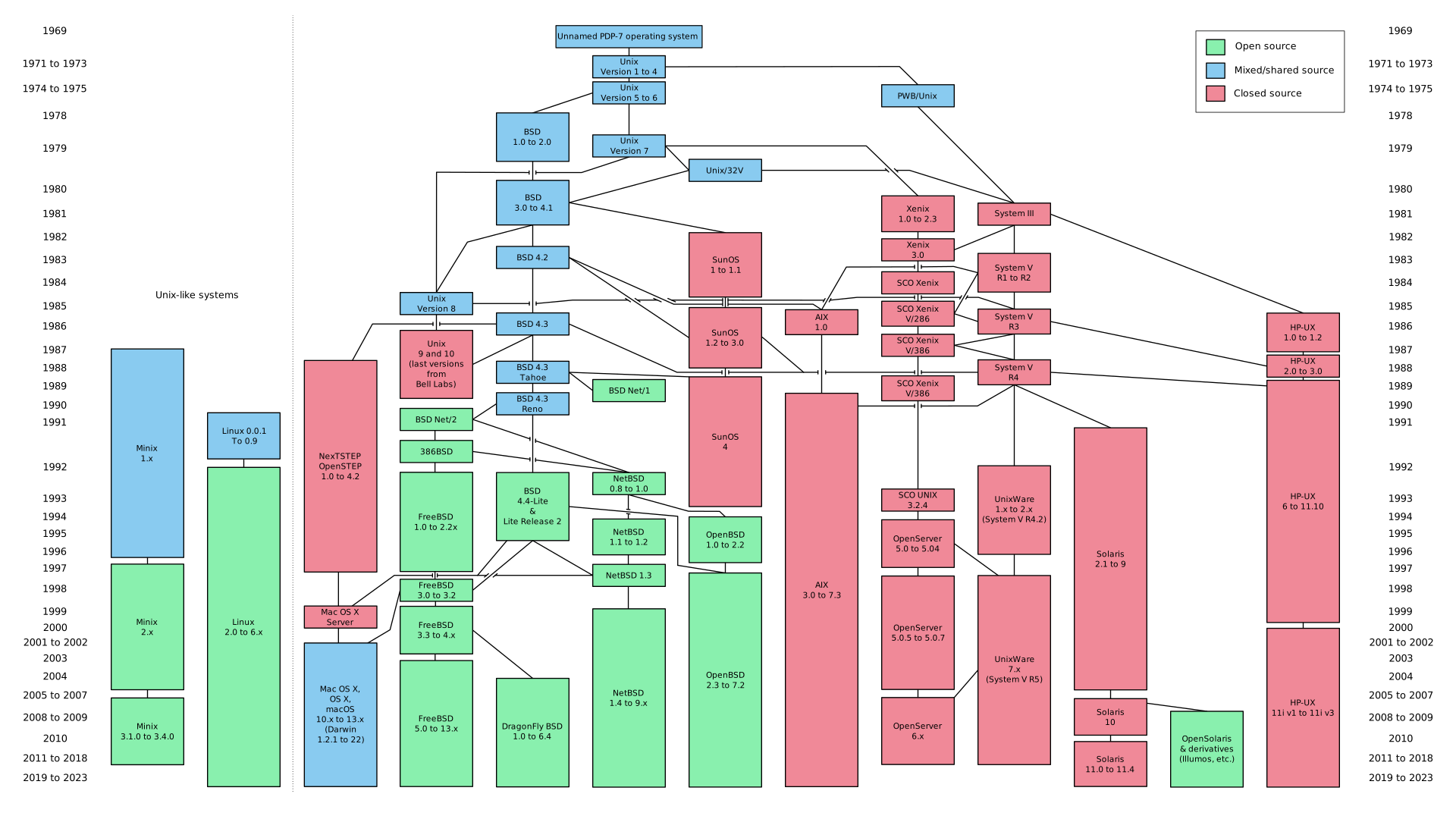
Copyleft licences are often the best way to go in this kind of situations: thanks to the GPL, Linux remained one until Google forked it for Android. And 15 years after its beginning, there is no fragmentation in the kernel space. On the other hand, BSD has been forked many times by companies to build their own proprietary OS [1].
The MPL will ensure that Servo is never forked by Google/Apple/Microsoft into a competing proprietary software, but will remain a free software.
[1]: https://upload.wikimedia.org/wikipedia/commons/7/77/Unix_his...
I don't doubt that. I just wish more resource was allocated to that, and less on new features. I do use the "share with twitter" feature, "hello" or the gtk3 integration, but I would trade it for better perf in a blink.
On the other hand, FF never saw a very disruptive feature for years. It could have added integrated torrent download or a kick ass JS/CSS IDE in browser. No perf and no disruption make is less appealing.
I'm not just complaining. I register to all the feedback program from Mozilla I encounter. I donate money to Mozilla. I activate the tracking features in my browser so they can use the metrics and crash reports.
I've been using firefox since it's been called phoenix, and it sadden me that I can't now honestly recommand it to others in any other way than "it's more ethical".
> You might be more interested in reading about platform improvements like getting Servo/Rust components into Gecko: https://blog.servo.org/2016/05/09/twis-62/
I'm dying to see servo in action. For those reasons, and also because I follow closely Rust.
While there has been and continues to be significant work in this area, the Web Extensions project has been making great progress and provides a much better means to contain and control extensions, while making the development experience better:
https://wiki.mozilla.org/WebExtensions/
This is already shipping today and many classic Firefox extensions have already switched over.
Open and close tabs and windows, browsing the modern web without extensions. Keep it up for weeks, having 10 to 30 windows, and an average of 10 tabs (some at 40). You have 5 to 12 gigabytes of RAM to work with, and at least a 1920x1200 screen. (maybe a 4k screen)
That's it.
Expectations for older hardware: run for weeks, 5 to 8 windows, average of 8 tabs (one at 30), 512 megabytes of RAM, and a 1600x1080 screen.
In general, existing bugs (that I am aware of) are either not actionable because of existing architectural issues, or just because the nature of the bug is difficult and requires an expert whose time is constrained.
Another problem is that it's hard to experiment in the browser; the stakes are very high when bugs or poorly-conceived ideas quite literally break the internet for users. As a result, the development cycle is righteously slow (~18 weeks), the cost of landing code in Firefox is righteously high, and it's just a difficult environment to try new things.
On Test Pilot we aren't trying to build the solution, we're trying to find it. It's a different model of product development than we've historically had at Mozilla. In this case, side tabs are the start, but you can expect new features and concepts to start coming down the pipeline as we start gathering feedback and data about how people use them.
It solves the problem for me using a combination of auto indentation and auto collapsing of inactive tab trees.
Oh god I thought I was alone on this. I've been talking to various Firefox users and nobody was able to relate with me. I usually keep Firefox open 24/7 with around 20-30 tabs open (~6 or so pinned). Every time I am typing (like in a hangout popup window or in a HN comment) Firefox is micro-stuttering and freezing and it eats away some of the words I am typing and it becomes very frustrating. I ended up typing comments in vim and then copypasting because it was faster. It feels like typing in an SSH connection with high-latency.
Also when scrolling long pages (like reddit threads) the "view" takes a while to update so I end up scrolling down to a totally grey page which then updates with content over and over again. And don't make me talk about twitter taking ages and setting my CPU to 100% (one core) with loud as hell fan every time I click on "show 50 new tweets"...
I have 16GB of RAM and a 2-years old top-of-the-line (back then) i7 CPU on a laptop, I shouldn't be having these issues...
Are you exaggerating ? If not, may I suggest an alternative way to browse the web ?
I use multiple virtual desktops. Each desktop logically caters to one task. Each browser window is logically grouped under one activity.
For example my desktop may look like this :
Virtual Desktop 1 ( Communications ):
* Outlook
* Lync
* Flowdock etc
Virtual Desktop 2 ( Development ):
* ConEmu/ Command prompt
* Intellij
* Browser Window with multiple tabs for referring stuff
Virtual Desktop 3 ( Procrastination ):
Browser Window 1:
* Various pages opened from HN
Browser Window 2:
* Various pages concerning World War 2
* Various pages investigating different investment strategies.
The advantage of this approach is that once you are done you can close browser windows and tabs. Done with researching World War 2 ? Close that window, all associated tabs close automatically. If you accidentally close a tab, you can always bring it back with Ctrl + Shift + T. If you want to refer to a previously opened window, you can always do a simple search in browser history.
Keeps your system responsive and makes it easy to find things.
8 or 16 gigabytes of RAM (got an upgrade)
8 virtual desktops, about 5 occupied with browser windows
1 to 20 windows per desktop
1 to 20 tabs per window
That is likely 100 to 300 tabs total. No, I really don't want to close them. I want more open, but performance is a problem. I like to keep going back to tabs that have been open for months. It hurts to close tabs because then I lose track of what I am working on; the scroll bar position matters and the page might even be gone from the web. Sometimes I write a comment on a web site like this one, then let it sit for days if I am unsure I want to post it.
> I don't run any.
You don't have to. The existence of extensions creates constraints on how they evolve the browser's internals.
Extensions themselves can also introduce performance problems of course.
I suspect that set is precisely equal to the set of projects that just close bugs en masse after a certain date.
As a developer, this destroys the credibility of Firefox when it comes to interoperability, and in the outside world I have been perceiving a rise of Chrome-only web applications, this can't be a coincidence.
As far as web compatibility and standards, the inconsistency is part of Mozilla. Is Firefox a tool for open web standards advocacy? Some in Mozilla feel that way. Do we just want Firefox to render things well? There's a whole team for that too (https://wiki.mozilla.org/Compatibility). And of course there's Bugzilla, which can feel like a lottery – it's very hard to know who you encounter when you enter the project through there.
This stuff is hard, and making the right choices is hard – I'm sure Mozilla has not always made the right decisions, but I personally prefer ongoing struggles to make the right decision over a consistent and credible stance.
There is in fact a middle ground between "free for all, implement whatever you want" and "implement only what is precisely required by a standards document". In fact, this middle ground is the only way to make a practical browser engine. The two extremes are untenable.
There are definitely some 10 year old bugs, just like there are funny, off-topic, celebratory bugs (https://bugzil.la/1000000). Like callahad said, you can tweak your email settings, and the bugzilla email headers are super easy to filter on.
Even if I didn't lose my state, reloading a bookmark is slow.
With bookmarks, deletion is a pain.
How would I even know when to bookmark something? I might open 10 links from a news site or search engine, each in a different tab. Do you propose that I bookmark them immediately, even though they are probably tabs that I will soon close and never wish to see again? If I see the page and think I want to consider it for a few hours maybe (or longer; how should I know?) do I bookmark it? Perhaps I should wait the few hours or days...? Why should I even have to make this decision?
The only issue I have with massive number of tabs, is the start-up time of the browser, which increase dramatically with the number of tabs (it's at least quadratic).
That's how it's supposed to work, but for me the tabs seem to consume memory even when they're not loaded (after a restart). I completely can't understand how this is a difficult thing to implement properly.
As far as web standards go, Gecko's the only open-source browser controlled by a nonprofit. The alternative is a webkit monoculture, a world controlled by Apple and Google (oh, and Microsoft). Within Mozilla, the Firefox and Platform teams are super focused on improving standards compliance and squashing bugs. Things are getting better :-)
I know, the name thing, what can you do? I worked on Persona before this, so I guess I'm not surprised by the Mozilla enthusiasm for reusing project names.
Have you tried the Activity Stream add-on? Captures so much of what we wanted to do with Chronicle. It's amazing what that team was able to crank out in four months.
The Search add-on turned out really well, though I wound up having to rewrite it in XUL after the MVP feature set got trimmed. It took some pretty strange requestAnimationFrame hacks to get highlight stealing working, I blogged about it: http://6a68.net/2016/highlight-stealing-hack/
Let's round up the Chronicle alums and grab drinks in SF sometime!
See you in the comments section ^_^
If you ever decide to stop being the Chrome users and general less advanced users darling i think about using Firefox again. But until that point, alternatives here i stay.
That test pilot is only damage control as you are now not only facing Chrome, also frustrated users move on to Brave or Vivaldi.
But it is no real browser and only an advanced web app bundled with Chromium. Also, smashing a wrapper on top of Chromium with features and call it a day is one of the most stupid things ever which a group of developers can do.
But Vivaldi shows what guys do when they have respect of power users. They add features we want and we prefer and not only features what simple users or Chrome users want and prefer.
You then chose to respond with sarcasm and disdain. What productive outcome could we possibly reach from that exchange?
I am starting to suspect that their prominent placement and sudden appearance in the default Firefox UI caused people to think that they are taking a larger amount of Mozilla's development resources than is actually the case.
To bring it back on topic to Test Pilot - hopefully this will help the overall Firefox community vet these types of ideas before they make it to the default UI.
Even if the outcome is ultimately the same (new feature is added/default UI is changed, which makes some subset of people legitimately unhappy), it gives a wider audience a chance to test and provide feedback and generally socialize new ideas.
You need to realize that behind every sarcastic, disdainful comment about Mozilla or Firefox is years, often nearly decades, of Firefox usage, contribution, and promotion. When people come to trust and rely upon a tool for getting work done for many, many years, and then the organization responsible for that tool starts changing priorities in ways that negatively effect the tool's usability and usefulness, people react negatively.
And when the organization then gets defensive and offended at people's negative reactions, it creates a self-reinforcing cycle of negativity and not-listening-to-the-other-side.
Mozilla makes a great browser, saving the world from Microsoft and IE. Nearly two decades later, Mozilla starts mucking with the UI, chasing the mythical never-used-the-Internet-before-and-will-always-be-that-way user, forcing unwanted, unrequested features upon all users, etc.
Naturally, people respond negatively. "Why are you doing this, Mozilla? Why are you ruining this great browser? Why are you now chasing numbers and mythical unicorn users instead of pursuing excellence and usefulness like you always have before?"
Then Mozilla employees get defensive and respond with, "What? Why don't you like what we're doing? Why aren't you being nice to us? We're doing this for you! Stop being mean!" And then they say to each other--especially on Bugzilla reports--"Ugh, more comments from the peanut gallery."--or in Mozilla-speak, "advocacy"--"Locking this bug to editbugs-privileged only accounts."
So now we have two sides that are offended by each other and not listening to each other. But the two sides are not equal, for without users, what is the point of Mozilla and its products? Plenty of well-made software has fallen into obscurity over the years when people weren't using it. And without Firefox, what are users left with but poor imitations?
Undoubtedly Chrome has had an impact here, but Mozilla is mistaken to imitate Chrome to recapture its users. Some people leave Firefox for Chrome because they prefer Chrome, or because Chrome is faster (and they don't mind its memory usage). But other people leave Firefox for Chrome because--wait for it--Firefox has stopped being Firefox! They figure, well, if Firefox is going to try to be a poor imitation of Chrome, I might as well just use Chrome.
But what we really want is authentic Firefox, the browser that we started using when IE ruled the world and Phoenix rose from the ashes of Netscape to save us from the Evil Empire. Microsoft isn't the threat to the Internet it used to be, but monoculture will always be a threat, and proprietary, walled-garden, app-store-style software is a growing threat to user freedom and empowerment.
We need Firefox to be Firefox, not Chrome, not Mozilla's experiment of the month, not Mozilla's platform for enacting social change.
I guess the problem is that Mozilla is literally not who it used to be, because the people are different, and they have different ideas. Probably money has something to do with that; a few years of hundred-million-dollar+ deals obviously has an impact. People get used to the money, and when it comes down to it, they'll do whatever they think it takes to keep the money flowing, even if it means undoing what made them successful.
But the root problem is the Rug Problem: people react negatively when the rug is yanked out from under them without their consent. Mozilla should recognize this and not react defensively.
Instead, Mozilla should interpret every such comment as evidence of bugs in the Mozilla organization, people, processes, and priorities. When "customers" are unhappy, smart companies don't get offended and tell off their customers, they figure out why customers are unhappy, and they make them happy again.
As for myself, I'm keeping an eye on Pale Moon, which has made a commitment to stability in API and UI, and to usefulness for its users. I wish Mozilla would make the same commitment to its users and extension developers.
if (requestFeature(x)) { complain(); } else { complain(); }
I promise you that I legitimately do hear the frustrations felt by long-time power users of Firefox. I don't agree with all of them, but I do my best to represent them internally nonetheless. To your concerns regarding stable APIs: that's exactly what WebExtensions are designed to address: decoupling add-on APIs from implementation details so that we can keep add-ons working, even as we refactor Firefox to be faster, more stable, and more efficient.
Is it so surprising that power users are the most vocal one's and do complain if one of their pet features is going to be axed? (And many of our pet features have disappeared since that Chrome UI annoyance called Australis has ruined a big part of Firefox)
And instead that Mozilla goes back a step towards power users and brings our features back what do we get instead? Features which more simple minded users do want and prefer.
It is the deconstruction of Firefox as geek base what we hate and that is the reason we are so vocal about it.
The moment where Mozilla makes a significant turn back to their roots, the moment will be the one where complaints are going to stop or at least where people can believe in Firefox again.. a little bit.
To advocate the devil, s/he'd like to change future plans. You did confirm it's being worked on, but the comment you're responding to tries to get you (mozilla) to work on implementing standards more often.
I'm not saying I agree or disagree, I'm underinformed (though I also ran into Firefox not having input types and am also not a fan of recent experiments, I can't tell whether the concept of doing such experiments isn't worth doing), I'm just pointing out there is something behind the negative sarcasm.
Despite vocal and repeated requests and complaints, Mozilla refuses to back down and remove things that users did not ask for and do not want; instead Mozilla does things like sneak Pocket support in in a point-release without any advance warning or any chance for the community to give feedback. And note that Pocket has had a fully functional Firefox extension ever since it was Read-It-Later--there was absolutely no technical reason to build in support for Pocket and deprecate the extension.
Mozilla has never been forthcoming about the real reason for doing this. In fact, the few Mozillians who have spoken about it seem to have had no idea why it happened, either.
Instead all we get is vague "people want to save things, this makes it easier for people to save things" statements. Well, people want to use Facebook, too: where is the built-in Facebook plugin? Where's the built-in Netflix extension? Amazon shopping support? etc. Clearly the decision to build in new Pocket code had nothing to do with a principled policy of making things easier for users.
The only reasonable conclusion is that Mozilla cut a deal and is getting money for it. And if that is the case, what is to stop them from doing the same for anything else? What if Microsoft cuts a deal to build in Bing support? etc.
Firefox started working on many features for power users (look at testpilot’s vertical tabs), but let’s hope they#ll do more.
Why people value simplicity and minimalism and design more higher today than having customization features and options?
> where is the built-in Facebook plugin?
> Where's the built-in Netflix extension?
> Amazon shopping support?
> What if Microsoft cuts a deal to build in Bing support?
These default search engines are how Mozilla makes 95% of its income (donations are basically a drop in the bucket, and because of tax laws they aren't allowed to use donation funds to finance Firefox development anyway). Mozilla sees this as a problem and has been actively looking for ways to diversify its revenue streams in the past years (go read any of their past financial statements to see them explicitly categorize their over-reliance on search engine revenue as a potential threat to the company), which has led to things like FirefoxOS (in the hope that telecoms would toss some cash Mozilla's way) and the "suggested sites" on the New Tab page. This why I find it extremely unlikely that someone "cut a deal", because Mozilla would want people to know that they're succeeding at the task of finding alternate revenue streams.
Yes, I remember. Another example of CADT-style development.
> Users demanding Netflix support is literally the reason why Mozilla was strongarmed into adding support for EME, despite trying to hold out against it for so long.
EME is about more than just Netflix, though, and I was referring to site-specific support, just like the Pocket support only works with Pocket. As I wrote on the mozilla-governance list, what should have been done instead is to define and implement a save-for-later API (which could be built-in to the Firefox Places/bookmarks/etc API), which Pocket could then add support for on its end, and then users could choose to sync with a save-for-later API provider.
> Click in the search box, type a query, and at the bottom of the suggestions dropdown you'll see that Amazon is one of the search engines supported out-of-the-box. I actually use this fairly regularly.
Yes, I know how the search engines work, thanks; I've been using Firefox since at least Phoenix 0.6. Again, that is not the same thing. The search engine API is a standard that is used by many web sites to let their site-specific engines get added to the list. In contrast, the Pocket support only works with Pocket. An analogy would be if Mozilla added an Amazon-only sidebar that integrated Amazon.com logins and shopping lists and order status, etc. They aren't doing that, so they shouldn't have done it with Pocket, either.
> This why I find it extremely unlikely that someone "cut a deal", because Mozilla would want people to know that they're succeeding at the task of finding alternate revenue streams.
Now that is an interesting point, and thanks for sharing that. However, I'm still skeptical, because, again, we still have not heard an actual explanation for why Pocket was added, other than vague "it helps people save stuff, and people want to save stuff [even though they could already do that]."
There must have been some kind of inside deal. If not, what other explanation is there? Mozilla added Pocket support suddenly, without any community input, going against established Mozilla policy regarding features being in addons. Mozilla has shown a pattern of removing features and leaving the community to reimplement them in addons, yet here it does the opposite, and for a proprietary service! And it has ignored repeated requests for an explanation of the real reason.
So some kind of secret, inside deal is the only answer I can see. If it wasn't for money, it must have been for something. If you are in fact right that they would want people to know about a deal for money, then what does that suggest? Why would it need to be kept secret? What is going on here?
Whatever the real story, the way they are handling it undermines trust.
Ok, that sounds nice, but is this yet another extension API that does it Chrome-style, restricting extensions to a solitary button in a solitary toolbar, rather than giving them the freedom to truly extend the browser and its UI? Because if I wanted handicapped extension APIs, I'd just use Chrome.
And besides, isn't that what Jetpack was supposed to be? How long until the next extension API that will get it right This Time?
One of the foundational pillars of Firefox is its powerful extension API, however messy and difficult-to-refactor it may be. Take that away, and it's just another browser, no better than Chrome.
WebExtensions are likely to be The One True API. Chrome, Opera, Edge, and Firefox all support them, and we're all working on standardizing them at the W3C: https://www.w3.org/community/browserext/
> If I wanted handicapped extension APIs, I'd just use Chrome.
Though we're trying to avoid reinventing wheels, we're not limiting ourselves to Chrome's APIs. For example, https://bugzil.la/1242871 extends Chrome's webRequest API to provide additional metadata needed by the NoScript and RequestPolicy add-ons. The initial development is focused on Chrome parity, since that covers most add-ons, but once we get there you'll see more of an emphasis on landing APIs that are needed by existing, more powerful Firefox add-ons.
If you're an add-on developer yourself and are concerned about APIs you need, please fill out this survey so we have a record of it: https://docs.google.com/a/mozilla.com/forms/d/1PtRXcs9UHVMjg...
I'm actually not, and one reason is because I've seen over the years how extension authors have to keep up with the churn constantly breaking things, and that's not a pool I want to wade into. I'm amazed that, e.g. the Pentadactyl authors have the time and patience to do so.
So, if this new API stabilizes things long-term, that's fantastic. I would love to have extensions that never break again.
But forgive me for being skeptical, because with the CADT-style development models ruling the world nowadays, what usually happens is, the old API is deprecated and dumped before the new one has feature parity, leaving authors and users hanging. And with Mozilla's trend of imitating Chrome, this seems even more likely.
I can hear the cries now of, "The old API is too hard to maintain, so we're removing it in Firefox 72. We hope to reach approximate feature parity by Firefox 84, but we do not plan to reimplement all features in the new API. Regrettably, this will prevent some addons from being ported to the new API," with the implied, "But 'no one' [compared to the number of users on the Internet] was using those addons anyway, so who cares." And cue me switching browsers.
Please prove me wrong. :)