China's Science Revolution(bbc.co.uk) |
China's Science Revolution(bbc.co.uk) |
It is excellent and remarkable how fast they are improving. In the late 1990s and early 2000s, Western scientists (mostly American and French scientists) were brought in quite a bit to help modernize the system, and it has helped substantially. The institutional resources and raw brain power available have meant rapid progress, especially once the Chinese grad students and faculty got up to date on the bleeding edge of research.
However, as with economic development, there are some substantial structural changes that need to happen in the transition from 'catch-up' growth to leadership. The biggest is a mind-set thing: There is far more respect for authority and confirmation bias in Chinese research than Western (especially American) research. In so many papers, the researchers go out and get great data and do a bang-up job of analyzing it, and then conclude by saying the results support the old hypotheses of the senior faculty who lead the research institute or some old Western luminary, regardless of the outcome of the analyses. I'm not going to say here that science advances funeral by funeral, but I definitely think that undergrad/grad students who grow up scientifically hearing about the cutting edge theories are more capable than older scientists of integrating the new theory them into their view of the world and their mental database of observations. This is required to further refine, develop or reject the theories and advance the state of knowledge. When junior scientists are not encouraged to rock the boat, then science advances much more slowly. Hopefully as national and institutional self-confidence increases, then revisionism (i.e. telling your boss that he's wrong, or that Dr. Famous American is full of shit) will get stronger.
The second is that, at least in my field, it is becoming very hard for Westerners to collaborate with Chinese scientists, and particularly to do fieldwork in China. (Note that I am a geoscientist and have mostly worked in Xizang province in Tibet, which has its own sensitivity issues). But I think that the government is deciding that the Chinese are caught up and then disallowing access to limit international competition. I can definitely see how they could feel exploited in a 'scientific imperialism' sort of way, and this is not at all restricted to China. But while this may lead to a more satisfying distribution of scientific fame for the Chinese, it also limits the rate at which the science advances. And Tibet is one of the richest areas in the world for studying tectonics and earthquakes, because it is vast, very active, and has essentially no vegetation so the quality and quantity of data is very high. Limiting access definitely means slowing down the rate at which we learn to understand earthquakes and earthquake hazards, and while there is a global downside (much of this knowledge applies to earthquakes everywhere), the downside is the highest for the Chinese citizens living near the faults that are not receiving as much study due to fewer researchers.
As research in the west becomes more politicised and regulated (the biosciences especially), having serious Chinese investments in science, with aspirations to become world leaders, is precisely what we need to promote competition and drive progress.
Another example is the use of CRISPR gene editing in human embryos. While we are dragging our feet ruminating over the ethical implications (largely ignoring the prospect of curing countless diseases), the Chinese have used the opportunity to get a head start.
As China continues to progress, it won't be long until we have another "Sputnik moment". If we won't fund and regulate science rationally, hopefully fear and national pride will motivate us instead.
Imagine if China and India could each double the amount of research done by the US.
Promoting and enabling people to have healthier progeny is in no way comparable to forcibly removing people from the gene pool through sterilisation or murder.
People are going to have children regardless. If there's an option to reduce suffering, I think we have an imperative to follow it.
P.S. Fantastic book BTW, quite different from general SF fare.
I don't believe I can put it better than the article above,
"These days, China is lavishing money on Mr. Science. But without the checks and balances provided by Mr. Democracy, the corruption plaguing the rest of the system is infecting the reputation of Chinese science. "
And other advancements were... not as impressive as elsewhere. See e.g. nuclear science.
But the upside of science under a dictatorship is that you will publish lots of papers claiming successes, for personal health reasons, so you've got that going for you.
[1] http://www.nejm.org/doi/full/10.1056/NEJM199005173222006
They conducted many unethical experiments to obtain results. If China is researching unethically (by plagiarism, etc), then their work is worthless.
Science has historically based on a system of open debate. From Galileo onward, the ability of a scientist to engage in experiments which put commonly believed ideas into question has been one of the foundations of scientific progress. Both the NAZIs and the regime of Joseph Stalin had a history of supporting well-connected frauds to the detriment of science.
This doesn't mean that an authoritarian regime make science impossible but a regime where one's connections largely determine one's success, which stifles public debate and where winning become more important than telling the truth is going to have a hard time cultivating the honest, open debate that science needs to arrive at truer theories.
China is well known for scientific fraud already. The current leader is attempting to "root out corruption" and the party may try to root out bad science too but given that the anti-corruption efforts have gone against the leader's enemies, it seems likely that bad scientists with good connections can rest easy.
if we follow the time-lines of the space exploration of NASA after 1960 and before 1960, his contributions are conspicuously evident.
Example: https://en.wikipedia.org/wiki/Saturn_%28rocket_family%29
This applies in the case of nuclear, but not in others: jet engine, rocketry.
Can you expand some details about that in the nazi regime ? but leave aside that nasty stuff with eugenics(which wasn't really a science) and focus on the hard sciences ?
But fine, let's skip eugenics.
* Ahnenerbe - racial heritage of German people, and plenty of occultism * Large parts of their human experimentation. * "Social Darwinism". (Granted, runs into eugenics. But it's the foundational belief under the whole regime, so hard to avoid) * Phrenology * "Jewish physics" - discarding Einstein completely. Trying to get Heisenberg & Quantum Physics, as well, but turned out his science worked a little too well to discard. * The idea that women can't get pregnant from rape[1]
In general, you'll find much of the "bad" science in the softer sciences - the more soft, the worse. The reason is that it's easier to maintain a fraud if the field doesn't expect clear reproducible answers.
The harder sciences were affected via Aryanization - e.g. Chemistry lost 25% of all its academics in the runup to 39.[2]
[1] http://www.slate.com/articles/life/history/2013/11/nazi_anat... [2] http://cen.acs.org/articles/91/i37/Chemistry-Nazi-Germany.ht...
That's not the definition of democracy, democracy is majority rule.
Bioethicists I've watched debate are seemingly unconcerned with the present day. I've never seen it emphasized (as it used to be once) that the potential for mental and physical handicaps goes up very dramatically as a woman ages. There exists a fairly narrow window to produce children optimally. I am confident no school children are aware of this through sex education. It is sort of brushed under the carpet in favour of 'right to choose'.
You would not believe the rate of deformed children that exist. In my small town there are six or seven special centers for children with mental and physical handicaps. I am convinced this is because the parents got to the idea of having children late. This is a failing of society.
"http://www.ivfne.com/content/editor/Fertility Age Graph.jpg"
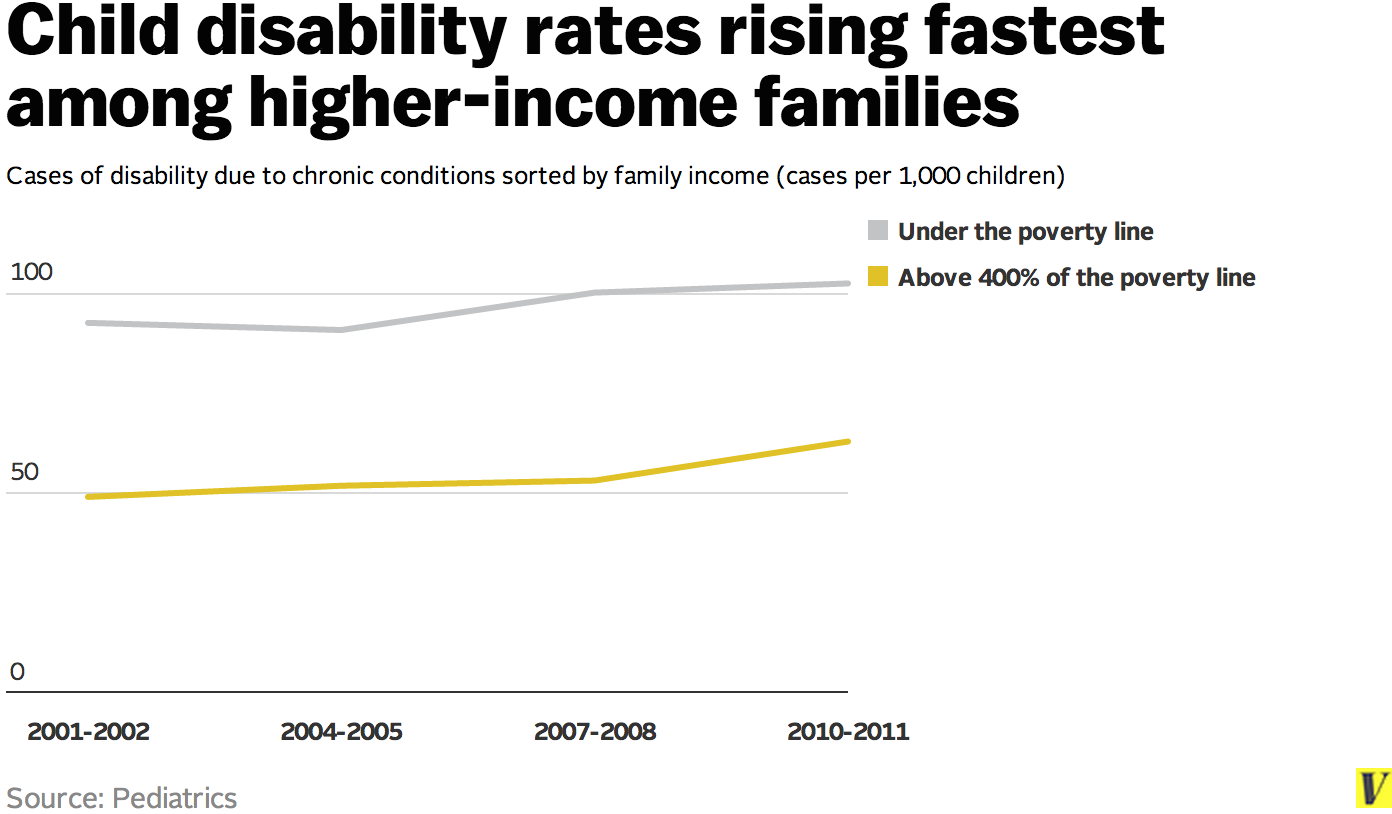
http://cdn2.vox-cdn.com/uploads/chorus_asset/file/1331118/di...
http://www.cdc.gov/ncbddd/birthdefects/downsyndrome/images/p...
I believe what I was saying mostly applies to the US and western European countries.
For all their faults, communist countries at least took science education seriously. The idea that a woman and man have a finite amount of time to produce healthy offspring is a 'bad culture fit' for the kind of egalitarian orthodoxy that is not taken seriously in ex-communist countries.
If you're in the US or western Europe, try asking random average people what the age limits are before the natural fertility rate is 1% per month (it is age 45).
http://www.huffingtonpost.com/2014/02/19/age-female-fertilit...
Ironic that it advises education. Most IVF clinics don't accept eggs after 42 because the probability of an IVF cycle working is less than 5%.
Here's a study showing the contradiction between what women/men have the impression of being true, with the facts.
http://humrep.oxfordjournals.org/content/27/5/1375.abstract
"Even though participants generally perceived themselves as being educated about fertility issues, both men and women vastly overestimated the ages at which female fertility shows a slight and a marked decline. The discrepancy between their perceived knowledge and what is known regarding the science of reproduction is alarming and could lead to involuntary childlessness if men and women's reproductive decisions are based on inaccurate perceptions."
I don't find it alarming that people make mistakes. I do find it alarming that this was well known in the past, even when people couldn't read and now university students are less educated than their grandparents.
Come to think of it, maybe the canard about education reducing the reproduction rate in developing countries is correct after all...
Doing moral calculations on people who have not yet been conceived is tricky, and you can't simply equate them with living and breathing ones.
Given the number of people on the planet - resulting in trillions (and trillions) of DNA combinations between mating pairs - millions of possible people are erased from the gene pool on the grounds of "not everyone can mate with everyone in a given lifetime, even if we wanted to". Not to mention all the potential genes that die each day.
I'm not sure I see your point.
Do you really think it's better for that couple (and society) that they do it the "natural way" and only have children who won't live to see their eighteenth birthday?
It is relevant because it precisely fits your criteria.
Of course, this is in fact true for all values of $TOOL in "Given $TOOL, a bad thing may happen".
Rich people editing their babies seems like it's more risky for society than most tools.
If I understand it correctly, your objection is that it may be possible for some group of people to use this to increase suffering in an abstract way.
This is true of most objections to things that have a social impact.
Reserving health to the wealthy in a feedback loop of relative advantage does not seem very abstract - it seems dystopian.