The rectangularness of countries(pappubahry.com) |
The rectangularness of countries(pappubahry.com) |
Score = area of the symmetric difference between country and the rectangle maximizing the score.
https://www.google.be/maps/place/Baarle-Hertog/
This is a Belgian city enclave within the Netherlands with enclaves of the Netherlands within its borders
Someone also tried to tell me Norwood, Ohio is the largest city within a city (an enclave city), but I can't find a source on that anywhere.
Really great video by Tom Scott about Baarle Hertog
If we discount natural borders like the Pacific Ocean, Santa Monica borders only Los Angeles and has twice as many residents.
https://www.amazon.com/City-Random-House-Readers-Circle/dp/0...
Some houses in the town of Baarle-Hertog/Baarle-Nassau are divided between the two countries. At one time, according to Dutch laws restaurants had to close earlier. For some restaurants on the border this simply meant that the customers had to move to a table on the Belgian side.
http://www.economist.com/blogs/banyan/2011/02/enclaves_betwe...
[0] http://www.dailymail.co.uk/news/article-3378842/Belgium-Neth...
Belgium should have 3
I suspect what's really going on, psychologically, is that Turkey looks much more like a rectangle than it does any other basic shape: I would never described Macedonia as rectangular, despite its considerable overlap, because it's "oval." Kenya's a pentagon before it's anything else, and so on.
https://www.reddit.com/r/polandball/comments/300b86/portugal...
Here's an archived copy: https://archive.is/cRkgb
Those kinds of borders are quite common and I've always thought they say a lot about a country and its past.
This is one of the main reasons why a lot of central Africa is a shit show politically. Most of the modern borders were drawn during the colonial era without much consideration as to which tribes and city-states ended up in which countries, so there's not a strong relationship between "nations" (i.e. culturally similar groups of people) and "countries" (i.e. demarcated stretches of land) like there is in most of the rest of the world.
http://everything2.com/title/Never+Trust+a+Straight+Line+on+...
I'd like to see it compared with a "parallelogramness" measure, based on rotating calipers. Rectangularity would be a special case.
To me, Egypt doesn't look very rectangular at all. The very deep concave section, and the sharp convex portion at the bottom right completely break rectangularity for me.
I'm also curious as to why Nauru seems to have such sharp, straight borders - it looks more like the Vatican than a Pacific island.
A similar approach is used in biology to define animal territories: A kernel density estimate is taken of historical animal positions and thresholded, rather than a minimum convex polygon.
Mercator actually would have been a good choice because it preserves local angles. Not sure why you'd be so opposed to it in this case. For this purpose, relative sizes don't matter at all.
And I don't think a local projection would clarify anything. Countries can get pretty big and non-local. If you strive for complete geometric accuracy on the scale of, say, Canada, the idea of a "rectangle" breaks down because there are no parallel lines on Earth, and four right angles don't bring you back to the orientation where you started.
The older ones grew; the newer were planned.
You can see it east-to-west in the USA states' borders.
The state borders, on the other hand, are often quadrilaterals. Perfect scores to Wyoming and Colorado, and near-perfect for many others.
http://geology.utah.gov/map-pub/survey-notes/glad-you-asked/...
Another kink in the souther border: https://www.google.com/maps/@36.988568,-106.87603,12z
Credit to this blog: http://www.howderfamily.com/blog/colorado-not-rectangle/
[1] http://www.theglobeandmail.com/opinion/why-the-zigzag-betwee...
Reagan would never have let this happen. #makeamericarectangularagain
Regarding Nauru, I think that's just poor resolution in the source data. It's only a couple of miles across, and the plot looks like it attempted to approximate the coastline with points roughly 1 mile (maybe 2km?) apart.
Another one might be: What's the ratio between the area of the country and the smallest rectangle which bounds the country. This would "punish" countries with protuberances more than ones with "in-cuts", which "feels right" to me.
Actual outlines:
Nauru: https://upload.wikimedia.org/wikipedia/commons/7/77/Nauru_ma...
San Marino: https://upload.wikimedia.org/wikipedia/commons/7/7b/San_Mari...
Vatican: https://upload.wikimedia.org/wikipedia/commons/5/58/Vatican_...
https://en.wikipedia.org/wiki/File:Sint_Maarten-CIA_WFB_Map....
https://www.theguardian.com/world/2016/mar/03/welcome-to-the... https://www.youtube.com/watch?v=J5iJSXaVvao
In name, they are each other's equal within the kingdom, but there is a 'slight' difference in size.
Also, 3 other islands in the Caribean are part of the Netherlands, the country: Bonaire, St Eustatius and Saba (but, if I have to believe Wikipedia, those 3 are not in the euro zone; the US dollar is legal tender in (part of) the country of the Netherlands)
(https://en.m.wikipedia.org/wiki/Kingdom_of_the_Netherlands)
The French have more overseas areas, and manage to make things complicated, too, with overseas departments, countries, territories, and collectives (https://en.wikipedia.org/wiki/Overseas_departments_and_terri...)
St Barts and St Martin are not overseas departments of France. They used to be part of the Guadeloupe overseas department, but seceded to be a "collectivite d'outremer" (overseas collectivity), which is different status than overseas department or overseas territory (France also has a few of those). St Barts (really "Saint Barthelemy") and St Martin not collect income tax locally and it goes to their budget (I think they wanted to stop shipping all their monies to the French state and/or Guadeloupe).
As some have said, I'd like to check the impact of only using mainland in the calculations.
Another fun one is San Diego, which does indeed touch Mexico, but to get from downtown to the border and stay within city limits you'll have to get on a boat and stay within a narrow band of water stretching down the bay to San Ysidro.
See:
https://www.sandiego.gov/sites/default/files/legacy//plannin...
https://www.google.com/maps/place/Los+Angeles,+CA/@34.091182...
Speaking of West Africa, you don't really have to think hard to figure out why Gambia's borders were drawn the way they were.
It is very likely that those drawing the border did not care one little bit about the opinions of those who already lived there, and it was definitely unexplored by them.
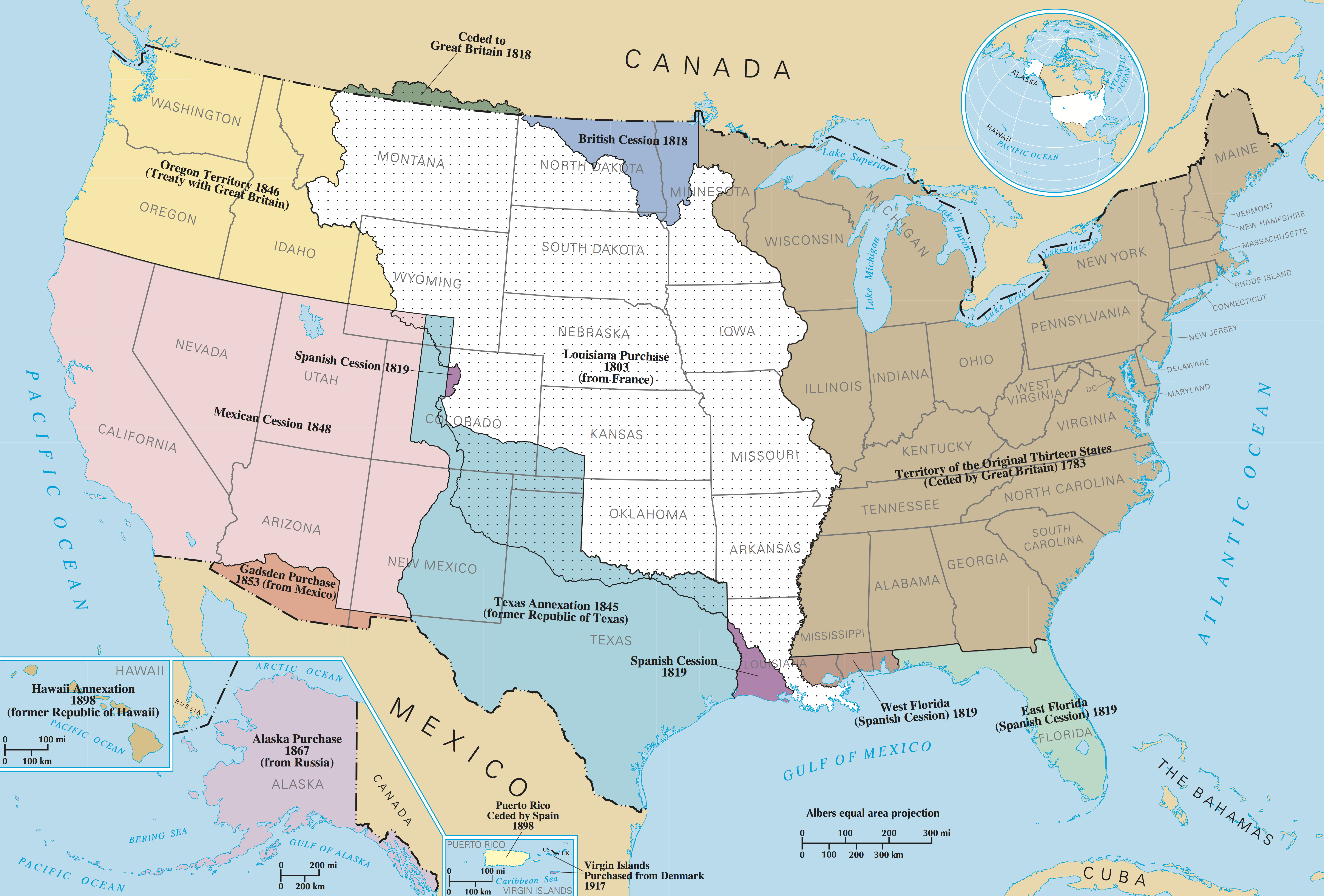
You can see on this territorial expansion map [2] of the United States, how the lay of the border differs between the first-settled east and the later-settled west.
[1] https://en.wikipedia.org/wiki/Treaty_of_1818
[2] https://upload.wikimedia.org/wikipedia/commons/2/29/UnitedSt...
Looking again, I see that Russia and Fiji also suffer from this problem, and those are the other two countries divided by that line.
The border is defined as a straight line, but was surveyed as a series of slightly wobbly series of lines. They put up thousands of stone pillars, cut out a strip of trees along the border, and it became official.
IIRC there's also some stuff about a disputed island
I heard that kids there go to school in Blaine, which means 4 international border crossings every day!
https://youtu.be/SxhUsPBFPkU?t=1m46s (Geography Now! Canada - btw awesome channel for people who like geography)
In the case of the borders among countries in the Sahara, my understanding is that lots of those were disputed borders settled by people pretty remote from the areas with the straight borders, so I'm not sure they provide a counterexample. "It's a desert" may increase the likelihood that decisions get made by people living far out of the region (since it reduces the number of people living close by), though.
Dividing geography with existing populations and long histories into discrete countries is always going to produce tricky ethnic issues. It's just that in Europe those issues were worked out violently over a period of centuries up to and including the second world war. The process is so big, that people don't notice it.
If a measure of rectangularity depends on the map projection used, then it probably also depends on how you orient the coordinate system (e.g. where the North pole is), and is therefore not well defined.
But yeah, probably bloodshed and war.
I wonder how many actual wars in the past have been started because someone didn't like how the border looked on a map. It has to be non-zero.
Plenty, though it's less about rectangular shapes per se but borders being drawn by former colonial forces with a ruler, splitting ethnic groups and forcing them to live under a new, foreign government. Under colonial rule every unrest was simply stopped by brute force, after "liberation" and division of countries according to some arbitrary border created by drawing a line along a ruler on the map there was no "moderating" force anymore and ethnicities that had ignored/evaded each other for centuries were forcibly mixed and the former colonial force usually decided who was the new government, based on their interest. A great example is Western Sahara:
Spain left and decided "this part goes to Mauritania, this part goes to Morocco". The Sahawri managed to beat the Mauritanian forces and to claim some land, then Morocco "invaded" (in quotes because Moroccans fought the Spanish in the 50s from as far south as Aoussard). Also, officially the border between Morocco and Algeria is closed because of Algerian support for the Sahawri. But in the north of Morocco, in the Rif area, people feel more connected to the Rif than to Morocco and cultural exchange with the Algerian Rif people is much more vibrant than cultural exchange with the south of Morocco.