This is really interesting to me, but I wish it were at a $10k level. That would be a no-brainer shift for me to move some money going into Vanguard into this, but I'm in that weird spot where I'm not rich enough to have $100k to toss around but am maxing out a Roth IRA and looking for more upside.
The high minimum investment is our equivalent of surge pricing.
We're working on it, though!
edit: If there's data that shows the performance of a basket of random 100 company samples being equivalent to any number of other random 100 company samples, then I am happy to admit that I am mistaken in this regard.
And A-List, a premium recruiting product for busy companies. That complements our free recruiting product with 180K active candidates.
Down markets are a good time to invest, but we're not anticipating one.
Unrealized gains are meaningless without liquidity.
Take that as you may.
This fund will not earn its investors a positive return.
You read all those PG essays about not dying? About bootstrapping? Well because it turns out the only way to capitalize a typical startup is to stand in front of your dollar-bill tree and urinate. Or organize some kind of free sporting event with the side effect of making people go piss on your trees. Then 97% of your trees die except the 5 you pissed on, but you can take them to the bank and next season repeat. That's how bad startup seed funding is.
You could not literally fund money growing out of thin air.
I sometimes think that the government should step in and fund these things (after all, even Tesla got gov't grants.) Because the private market sure as #@$% isn't.
EDIT:
This is already at -2 but I am keeping it without altering a word, because the downvoters are wrong and uninformed (or don't understand the analogy), and I am right and well-informed, also it's a good analogy. It's not even close. Here is an example of someone in Europe describing this precisely:
https://news.ycombinator.com/item?id=12198883
Notice the words "With a product like that, the second thing that we didn't expect was that we tripped the "too good to be true" sensor everywhere, raising doubts." (you might have to click parent from the comment I linked.)
It's not as bad in silicon valley as it is in Europe. But it's not that far-off either. There is next to no seed funding in existence. This is a fact. Downvoting me won't change it. Now at -3 after posting this update. Still right. Still not changing a word.
This could be interesting. I wonder if it will be restricted to accredited investors or offered to the layman?
As always, of course there are no guarantees in startup returns, but spread over that many companies... well, I'm not sure what to expect. I guess it all depends on the returns and how they decide to pick companies. It could be a cool new take on index investing. Then again, I became wary of most things "cool" and "new" in investing.
One big advantage of only having accredited investors is that it allows you to not have to make such regulatory filings.
Given their transparency to investments it's a very good combination.
https://www.cbinsights.com/blog/e-commerce-deals-drop-q2-201...
It's effectively Q4 of 1999 and I couldn't be happier.
I've never dealt with any structured seed funds, but high net worth individuals that like to kick-start startups still appear to be active in the US...
That there is next to no seed money in existence, for companies, regardless of whether they are making money, and anywhere in the world (including California which by a large margin has the best funding climate for seed rounds.) That if you sum up the total amount of seed money it is next to nothing.
As an exercise you could try to add up the sum total yourself, and you will see it is next to nothing.
With a backdoor Roth, you contribute to a normal, post tax IRA, then convert to Roth. However, if you have a rollover IRA, then you can't do it without taking a tax hit.
However, I have heard of people putting more than $5500 per year in a Roth. Search for it on the Bogleheads forum. I can't remember the details, but your employer needs to be on board as you contribute to a 401k, then do some conversion.
I think your plan (substitution index funds for cash) is already a lot better than what Taleb suggested.
You'll want to work with a lawyer to structure the vehicle, and have a full understanding of legal, compliance and tax considerations associated with it.
Edit: the entity investing must be accredited. Here's an overview of the criteria:
https://angel.co/help/accreditation/what-is-an-accredited-in...
Edit: and Kapil has answered :-)
Loser donates money to the winner's charity of choice. Pick an amount up to $200, and tweet @kapil so it's in the public record.
Just kidding. Ok, let's do this. $200 it is, but you have to pick your charity now, and the timeframe for a return has to be sufficiently short such that $200 can still at least buy a mosquito net or something.
My charity choice is the US Treasury.
Also, HN is fine (my real name / twitter / github are in my profile).
P.S. You didn't ask why I thought it wouldn't return a profit. It's not because I disbelieve in your company (you guys have more startup data than just about anyone).
The various data sources I have access to (CB Insights, et al), tell me that it's down, but not gone. The fact of this article (AngelList's rainy day fund) means that people are starting to prepare for stormy weather. A storm that has not hit yet - but people are skitterish.
Tactically, on the ground, I haven't seen much pull back, but I'm not in CA or NY. And I prefer to get cash-flow positive ASAP, so I might be a little less sensitive to it than others.
Thanks for your response: you raise interesting points (esp. your linked EU funding scene thread - that was interesting) and digging into this will provide some necessary weekend diversion.
I asked you to sum up all seed funding in existence: what number did you get? (This is the number that I call next to zero.) It doesn't matter what year you pick.
Since the rise of of on-demand data centers and software eating the world, Series A is the new Series B, and they expect some commercializable prototype (MVP) and customer traction before they'll talk to you.
So, even though Series A used to be called "Early stage" financing, I'm not sure it's fair to include it in what we used to call early stage any more.
So, to your question: sticking with angel/fund/corp seed, I don't know - maybe $10B or so in the US? You're right - that's pretty tiny. VC as an entire asset class is pretty tiny in the grand scheme of things (certainly very tiny for the amount of press it generates).
I'll take a look into the data this weekend, but I would guess that I'm in the ballpark of a binary order of magnitude with that guesstimate. Close enough to zero to make scrounging for it painful, I agree.
No, that's not even good enough. Even if you have a product in the market, with traction, if it's not millions of MAU/DAU then welp you're SOL. Doesn't matter what technology you built or how good your team is.
The only caveat to that is if you, as a founder, are already a known entity to the venture funds with a previous exit or in the right social network.
Currently I have a thing that is kinda/sorta like a B2B SaaS play, with bottom-up engagement directly with the employees of the target enterprise -- and I've had to shut the doors to (unnecessary) investor interest w/ only about 3K active users.
But, underneath it all the distracting details, I agree. I think the general consensus in this thread is: it's hard.
I will go see what I can see. As for a starting point, I'll probably dig around CB insights, pitchbook, angellist, and the Center for Venture Research at UNH (New Hampshire). Then go from there.
If you are right, that's a very very interesting result.
I'm trying to figure out how low it actually goes...
The lines have gotten so blurry compared to 20 years ago (entrepreneural creativity in action?), so sorting out the wheat and chaff is harder. More data - less definition.
Briefly, most of the published analysis is top-down and less is bottom-up. People seem to bundle Seed+Series-A in most places. There's a lot of talk about medians without a deal-count. There are counts for numbers of deals with a size exceeding some threshold, but that doesn't give us what we're looking for.
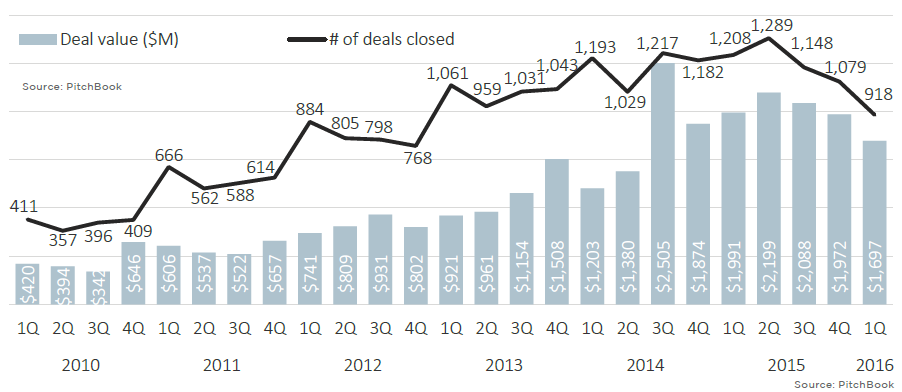
Here's a chart - US only: - https://files.pitchbook.com/images/Angel.Seed%20Activity.png
At about a thousand deals at about a million bucks, that's bumping the $1B mark, but doesn't break $2B.
Also if you'd like you can email me at the address in my profile, this thread is getting nested very deep.