London-Paris electric flight 'in decade'(bbc.co.uk) |
London-Paris electric flight 'in decade'(bbc.co.uk) |
For comparison, the fastest train is 2h 25m. I guess you need to travel to and from the train station too, but it's definitely more central (2x15 min) and you can easily hop on train even five minutes before the departure - although I usually plan at least another 15 min buffer. That is a total of a little over 3 hours.
I don't pretend to know enough about economy of future trains vs future electric flights, but it looks like short distances will always be a tough sell for airplanes. Personally I also find trains more comfortable and I was never given a free massage for carrying scissors in my pocket when boarding one.
Never-the-less, taking the train is wonderful. It is a much more 'natural' travelling experience in that you're not going to some artificial out-of-city place.
In terms of pleasure of travelling, St. Pancras is a joy to behold, a beautiful building that has been wonderfully converted for use of the Eurostar.
Also anecdotal evidence, but I've struck up conversations multiple times on the Eurostar that lasted the entire journey and even turned into friendships after, but never talked to someone on a flight.
Glancing at Skyscanner for this Sunday there are about 35 flights a day from London to Paris starting from £39 vs 14 trains starting from £151 single. The flights look like they are doing ok.
And it is not a question of feasibility, but rather of priorities. There is so much low hanging fruit to be collected! By the end of the decade, if all goes well, we will be in the middle of replacing petroleum fuelled cars and busses with electric ones, and maybe turning our attention to other land-based petroleum consumers such as trucks, agricultural equipment, mining machinery etc.
Airplanes are so far down the list of things we can easily swap over to batteries that it is not yet worthwhile to work in this field.
Longer version:
The article mentions "removing the need for jet fuel" but does not explain how the engines of this "electric" plane work. Propellers run by electric motors, or what?
No. Wright Electric's own site is scant on technical details and concentrates on praising the great team in its blog. From browsing other sites [0] it appears that the engines are still using conventional jet fuel to generate the thrust; it's just that the external systems (pressurization, de-icing, landing gear mechanics, fuel pumps etc) that are powered by electricity are using battery power instead of generator in the current jet engines.
This may be a step ahead in energy efficiency but is not that revolutionary, and calling it "electric flight" is simply wrong.
I hope I misunderstood, but Wright Electric really should tell how their electric plane is supposed to work if it is really electric.
https://electrek.co/2017/03/22/electric-plane-startup-150-se...
A little surprised they seem to be going after the ultracompetitive A320/737 market rather than the shorter-haul, lower-speed, turboprop market as well (closer to their starting point, less competition, even more fuel price-sensitive, airline customers less conservative etc.)
>Wright Electric said by removing the need for jet fuel, the price of travel could drop dramatically.
Note to self: Bring back Zeppelin travel.
They should have chosen a better city pair.
It's a [hypothetical] aircraft, not a hyperloop. It can fly other routes.
London–Paris is just an example in the article to demonstrate the range of that hypothetical aircraft. It could also be useful as a demonstrator.
There is no way a startup without any experience in aviation will design, build, certify and sell a commercial 150-seat airplane in 10 years. Not even mention the immense R&D groundwork required to even prove the concept of using batteries to power short haul flights.
Why do they put out bullshit like this? It just hurts their credibility.
However, I'm rather disappointed lack of even fundamental technical vision. I get that if you shoot to fly in a decade you can optimistically base your model on other technical advances (e.g. better batteries), but too much short-term hype can be deceiving.
It will take many years to get there and probably it would be easier to create first small turboprope electric plane. Something like: https://en.wikipedia.org/wiki/Bombardier_Dash_8
And, let's be honest, in case of a crash, I'd rather walk away (or be hauled away without a limb or two) to die of cancer ten years later, than be burned to crisp in a huge fireball. Fear of radiation is overrated.
* maintain a holding pattern for 30 minutes (45 for recip. engines) PLUS
* perform a missed approach at destination, climb out again, and perform a landing at an alternate PLUS
* contingency fuel (5% of trip fuel)
1) Dozens of new battery technology
2) Graphine will change our world
3) Genetic cures for thousands of diseases and birth defects
4) Linux Desktop :(
Airbus works on a 1000km battery powered regional plane (catch is, it's probably a turboprop) by 2030, by the way.
SF-LA, London-Dublin, etc would have made a lot more sense.
I'd guess that anybody wanting to put Li technology batteries aboard aircraft is likely to spend the next 10 years jumping through regulatory hoops, so unless rechargeable battery technology is "ready to deploy" right now on aircraft, I don't see any way this is happening within a decade.
Looking at the empty weight, the weight of max fuel capacity and range[1], it seems realistic to fly 200-300mi on batteries without any kind of jettisoning.
So it seems feasible, the next question is where could it be in terms of commercial viability.
So, it presumably can't work now but they're putting their money on the idea that it will in the near future.
There's also the issue of the mass of batteries not going away during the flight, unlike fuel, which will require maximum landing weight to equal maximum takeoff weight - this will impose a structural penalty versus IC aircraft.
Subtract again for the fact that you're not shedding half your takeoff weight in fuel over the course of a flight. You land with as much battery as you started with.
More if you're using metal-air batteries.
E.g. transmit energy wirelessly through microwave and just have enough fuel for emergencies.
Clearly only possible during the day though.
Air travel is intensely competitive in most areas, and customers generally have very little "brand loyalty" and buy almost entirely based on price. The difference in expenses should result in lower fares.
And it is yet unknown whether the extra cost of flying tons of batteries around (they weigh the same when depleted, as opposed to jet fueled aircraft which become lighter as they use up fuel), and the extra cost of those batteries, and maintenance/replacement of them, will net out to be significantly cheaper than using conventional jet fuel.
    As Bart wisely suggested, we’ve designed our battery strategy to be robust to different battery futures.

    If batteries don’t get dramatically better in the next decade, we design our plane as a hybrid with electric motors, like a Volt. It still has great cost savings as compared to today’s planes, and it doesn’t require massive battery advances.
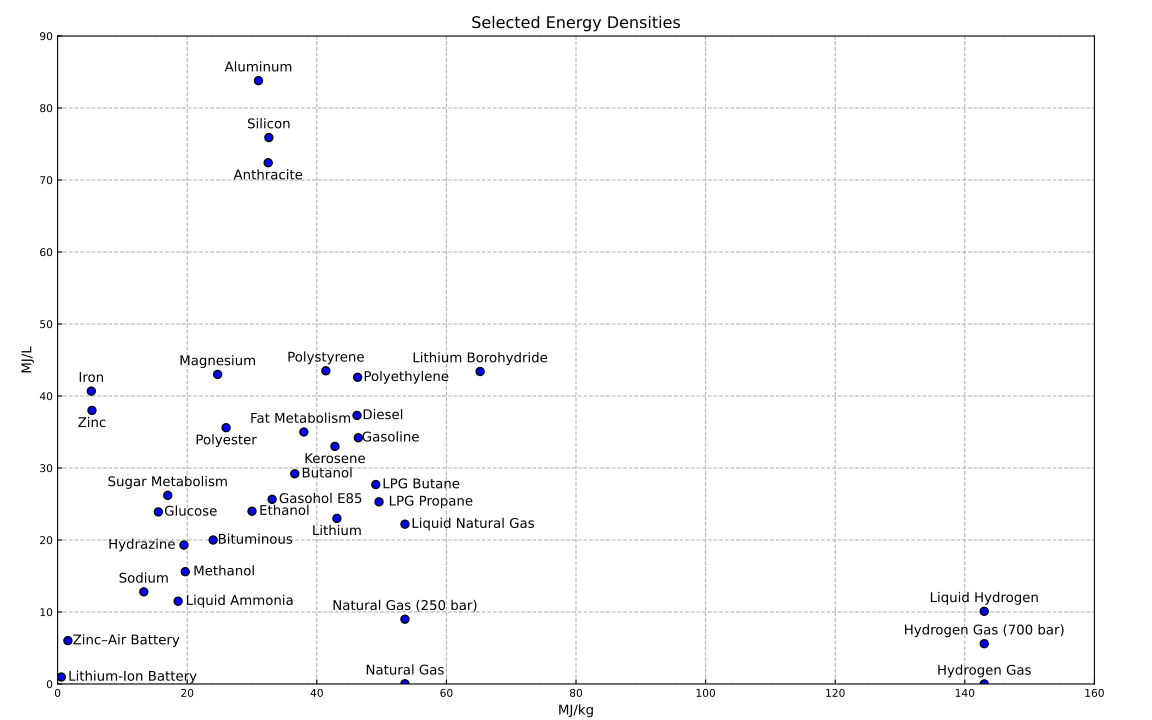
    If batteries do get a lot better in the next decade, our plane is fully-electric and has fantastic cost savings. See chart #2 below; a near-future jump to a chemistry like Li-Metal doesn’t seem beyond the realm of possibility.
The legend for that image is:
>This image shows the potential subsystems that could be powered electrically. (Note: an fuel plane can also install electric subsystems – for example the 787 is making headway in this direction – but the subsystems in an electric plane will be all electric!)
From what I read from the blog, it looks like they are going all electric. So I'm not sure what magic they intend to use in order to propel the plane, but I'll assume propellers until proven wrong.
However, I'd expect a competent tech journo to make some questions and write about how the electric plane actually works.
I don't think there's a clear description of the plane, so I don't think you can say what it "does" use.
Their blog says they'll go all-electric if batteries progress fast enough or they describe taking a hybrid approach "like a chevy volt".
> From browsing other sites [0] it appears that the engines are still using conventional jet fuel to generate the thrust; it's just that the external systems (pressurization, de-icing, landing gear mechanics, fuel pumps etc) that are powered by electricity are using battery power instead of generator in the current jet engines.
The clip I think you're referring to comes from this: https://drive.google.com/file/d/0B5dHV3MyeeBjN1BoU3hHclFYd3M...
which is not describing their proposal but they bring it up in one of the reports as a side opportunity for electric aviation.
Anytime I read anything that says 5 - 10 year, my initial reaction is, baloney.
Uber is a company that has a 60 Billion dollar valuation contingent on the idea that it will somehow both develop driverless cars, and maintain a monopoly on them (dispite having zero expertise in this area whatsoever, and competing against entire industries that do) before they run out of money losing 2 Billion+ a year.
Theranos had promises of technology that was not physically possible, and they knew it. Yet the billions still poured in.
Magical thinking is powerful.
I'd be more concerned with the realities of battery technology not being ready and existing regulations/testing stretching the timetable v.s. pure technical ability of a team to design something that would be fit for purpose.
If a space rocket blows up, including passengers, it's okay, part of the business - everyone knows space flight is high risk. If a commercial flight crashes, that is simply not acceptable.
An electric plane with 100+ person on board has no POC so far...
It's an important difference.
Even if they fail to produce a working electric airplane, they will make a lot of money in the process.
"There is no way a startup with no experience in spaceflight will be design, build, certify, and sell an orbiter in ten years." -- Someone just like you in 2002, when SpaceX was founded. It actually only took them six. Acknowledged they are different industries, but I'm wary of confident statements of impossibility, especially without all the relevant facts.
It's possible to buy a train ticket which includes the ferry, and trains at both ends. (e.g London to Rotterdam.) The ferry itself is from Harwich to the Hook of Holland.
Of course, budget airlines will also take you all over Europe for low prices. But for the narrow case of just London-Paris, the Eurostar is competitive, which is quite a bit cheaper than I'd remembered.
For comparison: https://idlewords.com/2005/08/a_rocket_to_nowhere.htm
But for the sake of fun - For a Bombardier Q400(that was the only reliable data I could find)[0], the total surface area is ~213 square meters. That's obviously total surface area, so it includes both the top and bottom of the airplane. For simplicity sake, let's say only half is in full view of the sun - so 107 square meters.
Even if we assume magical solar panels that can actually convert 100% of the energy into electricity, and assume that the plane is flying in full daylight, that's only ~100kW.
The aircraft uses two PW100 engines, each producing....3700kW, so the total output of the aircraft is around 7400kW.
So even if the conditions were ideal, we had magical solar panels, and covered every inch of the aircraft, they would produce....less than 1% of power necessary to fly it. To be fair, a normal 2.0L petrol engine produces more power than what those solar panels would produce.
In reality, those panels could maybe power the onboard lights and computers? Just about?
[0]http://www.supersonicinstitute.org/docs/Q400SurfaceAreaRepor...
Doubtful. I don't have the exact numbers handy, but the power draw there is much higher than you think. That said, if you're unicorn farting skittles scenario was actually possibly (100kW solar per plane), which we know it isn't, then sure, it's enough power for that.
Excellent point; currently as fuel is burned off, planes can climb to higher, more efficient altitudes (known as a step climb). What's the performance penalty for not being able to do this as your batteries aren't getting lighter as the flight progresses.
One can imagine an electric aircraft relying on powered landing gear (as previously trialled by Airbus/Lufthansa Technik) which would further improve efficiency during taxiing.
The current turbofan engines are close to the size limits in relative fan size and bypass ratio without a gearbox, which adds cost and mass. (Only one manufacturer is in the process of introducing a geared turbofan.)
Because of no high speed jet exhaust and large area thrusters, these aircraft have the potential to be able to take off really steeply and to be really quiet.
0. http://space.stackexchange.com/questions/8566/what-is-the-su...
Since current turnarounds include freight container swaps, I don't see why a battery swap wouldn't fit in it.
Whereas you wouldn't think twice about jet fuel fires, because you're used to it rather than because fuel isn't a fire hazard :-)
If you're in the north of England, it'll take you longer to get to London than it will to get from London to Paris afterwards. At that point flying starts to look a lot more attractive.
But if what they're building is an APU rather than a new means of propulsion involving radical wing redesigns, I'm not sure why they're talking about building their own airframe rather than getting it certified to go onto the next generation of other manufacturers' airframes
Longer term, they would want to start using electricity for propulsion and ramp that up as batteries improve.
Imagine a system where the plan actually jettisons the spent batteries along the way. They could glide/parachute down to a collection depot to be recharged and sent back to the airport for installation.
The plane could take off with battery packs slung under the wings which are jettisoned and become drones, gliding down to a depot.
I'm now waiting for someone who actually knows what they're talking about to point out the flaws. One that springs to mind is the logistics of collecting the drone-batteries and transporting them to be reunited with the parent aircraft.
There's also the problem of mass-transfer. In general, aircraft should keep the center of mass behind the center of lift, and ... bad things happen when this isn't maintained. With liquid fuel, tanks are actively pumped to retain both forward-aft and left-right balance, something difficult to achieve with solid battery packs.
There's the problem of both energy consumption profiles and battery delivery/drain cycles. An aircraft generally needs maximum power to get off the ground (hence: all batteries delivering at or near their maximum output), but only partial power once airborne. What you'd like to do is to drain a few batteries completely in the take-off and ascent stages, then jettison them, but this doesn't match the batteries' own power delivery capabilities. You might be able to switch to jettisonable packs after TOaA, to completely drain those.
If fit between wing spars, you might end up with a roughly rectangular package which could be ejected aft of the aircraft from the wing, with a door sealing off the cavity. The battery itself would require some sort of deployable wing itself, as well as guidance and control systems and surfaces, possibly a small propulsion unit. A guided descent stage might actually be one of the more viable options.
It's also possible that jettisoning additional batteries on final approach would make landing dyanamics for the aircraft itself simpler.
On whole, though, I'm questioning the usefulness of this, particularly given coplexities, a likely low airspeed, and competition with ground-based alternatives (high-speed rail, Chunnel) which would bypass the power storage requirements entirely, and would likely operate at equivalent or greater speeds, direct to city centres.
Though it might be best-suited to short hops between islands, islands and mainlands, or across deep peninsulas. That's a somewhat limited set of markets.
For travel between heavily-populated continental points, ground-based rail would almost certainly be more efficient and practicable, and even in the case of the suggested London-Paris route, there is a ground-based alternative.