The Cheap Energy Revolution Is Here, and Coal Won’t Cut It(bloomberg.com) |
The Cheap Energy Revolution Is Here, and Coal Won’t Cut It(bloomberg.com) |
What's driving energy prices is cheap natural gas. Natural gas is cheap to extract and can be extracted fast. But after a while, it's all gone. Britain's North Sea Gas boom is over.[1] Gas fields also drop off faster than oil fields. The cheap natural gas boom won't last forever. It's created the illusion that the energy problem is over.
Nuclear is discouraging. After Fukushima, nuclear plants are scary. Fukushima was a reasonably good plant which got hit by a larger than expected tsunami and lost site power. That was enough to cause a major disaster. Nuclear now looks like a technology where every decade or two you lose a city. The small-nuclear enthusiasts are a bit scary; some argue they need fewer safety precautions because their reactors can't melt down. What could possibly go wrong? Big, expensive containment vessels are a good thing; when Three Mile Island failed, the containment held it in.
Battery technology will help. Wind and solar are intermittent, and can't carry too much of the load until there's more storage. But it's going to take a lot of batteries.
[1] http://www.crystolenergy.com/assessing-future-north-sea-oil-...
But you are absolutely right that its entirely due to natgas and that will maybe last us a decade or two but certainly not three.
In fact its just enough time to build a fleet of nuclear plants, but as you also point out, fear rules that decision far more than physics.
Wind and solar and batteries are awesome, but even in very optimistic case scenarios we need an alternative to coal and the temporary surge of natgas to handle baseload between here and ~2040. It should be nuclear, but, sigh.
Grandparent post was just missing a comma:
"Well, over 40% of US electricity is still from coal"
Wind and solar's bigger problem isn't really the intermittency of availability of electricity, it's the distribution of availability. It needs a more sophisticated grid. America's grid operators (who also own generators) would be shooting themselves in the foot by upgrading the grid since renewables eat into their bottom line (they want to sell natgas/coal/nuclear electricity, not buy solar from your rooftop or set up windfarms that makes a razor thin profit...).
Utility operator lobbyists thus have a marked tendency to overstate the problem of renewable intermittency.
Nuclear is cost competitive with solar and wind but it's only cost competitive if the liability is capped. Remove the liability cap and mandate that nuclear insurance cover the cost of a Fukushima style cleanup and there's no point in ever building a plant ever again. Whereas if you remove all the tariffs (e.g. things like the 40% solar import taxes) and subsidies, renewable prices probably wouldn't change all that much.
What I realize I don't understand is the meaning of "Generation at Utility Scale Facilities" in the header of the table. What does this exclude and how meaningful is the exclusion?
According to the table, net generation at utility scale has decreased 10% over the last decade. How much of that is driven by non-utility scale generation versus decreased energy usage? (Alternatively non-utility scale generation has outpaced total growth in energy use - I'm ignorant of total consumption data so I don't know what is really going on).
Either way, the numbers do seem to suggest a case for new nuclear generation overall.
Currently our known natural gas reserves will last over a century. And we're still finding vast new pockets of it:
http://oilprice.com/Energy/Natural-Gas/Massive-Natural-Gas-D...
Citation? Unfortunately it looks like there are large proven reserves of natural gas:
>...The U.S. Energy Information Administration estimates that as of January 1, 2014, there were about 2,474 trillion cubic feet (Tcf) of technically recoverable resources of dry natural gas in the United States. At the rate of U.S. dry natural gas consumption in 2014 of about 26.6 Tcf per year, the United States has enough natural gas to last about 93 years.
https://www.eia.gov/tools/faqs/faq.php?id=58&t=8
It is unfortunate because for those who care about climate change, there are inevitable methane releases from fracking and from distribution of natural gas and those are now known to be much worse for the atmosphere than previously thought:
>...Back in August, a NOAA-led study measured a stunning 6% to 12% methane leakage over one of the country’s largest gas fields — which would gut the climate benefits of switching from coal to gas. We’ve known for a long time that methane is a far more potent greenhouse gas than carbon dioxide (CO2), which is released when any hydrocarbon, like natural gas, is burned. But the IPCC’s latest report, released Monday (big PDF here), reports that methane is 34 times stronger a heat-trapping gas than CO2 over a 100-year time scale, so its global-warming potential (GWP) is 34. That is a nearly 40% increase from the IPCC’s previous estimate of 25. ...The IPCC reports that, over a 20-year time frame, methane has a global warming potential of 86 compared to CO2, up from its previous estimate of 72. Given that we are approaching real, irreversible tipping points in the climate system, climate studies should, at the very least, include analyses that use this 20-year time horizon. Finally, it bears repeating that natural gas from even the best fracked wells is still a climate-destroying fossil fuel. If we are to avoid catastrophic warming, our natural gas consumption has to peak sometime in the next 10 to 15 years, according to studies by both the Center for American Progress and the Union of Concerned Scientists.
https://thinkprogress.org/more-bad-news-for-fracking-ipcc-wa...
As we use more and more natural gas, we can expect more and more methane disasters like the leak from Aliso Canyon in CA which was the largest methane leak in US history. This released over 100,000 tons of methane into the atmosphere and required 11,000 residents to be evacuated.
http://www.bbc.com/news/science-environment-35659947
>...It should be nuclear, but, sigh.
Yea, nuclear has so far been the safest form of base load power we have ever used. Unfortunately anything at all related to nuclear is covered by the media orders of magnitude more than other power sources so people have an understandable perception that it is much more dangerous than other sources of power. What if the Alison Canyon was a nuclear storage site (instead of a natural gas storage site) and 11,000 people had to be evacuated - how much would the media have covered that? Another recent example would be the evacuation at the Oroville dam - almost 200,000 people were forcibly evacuated since the worst case failure scenario would have have been a tidal wave of water 30 feet high rushing down stream. This made the news for maybe a day. I can't blame some for being afraid of nuclear power, but there are many who should know better.
No, it's a technology where if you use power plants decades out of date, that have known safety issues, and then cover-up the magnitude of the problem once a catastrope occurs then you have a very expensive clean-up operation.
Cleaning up Fukushima will be expensive, there's no denying it, but it's arguably the case that the Deepwater Horizon rig mess could cost significantly more.
There are many unanswered questions about the long-term impact of hydraulic fracturing on seismic stability and on groundwater, and the technique is under scrutiny in many parts of the world. Predictably favored by energy-lobbyists and opposed by environmentalists, fracking remains a contentious issue whose future in the US could depend on a "simple" party change -- hardly a sure bet.
I do think there are many experiments with different storage technologies to smooth out supply, so this particular advantage of NG could change in the next few years.
The Chekhov's gun waiting to go off in electricity demand is electric vehicles. When they become a non-trivial part of transportation they'll be the biggest new demand driver for electricity in two generations. Hopefully they'll arrive in a big way shortly after the big wave of coal retirements is finished; otherwise they could keep marginal coal units lingering for a while longer.
I read on until "The natural gas that comes out of these wells is practically free"
Then I had to give up because its obvious propaganda with no real interest in the truth. I am all for clean energy, but unfactual propaganda isnt good for anyone.
The worst victims of all of this are of course the people being told that coal is coming back, that the way that their fathers made a solid living will someday return so they continue sitting in a pit of addiction and despair, waiting for their ship to come in while the politicians get ever fatter.
Here is a list of Independent power producers in BC https://www.bchydro.com/content/dam/BCHydro/customer-portal/...
Wait! Hold it right there! Are you trying to tell me that "clean coal" is not coming back? </sarcasm>
He doesn't want to reverse it. He doesn't give a shit about coal. He only wants their votes, and the votes of similar industries who will view him as a defender of old-school industry.
What is the relative value of marginal votes from those different areas...
I seem to recall reading a study that suggested that surprisingly few electric bus or delivery van fleets would be required to soak up this cheap electricity and tame demand fluctuations but more recently I heard people saying that it's going to be a problem/disaster.
I'm not sure if there's new knowledge or it's just become a popular talking point.
Not to say, it's not good to keep coal in the ground for the same reason. Just thought I would share another tid-bit lol
(As far as I'm aware most peat extraction happens not for energy usage, but for gardening and agricultural use - but the harm is the same.)
And that's assuming we don't still have access to, say, the hardcopy US Patent filing records. You could get very far indeed with basic metalworking + modern knowledge of the optimal energy-collecting shapes for rotor blades.
I could also say that is a falsehood in the practicle sense because of what it left out but that wasnt my original intention. My falsehood statement was to include the part about shale which since shale fields are limited its simply not true.
We could further get into UV rays breakin down solar panels etc but that really wasnt my point. I dont expect people to see the rhetoric and falsehoods used in this article but it stood out to me like a sore thumb so I commented.
Nor was I somehow saying save coal or coal is more efficient etc. It was only a comment on the rhetoric and falshoods I saw in a very short span of words.
The marginal cost for additional GW is essentially free. The marginal cost totally ignores capital cost and just involves operational costs, which are (?)nothing for solar and (?)low for wind.
Why do you think "essentially free" marginal renewable cost is a falsehood? The difference between lettings the electrons flow and not letting the electrons flow on an installed plant is what, exactly? That's what's being referenced.
Though there's lots of data to support the article, they do leave out the cost of extracting natural gas from the "practically free" wells. What is that cost?
>unfactual propaganda isnt good for anyone.
As I see it, the article's thrust is true. I'd love to be proven wrong though, with some facts, if you can provide them.
Why do you think "essentially free" marginal
renewable cost is a falsehood?
There's lots of talk, and boy would I ever love to see these actually happen!
However, there's stuff that a utility can design and install toady, and there's stuff that's decade out. For nuclear, deployment of "understood" designs can take a decade, easily.
The other thing about these new nuclear reactors, I don't ever hear anybody talk about them being much cheaper than current reactors. That should be one of the key selling points. They need to be cheap enough that they can run at, say, 50% capacity over the course of a day to follow the demand curve. Right now nuclear runs continuously at near maximum in order to be economical.
Wind and solar are getting cheaper. Storage is getting cheaper. These new nuclear technologies don't need to compete with natural gas and coal, they need to compete with the cost in 20 years of renewables with 30%-50% of that energy getting stored.
In any case, I'd love to see these technologies enter production so that we have a more diverse energy pool. But I don't think it does them any favors to pretend that they're further along than they actually are.
Every nuclear reactor design that has something complicated going on in the radioactive section has had serious problems. Gas-cooled reactors leak. (Ft. St. Vrain was so promising.) Pebble bed reactors jam. (The one in Germany is permanently jammed and can't be disassembled.) Sodium reactors have sodium fires. Ones with attached chemical plants have problems with handling of hazardous materials. It's discouraging.
Ordinary water-based reactors have a simple radioactive section. All the complexity is outside. Yet even those have problems.
Hyman Rickover on this subject:
An academic reactor or reactor plant almost always has the following basic characteristics: (1) It is simple. (2) It is small. (3) It is cheap. (4) It is light. (5) It can be built very quickly. (6) It is very flexible in purpose ("omnibus reactor"). (7) Very little development is required. It will use mostly “off-the-shelf” components. (8) The reactor is in the study phase. It is not being built now.
On the other hand, a practical reactor plant can be distinguished by the following characteristics: (1) It is being built now. (2) It is behind schedule. (3) It is requiring an immense amount of development on apparently trivial items. Corrosion, in particular, is a problem. (4) It is very expensive. (5) It takes a long time to build because of the engineering development problems. (6) It is large. (7) It is heavy. (8) It is complicated.
You can have an equivalent in solar, wind + storage in less than three years. That's 17 years of not producing electricity.
A nuclear power plant can crank out 5 gigawatts.
There aren't any solar or wind plants of that capacity that were constructed in any amount of time, much less three years.
I wonder why the tech community has this infatuation with nuclear power. Ever since I registered my three-digit slashdot account, I've been reading exactly this post, just that the type of reactor people dream of seems to change every five years or so. Good to know it's "Liquid Fluoride Thorium Breeders", right now.
Meanwhile, solar power has lowered prices by a factor of 10 or so and is on a clear trajectory to beat fossile fuels on costs, without subsidies.
I'm suspecting there is something cultural going on here–maybe some instinct to seek out what others perceive as dangerous? Beats me...
Science fiction commonly has nuclear reactors at the core of energy for space travel. For extremely long hauls it's compact in terms of volume and weight. As far as I can tell.
So nuclear has a history of being the "future." So tech-related people like it for that reason. We're not going to get personal jet-cars for transit either, most likely. But there's that hint of a dream in tech culture.
Any reasonable carbon-neutral energy plan that I've seen uses at least a bit of nuclear. It won't be the backbone, and it's unlikely that its performance characteristics or cost will change much, but the rest of the century will likely see a consistent amount of nuclear energy, given the longevity of existing reactors.
Because it works.
Fusion probably would have been if funding for nuclear fusion research had been kept at the same level as it was in the 70s. It took a deep dive after that though for reasons which most people can probably guess.
But it was not creating fuel itself and it had some issue with corrosion which would have been fixed. There was not one built since and a lot of documentation was lost but luckily saved by NASA.
In last 10 years more and more people are working on them, specially India and China but also USA (Bill Gates is working on similar thing among others)
Further, if you've lived your entire life in a coal town, the sheer scale of the plants, mines, railroads, and other infrastructure can make them seem permanent, reliable. It is very difficult to imagine so much specialized infrastructure simply ... going away.
Imagine if you had spent your entire life as a datacenter tech, as had your father. You knew the business inside and out, understood the network of suppliers, the customers, the hardware, everything. You've gotten into arguments about different rack configurations and which you prefer to work on. This is your career. You got into this business because it would provide a stable life for you and your family, and you were damn good at it. Then people started telling you that we would no longer need datacenters - at all - in 5 years because there were now cheaper, better alternatives. You wouldn't believe them.
W. Virginians are notoriously undereducated. So it will take a while but eventually the truth will be known and a day of reckoning will come.
To be fair my undereducated family in neighboring rural Virginia truly believed Trump "will bring the jobs back". They were aghast when I showed them a video of Tim Cook on 60 minutes explaining that those (manufacturing) jobs aren't coming back.
I'm not saying it's a good thing they believe it, I'm saying the conned is still the victim: it's the conartist that should be punished, and the GOP has been conning Appalachia for decades.
The end incentive of a politician is to win and retain power. The means to the end this is to take popular positions and be seen to do something about issues voters care about. They're doing precisely that.
"We are backing nuclear"
"This time it will be good"
Can you see a populist saying that?
The ones truly complicit in the Great Lie know who they are, and I have a feeling their day of judgement is closer than they want to believe.
Coal still accounts for 28% of total world energy production (behind only oil, at 31%) and about 41% of the world's electricity production (way ahead of natural gas, at about 27%).
It's not going anywhere, dude.
The ideal dam site is Hoover Dam. One dam at a narrow point created a large lake with a high drop for power generation. No population to displace; the surrounding land is desert. Few other sites in the world are that good.
There's nothing anywhere near that good left in the US. China has some good hydro sites in the west, and they're building hydroelectric dams there. Million-volt DC lines going thousands of kilometers are being used to move the power to the loads in eastern China.
https://www.eia.gov/dnav/pet/pet_pnp_capfuel_dcu_nus_a.htm
and here:
https://www.eia.gov/dnav/pet/pet_pnp_refp2_dc_nus_mbbl_a.htm
Which suggest 46,860 million kilowatt hours of grid electricity used.
577,245 thousand barrels of motor gasoline produced.
Which works out to 2kWh per gallon (but ignores the fact that lots of other non-gasoline products are produced as part of the same process).
I've seen estimates where if it was 4kW per gallon, then EVs are kind of breaking even and there would be no increase in electricity usage. I'd wildly estimate that maybe only .2 kWh would actually be saved since kerosene etc. would still need to be refined.
It's actually possible, that if a carbon tax was imposed, then refineries would use more grid electricity sourced from wind/solar/nuclear/hydro as a cost saving measure rather than burn fossil fuels.
I agree it's destructive, but it is actually classified as semi-renewable because it takes "only" a thousand years or so to develop (where oil is millions). In the case at hand, we were discussing a "dark ages" scenario where we end up regressing a bit. I was just bringing up that there are alternatives to coal (also destructive).
FYI peat covers approximately 2% of the earths surface, and around 7% of it is used in agriculture, gardening, and energy[1].
The marginal cost is the price of producing one extra kilowatt-hour on your already-purchased panel.
Fortunately recent progress allowed newer designs that are much cheaper [1]. That is the reason that we got startups investing in fusion. It is still not pocket money, but at least the scale of investments is 1e8 USD, not 1e10 as before.
[1] https://www.google.no/amp/s/amp.theguardian.com/environment/...
I thought it was telling that the only world leader who reacted to Fukushima by mandating the end of nuclear power wasn't a hippy but a physicist.
I don't see the problem being that nuclear can't be made safe. I see the problem being that operators are motivated to stretch the margin of safety in order to make a buck and lawmakers appear to be prepared to let them and the one thing nuclear operators will never, ever, ever, EVER stand for is allowing the privatization of that risk (i.e. let insurance companies instead of taxpayers shoulder the risk).
It's worth noting that even formally qualified scientists are susceptible to bias, and politics. There are even scientists who are practising religious adherents.
Angel Merkel was previously the minister for Environment and Nuclear Safety. I'd suggest that is potentially more informative than that she has a doctorate in physical chemistry.
Are you trying to argue that keeping coal plants and shutting down nuclear plants is a good idea?
From a previous comment someone made, here are the death totals for generating power:
Energy Source Mortality Rate (deaths/trillionkWhr)
Coal – U.S. 10,000 (32% U.S. electricity)
Natural Gas 4,000 (22% global electricity)
Solar (rooftop) 440 (< 1% global electricity)
Wind 150 (2% global electricity)
Nuclear – U.S. 0.1 (19% U.S. electricity)
>...I don't see the problem being that nuclear can't be made safe.
Actually you are wrong - NOTHING can be made 100% safe. Anyone who promises you something is 100% safe is simply a liar. Walking down the sidewalk has risk, much less walking down a street. When making choices the only thing you can do is choose the safer alternative. Planes are safer for a long trip than driving a car, but how many people are afraid to fly vs afraid to drive? Nuclear has has a very good safety record compared to the alternatives (utility solar farms might end up lower, but all others are much higher) but to the people who fear nuclear power, I know the numbers don't really matter - much as the person who is afraid of flying doesn't care it is safer.
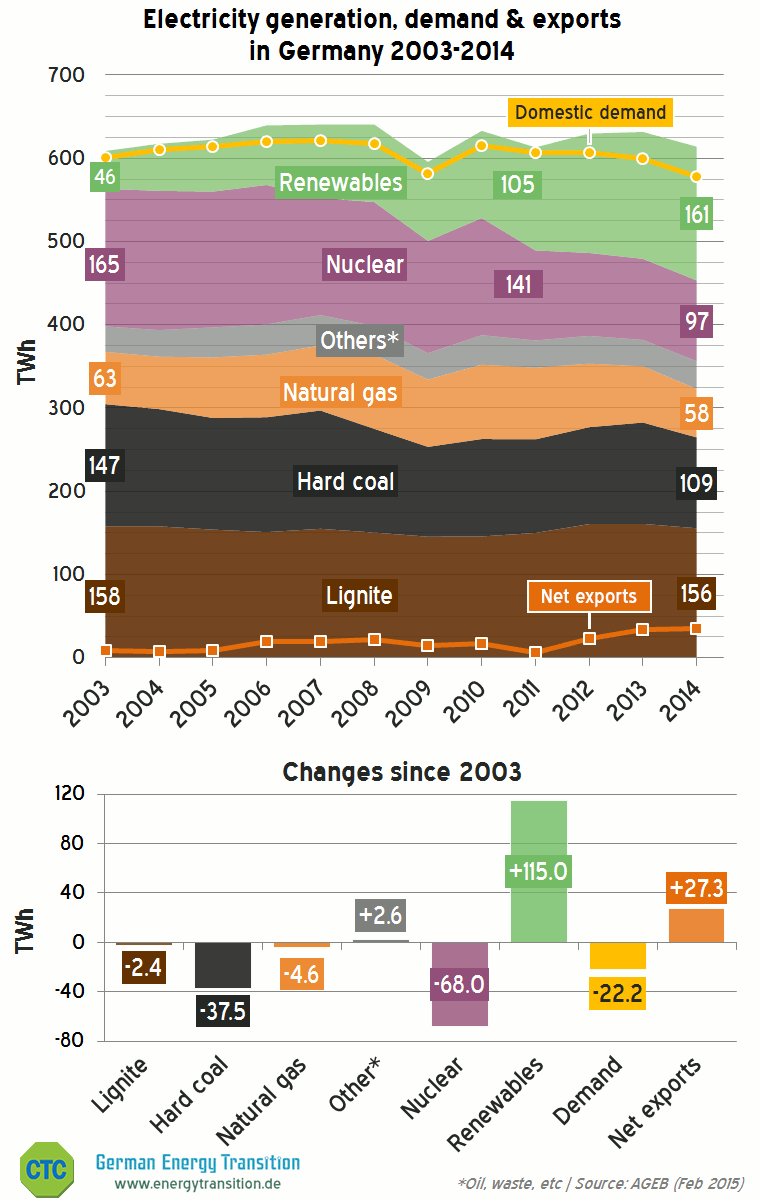
Nope. I'm arguing that shutting down both is a good idea - which is why Germany is shutting coal plants too:
https://energytransition.org/wp-content/uploads/2015/05/germ...
So... straw man?
"Actually you are wrong - NOTHING can be made 100% safe."
I'm pretty sure my implication of "acceptably safe" was fairly clear.
So... another straw man.
What was telling is she didn't want to do it but was forced by public opinion, the fact that she proceed to run to the front of the parade notwithstanding.
I didn't grow up in the coal mining regions of the state and I've since moved away, but it is depressing watching the citizens of my home state consistently vote against their own interests due to outright fabrications and lip service paid to them by gutless politicians who lack the backbone to tell them the truth.
West Virginia has a lot to offer and I do believe the people there could pull themselves up by their bootstraps if they accepted the fact that coal is the past and the state needs to move forward into new industries/the future.
Based on EIA data, in 2016 the capacity factor of US nuclear power was 92.5%. Utility scale PV was 27.2% and wind was 34.7%: https://www.eia.gov/electricity/monthly/epm_table_grapher.cf...
Based on 2016 capacity factors you need to install a total of 17 gigawatts-peak of American utility scale PV or 13.3 GWp of wind to match the annual energy production of 5 gigawatts-peak of nuclear reactors. Last year the US completed about 10 GWp of utility scale PV and 8.2 GWp of wind (5.57 real annualized gigawatts, assuming same 2016 capacity factors going forward).
Storage, though? Nobody's going to install sufficient storage in the next 3 years that you could shut down the nearest reactor without burning more natural gas. Large scale storage is just starting to enter the mainstream.
So if a nuclear plant has 92% capacity factor, and a solar plant has 27%, that means a 5 GW nuclear plant would require about 17 GW of solar to replace it. In other words, there was less than 2/3 of a nuke's capacity of solar installations last year. Total. For the entire country.
So multiplying capacities and capacity factors, for 2016 we get:
2016 nuclear: 0.925 * 1165 = 1078 MW
2016 utility PV: 0.272 * 10000 = 2720 MW
2016 utility wind: 0.347 * 8200 = 2845 MW
Last year's large scale wind and solar installations would be expected to produce as much electricity, annually, as 5 reactors like Watts Bar 2. Watts Bar 2 is pretty typical as far as capacity goes. The four new AP1000 reactors under construction in the US are each 1117 MW net, for example.
I personally hope that the US continues to build enough reactors to regain and maintain the institutional competence that was lost after the last wave of builds ended in the 1980s. Nuclear power has an excellent safety record, no air pollution, and is easier to manage at high penetration levels than wind/PV. But when I'm crunching the numbers I estimate that renewables will grow faster in North America for the foreseeable future; renewable projects scale down better, are cheaper per MWh generated even adjusting for capacity factor [1], and are much faster to go from first concrete pouring to first revenue.
[1] Cheaper per MWh than observed real-world prices for reactors currently under construction. Some older reactors can produce electricity at significantly lower costs.
Adjusted for the capacity factor that's over 5.75GW. Sure, it's not one plant, but quite possibly most of that capacity wasn't commissioned until 2013. Better still, they're just getting started with this.
The beauty of this power source is that it scales great - instead of erecting one 7MW turbine you can do that with any number of them, limited only by your budget.
Meanwhile it takes 5 years to construct a single 1GW block of nuclear and you can't just simultaneously start building another one next to it.
Nuclear won't win, because it's expensive and doesn't scale well.
https://en.wikipedia.org/wiki/List_of_largest_power_stations
I see several nuclear plants on that list, but not one solar or wind plant.
I think perhaps claims about the latter being "less expensive" and "scaling well" should wait until they've actually been economically operated at scale.
It's just that they believe that both sides are conning them, and they vote for the most appealing set of lies.
Americans are hopeful, it's our single greatest strength and the source of our most disastrous failings.
Meanwhile there's no coal mining company that's booming while others flounder. The whole industry is shrinking. It'd be more like if cell phones were becoming obsolete in favor of cranial implants or something, but you were still working on a social app for Android.
Not cost effectively, which is why even with existing protections from generally-applicable liability standaeds the industry demands greater direct subsidies and/or liability shields and without them has no interest in building new plants.
Can you provide some examples of grid-scale solar or wind projects that don't get massive government subsidies?
Edit: Did you mean to imply that Coal is not actually going away because the 'cheaper alternatives' are fake?
https://www.eia.gov/electricity/data/browser/#/topic/0?agg=2...
Nuclear could cover base load but is orders of magnitude more expensive (up-front) than coal. Huge investment, huge regulatory burden, huge political risk. Until recently, we hadn't built a new nuclear plant in the country for decades. [0] Coal is cheap and reliable. Always has been.
What's killing coal is low, non-volatile natural gas prices from shale fracking.
[0] https://www.washingtonpost.com/news/energy-environment/wp/20...
http://www8.nationalacademies.org/onpinews/newsitem.aspx?Rec...
(Unfortunately...)
Prices are cutting in half every 2 years.
There is not a whole lot more price cuts that need to happen before Solar is at grid parity, and cheaper than coal.
In places like Hawaii it is already way way cheaper than any other available power solution.
What you actually wrote was "I thought it was telling that the only world leader who reacted to Fukushima by mandating the end of nuclear power wasn't a hippy but a physicist."
You made an appeal to authority and didn't mention coal in your original statement.
>...which is why Germany is shutting coal plants too
You are somewhat misrepresenting the energy situation in Germany.
>...Coal is still the largest source of power in Germany. ...In 2007 German Chancellor Angela Merkel and her party agreed to legislation to phase out Germany's hard coal mining sector. That does not mean that they support phasing out coal in general. There were plans to build about 25 new plants in the coming years. ... No concrete plan is in place to reduce coal-fired electricity generation. As of October 2015, the remaining coal plants still under planning include: Niederaussem, Profen, and Stade. The coal plants currently under construction include: Mannheim, Hamm D, Datteln, and Willhelmshaven. Between 2012 and 2015, six new plants went online. All of these plants are 600–1800 MWe ...A coal phase-out for Germany is implied in Germany's Climate Action Plan 2050, environment minister Barbara Hendricks said in an interview on 21 November 2016.
https://en.wikipedia.org/wiki/Fossil_fuel_phase-out
To eliminate a non CO2 producing energy source and continue to use the most dangerous source of power which is also the major producer of CO2 for a couple more decades (best case), is pretty irresponsible.
Fukishima was a major accident and resulted in zero deaths to the public. You wrote: "I don't see the problem being that nuclear can't be made safe." and also seemed to approve of an entire county abandoning nuclear power when they are using power sources orders of magnitude more dangerous. It did sound like you meant that any accident from nuclear power would be unacceptable to you since the alternatives Germany will be using for decades are more dangerous to the human health and the environment. You now say that you meant "acceptable risk" - unfortunately that is a somewhat meaningless subjective term. You can only compare a choice against its alternatives and since we know we need to generate terawatts of power for our civilization to function, the real question is what is the relative risk from generating power from different sources. From a previous comment someone made, here are the death totals for generating power:
Energy Source Mortality Rate (deaths/trillionkWhr)
Coal – U.S. 10,000 (32% U.S. electricity)
Natural Gas 4,000 (22% global electricity)
Solar (rooftop) 440 (< 1% global electricity)
Wind 150 (2% global electricity)
Nuclear – U.S. 0.1 (19% U.S. electricity)
If you demand zero risk when producing terrawatts of power, you aren't going to find it. In the same way that if you were afraid of jet travel, all anyone can say to you is that jet travel is safer than driving, not that there will be no plane crashes.
Correct. You brought it up along with the presumption that I'm in favor of it.
>You are somewhat misrepresenting the energy situation in Germany.
Actually I think you are:
"The coal plants currently under construction include: Mannheim, Hamm D, Datteln, and Willhelmshaven. Between 2012 and 2015, six new plants went online."
Plants take a long while to go from planning to complete. These plants were ALL planned and approved before Merkel made her decision. No new coal plant has received a permit since 2009, 2 years prior to Fukushima, meanwhile many others are slated for early closure.
Coal is most assuredly on the way out in Germany, NOT, as you seem to presume, making up for all of the lost nuclear power.
>Fukishima was a major accident and resulted in zero deaths to the public. You wrote: "I don't see the problem being that nuclear can't be made safe." and also seemed to approve of an entire county abandoning nuclear power when they are using power sources orders of magnitude more dangerous.
I approve of them abandoning both, which they are doing. It wasn't ever going to happen overnight and it is ridiculously unrealistic for you to expect that it will.
>You now say that you meant "acceptable risk" - unfortunately that is a somewhat meaningless subjective term. You can only compare a choice against its alternatives and since we know we need to generate terawatts of power for our civilization to function, the real question is what is the relative risk from generating power from different sources.
Do you have a problem with the risks presented by wind and solar which are both replacing the power from the nuclear and coal plants which are slowly going offline in Germany?
Do you have a problem with this trend continuing? I don't.
>Fukishima was a major accident and resulted in zero deaths to the public.
573 deaths are attributed to it, and it's projected that between 130 and 1100 deaths from cancer will be attributable to it.
>If you demand zero risk when producing terrawatts of power, you aren't going to find it.
I'm okay with the risks presented by the solar and wind. Most importantly there are no large scale tail risks for solar and wind, unlike nuclear. Falling off a roof is typically easier to mitigate than cancers following nuclear disasters, too.
No, what I said was "Are you trying to argue that keeping coal plants and shutting down nuclear plants is a good idea?"
>>>You are somewhat misrepresenting the energy situation in Germany.
>Actually I think you are:
No, what I wrote was from the wikipedia page. If you think you are right and they are wrong, you are free to edit the page with more accurate info.
>..."The coal plants currently under construction include: Mannheim, Hamm D, Datteln, and Willhelmshaven. Between 2012 and 2015, six new plants went online." Plants take a long while to go from planning to complete. These plants were ALL planned and approved before Merkel made her decision.
It would obviously have been easier, less disruptive and cheaper to cancel plants that are still in construction and not actually generating power. Much more costly and dangerous to the world to shut down nuclear power plants to build more coal plants.
>...Coal is most assuredly on the way out in Germany, NOT, as you seem to presume, making up for all of the lost nuclear power.
No, I did not say that nor did I imply that. What I said was: "To eliminate a non CO2 producing energy source and continue to use the most dangerous source of power which is also the major producer of CO2 for a couple more decades (best case), is pretty irresponsible." They are using less coal and have finally stopped subsidizing the coal mining industry this year - these are all good things. If they had kept their nuclear power plants, they could have eliminated that many gigawatts of coal burning right away. I don't think what I said was difficult to understand. And as I think you agree, coal is far more deadly than nuclear power.
>...Do you have a problem with the risks presented by wind and solar which are both replacing the power from the nuclear and coal plants which are slowly going offline in Germany?
Replacing coal with any other power source is an improvement - I think everybody (well except those who own a coal mine) agree with that. Roof top solar and wind have been more dangerous than nuclear, but these 2 power sources don't place massive negative externalities on the rest of the world like coal does, so they are preferred over coal.
>...573 deaths are attributed to it, and it's projected that between 130 and 1100 deaths from cancer will be attributable to it.
It is misleading to not put the 573 number in context. These weren't people who were killed by an explosion or radiation poisoning, etc, but instead were labelled as "disaster-related" in the areas near the nuclear power plant. This is when a local death was considered to not be directly caused by a tragedy but by a "fatigue or the aggravation of a chronic disease due to the disaster". With the earthquake causing more than 18 thousand dead or missing and 6 thousand injured, extensive structural damage, including fires in many areas, etc. It isn't clear how well one can separate out the stress of moving people out of the area with the stress caused by a massive earthquake and its 11 thousand aftershocks. Other reports don't reference that claim.
Both the WHO and UNSCLEAR reports predicted any deaths from radiation would be low enough to not be detectable in the statistics - and they based this on using the linear no-threshold model. I think your 130-1100 deaths estimate was from a report done by Stanford and in that report, the range was 15-1100, not 130-1100. (It isn't clear to me how the Stanford report got its numbers.)
>...I'm okay with the risks presented by the solar and wind.I think of any death as being a tragedy, whether it makes the news or not.
I think of any death as being a tragedy, whether it makes the news or not.
This is a forum for people who are inclined toward entrepreneurship, who understand basic economic terms like marginal cost without additional explanation.
Marginal cost is the only appropriate measure for discussing what even becomes a challenge where/when electric energy approaches non-scarcity — for example you may not have a use for it, but it requires resources if you wanted to sell that energy to a far away aluminum smelter.
I've had a discussion before where some one was convinced that "servicing debt" was a misleading term, because the debt wasn't being paid down at all. Hopefully we can agree that that is an absurd argument. Terms either mean what they do or not.
Marginal cost is something that people who study economics would instantly understand, to the point where they would be confused as to why others are confused.
It means something very specific, but it is very common to talk about in economics.
I will throw around the term accidently, without even realizing that it would make some people confused.
Capital costs vs marginal costs is an important concept, and definitely appropriate to talk about in the energy sector. But you of course have to explain it.
Some are assuming I did not see "marginal" in there, but the rhetoric angle is exactly why author chose marginal cost. It was simply to get the word "free" in there and then again author used "free" when speaking about shale.
Again though I dont expect everyone to see the rhetoric I see.
The solar-power equivalent would be a balloon every few minutes every weekday, but they run on a strange calendar and you can't predict when weekends happen.
I just don't see how a supply that's unpredictable on a short-term basis, but very predictable on a long-term basis, disqualifies it from being "free".
Again though I dont expect everyone to see the rhetoric I see.
The production of energy has always the costs, and some interested parties attempt to hide them to make them an easier sell.
You're not wrong, and of course things like a carbon tax could change the economics substantially, but base load generation is not going to be solved by cheaper panels alone.
from wind-watch.org:
> "How does wind power affect base load? Wind power has no effect on base load.
When power generation companies demonstrate that you are correct and replace their base load production capacity with solar and wind I will (joyfully) eat crow. That isn't really happening right now, though. Natural gas is replacing coal and non-hydro renewables make up a very small fraction of overall capacity.
https://www.eia.gov/electricity/monthly/epm_table_grapher.cf...
But they aren't. That's not to say they shouldn't be - just that right now the fact is that they aren't.
If at least one of the alternatives was cheaper too, then I would surmise the game was up.
Efficiency programs have been pretty successful, and the overall trend in power consumption (in the US) is negative for now, which is great. But relatively few people even know what fuels are used to supply their power, so I'm not sure how easily consumers can respond.