https://www.youtube.com/watch?time_continue=291&v=JinhIHIF8E...
This is content marketing done right.
I think that the terms have historically been used interchangeably, but the distinction should be made. It's awfully nice not to need to carry oxidiser for your propellant.
In terms of innovation, what do you think of their execution strategy?
The founder has extensive experience with Jet Skis, created an innovative hovering contraption using water jets and a business around it, then used some of that money to fund this next innovation - Flyboard Air.
Also, I've read that the engines are repurposed Jet Ski engines. Is this true?
It was noted that at least some shots were most likely fake. I guess this validates it as real?
How much does a good rigging setup cost plus good professional video editing software to edit out such lines? I suspect it's not even much cheaper than making this work. (Particularly since you need to buy the jet engines anyway.)
I always wonder why people think something is fake when the real thing would actually be easier (if more dangerous) and cheaper than faking it.
But then the astronauts walking on the moon didn't look real to some people either, so we should definitely give him the benefit of the doubt.
I wonder how easy it is to get one, do you by any chance need any sort of special license to operate them?
I love these things. I love enabling gadgets that enable hobbyists and garage entrepreneurs to do crazy things like this that would normally require a military program to fund.
In the comics, the first flying suit had chemical jets. And the early suits just ran on batteries.
"Mr Browning said it is easily capable of flying at 200mph (321km/h) and an altitude of a few thousand feet.
But, for safety reasons, he keeps the altitude and speed low."
But for safety reasons I only jump a foot or so off the ground.
:-)
Sure.
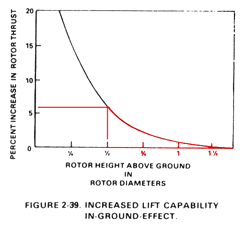
I have watched some of the video, and at no point does he sustain a height high enough to stop benefiting from ground effect.
Hovering for maybe 10 seconds at 5 meters up would do it.
Until he does demonstrate this, I shall choose not to believe him, and won't consider this actual "flight". For much the same reason that an Ekranoplan is not actually an aircraft.
See also: https://en.wikipedia.org/wiki/Ground_effect_(aerodynamics)
or comments last time this device was on hacker news: https://news.ycombinator.com/item?id=13993728
Was this really necessary? Imagine the reaction of the guy: "Oh cool, there's a bbc article on me.. oh... :(".
>TED 2017: UK 'Iron Man' demonstrates flying suit (Original title of the post)
Keyword analysis: TED, BBC, Ironman.
Conclusion: British Clickbait.
Inspired he was; his invention clearly has the potential to kill the user. He may end up doing the same thing his father did, though surely I don't wish him such fate.
Seriously though, there is a long (and sad) tradition of flying machine inventors (or engineers) getting killed by their own inventions. Looking at this particular one it has all the flashy features ('Look! I am the Iron Man!') and none of the safety ones.
Do something worth living for while you can, we all die.
Tom: Aren't you scared you'll kill yourself if you crash?
Burt Munro: No... You live more in five minutes on a bike like this going flat out than some people live in a lifetime.
Someone figuring out how to strap jet engines to themselves and not instantly die is impressive, but it's not really solving the hard problem. The "10 minutes" claim is probably already based on loading up with the maximum amount of fuel the person can carry - add more and you don't get off the ground without adding another engine, which burns more fuel...
So I find the claim totally believable, and impressive for what it is, but it's not the sort of thing that has me reaching for my wallet to throw money at the guy.
(Jet ski not the perfect analogy as jet skis are fairly safe and it's not unheard of for people who live on islands to use them for errands, etc, but yeah most people seem to use them for fun.)
You could extend the range and flight time by using a wingsuit, allowing up to a glide ratio of 3 or 4 without using structures other than the human body. But wingsuit flying and this iron man suit thing require immense strength, so physical exhaustion is probably even more of a constraint in this situation than fuel consumption.
Exists: Jetman - Yves Rossy (also a TED Video)
https://www.youtube.com/watch?v=x2sT9KoII_M
Enjoy. ;-)
(That guy crosses the English channel at ~3:50.)
The actual exhaust velocity of those jets is extremely high, and for a lot of the video he is holding the jets at a significant angle with respect to vertical, giving cosine losses. With a thrust to weight ratio of over 1, I have no doubt he could achieve extremely high speeds (yeah, 200mph or over) given even a slight amount of lift from his body in horizontal(ish) flight.
Then it should be easy for him to demonstrate a sustained hover at 5 or more meters up. Or if it's not a lack of power, does he not have the necessary fine control do do that?
The answer is pretty obviously safety. That, and I doubt flying is terribly reliable either given he is doing it with muscles and his muscle memory (super impressive, by the way), so if he did it over water just to prove a point, there's a good chance he'd ruin tens of thousands of dollars worth of equipment.
Controlling power from your backpack doesn't wear the body down nearly as much.
[1] Flyboard - https://www.youtube.com/watch?v=m4Bm3cs9TFo
https://www.youtube.com/watch?v=deyMNPbaRpA
It looks insane. Though more Green Goblin than Iron Man.
I was just talking about keeping the vertical take-off, vertical landing and just adding extra material flaps between the arms and legs like a wingsuit to extend range and endurance.
My impression watching this guy's videos when they have hit the news over the past few months has been that, for whatever reason, it skims the ground and can't ascend. If he wants to disprove that, it should be possible to rig up a safe test.
No reason to disprove something that is disprovable with a basic understanding of basic physics and aerodynamics.
I expect the big challenge with a device like this is NOT ascending too high where you'd be at risk of breaking a leg or thousands of dollars worth of red-hot jet turbine. This isn't a drone, it's a flying person.
So he's not going to fly much then, is he?
But if there's no ground effect in those videos, then he can already hover. So if there's plenty of footage of stable hovering at 0.5 meters "in mid air", why is there none at all of hovering at 3.0 or 5.0 meters? It doesn't entirely convince me that it can be done.
EDIT: If you want to see him testing the concept in a bunch of iterations, you can check out the vimeo page here: https://vimeo.com/gravityindustries/videos/
Arguably, the leg-mounted jets COULD be close enough for ground effect, but they're apparently destabilizing so they switched to two backpack-mounted engines instead.
I get what you're saying, but when applied to someone supposedly building flying machines, I just find it a bit of a thin rationale.