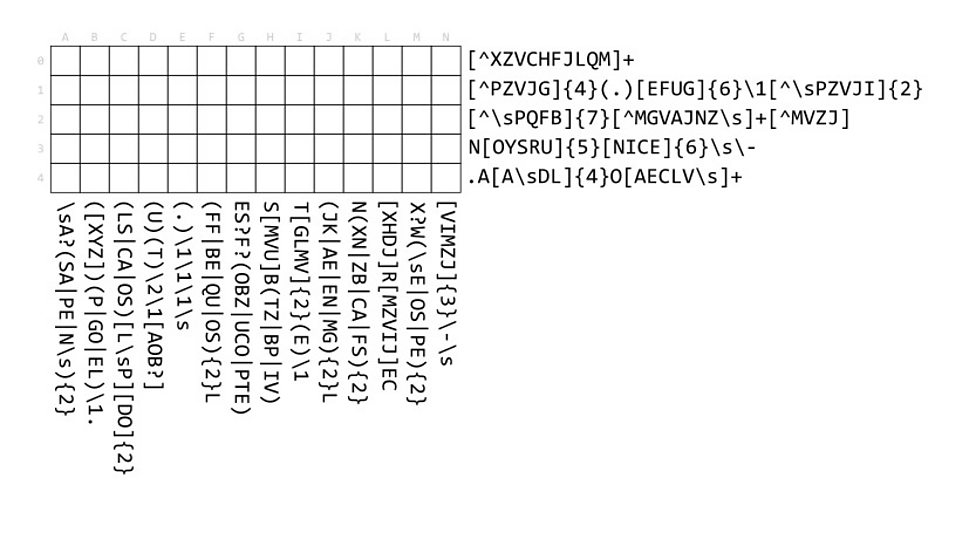
Regex Puzzle(bbc.co.uk) |
Regex Puzzle(bbc.co.uk) |
I always end up spending a fair amount of time using tools like:
And of course stackoverflow.
Very useful when code reviewing other people's regular expressions.
Links :
https://www.microsoft.com/en-us/research/publication/symboli...
https://www.microsoft.com/en-us/download/details.aspx?id=523...
It now seems to be Open Source (MIT):
But I guess if it's meant for an audience of folks not very familiar with regexes it's difficult enough as it is.
[1] https://www.ncsc.gov.uk/news/take-our-regex-crossword-challe...
https://devjoe.appspot.com/huntindex/puzzle/mit2013601
PDF: http://web.mit.edu/puzzle/www/2013/coinheist.com/rubik/a_reg...
The puzzles generally don't tell you how to extract the answer, but the idea is you know it when you see it.
Some implementations: https://github.com/ekmett/ersatz/tree/master/examples/regexp... https://gist.github.com/LeventErkok/4942496
For example, you can split each one of these regexes up into smaller ones based on positioning. Now some of them are simply "match any of the following characters" which can be combined together with set intersections (and something similar with "none of these characters).
The published solution says H0 should be "S".
Guess nobody tested it.
I suppose the two main benefits are
(a) neither the writer nor the reader has to remember which punctuation characters are meta-characters (you just have to remember that it's always a literal if it's escaped), and
(b) in implementations like PHP's which try to replicate the Perl-style 'delimited' syntax (e.g., /foo/), it prevents characters in the pattern from conflicting with the delimiters.
Maybe there's some other advantage but i can't think of what.
The designer is local so if they no longer stock it you could look online...but it's better to get it from the shop if you can.
I am toying the idea of writing a little game where player A thinks of a regular expression, and player B tries to guess. If B guesses right, they win. If B guesses wrong, A has to provide a false positive and a false negative (if they exist), and B gets to guess again.
Can you think of ways to automate the roles of A and/or B?
A classic algorithm for inferring regular expressions was given by Angluin: https://people.eecs.berkeley.edu/~dawnsong/teaching/s10/pape...
(This isn't quite the same setup as you're thinking of but there are a ton of variations on the basic idea)
Automation of regular expression generation, it seems easy : use RE fragments and aggregate them, or walk the type hierarchy of the RE AST and generate them randomly.
B needs to guess A's RE so we need to generate examples of strings belonging to it to gives hints : this is exactly the use case of AutomataDotNet.
Also if B guess a RE that is equivalent to A's RE it seems unfair to not attribute a win, so we need to tell if 2 RE belong to the same equivalence class. AutomataDotNet does have a AreEquivalent method.
You can automate the generation of false positive and a false negative with the method Minus to creates an automaton that accepts A-B or B-A and generate an example.
The \1 is from the original puzzle, and refers to the value of the first (capture group). I ran into this issue while filling out the puzzle. The \1 is required to 'propagate' the value in that square to other places. The puzzle is ambiguous without this fix.
Thanks for the pointer, I've added the note in the comments. Hopefully the puzzle is editable.
Lovely puzzle, and it's a great quote. :)
For an n x m grid, you can encode any CNF formula with n clauses on m variables. See here if you are unfamiliar with CNF: https://en.wikipedia.org/wiki/Conjunctive_normal_form
[^PZVJG]{4}(.)[EFUG]{6}(.)[^\sPZVJI]{2}
should be
[^PZVJG]{4}(.)[EFUG]{6}\1[^\sPZVJI]{2}
(note the \1 )
You are right about the equivalence classes: for that you want to talk about the corresponding DFA (which have a unique normal form in the shape of the minimum DFA).
I am not sure about the rest of what you are saying: in general even just minimizing regular expressions is EXP-SPACE complete, if I remember right.
Yes, generation of false negative and false positive ain't so hard---theory agrees with you. But automating the guesser is, as far as I know.
I'm basically interested in the equivalent of the "guessing game" for regular expressions. (See eg https://stackoverflow.com/questions/5440688/the-guess-the-nu... for a rational number solution.)
With a fixed guesser, that would encode all regular expressions / finite automata as sequences of binary digits. (But in a interestingly different way from just serializing the table for a DFA, or writing down the regular expression in ASCII characters.)
You don't always get to pick the flavor of regex engine you're using and I've sort of become (partly because of RegexBuddy) the "regex expert" at the office. Aside from `re` in Python I don't even remember the names of the regex libraries. Why should I?
I would love to be able to remember regex specifics from lib to lib and app to app, but try as I might, I can't. I never know if I have lookaheads or backrefs or named captures available and what the syntax is, I can't remember if there are named character classes. I end up reading the docs, again, almost every time I dig into a regex problem. Same reason for me- I use too many flavors of regex libs. If I could stick to one language, I'd have some hope.
I haven't tried RegexBuddy, but now I'm going to because of your comment, thanks for sharing!
Find some awesomeness here on HN -- there's a lot of that too -- and comment about it. Build something and show it off or support someone else who's built something cool. Write comments that contribute meaningfully and are positive and you will find more upvotes than you can possibly imagine, if upvotes are what you're going for. And you're right, you can find lots of upvotes (and downvotes too) by judging other people's legitimate choices without even bothering to understand them, but that doesn't make HN a better place, it doesn't help anyone learn, and it might not make you happy in the long run either, even if it's fun for you at the time.
We get to decide if this place is cool and supportive and fun to play in, or lame and thorny and dangerous to share any of your thoughts for fear someone will be an ass about it and insult your choice of tools. I choose the former, and I'm happy to spread the love and request that people refrain from trying to knock others down or engage in flame wars.
I generally upvote people who reply to me just as a way to say thanks for reading what I wrote and engaging with me. Here's one for you. I hope you'll find more peace on HN and get exposure to more of the positive side of it. There are some incredibly amazing people here, and it's true there are also some destructive forces too. I hope you can let the crap roll off and seek out more of the good stuff!
The built in regex step-debugger is also great, though I've learned that if I have to rely on that, it's probably not a task well suited to regex.