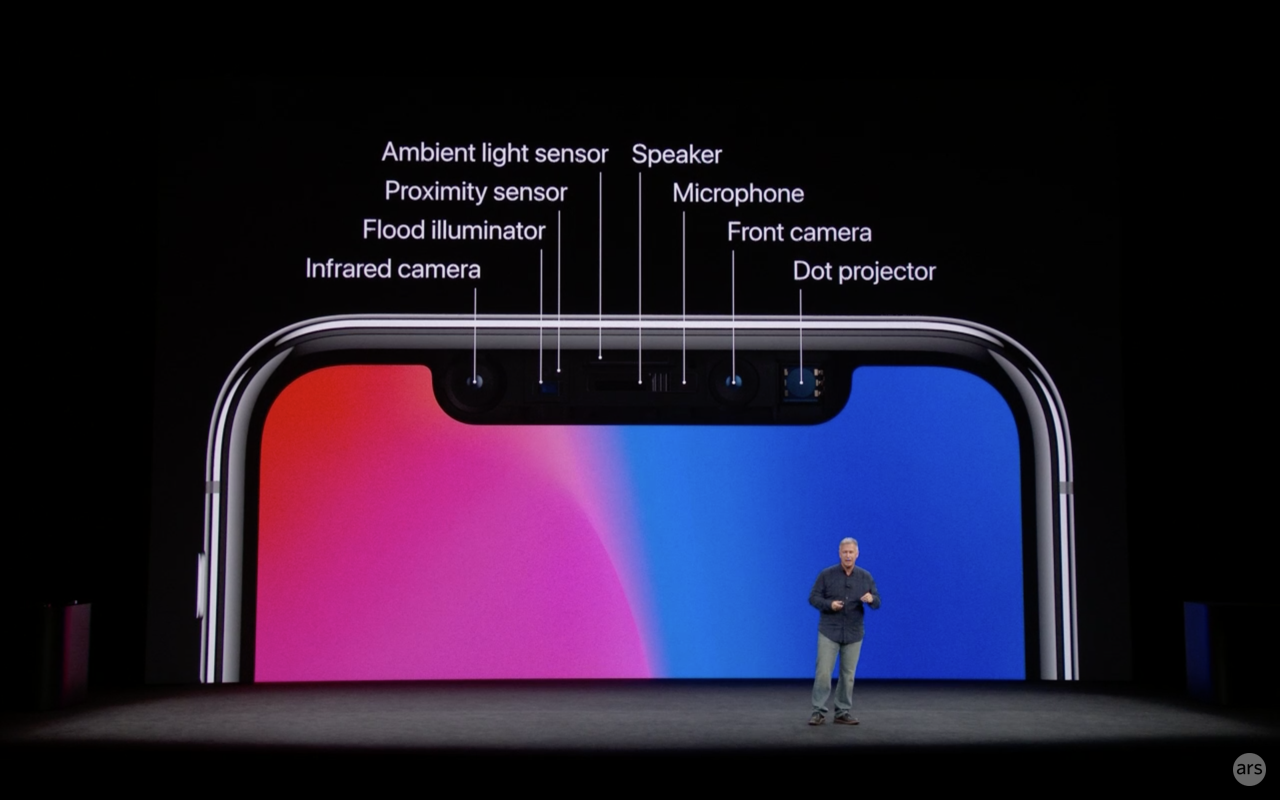
iPhone X(apple.com) |
iPhone X(apple.com) |
- Case 1 : Imagine crossing security check or border crossing. Guards just take your phone and point it to you : UNLOCKED . No need to resis to give passwd
- Case 2 : drug the activist and point unconscious victim ! Voila !
- Case 3 : Steal the phone, and change the cover and flash it in front of the real owner !
could go on and on ...
Obviously the "hype" for a new iphone is still up & running since there is a thread for not yet officially announced device...
Doesn't Apple announcing it at their "Special Event" count as an officially announced device?
"Please refresh for updates"
Besides there is a new thread ( https://news.ycombinator.com/item?id=15229902 ) for the same subject - nothing offcially started, yet several threads for it.
Anyway, it will be fun to see if this one will hit 1000+ comments :)
That would be a perfect jump off point to AR glasses with the phone as the computing engine in 2020.
It would let Apple re-focus, kill a bunch of product lines and swallow the market with a singular device + robust peripheral market.
* Sleeping victims * Attacker holds the phone to your face
Its not as simple as using the 'wrong finger'. You only have one face.
This is awful, Apple. What were you thinking?
If you have people in your physical space while you sleep that you cannot trust to not mess with your phone, then you have other serious security problems.
That being said, I also prefer Touch ID because it still appears to be much faster. But it offers no additional security over Face ID, and based on what was said, Face ID is more secure in other ways.
so the iPhone 2x will have no speaker or camera in the front... or they will be behind the screen.
I don't have an iPhone and don't plan to have an iPhone, but this is going to be a surefire hit feature for Apple, and I expect other platforms to try to emulate it pretty quick.
Also, a friend of mine pointed out how popular it will be among the furry community. :)
What's your specific privacy concern in relation to the presentation given?
They have already been doing this for quite awhile. With their practices on device encryption, public stance on cooperating with police for unlocking devices, etc, they have made it a key differentiating factor between them an Android in many ways. And when it comes to security and privacy, you are incorrect when you say that all phones today are the same.
Throughout HN comments for the last couple years, it seems to be widely acknowledged that Apple offers the best privacy of the current mobile industry.
Not every release can be amazing, but this is just an incremental hardware upgrade with some features taken out.
Meanwhile, they haven't fixed any of the most infuriating and annoying iOS bugs, and don't seem to have any plans to do so...
The new photo features clearly showed how it will be used by the Instagram crowd as well.
For instance if I'm using an app right now I hit the home button and it take me to my home screen with all of my app icons. How do I do this on the iPhone X?
That would be neat to attach it to my wall. And it would open up a lot of options for car holders.
Even if you question their design decisions, it's hard to fault their product strategy
Why are the 6S and 6S Plus still there? Why no love for the iPhone SE? It's now two entire generations of processor behind.
What I am more disappointed about is Apple not going with a curved display. It looks amazing on the S8 and taking it edge to edge would have made for an incredible bezel-less illusion.
That, and I'm not all that jazzed about Face ID. Seems less secure than touch.
The screen is a fair bit larger
https://9to5mac.com/2017/09/06/iphone-8-compared-to-iphone-7...
More PPI sure, but I think we reached the point of diminishing returns a while ago.
(Ignore the headline - the opening image is an X set next to a 7+)
That said: I go through at least a screen repair, maybe two, for a phone.
If I calculate the price of phone + 1 extra screen, it's probably looks even worse for the X.
My daughter likes to "steal" my phone to play games on it. With touch ID, she can't. She wouldn't have a problem if the phone has Face ID.
For me, from reading previously leaks, this feels like a compromise where design (we want a phone that's all screen) wins out over usuability (TouchID is great for usuable security)
sorry but "neural engine" is just too funny. i mean there's normal levels of bullshit bingo and then there's branding your chip "neural engine".
BTW, wondering how fast until there is "3D print you GF face so you can unlock her phone" service. I see Ali Express business booming.
Haven't we seen such phones from other companies already a thousand times over?
Everything is done on device and the device is sealed tight enough to make hacking impractical for everyone except for state level actors.
- force touch an image to view fullscreen
- force touch app icons to open a quick menu
- force touch buttons in Control Center to open a menu
It's like a quicker touch-and-hold action in other operating systems, although sometimes there's also a touch-and-hold action in iOS which can be annoying.
It initially came off as a gimmicky way of 'right clicking' but has evolved into more than that. Software has also been refined since first release.
Also wonder if this "security feature" is NSA-approved, m pretty sure it is.
I wonder if the plan is to keep refreshing the iPhone X into the future, like all other X/10 versions seem to do.
:-)
See Windows 10.
I think the iPhone excitement is mostly a US thing. For a lot of people here, it was the first smartphone they saw - or even their first mobile device.
It's hard to get excited about iPhones when you're used to more modern technology.
More to it than that from what I see here, but that will get you started
Biometric has the same issues regardless of touch or facial recognition.
(mandatory https://xkcd.com/538/)
Or am I a transplant from that weird parallel universe with "Mack Oh Ess Ecks" and the Berenstein Bears?
Sounds more useful and secure to me than any fingerprint/facial scanner. And it allows Apple to sell more watches.
Let's watch Spider-Man with a rounded screen
How is this worth over $999?
Or you can use the "panic" mode on iOS11 and force it to ask for a passcode.
Oh, and panic mode? Cop sees you doing that, you've obviously got something to hide and they can act then and there. Not a very smart move.
This is reality. You may not like it, but you're part of the reason it is what it is.
This is a thing, has been for a while.
"Celebrity gets iPhone stolen. Naked photos unlocked at wax museum." :D
Wish Apple had the balls to just plain steal it, the iPhone home screen nowadays seems from last century.
I just want it. But i know i have absolutely no need for it.
"Face data protected by A11 chip's secure enclave. On-device processing."
Looks like its using a dot projector for the depth sensing (similar to the xbox kinect).
Loved that phone.
From wireless charging to FaceID it just feels like a bunch of incremental, gimmick-y changes.
But the problem with that is that the regular iPhone screen is unbelievably good already. Why would people pay so much for the improvement?
I probably have to swipe carefully from the very bottom or stay away from the bottom?
Also, there is always a big obvious bar down there.
- No USB-C
- Gimmicky features
- Protruding camera
- $999
and add this:
- to access Ctrl Center, every time you have to swipe from the top right corner of the screen, on a 5.8" screen for God's sake...
- Less space than a Nomad
- Lame.
Let's not mince words here, this thing is gonna print money.
> So what does a decade of iPhone innovation look like?
> Developing… Please refresh for updates.
> There is no formal definition on what constitutes a "surgical stainless steel", so product manufacturers and distributors apply the term to refer to any grade of corrosion resistant steel.
But yeah, I think "surgical" is used the way we used to say "space age plastics" and such.
Beside, we're making phones, not doing surgery. What is that even supposed to mean to me the phone consumer? I understand that I'm supposed to think "better" because "surgical", but for all I know the standards aren't all that high because it just needs to be sharp, not durable.
IOW, it's just marketing, just like "military-grade encryption".
So surgical tools are instead produced for single time use, and after that recycled, to ensure they’re always sterile.
EDIT: For example, with scalpels, you can remove and replace the blade, and do exactly that after every use. Removing and replacing the blade looks like this: https://qph.ec.quoracdn.net/main-qimg-dc86caa627022bbfb7e6b4...
As to banks, I'm fairly sure (although I have no inside knowledge) that the banks won't have been allowed to review this technology in advance of the release, so they have no real assurance here.
You can of course assume it's secure and as usuable as TouchID, but I'm guessing the devil will be in the detail on this one.
Lower cost items are not reused (a scalpel, which might simply be a piece of plastic attached to a blade).
So stuff like scalpels, for example, is recycled after every single use.
Even such simple things as prions actually already require far more complicated autoclaves than you’d expect.
- "bezel-less" display
- wireless charging
- no hardware buttons on the front
- facial recognition
- dual cameras
Not to downplay the quality engineering of Apple, but this seems like a big "meh..." to me. A lot of hype for stuff that is commonplace.
edit: so does /iphone-6, but not /iphone-6s..
How's that Fifth Amendment thing working out for you?
EDIT: There's legal precedent that specifically says you can be compelled to unlock your phone with your fingerprint, and that's not "testimonial" (that is, your right against self-incrimination isn't in play). There is zero reason to think FaceID will be treated any differently.
Interesting twist. There was advice going around for protestors to disable Touch ID as cops need a warrant for a keycode, but don't for a touch ID. Not sure how accurate that is, but presumably you can disable Face ID if you think you're at risk of being shaken down by the police.
Edit: As only one example you could in theory program a finger that wouldn't typically be used with touch id.
Just look away or close your eyes.
I know it kind of goes against how their Camera app and system works, but I really wish that Apple would (or will) enable RAW shooting from within the default Camera app. I use a separate app, besides for the special features like level and white balance adjustment, for the RAW shooting. I feel that it's kind of put there because it's available but they don't really care about it -- you can tell from the fact that the Photos app doesn't properly show RAW photos. It would be great if you could seamlessly take a photo and be able to take and export the RAW if you enabled a flag in the settings, just like how 4K was/is hidden behind a flag.
The other gripe is now the control center is from the top, rather than the bottom. I use the control center often when controlling music and the flashlight and it makes it less usable for one hand. In fact, I'm wondering how the "swipe from the bottom" will work with apps that take over that gesture, because I run into a lot of issues with trying to open the control center but being annoyingly overridden by the current app. I'm hopeful but hesitant that Apple thought of this and worked out kinks regarding this.
Didn't help too much though re: leaks.
1- https://en.wikipedia.org/wiki/FCC_Declaration_of_Conformity
FTFY FCC has no authority outside US
One button without an always on back button was already a turnoff for me, but no button at all? at least android has swipe from the bottom.
FaceID instead of TouchId will remove a lot of use cases people got used to - no longer answering texts in meetings anyone?
When they showed a video playing in landscape I could only facepalm.
They even demonstrate that it recognizes you with facial modification like a new beard, a new haircut or a new pair of glasses.
By bet it that this technology is totally overblown and circumvented quickly.
That was using primesense. Apple bought primesense. I'm sure they're doing something similar
They also said that they got special-effects artists and other things to work on it and try and make it hard to track. I imagine it's going to take a lot more than a simple 3D printed head to trick.
We all knew as soon as this phone is released people are going to start trying to break this, it should be fun to see what people find.
Press release: https://www.apple.com/newsroom/2017/09/the-future-is-here-ip...
I have yet not watched the release and read the technical details but I am more than slightly concerned about “Your face becomes your password”, while it’s obviously optional so security conscious people by no means have to use it, I’m not confident that it’s a sensible idea to promote the widespread use of what is known not to be a secure, private piece of information that you can change or choose not to use.
However, in my opinion Apple is by far one of, it not the most security conscious large corporate manufacturer of hardware and software and generally tries to know as little about your personal data and promote encryption (FileVault, forced phone encryption etc) as much as possible while maintaining practical use for general public. So I am very interested to see what makes this so different from Samsung/Google’s failed and easily bypassed face unlocking they were very vocal about but ultimately was an embarrassing security and PR failure.
For those of us who enjoy one handed use, the SE still seems unmatched.
I have bus times on my lock screen, one swipe to the left away. That seems to become obsolete if the phone automatically unlocks when I look at it.
Additionally, swiping up from the bottom is the single least effective swipe for me. Pulling up Control Center fails for me more often than not, with the little "looking for me?" rectangular handle popping up on the bottom, and still it doesn't work well.
I wonder also what this means for screenshots; with no Home Button to push along with the power button, what do you do? And what do those screenshots even look like, given the ears at the top of the display?
Face recognition (other than Face ID I mean) is fairly advanced. Let's say a government wanted to unlock my phone they could search for similiar faces and just pay the person. Sure a lot of trouble for unlocking a phone and it's theoretical but it's still a flawed system in my opinion.
Which is insecure. I use a 25+ character random alphanumerical password that I change at least every six months.
If they don't add any value to me, I don't really care.
> Or the longer battery life?
Doesn't justify $300+ price bump
> Or the 4+2 core chip?
New chips come out every day and they are priced at the same price or lower than the older generation at the day it was introduced.
> Or the reengineered OLED?
You mean the one similar to Samsung S8?
> Were you actually sleeping during the announcement? Serious question.
Why do you have to be offensive?
anything which cost more than S8 must have serious benefits over S8
With Windows 9, there was at least the explanation that software might confuse it with Windows 9x (which I didn't buy, since there is view api returning the version as a string, and Windows shims GetVersion if you don't declare compatibility anyway).
More on topic, this looks nice, I think people will not be disappointed like they were with the MBPs. Can't wait to try it in a store (and probably can't afford it either...). Edit: no touch ID?? Might have spoken too quickly...
They may also be trying to indicate that they feel this iPhone is on a par with OSX for productivity or something.
1) Touch status bar to scroll to the top of the page(my favorite iPhone feature).
2) Locking the screen. I'm assuming the double tap and Siri don't interfere with this.
> iPhone X is splash, water, and dust resistant and was tested under controlled laboratory conditions with a rating of IP67 under IEC standard 60529. Splash, water, and dust resistance are not permanent conditions and resistance might decrease as a result of normal wear. Do not attempt to charge a wet iPhone; refer to the user guide for cleaning and drying instructions. Liquid damage not covered under warranty.
I wish they had enough confidence in their water resistance that they would cover water damage to some degree in the warranty ...
You could unlock Samsung phones with photographs [1]
[1] http://www.businessinsider.com/samsung-galaxy-note-8-facial-...
No, they didn't. What Samsung did was release software that mimicked facial recognition. In fact, it mimicked it so well, people were convinced that Samsung did it first. What Samsung actually did was implement software that would sometimes coincidentally "recognize" a face, and more often would "recognize" a photo of the target user. What Samsung didn't do was implement facial recognition that was reliable and secure, which I think is what most people think of when they think "facial recognition".
I just don't see a security model in which Apple has substantially improved it. The security of it is terrible in either case - all Apple did was make it more expensive.
No way unique to Samsung. Every implementation I've seen fails at this, even the latest one in Windows 10.
If you care about security, don't use it. That's my advice.
They've survived both in the past.
"No wireless. Less space than a nomad. Lame." [1]
[1] https://slashdot.org/story/01/10/23/1816257/apple-releases-i...
Being first with a crappy solution is not exactly ideal, either. We'll see if Apple's solution is that much better - I don't really trust any face recognition tech, but the 1:1,000,000 FAR ratio vs 1:50,000 for fingerprint looks promising at least.
Not even copy and paste.
Adding more expensive components to a phone, doesn't make its value go up if it doesn't add some extra functionality or durability or something.
The array of components for FaceID are just replacing TouchID, so for the consumer the net value is 0.
I don't care what they have to add to make it work, what matters to me as a consumer, is what value I get out of it. And at the moment it looks like a net of 0.
You see why I say "I don't care"?
Like I said, that's all speculation. From what I can tell based on the shade of gray of your comment, you received at most a couple of down votes. It's really hard to distinguish between something meaningful and noise here, particularly in a hot-topic thread like this one. At the end of the day, I think I'd just make a small mental note but otherwise just chalk it up as collateral damage in a heated thread.
This is the first time Apple have given in to OLED displays and wireless charging (and a standardised one even) - both relatively old technologies [1] which were at their disposal during Steve's time.
From what I've seen the corporate secrecy at Apple will make such conclusive investigation next to impossible. What I often think of is NeXT and Steve's return that saved Apple in the 1990s.
[1] http://www.gsmarena.com/qualcomm_taunts_apple_list_android_f...
> Like I said, that's all speculation.
Grr. Scratch that "Like I said". The second sentence is meant to be that my take on the down votes is speculation. The editor regrets the error.
I manage just fine with a 25+ character random alphanumerical password that I change at least every six months. I only use Touch ID when I'm home and am very aware when entering my password. In the end it's just a phone but I like to have it at somewhat secure.
(from https://en.wikipedia.org/wiki/Cut%2C_copy%2C_and_paste)
Sure, a useless system is technically safe but it's still useless.
For laptop and desktop computers this should be the standard in my opinion, at least 20 random chars if you value your privacy and care for security. Once your inside the system you can use a password manager to use passwords as long as possible without any notable impact on user expierience.
But I haven't said I'm the average user, and a six digit passcode just isn't secure I doubt you'd argue on that point?
For things like hard drive encryption where you can get the specific piece of hardware and have software brute force it then yes I agree it's insufficient.
Still expensive, but very much an attainable status symbol.
Lifting a working fingerprint and transferring it to a play-doh mold or a hi-res printer is a whole another beast.
Could be a different thing when somebody uses a quality 3d printer to print image that is based on detailed laser scan.
I say if you're willing to undergo major reconstructive surgery just to read my emails, go ahead, you've earned it.
Also, I stated capacitive, not multitouch, if that is meant a strawman.
Capacitive touch sensors that registered an X/Y position rather than a simple on/off state were also common in laptop touchpads from around the mid to late 90s. The iPod introduced a capacitive touch wheel to replace the click wheel in their second-generation model, released in 2002.
There were various capacitive touchscreen display devices around before the iPhone, but probably the most relevant to your query (and one of the most well-known, due to its similarity to the first iPhone's technology) was the LG Prada, a phone with a capacitive touch-screen announced about 6 months before the iPhone.
The thing with the iPhone's touchscreen wasn't that the technology was particularly revolutionary -- sure, if you combine enough words together, then you can make the argument that the iPhone was probably the first mass-consumed capacitive multi-touch hand-held consumer device, but you can remove any of those words and it was no longer the first. The revolutionary aspect of the iPhone was, in my opinion, the software that allowed the device to be controlled with the relative imprecision of a finger, rather than a stylus. The actual hardware to process the touch inputs was at best evolutionary, not revolutionary.
Neonode N1 had a different kind of touch screen (not resistive), but share a lot of features with the iPhone as well.
"I didn't mention multitouch, answer my question!"
"Oh, you're right. But it didn't have multitouch!"
No wireless. Less space than a nomad. Lame.
A few other quick notes:
1) Those short x-ray shots of the iPhone camera assembly look impressive. I wonder how many components and extremely-fine-scale positioning have to go into the lens system (especially since they have to move! =) )
2) The lack of TouchID seems like a hardware regression to me, but I'd feel more or less confident in that based on the actual experience of FaceID vs TouchID. On a separate note: the engineers working on that must be paid boatloads given how valuable they must be to the company, combining both machine learning + security knowledge. (Not easy to find people like that.)
3) The screen is nice. I don't understand why people are complaining about the screen extending "behind" the front-facing sensorbar, to be honest --- seems like a tiny, fixable detail in the scheme of things
4) I really think people will buy this phone for the camera, and not for many of the other features that were advertised. (not AR, not awesome graphics, not amazing aluminum and glass, etc.)
5) Anyone know what usage has been like for Force Touch? I always was under the impression that it wasn't that popular, but kudos to Apple for not dropping it and still believing in it.
Someone's going to build a toolkit that lets kids make their own CG movies with friends acting out all the roles. That's gonna be nuts and is just the start.
Sometimes i wonder if the people in the valley are so dumb or just so far ahead of the pack that foresaw a future were you can make a beautiful lie just to the take money from the big fish on the pond. // offtopic
I'm headed back to Apple after having an Android ever since my IPhone 4, I'm just done with Android. I love my 6s work phone.
I think I'll just be choosing between the 6s and a 7.
For me? Having a phone is basically the same size but with a bigger screen is a great win, as is the improved contrast and visual quality.
I can tell you TrueTone fantastic from using it on my iPad.
I've wanted the camera system from the plus size phones but again I didn't want to phone that large. So to be able to get an improved version of that in a phone that's almost the same size? That's another big win.
The rest is just bonus.
edit: meant CAD.
I'm pretty sure the 10.5 inch iPad Pro already is.
My understanding is that they do not want people to make a direct mAh capacity comparison to competing phones on the basis that iPhone can "squeeze out" more out of the smaller battery thanks to optimisations.
I can't get over the black bar at the top of iPhone X though. It looks like it has devil horns...
Still, I'm glad they're trying something different. I'm curious how it turns out.
Current apps ignore input that starts on the bevel and only detect it if it starts and ends on screen.
Ok, I stopped there. Now let's talk about the sociological impact of Apple.
Also speaking of Black Mirror, the first episode specifically, and the real world news story that reminded everyone of that episode… I'm sure David Cameron would love to unleash his inner pig :D
(The tech is cool, though. Actually amazing, that it fits on a phone.)
Like iPad replaced a log of information display in Public places like airports, Face ID could one day become our entry pass in many places.
But in the age of Trump, what if Equifax fate to apple?
Face ID: Don't go to sleep ever again
If you're worried about people living with you, I'd guess TouchID is already a huge issue.
// And they had a demo failure on their new unlock and swipe up for home.
Then, does someone become lower risk the more time and experience with a phone, like no claims, age and sex profiling on car insurance, or is the price of insurance the same whether the customer is a 25 or 50 adult male.
I have a shitty car and a relatively cheap motorcycle exactly so I can confidently leave them in the city without worrying too much.
is this a trick question or something? i'm not going to jump into a swimming pool on purpose, but losing my phone isn't something that concerns me.
Just put your phone number, address, and credit card details on your HN bio and one of our prestigious client grooming agents will be personally in touch with you at your earliest convenience…
New models are waterproof, dive in ;)
But, I completely agree with you otherwise. This thing is just too nice to keep in my pocket all day. Plus, I'm too spoiled to appreciate it. It's like the most awesome, user friendly camera known to man, with an onboard computer and phone -- and I'm not sure I care enough to use it.
Also personally over last 10 years I lived in different parts of the world including Europe and Asian countries and worse and none of my devices or personal things were ever stolen and I only break few devices. So might be it's just less of problem for some especially considering many people rarely go outside of their usual home / office or travel to countries with high risk of theft.
But there are other reasons too.
I've owned every iPhone from day one and use them without a case and without insurance. I've never had anything broken. I've never had anything stolen either.
Different companies target different demographics who have varied preferences and utility functions.
Just parking my car is a risk of a sudden $1000 loss, even with insurance.
I assume they are doing this mostly because of an inventory surplus combined with "Pixel 2" less than a month away but it's still nice of them to do it even though these phones are a year out of warranty for a lot of people getting these replacements. Even with the Pixel 2 out they could likely sell the older Pixels for a few hundred bucks.
I think AppleCare+ insurance is a good deal here. I use the phone wherever/whenever and never sweat smashing it to bits. It also means I never both with screen protectors or cases (except for ones that add grip or just look interesting).
Given that I have a pile of four generations of smartphones sitting on my desk waiting to be recycled, it's also easy to visualize that brand new $1,000 iPhone X sitting in that pile in a few years time. The new phone looks great, but the marginal improvement over my existing phone doesn't look like it's worth $1,000. (Particularly in light of the opportunity costs involved.)
I never understood why vendors keep mentioning "thin" and "sleek" in the marketing, when most people end up getting a case which in turn makes it thicker than a 10 year old flip phone.
If we purely compare prices without tax then 999$ are currently 835€, compared to 965€ (1149/1.19) on the german side. Or as the original post was about CAD, the 1320 CAD are 905€, which is somewhere in between. Which means before taxes the phone gets already more expensive here, and after taxes even more. But this is nothing new for the iphone X and also not limited to phones. Electronics are usually more expensive here.
> if not, what would be an identical EUR price for the $999 phone (tax not included)?
The question is what is an identical price? Based on end-user price and actual exchange rates? Maybe 920€, since that should be what is costs in the US after tax. Based on the average disposable income in the target markets? Don't know. Based on what people are willing to pay in each market? Or based on what the phone manufacturer simply wants it to be priced in each marked?
> Based on what people are willing to pay in each market?
I'd expect it's largely based on that, and that Apple has put a good deal of thought into what they can get out of you guys.
I think it's totally fine actually... I'm sure there are several strange scenarios where FaceID is cumbersome because you can't point your phone straight at your face, but in those scenarios you can always just type your passcode.
That in combination with scenarios where FaceID is more available than TouchID (wet hands, for instance), I think it probably evens out.
1) Scroll to the top of the page https://www.youtube.com/watch?v=pvJDXTNblbQ
2) Hold home button to activate Siri without unlocking phone. There is no Google Assintant button on most Android devices except the Samsung S8. I want to be able to activate with headphones on while in my pocket without having to count on Ok Google.
3) Album covers are displayed like this on Android. https://img.gadgethacks.com/img/25/61/63562663618448/0/disab... While on my iPhone it looks like this http://community.oppo.com/en/forum.php?mod=oppo_attachment_x... I want to see the entire album cover.
4) The battery life is better on my iPhone especially when listening to music.
The apps are slighty better in my experience. Want an example? Spotify allows reordering of songs on iPhones but not Androids.
1. "Play album x____" used to work in google uh... assistant? Now? Whatever it's called now. Now it doesn't. I remember it working on my iPhone 3gs waaaaay back. Does it still? How about "next song" and etc?
2. How is Google app integration? Even if I make the switch, I'm not going to be using apple suite of calendars and whatnot, my company uses google suite, and I do not like spotify and will continue to prefer Google Play Music. Do those apps work well? (Calendar, Google Play Music, Inbox)
3. You ever hear of someone with a google voice number successfully using an iphone for SMS? I have to use the Google Voice (good) or Hangouts (shit) app for texting, and I need a data connection to do it. I have my reasons for this, is it possible on an iphone ?
2. The Google Suite works well enough for me on both the iPhone and Nexus. To be fair I actually use Gmail and Google Calendar on my iPhone so there really isn't much of a switch. Google Play Music seems to work just as well on my Nexus as the iPhone in fact I sometimes play music off it in the car because it has a headphone jack. I have not encountered any Google Apps that work better on the Nexus vs iPhone except probably Google Photos because it won't sync in the background for the iPhone.
3. The apps last time I used them were identical. I have had connectivity issues/dropped calls when using G Voice years ago.
Started with the original iPhone, to iPhone 3, to iPhone 4, switched to Android for a few years and the last one I had was the LG G5. The customizability is awesome in Android and I made use of 3rd party launchers to great effect. To me, Android's strength is the ability to get the information you want fast.
I'm still frustrated by this aspect with iOS (I have an iPhone 7 Plus now). Android OS UX is streamlined -- I feel like I have to fumble a bit to get to the app / information that I want in iOS.
But I went back to iPhone because the interop is better (I use an MBP daily for work/personal), apps are better, battery life is better, camera is better, phone is better, etc. It's just better hardware ... at least compared to my experience with HTC and LG phones.
Also, another nice thing is that the Android app sizes seem to be about 1/10th the size of comparable iPhone apps.
Of course this sync should happen directly between our devices when they are on the same network. No need to go through the cloud.
By default if her phone rings it should only alert on her primary device. Unless she authenticates to my device at which point everything is there waiting. If her phone was ringing and she picks up my device and authenticates it should answer the call.
Ideally this is all smooth enough that we have matching devices and don't care which one either of us walks out of the house with.
The end game is that when networks are fast enough, the cloud mature enough, and homomorphic encryption performant, we get to the point where the phone basically lives in the cloud and anyone can pick up any iDevice, authenticate, and be looking at effectively their own device.
Every Apple device, from Macbooks to iPads to iPhones to Airpods is built to be a personal device. Even Macs, theoretically capable of multi-user, are a pain to share (eg try updating a Mac App Store app purchased with a different user account than the one you are logged in as)
Apple doesn’t want to sell one shared device to a family. They want to sell multiple devices to every family member.
So Apple devices are actually closer to being a PC than what we commonly call a Personal Computer.
I think the ideal should basically be that. You can pick up a phone, any phone (limited to iPhones for Aplle), login to your iCloud account and suddenly it's your phone, indistinguishable from the other phone thst was yours, outside maybe unavailable hardware features.
That's one of the great things about web apps. I can log into Gmail anywhere and it's the same thing. I haven't used it, but I believe this is the promise ChromeOS delivers.
I don't think this is the right end game. Now that almost every adult in the 1st world has a mobile phone in their pocket that is more than capable of being a desktop PC, the solution we should be heading for is universal docking stations (preferably) wireless. So that wherever you are, there's a large screen+keyboard+mouse (or the phone screen can be a trackpad) and your phone just connects to those, be it at work, or home, or in a hotel.
Your main machine is in your pocket; a lot of non-techie people don't even have any other personal computing device (laptop/desktop etc.).
Personally tho, I like having a division between my work machine(s), and my home machine(s).
In any case, my desires are for the opposite. If you don't own the storage substrate, you don't own the data on it, and I prefer to own my data. I have an iPhone, but don't use iCloud, except for syncing a couple specific things.
I remember the first release, and remember the NeXT model of "home directories on an optical drive". I was really, really hoping at the time that the iPhone would be that home directory, portable between machines. Now, I join the chorus of folks who think I should just be able to plug a monitor and keyboard into my phone. But that also needs to come with a viable computing environment, which for me means a unix shell and hardware control. Which is why I'm bolting for an open phone, as soon one actually gets off the ground.
Imagine you walk into an Apple Store and pick up the latest iPhone XV. And there you are looking at your phone, your contacts, your apps, everything.
Underneath, it's a virtual shim. In the first instant it's merely grabbing thumbnails of all your apps and notification metadata so it can "look right". As you click in, scroll around, you polyfill data as you need it. Obviously in some cases a more substantial download would be needed, so you may not be able to pop into an AR game with 1GB of assets within the first 10 seconds of picking up the device, but if your primary is on the LAN you could bring the necessary data locally in ~5 seconds from tapping the icon. Underneath it's doing something analogous to "docker run" on that apps image. In some cases this would lock the image from running concurrently on another device, in other cases multi-master could be fully supported with live sync of the backing stream, e.g. for Apple Mail.
Imagine anyone points their phone at you in the street, and there they are looking at your phone, your contacts, your apps, everything.
polyfill definitely doesn't mean what you think it does.
Personal devices are personal for a reason. Simple, elegant, effective. Expensive, yes... but a better solution is to buy your kids cheaper phones.
Literally every single person in the world with an iPhone and young children wants this feature.
I'm guessing based on your proposed solution, you probably don't have kids? They don't want their cheaper phone; they want your phone.
So, it doesn't have to alter the security attack surface or really even a major change in the secure element.
Someone from Apple should just reach out, the design is not simple but it's absolutely workable.
Walking out the door with just "any device" that is laying about? Nobody wants that. For one thing, an object like a phone is a personal device, not a sugar bowl passed around and left anywhere.
Your son and daughter will want their own devices, and it makes sense to give them their own devices such as your old phone or cheap phone. For one thing, when you hand your kid your phone you no longer have a phone. Someone might text or call, or the kid will burn through your battery with some game.
This only scratches the surface of what's wrong with your idea.
They obviously already have this tech most of the way there and just... haven't implemented it?
Unfortunately Apple don't get to decide how SIM cards, phone numbers and the cellular networks work. So that's not going to happen. Note how the watch has to have a SIM mated to your phone to take calls on your number.
As for FaceID and TouchID, that data isn't supposed to be readable at all, it's never sent to iCloud so how would it get synced between phones?
Then there's storage, all the contents of all your family's devices would need to be syncd between them all the time, multiplying up the amount of storage each device would need. You'd completely lose control of managing storage on your own device. You'd also essentially lose control of wireless bandwidth utilisation.
It's a lovely dream and maybe one day we'll get there. None of these problems are unsolvable in principle, but nobody can wave a magic wand and make them all go away. I think in the same way secure resource and feature sharing between apps required Apple to develop Secure XPC, this would require a lot of fiddly, complex technological and infrastructure groundwork before it could be possible.
Maybe there are limitations like needing to be on the same WiFi network or some such.
*By everyone I mean the majority of people in first world countries, some second, and third.
As for this feature request, I think it makes sense... I wouldn't want my kid tapping on my work email or social apps.
It's an interesting question how exactly the device switches to the remote profile mode versus an "authentication failed" route. If the profile has never existed on the device you'll need permission from someone who is live on the device (in other words you need to get past the lock screen) to retrieve a new profile.
But if two profiles are live on a device owned by identical twins who can't be distinguished by FaceID -- perhaps detected by trying to authenticate the human to both profiles and seeing if both pass -- you're going to need a PIN (or something else) to distinguish them.
I think that setting up multiple accounts would make the experience worse as I don’t want other people to get too comfy. On an iPad that is a different case though.
But I could really see this on an iPad. iPad's are often shared around a household, this would be amazing for that. Macs themselves would also apply here.
"Do you think that's air you're breathing?" ;-)
What I dislike most is handing someone "my phone" for them to use for a minute and they are actually using my phone. If they authenticated and were immediately interacting with their phone I have no problem sharing the hardware for a minute when the wife/kids want to do something briefly on it.
One shared device with multiple profiles for your family members VERSUS One device each for each family member
To understand how Apple chooses to prioritise, simply ask the question - "Which option makes more money?"
Concur on all the other points. Devices should be as transparent as possible. They're empty shells by design.
This is so obviously the opposite of what Apple has in mind. They want to sell as many phones as possible - not make them shareable.
On a more serious note, the most I think we'll ever see from them is limited web browsing as a guest user.
no, it isnt. and neither are your fingerprints. none of this publicly available data is a password.
a password is something i can change if it gets compromised. a password is secure from others.
biometric data is a username/id.
why do companies insist on getting this shit backwards?
also, some engineer at apple had to continuously grow a beard to test this
As far as this phone goes, I am really excited to see how it stacks up to the Galaxy S8. Face ID is incredibly enticing, but Samsung Pay is much more universal. The only thing that is making me want to retreat back to an iPhone is its inferior Bluetooth audio quality.
Well, with the birthday paradox, let's say there were, say, exactly 1179 people in the Steve Jobs Auditorium and they all had iPhone Xs. That's 694,431 unique pairs of people, and there would be roughly a 50% chance of two of the attendees faces unlocking the same phone.
That's not helpful for brute forcing a single phone, but it is mildly disconcerting that a security factor of only 1 in 1,000,000 is considered a "wow" factor.
Edit: Some people are asking, "But isn't that equivalent to a six digit pin?" Yes, of course. I am just opining on the marketing spiel for security not being nearly as impressive as it sounds. More boring features like the secure enclave play a much larger role in the security of the iPhone than the "1 in X" chance of a successful unlock.
What I cannot understand at all is the compromise in landscape mode, for games and video. Rather than just black out the uneven area and limit the drawable area to the largest unbroken rectangle, everything Apple shows appears partially obscured by the notch. The AR game example literally has the notch starting to eat into the UI. In my book, this leaps from "acceptable trade-off" to "bizarre sacrifice." It's like living with a cracked corner of the screen, right out of the box.
All these features are cool and somewhat exciting but nothing groundbreaking that will change computing/communications forever.
VR was supposed to be the game changer but it appears that it will also take around 4-5 years at least to be mainstream.
What do you think will bring the next revolution in personal computing and communications?
If so, this could be game changing for allowing the creation of VR spaces quickly and inexpensively. E.g., play a VR game in your real house after mapping it with your iPhone X. Or better, do a detailed remodel in VR before doing it in real life.
A lot of commercial uses of VR technology (e.g., construction, industrial design, etc.) can benefit from inexpensive, and accurate mapping. Today, the alternative is to get an architect to build a model of your house, to build a crude version yourself, have a Hololens/Tango phone/or other nascent and expensive technology.
If not, what truly is the game changing aspect of these cameras + specialized compute for machine learning/neural nets? They have to have thought through dozens of use cases beyond photos, animated emojis, and other trivial entertainment... right?
So... yes, developers will be able to get their hands on some of this tech, but how much can we do with it?
If room mapping was truly possible, I would imagine they would have done more in their demo with this, e.g. see the Hololens game where robots come flying out of walls, and hide behind your couch. That demo was more substantial than seeing a flat tabletop with a projected 3d game, or a projected 3d robots standing on a flat basketball court.
Otherwise that’s the dumbest design decision I’ve ever seen them make on the iPhone hardware. It’s worse than the protruding camera that they STILL have.
I love my iphone camera, and if the upgrade program isn't too terrible, I will get the iPhoneX, but call me underwhelmed.
The implementation of faceID seems really poorly thought out. I can unlock my phone, and navigate it before focusing my attention on it. I feel like "attention to unlock" is going to cause an increase in distracted driver related incidents.
>Thanks to this new design, the iPhone X is sealed for water and dust resistance.
So the iPhone 7, which does not use this design, was not water and dust resistant? I know this is a meta point, but it's annoying. Apple can say whatever they like in their releases, but it would be nice to have people familiar with the domain do a smell test on the content.
My 6s has a scuffed camera ring, and rattles when used on a table, due to its inability to lay flat.
> My 6s has a scuffed camera ring, and rattles when used on a table, due to its inability to lay flat.
Exactly. This was my first impression when I saw that protruded camera on iPhone 6.
Can anyone enlighten me as to why Apple are still using the Lightening connector here?
Some AR glasses? Self driving car?
Oh, another iPhone.
This indicates an error. When you have too many failed Touch ID attempts, the iPhone says "Your passcode is required to enable Touch ID"
After you restart your phone, the message is "Touch ID requires your passcode when iPhone restarts"
(it asks for your pin)
Double the...
This is similar to what James Cameron said after filming 'Avatar' that his vision was to create such a film for more than a decade but slow technology advancement was the reason he could not make this film sooner.
This mentality is why our political system is so disfunctional.
Is it? I thought it was simply a tongue in cheek response. Didn't seem entirely seriously to me.
However, Apple seems to just forget that people use their damn phones in cars. Waze is my GPS because no matter how much my car's built in GPS tries, it's not going to be as good as a thing connected to the internet. And in the car I hate to use the damn charger, so yay wireless charging right? Not so fast. Your choices are limited to a big clunky clamp style holder, or a little tiny magnetic holder that usually goes over one of the vents. Guess what? Magnetic holders don't work with wireless charging. Or rather they could, but the ones I've tried (available on Amazon) were complete shit that broke almost immediately.
There are several options to fix this problem:
a. Car manufacturers could include some kind of standard solution to this. At the least they could make a spot to easily mount a phone and make sure it doesn't obscure the driver's view too much while still being visible. Instead they keep insisting on adding bigger and bigger screens. Sometimes they'll go as far as adding a touch screen (looking at you Tesla) for no goddamn reason. Just give me a nice place to put an aftermarket phone cradle. Or at least don't add a 22" monitor where I want to put one.
b. Apple and/or Samsung could lead the industry in making wirelessly charging magnetic car mounts. It's not impossible to do, and magnets would actually help align the phone so charging is efficient wrt the induction coil used. Sure it has a nice glass back, but who gives a crap if I now need to add an ugly rubber case with a 2.5" steel washer to it just to get it mounted?
I get that Apple thinks CarPlay is their long term solution to this. But I think universal adoption by car manufacturers on that one is probably at least 5 years away. And even so, lifetime of older cars is like what 15-20 years?
This is why we can't have nice things.
You do realise the phone can still be charged with a cable, right?
Of course you can charge with a cable. But you shouldn't. Wireless only charging would be fantastic. They already got rid of the headphone jack. Why do we need a data port?
Also, having a dedicated spot on the dashboard would mean not having to run dangling cables all over the place.
1) The use of 3D data is a step in the right direction, but to use it reliably it has to constantly re-calibrate to the individual(s) it is supposed to pass. This is very important and a constant issue if using a person's 3D depth data as their face for authentication. My employer pioneered the use of 3D data for facial recognition, via 3D reconstruction, before scanning and depth cameras were feasible. In doing so, we became aware of the significant variation an individual's 3D facial form undergoes during any time period: different times of the day, yes, significant 3D facial form transformation; different days, definitely. Females significantly more, as they experience 3D form transformations simply from their menstrual cycle. Men who drink, less so than women, also gain significant facial form transformations on a weekly basis. Over the course of a season, everyone undergoes significant 3D form transitions, to the degree authentication is not reliable unless constant re-calibration occurs. Which introduces issues of system failure after indeterminate lapses of use, or sudden physical transformation - such as an accident, where your face is swollen. A person could be attacked, and their face altered to the degree their phone no longer authenticates. A person could fast for 2 days, not use their phone, and it will no longer pass.
2) They should be using multiple biometrics for authentication. The facial image in combination with the depth information, if treated separately with completely separate verification trained algorithms, only counts as two biometrics. Reliable authentication of a device attached to one's credit cards and finances requires a MINIMUM of 3 biometrics. They could solve that with the addition of Touch-ID or the addition of a pass code in addition to the face image and the face 3D depth data. But that borders on 'inconvenience', and I feel consumer pleasing stupidity. Sometimes being safe should require an extra step, simply so the consumer has the assurance their data is safe. It's like hearing the click as the lock on your door seals. Too automatic, and it's insecure because one never knows if it is active.
However, ignoring the face as authentication, the iPhone just became a very slick 3D avatar creator.
Hats/sunglasses/rain/lighting all cause problems for mobile devices and face recognition.
It'll be interesting to see if/how Apple overcome those problems
After OS X they never went to 11. They codenamed the 10.N versions but it doesn't seem likely with a "iPhone X 10.2 mushroom badger"-type name.
Best guess: they'll just call it the iPhone next year. Like some other products they'll just use the model year to distinguish. Guessing we won't even see the "iPhone XS", it'll just be "iPhone (2018)".
It looks really clunky to me.
If you're worried about law enforcement requiring you to unlock your phone DO NOT USE TOUCHID OR FACEID.
But how is Google going to ensure "full portability" across the lineup of all Android devices in the same way that Apple could do so for iOS?
Edit: Maybe this is what you meant? https://news.ycombinator.com/item?id=15234615
> why do companies insist on getting this shit backwards?
They don't have it backwards, but they're also simplifying when they say it's your password. In the presentation they actually say specifically that there's a chance that someone else can unlock your phone (1 in 50'000 for fingerprint, and supposedly 1 in 1'000'000 for Face ID, given that you don't have a twin).
Reality is that it's somewhere in between. A fingerprint sensor or face reader will keep casual snoopers - and most people who find your phone on the street - out. That's all that matters for most people. It's not a username. It's at least moderately hard for someone to duplicate, and it's not something you'd actively share with someone. It's not as safe as a password, but Apple isn't trying to claim that either.
I think it's a good idea to avoid false dichotomy here. Biometrics is biometrics. It should be treated as distinct from passwords or usernames.
Whether biometric access is a password or username is trying to force the wrong paradigm. Going back to first concepts, we had keys and we tried to make them hard to copy but not too inconvenient. The face is the key. No, there's no practical way to re-key this lock, but it's still a lock and key. But the door also has a deadbolt (PIN code) which has to be disengaged for the "face key" to function.
The username concept applies when you have multiple people using the same resource (and don't want to know or reveal whether any 2 people use the same password) -- which again doesn't apply to a single-user device.
Finally, all this combined with the quick "hard lock" of the device (5 taps of power button) gives me the impression of a very thorough approach to security.
Plus, as the parent said on the issue of not being able to replace your face as you can your password, they can still target your face data stored on the phone.
All you need is a camera over your shoulder and you don't even need to observe the key-presses as generally the current character is displayed on screen. You could likely observe 100s or 1000s of them a day with an overhead camera at transit stations and the like.
The same thing goes for "Tap And Go" contact less payments not requiring a PIN number under $100.
Everyone goes on about how people can run up a few hundred dollars at different stores with your card if they steal it. But consider exposing your pin to surveillance during most common transactions which then also lets you remove cash from an ATM with that card if stolen which is much harder to recover and is also much higher value than the generally $30-$100 limit for transactions without a PIN.
Next minute you'll freak out when I tell you I can clone your house key from a photo of it hanging off your belt...
The general point is that security trade-offs are generally deeper than you might realise on the surface, especially at "public outrage" levels of observation which so frequently haunt the public mind in recent times.
A fingerprint lock is way more secure than no lock.
Perhaps we can see more customization as to what biometrics unlock and what they don't?
Factors of authentication:
* What you know - things like passwords online that other people shouldn't know
* What you have - Two-factor tokens, certs (kind of "know" but used to supplement "have") that other people shouldn't have
* What you are - Biometrics like finger, face, or eye that are unique and difficult to duplicate or trick (ideally)
So the question becomes which and how many factors to require, and when, depending on the risk model.
And/or, you don't want to give Apple your facial or fingerprint information.
The neural networks have been trained to recognise them as fake faces.
'Sneakers' had it right. Consider it more of a "passport."
Identities both identify who you are and are, ideally, difficult to fake. Username password artificially handled those two concerns separately, but that doesn't mean that all identity schemes must do so. For them to say it's your password is wrong, but for you to say it's your username is also wrong. It can be thought of as both or neither but it isn't either one on its own.
For what it's worth, I would say that Face ID isn't quite a username either. Once known, anyone can reproduce a username. I can't easily recreate your face even if I know you well. That would require an extra set of skills/equipment. The same argument goes for Touch ID.
It's not perfect, which is why we have policies for accessing things. It's almost certainly a better security mechanism than a password.
That actually works very well between humans; we let friends in our house without asking for passwords. Machines still have a bit of catching up to do, but Face ID is a step in the right direction.
Which is why it's called "Touch ID" and "Face ID".
Username != ID.
That's a direct quote from the product page.
FaceID and TouchID are compromises for an actual password or pin. Also, setting these things up force you to set a 8 digit pin.
Anytime you go 24 hours without unlocking your phone you are also required to give the passcode.
Apple is just following suit with the trend.
Another neat feature in iOS 11 is the ability to disable Touch ID quickly, but touching the lock button five times. I assume this works for Face ID as well – this would help those who have immediate concerns that they would be coerced into using biometric data to unlock their device.
edit: updated to five touches
Edit: I agree with your statement that "a password is something i can change if it gets compromised. a password is secure from others." Which is why I like that there is a method for disabling TouchID/FaceID with iOS 11.
It is also safer than not using a password, which I'm sure some people still do.
It's authentication. When it unlocks, it's authorization.
When, Oh When!, will my kids get their own home screen and separate sandbox, limits, etc. when I hand them my phone?!
I always thought chances of finding facial-doppelgangers are higher than fingerprint ones. Is that really wrong?
Slower and more error prone. Environmental changes such as extreme lighting (being outside) or wearing sunglasses stopped it from working.
Windows Hello and compatible webcams work really well in a stable desktop environment mind. I've just rolled them out across my firm.
e: But watching the keynote, it's definitely doesn't seem that fast...
TouchID is much faster.
So much speciesism.
Could have just made the laptop camera up to scratch for this like Surface books are.
I feel we're being sold a compromise and until they failed to get a Touch ID sensor below that screen this was plan B.
The iPhone X is currently the only device to support face detection. All other iPads, iPhones, and MacBook Pro range use TouchID. It was years before it was ever added to the Mac, it'll likely be years before FaceID arrives as well.
All these people posting about consistently unlocking it without looking seem like they're from a different universe.
This requires you to always orient the screen "inwards" (towards your leg).
I do the pocket-unlock you describe often. At the same time, Touch ID has its own limitations. For instance, it doesn't work if you try to unlock after recently holding a cold beer (or have even slightly damp hands for any other reason).
You know, it really depends how fast it is. You need attentiveness to use your phone, so requiring attentiveness to unlock it doesn't seem unreasonable, provided it happens in less time than it takes to move your thumb to the glass.
No, this is not true. I can log in and activate functions of my phone right now without looking at it.
If I have to look at my phone, there is a problem. If the phone merely needs to see my face, maybe it's less of one. The iPhone is already slow enough I find myself waiting on it, I don't want it to be any slower.
And then it felt like the real Apple magic. We sat there and at every product presented we said "Wow, we want this. NOW!". While the iPhone 8 still felt quite normal, the iPhone X absolutely killed it for us. And let's not begin with the eSim-Watch... which is so SciFi that I wanted it back in 1990 when I was still 8 years old. We have to appreciate that there is more to life than revolution, Apple "simple" does evolution at a very high level and in the end, they lead the competitors. Today, we could see the stuff that Samsung and others will get right in a year or two. When Apple already presents their next evolution... It is not about having the right specs, but the right concept. I already know the friend who will come to me tomorrow that his HTC has and 8 core processor while Apple has only six. The point is: it is all useless without the whole package being perfect. And while Apple is freaking expensive upfront, the peace of mind is worth it.
I've been using the Galaxy S8+ since launch. And the Note 8 is, by any definition, as good or better than the iPhone X.
If you haven't used a Samsung phone lately, go try an S8 or Note 8. They have "the package" down. It just works, and doesn't require a PC or iTunes. I don't care about speeds and feeds. I care about how the phone operates on a daily basis.
iPhone X has FaceID and pin# to login. Samsung has face, retina, touch and pin options.
The Note 8 is cheaper, with expandable storage, a higher density display (with the same white balance adjustment), stylus, side-by-side applications, a headphone jack, samsung pay, and NFC.
(There are probably many more, but these are things I use on a daily basis, or very frequently in the real world)
The iPhone has iMessage and Facetime.
Seriously, it's worth a sniff of the other side of the pond. It took me 2 hours to transfer everything - contacts, media, apps. And another day to get the UI sorted (there's even an "ios mode" for the launcher that acts almost exactly like the ios interface). I still use an iphone often for work and it's honestly painful going back to it, there are so many little annoying papercut experiences.
This felt very different. The iPhone X is the first iPhone I've seen in a while that I want.
Same for Apple Watch. I'd written it off but the eSim makes it a very alluring buy
Carrying a device worth $1000 around with me all day would not give me peace of mind. Quite the opposite. I'd rather carry a battered hand me down and not feel sick in my stomach if it falls off arm of the couch
To be concise, if something is truly groundbreaking, leaks don't diminish their value.
People enjoy the keynotes for the suspense and shared joy and excitement.
Leakers of movies, shows or new device features do take away some joy from some people. For me, the fact that 99% of the features are available in some form on another phone already (unlike early iPhones) is a bigger spoiler than the leaks.
I love seeing how Apple can take existing common features and take them to 11 and it's why I've come back to iPhone.
All of the X leaks had me wondering "I hope they have more to this because this is effectively a S8;" the keynote didn't change my opinion.
Even without leaks, there's usually nothing really surprising in the keynotes. You get the usual hardware and software upgrade you would expect from a year to the next. Far from magical, I find these keynotes stereotypical. The fake enthusiasm, the marketing buzzwords and the endless flow of superlatives are sometimes painful to watch. I almost feel bad buying their products after seeing this (unfortunately they still make the best laptops!).
Are they still soldering hard drives and memory down? That pretty much permanently drove me away from their laptops.
Until Apple is able to bring much more in-house, which they can't realistically do in most cases involving manufacturing, the leaks are inevitable.
If you want to maintain the magic for yourself, though, that's simpler: don't look at Macrumors or what have you :)
It was leaks of software images, and those revealed WAY more than case leaks ever could have.
(Aside: in France you can use Apple Pay anywhere a bank card would work up to 20€ but in shops with explicit support there is no limit, few have it though)
The S8 has AptX, which in my experience is really quite good. Once Android O drops for that phone you'll have AptX HD and LDAC as well. I've got a pair of Sony headphones. Running LDAC from my Pixel XL on Android O to them, sounds CD quality to me.
Apple sell expansive product without argumentation about the technology. People who fall in this scheme are too easy tricked. I buy because of the technology, support not because I see a keynote. What a waste of time to see Apple Keynote and how they never had real innovation that increase the price by 2.
It's 2017, almost 2018 and Apple continue to over price the storage and you all support them?
It's just a phone, what do you want magic behind a phone?
What they've shown is just fancy new technology to do the same old things - great, now I can lock my screen in a different way!
We are at peak Apple. If I may borrow a similar peak story I'd look at Microsoft and the release of Windows XP. Balmer banked on that cash cow for far too long.
Tim Cook is doing the same thing here.
They need to buy Tesla and put Musk in charge of Apple.
Everything they do these days is just another way to milk the money machine for them.
They need a world class micromanaging innovator at the helm.
Tim talked about Steve's legacy, but really, was SJ's dream to build a stale stagnating company? Did he prefer money over putting a dent in the universe?
So regardless of how many people in a room, or a country, have the same face you still need to bring your one phone up to 1 million people to unlock it.
Yeah, like an identical twin, or family member.
I'm already comfortable using Touch ID and that number is much lower.
Source? I was under the impression that fingerprint recognition was more secure than facial recognition.
I strongly suspect that the number 1,000,000 was chosen due to marketing, and that the actual strength of the security lies in the enclave preventing repeated failures and this feature that disables Face ID by repeatedly pressing the power button.
If person A's face unlocks person B's phone, does the reverse hold? I'd guess it's moderately likely, but not certain (e.g. the chance in the other direction becomes 1 in 1000 instead of the magical 1 in a million).
If the risk is "1 in 1,000,000" that means it's 1 in 1,000,000. People understand that doesn't mean it never happens. But it's orders of magnitude lower than their risk of dying in any given year, so it's factually negligible.
I didn't watch the keynote: do they have touch ID on the back?
>> I didn't watch the keynote
This is nothing like the version that's been available on Android for years. Read up on it or watch the keynote before jumping to wild conclusions.
This one goes a bit deeper with IR and depth mapping.
"non-tech savvy"? I write software for the damned things, and my first thought was, "oh, great, more obscure swipe gestures to try and memorize." As an added bonus, the control center is now a swipe from the top, not the bottom like it's been for the last, what, five versions?
[1] https://motorola-global-portal.custhelp.com/app/answers/inde...
Touch button (without actually pressing it down)=back
Long touch button (still without pressing it)=recent apps
Physical press of button=home
I have it set up to wake&unlock with a touch instead of a press, so the only time I have to press the button is to go the homescreen.
That said, maybe the X branding is akin to 'Pro' and is not intended for the less tech-savvy
In fact, this actually improves the lock screen quite a bit now - no more accidentally missing my notifications because the home button that woke up my phone also unlocked it and took me away from the screen.
It had a little button there too, but swapping the swipe up for this works fine imo. I think this is a great move forward, but will wait until I have to use it every day to decide.
"Don't mask or call special attention to key display features. Don't attempt to hide the device's rounded corners, sensor housing, or indicator for accessing the Home screen by placing black bars at the top and bottom of the screen. Don't use visual adornments like brackets, bezels, shapes, or instructional text to call special attention to these areas either."
https://developer.apple.com/ios/human-interface-guidelines/o...
I wonder if the graphics and UI SDKs will have built-in functions to determine where these boundaries are (as they're likely to change in future models), or if developers will just be expected to work around them as best they can.
I find that an odd glass-half-empty view. Since the screen has more pixels than earlier phones, instead of worrying about some being "taken away" by the notch, consider it as Apple adding some space for status info and the like to dead space that was previously bezel.
But my bezel didn't literally cover parts of videos or fullscreen app UIs.
I don't really get your point. Sure, overall you get more pixels but the screen still gets covered partially and you're not allowed to fill in the left and right of it with a black bar to make your content look not overlapped.
Thats one of the most awkward things Ive seen on an tech gadget that wasn't made by Doc Johnson.
You earned those looks.
https://images.apple.com/media/us/iphone-x/2017/01df5b43-28e...
There is no camera bulge there... they just deleted it. This is not something I expect from Apple.
I would expect it from Apple these days. That bulge is the number one reason I will never buy a 7/8/X. Steve Jobs must have been rolling in his grave when they first showed that off.
The lack of a headphone jack (and no valid replacement, such as USB-C) gets me way more annoyed!
By all means, if you're displaying UI stuff there then great, don't obscure your buttons with the notch. However I love seeing images/etc with all possible screen visible. I've been wanting a head/chin-less phone for years now.
From the looks of it, I love both of them. The Android and iPhone version.
Weird annoying notches in your screen better not be the future.
I think they wanted to show how "cool" is the whole edge-to-edge screen with all the four rounded borders. If you black out the notch and keep that side square, then you must do the same on the other side and the screen will just look like the old rectangular display.
While I'm sure there will be some option to do this, at least for video, for me, a square shaped phone would have made sense.
Me too. Still, it'll be nice if there's an option to disable the notch and just use a slightly shorter display. There are no doubt Apple engineers out there who want this, so I hope it's a hidden accessibility setting :)
The problem is that the AR game was most likely built with Unity, which has its own 4-5 different UI systems, and my guess none of them are aware of a safe area.
The problem is fixable, but why did Apple allow demo that was not polished enough to work well with their flagship phone?
Phones historically have been weird for not cutting off part of the image that CRTs and even flat screen TVs have been known to do.
I don't expect the area encompassed by the notch to be meaningful to a lot of video content (possibly most). I think there are scenarios where it would be a minor problem, though.
I already find watching video on a phone annoying because my fingers get in the way. I'd think it would be worse on this device.
"Placing black bars makes your app feel cramped"
Screenshot from Apple design video: https://twitter.com/SteveMoser/status/907686208154816515
Would Jobs have delivered this?
note: I personally say no. The form factor is, with all it's curves, a failure for creating UI/UX that feels complete. It's going to force more people to go Android first with their software development. When Android starts getting newer and better software more frequently the sea change will continue to widen and even long lasting fans will want to try something else.
I don't understand this comment. What do "all its curves", as you say, have to do with iOS developers suddenly preferring Android? The iOS App Store has approximately a 7x revenue potential vs. Android's store, why would a developer abandon that just because of a new phone's form factor? There have been many new form factors in iOS devices over the last years, and that hasn't swayed anyone.
Here is another explanation http://www.quickanddirtytips.com/education/grammar/begs-the-...
It's always been an evolution. What we're seeing now is a trend towards cellular everywhere, and device-agnostic services (same phone number on your Apple Watch as your iPhone). The next shift seems like it will be greater situational awareness in your devices -- your device can understand its surroundings (ARKit), and what you look like (Face ID).
So phones as a category may lose their uniqueness, in that other devices can fill the same roll, but I think we'll always see an evolution of a phone -- that is, a pocketable connected computing device.
When it comes to AR, I am not interested in those "look at the pokemon on the street" kind of AR. I'd like projection on the street from the device. I want the Apple Watch to show me a hologram like in Star War. That's the kind of real AR I want to see. I will enjoy driving if map can be projected like hologram on the car windshield so I don't have to check the app on the side.
I think the next breakthrough is just happening now: all cashless transactions. This is already happening in China, India, and some country in Europe (I forgot which one, but over there even newspaper street vendors accept credit cards). US is way behind. Also, chip in human will eventually take off. So just wait for more human-wearable integrations (and this is depressing and dangerous, see my comment below). I bet in no more than 10 years.
We need Google Glass, Spectacles, or some equivalent AR device. All of that stuff you're talking about- projecting onto the street, onto the windshield, etc... that's setting the bar very low. We'll be able to do all of that on a per-user basis once we have AR glasses.
And those are hard problems to solve- projecting holograms into daylight without a surface? Good luck outshining the sun without overheating your tiny pocket projector. They all require unique solutions tailored to the problem and the environment they'll be used in. Why bother with that, when you can either work on AR glasses, or wait until AR glasses are readily available, which is pretty much an inevitability.
However after reading your comment and the one below which mentions quality AR glasses which can replace a monitor will be really revolutionary on how we approach computing.
Yes, cashless is something truly revolutionary. Being in India I am personally experiencing the change that it is brining in.
"From mobile... to desktop. Yes, it’s the full Ubuntu desktop OS used by millions on a daily basis -- and it runs directly from the phone, so you’ll be able to move seamlessly from one environment to the other with no file syncing or transfers required. The core OS and applications are fully integrated with their smartphone equivalents, so you can even make and receive calls from the desktop while you work."
The more interesting thing is how tightly connected the macOS VM could be with the iOS VM (I use the term VM here loosly, they could easily be containers living side-by-side and not within a literal hypervisor).
For example, are there two processes running 'Mail' and two copies of every message so that iOS and macOS Mail apps are both working? Do I have to configure them both separately to connect to my accounts? That would be quite silly.
If you can get the two OSs sharing resources but still effectively providing desktop sized vs phone sized user interfaces that could be something quite powerful.
Unless someone invents a phone screen that can roll up like a piece of paper, I think phones are going to look the same for a long time.
We are getting all this new tech in the phone space, faster processors, more ram, etc. But prices keep going up for "premium" experiences. Seems backwards to me
I think prices have stayed pretty much the same or become lower over the years. You can get a 64GB iPhone 8 this year for $699, vs $749 for the iPhone 6 in 2014. I think the iPhone 8 is still a pretty "premium" experience, even if Apple now has a more fancy and more expensive model.
I'm still using a 6 year old iPhone on the current OS without problems. And battery is working fine too.
I first started creating custom roms for the Sprint HTC Hero when it came out in 2009. It was my first Android phone and I was in love with everything about it. I was obsessed with getting the next new phone with new features every time a new one came out. I made pretty good money and saved most of it; buying new phones was the one thing I would splurge on.
Now it's 2017 and I have had the same phone for just under 2 years. Previously I wouldn't go 6 months without buying a new phone, so having the same one for 2 years seems like a lifetime. But I just don't feel like I have a reason to get a new one.
It feels like the same thing over and over again.
Worse, I get worried about some newer devices which may make me less free - the Pixel has a very locked down boot process and the Magisk developer has been struggling to support it. I currently use Android Pay on my rooted device and I'm definitely not willing to pay to lose that freedom.
The basic pattern of mobile phone design was more or less settled in the 80's with the DynaTac, and the phones leading up to (but not including) the original iPhone were all refinements of that same original pattern. The same thing happened with smart phones: the original iPhone set the pattern and then there've been a number of refinements ever since.
I'm not saying the refinements aren't huge improvements (particularly when viewed collectively over a period of 10 years), but just that the basic pattern is relatively fixed most of the time.
> All these features are cool and somewhat exciting but nothing groundbreaking that will change computing/communications forever.
Personally, I'm not that excited about a world where there are are continual 'groundbreaking changes that will change computing/communications forever'. There's a lot to be said for consolidating the gains made in these periodic steps up in functionality, and taking the time to understand the new capabilities offered by each.
The Star Trek communicator nailed the flip-phone design in 1966. The StarTac in 1996 was able to realize this: a quite different design from the DynaTac brick and its candy bar descendents.
I doubt there will be another big revolution in personal computing until you have direct brain communication (implants or sensors/transmitters that look unobtrusive).
A cell phone iWatch could change its usecase quite substantially, but whether it'll find new uses remains to be seen.
Pocket computers are pretty handy though. Maybe it will evolve into wrist computers or necklaces or something. The smart watches are coming along, but they all have the problem of screen real estate.
To be fair, phones have it too, but with the various zoom features and "readability" modes, they work around it.
I think we'll have something akin to the smartphones (whether or not they include a phone feature) until we have portable, practical, hands-free displays.
It will probably be a fashion accessory that rasters directly on the retina.
It's awesome that now we have a supercomputer in our pocket that is stuffed with sensors, needs no cables and is always connected to the internet. But looking at it is still cumbersome.
See for example this foldable paper computer concept: https://youtu.be/F3i7KBPAx4A?t=66
A solid, feature-less block of aluminum.
http://pretotyping.blogspot.com/2010/08/one-of-my-favorite-p...
Evolution is how we got from primitive sea creatures to man.
>What do you think will bring the next revolution in personal computing and communications?
I think that there have not been many revolutions in personal computing and communications. It's all incremental evolution. The only actual big revolution was the invention of the digital computer and of networking.
Beyond that, well:
There were computers at homes before everybody got one.
There were mobile phones, even touch phones, before the iPhone and mp3 players before the iPod.
There were tablets before the iPad.
There was "internet" and "www" (ARPAnet, minitel etc) before the internet and the world wide web.
There were social networks before Facebook.
Heck, there were actually newspaper columns chronicling a person's opinions and everyday life before blogs.
Uhhh, I guess that doesn't count as post processing, then.
Raw sensor data to JPEG undergoes incamera processing. Cameras typically only allow small oversight of that process, so many photographers prefer to shoot RAW, and do 100% of the processing via post-processing.
My understanding is that the iPhone applys GOBS of processing to reduce noise and do other things to make such beautiful looking photos from such a pathetically tiny sensor. I assume other phones do as well.
I'm glad the Iphone X is smaller than the Plus line, and has a more advanced dual camera system with the addition of a fast point cloud. That's good enough for me, I skipped the 7 because the smaller model didn't have the depth camera, and the bigger model was too big.
Face ID is marginally interesting, would like to use the API for more. I mean A FREAKING POINT CLOUD IN YOUR PHONE! Good bye Kinect! I can't wait to hover my hand over the screen for gestures, please open up the APIs.
There are multiple scenarios where not looking directly at the phone comes handy. You mentioned the driver scenario, but there's more.
E.g before bed, I don't wanna look directly to my phone as it's annoyingly bright.
Or sometimes I want to use the phone while it's still in my pocket (for example, click Next Song ...).
Works for me for the first one. Don't pause after hey Siri; just make it one smooth utterance.
For the second one, not sure how you do that even with today's phones.
Aren't you not supposed to use your phone when driving, and it is specifically against the law to do so in a lot of places? In any case, it's as distracting as using your phone currently because it seems that it doesn't have to be pointed directly in front of your face, as long as it gets a decent look at it.
Yes, but while laws say one thing; 80% of your users say a different thing.
Unless Apple is being purposeful to work to reduce texting while driving.
I know that when driving if we need something on my phone, my girlfriend uses it and I just put my finger out to unlock with my attention still solidly on the road
In WA, it's now illegal (a primary reason for a stop) to use the cellphone when you are in your car, unless you are in a parkinglot, pulled over.
Say with this new feature, you disable it, and you are found to cause an accident while being distracted, are you in more trouble because you knowningly disabled the phones safety features?
Also, I commute by bus everyday, so I will definitely be disabling the "are you sure you're not driving" warning.
http://www.kenrockwell.com/apple/lightning-adapter-audio-qua...
I use an external DAC (Beyerdynamic A200p) when I use my notebook or my iPhone stationary.
Edit: I use Shure SE846 as headphones.
http://www.kenrockwell.com/apple/lightning-adapter-audio-qua...
The reason to buy these expensive headphones is not only sound quality, but build quality. Before I bought better IEMs, normal / cheap in-ear headphones lasted like 3 to 6 months.
I don't really see a problem with this. Apple has done a good job of making it known their biometrics aren't perfect, and will err on the side of caution when tested with strange inputs. You're not allowed to setup the phone without a passcode, and it serves as the final barrier to access if biometrics fail.
But the guy did have issues on stage...
Also, there's a "cop button", in iOS 11 you can disable touch/face id by pressing the power button quickly 5 times.
Also when Craig demonstrated it, he raised the phone, looked at it and also swiped up from the bottom. If that's how it works, they might activate the sensors at the beginning of the swipe gesture.
Or just use the passcode if you're unable to do that for some reason.
Just me, without a twin, change beards all the time (shave it, grow it, shape it, etc).
I have also have friends who do contact sports (brazilian juijitsu) and trust me, their ears change shape all the time.
I dont have any personal friends that box, but man, I can also see that not working so well.
I wouldn't even mind having a sync server in the house (a desktop mac, maybe) to help with that.
The AR demos of games use the normal cameras on the back of the device. That stuff will be available to any device 6S and up.
Something similar comes up on reboot for touch ID users. You have to enter your passcode once on startup to decrypt the storage where the fingerprint data is stored.
The thing is if two of you have the same birthday then it falls on the same day . But if two of you have the same face, that doesn't mean you have to use the same phone. So unlike the birthday paradox where your birthdays "clash", you'd still have to try everyone's face on everyone's phone.
An actual Birthday Paradox equivalent would be if you had 1,000,000 phones and the 1,179 people in the auditorium, and you assigned people to a phone based on their face recognition ID. Then you would get your high chance that not everyone would get a unique phone.
Bearing in mind that FaceID uses a depth map of the face, you'll need more than photos harvested online. They also specifically said that they've tested against realistic masks to make sure they won't work, so I don't think it'll be quite as bad as you imagine!
This number was also mentioned during the presentation today when they were comparing the two.
Jarring if you're used to swiping from the bottom, but it does make sense at least.
You need your iCloud login/password and also (I think) an existing device which has the key to approve the request.
This is literally no different than how it works exactly today when restoring an iCloud backup onto a new phone, except imagine it can happen as a polyfill so it looks instantaneous instead of the 2-4 hours it seems to take today.
If you do believe Apple is lying and is secretly phoning home with your personal information, then I think you'd have bigger problems than fingerprints; I would be more concerned about surveillance on everything you do with the phone.
The Secure Element would need to be upgraded to support "multi-tenancy".
That's all assuming the feature works by building on the existing infrastructure.
Ideally between your face and your iCloud password you could bring your "profile" to new hardware without having to touch an existing device. After the first time, just your face is enough.
First off, as the person above said, you can start the unlocking process long before it's even facing with with touch-id, as you're taking it out of your pocket. With this, this "timer" starts only when it's fully out and facing you.
Next up, in this, it has to be facing you perfectly. You can't unlock it sneakily under the table, you can't do it while someone else is looking at your phone, etc.
Lastly, you still need to manually swipe to actually open the phone, so it's not like you're not using your finger either. If at least you could unlock it without using your hands that would be something.
At the end of the day, I still want to see properly reviews of what the actual successrate is too. It's not all about speed, if it fails 5% of the time, that's extremely annoying.
As someone who's quite withdrawn and reserved at work, I'd imagine it's quite a challenge to have to develop those skills.
In the cooking use case you ought to be able to say "hey Siri, keep my phone unlocked", but she'd probably just search for that on Bing.
A lot of people have had that idea over the years (remember John Gage's "the network is the computer"?) You could even argue The Shockwave Rider, a 1975 Science Fiction novel, described it pretty well.
I don't know about the Steve Jobs quote though, do you have a link?
Technology-wise it was a bit of a dead end. However the underlying protocol was VNC which they invented for this purpose.
We don't have the infrastructure for this yet.
The absolutely open version - even if it was just storing apps centrally and downloading them on demand, and not downloading everything - would still require something like 100 times more bandwidth than we have now to be usably fast.
A workable version, with local storage providing device accounts for a small number of users, would still need more local storage than we have now, and storage isn't cheap enough yet to make this fully affordable.
256/512GB devices could possibly handle family needs, just about, but would struggle at work.
[1] via sshfs
I understand the point you're making though. You want a phone that's a terminal to the cloud, with caching. That's a fine use case I suppose. Wouldn't stand in your way.
Many phones are cheap enough today (not to mention hand-me-downs) that there isn't a huge need however.
But it's also bigger than that. If everything you do user-land can be synced down fairly instantly to any piece of hardware - phone, tablet, desktop, TV, watch, etc. - it provides a level of mobility and usability which can enable some very powerful use cases.
Approaching a device and have it immediately be "yours" is important for the screens in the self-driving ride you hail, or the shared workspace you might rent by the minute, or even the TV you sit down in front of in your own living room.
But this could even extend to the POS terminal which you checkout with at a store, a screen you walk up to in a mall, a digital assistant you approach in a store, an ATM, etc.
FaceID is transparent walk-up/pick-up authentication, which is table stakes for some very cool possibilities.
Your kids want their own device. They will get it sooner or later. Mobile devices by nature are personal objects, complete with personal greasy screens and battery levels we have nobody else to blame for.
Approaching a device and having it become "yours" might be a fine idea for certain applications, but I'd argue the living room TV is better off having a default profile which everyone in the house uses. If one person's profile is lagging or missing content or apps or settings, they fall behind and we now have a frustrating scenario of some profiles better than others for watching TV. Obviously sub-usage areas such as Netflix makes sense to have different profiles, but not the whole TV.
This would be a very welcome feature but considering how the secret stores work at this point it is not likely to see this any time soon.
Sidenote: The false positive rate on any biometrics is way higher than you think (it is highly disadvantageous to be black unfortunately, yes biometrics are racist). People usually consider the near bound (e.g. small sample size, high differentiation unless you have twin) of the people around them as proof it is impossible but this has been problem a fallacy in even mediocre sized studies.
It still works but I would really like to see your suggestion to make sure real secrets are properly stored/safe.
That's a weird definition of "secrets". Mails may contain secrets. Pictures may contain secrets. Messenger posts may contain secrets (cf. all the leaks of chatlogs).
If I remove all apps from the homescreen that may contain secrets, that leaves me with the flashlight and Candy Crush.
This really seems like the argument to not use biometrics at all, not a specific issue with Face ID.
https://www.theverge.com/2014/9/16/6209759/apple-has-an-emba...
In the exact same way! I'm very surprised, I did not think Apple of all companies would deliberately do such a thing.
In reality it's probably that the camera is positioned just right so that it's obscured.
They did the same thing when they made the iMacs skinny, just show them at the exact angle to hide the giant butt on them and make them look razor thin.
The protruding camera on the back of recent models would be considered unacceptable.
This already sort of happens with some web apps.
That's why many feels Apple is going backwards
And that's why many like me are not buying their new products
They're simply not a good value for money anymore
My next laptop is a Dell XPS
My phone's are Xiaomis as well as all my "smart home" gadgets
At least if they break I have better guarantees from a company that's not trying to sell me support as a religion that you have to go to the temple and/or they are much cheaper
Faceid is not worth a thousand dollars
It's a joke for rich spoiled people
I completely agree with you on newer devices being worse in some aspects, especially when it comes to rooting.
Having used both, the StarTac was pretty clearly an evolution of the DynaTac, in particular as far as the functionality goes. (But I tend to discount the significance of the flip phone physical design as any kind of major step forward. Which is borne out by the fact that it's so uncommon these days.)
I say that because I consider them completely different from late 90s cellphones. Design, interaction etc.
Also if you close your eyes or look away it wont unlock, arguably harder to force than putting someones finger on the phone
Blood vessel scanner, or get out, see http://nsmartphone.com/fujitsu-lifebook-u745-review/
My point is more that why make a big deal about shipping dead tech to the laptop if this truly is what they consider the future and a better system.
That is exactly what non tech people want. Things that just works. There is an enormous market of people that don't want cutting edge, but reliable and long lasting tech. Apple fits that way more than Android. That is their force. It is entirely within their philosophy to not include wireless charging unless it is their own they back for a long time, or a market standard emerges. Arguably since Ikea included Qi chargers in a lot of their affordable furniture, that made Qi chargers the emergent standard.
It will be super easy to support the USB-C Macbooks out of box -- they just swap out the USB-A-to-lightning cable and charger in the box with a USB-C-to-lightning cable and charger.
Apple is using 3-D scan data as well as infrared reflectivity and for all we know temperature sensing. You can't compare the two.
Did you have something that's a closer comparison?
It had to do with the perception of the physical button's flimsiness and unreliability. And was coupled with the far different experience in regards to Apple Repair centers (sometimes not even provided by Apple itself) which made the whole experience an ordeal. So, to preserve the value of the phone, they preferred the software button instead.
Others chimed in to say that, other than having to deal with repositioning the button from times to times because it obscures something below, it was actually a step up in usability as it offers more options (there is a whole user configurable menu there).
Why they continue to do it after the 7's fake hardware button? Probably because of the latter cause.
And, isn't it true that phone cases are pretty much a necessity? I remember I took my iphone case off a few a months ago... and just a week or two in, the screen shattered when I dropped it on the concrete floor outside as I was stepping outside the car.
Phone cases have a certain thickness (which is more or less equal to the thickness of bulge). In all likelihood, you'll have the case, so the bulge is perhaps not really a problem.
I like using them the way they were designed.
Yet TV manufacturers, for some reason I cannot wrap my mind around, continue to implement it, often by default (or in the extreme case, as you mention, with no way to disable it). And so title-safe areas continue to be an issue long after the obsolescence of the technology they were invented to work within.
And even if you don't care about watching the film in the right conditions, isn't it annoying to know there's something you're missing behind that notch? It's like having somebody's head in front of you when you go to the movies. Also, there are many films that have a 2.35 aspect ratio, which is wider than 19.5/9.
Sure most of the videos are not films and you wouldn't use a phone to watch films in the first place, but for that price I expect those little details that make the difference. I think Apple has lost that in the recent years.
https://developer.apple.com/ios/human-interface-guidelines/o...
"Don't mask or call special attention to key display features. Don't attempt to hide the device's rounded corners, sensor housing, or indicator for accessing the Home screen by placing black bars at the top and bottom of the screen. Don't use visual adornments like brackets, bezels, shapes, or instructional text to call special attention to these areas either."
It's like the way people talk about moles or scars.
The average user could no doubt make due with a minimal multi-window iOS interface. I have no idea how people work with an iPad in any serious capacity when you are restricted to a full screen interface.
Face ID has been done, no home button has been done, big screen to the edges has been done. That notch thing is new, but ... doesn't seem interesting (it just obscures part of the screen).
> I sense something. A presence I've not felt since...
I don't see how this changes anything really. How are you going to be in more trouble? I don't think there are any laws regarding bypassing safety features of the phone. If it's not explicitly illegal to bypass the safety features, it's technically legal isn't it?
The new law Driving While Under the Influence of Electronics codifies this even more clearly. No more using phones, unless it's mounted on the dash, and you use minimal interaction (such as starting an app)
Between Google knowing my porn fetishes and the increasing number of issues & bizarre bugs (severe battery degradation, performance issues during normal usage, random freezes, photos occasionally not saving properly and getting corrupted) plus no security updates after 2 years, I've just about had it.
Google/Huawei should be ashamed for the 6p.
iOS is getting worse, but it's still an order of magnitude less buggy (in terms of crashes etc)
Musk is certainly an inportant innovator, but he’s not a Messiah.
Global warming
So which phone maker fits your level of privacy?
There are probably many redundancies in face ID, but I wouldn't be surprised if some interesting techniques for fooling it show up.
We solved it once and for all by creating a new Apple ID under the new email address.
That's the TL;DR version, the full rant is available at: https://news.ycombinator.com/item?id=13708712
I'm not sure if “that post” refers to the grandparent or the one linked from it, but in either case you are incorrect. There are several other things addressed beyond frequency of usage.
Otherwise, there is no way for AR to really take off as a general use. It would be nice to watch your baseball game from a AR+VR (watching from the "eyes" of the players) views.
But on the larger point, I'm not sure how it's depressing. We mostly all live in similar houses and buy similar consumer products, and we have interests, work, families and hobbies that look similar to other peoples.
Maybe along the same lines of how everyone just has their face buried in a phone these days? Disconnecting from "glasses" (or eventually smart contact lenses or brain-interface) will be much the same.
It's really a personal choice. I swear a lot, and I don't like glasses hanging on my nose. Also, I like to relax and practice mindfulness during my run so without glasses I am not distracted by the details of my surroundings (the same reason i think people like filming black/white monochrome). I do recommend without glasses if you can try.
I just feel we are slowly reaching to a point where we can't be free from "vendor lock-in" even in our lives. Perhaps one day there is no physical device you need to carry around except a pair of glasses or wearing a pair of contacts.
Of course these are just my wild speculations.
Much easier to just 100% of the time splat out 4 numbers.
Touch ID: 1:50,000
Face ID: 1:1,000,000
My guess is that he didn't want to dwell on the issue, or didn't know the passcode.
Even when computers surpass humans at this task (probably not that far off) they will likely have difficulty with identical twins because of how they do facial recognition. At the moment computers do it by identifying points that correspond to the geometry of the face, like nose, eyes, and cheeks. These are all features that would be similar between twins. Usually humans can differentiate twins by fatness, scar tissue, hair style, etc. Not something that can't be overcome, but also not something common with current approaches.
If I could also get a laptop-like dock, my phone would take care of ~95% of all my computing needs.
Strictly personal, though. I envision simply having a different phone for for work, for privacy reasons. But plugging it into the same docks.
Rumors have been circulating for years about some future Microsoft mobile device. The latest rumors suggest a Windows 10 ARM device with x86 emulation and their new CShell "responsive" UI. If that rumor pans out, it's possible Windows 10 ARM may also include the Windows Linux subsystem, getting you closer to your ideal.
And yet, I insist on having a completely separate phone of my own, on my own subscription, completely separate from work.
The work phone is business-only, I have my company email, all of the apps we offer, and the ones we use internally, and that's it.
The personal phone has all the Facebook and messaging and other funtime apps that I use personally, and nothing work-related whatsoever.
The reason for all of this is that I used to have a boss who would call or email at 23:00 and ask me to do something, expecting it to be ready at 09:00 next morning, at the very latest. Because I'm on a "no maximum work hours" contract, he expected me to put in hours basically whenever he wanted (he was later fired, big surprise).
This is why I have two phones, and why my work phone now gets turned off when I leave work, and turned back on when I arrive in the morning. My personal life is not to be mixed with my work.
I fully understand the revulsion towards the day phone/night phone thing. My setup is not a case of handing over, it's a matter of keeping my personal life private.
https://www.indiegogo.com/projects/ubuntu-edge#/
I also like a division between home and work devices, but I largely accomplish that by simply having a Personal and Work account with Google.
More appealing to me is the idea of being able to have my Work computer with me all the time if needed, without carrying a special bag, etc. I like the vision of Universal Docking Stations, where you go the coffee shop and just sit down and start typing on your own device, with a full sized screen and keyboard, which you carry in your pocket.
It's either in my pocket or in my hand, and I never ever put it down in public. If get mugged (god forbid.. and do people still mug other people for phones these days?) there's nothing mega personal on it, and I can remote erase it pretty quickly.
For presentations like these you always have multiple devices standing by, ready to flip over to at a moment's notice.
My 6 worked so infrequently that i stopped bothering. At least with my 7 it works about half the time on the first attempt or two. I've put my prints in many times, I've even recorded my thumb from all sorts of angles as multiple fingers. Still no joy.
Wet hands also cause problems, but wet beyond sweaty.
Smartphones were just a niche before 2007 made them mainstream. The iPhone did to smartphones what the iPod did to digital music players, turning niche into norm.
It was a revolution because it actually sold and was relevant to more than just a handful of high-end users. (I had phones with e-mail, web, and app capabilities prior to an iPhone, but those features were all just sideshows until the iPhone made them useful. The only use I can remember having for J2ME apps was to play Yahtzee on a Sanyo 4900.)
To claim "well, it's not really post processing because you're doing it before 'saving'" (also doubtful because if it's an extension of what is currently possible with editing on the iPhone, it's an edit to a saved original) is grasping at a straws, as is comparing it to "raw-to-JPEG". This is 'straight out of Aperture/Lightroom' style editing, aka post processing.
Edit: Hell, even Apple's own iPhone X page up now says this:
"A new feature in Portrait mode, Portrait Lighting produces impressive studio‑quality lighting effects."
"Create beautiful selfies with sharp foregrounds and artfully blurred backgrounds."
Somehow, these are "effects" which don't fall under the umbrella of post-processing.
But this is a nitpick, admittedly. Nothing wrong with the feature or whatever, but it amused me to hear "No processing. Just [applied post processing]."
Thats why the elitists originally got into the craft right?
Plenty of content will use a black bar, especially 16:9 video.
For non-video content you could put info there that previously would have covered other content. (Plus I think the non-pixel notch area would be a perfect place for Safari to banish those stupid floating "share" buttons).
Instead of getting hung up on the camera zone and what it "takes away", think of the phone as having a large rectangular screen plus a pair of small rectangular additional screens, like ears. Even if those little regions were always black you'd still have more pixels than Apple's previous phones.
Huh? I'm not sure I follow. By default video playback does not unless you manually resize it. Apple's updated language means you can't explicitly do this to cover those gaps with a black bar, either.
It's not exactly the best user experience if I have to manually resize videos smaller to fit the screen properly.
> Even if those little regions were always black you'd still have more pixels than Apple's previous phones.
That would be great but Apple does not approve of that as per their updated language in their ToS for developers. You can't just fill it in with black bars (otherwise I would agree with you though I would argue Apple should have ways to automatically handle that).
Regarding safety, I don't think it's unsafe but would be happy to have my mind changed if you have more experience with the relative risks of driver distraction: my hand is on the wheel with a finger held out and she positions the touch id button under the finger, so I've still got both hands on the wheel & have full control in the event I need to steer out of the way of a hazard. I'd only do it on a straight stretch of road with no obvious hazards (and on top of that it's rare that it's needed, usually just if we need a contact number that was sent only to me).
I'd definitely not use FaceID while driving because I'd be uncomfortable taking my attention away from the road to look at a phone screen (even if it's just a glance just like checking the speedometer)
My wife tells me the unlock code for her phone occasionally, and I never have bothered to commit it to memory.
My toddler son watches me unlock the ipad for him, in a few weeks or so, he'll be able to unlock it himself.
Well, true, but they're also banking on wireless headphones.
I think they might be right. I never cared about wireless headphones until I tried AirPods and there're so incredibly convenient that I use them all the time now.
Now I understand why so many people said wireless headphones were amazing.
I have not. I like the design, and hate cables, they're just a bit more money than I'd like to spend on headphones right now. When the price drops, I'll check them out.
Alternatively, they also have bluetooth transmitters that plug into the jack on your headphones now that you can use. But I don't know what the battery life of UI convenience is on those. I switched to the Beats X for listening on my iPhone and have never been happier. The occasional frustration of not charging my headphones pales in comparison to the everyday frustrations of untangling wires all the time.
They are also convenient to use while commuting and while working out, which is basically 95% of my time using headphones with my phone. Ambient noise while walking, riding a bus, or being in a gym is generally too noisy to prioritize audio fidelity anyway. That's not what listening to music on my portable phone is for. I have better headphones for my desk.
I personally use my Sennheiser headphones on the PC, but also on the phone, and elsewhere. I got them from my parents when I was young, and, just like my parents used their top-of-the-line sennheiser headphones their entire life, I plan on using mine for the next 60 years, and I’ve got one single set of them.
So leaving an adapter plugged in isn’t optimal, nor is buying new headphones. Because, who are we kidding, in 60 years lightning and USB will be long gone, but 3.5mm Klincke will still exist.
No, I don't consider bluetooth to be a great solution, either. I've got more than enough individual things to worry about keeping charged already. It's like the electrical outlet is trying to give birth to a damn squid every evening.
Youngsters might not remember, but I've followed those keynotes and introductions since 2002 or so.
It took 4 years for the iPod to get a color screen -- and 8 years to get a video camera. Several years to get Wifi. The original iPhone wasn't 3G -- that was the next model. Those years we waited year over year for Jobs to announce some extremely incremental updates. And people cheered for them -- they were actually exciting, all the press was speculating and gushing, and it was e.g. just a few additional features on the iPod, like the touch wheel as opposed to the old click wheel.
New announcements like the iPhone and the iPad were rare under Jobs too. And those products were low hanging fruit for Apple themselves -- a mobile phone and a table. Quite basic stuff -- not some whole new product category like flying cars and whatever people expect to see.
Apple is not in the business of creating experimental stuff to dazzle geeks. It's in the business in incrementally improving mass market products.
Besides, what competitor exactly did introduce those mythical "Jobs-worthy" products that people ask from Apple to deliver? Google Glasses? Microsoft's laptop/tablet combo that failed to gain much traction and is returned like crazy? https://www.theverge.com/2017/8/14/16142490/microsoft-surfac...
What Apple did better, and affected the industry, was not innovation in the sense of some new BS product category that didn't exist ever, it was delivery. Better thought out, more polished, and with lots of innovation in the details. The kind of innovation that the iPhone models get incrementally but few can understand, but then you use a model from 2-3 years ago and it feels ancient after you've used the last one.
For such introductions of new products, the Apple Watch has been one such under Tim's, err, watch, and it does great in the market (in fact it's almost the only smartwatch people can actually see in the wild -- it outsold Samsung Galaxy watches so much in units it's not even funny).
There was no improvement on the MP3 player, only the storage, but on crap Apple storage, you don't have choice to throw away a device that have slow memory 8GB? when you can buy a SD card? Too much innovation from Apple...
Well, you might find yourself in the extreme minority on this.
It's not like non-color-screen, non wi-fi full-week-lasting mp3 players don't exist -- there are tons of such models.
It's just that the market has spoken, and most prefer to be able to also stream, plays apps, etc on their multi-purpose device than get one such.
>There was no improvement on the MP3 player, only the storage, but on crap Apple storage, you don't have choice to throw away a device that have slow memory 8GB? when you can buy a SD card?
Well, obviously companies like Apple don't cater to some small niche of music aficionados. Most people don't care for juggling cards and having different parts of their record collection on different SD cards or whatever -- they did it with CDs and such on 1999 out of necessity. Heck, most people will just stream today and be done with it.
Also not sure how "slow memory" means anything in the context of an mp3 player. Ever had problem reading mp3s from the memory quickly enough?
Now that it's a bit in them so bad they'll probably change the way they do it, which I'm guessing they haven't thought about in a long time.
Wink/Blink if you don't want to unlock your phone seems, to me, to give more consent to unlock than a fingerprint.
Guards/police won't know, they'll just hold the phone up to your face and try to unlock it.
What? TouchID effectively hands your entire phone contents over to the Feds, as it's significantly easier to compel a fingerprint than a passcode.
There is absolutely nothing to "love" about TouchID, unless you work in law enforcement.
Worst case is that you have to use the passcode and it'll relearn your beardless face.
> Inset essential content to prevent clipping. In general, content should be centered and symmetrically inset so it looks great in any orientation and isn't clipped by corners or the device's sensor housing, or obscured by the indicator for accessing the Home screen
...and...
> If your app currently hides the status bar, reconsider that decision on iPhone X. The display height on iPhone provides more vertical space for content than the displays of 4.7" iPhones, and the status bar occupies an area of the screen your app probably won't fully utilize.
[emphases mine]
My take is they don't want you putting a black background up there to mask it (unless all of your background is black, presumably) but you don't have to lay out around it either. For videos and photos in particular, since black is the normal background for outside the image I doubt there'll be an issue using it at the ends.
> Be mindful of aspect ratio differences when reusing existing artwork. iPhone X has a different aspect ratio than 4.7" iPhones. As a result, full-screen 4.7" iPhone artwork appears cropped or letterboxed when displayed full-screen on iPhone X. Likewise, full-screen iPhone X artwork appears cropped or pillarboxed when displayed full-screen on a 4.7" iPhone. Make sure that important visual content remains in view on both display sizes.
Emphasis mine.
EDIT: Also here [1]:
> Adhere to the safe area and layout margins defined by UIKit. These layout guides ensure appropriate insetting based on the device and context. The safe area also prevents content from underlapping the status bar, navigation bar, toolbar, and tab bar. Standard system-provided views automatically adopt a safe area layout guide.
The diagram shown suggests a "safe area" even inset a little from the notch.
[1] https://developer.apple.com/ios/human-interface-guidelines/v...
And I don't know what you mean by apple doesn't approve of that: their own Human Interface Guidelines for the iPhone X ( https://developer.apple.com/ios/human-interface-guidelines/o... ) read: "Inset essential content to prevent clipping. In general, content should be centered and symmetrically inset so it looks great in any orientation and isn't clipped by corners or the device's sensor housing, or obscured by the indicator for accessing the Home screen. " They also include a picture showing precisely that.
Also just above that they read, "When designing for iPhone X, you must ensure that layouts fill the screen and aren't obscured by the device's rounded corners, sensor housing, or the indicator for accessing the Home screen." I.e. don't use a square element part of which would lie off-screen, do try to light up in a practical way all the pixels.
But regardless of what apple says, feel free to be unhappy about this if that makes you happy.
http://cinetropolis.net/the-many-faces-of-peter-sellers-part...
Whereas if it was some geek factory making "wild bets" on not-ready-yet technologies, like the kind geeks ask to see, it would be liked by few, ignored by most (and for good reason).
If someone wants that, they can buy all those wonderful innovative products MS, Samsung and Google regularly put out... Rocking their Google Glass look and pioneering VR with their Rift.
Is that extremely hard? Yes of course, but doing that effectively is why Apple got the reputation it has.
This is actually a conversation I have over and over with friends, family and coworkers. The OS switching cost/risks are too high although most iPhone users know the top Android devices are typically better than the iPhone the risk of not liking the OS experience is too high compared to the reward of taking slightly better photos or bigger screen or whatever Android does now that iPhone won't until XI
In some ways (and on paper), you're right. Apple's stores are a huge advantage though. Any family member that asks me what they should buy is going to be told to get an iPhone. The Genius Bar might not be perfect, but it's better than calling Verizon or posting a message on the One Plus forums.
Based on their phrasing, I'm assuming the "adaptive" aspect means that slow changes, such as gaining or losing weight, will progressively train the existing face - without it ever failing to recognize you because you passed some weight threshold. Same would go for growing a mustache or beard. As to whether you can shave off a 5-year beard and have it still recognize you without manual intervention, that would depend on how much the algorithm cares about your chin and lip regions vs. the rest of your face. Based on the demo, the hair on top of your head is 100% ignored.
Banks are all about risk management not necessarily avoiding and and all risks.
Ask their mom. (Hint: They're not.)
Their solution was to split it into two different steps.
You have the same issue with Face ID. If the "lock screen" went away as soon as you look at your phone you could never actually look at the notifications there.
Clearly they had to do something. Does this work well? I guess we'll find out when the reviews come out.
- attention - faceid - swipe
And no cue to know if faceid worked before swiping. I couldn't see cues (maybe I missed them).
It would be so fantastic if he could just start HIS apps and would access a restricted Prime account. My 6 yo is the same and since he was 2 1/2 I switched by iPhone twice. So I don't see the case that it's not important as they will get their own ones when they are 8 or so - that's 5 generations of iPhones.
>By default if her phone rings it should only alert on her primary device. Unless she authenticates to my device at which point everything is there waiting. If her phone was ringing and she picks up my device and authenticates it should answer the call.
He's talking about each person having their OWN DEVICE, but being able to seamlessly switch between devices among their family group.
I get having a screen to the edge of the phone is "cool" there is a half inch of black on the top of the iPhone 7, cutting it down to a 1/4 of an inch or whatever it is on the X and not going to the edge would have been perfectly sane... right?!
Edit: It wasn't a shout, so much as a dumbfounded exclamation. In retrospect, I should have table flipped and yelled "Im switching to a Nokia!"
I get that there is the FaceID, etc in there, but if they could reduce the size and focus on things that are necessary instead of narcissistic that'd be the bees knees.
You might be stretching it a bit there, but otherwise this point stands.
Admittedly, I'm upgrading this cycle, but I'm super impressed by how long this phone has lasted. I bought a Nexus 4 (9 months older phone), and it's been complete shit for the past 1.5 years.
Only real problem is the glass A 5 dollar protection fixed the problem
fixed typo: 120 dollars was really 200.
    if (true) {
      unlock_phone();
}They seem to work so hard at making sure all their products work well for people various levels of vision problems I have to believe they would've done something. After all even the Apple TV has support for people with total vision loss. I don't see why they'd break their flagship product.
I think the slides in the keynote were actually on-point for this, there've been multiple innovations (multi-touch, high-DPI screens, Touch ID, their shift to in-house processors, computational photography), and it's really the aggregate that's lead to a great device. But break it down and it is an iterative, evolutionary process. That's why so many people often seem disappointed after every keynote!
That said, maybe the original iPhone really was a bit special :-)
It's just that the iPhone appeared all at once, whereas you have 5 keynotes to go from 2012's iPhone (the iPhone 4S) to the iPhone 7.
Since then we've got: 4G (LTE), Touch ID, dual-LED flash, NFC and Apple Pay, motion co-processor, 802.11ac, Lightning, Bluetooth 5.0, phase detection autofocus, 4K video and slo-mo 1080p, 3D Touch, haptic feedback, water resistance, wide color gamut, brightness increases, and several times faster CPUs and GPUs (allowing for far more demanding apps).
If I had to go to an Apple store every time I lost my headphones and had to pay $20 for a new converter I'd go crazy. And I heard they don't even come with a free one with new iPhone's? (I could be wrong here)
This is the real core of the problem to me... they have to make legacy support extremely seamless after making an extreme early adopter product transition to wireless headphone tech. At least with the lighting chargers they are everywhere and cheap.
I personally have not used an iPhone recently to have an opinion on how well Apple currently does it.
Maybe I just have stupid shaped ears or something, but I have always thought as apple-brand "earpods" as gilded shit.
Apologies for the rough language, I just cannot express strongly enough how much I despise those "earbuds."
"a dramatic and wide-reaching change in the way something works or is organized or in people's ideas about it."
First comment:
    Do you think phones are a "done" thing? I mean what we are seeing these days is more of an evolution than revolution.
    It's always been an evolution.
    It wasn't always an evolution.
    And for the first few years after that everything was changing so fast it was a revolution.
You sure about that? I don't really have fond memories of WAP...
Local police? No fucking way. Random phone thief? Don't make me laugh.
And people seem to actively "forget" that this is a learning model, getting better with every unlock. Just like TouchID, but better.
It sounds like this in some ways is a step forward from touch id in that regard, but we'll have to see.
> Every Apple device, from Macbooks to iPads to iPhones to Airpods is built to be a personal device. (...) Apple doesn’t want to sell one shared device to a family. They want to sell multiple devices to every family member.
Not sure why people are having problem understanding that.
The docking station for my Thinkpad doesn't lock me into a specific software ecosystem. I see no reason why a hypothetical phone dock should be any different.
This occurs optically, by choosing the proper depth of field, and an appropriate focus point. The blurring of the background is "bokeh" and used in portraits, none of which is considered "post processing."
Clearly the iphone guts aren't nearly as capable as my 5D2, but my opinion is that if it's software that can produce a reasonable approximation of something that can be done optically (or in the case of studio lighting with a pair of strobes), it's fine to not be pedantic.
The “bokeh” here is completely software generated, and made quite the buzz last year. I remember reading a technical post by an Apple engineer explaining how they reinvented a way to do lens blur instantaneously on the phone.
"I already know the friend who will come to me tomorrow that his HTC has and 8 core processor while Apple has only six. The point is: it is all useless without the whole package being perfect."
Android, just like iOS or any other OS, requires non-crap hardware (not amazing, just well designed) and an OEM that doesn't bloat it up with tons of crap. Newer versions of iOS run like crap on older iPhones, because the OS is designed for newer hardware. Android runs beautifully on well designed hardware, even inexpensive hardware like the Moto G. It runs great without bloated skins and shovelware that "adds value".
Apparently it has, for a long time:
> The Adapt Display Mode provides real-time adaptive processing to dynamically adjust images and videos – for some applications it will vary the White Point, Color Gamut, and Color Saturation based on the image content and the color of the surrounding ambient lighting measured by the Galaxy S5 RGB Ambient Light Sensor (which measures color in addition to brightness).
200 ms is like a full react/response time for a human to take action in response to input, our actual sense of time is much finer than what our nervous system can make our muscles do.
The question is could you tell the difference between your 144hz monitor and your 144hz monitor with the signal delayed 100ms.
Curious as I just got back into gaming after several years and everyone seems to love 144fps now, wondering if I should upgrade. I have a 1080Ti, so I could presumably render that
I literally think you don't know what that word means.
Edit: David Cross explains this point better than I ever could: https://www.youtube.com/watch?v=6ly1UTgiBXM
I'd guess most people hand down their old phone to their kids and then carry that for occasions where they might need them (distraction while waiting somewhere, etc). I don't give my phone to my kids otherwise because I don't want them to drop it and break the screen.
(I'm an iPhone user and have kids.)
I used to have the big iPad Pro while my kids had the old busted iPad whatever-it-was. But they were like (to paraphrase), "Fuck you dad, that busted shit loads YouTube hella slow, we want yours!"
So I ended up with a busted old iPad in a drawer, my kids having the big iPad Pro, and I got myself the new smaller 10.5 one. They know they can't use that one, but they accept it because theirs is bigger and not noticeably slower or worse for the things they do.
Also, just to ward off more "bro, do you even parent?" comments from people with no kids: No, I don't let my kids use the iPad whenever they want. No, they don't get to watch TV and eat trash whenever they feel like it. They do chores and read books. Woo hoo.
But, anybody with kids will tell you: trying to implement a you will never, ever, under any circumstances, use my phone policy is completely insane. It will make your kids life worse, and it will make your life as a parent a LOT worse.
Oh shit, this United flight is stuck on the tarmac for an extra 180 minutes, and all our new coloring books are already done!
Buddy, I know you're tired, but this is a funeral service for good old Uncle Jesse who suddenly and tragically died, we really need you to hold it together so we can deal with your little brother who is definitely not...
(Et cetera times 1000 pls use your imagination...)
So in these instances, you really want to be able to hand your phone to your child. And if you do so, every piece of data you've stored in the cloud is at risk. And you just can't have critical business data on your phone. Which limits how useful the phone can be to you.
It's like having your own real, biological Chaos Monkey.
And it can be humorous. I laughed when my wife bought a new MacBook and during the very first 10 minutes of setting it, somehow pressed 'th' and had it auto-expand into 20 paragraphs of Japanese text. She was like, wtf, and handed me the machine... boom! Another 20 paragraphs of Japanese text (seemed to be a cooking blog post).
What I guess happened is:
1. somehow, some kid managed to copy a blog post
2. then they managed to somehow get to the "Text Expansion" settings on one of her iOS devices
3. then, they somehow managed to create a new shortcut for "th" and paste all the blog content into the shortcut expansion text area (didn't even think that was possible?)
4. the cloud did its cloud thing and now my wife can't type "the" on any of her machines
That's just a guess as to how that happened. But shit like that happens pretty regularly. The Chaos Monkeys also managed to delete my favorite photo of my wife — I only noticed because it was my favorite, so who knows how many non-favorites they've deleted. The weirdest shit shows up in my photo stream. I have thousands of notes consisting of variants of 'afhdsf8aiyfoew9ry4t340822u9rtf20悪悪悪'. And I can't find this super-super-important receipt in Evernote... another heinous data-loss Evernote bug, or.... the Monkey???
So yeah. Just because you'd like to hand your phone to your child safely does not necessarily mean you're a shitty parent.
If Apple had multi-user on iPhone, or even just a limited Guest Mode, it would get close to completely solving this problem.
My kids (2yo and 5yo) never use my phone and I haven't noticed an issue with my insisting on that. It's likely that they're not old enough to know that the age of their devices is limiting their play so I'll grant that I avoid that issue. And my wife isn't as insistent, so will share her phone with them to keep the peace, but it doesn't seem to be that often.
Might be the ages of the kids? Maybe 5-10yo is tougher?
Neither of my sisters, with multiple kids, want this feature. In fact, of all the people I know with iPhones and kids, only one has ever mentioned this.
And he believes coloured TTYs are an abomination.
But if you asked all parents on earth "Hey, would you like to be able to hand your kid your phone and have them be able to use some apps, but not necessarily be able to delete all your data?" I think that the positive response would get pretty close to the literal meaning of "literally all".
What they want isn't relevant. Maybe try some parenting.
With how cheap video surveillance is these days, any PIN that you've regularly entered on your phone in public is probably recorded on video somewhere.
So is your face, of course, but like you said that's much harder to reproduce.
Right, but couldn't somebody just use my actual face? Steal my phone, hold it up to my face for a second to unlock it and then run off?
A really interesting thing to think about is what happens if somebody is in custody and is refusing to unlock their phone, but uses face authentication? Can the police just hold their phone up to their face and unlock the device that way or is there any protection from that in the law?
Should make it more difficult (though not impossible) to force an unlock by waving the phone in an unwilling person's face?
"Excuse me. Is this your phone?"
Or some derivative of that.
You only need to look at the phone for a brief moment. It's designed to quickly unlock. If you had to stare at the phone for 10 seconds it would be a frustrating experience.
I mean you could just make a setting that ignores whether someone is "looking" at the phone. It would make it a little less secure but at least it would still work.
I have a very hard time believing the rumors that they took touch ID out at the last moment. Maybe when people do teardowns will see some empty space but I figured that something they would've had to lock down early in the year.
I've got to admit I'll miss touch ID. I wonder if it'll ever come back if they figure out a way to get that sensor-under-the-screen thing going, or at this point do they just decide Face ID is good enough and go forward with it alone?
So it looks like they do, in fact, black bar it by default. If you double tab it will zoom in which causes the video to be clipped by the notch. https://twitter.com/stroughtonsmith/status/90778373980314828...
> And I don't know what you mean by apple doesn't approve of that
Nothing what you posted is relevant to what I was discussing. In fact it was completely differently.
What I was discussing was having games / apps fill in the rest of the bar so it looks like a flat bar (so it won't look odd with partial content above and below the notch). Many iOS developers have been chatting about this over twitter and other forums and the language being pointed out seems to prevent deliberate obscuring / hiding of the notch itself. https://twitter.com/cabel/status/907684825376595968
> But regardless of what apple says, feel free to be unhappy about this if that makes you happy.
I don't follow; I originally replied to offer a correction to a statement you initially made. I never even stated that I am unhappy with the notch. I'm not a fan right now but it would likely grow on me and I was thinking about getting a new phone later this year.
There are some UX concerns that I think are legit to discuss. I don't see why that would make me someone who is happy to be unhappy.
Sure, if you zoom in part will be lost but then again if you zoom in, because of the different aspect ratio other parts of the video will be cropped too.
I guess we simply disagree that this is a big deal.
In its purest form, marketing is any communication from a company. Without marketing you would not know about any products from any company. So some forms of marketing are very valuable to everyone. As with any discipline there are bad points as well.
I am very skeptical about FaceID. I actually love TouchID, can hardly imagine anything better, but Apple has surprised us before.
Consider:
1. It's been used like this for centuries
2. By well-known writers including Dickens, Twain, Fitzgerald, Joyce, Brontë
3. The definition of such usage is included in all major dictionaries
4. It's incredibly common in real-life use of the language
To somehow insist that it doesn't mean that, despite overwhelming evidence to the contrary, requires extraordinary feats of denial.
0: https://www.merriam-webster.com/words-at-play/misuse-of-lite...
The average opportunist thief won't be able to duplicate that key. The best that they can do is use your actual face, within a few feet from you, while you're staring directly at the phone in their hands.
A 3d rendering on a screen is probably enough. The device seems to infer 3D from motion, but would probably be fooled by a rendering or even a recording.
That makes all the interlocutors you had on video chat as potential ID thieves.
Language evolves - things that start out as misunderstandings or errors become informal usage, then dominant usage, then the correct way.
Others stay misunderstandings or errors.
It pays to learn the correct way so you sound educated as you speak, and so other educated people don't automatically discount what you say, but there's little benefit in attempting to correct others.
That said, mis-using erudite words or phrases spoils the effect.
Yes, language does evolve. For example, American English has evolved in such a way that "beg the question" now means "raise the question" to the vast majority of people in the year 2017.
Forgive me, but I think you're in the minority of people who bristle at the contemporary usage of this phrase, which makes you come off as incredibly pedantic.
Kind of like how "I could care less" actually means you don't care at all, despite the literal interpretation of the sentence meaning that you're capable of caring less, which means you DO care.
"The question is," said Alice, "whether you can make words mean so many different things."
"The question is," said Humpty Dumpty, "which is to be master-that's all."
I've literally never seen a usage of "begs the question" that couldn't be immediately disambiguated by context.
But hey, if you want to use the wrong words, phrases, etc, then it's your right to do so. ...
Words mean things, but what they mean is a social phenomenon, not handed down from some authority.
You say while advocating for a mistranslation.
If those same parents could instead just hand off their ipad to their children and have it only load their apps this could lead to them being more familiar with ios and buying apple devices later in life.
Not a guarantee obviously, but it could theoretically have an impact in future sales and market share.
Or did they make an exception for that, since most webpages are not specially designed for each and every device that Apple makes?
This is a weird UI problem and I'm looking forward to seeing how Apple addresses it in each of the built-in apps.
On the plus side it's only gonna be an easy software upgrade to fox this for video and the web although it remains to be seen whether apple will accept they're wrong.
[1] https://developer.apple.com/ios/human-interface-guidelines/v...
But again if you can't trust your twin well then your phone is the last thing I would be worried about.
Apple ecosystem has no escape routes, either you take it all or you don't.
Anyway when the iPhone 5s came out it costed 800 euros in Europe and still costs around 250 euros on Amazon.
The iPhone's price makes no f*ing sense
I can understand rich people wanting it, I don't get why regular folks spend so much money for so little real value.
> The sound quality is terrible, they don't block any external audio, they constantly fall out.
I think the first two problems stem from the third, namely, they don't fit your ears.
> Maybe I just have stupid shaped ears or something
Yes, that is one issue with these headphones is that they don't seem to fit in everyone's ears. I'm not sure if there's an easy fix for this.
But of course, that's not the problem. It's ok that the phone doesn't unlock with out me noticing the delay. It just can't be so long that I start doubting whether it works.
This overdrive is probably also the cause of burn-in-effects that seems to be especially common in VA panels.
It baffles me that Google are so bad at this.
Perhaps they can sidestep this by offering a specific twin learning feature.
That's not exactly Tesla (the inventor, not the company) territory, bet-wise.
Phones were one of the hottest markets already -- and they would have only gotten smarter, iPhone or not. The iPhone just brought lots of smartness and polish in concentrated form all at once -- it took around 3 years for competitors to catch up (Android wasn't released for another full year), and I guess it would have taken them like 5-6 years or so to put it all together (or course with less panache) if they iPhone had not existed at all. But still it was no wild bet (except in daring to deal with the telcos -- that was a big bet and took balls).
So, in 2017, what exactly product would you think Apple should introduce as a bet?
Plus, people don't like strangers with always-on cameras on eye level eyeing them (Glass-holes).
And people who don't need actual glasses, won't go around wearing AR ones, except if they're geeks and do it for the novelty.
Combined this makes them a non-starter.
It's Apple's speciality to take good ideas that were never implemented properly and do it properly.
Sure, many devices had fingerprint scanners before Touch ID, but the Apple implementation was pretty damn impressive compared to what came before.
Still, I can't help but feel that Face ID is a fudge they resorted to because they couldn't get Touch ID working through the screen reliably.
If not then what the GP said doesn't apply.
Of course we could talk about the fact that Google was demanding all sorts of user data from Apple and wanted the ability to display ads on top of the maps… But people never talk about that. And Apple replace the head of the division that messed it up.
Just Apple is mean.
And that said they have made decent improvements over the years.
Even if that idea was good.
https://www.windowscentral.com/how-iris-scanner-lumia-950-an...
Amazing, -4 for mentioning this isn't a new feature. This is exactly how the kinect works, how windows hello enabled webcams work.
From https://www.petri.com/windows-10-tip-using-the-lumia-950-wit...:
>Let’s be clear about how Windows Hello works on the Lumia 950. It doesn’t use facial recognition, but instead relies on the front camera and a nearfield IR diode so that the camera can clearly see your iris. When you enable Windows Hello for the first time, your iris is scanned and a cryptographic hash is generated and stored securely on the phone. When you attempt to unlock the device using Windows Hello, a new hash is generated and compared with the original, and if the two match, access is granted.
>Facial recognition on the other hand, as used in some new notebooks designed for Windows 10 and Intel’s RealSense F200 camera, uses three different methods to recognize your face: infrared, a standard camera, and a 3D camera. This technology requires more space inside the device and as such isn’t suitable for use in phones, but unlike iris scanning works at a distance.
You didn't get downvoted for mentioning a feature already implemented elsewhere, you were downvoted by trying to claim a device did something it clearly didn't.
Additionally, https://en.wikipedia.org/wiki/Iris_recognition says "Iris recognition uses video camera technology with subtle near infrared illumination to acquire images of the detail-rich, intricate structures of the iris which are visible externally" which doesn't involve any kind of infrared dot map.
https://arstechnica.com/gadgets/2017/03/video-shows-galaxy-s...
Here's what Samsung has to say about the feature
>The Galaxy S8 provides various levels of biometric authentication, with the highest level of authentication from the iris scanner and fingerprint reader. In addition, the Galaxy S8 provides users with multiple options to unlock their phones through both biometric security options, and convenient options such as swipe and facial recognition. It is important to reiterate that facial recognition, while convenient, can only be used for opening your Galaxy S8 and currently cannot be used to authenticate access to Samsung Pay or Secure Folder.
Not exactly a vote of confidence from the manufacturer, is it?
Now that I see how apple is doing face id I think it will work more reliably ... eventually. I doubt they'll get it right on the first try because this is the kind of feature that has to bake in the real world (like apple maps). Still, they may surprise us like they did with the equally hard touch id feature.
To be honest, with the full glass, I expected something like.. a full screen fingerprint scanner (have no idea if it's feasible at all). I thing TouchID is the best biometric input for casual operation.
    - IR camera
    - IR illuminator
    - Proximity sensor
    - Ambient light sensor
    - Speaker
    - Microphone
    - Front camera
    - IR dot projector
https://cdn.arstechnica.net/wp-content/uploads/2017/09/Scree...
Sure, when it comes to more organized crime or the government they'd be more capable. But at that point if you really want to protect your data then I don't think an iPhone is where you want to be putting that data in the first place..
Or I'm wrong.
>All of these system have been proved easy to trick.
By what standard, and in comparison to what? Even ignoring that implementations vary dramatically and importantly in inherent hardness [1], even what you're describing is already significant effort. In terms of security categorization, what you're describing ("3d prints", "specially prepared photo", whatever) all fall into the fundamental form of a targeted physical attack. But once we're into targeted physical attacks everything becomes much harder. Passcode? We live in a world where cameras are everywhere already and becoming more ubiquitous still, along with drones. Even simple shoulder surfing is a thing, but when you're out in public and need to unlock your phone how certain are you really that there is not a single camera, anywhere, pointed in your direction? Even if it's not directly down at the screen merely seeing your finger/thumb movements may be enough. How much work are users in general actually willing to go through to unlock something they use constantly for often very short bursts of immediately desired information? Because if your system isn't actually something people will use and has a good work/value tradeoff, it's worthless. It's not the people who are wrong, it's the system.
This is why threat scenarios are vital in security evaluations, always. In general, there is a big topological difference between scalable attacks and targeted attacks, and with remote vs physical presence requirements. Coming up with convoluted attacks and scenarios quite literally misses the entire point. You need to consider what a system is trying to do, how well it does it, what it is trying to defend under what circumstances, the value therein, the audience targets, etc etc. You didn't do any of that, and on HN people really should know better.
FWIW, I do have significant concerns about Face ID, both in terms of implementation in practice, and in terms of how amenable it is to some real practical security practices I'd like to see like coercion code/variable unlock for example. But my list of concerns do not include anything that relates to a targeted physical attack unless it proves trivially scalable in the real world, as that's outside the core scope.
----
1. Seriously, it's immensely irritating how many tech people think ideas, theory and so forth have much of any value whatsoever vs real world implementations, or think they can always talk broad categories rather then specific implementations.
Someone running around with a perfect 3D model of your face isn't an every day occurrence, though.
Upgraded to a 165hz G-Sync panel recently and it was a revelation after running at a v-synced 60hz for years and years.
Order the 1080TI about a week later as the 970 I had wasn't cutting it at 1440p.
I literally could care less about "begs the question". The formal use can be depreciated - we're not likely to staunch that floe. But irregardless of my feelings, people who flaunt the official meaning and right "begs the question" in the increasingly common usage have the wrong affect - they sound like they're putting on heirs - "raises" or "brings up" each sound more naturist.
(Yes, that was fun. I hope you like it, too!)
But still, with the dot projector, and that kind of processing power, they should be able to detect 3d gestures, similar to leap motion.
I've heard (anecdotally on podcasts) they're roughly even.
The one thing I've heard in the past is it really depends on where you live. Google had better data in rural areas or other countries (they've been at it for what, almost 15 years?) so Apple Maps may not be an option for some.
In the US? I'm not sure there is a big difference for streets.
(Pretty sure Apple has slightly fewer points of interest like businesses, but it's rare I run into that).
https://techcrunch.com/2011/11/11/android-facial-unlock-phot...
That's a beta version and I can't guarantee it was true of the release version, but since all they were working with was the normal front facing camera I doubt they were able to make this secure.
And on the other hand, there are also benefits (for Apple) of encouraging one-user-per-phone. For example, it makes it more likely it becomes an extension of your identity. Having multiple users per phone undermines that type of personal attachment.
This isn't something that started with Apple - mobile numbers have always been tied to individuals - but it's very convenient for their "lifestyle" approach to selling their units.
True, it will not exactly boost sales, but it will not decrease them. It will make some people more likely to recommend Apple. Everyone will still have their own phone.
You can overcome the risk of decreasing the likelihood of creating personal attachment by letting the foreign user log in to a de-personalized (no custom wallpaper and so on) space and use a limited subset of functionality, e.g. a browser, contact list, the Apple messenger app and a phone app (that would call from your own number/phone over VoIP); this functionality would be available only when both phones are connected to the same wifi.
Should I start randomly using your and you're? If you can figure it out, what's the point of using the "correct" one?
Aren't you advocating for the "correct" use of "begging the question"? I'm just pointing out that such a use is also wrong.
> I thought I was advocating to keep everyone on the same page?
As if it actually confuses anyone.
> If you can figure it out, what's the point of using the "correct" one?
Because misspellings slow down comprehension. Using words in a different manner that both people understand doesn't.
I can see where you're coming from. It just sucks that this argument seems to be, "there is no right, get used to wrong shit". And I know, I know, you're debating whether it's wrong at all - but I can't help but feel when people say the exact opposite words than what they mean, it feels wrong. For example, "I could give a damn" vs "I couldn't give a damn" _(and variations of it)_. It's an almost hilariously opposite meaning to what the user intended, yet.. it's going to become the "right" meaning.
Is there no end in your eyes? When does this just start becoming broken English?
The broader point here, and this makes the point, is that Apple should be taking on any and all major challenges to keep it as a breakthrough trailblazing company. They have the cash, talent and position to do it.
"Any and all" major challenges strikes me as kind of a recipe for (slow) disaster, unless Apple decides to set up a quasi-independent Apple Research division dedicated to moonshots. That would be kind of cool, to be sure, but it strikes me as something that isn't really in line with the kind of company Apple's been the last ~19 years.
Hololens, all the Daqri products, Meta are all in the HMD space with products that are selling. The AR HMD space is WAY PAST where the mouse and GUI were when they introduced it on the Macintosh. They could even buy Magic Leap if they wanted but could probably do better themselves. I mean I live this stuff. If Apple wanted to do AR glasses right, they could.
Overblown concerns that all made the Google Glass a total non-starter failure.
>The broader point here, and this makes the point, is that Apple should be taking on any and all major challenges to keep it as a breakthrough trailblazing company.
Nope. Apple should focus on carefully selected markets that keep it as a consumer favorite, best experience, record-profitable company.
Trailblazing breakthroughs in various random "major challenges" can be left to those without commercial concerns, like Google Labs who mostly makes up for money spend in positive press PR for its non-marketable "innovations".
I actually find most modern games run at about 90-110fps with what I would consider "good settings".
Even if you turn settings way down 165 is really hard to maintain.
That's more understandable to object to because the words in a literal context are being misused. This is the creation of an idiom because of people misremembering the phrase. It's probably too late to stop, but idioms aren't created at a very rapid pace.
Begging the question is nearly the opposite situation. There exists an idiom where the words as taken literally are a mess, and people are using the same words, basically-correctly, to not mean that idiom.
>I mean I live this stuff.
That's the selection bias issue. Most people don't and don't care for these technologies.
Over the last 20 years Apple has had the same kind for advice to get in to all kinds of fads that never went anywhere and technologies that were way before their actual mass market stage.
Just like the mouse and smartphone markets didn't exist previously.
You do realize that all of the majors are focusing heavily on AR right? As in, most of WWDC was dedicated to ARKit, nearly the entire Zuck Keynote was about AR etc...?
I was asked for what the next revolutionary technology would be that Apple could break out with, I gave it. It's staring everyone in the face and has been desired for the better part of 60 years - through thousands of iterations that never worked because processing, integration etc... weren't there.
Miss it at your peril.
Wired earphones are cumbersome and don't really offer any significant audio advantages.
I have a pair of studio headphones for listening to music when I'm at home. But when I'm out in the gym or heading to work on the metro, wireless earphones are 200% more convenient.
Remembering to charge them is easy. I reach my office and plug the charger right next to my laptop charger. Impossible for forget it
To be fair, OK-ish quality wireless earbuds are now available for ~$30.
You can get voice quality ones for less than $20.
Charging is annoying though. :(
Maybe use it as product placement in the movie 'Last Action Hero 2'?
https://electronics.stackexchange.com/questions/102540/why-t...
I haven't used wireless headphones yet but I will continue to hesitate until they have fixed the audio quality and pairing issues for good.
Wait, you mean for music? I've tried them once and I felt as soon as there's more than 5-6 instruments the expression goes way down, it becomes basically impossible to even identify all the strands. Would not recommend - you can get something like AKG k702's for cheaper and get better sound.
This is laughably false. Accessories are a tiny percentage of Apple's revenue.
This is no small business, even by Apple's standards!
Removing the headphone jack was a marketing-driven decision. AirPods are a cool product, but wouldn't have sold anywhere near as well without the forcing effect of the jack removal.
This guy managed to install a fully-functioning jack back into an iPhone 7:
https://strangeparts.com/bringing-back-the-iphone-headphone-...
>They're gutting a huge market.
How big is this market of people using iphones to produce music?
Having attended and played hundreds of rock shows throughout the world, I've seen many musicians use iPads as synthesizers, loopers, effects pedals, and DAW recording studios. I and all of my professional musician friends use it in performances for both audio and visuals. The audio latency and MIDI support of iOS is legendary among musicians, and is why they dominate the musical app market compared to Android with its unusable 20-300ms audio latency.