Tether Critical Announcement(tether.to) |
Tether Critical Announcement(tether.to) |
https://chrome.google.com/webstore/detail/bitcoin-to-buttcoi...
Tethers is a sole-source cryptocurrency, pegged to the US dollar. Bitfinex produces it, though they're cagey (some would say outright lying at times) about the level of involvement.
The primary purpose of tethers is money laundering, even more so than cryptocurrency generally. Bitfinex was cut off from the US financial system, which makes it impossible for them to clear USD-denominated wires. Their clients have ~$400M of USD on deposit with Bitfinex. Their solution: issue a cryptocurrency which is claimed to be 100% backed by USD and say that it is redeemable 1-to-1 for dollars... we just can't actually physically give you the dollars.
Incredibly, this has worked so far. Bitfinex has issued approximately $600 million in tethers, all but $10 million or so in the last 6 months. They're usable on a handful of exchanges, for the purpose of buying BTC and other cryptocurrencies.
Tether claims that someone has stolen 5% or so of their $600 million tethers -- the digital claims, not the underlying dollars sitting at their totally-exists-we-promise bank account. They've made a technological change to the Omni client to disallow transactions on the stolen tokens, but there is no guarantee that they succeed in convincing all parties to use this.
The nightmare scenario for them is 1+ exchanges say "Well, actually, we rely on your money actually being money to list it here, so pick: we delist you or we don't, but we don't have any incentive to apply that patch." [0] The thief immediately exfiltrates to Bitcoin, and suddenly 30 million hot tethers are contaminating the money stream at the exchange, and they cannot be conveniently disambiguated from clean tethers, because money is fungible.
Hilarity then ensues, for values of hilarity which probably mean "bank run" on a bank which is structurally incapable of paying out most holders of money.
[0] Why does Bitfinex care whether their cryptocurrency is listed at other exchanges? Because they need to launder money to support their exchange business. Tethers are institutionalizing a sort of crypto-hawala (or crypto-Liberty Reserve), allowing the physical transfer of real money to happen at legal remoteness to the cryptocurrency exchange.
Bitfinex has an order book filled with something people want. A way to get access to that orderbook is to say "Bitfinex, I want some tether, how do you sell them to me if you can't accept a wire?" Bitfinex might say "Are you a trustworthy US VC? Spiffy. Move $20 million from your left hand pocket to your right hand pocket. The right hand pocket is now ours; here's $20 to $21 million in Tether, which are good for BTC at your favorite exchanges. At some time in the future, a trustworthy US VC other than yourself is going to ask you to buy some tether from them at par value. You will do that, and pay them from your right pocket. If a regulator asks you about this transaction, you bat your eyes and say 'Oh, sophisticated investors doing a cryptocurrency transaction, nothing to see here.'"
Post-script: Is this good news for Bitcoin? Oh this is great news for Bitcoin. If you don't believe Bitfinex's $600 million in liabilities are worth a copper shilling, the only option for getting your value out of Bitfinex is to swap your liability for Bitcoin, which drives up the price of Bitcoin at the margin.
This is exactly what happened in the final months of Mt. Gox.
Tether has printed $600 million worth of tokens since, so either: 1) Local Taiwanese have deposited $600 million to buy Bitcoins through domestic wires, OR 2) Tether is lying and printing tokens out of thin air.
Place your bets gentlemen.
$600 million bet — literally.
They don't need to do that on that many exchanges to have effective peg to USD. However they of course still need traditional bank accounts, and they need to trade the BTC on OTC markets or somewhere else.
Basically everything about the parent comment is factually incorrect. I'm not sure why it's so upvoted. I guess people just like scandal in the cryptocurrency world and would prefer to believe what comports with their preconceptions.
Even if BFX did not know this before they build their exchange, this most likely became clear from day 1. Tether is a great hedge against this (politics aside).
Could you address anything that you think is "factually incorrect"?
patio11 is well respected in this community, so I guess the post is upvoted just because of the author. I personally respect patio11 on quite many topics as a very knowledgeable, but when it comes to Bitcoin and cryptocurrencies he seems to have some personal issue with them, which makes his posts on the topic not that objective.
When you have to choose between following a pre-bankrun rumour or following unsubstantiated pushback, follow the rumour. It costs you maybe 5% to get out vs 100% if you're wrong and banks / money holders compete on assuring people that there is less risk with their solution so if Tether can't provide assurance then that is their problem. Cut and run.
Well, they've never proved it. Just a literal: "Hey, we promise we have the money."
So, can't really say; it's basically a Schrödinger's cat to everyone on the outside. We will only know when it booms — or busts.
And the company officers are currently actually bitfinex people?
Total coincidence.
Correct me if I'm wrong here, but this seems to be an argument for BTC/USD going up on Bitfinex -- but not necessarily elsewhere. Is the market failing to price in the fact that "USD on account at Bitfinex" has a value which is not identical to that of "USD in a regulated US bank account"?
If the price of Bitcoin has been inflated by 600 million USD that doesn't really exist, then when this unwinds it will be bad news for Bitcoin.
I think there is a place for a 1:1 backed currency on the blockchain, but I'd rather see Governments actually print for example USD and AUD onto something like an ERC20 Ethereum token.
This would add real fiat to the blockchain which is important, as in the end all taxes are paid in fiat. (It would be nice to be able to go directly into AUD for all crypto currencies, rather than the mess I have now which is to use an intermediate crypto currency like Ethereum or Bitcoin to move in and out.)
Those extra transactional costs really screw with a lot of us.
You briefly mention that crypto-currencies are used for money laundering. Do you think that's what's driving btc price to insane levels? Or is it just good old euphoria?
For example ECB (european central bank) is issuing 60 billion euros new money each month, and buying bonds with it. That is half of the bitcoin market cap.
I feel like I'm missing something here -- doesn't the first VC end up with more in tether than the right-pocket money?
Well, yeah. People don't just participate in schemes without getting "paid" for it.
Participating exchanges have to upgrade their omni/tether clients or they run the risk of accepting the unredeemable tethers for which their customers will hold them liable. Omni's design allows tether to track all the disavowed tethers so there's no risk of payout to addresses downstream of this one.
EDIT: it appears I was wrong!
It was shut down by US authorities sometime in the Spring of 2013 as I recall. Tether is playing a similar inter-exchange roll today. At least now there is some kind of public ledger, but that may not be saying much.
To add to the excellent summary of patio11:
The other side of the coin is that more and more exchanges are using Tether (USDT) as the only thing pegged to the FIAT world in any way (value wise), not having to deal with actual dollars and banks makes the legal side of running an exchange a lot easier and cheaper. So a lot of exchanges are supporting USDT for a reason way bigger than simply providing a trading marketplace for them. Think about exchanges like Bittrex and Poloniex, which volume wise are huge and don't offer any real dollars or euros.
My bet is that exchanges are holding a lot of these, and they're a bit bought in to Bitfinex not falling over...
Insofar as market cap means anything, Bitcoin alone takes up about 56% of the sum of all cryptocurrencies listed on coinmarketcap.
They accept anonymous reports, and pay out whistleblower penalties in some circumstances.
I can't tell if Tether is a US company or not, but regardless, it's still worth reporting if y'all care to - that USD has to get into the country somehow, and it sure is interesting how it isn't being reported properly!
Generally, they know about it, but they have to work to build a case against these people?
This is the only thing that matters: no matter how many faults, and bugs, and breaches, and unauthorised transactions there are, people still flock to these poorly specified, even more poorly executed soap bubbles with no real-life uses.
This like the tenth time something like this happened this year (or just last month, I lost track). And still, somehow, there are (perceived) millions upon millions of dollars in these systems.
Certainly you won't believe it does without some strong verification right?
The short version: Mt. Gox stopped paying out USD-denominated claims, because (as was correctly perceived by many people) they were insolvent. They continued paying out BTC-denominated claims. The only way to get value out of Mt. Gox was to either go through yen (which the vast majority of customers couldn't do [0]) or buy Bitcoin and withdraw, which caused the price of Bitcoin to gallop upwards in late 2013.
[0] I got a number of interesting business propositions that year: https://twitter.com/patio11/status/423869016776933376
Similar thing could happen with people redeeming USDT for USD if they don't have enough to cover the already issued USDT.
Tether certainly has a connection to Finex but they are not its biggest client. Tether is being used by crypto-only exchanges mainly Bittrex and Poloniex to give people the possibility to trade coin/usd.
A possible explanation of Tether growth is simply that: Polo and Bittrex started using them. Is that shady and tries to avoid regulation by placing a crypto sign over a real dollar? Yes.
> If you don't believe Bitfinex's $600 million in liabilities are worth a copper shilling, the only option for getting your value out of Bitfinex is to swap your liability for Bitcoin, which drives up the price of Bitcoin at the margin.
Except that the price of bitcoin in finex has been lower than other exchanges in the last few weeks and only slightly higher now.
> I, J.L. van der Velde, hereby declare as follows:
> 1. I am the Chief Executive Officer for iFinex Inc. (“iFinex”), BFXNA Inc. (“BFXNA”), BFXWW Inc. (“BFXWW”), and Tether Limited (“Tether”). I have personal knowledge of the facts set forth below, and if called and sworn as a witness, I could and would testify competently thereto.
> 2. iFinex, through its subsidiaries BFXNA and BFXWW, owns and operates a leading global Virtual Currency platform called Bitfinex.
I don't know what else you need for a smoking gun. Tether and Bitfinex are the same thing.
This is false. In fact, every "USD" market on Bitfinex is actually a Tether market. It doesn't matter what the label on the ticker is, because USD cannot be deposited or withdrawn from Bitfinex, only Tether. Given that, Bitfinex is by far the biggest Tether market.
There are others though not really at Tether's level. There is bitUSD on cryptocurrency called Bitshares.
> Is this good news for Bitcoin? Oh this is great news for Bitcoin.
Some more discussion on this topic here: https://news.ycombinator.com/item?id=15633852
To add to your post, there are some claims on the fact that it is not finex which has the highest volume rather Bittrex and Poloneix.
There is an interesting reason for that- there is no market for BTC/USDT on Bitfinex as far as I can tell: https://coinmarketcap.com/currencies/tether/#markets
Though I am unable to open the exchange link - https://www.bitfinex.com/t/USDT:USD
This means if I need my USDT to convert to BTC Finex is not the place. They are rather Poloneix and Bittrex which have an exchange for BTC/USDT. Hence people are going to those exchanges in droves, instead of finex.
The second interesting thing is as far as I can tell, finex seems to peg the USDT to $1 and invariably sell/buy at the same price. There is no free float. While others have a free float to BTC/USDT which means prices can be pushed higher there. So I will not be surprised if Bittrex/Poloneix had higher BTC prices.
That said, the chart of USDT is also interesting: https://coinmarketcap.com/currencies/tether/#charts
The peg was maintained for a long while before things seem to get hairy in April/May this year.
You have it backwards. There is no BTC/USD market on Bitfinex. Their "BTC/USD" market is a BTC/Tether market. They have simply labeled it wrong to mislead people. USD cannot be deposited or withdrawn from Bitfinex, only Tether, and that makes their "USD" market a Tether market no matter what the ticker says.
It's really a brilliant scam, but it's only a matter of time before Tether is shut down for enabling money laundering, and Bitfinex with it. Banning US citizens may buy them a little time but it won't last forever. Bitfinex will be the next BTC-e, only worse. Not only is their volume higher than BTC-e, they may bring down Bittrex and Poloniex with them.
1. USDT > USD. This is the benign version. This signifies increased demand for Tether itself. This happens when there are arbitrage opportunities between exchanges that can only be exploited quickly using Tether. This is the variety that is most common, and exactly what Tether was intended to be used for.
2. USDT < USD. This is bad. This means that people are willing to take a small haircut to not be holding Tether. This means that the market views Tether as risky in some way, possibly implying insolvency. This has happened a few times, but is less common.
Understanding this is essential to interpreting Tether, price divergences, and also the nominal divergence between prices on different exchanges.
1. The saw all the buzz about BFX and Tether and decided to pile the negative buzz all at once.
or
2. Let's tell them we got hacked and shift the attention their; plus they might feel bad for us.
They were good when they first started but then they got full of themselves and started implementing very odd and sketchy operations. Personally, I won't use them until they become verified: https://cryptonaire.com/digital-assets
Or any other altcoin available on Bitfinex.
That is some backward logic there.
If there was 600 mio. USD of fake money used to trade bitcoin, it would have driven the price of bitcoin up (and the price of USD down).
Now we get that thing in reverse.
Try to look at all this holistically.
How many people and resources do we dedicate on this planet to keep track of money, economy, mine the coins, cash the checks, swipe the cards, keep the lines working?
All of these abstractions make trade faster and more liquid but honestly it really feels like dimished returns in the grand scheme of things.
So many people make money by keeping track of money. So much resources. I can't even fathom it.
Bankers, store clerks, amazon servers, politicians, Dunbar, Stock markets, its crazy.
How much do we allocate to this cause, the cause of keeping track of "who owns what"?
This is not rhetorical, If I had to guess, I would guess that 70% of our resources and jobs are dedicated to this nonsense.
Just think we are mining coal out of the real ground just to mine these "valuable" ones and zeros. What the actual fuck?
It all just seems like a waste.
Use my empty clock cycles to mine and keep track of everyone's virtual coins?
I was behind folding proteins and SETI, and all the other distributed computing ideas. It felt meaningful, like I could help change the world and help raise up the human condition...
Thanks to this post, I just learned what "Tethers" are, and I have to say, I'm so fucking disappointed with this part of the industry.
One of the early promises of cryptocurrency was to "sick it to the man and governments". Now its powered largely by greed and consuming our most important resources in breakneck speeds.
I wish you all luck this this "investment", hopefully the planet will survive this next abstraction of "money".
Tether was originally setup as RealCoin. It originally had a clear bank account relationship with a Taiwanese bank. It had about $30mm. Then the bank cut them off.
Since then they've been floating without any announced banking relationship and they also changed their terms of service. Over the same time period they made a partnership with BitFinex and their supposed AUM has gone up over 10x.
No one really knows how much of that corresponds to actual USD or if anyone can actually withdraw. A famous twitter account (https://twitter.com/Bitfinexed) points out every day the ostensible discrepancies between the supposed AUM and public amounts.
I'm generally a huge fan of the goal of Tether (a stable USD backed cryptocurrency), but the proof is in the pudding (i.e the reserves) and your access to it, and both of these are rather questionable.
Full disclosure: I know and am friends with some of the current Tether team and was recruited for RealCoin in the early stages of the project. They are working on a hard problem (asset-backed cryptocurrency on the way that gets the most traction in the market at present, not necessarily the way that inspires the most confidence.
A “USD-backed cryptocurrency” is a misnomer — it’s just credit. It’s a promissory note saying some issuer will, allegedly, pay you a given USD amount. But unless you believe this claim is 100% certain, it will trade under par, which means it’s no longer backed 1-to-1 (or, at least, the market doesn’t believe it to be in practice).
bitUSD is backed by a liquid-market peg and has generally held up fairly well since 2014.
Here is the paper if anyone is interested: https://www.gogreenmango.com/whitepapers/Bitcoin-Volatility-...
I'm indifferent on bitcoin, it's a cool idea but there seem to be a lot of these "hammer everything" types that are doing it a disservice across the board.
A whole bunch of people have been questioning whether they ACTUALLY have that money, very recently, and surprise surprise, there just 'happens' to be a hack that happens right now.
Tether is an ERC20 token. [1]
[1] - https://blog.ethfinex.com/announcing-the-erc20-tether-c84cc3...
If the attacker is moving fast enough, exchanges probably can't even respond in time. That shouldn't mean that they lose money. If tether reserves the right to delist coins at any time without much notice, why would you ever consider that a safe asset to accept?
> […] they have been flagged and will not be redeemable by Tether for USD.
How will this ever work in real life?
If I yesterday — right after the hack, but before the announcement — in good faith received $1m in USDT, and paid in Bitcoin, who’s liable?
In effect, this policy just shifts the financial burden to innocent people, who may have paid e.g. Bitcoin in exchange for “fake” USDT in good faith.
The issuer needs to take sole responsibility for this. Not because it’s the right thing to do, but because the USDT is useless otherwise. How can it be used for payments if the issuer can make a blog post saying “by the way, if you received USDT from this guy then you have nothing”?
> The attacker is holding funds in the following address: 16tg2RJuEPtZooy18Wxn2me2RhUdC94N7r.
Rip Tether. I'd expect everyone to stop accepting Tether transactions effective immediately. Tether just made their own security breach a collective responsibility. Now you have two types of coins: the clean ones and tainted ones that are useless.
I'm finding this a little confusing as it looks like BTC blockchain addresses can also be Tether addresses. Is this correct?
They are currently holding $30.9M USDT. If they transfer this to another USDT address, I assume it would show up here, like the 3 inbound tx from 31okFF1rUu8jjPEVuajycTRBp82Nteo4Mv that makes up their balance.
But what if they want to cash out to BTC? If they bought on Bitfinex with their USDT would another transaction appear? And could it then be tracked to the BTC blockchain explorer?
It was claimed that the stolen USDT could be mixed into the main supply of BTC, but I'm failing to understand how that would happen, as it seems traceable from the public addresses.
Yes. Tether is so-called Smart Property (with Property ID 31) stored using Omni Layer. Omni Layer stores transactions on Bitcoin Blockchain. Transaction data is encoded as output script, which uses OP_RETURN opcode and zero value. OP_RETURN opcode allows 80 bytes of data. Omni Layer uses 4 bytes ("omni") of 80 as a prefix to coexist with other systems using OP_RETURN.
Crypto has made it easy for people to essentially start a bank, without actually thinking too much about or knowing how to build a vault properly.
#Tether Critical Announcement
Yesterday, we discovered that funds were improperly removed from the Tether treasury wallet through malicious action by an external attacker. Tether integrators must take immediate action, as discussed below, to prevent further ecosystem disruption.
$30,950,010 USDT was removed from the Tether Treasury wallet on November 19, 2017 and sent to an unauthorized bitcoin address. As Tether is the issuer of the USDT managed asset, we will not redeem any of the stolen tokens, and we are in the process of attempting token recovery to prevent them from entering the broader ecosystem. The attacker is holding funds in the following address: 16tg2RJuEPtZooy18Wxn2me2RhUdC94N7r. If you receive any USDT tokens from the above address, or from any downstream address that receives these tokens, do not accept them, as they have been flagged and will not be redeemable by Tether for USD.
The following steps have been taken to address this matter:
1. The tether.to back-end wallet service has been temporarily suspended. A thorough investigation on the cause of the attack is being undertaken to prevent similar actions in the future.
2. We are providing new builds of Omni Core to the community. (Omni Core is the software used by Tether integrators to support Omni Layer transactions.) These builds should prevent any movement of the stolen coins from the attacker’s address. We strongly urge all Tether integrators to install this software immediately to prevent the coins from entering the ecosystem. Again, any tokens from the attacker’s address will not be redeemed. Accordingly, any and all exchanges, wallets, and other Tether integrators should install this software immediately in order to prevent loss:
https://github.com/tetherto/omnicore/releases/tag/0.2.99.s
Note that this software will cause a consensus change to currently running Omni Core clients, meaning that it is effectively a temporary hard fork to the Omni Layer. Integrators running this build will not accept any token sends from the attacker’s address, preventing the coins from moving further from the attacker’s address.
3. We are working with the Omni Foundation to investigate ways that will allow Tether to reclaim stranded tokens and rectify the hard fork created by the above software. Once this protocol enhancement is complete, the Omni Foundation will provide updated binaries for all integrators to install. These builds will supersede the binaries provided above by Tether.to. After the protocol upgrades to the Omni Layer are in place, Tether will reclaim the stolen tokens and return them to treasury.
Tether issuances have not been affected by this attack, and all Tether tokens remain fully backed by assets in the Tether reserve. The only tokens that will not be redeemed are the ones that were stolen from Tether treasury yesterday. Those tokens will be returned to treasury once the Omni Layer protocol enhancements are in place.
We will provide further updates as they come available, and we appreciate the community’s patience, understanding, and support while we work to rectify the situation in the best possible manner to everyone’s benefit.
The Tether Team
And will you get it back? By design, no. This is the unfortunate reality of crypto currencies.
The funny part is that Tethers came into being after Bitfinex was hacked, right, as a way to help them out? Sometimes we say after someone or a company makes a mistake they're less likely to do so again. In this case, "oops"?
No, Tether is completely unrelated and existed (or was in the process of being stood up) years prior. It just became widely used in 2017 after some exchanges (bitfinex being a big one) switched to it for USD for a variety of reasons.
> The primary purpose of tethers is money laundering.
you don't back up this statement. The primary purpose of cryptocurrency isn't money laundering. CME is not a money launderer. the us vc aren't in the business of money laundering. What do they gain from buying tether ? How do they move their real usd to bitfinex ? Why does bitfinex even want US dollars ? How is bitfinex able to maitain the usdt/ btc rate appropriately ?
1) Bitfinex being the producer of tether? 2) Bitfinex being cut off from the US financial system? (According to their knowledge base, USD withdrawal is an option: https://support.bitfinex.com/hc/en-us/articles/213919309-How...)
1) Declaration 1&2 show that Bitfinex (through iFinex) share the same CEO (and they're the plaintiffs in this case)
2) The whole point of the case was Bitfinex fighting against being cut off by Wells Fargo.
http://article78againstnydfs.com/docs/317-cv-01882-BitfinexC...
But money is a strange thing. Almost everyone you speak to doesn't understand it. People think the money itself---the bank notes and numbers in an app---are "worth" something. The system itself does have value because it enables asynchronous trade, which seems to be a good thing. But when you tell people that the numbers in their bank account were just created from thin air by some bank who lent someone money at one time, their eyes glaze over.
When you look around it is obvious that there really are people who are "good with money", and people who are not. Who knows if the poor understanding is intrinsic or has been nurtured by the finance sector. But if we accept that money is a good thing and that some people are bad with it, then that does mean the finance sector has some value.
Bitcoin has long been about greed, unfortunately. In the beginning it seemed like a majority were in it because they saw the value of trustless electronic cash. A system much like gold but completely electronic and completely accurate. But it hasn't been about that for a while. Today you can't even move BTC around due to high transaction fees. I can't believe that the current market cap reprents the value in the current system.
You really think that having only 30% of output go into actual, productive endeavour would be a good thing?
It just screams of a completely broken system to me, and inefficiency.
I could understand if your attitude was that, well, it seems it had to be this way, it's the best we can do. But to actually celebrate a ~2:1 ratio of fund-shuffling busywork over production seems crazy.
Don't get me wrong, I work in the sector right now, I'm happy to get paid for it, and I can see a use for what I'm doing (exposing data for use in new services) but really not so much when it comes to using distributed supercomputers and thousands of coders to try to predict tiny market movements. And really not "burning energy as fast as possible to (adversarially) compute transactions on a shared ledger".
I liked that thought, however, I don't agree with the sentence that followed it. We can do way better than that, if we're designing the "next gen" currency, it better give us way more productivity.
So we need to understand why part of it sucks, why part of it is great, and develop better alternatives that are also great but suck less. For example, it is important to keep track of who owes what to whom, otherwise people can't trust each other to make promises on a large scale with strangers. It's less good that people can gain a lot of profit simply by manipulating numbers and moving financial instruments around. Part of this stems from all value judgements being collapsed down into a single number which of course can never be self-consistent [1], part of it stems from informational differences between actors and other real-world deviations away from what a "perfectly-liquid" market should look like. If financial activity was truly a "market optimisation" mechanism, we ought to be able to replace the entire thing with a neutral algorithm and get rid of bankers and personal profits here completely.
[1] you cannot totally-order a 2-vector (and in general a n-vector) so that the ordering obeys the neighbourhood principle
> Lot of HN-ers are extremely cynical about cryptocurrencies
I think cryptocoins are great but we can all see folks dumping their money into assets that they have no hope of understanding, guided by FOMO. As a whole it seems like there's not enough cynicism.
However, I think about it slightly differently -- crypto currencies (and their likes) are just an attempt to replace man-power with computer-power. We need someone to enforce the rules without human intervention, hence, freeing up more people to do stuff that doesn't involve managing the abstraction of money.
edit: When we imagine "mining" in this realm, it'd help to think in terms of mining abstract resources like cost for verification of a transaction, rather than tangible resources like coal.
We literally are mining coal to burn it in powerplants to energize servers and GPUS to waste clock cycles to find "coins".
The world is the realm and how we use its people and resources matters, especially when its to just create more entropy faster then natural systems.
Don't forget that decentralized currency is a rather new technology, and is constantly seeing progress being made on all fronts. You can even mine Grid coins doing SETI and Protein folding work!
* has been moving for years with no end in sight
Which is higher than it should be, but thankfully not 70%...
The above probably includes the accounting industry but not all employee accountants/cashiers embedded in all companies, but even if it did, it would move the needle only a bit (maybe 10% of employees?)
I think that's a wild overstatement, even if you're including every kind of management and public service job in the world.
There is a really critical distinction between truly trustless currencies like bitcoin and "managed" [centralized, trusted] assets like the ones Ethereum offers. Interesting that once you start to grant some amount of trust there are options that don't leverage proof-of-work at all, so the waste is not necessarily a concern.
Proof-of-work is "only" necessary if you want trustless coin w/egalitarian distribution. Some folks would argue that it's not necessary to be truly trustless (perhaps bootstrapping a new bitcoin node could suffer a DoS from a sybil false-chain attack, at which point you would trust someone authoritative's copy of the blockchain).
No matter how you slice it, you should be very, very suspicious of any new cryptocurrency and super extremely suspicious of any new "crypto-asset".
Especially after the Bitfinex "hack". I won't touch them with a ten-foot pole, but for large scale money laundering, nothing fits the bill better.
Poloniex is owned by a guy named Tristan D'Agosta. He's a little bit less easy to track down, but does seem to be a real, known person with a real history and life.
I don't know how they each separate customer and operating funds, but i'm sure the Bittrex guys at least would probably be happy to tell you if you ask in their Slack channel, assuming they don't consider it a security risk.
It’s structured in a manner that makes it trivial to establish third party exchangers with no KYC processes. There is no KYC for individual Tether users, who only need to generate a bitcoin address to get started.
Only time they do KYC is when you want to exchange via Tether website directly, which is no different from what LR did IIRC.
In the meantime take my word for it.
There is a letter signed by iFinex CEO that he owns both Bitfinex and Tether: http://article78againstnydfs.com/docs/317-cv-01882-BitfinexC...
From the looks of the chart here(if you need more clarity zoom from April to date): https://coinmarketcap.com/currencies/tether/#charts
It is you second but is less common, USDT < USD is what is happening more. Sure there are some spikes in the opposite direction.
Didn't the price crash after the extreme rise? Or was this because the BTC was stolen and unrelated to the USD insolvency? Was the "good for BTC" tongue in cheek?
Whether they are holding a lot of USD₮ or not, I don't know. But since they cannot receive USD, by construction their USD holdings are limited.
[1] https://support.bitfinex.com/hc/en-us/articles/213919369-Wha...
People with real money would instead wire the funds to Gemini or ItBit or even a terribly managed company like Coinbase.
KISS
For context, I reported couple of bugs to MtGox back in the day, and even MtGox fixed them in under a month which is more than what I can say for Coinbase. I guess this is what happens when Coinbase speed-hired 100 people in one year with no proper team-building exercises.
It worked fine, but had to go into the bank in person with ID to get the funds approved.
Not sure what it'd be like if I moved $100ks.
Don't people who run arbitrage bots usually understand concepts like counterparty risk? Do they not realize that by moving money into Bitfinex they're potentially acquiring a large amount of assets which will end up being devalued?
If you have a substantive rebuttal to make, do that instead of engaging in passive aggressive character assassination. What you’re doing is probably satisfying, but it doesn’t convince anyone else that you’re correct who doesn’t already side with you, and it’s insidious in that it steers the course of the conversation away from an individual’s point and onto their identity.
This change was from 14 hours ago: https://github.com/tetherto/omnicore/pull/1
Couldn't you just try to find exchanges where Tether volume spiked around that time?
Yes, this drives bank savings account rates down to nothing, thus people are looking for better "investments".
Tether published an audit a month ago.
Exchanges could publish a daily report of their bank account balances for each currency along with a daily message signed by each cold-storage key.
And the transparent bank would publish a daily record of balances for each account, which ties out to the bank's balance sheet.
We wouldn't need to rely on historical audits, because we could do our own automated audit every day.
Transparent exchanges with transparent bank accounts would attract funds away from secretive exchanges with secret bank accounts.
My guess is that the costs of doing this (security is quite hard: anything that can sign messages using cold storage keys can obviously also empty the cold storage, since transactions are simply signed messages) does not outweigh the demand for this. Most traders don't care (and subsequently get burned).
> And the transparent bank would publish a daily record of balances for each account
I think this is a terrible idea though. Even if done anonymous it gives way too much information about a market and its participants. IMO just use a merkle tree so everyone can check their own balance.
https://tether.to/wp-content/uploads/2017/09/Final-Tether-Co...
What an amazing coincidence!
It is almost as if people predicted literally this exact scenario.
Is it really that ridiculous that we dedicate a lot of resources to keeping track of who owns what? We're a mostly capitalist society, right? In a system where private ownership reigns supreme, you absolutely need to keep track of who owns what or we'd have even greater wealth inequality than we have now. Personally, I'd like to see some kind of anarcho-syndicalist structure but let's be honest our greatx10 grandchildren will probably still be capitalists.
This article is a little over-the-top in some spots, but the main point is correct. Cryptocurrency is an innovation in accounting: https://hackernoon.com/why-everyone-missed-the-most-importan...
Cryptocurrencies are trying to make trustless transactions a reality so we don't need a human workforce to keep it all mostly accurate. Don't get too disappointed yet, this stuff is just getting started.
If society is burning up not just a lot, but a majority of its effort in servicing its model (resource tracking), it seems to me something has gone very very wrong.
You need to keep track of who owns what. You don't need to make that such a complicated thing that it takes vast portions of available human effort to track, and sucks in vast portions of the fruits of said effort.
You don't have to be an anarchist to think that that's ridiculous.
We can do that with trust and the vast majority of people don't care.
I think the situation will improve dramatically when some of these crypto projects begin to mature. From what I can tell, blockchains are the opposite of lightweight, and personally I'm not holding my breath for one to become useful for anything besides profit anytime soon. I think something like IOTA is a better candidate to be useful (a fee-less directed acyclic graph, not a blockchain). It's more like a new communications protocol that will allow machines to conduct their own transactions with each other. The team's goal is to make it useful first, and if it's profitable too well that's great. Maybe I'm just not that creative anymore, but I can't see a production-quality future for blockchains, and would agree that giant PNW datacenters doing nothing but proof-of-work is a massive waste of resources.
That said, these are mostly just research projects hoping they have one of the big ideas that will win.
The first is what everyone can agree on is evil and the later is what we haven't agreed on (or not yet).
To quote from the page on malum in se; "The phrase is used to refer to conduct assessed as sinful or inherently wrong by nature, independent of regulations governing the conduct", which I don't think is a thing tbh.
Moving some money around without telling the government is only illegal because it's illegal.
To me, the difference is whether or not there is a victim. No victim, no wrongdoing.
> The post I was responding to claimed Tether was specifically created to address Bitfinex's wire issues. That is false.
It does not claim that it was "specifically created for that", it claims that "Their solution" to the wire problems was "Tether". It does not state anything about why Tether was created in the first place.
> Secondly, there is plenty of reason to create something like Tether independently of any wire issues (specifically: to normalize prices between exchanges).
People will arb the effiencies away anyway, regardless of what tools the exchanges provide them. Besides tether a lot of people in Taiwan are arbing through the traditional banking system [0].
But you are right, it IS important that there are ways to flow money in and out. Which is exactly what Tether is for according to OP's argument.
[0] https://steemit.com/bitcoin/@kingscrown/living-in-thaiwan-yo...
Read the post, man, very first paragraph:
> Bitfinex was cut off from the US financial system, which makes it impossible for them to clear USD-denominated wires...Their solution: issue a cryptocurrency which is claimed to be 100% backed by USD and say that it is redeemable 1-to-1 for dollars... we just can't actually physically give you the dollars.
> People will arb the effiencies away anyway, regardless of what tools the exchanges provide them. Besides tether a lot of people in Taiwan are arbing through the traditional banking system [0].
That's true, except you probably have never tried to actually execute that kind of arbitrage before. I have, so let me tell you the problem tether solves: speed. If you do arbitrage through the banking system, you have to wait for wire transfers to clear. That can take days to weeks. That means you have to wait for the spreads to be large enough and stable enough to compensate you for the enormous risk of being exposed to the vicissitudes of the crypto markets during that time. And that's assuming you already have the accounts setup in the right countries. Tether makes all that instantaneous. That is an enormous benefit to arbitrageurs equalizing prices, and inter-exchange liquidity.
Why not just run it in your favorite RDBMS? That way we’d at least save a bunch of CO2 emissions.
This is just giving sentimentality an economic value. Forking should constantly be considered, you should always be looking to maximize the value of your stake.
Imagine two coins A & B with exactly the same distribution, except in coin A a real jerk has 10% of the coins and you know his addresses. You also know almost all of the holders also consider this guy a jerk who will not contribute to positively to the value of the coin (at least not 110%). Its in everyone's best interest to just erase this jerk from the ledger and choose B, everyone ends up with 110% of their original stake.
That scenario is completely ridiculous and unacceptable.
Also draws a nice crosshair on your exchange, so that hackers can exactly calculate cost/benefits as well as learn from your systems (how you divide your cold storage over different addresses, how that changes over time, how money from different dummy accounts effects cold storage in what way).
> I, J.L. van der Velde, hereby declare as follows:
> 1. I am the Chief Executive Officer for iFinex Inc. (“iFinex”), BFXNA Inc. (“BFXNA”), BFXWW Inc. (“BFXWW”), and Tether Limited (“Tether”). I have personal knowledge of the facts set forth below, and if called and sworn as a witness, I could and would testify competently thereto.
> 2. iFinex, through its subsidiaries BFXNA and BFXWW, owns and operates a leading global Virtual Currency platform called Bitfinex.
Bitfinex is responsible for Tether.
This is not to say that proof of work is the best consensus algorithm, but given it's age, the fact that Bitcoin has stood up so well to the test of time is a testament to it's viability as a consensus protocol.
I'm curious to know what the carbon footprint of a human is, that way we can compare it to the GPUs doing an equivalent amount of work (which I think will be tricky to determine in the first place).
> The world is the realm and how we use its people and resources matters, especially when its to just create more entropy faster then natural systems
if anything, we're pushing entropy away, we're tending towards order not away.
A RX480 uses 160W on average according to TomsHardware, mining might pull more but lets use that as a conservative example.
A Mining Rig, decent one, might have 4 cards and pull 100Watts for itself (conservative estimate).
That puts the total power of the rig at 750Watts (approximately)
This will yield a hashrate of about 20MH/s for each card or 80MH/s for the entire thing (atleast from what I can tell)
So the right has about 0.7KWh per hour for 80MH/s, which yields about 0.35kg of CO2 every hour.
Ethereum has a total of 120TH/s or about 1'500'000 of these mining rigs. Which means the total carbon footprint estimate of Ethereum is about 525'000 kg or 525 Tons each HOUR. And that is using my conservative estimates.
The entire year (ass. 365 days incorrectly) is 191'625'000, or about 191 kilotons of CO2.
To comparison, a single person uses about 6 to 8 tons o CO2 per year so Ethereum alone produces as much CO2 per year as 191'000 people combined.
>if anything, we're pushing entropy away, we're tending towards order not away.
What order? Burning any fuel is literally increasing entropy. If you break a wineglass you increase entropy. If you repair the broken wineglass you still increased entropy. Entropy inevitably goes up and you can maybe delay it by putting in massive amounts of energy compared to the entropy saved.
Assuming those estimates are correct (I haven't verified it), I think it's hard for me to believe that there are fewer than 191K people working to manage an equivalent number of financial transactions in USD.
I tried this wolfram query: http://www.wolframalpha.com/input/?i=number+of+people+workin...
Yes, we are increasing entropy outside of ourselves but not within, if the population of humans is increasing, humans have acquired more negentropy from the environment and are "winning" against entropy as they get better at extracting energy from the environment, we'll run out of energy in the form of fossil fuels soon, so we'll have to find another source of energy, because we need more energy to decrease entropy.
Let me be clear(er) in saying that I don't support burning fossil fuels, I think OP linked mining bitcoins directly to burning coal -- we're mixing two very separate arguments here. Burning fossil fuels for generation of electricity is a topic on its own.
And the legacy systems from barter to bitcoin are all still around.
That said, I don't think it's right to just short the connection between "coal" and "bitcoin", we aren't mining coal to get bitcoins, it just so happens that majority of the electricity generated is through coal and mining uses electricity, so does our conversation on the internet.
> And the legacy systems from barter to bitcoin are all still around.
I'm not sure I get your point here. At some point, money of any form will be exchanged for goods or services.
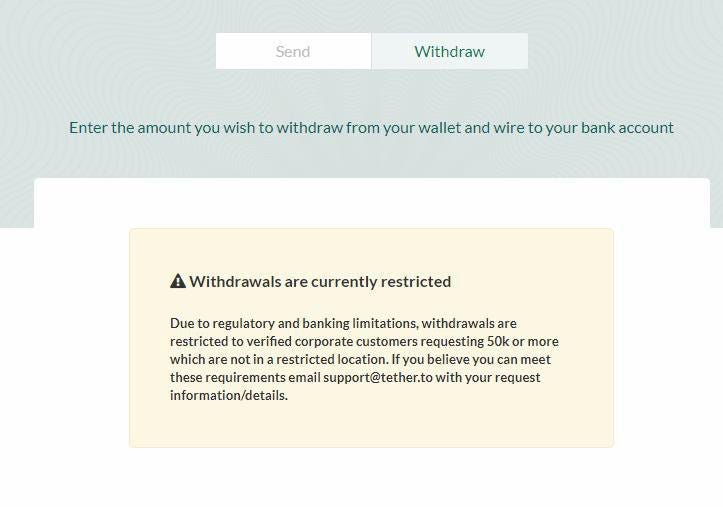
When you go to withdraw from Tethers it basically says "if you don't have more than $50k in claims, go away" [1]. Suffice it to say that most of their customers don't have that.
My guess is that Bitfinex, through a combination of wash trading and Tethers, have been pushing up the price of Bitcoin and they've basically been running a Ponzi scheme.
[0] https://tether.to/wp-content/uploads/2017/09/Final-Tether-Co... -- "This engagement does not comtemplate tests of accounting records or the performance of other procedures performed in an audit or attest engagement"
[1] https://cdn-images-1.medium.com/max/800/1*7BOwdYvUycjNFdUB2e...
The requirement to redeem in large blocks doesn’t change that logic, and still ensures that the smaller trades happen at par.
This is not how most people redeem tether, they go to any of a wide range of exchanges (kraken, poloniex, bittrex, etc) and trade whatever amount (from a dollar or whatever the minimum trade amount is).
It is the definition of inflation: increased money supply. Except it's priced in $, which hasn't actually inflated. So if the bubble pops and the money is found to be fraudulent, then it equates to money supply shrinking. Artificial demand removed..
(Possible responses include both "the traditional financial system and fiat currency is actually pretty good" and "someone should run a reliable FDIC equivalent as a business for new exchanges and new coins".)
The only problem is that there's no way to know for sure whether an exchange is running on a fractional reserve or not.
I've read it a few times now, still can't find where they say they specifically created tether (the system) for this exact purpose. Keep in mind that the issuance of tether is not the creation of the complete tether blockchain/system (they are issuing new tether around the clock).
> That's true, except you probably have never tried to actually execute that kind of arbitrage before. I have, so let me tell you the problem tether solves: speed.
You are right, I have never tried arbing through the banking system. I am doing small/mid scale arbing in cryptomarkets, however I stay away from anything that touches any bank / FIAT.
Though my point is that: yes arbing through banks is slow, inefficient and very dangerous. People will do it nonetheless because of the margins you can make. The exchange does not care how hard it is or how people do it, just that there is some guy somewhere (potentially flying around with suitcases of cash) who is doing it.
So yes I 100% agree with:
> That is an enormous benefit to arbitrageurs equalizing prices, and inter-exchange liquidity.
But bfx only cares about the latter, not really about the people doing it.
> Bitfinex was cut off from the US financial system, which makes it impossible for them to clear USD-denominated wires...Their solution: issue a cryptocurrency which is claimed to be 100% backed by USD
Right there. patios11 claims that Bitfinex's "solution" to their wire problems was issuing Tether. That is demonstrably false, because Tether predates Bitfinex's wire issues by more than a year.
Correction, there is no support. I have a bit of money permanently locked in a coinbase account because their support does not reply at all.
At some point I will just have to convert it all to BTC and send it elsewhere. Caveat Emptor.
On the account draining -- well, there's a latency in setting up new bank accounts there. So I'm surprised it's that easy to just yank money out.
Although I did notice there's no account verification. For example, on Vanguard or other platforms they do a small deposit of a few cents and ask you to verify the payment amounts, a process which has a latency of a day or two.
Are there any ways to make coinbase safer other than a very secure password?
If you knowingly helped a murderer dispose of a body, that’s wrong by nature right? Money laundering is the financial equivalent of that.
It's not necessarily disposing of a body, and punishing people for moving luggage around without asking questions is obviously absurd.
International airlines are a better analogy; should we just let people run weapons, drugs, even children in their luggage, with no mechanism for inspection?
If you don't tell the government you're moving resulting in taxes not being paid properly then you're damaging the government and by proxy, society. Atleast, that's what I think.
In cases where you're not tax avoiding, why does money laundering have to be a separate crime? It comes back to "Money laundering is just a cheat code for prosecutors to get easy points when they can't actually find real wrongdoing."
Reversing Tether tx does nothing to recover those Bitcoins.
Edit: found this: https://www.reddit.com/r/btc/comments/7e1840/the_30000000_us...
It seems like people did in fact notice the $30m being deposited on Bitfinex and being used to buy Bitcoin, all before it was known to be stolen. Difficult to confirm a thing like this, but I wouldn't bet against it.
http://article78againstnydfs.com/docs/317-cv-01882-BitfinexC...
However I don't think it's obvious that this thing will implode, based on the information we have we can only speculate. Pointing to screenshots about being unable to withtdraw tethers is a red herring and has nothing to do with whether tether will implode.
1) Let users exchange USDT for USD no matter the denomination or status. If they can't do that, remove the thing that says "You always have 24/7 access to our balance" from the website marketing.
2) Release an official audit (that doesn't say "this is not an audit")
3) Explain the large amounts of Tethers being minted. If they are legitimate, who is pumping $100m into Tethers almost every 3 days? No need to be specific, but records would be nice.
4) Tell us who their banking partners are that are holding the USD.
5) Put their transparency page back up [0]. Bonus points if they actually keep the "Shareholder Equity" number negative in the interest of transparency, or explain why it might have gone negative.
[0] Compare: https://archive.is/6os3c https://wallet.tether.to/transparency
The fact that they haven't done any of these heavily imply to me that Bitfinex and Tethers are a sham operation.
This again, is related to their marketing and not actually to their solvency (red herring).
> Release an official audit (that doesn't say "this is not an audit")
Lack of proof !== proof of insolvency.
And for all the other ones:
They are not entitled to tell you everything. The fact that choose not to is in NO way proof that they are insolvent.
I 100% agree that based on your list one might choose not to trust them. Just don't go screaming "they've basically been running a Ponzi scheme" with the only proof being them not telling you what you want to know about their operations.
Is this real trading activity, or is it people discovering that there's no feasible way to trade USD directly for the meme coin du jour?
Both are owned by iFinex LTD, and had the same CEO till earlier this year. Total amount they have lost comes out to $1 Billion.
How are you still claiming "They may not be"?
Where is the evidence the exchange itself is doing it?
The problem is, this estimate is just for Ethereum. It does not account for Bitcoin which must arguably have a much larger energy usage.
The thing about these 191K people is that Ethereum uses them just for transactions while people working in the banking industry will most likely not spend most of their carbon footprint just on managing transactions.
Most modern banks also don't manage transactions with employees anymore, they use computers to transact. They use the power invested into transactions more efficiently, the energy used being directly proportional to the amount of transactions moved around, the human meat sacks are only there for the smiles and managing things the computers can't do. yet.
> if the population of humans is increasing,
> are "winning" against entropy as they get better at extracting energy from the environment
Making a human is a net increase in entropy. Burning fuel is a net increase in entropy.
>so we'll have to find another source of energy, because we need more energy to decrease entropy.
This is not a fight you can win as the amount of energy you need to expend is magnitudes larger than the amount of entropy you decreased, actually, by the law of thermodynamics, any energy you expend to reduce entropy will produce an equal or larger amount of energy as a result.
Entropy may decrease temporarily in a locality but overall it will always increase inevitably.
> Most modern banks also don't manage transactions with employees anymore, they use computers to transact.
so, there's some of that carbon expenditure going into computers and networks to manage these transactions? Banks also use your money to make more money for themselves, does that bother you at all? considering that this thread started out by looking at things "holistically".
In any case, my point here isn't that crypto currencies are the best thing ever, but they're definitely a step in the right direction. I hope you can see the potential in these ideas and what they're trying to achieve. Basically, we need a system that can't be defeated with fraud, if everyone was honest we could just pass around a piece of paper and ask everyone to write down how much money they have and we'd be good, unfortunately that's not the case, as I see it, most of it is a just the cost of preventing cheating, we can certainly observe the current networks and come up with better ones in the future.
> Making a human is a net increase in entropy. Burning fuel is a net increase in entropy.
> This is not a fight you can win as the amount of energy you need to expend is magnitudes larger than the amount of entropy you decreased, actually, by the law of thermodynamics, any energy you expend to reduce entropy will produce an equal or larger amount of energy as a result. > Entropy may decrease temporarily in a locality but overall it will always increase inevitably.
so, are you suggesting that we stop reproduction and burning fossil fuels and slow down the "advance of entropy"? (or is it just bitcoin you want stopped?)
Also, "net increase" in what system?
Yes, but a bit less, with high confidence.
>Banks also use your money to make more money for themselves, does that bother you at all?
Not really, miners in bitcoin also make money, don't they?
Additionally, European Banks announced they're starting SCT Inst, SEPA transactions which are confirmed in 15 seconds instead of overnight. My bank doesn't charge me fees for it.
Why bother with bitcoin's immense carbon footprint when it can't beat the lower effective carbon footprint of banks if they are faster and cheaper?
>but they're definitely a step in the right direction.
I can agree with that, but they need to fix things to be applicable for a wider audience.
> we can certainly observe the current networks and come up with better ones in the future.
I'm currently somewhat invested in Ethereum since they plan to go into PoS which would be immensely more efficient.
>so, are you suggesting that we stop reproduction and burning fossil fuels and slow down the "advance of entropy"? (or is it just bitcoin you want stopped?)
No at all, just refuting that you can decreaser net entropy.
>Also, "net increase" in what system?
In the closed system that is the reachable universe. In any closed system, net entropy increases over time. That's nothing inherently bad, just a property of closed systems.
You can somewhat "cheat" and decrease entropy in some parts of the system but the entire system will increase or not decrease it's entropy.
Visa and mastercard together employ ~20k people and handle much, much, much more transactions than all the cryptocurrencies combined.
The EU SEPA customer payments system handles ~1000 times more transactions than ethereum, and the infrastructure for running that (spread across all the involved banks) likely takes thousands of people, but not 200k, and certainly not the 200 million people that would be required to do so as horribly inefficiently as cryptocurrencies do.
20K people (debatable) and a bunch of computers and networks which need to be managed by more people, and the infrastructure doesn't run on sunshine either (yet).
Without laboring the point, if your position is: * The methods applied by the crypto currencies waste more energy than our current system of currency.
I'll accept this, iff we make sure we've collected data rigorously and we notice that the difference is significant. Even then, there's no reason to give up on the idea of crypto currencies, we just have to make it more efficient.