2017 Homicide Rates in Latin America and the Carribean(insightcrime.org) |
2017 Homicide Rates in Latin America and the Carribean(insightcrime.org) |
There's no "fine tuning" of police operations in Guatemala. Everyone is incompetent, and the UN and other "human rights" groups fuck it up even more. Average citizens are afraid to even kill thieves and extortionists due to court prosecution. Said criminals continue to run gangs from inside prisons. Most "good" people just leave as soon as they can. My ex finally called it quits when Telefonica, the multinational phone company, got extorted. Someone calls them up, tells them they owe $X/week, and then just starts shooting employees. It's getting worse, not better.
The only hope I've had here in recent times was several people, including young women, talking fondly about Rios Montt and how they wish a leader would come clean stuff up. Even a semi-indigenous person told me that (despite him supposedly being genocidal). Unfortunately GT has a preference for electing nitwits that can't even steal without getting caught. That's how incompetent they are. So it's unsure if we'll ever see a strong ruler come back in. But now more than ever are people ready for that.
Turns out, when you can't safely walk around, when you can't start a business because any day you'll get a phone call that means either bankruptcy, death, or exile, yeah damn right you start preferring a military rule. As one woman told me, "at least I could walk anywhere, anytime with my purse and no one ever troubled me".
This is a good thing usually. What are you meaning?
Civil liberties aren't worth much when you can't freely travel and live in the first place. Sure, a few innocents will lose out with an abridged justice system. But that's already happening at a high rate.
And sure, they could also just turn the country around. Get foreign countries to run ministries, get a whole new police force, increase resources to the justice system 10-fold. But tell me what's more probable, that, or just taking a hard stance, have swift summary justice and giving citizens strong defence rights?
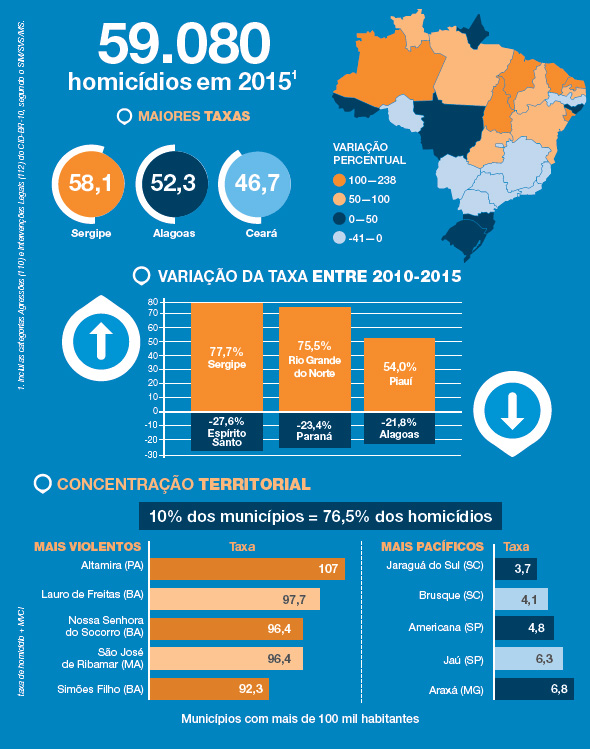
Northern region has places with 60+ homicide rate, southern region has places with 3-4 homicide rate.
Take a look at this article: https://pt.m.wikipedia.org/wiki/Lista_de_unidades_federativa...
And this map with some of the highest/lowest homicide rates: http://55ca7cd0-f8ac-0132-1185-705681baa5c1.s3-website-sa-ea...
Both in Portuguese but I think it's not hard to make sense of the numbers (rate is 1/100k, map colours describe increase/decrease in violence, bottom lines show current top/bottom rates in cities with 100k+ residents).
https://en.wikipedia.org/wiki/Murder_in_the_United_States_by...
From New Hampshire at 1.1, Hawaii at 1.3, and Vermont at 1.6 to Mississippi at 8.7 and Louisiana at 10.
Among OECD countries, only 3 countries are worse than the USA [1]
The USA really does rank among developing countries in a lot of different measures.
[1] http://www.businessinsider.com/oecd-homicide-rates-chart-201...
But numbers don't tell the whole story. I remember waking up and laying on the floor of my bedroom because there was a drug gang shootout with automatic AK-47s in front of my home. Seeing the blood stains of victims on a neighbor's walls (someone was executed against a wall). The sound of weapons always being a part of the night.
- Venezuela leads unsurprisingly with 89 per 100,000
- Chile has the lowest number, 3.3 per 100,000
Compare that to
- Germany: 0.3
- US: 4.9
Source: https://en.wikipedia.org/wiki/List_of_countries_by_intention...
That's a U.S. territory with a higher murder rate than Brazil.
This includes St. Thomas, St. John, and St. Croix.
I lived there for only a few years and experienced the loss of two friends due to homicide in that short time, on an island that is only 13 miles long, and 32 square miles.
Many of these crimes go unsolved despite such a small population, in such a small place, due to corruption, fear, and lack of resources.
Top homicide rate for cites in the world:
https://en.wikipedia.org/wiki/List_of_cities_by_murder_rate
US cites (sort by murder):
https://en.wikipedia.org/wiki/List_of_United_States_cities_b...
[1] https://en.wikipedia.org/wiki/List_of_countries_by_intention...
https://www.vice.com/en_ca/article/ppvx8g/a-closer-look-at-n...
http://amp.kansascity.com/news/local/crime/article191211704....
Population of St. Louis: 312,000
It would also have a GDP much like the USA, and would qualify for the OECD.
Obviously this is just about how averages work -- the high violence stats of the 10% can completely skew the average, but their low income stats can't. But it's worth remembering, every time someone tries to tell you what an outlier among rich countries the US is. It's a large, diverse, country... and often different averages are telling you facts about completely different people & places.
http://bismarcktribune.com/news/national/the-cities-with-the...
If there's a correlation there, it doesn't seem obviously strong.
This linked adds a new dimension - climate change with warmer temperatures would appear to come with an increased death toll due to crime.
https://www.sciencedirect.com/science/article/pii/S009506961...
The common US murder rate where ~95% of the population lives, is closer to Canada typically, at around 1.5 to 2.5. Then you have extreme murder rate areas in the worst parts of eg Baltimore and Chicago that blow the scale up (Baltimore hit 56 per 100k for 2017, with more murders than NYC). Several dozen neighborhoods in those cities account for a truly incredible share of the US murder rate. People outside of the US commonly make the mistake of thinking most of the US has a 4.x murder rate, when that isn't the case; in the US murder is hyper concentrated.
The murder rate among Sweden's largest cities does not consistently vary by ~20-30 fold top to bottom. That's the gulf between New York City and Baltimore, or Honolulu and St Louis, or Detroit and Austin TX. That extreme of a variance, is very unusual for all but a few countries.
Argentina for example, which is at least somewhat similar to the US in per capita murders in a given year, in their major cities you do not see Baltimore, Detroit, Chicago type examples of extreme outliers vs the ~6 national rate (eg Buenos Aires is typically around 5 or 6, as is Cordoba). Rosario, which saw a large murder rate spike in 2012-13, was considered shocking, because the murder rate went from ~10 to ~22 over a few years. So the US national rate is lower than Argentina, while having drastically higher outliers like Baltimore and Detroit versus eg Rosario (their bad case example).
    per_capita_data = {'white': 3, 'asian': 1, 'black': 21, 'hispanic': 6}

    cali_cencus = {'white': 37.7, 'asian': 14.8, 'black': 6.5, 'hispanic': 37.7}
    texas_cencus = {'white': 42.4, 'asian': 4.8, 'black': 12.6, 'hispanic': 39.1}

    def calculate(per_capita, state_stats):
        rate = 0
        for race in per_capita:
            rate += per_capita[race] * (state_stats[race] / 100)
        return rate

    print calculate(per_capita_data, texas_cencus)
print calculate(per_capita_data, cali_percentages)http://amp.kansascity.com/news/local/crime/article191211704....
Population of NYC: 8,537,673
Population of St Louis: 312,000
The one thing NY does have is high inequality measured in gini, the highest of all states. That usually drives crime/murder rates. But it's probably because of rich outliers (extreme upper capital class), rather than a big gap between lower-uppermiddle.
It's true that the rates are rising for a few years in a row, but this is nothing new. If anything, Canada's typical pattern is to see a rise a few years in a row, followed by a stronger drop. [0]
It's also true that gang related offences were part of the recent rise. But let's also note that they entail about 100 of the 600 murders in Canada, 15.5% in the last year for which I can find data. (2016). The vast majority of murders are done not by strangers but by friends or family, not related to gang violence.
[0] http://www.statcan.gc.ca/daily-quotidien/171122/cg-b001-eng....
So how effective is that alone? It seems per capita income would be the prevalent factor.
Arguably the poorest US state, West Virginia, has a typical murder rate of around 3 to 4 per year per 100k.
Vietnam has been extraordinarily poor for the last half century, only recently beginning to climb economically. Its murder rate is typically 1 to 1.5 or so.
Per capita income probably only has a correlation in regards to the resources you have available to deal with crime problems if such presently exist, rather than being the defining characteristic of whether eg murder will be prevalent in a nation.
It isn't, alone, in a cherry-picked example. But ceteris paribus it's a explanatory factor.
I mean, one could also use your argument the other way around and question whether income is effective as a factor by itself. Cherry pick some country with similar levels of median wealth and a wildly different murder rate and gun laws. Like say the Netherlands and the US. Doesn't really prove a point, it'd be silly to now claim income isn't an important factor.
Amsterdam has a murder rate commonly as high as the whole of the US. That isn't a rational comparison and isn't indicative of the murder rate of the Netherlands.
Currently, St. Louis, United States, sit's at # 14 most dangerous city worldwide. https://en.wikipedia.org/wiki/List_of_cities_by_murder_rate
That's significantly higher than average, but not 'crazy' relative to Venezuela's murder rate of 90 per 100,000.
On the other hand Washington DC was ~70-80 from 1988 to 1998, which would have put it on the current list of top 10 deadliest city's worldwide. DC: (http://www.chicagotribune.com/news/data/ct-homicide-spikes-c...)
Current top 50: http://www.businessinsider.com/most-violent-cities-in-the-wo...
PS: Homicide rates are not necessarily accurate, but tend to be closer to reality than say rape statistics.
To believe you aren’t in danger does not make it so.
Sure if the average salary in Vietnam is $150/month then yes per capita income is going to to be lower than the poorest cities in US. $150/month is a different story in NYC or SF. It would have to be adjusted for purchasing power or maybe just looking at poverty rates.
That's why for example, the US hispanic murder rate is 1/3 that of the black murder rate, while hispanic poverty is quite high (most of the US hispanic population is sub 40 years old in terms of its existence in the US, and most hispanic immigrants were poor and with low skill levels when they came to the US). It's very clear that poverty is in fact not the primary cause, it's the collapse of poverty support systems in the cities in question (call it basic human infrastructure, or something). That system collapse leads to extreme desperation, which rapidly erodes a culture, which feeds on itself (~93%-95% of murders in St Louis are black on black murders for example), which prompts a vicious circle that becomes very difficult to break.
Cities like Baltimore and Detroit are more like failed states, to so speak. They've generally suffered total breakdown in the neighborhoods seeing these incredibly murder rate numbers. For example, the Baltimore murder rate comes across as shocking at 55 per 100k. When you drill down further, it's far worse than that, because those murders are isolated to a small percentage of the city, neighborhoods that see dozens of murders each year. These are neighborhoods that have suffered total collapse, their cultures have been destroyed, support systems are no longer existent, and almost everyone is universally afraid to go near the problem (both literally and figuratively). Simultaneously in eg Baltimore or Detroit, you have very scarce resources to go around, the collapsed neighborhoods killing themselves are not going to get those scarce resources. As cliche as it might sound, it's very simply a downward spiral (and as one might expect, to break that, is dramatically more difficult and costly than to just maintain a healthy context in the first place).
My suspicion is, the best way to fix failed cities like Baltimore, is direct, temporary Federal takeover, on the basis of a national interest. I don't see how it makes sense to pretend a city like Baltimore is an independent, functioning city any longer.
What would you suggest?
Detroit is undergoing a modest recovery right now that is properly giving some people hope that it could get better there. It has far more industry to pull from than what Baltimore does, and it appears to have a spark to do so, a cultural determination if you will. Baltimore right now is lacking that aspect, it seems entirely adrift in a swamp of hopelessness.
If the Federal Government were smart, they'd shift a few major agencies over to Baltimore and push resources into the city by doing so. Absorb some labor slack, invest into communities, put resources into education and job training, etc. It would make a meaningful difference, Baltimore isn't a massive city. Just normalizing their high school dropout (~70% graduation rate, versus closer to ~90% for the US) rate would probably do wonders for sparking improvement.
If you look at what NYC accomplished, going from 1,200 murders to 1/5th that over 25 or whatever years. They had vast resources to pull from to accomplish that reformation. Baltimore is stuck between a classic rock & a hard place, lacking the resources they'd need to do it.
The city mostly has itself to blame for ending up where it has, I'm skeptical it can fix itself at this point. If it can, it'll take a very long time. Failed states usually take a very long time to recover. Ethiopia took decades to begin finding its footing after the disaster of the 1980s, and it's still on a difficult course. One would assume Venezuela has decades of recovery ahead of it, even if things stopped getting worse immediately. I consider Baltimore a humanitarian disaster, which in the world's richest nation is about a thousand notches beyond unacceptable. The Federal Government should step in and effectively abolish Baltimore as we know it today and reform it, put tens of billions of resources into the city, at the expense of all US tax payers. It should set various standards for how to operate the city to try to avoid it ending up right back where it is and gradually return control to local governance. Little different than when the US Government steps in and takes control over police departments (eg Seattle) when they effectively have failed at their basic responsibilities.