Practical Tips for Cheating at Design(medium.com) |
Practical Tips for Cheating at Design(medium.com) |
I think that's one problem with the web: so often are designs simply copied that the web looks boring. Well-designed, but boring.
Note that "closer to background color" is, more or less, "making it transparent".
A interpolation of 20% from black to the background color will still be plenty readable.
I do love the accent borders. I've been using them a lot lately in PowerPoint tables.
Not all the advice is going to work in all situations, but they do serve as a great collection of simple but effective tips for improving the design. I've spent a long time tweaking things about in this realm, so these tips are welcome even if i already use many of them. Seeing them together also helps identify new techniques or combinations you can use.
I don't agree with tertiary buttons with no border and no underline, for example. I think that poorly communicates what's clickable/tappable and whats not. But then again, that's an easy tweak.
I agree, this is the best design article I've read in maybe a decade.
Fewer font sizes and more font weights in general is always good.
Removing borders is extremely powerful for a lot of great reasons. When trying to maximize data density and readability, when trying to reduce clutter/visual noise and gain whitespace. The use cases for borders can often be resolved in other ways. However this puts more demand on the quality of the typography and layout hence the other techniques mentioned come into play those are design challenges worth addressing.
More on borders: This of course is a tool that can be mis-used but I find it is one of the best tools I have. The emphasis should be on data / information not on arbitrary borders. You can say the same thing many different ways visually. This is under-appreciated. You need not have font size, color, style all colluding to say the same thing, that you can accomplish with only one of these. When dealing with any series of items the human eye will clearly see periodic patterns and implied lines / alignments very quickly thus I find that often borders are unnecessary and even impede a working design.
A key observation is that with every border you have two white space areas to design with and a foreground element competing for attention with your actual information. Every border you eliminate gains you twice as much whitespace as you had and one fewer foreground element. 3 design components to 1. As with lines of unnecessary code, when you can delete elements in a design you are winning.
I just have two nitpicks: different font sizes are not a problem as long as the hierarchy is clear (i.e. sizes not seemingly chosen at random) and the advice on text contrast is accurate (unless you're using a display at very low brightness, pitch black text is jarring on light backgrounds), but the contrast on the example is too low. For body text, the ideal choice is closer to #222 or #333. Here, the advice on colors also applies: you can give the black a slight blue hue if the rest of the interface has blue accents.
The last example (https://cdn-images-1.medium.com/max/1600/1*cuYcwjOO26sKHImHa...) also moves me to give an unsolicited tip: pay attention to the "color" of the typeface you're using. That example has body text in Avenir (EDIT: looking again, it must be Proxima Nova); it's a thin geometric type, so the gray of the body text should be darker, or a bolder weight should be chosen. As it is, it's not very readable, which is okay for certain sentences but not appropriate for a warning message. Since system and webfonts are often constrained to regular and bold (and rarely, a bolder and a lighter weight) it's easier to control this by tweaking the gray.
An alternative is to give a higher priority to "you will lose all of your saved data".
#2.1: Reducing the opacity of your text makes it harder to read.
#4: Borders help logically separate areas of an interface. Throwing in more white-space is wasteful.
#4.3: Gratuitous white-space is wasteful, especially if you have limited screen real-estate (i.e., mobile).
#7 is a major pet-peeve of mine which I cannot agree with. If it's a button, make it look like a button. Nothing is more confusing than a button that just looks like some text label.
A regular border is easier to spot and more definite. It's not skeuomorphic but it's more functional.
[1] https://cdn-images-1.medium.com/max/800/1*qH-2RAS3rbnql-vpP8...
When web pages had a proper structure and color scheme (compare www.gnu.org now and in 2004: http://web.archive.org/web/20040113091408/https://www.gnu.or... ) they were more readable.
I still have trouble not underlining clickable links, for example. But sometimes in a design it's just as obviously clickable without it, and less cluttered too.
Also, make your buttons look like buttons.
Most of the time I want to see more playlists, or email subjects, in preference to delighting in your use of whitespace. Information density matters.
Buttons should look like buttons. Always.
Please no. Light grey text on not very dark grey background? Can this design trend just die?
Ironically the contrast rebellion site uses very similar techniques to create visual hierarchy, see slide 2 in particular.
Maybe you're younger or have better vision or a significantly different screen than I do, but then let that be a warning that either you need do usability testing on some settings where that particular picture looks not sufficiently 'contrasty' to you as well, or you need to write down the RGB values that this image has with a note "that's not enough contrast for general usage even if it looks ok to my eye".
Many of the "good" examples don't have sufficient contrast for a lot of people.
The first step to fixing a problem is understanding that it exists.
Edit: 2.80:1
Borders and clear destructive actions are a must. Needless spacing is wasted space.
In a more applicable example I removed most of the borders and heavy rules from a information dense page of a popular B2B site I worked on and the readability / scan-ability of the page increased dramatically and it had a very positive reception from out clients.
I do think one thing is missing from this guide and that is point lines or point rules. This is something I think I learned reading one or Edward Tuftes books. In print horizontal rules of 0.5 - 1 points (see: https://practicaltypography.com/rules-and-borders.html ), however on the web I find dark grey 1px bottom borders to have a similar effect.
Designers seem to love to decide that certain text doesn't look right, is unimportant compared to that stock image they spent 3 hours selecting.
A great tip for cheating on design regarding typography is to completely drop "grey" from options.
What will happen is that during any manner of stress testing, usability or accessibility testing someone will immediately point out the lack of legibility.
More importantly when your site is audited for accessibility issues, you will fail on contrast every time.
I realize this was written as tips to help non designers but most "designers" should be staying away from making decisions about font color that lean towards "grey".
The cost and effort in development of most written copy far exceeds the value of this design trend that leads to low legibility, low impact type.
Web designers need to get back to the basics of typography. The web as a whole and "start up" style sites particularly suffer greatly from design choices by designers who clearly never actually read what they layout.
I see this problem in the footer almost universally. High contrast footers have somehow become rare. I understand the desire to de-emphasize that section versus the primary content of a page, however if the footer is going to actually do its job I think it makes sense to have it set to a higher contrast design than not.
If you have 3 alternative actions and one looks like a button, why don’t the other two? It is actually very easy to miss at least one option that way, or otherwise make a mistake.
https://codepen.io/tyrellrummage/full/ZJPXgy/
The one technical question I have is about using a lighter font to de-emphasise things: the example de-emphasises "*Prices may vary ..." underneath the bold, emphasised "$17 per person". Isn't that a bit of a "dark pattern"?
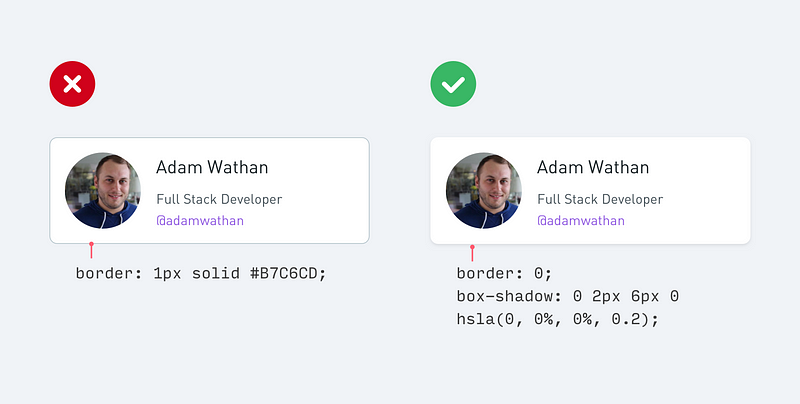
In the shadows example, I prefer the bordered version. Shadows do not always look good and borders are "safer" to use.
So if it doesn't look right at first, keep tweaking. Try a shade darker, try a shade lighter. Add more spacing, add less spacing. And so on. Expect to spend some time on it. Don't be discouraged if at worst it looks bad. Moving stuff around, and adjusting the different parameters, can eventually bring everything in a state that sings.
This article has a lot of great advice for the visuals. Using opacity to better mix colors is super handy.
But my main reaction is there is one bigger, better way to cheat at design in nearly all situations, and that's to avoid hierarchy. All the tips here can be taken as ways to cram more things together.
When I try harder to say one and only one thing in any page or dialog, my design has usually improved. It can be really very difficult to let go of some things I strongly feel the user needs to see, but when I do, it's surprising how often I find that "less is more".
I find that when a screen has a lot of options, it usually means that the creator is un-opinionated / didn't make a decision on what's important and surrendered to implement everything that was asked, whereby it feels like a clown fiesta.
#2.1: Yes, this would be an issue if overused, especially in paragraph lengths of text. However, inconsistent font sizes are worse.
#4: Why are you worried about white-space? If you have space, you can use it. If you run out, then you have to start rationing and using other visual tools. Borders have their place, but white-space should be preferred as the most neutral and inobtrusive strategy.
#4.3: So create a responsive layout for mobile that uses more borders where necessary.
#7: This is a major (and valid) criticism of flat UX, but slightly adjacent to the point in the article. The article says you don't need a background colour for every button, which is good advice.
The client wanted a "button" without a background color because it looked bad to have two buttons side by side. My company told them that was a bad idea based on data, so we added tracking to their site and A/B tested their home page. Button with a background color had 40% more conversions than the "button" they wanted without the background color.
Several pieces of the advice given on that article are proven to be bad ideas for most websites if you track your users. What "feels" right and what is right are often two different things.
If you're ever making a change because you think it will perform better you better be tracking the statistics. Often times you'll find out you were wrong. Another, similar, example is that a client had a button they wanted to "draw attention to" so wanted to inverse the :hover background color with the normal background color so that it would stand out from other buttons. It looked different - but hurt engagement because it no longer looked like every other button on the site.
E:
This was meant to be a response to cpburns2009, the parent of the comment I responded to. Thanks to metalliqaz for pointing that out.
I should have clarified this better. I dislike low contrast text because it makes it hard to read which is popular with the flat UI trends. Opacity isn't used so much from my experience, but light grey text on white is which has the same effect. I agree that inconsistent font sizes are bad too.
> Borders have their place, but white-space should be preferred as the most neutral and inobtrusive strategy.
In the example from the article I think the bordered version is much more concise and clearly delimits the search box and list. White-space seems to be used too carelessly in an attempt to avoid any clearly defined borders.
> The article says you don't need a background colour for every button, which is good advice.
You don't need to give every button a colorful background. But each button should have at least a border or background to distinguish it from standard text. The background can be just a boring grey like the classic Windows dialog buttons.
That's the point, to take away focus from something lower in the hierarchy.
>#4: Borders help logically separate areas of an interface. Throwing in more white-space is wasteful.
You're defining waste from a screen-space point of view, not a usability point of view. Who cares if the screen's pixels are at maximum utility, I want my user at maximum utility!
>#4.3: Gratuitous white-space is wasteful, especially if you have limited screen real-estate (i.e., mobile).
See above
>#7 is a major pet-peeve of mine which I cannot agree with. If it's a button, make it look like a button. Nothing is more confusing than a button that just looks like some text label.
Again, hierarchy.
But there is a difference between merely moving something further down in your information hierarchy and making it hard to read. Low contrast text, like very small text, is hard to read for a large part of many markets. If it doesn't need to be read, why not go to the next stage and remove it entirely?
You're defining waste from a screen-space point of view, not a usability point of view.
There is precious little evidence that the trendy, overly spaced-out look of flat design and its derivatives has any usability advantage at all.
On the other hand, it is self-evident that if you're trying to show some sort of dashboard and spacing it out like that means you can only get 75% of your data onto a single screen instead of 100%, then your design is less practical.
There is also ample evidence that mystery meat navigation impairs usability, which is particularly relevant to the discussion of button styles here.
People tend to see it as a void that could be put to better use. We shouldn’t think of it as a void, though. We should think of it as a separator. It’s gestalt theory: objects that are close to each other appear connected. When you remove too much white space, groups of elements become less distinct, and cognitive load increases.
1 - In fact, the buttons there don't look like buttons. But that's because it uses a normal design, and nobody creates buttons that look like buttons anymore. Could we please standardize the "button look" with a small, fuzzy outset?
There's not much to think about the whitespace in such a scenario - it's a simple yes/no experiment; you can try to simply remove the separating line. If the resulting whitespace ensures good enough readability/separation, then it works; if it'd need increased spacing, then it's worse than having the separator and not worth thinking about how much extra spacing you'd want - the answer to that is as little as possible, i.e., zero.
"White space" is negative space. It's something you should think of as an active part of the design.
One of the first rules of web design is "content is king". As a rule of thumb, any use of white space that makes your content harder to reach, read or see is a bad use of white space. It's breaking the "content is king" principle.
No part of your design should break the main web design principles. While there's no agreed upon list, "content in king" (or however you word it) is always present.
In short, yes, I agree.
---
Edit - A nice description of it:
"White space (negative space) is the area between design elements. It's another tool for designers to design for the user experience (UX). Remember that white space is not necessarily white; it’s just the name to indicate spaces where there are neither user interface (UI) elements nor specific content.
As a designer, you can introduce white space based on four main factors:
- Content,
- Design,
- user and
- brand
Use macro white space to organize content in the layout and direct the user through the blocks of content shown. Use micro white space inside the design element features as seen in the text, images and content blocks.
We can also approach white space as being passive or active. Passive white space does not have a specific role in the design other than facilitating the user experience. It is all about being easier to read. Active white space guides the focus and attention of users. It is more about standing out and making a statement." https://www.interaction-design.org/literature/article/the-po...
If you change "hard" to "harder", would you agree that there is no longer a difference? It seems you are just placing your bar for "too hard to read at all, in any context" somewhere different than the author of the article. The author is definitely making things lower in hierarchy harder to read on purpose, that's the whole point.
>There is precious little evidence that the trendy, overly spaced-out look of flat design and its derivatives has any usability advantage at all.
Honest question, is there any evidence that shows the usability is _worse_? How about evidence that reducing spacing or adding more options/data to a page _increases_ usability?
>if you're trying to show some sort of dashboard and spacing it out like that means you can only get 75% of your data onto a single screen instead of 100%, then your design is less practical.
A dashboard is a very specific design case. Most pages in general are more geared towards specific actions or specific "detail views" of data, where you have clear hierarchy of both data and actions. Aggregate data pages like dashboards are a whole different beast, and it seems weird to bring them up in a general UI design discussion. I would think dashboards are also more often internal than even a feature shown to real users. The days of dashboard-style pages like "web portals" are long gone.
It is obvious that usability will suffer when you cannot fit all the required functions into the screen real estate. Now, since we're talking about websites, which usually have a rather low function density, that's not necessarily a problem. But try to apply this design advice to more complex web applications, or to professional software like Photoshop or Blender.
No, I wouldn't. Of course variations in contrast or colour can be used up to a point without significantly affecting readability, and dogmatically taking any design guideline too far is usually not helpful. But when you really do get to the point of making things significantly harder to read, I think you've crossed into dangerous territory, with the usual caveats about readability depending on your expected audience.
Let's not muddy the issue with terms like "hard" vs. "harder". Let's look at the actual examples the author gave to illustrate the suggestion.
In the "Amsterdam walking tour" example, the light grey text is #737373 on #f7f7f7. That's already past the WCAG threshold at AAA level for normal (i.e., body size) text. It's used for legally significant material, while describing an activity that could easily be of interest to an older clientele.
In the later "Steve Schoger" example, the job title in the left pane is #929292 on #f7f7f7. That would be past the WCAG threshold even for large text and even at AA level. Maybe the job title isn't intended to be so important in that example, but again, if it doesn't need to be readable, why have it there at all?
The author is definitely making things lower in hierarchy harder to read on purpose, that's the whole point.
I understand that. I claim that doing so is measurably bad for usability in many situations, and that there is ample research to demonstrate this, upon which guidelines such as the WCAG's are based. The W3C pages about the guidelines provide extensive explanations of the reasons behind them, if you're interested.
Honest question, is there any evidence that shows the usability is _worse_?
In the sense of reduced data density, isn't it self-evident that some information is then harder to access?
A dashboard may be a somewhat specialised example, but the same argument applies to anything else with a lot of data to show: tables, lists, even the menu example in the article, where the more spaced out version has lost an entire menu entry off the bottom compared to the original.
A related argument also applies anywhere that space is at a premium, even if there is only a modest amount of data to present. That includes almost all UIs to be used on smartphones, and it includes many types of UI where you have different screen areas for different purposes and so the space within any given area can be quite limited.
In more specific cases, for example removing clear demarcation of search controls in favour of a generic background colour as also demonstrated in the article, there is plenty of research to show that the mystery meat approach to controls and navigation doesn't work well.
If someone is going to advocate for the fewer borders and more spacing approach, and if there are multiple well-established arguments for how doing so can harm usability in at least some cases, then I think the burden initially falls on the advocate to argue/demonstrate that their way doesn't fall into those traps.
This is "cheating at design" though, not "how to meet the full AAA WCAG thresholds."
I'm still not sure I really follow your line of thinking here. When the author says (paraphrasing) "make low priority text less readable, in order to highlight the important stuff comparatively," and you say "less readability is bad for usability," I think 'yeah... that's the point'. You take something that isn't as important and you make it less readable so that the important stuff is more readable by comparison. It helps users to differentiate between expected/primary data/actions and secondary/tertiary data/actions.
Do you just completely disagree with this philosophy? Do you think the author is mis-applying this, and you think some text that the author has made less readable is actually more important to users than the author thinks it is? Something else entirely?
Honestly I'm struggling to figure out where you actually disagree with the author, it seems to me you are both saying "lower contrast ==> less readability/usability." What am I still missing here?
Of course it did, it looked more like a button! But at what cost? It sounds like this button was not the primary action. So how many clicks were lost from the primary action - how much usability was lost from the page?
>Of course it did, it looked more like a button!
And buttons without the look of a button are just called links. Links without visual distinction may as well be invisible. Like the infamous "black text link with no underline in the body of a paragraph of black text".
You might have your little favourite programming trick, but a good programmer will know when and where to use it - you don't want to use a map function everywhere.
Note that the article's point about buttons isn't prescriptive and doesn't say "always do buttons like this". Instead, it talks about a common specific use case and talks about how you can improve the situation. It's up to you to take that information inboard and judge where to use it. It sounds like the specific example you cited was a good time to not follow this approach.
Then why did they put another button side-by-side of it?
If you made the primary action a button without a background than you did not do what was suggested in this article.
Enterprise apps are expert systems, they are not designed for the masses. Your goal is not to surprise and delight, your goal is to help people get shit done and go home. That means data needs to be organized tightly and densely, forms often have a lot of inputs, tables often have a lot of columns and tons of rows. A simple separator line between rows and columns, and perhaps alternating background colors for even and odd rows is all you need. Think something that looks more like an Excel spreadsheet, and not some social network with documents.
If a new feature is needed, it needs to plug straight into the existing design wherever there is space. There is no time to think about a redesign, and changing a layout may just confuse an employee who got used to the previous one.
Here, take a look at this example and tell me that the left paragraph is something you would use or want in an enterprise application: https://imgur.com/a/mIBZz
> There is no time to think about a redesign, and changing a layout may just confuse an employee who got used to the previous one.
I very much disagree and have experience with such tasks.
One of my main task right now is to manage an in-house ERP. Before I started to work here, there were no front-end developer, no UX expert and no designer.
Every screen was a pizza. The previous developers simply piled on changes and everything quickly became a mess.
Last year, we changed half of the screens (early 2000 style) to modern user interfaces. Out of the ~150 employees working with the software, only one was resistant to change. It was one of the newest hires and had just been trained with the previous version of the screens.
Two months in, she admited that the newest version was way easier to use and that she would have had an easier time training on it. Everyone else simply adjusted easily from the cramped design of the previous version.
Smart use of white space isn't about making everything like one of Apple's websites. It's about managing your negative space in such a way as to guide the eyes of the end user.
The button/button was for a search. They wanted to draw attention to the 2nd button that sorted the results alphabetically. Why wasn't the alphabetical sort the default? Well... doctors are all very bothered about who gets shown above who - so the list of doctors has to be sorted randomly to please the doctors. The hospital doesn't want to piss off the doctors but also wanted to make it easier for users to search. They wanted to draw attention to the button that would sort the list alphabetically by changing the color of the button to stand out more.
I'm positive doctor names would look like Yellowbook pages back in the day with "AAAble AAApplebottoms" just so they could be the first shown. You'd think users being able to find their doctor would take priority over the order the doctors are shown in, but apparently not.
I work in Healthcare. The only thing that irritates doctors more than listing them alphabetically is forgetting one of their various titles. Dropping the "MD" after their name is a cardinal sin.
The WCAG are just one authoritative source that happens to be readily available and therefore seemed a useful objective reference for the discussion.
The point I've been trying to make is that there is a very important difference between simply de-emphasizing text (which is often useful, and which a moderate change in contrast might indeed achieve) and making it hard to read (so that even someone who wants to read that information will find it more difficult). What the author is advocating in this case doesn't just do the former, which would be fine; it also potentially does the latter if taken too far, as several of the author's own examples have been, and at that point the presentation certainly is undermining usability in that respect.
Perhaps my point would be clearer if we consider the opposite effect. In a magazine or textbook, a key definition that is shown in boldface is readily picked out when scanning the page, thanks to the contrast of its darker appearance compared to the main text. Likewise, a heading in a different colour is readily located, or a pull quote set in a large, italic font. All of these typographical techniques show some form of priority in the information hierarchy and guide the reader's focus, yet none requires that any of the text, including the less emphasized main body text, be at all difficult to read.
The reason I am trying to make this point so forcefully is that this is also a classic case of a mistake where young designers with good eyesight and high-end display equipment frequently fail to realise they are doing anything wrong, and as such I agree with others commenting today that the advice in the article could be counterproductive without additional qualification. Ironically, the author did flag up the related bad practice of using lighter font weights at body sizes, which is another common usability problem with some modern UI styles for much the same reasons. It's a little hard to reconcile awareness and avoidance of one danger with actively promoting another that is so closely related.
I.e. the main text would be at maximum contrast, the tertiary text would be the contrast at the WCAG guideline threshold, and the secondary text would be somewhere in between.
The only time I'd use a 'button' without a background color is something I don't actually want the user to use. For example, a 'delete' option on their profile or the 'unsubscribe' link in a newsletter.
But I'm not user hostile so I'd still make those options easy to find for users who wish to use them instead of trying to pad my "user retention rate" or whatever numbers the marketers are trying to make look good.
Yes! You've got it! That's exactly what the article says!
And that's what I'm saying - good design is learning these tricks and identifying when and where to use them. It's not form over function, but how the form influences the function.
I think good design should benefit the user. Making "opting out" easy is providing a good user experience. If the user is wanting to "opt out" the answer isn't to make it difficult to opt out - it's to fix the reason that is causing your user to want to opt out to begin with.
In short, A/B tests are great, but they're not a substitute for design skills, they're a way of refining what you already have in some situations.