"I must study politics and war that my sons may have liberty to study mathematics and philosophy. My sons ought to study mathematics and philosophy, geography, natural history and naval architecture, navigation, commerce and agriculture, in order to give their children a right to study painting, poetry, music, architecture, statuary, tapestry, and porcelain."
What Adams is talking about is quite different.
He wrote an entire article about how Americans are "abandoning" manufacturing without ever mentioning offshoring. If you read his article you would think that the American decline in manufacturing has something to do with some weird pretentiousness of the American workers and nothing to do with the millions of manufacturing jobs leaving the country.
We aren't "declining" in productivity. We've continued to increased productivity at the same historic rate as previous industries. (http://www.bls.gov/lpc/prodybar.htm)
We are accomplishing this productivity gain with less people. Increased productivity allows for companies to increase their output with less people.
As Peter Drucker predicted, if these productivity gains aren't matched in the service and knowledge worker sectors, then we'll see an increase in social tensions and class warfare. No one can deny the social acrimony that continues to surface in the news.
This will be the challenge of the 21st century. What to do with a nation that doesn't require a majority of its workforce employed in moving or making things.
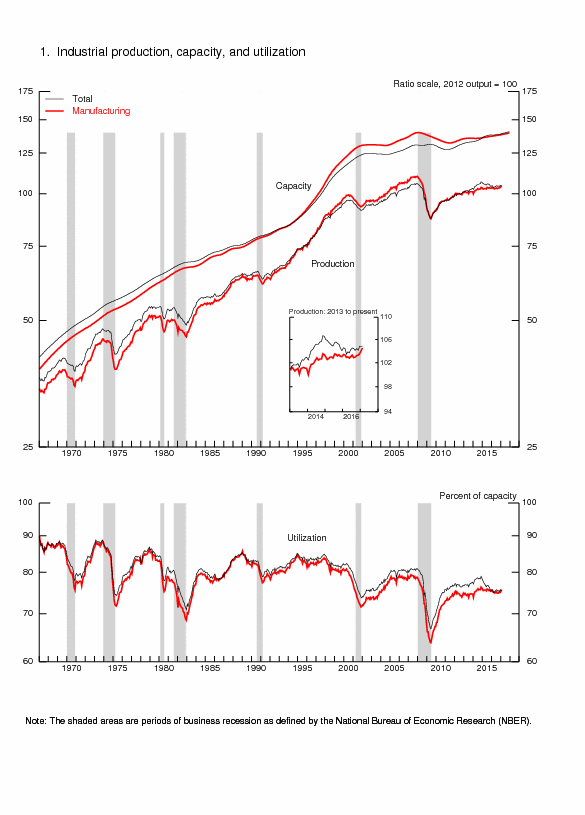
http://www.federalreserve.gov/releases/g17/current/default.h...
http://www.federalreserve.gov/releases/g17/current/ipg1.gif
And other pretty charts in section G.17 Release Tables
When economic measures seem out of whack with observed reality, one should question what the numbers really mean.
Regarding the statistics of manufacturing supposedly growing they are misleading. I don't have time to explain why they are misleading but if you dont believe me you can just visit Detroit, or Flynt Michigan, or even Philadelphia.
No, that can't be it. Surely the order of magnitude difference in living cost, lack of safety and labor law has nothing to do with it. Surely it is the "weird pretentiousness of American workers".
"Pretentiousness" is a good term, especially given David Brooks's "did not want their children regressing back to the working class, so you saw an explosion of communications majors and a shortage of high-skill technical workers." But high-skill technical work is also much harder than teaching and the newer "high touch" "professions", so I think "wussiness" may be as good a term, depending on what influences predominated.
The relative cost of turning a lump of metal into a car has only gone down over the years. This is the case with most manufacturing. The marginal value of "building stuff" decreases. This makes answering the higher level questions more valuable.
Perfect example would be YC. They could have made another technology startup with their various talents, but instead they produce more value by consulting and acting as the middle man between skilled kids that need funding and people with piles of money that don't know how to pick winners.
From the perspective of a well-paid NYT journalist, maybe. But I doubt the average 18th century farmer would have traded his iron tools, draft animals and brick-built house for the flint axes and caves of his ancestors.
It was fairly easy to view finance as a safe and socially acceptable career in 2007, and that was reflected in the recruiting numbers at the time. The past 3 years have disabused many of us of that impression, and the effects are being seen right now in the career decisions top students and people already in finance are making.
20% of the people in my little corner of quant finance have left for tech jobs or startups in the last 4 months, and I'm hoping to follow them as soon as I get enough traction on my side project. I hope for their sake that current students have also figured out that the game has changed and are directing their ambitions toward tech.
You can make billions of dollars in the business (particularly in finance), screw people over with little or no consequence, and you can't do that as easily as an engineer.
But i disagree that our best and brightest aren't trying. There are still engineers, and there are still people going out and becoming doctors, regardless of the difficulties in their fields.
The problem is that to do interesting and innovative things in tech, you have to go up against the regulatory and entrenched business interests in the US. The Obama Administration is having to contend with this, and Google has tried and failed to contend with this (look at the Nexus One experiment, and their whitespace wireless efforts).
It sucks to try and disrupt in the US.
Maybe we'll see a rise in business creation when people can't get a job working for someone else. It happens during every recession. I wonder what the impact would be of corporate jobs becoming increasingly rare.
(Of course, the USA still produces lots of stuff you can kick. Don't worry.)
Moreover, the 1800 Britain he talks about in which technology roamed free was a horrifying place to live in if you didn't belong in the right categories. It was a time when the world of Charles Dickens wasn't a fantasy.
The problem over here isn't the fact that the USA is moving from technology or innovation. It's just that the shape of it has changed. Instead of dashing off a patent for a new harvest machine. Today, people apply themselves in creating digital enterprises(not just software, this includes algorithms, hardware, AI, media, etc). Yet, the metrics that plug those super policies don't take this into account; if there was a measure of the total lines of code written in the USA then they might start taking things differently.
You can say everything will be digital and that's fine, but until we have nano machines replicating material goods, who's going to make the things we use every day, or the things that store all those digital bits?
Moreover, unilateral hegemony is something that no country will be able to maintain in this system. Earlier the British were "outsourcing" their work to the colonies and getting raw materials from them at substantially cheaper costs. Today, we have moved beyond that and instead you have entities existing in different pieces of land to get the optimal yield.
So, in this interconnected world those realities are harder to maintain. What lies ahead is anyones guess, but something fascinating is happening around us and we are witnessing the start of a huge shift that no one can predict right now. The times they are a-changin'.
Or you could just say that they invented and started using steam engine that removed the cap on physical work output of any given population. They just needed to dig some coal, so they did. Rest is history.
Btw, he should have added "pundit" to the list of non-productive fields. ;)
The idea that England had (and has) no social mobility is quite wrong. People have been climbing the social ladder since long before the Industrial Revolution.
It may help you in some ways to think of the new America as opposed to everything Britain stood for, but I think that is mostly incorrect. The philosophies and values of the Age of Enlightenment came from a long history of European thought. America was far closer to a young son continuing and realising the father's long held hopes and ideas with fresh blood and the chance to start on its own feet.
The UK had plenty of social mobility from the late 18th century onwards -- it's just that if you made it good, you did your damndest to copy the social manners and graces of your peers and make it look as if your family had always been well-off. And part of that process entailed hiding your humble roots. Hence the illusion of class immobility.
Also, where the confidence that Chinese would continue to need American investment advice comes from? If they get the majority of capital and trade along with industrial base, wouldn't these jobs simply follow the money? Americans certainly didn't need any external help back in the day.
America did use lots of foreign help back in the day. The British helped finance the railways. But America did not rely on foreign finance forever. After the First World War there were the greatest creditor nation.
The rise of America has not dented the European standard of living. And neither should the rise of China curb the American living standards. Relative decline is not absolute decline.
Innovations in design and manufacturing tend to dovetail and drive each other. Doing both under one roof reaps more of a benefit from that dynamic.
There is also a historical argument. The most prosperous, successful countries have had a large industrial base. That doesn't necessarily mean one requires the other, but it does suggest a strong linkage.
That's Andy Grove's current argument too. I would have thought it to be obvious, self-evident even, but apparently not.
Moreover, the problems of Detroit and Flynt are not entirely encompassed by the decline of local manufacturing jobs.
The fact that Flynt and Detroit and Philladelphia are empty shells of their former selves is not because the goods they made are still being made in America but more efficiently, but because the goods they made are being made somewhere else.
I cannot parse this, what is your meaning?
Edited in original.
You're also forgetting that consumer products are but a portion of total manufacturing output - industrial goods are also an extremely large segment of the market, and one where we have not yet lost the lead to the Chinese.
Hands-on work like sewing and hand assembly gets done in Asia where there is a good supply of cheap labor, but that doesn't mean that plenty of stuff doesn't get built in the USA, often with extensive help from robots and computers.
Heck most smart phones have more computational power than a 1980 computer.
So yes, the US has grown richer (money != wealth).
Since the 80s median family income has increased by about 1/3, adjusted for inflation:
http://en.wikipedia.org/wiki/File:United_States_Income_Distr...
Build a graph from that data and you'll be very surprised, I guess.
1980 -- $1.3 trillion
2006 -- $12.8 trillion
[edit]: Oh, there's a graph actually: http://globalpolicy.org/images/charts/SocialEconomicPolicy/t...
Your analogy, corrected:
Today Bob's parents borrowed $100 from Alice and Bob earned $5 on his own. Bob thinks he became $5 richer, Alice is owed $100, and Bob's parents now have more debt.
Whatever, I'm done with that thread, as HNers don't seem to approve :)