The future of AutoCAD(through-the-interface.typepad.com) |
The future of AutoCAD(through-the-interface.typepad.com) |
"Unsupported Browser. The AutoCAD web app is currently only supported by an up-to-date version of 64-bit Google Chrome on Windows or Mac."
Nix hosted, colloborative workflows. What is old is new again.
Personal Computer software like Solidworks or Maya might seem "cool" or cheaper; I once made money as a contractor recreating what companies lost from older solutions and refused to pay for from platforms like Catia. These frustrating paradigms are not excuslive to CAD or DCC.
So many designers and architects I know still use pen and paper more than software, I am not sure if the tooling advancements in PC hosted software has outweighed what was lost in centralised, transaction backed, collaborative workflows.
I wasn't able to find any technical information about whether SketchUp takes the same approach of compiling their desktop code to Emscripten.
Something in our industry went horribly wrong, investments going to self-serving "innovations" instead of needed areas.
This is probably an attempt to turn a full-blown desktop app into a SaaS-bound, remotely-delivered app without much concern for users. I guess we will have to get used to it; next is likely going to be Photoshop & co.
Web apps aren't perfect either but they have a lot of value to offer users.
I like to have my stuff on my computer.
(I wonder if anyone thought command lines were dumbed-down versions of punch-card batch setups.)
Web apps, however, tend to have fewer features and are more limited than desktop apps. Their only advantage being the ability to run in a web browser.
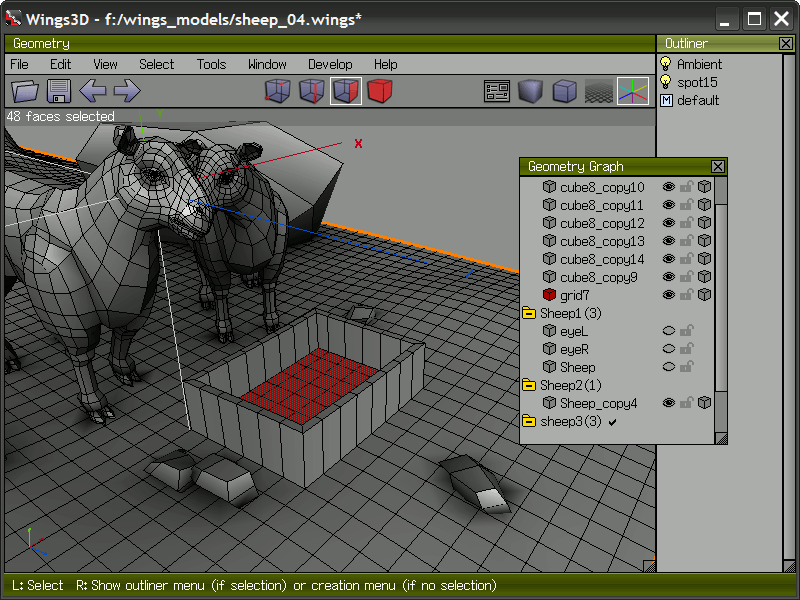
http://www.wings3d.com/wp-content/uploads//SS01.png
Wings is mainly for creating renderable meshes.
A CAD software's main usage is in modeling physical structures.
Whelp, I guess I didn't care that much.
NURBS does not define a single mathematical entity, like a Bezier curve for example does. You can't convert NURBS trivially from one kernel to another. If the implementation is not exactly the same, the transform is unlikely to be mathematically exactly equivalent.
Generic CADD was pretty good. Bought and shut down.
I also remember Visual CAD (which I don't think is the same Visual CAD a quick google search is turning up). I forget who bought them.
There's a zillion others I no longer remember.
Unbelievably, as bad as AutoCAD is/was, Bentley Systems' MicroStation was a hellspawn of turrible.
I've never really understood how AutoCAD and Office maintained their dominance. Conventional wisdom is control the file format. There were so many efforts to open up DWG/DXF. But I don't know that interop ever mattered.
I think it's just been inertia. Nothing since Generic CADD has been enough better to warrant the switchover costs.
A talented CAD technician would be useful using pen and a drawing board. We are just not very good at selling those more inate qualities. It is just easier to just sell yourself as an AutoCAD driver.
Of course these sort of packages take a long time to learn, and you are much more productive using something you know. And people adapt their mental model to a particular package. So there is often little obvious point in changing software.
Saying it's hard to write something that's 100% compatible would be an understatement.
Viewing the same document in Google Apps, Microsoft Word, or Open Office makes me think of QA'ing a website in 3 different browsers.
Network effects. Once you reach a certain level of dominance in the kind of market they are in, the fact that it easier to find staff that know the product and the people you exchange days with are using the product, the cost of unfamiliarity and potential data exchange errors means anything else has a very high barrier to overcome even to be considered. An incremental improvement isn't enough, you have to either be wordshatteringly better or have near infinite runway and some non-feature advantages to leverage (the latter is how Excel and Word dethroned 1-2-3 and WordPerfect, but who is going to play 1980s Microsoft to dethrone AutoCAD?)
Joel Spolsky explained it: most users use only 20% of the app. But each user uses a DIFFERENT 20%. Thus you won't go nowhere until you are almost at feature parity, because everybody will have one little thing you didn't implement, but which is critical for them.
I think you mean is a hellspawn. I think they still have a solid foothold in some sectors.
That's the catch, I think. The market is not so large for 3D modeling tools.
The second hurdle is the ridiculous amount of inertia DWG has in the AEC industry. Any solution that would topple Autocad would need to likely provide DWG and/or Revit interoperability to even have a shot at the market.
There are no good options for Revit at the moment so, that's a deep vendor lock in. For DWG there is at least Teigha library from ODA which is based on reverse engineering the DWG format and offers reading and writing of it.
It works amazingly well.
Are 2d CAD and 3d modeling different kettles of fish?
Autodesk also has a newer product called Revit. I have not used it.
For a lot of the workloads a sub 1000 PC is enough (I'm in the AEC software industry and am quite familiar what we are talking about).
Take into account that most software in the domain we are discussing is decades old. Some things would work just fine on the lowliest PC you can buy from the cheapest vendor. And yes, sometimes even the most beefiest machine is not enough.
Looking at its stock UI, I'm reminded of one of my basic grievances with CADD of the AutoCAD model:
I hate layers.
When doing architectural plans, which layer does the electric water heater go onto? 'ELECT', 'PLUMB', or a special case 'ELECT-PLUMB'?
Much better would be something set based. (Today we'd probably call them tags.) Instead of toggling visibility, views should be queries.
No fun.
Ages ago, I was buddies with a guy (Dale?) who reverse engineered DWG, which I think became the code dump for the Open DWG Alliance, which may be this group today https://en.wikipedia.org/wiki/Open_Design_Alliance, though I don't see McNeel & Assoc listed (Rhino3D).
Dale worked for a graphics card company, Appian?, writing drivers and file viewers. He'd reversed DWG to write a wicked fast viewer. Just like those guys from Atlanta (don't remember their names).
I now dimly recall that Dale's team had to also reproduce AutoCAD's rendering bugs.
Revit, on the other hand, is used for building information modeling. It's main domain is designing buildings.
Except for Revit and Autocad, which are somewhat interchangeable within their users' domain, none of these products really serve each others core userbase well. Hence, they are not really comparable. It's like saying Word is a bit like Excel since you can compose tables of numbers in each.
If you were to offer one to the core user of the other they would complain as much as if you were giving a steak for a vetenarian to cook.
I have been developing on Bricscad for years and it is far faster with a much less buggy API as well. Bootup times smash AutoCADs :)