Impossible color(en.wikipedia.org) |
Impossible color(en.wikipedia.org) |
When he stopped the motor, the disc spun down and it was yellow on one side, and blue on the other.
You might find playing with the LAB color scale in photoshop an interesting toy to see why a reddish green color has no sense. by adding red to green you end up on the gray side. basically the colors just neutralize each other.
Keep in mind that the red and green you’ll be mixing is not 100% color pigments, so it cannot merge into a dark grey.
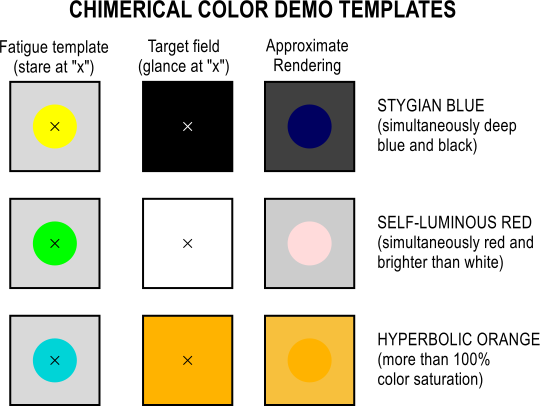
https://upload.wikimedia.org/wikipedia/commons/5/56/Chimeric...
Humorously, Negativland, the amazing decades old plunderphonics group, had a whole prank site[1] and a Over the Edge[2] radio show[3] regarding the 'fourth primary color', Squant. This was also the only color with it's own smell as well. Negativland also had a plugin for web-browser that allowed you to 'see' this magical fourth primary color.
[1]https://www.negativland.com/archives/015squant/story.html
This article could use some serious copy editing.
Impossible colors are derived from the frequency-response curve of the three standard pigments in the retina. (There are people with 2 pigments and thus have a reduced color space, and people with 4 pigments who have an increased color space.) Since the pigments are not evenly distributed, the brain synthesizes some colors from incomplete information.
The dress problem stems from luminance-color correction in the brain itself. The eye has quite an amazing dynamic contrast ratio, but a much narrower static contrast ratio. If you have picked up on clues that the photograph was over-exposed in one way, your brain interprets that as a signal that the colors are washed out. If you have picked up on clues that the photograph is undersaturated, your brain says that the colors should be brighter than the pixels are. The photograph in question gave ambiguous clues.
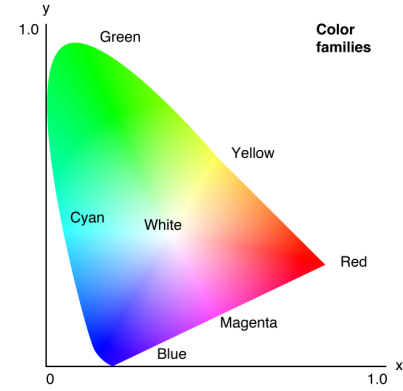
So the different colours are all points in a 2-dimensional space. Each frequency corresponds to a given point in this space. If you plot all the frequencies from the spectrum they form a curve in this space, which is a semicircular shape. Red is at one end of the arc, and violet is at the other.
But the possible colour aren't just the ones on this arc. We can also see colours that correspond to mixtures of different frequencies. These fill in the inside of the semicircle, creating the full space of possible colours, which looks like this (https://pbbhandarkar.files.wordpress.com/2016/10/colorspace....). The spectral colours are on the arc around the outside, and all the colours on the interior can only be made by mixtures. The line joining red and violet is called the "line of purples". It joins violet back up to red to make a circle, but it consists only of mixtures rather than spectral colours. The spectral colours don't go around in a circle, just a semicircle. We need the line of purples to join it back up.
Given that, violet appears to be between red and blue in the same way the pitch of G appears to be between the pitches F and A.
Zhang, Haimo, Xiang Cao, and Shengdong Zhao. "Beyond stereo: an exploration of unconventional binocular presentation for novel visual experience." Proceedings of the SIGCHI Conference on Human Factors in Computing Systems. ACM, 2012.
http://www.shengdongzhao.com/wp-content/uploads/2012/06/chi2...
Does anyone have the same or a very different experience?
I imagine something similar would happen with your proposal, and possibly make people sick.
(Mixing vision between eyes is really interesting. My eyes are really different (one is good for close-up, one better for distance) so I have some experience with this.)
As with many things I have examined under a microscope, I didn't actually learn anything new, but it was still interesting to see for myself.
For opaque paint, it’s weirder: paint scatters and absorbs, so white light goes into the paint layer and starts bouncing around. The resulting reflectance spectrum you see is a function of the ratio of absorption and scattering across the spectrum. Mixing paint mixes the absorption and scattering spectra. One weird result is that adding white can increase a paint’s saturation. (Think of adding apparently-black blue food coloring to white frosting.) Weirder still is you can have two identical-looking paints that, mixed with a third paint make different shades depending on which you use. As a related weird example, yellow plus black can give you a blueish-gray, since the black paint may absorb yellow more than blue (so long as it doesn’t scatter much that’ll still look black) and the yellow will scatter some blue and not absorb all blue (it’s not perfect). So when you mix those you can get something that scatters blue more than it absorbs it and absorbs yellow more than it scatters it. But pick a different black and you’ll get a different result! Color theory is tricky stuff; paint mixing is perhaps the least intuitive part of it.
[1] http://blog.everydayscientist.com/wp-content/uploads/feynman...
Basically the counterintuitivity you're citing goes away when you talk about color distinct from luminance, which is how most people here understand it anyway.
The website https://www.handprint.com/ is also very good.
In practice it is possible to mix a grey from coloured paints, but you need disproportionately much blue. Brown is just dark orange, and blue is the complementary colour to orange, so you need to move in the blue direction if you want to get to grey. Also, if you're using red, yellow and blue, you generally need less yellow than red. Try a ratio of 1:2:4 = R:Y:B.