One could have a tiered rate system, where the first N kWhr are inexpensive and the rates rise after that (just as we do in Seattle)
http://www.seattle.gov/light/Rates/docs/2018/Jan1/Schedule%2...
If supply is constrained, and demand grows, it won't stop growing until the price goes up.
An imposition of a quota system is interesting, just because it might yield free residential heating for homes that welcome miners into their basements.
I used to mine in Magnolia and paid way less than RSC rates. Only peak/off-peak mattered.
IDK, I see a bit of an issue turning energy into heat so people can get play a commodity game, most of whom don’t understand at all.
I personally quite like the idea of a quota system for access to cheap, local power. It is interesting however to imagine what might happen if the power was sold into the market at market rate and the profits divided up amongst local businesses and residents instead of giving them cheap power.
That way, they in theory would be no worse off (they can buy power and the dividend cancels the loss of the subsidy), but they can also directly buy things that have higher utility than the direct energy would provide them.
That would also stamp out local bitcoin mining operations and divert the cheap energy to uses more productive than burning it for crypto creation.
The market distortion here means that the overall % of green energy in the country is lower than it otherwise would be.
There are actually (at least) two distortions being exposed here:
1. Power being sold for below market rate
2. Someone being able to join the original investor pool (i.e. become a local) and reap the benefits of an earlier investment by the municipality
As a currency, I'd say that, in the narrow case of BTC itself, failure is baked into its design. The current protocol imposes an estimated upper limit of 3-7 transactions per second on the network. That's just not acceptable for a currency (assuming it has dreams of being more useful and widely accepted than Ithaca Hours, anyway), and the suggested plans around forking are awkward at best.
There are also solutions like the Lightning network. To me, I have a hard time seeing those as efforts to make Bitcoin a currency so much as efforts to create a new currency that is backed by Bitcoin. Sort of like the gold standard of old, where different currencies were backed by commodity reserves.
My view is that the upper end of btc viability is taking over some fraction of why people want gold. The system is way too expensive for a viable txn network (a la cash or Visa) and will never become one.
It's normal for governments to crack down on mining at some point, the energy consumption is indeed hilarious, but that's not going to bring down bitcoin anytime soon.
The reward rate is relatively constant, since the protocol automatically scales the difficulty of completing a block to try and make it happen on about the same interval regardless of how many people are mining. And mining is also a zero-sum game. (Unlike in real-world mining.)
This creates a completely wacky incentive structure where, instead of incentivizing producers to only expend enough resources to satisfy market demand, and no more, they're instead incentivized to expend as much energy as possible, at all times.
It's like if there were a King who likes to buy cheeseburgers for $10,000 apiece, and he always buys the first cheeseburger he sees, but he considers any cheeseburger that is more than 1 second old to be spoiled. So then you end up with a market where people are furiously making cheeseburgers as fast as they can, and just littering them everywhere, in the hopes that one of the cheeseburgers they made happens to be the one that the King sees first whenever the urge for a snack strikes him. Meanwhile, the world is getting increasingly littered with spoiled, rotting cheeseburgers.
Plattsburgh is 300 miles away from Niagara Falls, on the other side of the state! I don't know why Plattsburgh prices are so low, but it's certainly not proximity to the Robert Moses Niagara Power Plant.
I mean, could there not be a cryptocurrency which bootstrapped off of the exchange with "real currency"? Or perhaps by direct exchange of goods and services?
Anyway, turning off power to mining companies will just trigger investment in better off-grid power solutions. It's a double-win for everyone else.
Sounds like author has no idea what he’s talking about.
(I can't wait for that 'crock o shit' libertarian sea nation to get it's first visit from the libertarian pirate nation.)
This isn’t about libertarian dreams, that’s just not at all how PoW works.
The author is clearly utterly clueless (or intentionally trolling).
If you happen to disagree, I’d absolutely love to know how municipal electricity companies could even hurt bitcoin.
Bitcoin miners are consuming in the order of 73TW/h[0] annually.
Let's consider those quantities equal for the next argument:
Isn't it a good thing that crypto is generating business for the energy sector? If those revenues are invested in more energy research it is favorable to human kind, isn't it?
Why deny the energy sector its business and favor the financial sector?
[0] https://digiconomist.net/bitcoin-energy-consumption [1] https://www.quora.com/How-big-is-the-international-money-tra...
Wouldn't it be good for the window industry and service/repair industry if we all went around town throwing rocks through windows? https://en.m.wikipedia.org/wiki/Parable_of_the_broken_window
The energy sector is primarily producing the energy in question with non-renewable resources that pollute the environment and raise costs for everyone else, disproportionately harming the poor. Not to mention rising food costs due to money grabs in the ag industry with things like corn based ethinol.
This is not entirely correct. You pointed out that the reward rate is relatively constant which limits the income of all miners combined to 1.25 Bitcoin/minute. They really can't be spending more then that on mining. That includes Hardware + Energy + Salaries + Offices + Warehouse. Any single miner is also only going to get a fraction of that 1.25 Bitcoin/minute and anyone spending more then what they get will find themselves with a deficit.
That is also just until ~May 2020 when the next Halving is going to occur. They have until then to figure out to decrease their spending on mining to be lower then 0.625 Bitcoin/minute.
I'd love to see someone go more in depth with these types of "how much energy is wasted on x" estimates. Including just addressable grid and power plant inefficiencies. I suspect bitcoin is simply not a big deal (at this point), so this entire issue is concern trolling.
And then you come to the problem of what it means for the electricity to be "wasted". Eg, is going to church "wasting electricity"? What about the entire alcohol industry? Playing videogames? Preparing and storing deserts?
https://phys.org/news/2015-12-christmas-energy-entire-countr...
Or people actually care. The fact there are existing, worse ways to use energy doesn't mean we shouldn't care about Bitcoin. For the same reason I'm composting, even though the nearby supermarket throws out way more packaged food than I'd ever buy.
This isn't a zero-sum game. We can address multiple inefficiencies. Bitcoin is just one of the more flagrant sources of tech-based waste that doesn't actually benefit anyone.
>And then you come to the problem of what it means for the electricity to be "wasted".
Nobody's going to ever fully agree but I think we can reach a quorum agreeing that fake money made up by libertarians who think a couple hundred years of bank regulations are totally gay bullshit put in place purely to stifle people and not to address totally legitimate concerns of abusive behaviour is enough of a waste to curtail it.
> Eg, is going to church "wasting electricity"? What about the entire alcohol industry? Playing videogames? Preparing and storing deserts?
Alcohol and food are tangible physical products that have had demand for thousands of years, video games are entertainment, and church builds community. Some people will have problems with all of these, but they are almost certainly going to be the minority.
Cryptocurrency mining creates literally value.
I don't see how bitcoin cannot become more efficient "by definition". In fact it is a very straightforward process. All you have to do is add more zeros onto here and get people to use it.
  /** The maximum allowed weight for a block, see BIP 141 (network rule) */
static const unsigned int MAX_BLOCK_WEIGHT = 4000000;The actual limitation is storage, bandwidth, and memory costs. If those become cheaper then there is no reason not to increase that value.
I'm gonna get a bit Marxist on value here.
Transaction value, or intrinsic value?
A bitcoin can be exchanged at the current exchange rate, as can any commodity given unit of exchange.
What is the intrinsic value of that commodity? The amount of wind needed to blow through a windfarm makes it virtually free aside from the depreciation and cost of producing that windfarm, which is the cost of production.
What is the future discounted future value of Bitcoin? That will depend on the Bitcoin interest rate, for which there is only a transaction value, there is no yield on Bitcoin. Not yield means no return on capital. Given it has cost to produce, yet to yield (intrinsic return on capital) it is a negative sum game, so zero.
If the power's there, why not use it, even at below market rates? Because Bitcoin may be using cheap power, but why does that power even need to be there? Paying little / subsidising producers to over-produce for negative-sum good is still paying something, and encouraging over-production and inefficient production.
Bitcoin is interesting, has some transaction value, but negative intrinsic value/opportunity cost.
The world would be better off without bitcoin mining, and much better off without gold mining.
Gold mining was of kinda stable fixed supply for millennia, then after the 'miners' in Johannesburg discovered half of the world's gold beneath their feet and industry progressed, became of productive value. As of diamonds today.
Bitcoin is of value there. It proved the blockchain, fantastic achevement. But like a natural vs synthetic diamond, of little future value. Further resources invested mining it are seeking returns which will not tend to zero but end in negative. Ethereum, the blockchain which no one fully understands or trusts, the left to Bitcoin's right.
Pivotal ideas, yes. And the end is a long way away.
The growth of an economy is equal to it's return on capital. Balance sheets must balance. Add-in 'long term growth' as in the short term banks and other money market intermediaries make terrible terrible decisions so what seems like growth is often hidden was, well, not growth.
> What is the future discounted future value of Bitcoin? That will depend on the Bitcoin interest rate, for which there is only a transaction value, there is no yield on Bitcoin. Not yield means no return on capital.
Generalise all individuals, companies, government, across an economy (I suppose it would have to be the global economy): As an aggregate (ignoring individual credit situations, this is an aggregate), can they conceptually apply for a Bitcoin loan of B10 @ 10% annual interest and with successful growth repay B11 next year with no change in exchange value of Bitcoin (i.e. there has been growth in the real economy)?
Until this market exists, where real value dominates speculative value, Bitcoin remains a commodity of negative intrinsic value return.
Edit: Financial companies allocate capital. How well they do it is under question by regulators too. Efficient allocation of capital is really important for creating growth.. obviously. Reward for allocation of capital... in my view should be a lot less shorttermist quarterly or annual results-chasing.
I'd argue that BTC is very much backed with something - lots and lots of thermal dissipation. The entire argument for why it should be accepted as a stable, reliable, trustworthy store of value is based on proof of work.
If BTC is challenging anything about money, it's challenging the idea that money needs to be something that exists under the auspices of a government body.
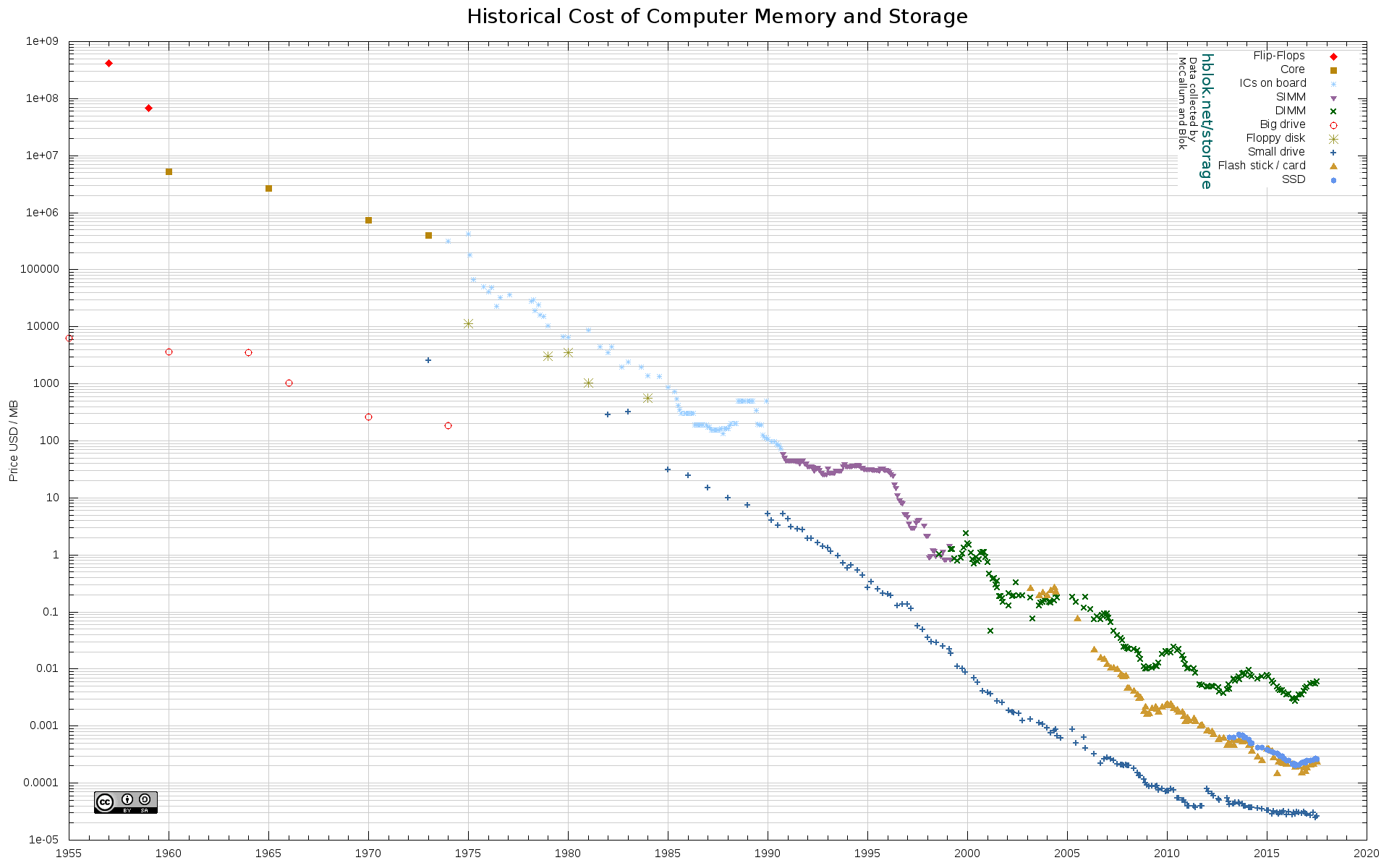
"I challenged"If those costs come down then the "efficiency" can be increased without any impact. It looks like in the last decade they dropped about 10-100x:
https://hblok.net/storage_data/storage_memory_prices-2017-12...
http://drpeering.net/FAQ/What-are-the-historical-transit-pri...
This isn't a subsidy, it's hydro power; which is limited, but cheap to produce. If the bitcoin miners drive the price up without providing many jobs, it may incentivize the actual employers that were attracted by the low price to leave for other areas. It's a net negative for the community.
To benefit from cheaper electricity, you have to use it, and traditionally that's been through employing people to operate machines. If the companies got a cash subsidy instead, they would probably pocket the cash without doing as much as they promised to do to get it.
Money is fungible. Whether they're saving it by having cheaper electricity or getting cut a check is irrelevant.
Energy-intensive industries that form part of the productive economy are exactly the industries that we want to use that power. We want aluminium smelters and chemical manufacturers to be sucking up that cheap, clean energy. It's an efficient use of resources.
Churning out gigajoules of waste heat to process kilobytes worth of transactions is not an efficient use of resources. It's a colossal waste that has done nothing useful except enrich a bunch of speculators.
That's wrong (and also kinda dogmatic). Money is fungible with itself, but it's not fungible with electricity. If a business gets a cash subsidy, they have all kinds of options to subvert the purposes that subsidy [1], but still collect the money. With cheaper electricity, the incentive is tied far more tightly to the actual activity of operations.
[1] which are to incentivize them to locate their operations in a particular place
The government is buying electricity from the region next door to make up for shortfalls, so I am confident they could sell their cheap electricity the other direction as well when they have an excess. Not selling that electricity at market prices and instead selling it at below market rates to companies because you think they benefit your community is a subsidy.
Heck, even if you couldn't sell the electricity to neighboring regions, you should still sell it at market rates and then distribute the resulting money in a more targeted way.
> If the companies got a cash subsidy instead, they would probably pocket the cash without doing as much as they promised to do to get it.
You don't have to hand them cash for nothing. You could give it as payroll tax breaks or a million other methods that are a lot more targeted than per-KW-hr. It's lunacy to think that power usage is even roughly proportional to the number of people employed pre-bitcoin. Businesses very tremendously in their power-usage-to-employee ratio.
Edit: your comment got me thinking, what is substantive to you? Is it just the general hivemind of HN that's only allowed here?
A comment is unsubstantive if it doesn't include any more information than 'boo' or 'yay'. (Although polite empty comments like congratulating someone are just fine.) On HN we want discussions where readers can learn a bit more than that someone likes mining.
Edit: another unsubstantive comment you posted was https://news.ycombinator.com/item?id=17672125, which was worse because it invokes the uncivil why-dont-you-move-to-another-country-then internet trope. Can you please review https://news.ycombinator.com/newsguidelines.html and follow the rules more carefully here?
>https://news.ycombinator.com/item?id=17672125
Fair enough.
> https://news.ycombinator.com/newsguidelines.html
Why is this selectively enforced? "Assume good faith." for example? I haven't seen anyone do that on here.
Example: https://news.ycombinator.com/item?id=17681471
This was a genuine question of mine, it's currently -2.
I wasn't the first one with this thought: https://www.popularmechanics.com/space/a19666/we-cant-just-t...
I'm currently negative 3 points for trying to start a conversation about the topic at hand. How is this not a hivemind? I followed your instructions and yet this still happens.
Look forward to your response.
If you think cryptocoins have no utility, then it stands to reason that the proof of work is wasteful. And beyond: the time and money spent by developers, corporations, exchanges, etc: all waste.
But if you think that cryptocoins do have some utility, then it seems unfair to call it a "proof-of-waste". The PoW is the only way to equitably mint new currency.
> The PoW is the only way to equitably mint new currency.
Why can't exchange of goods or services substitute for proof of work?
Why does proof of work _have_ to be power-hungry number crunching?
I should have made it explicit that I meant "trustless + equitable" with respect to minting new currency.
> Why can't exchange of goods or services substitute for proof of work?
'exchange of goods or services' can't be used to mint new currency. When you want to issue new money, you have to give it to someone. If you take goods or services, who should get those? Let's say you come up with a method to solve that, equitably. How could you prove to everyone who got those, and how could they trust your claim?
> Why does proof of work _have_ to be power-hungry number crunching?
It might not have to be number crunching (I didn't say it did), it just happens to be the most popular. However I think that 'Work' here is the physics sense of the word -- the proof-of-work is evidence that you consumed energy.
Another mechanism is to just delete the "trustless" requirement. Just issue the currency via some trust-the-individual(s)-who-created-the-coin mechanism, like some DPoS coins do (e.g. Nano). They can use a fountain with a CAPTCHA, and we have to trust that the fountain is indeed fair. This coin is popular for the sake that it does not require PoW for minting and has no inflation.
Because it's a waste. It's not worth what it costs to do, and it's making our world worse by eating up more resources.
If you concede that it has utility at all, then all you're saying is "I wouldn't be willing to pay that much". But clearly the market will bear a higher price than you're willing to pay.
Other things that are proof of waste: 1k USD iPhones, Cartoons on TV, all-you-care-to-eat restaurants, dabbing, hoverboards.
Its more like you are trying to catch rainwater in a strainer full of holes but are worried about a tiny pinhole in the side. So sure people may actually care about it, it just makes no sense and living your life that way is not a recipe for success.
For 2013 we have the estimate for total energy supply of 157,500 TWh/yr https://en.wikipedia.org/wiki/World_energy_consumption
Lets say bitcoin used 1000 TWh/yr worldwide (~15-30x what is estimated to use now). That'd work out to:
100*1000/157,500 ~ 0.63 %
EDIT: That energy supply number is actually TPES, which ignores efficiency:
"Closely related to energy consumption is the concept of total primary energy supply (TPES), which - on a global level - is the sum of energy production minus storage changes. Since changes of energy storage over the year are minor, TPES values can be used as an estimator for energy consumption. However, TPES ignores conversion efficiency, overstating forms of energy with poor conversion efficiency (e.g. coal, gas and nuclear) and understating forms already accounted for in converted forms (e.g. photovoltaic or hydroelectricity)."
I suspect that if mining encourages even tiny innovations in power plant and grid efficiency it will have a net negative effect on energy waste. Apparently its that about 65% is lost due to powerplant, and 10% due to transmission/distribution, for ~75% total:
http://insideenergy.org/2015/11/06/lost-in-transmission-how-...
[0] https://www.washingtonpost.com/news/wonk/wp/2012/12/08/all-o...
But it won't. All the incentives to increase power plant and grid efficiency are already there. Moreover, as you state quite clearly, bitcoin energy use is a small proportion of energy usage.
So I disagree, at least if it gets big enough to matter. I'd expect power plants, towns, etc to find it more worthwhile to invest in more efficient tech to attract the miners.
100*1000/157,500 ~ 0.63 %So, THREE ORDERS OF MAGNITUDE are no big deal? Okay.
As noted in the original post, its based on 5 kWh per GB of data transferred as described here: https://aceee.org/files/proceedings/2012/data/papers/0193-00...
If you have a better method, I'd love to see it. This is back of the napkin stuff, it doesnt need to be perfect.
And using he same methods, HN is ~70 KB which is decent for a text-content site. The OP wired page is about 700 KB (but wired.com is 4.3 MB), slashdot is ~1.9 MB, and reddit now like 4.3 MB, etc. Pretty much the entire internet is over 90% unnecessary junk at this point even if you allow that the content has value.
It doesn't need to be perfect, but if the result is off by an order of magnitude or more than it's pretty useless.
If you have a better method, I'd love to see it.
I'm not saying I have a better way of answering the same question, but that doesn't make your analysis more valid.
As noted in the original post, its based on 5 kWh per GB of data transferred
Yes, I believe that if you take the entire amount of data transferred by the Internet, then divide it by the total amount of power used by all internet-connected devices, then you get 5 kWh per GB (or at least you do if you base it off of the data available in 2012 when that paper was written). But that doesn't mean that if I download an extra GB of data that it took anywhere near 5 kWh to do that.
That paper you linked includes things like "total power consumed by all connected desktop computers" as part of the power budget, but this is obviously flawed reasoning. There are many things that computers do besides transferring data, and even if a computer is sitting idle it consumes a good deal of power as long as it's switched on. If I spend 1 kWh of electricity playing an offline computer game for an hour, then download a 1kB file, that doesn't mean that it costs me 1kWh/kB to download data.
Afaict, you should complain about both or prioritize the larger waste if your true goal is to reduce the amount of wasted energy.
Yes, really. You're trying to deflect to another subject using extremely shoddy calculations (and don't use the "It's a back of the envelope calculation" excuse) because you have no defense for the topic at hand.
"Afaict, you should complain about both or prioritize the larger waste if your true goal is to reduce the amount of wasted energy."
AFAICT, you should stop deflecting and concentrate at the subject at hand before trying to veer off.
However, I do like how things like PrimeCoin have a residual product from their security.
Is it any better than spending money to dig up yellow rocks or carbon crystals to be used as status symbols?
If De Beers found diamonds in my neighbourhood, I'd petition my local government to refuse them a permit to mine; if that permit was granted, I'd petition them to enforce high environmental standards and ensure that the externalities of that mining activity are appropriately priced.
And since we can't create gold in labs yet, at least not more than a few atoms, it's actually better to buy diamond jewelry (as long they're lab-grown) than gold at this point. Just don't buy the De Beers lab-grown diamonds; even if those are ethically produced, we shouldn't support that company in any way, shape, or form.
The real "problem" is that Bitcoin mining is harder to centralize & control, so certain jet-setting, energy-guzzling, interested parties will play the morality card. The general population is not allowed to use untaxed energy, but those who control the energy are allowed to. It's the original scheme of civilization.
> I wonder what the chances are that you believe in man made climate change?
Key in on the word "believe". It's a faith. Not saying the climate is not changing, but I am suggesting we ought to have healthy skepticism & awareness of the history of the networks of people (i.e. the priesthood) who demand that we allow them to tax energy; lest the wrath of the gods (e.g. Gaia in this case) tear us asunder with their judgment. Unless you pay your tribute, using their money, of course.
If climate skeptics are wrong, millions of people will die due to avoidable natural disasters and hundreds of millions will become climate refugees.
Those are our choices - do the thing we need to do anyway, or put it off until later and risk catastrophe.
Asking whether or not climate change is "real" is entirely the wrong question. It's always the wrong question. We need to ask what the probability is, how wide the error bars are and what the effect size will be across the range of possible outcomes. Even if our predictions are wrong by a couple of orders of magnitude, reducing our carbon emissions is +EV. Doing something now is obviously the best course of action, because you avert a high-probability and high-magnitude loss at a relatively low marginal cost.
I think this is a place where hippie vegans (sorry!) and redneck Luddites can agree :)
I could be entirely opposed to the idea of a tax solution to "fight" climate change while also being entirely opposed to bitcoin because of the uses of money laundering, drug purchasing, a My First Day Trading schemes.
I'm personally opposed to bitcoin for lots of reasons, mostly like kids think it's a decentralized currency, when really it's a very centralized commodity (any one of 12 people could effectively destroy bitcoin at any point in time) - but...
I'd be a hypocrite if I considered myself into bitcoin and environmental issues.
Is that a question? Or a statement?
No. What if they have operations in multiple locations? They could locate the bulk of their operations elsewhere, and only maintain the minimum presence in the jurisdiction of the local government to collect the subsidy.
With cheap electricity, they're incentivized to locate as much of their operations (that would benefit form the electricity price) as possible.
Reddit is apparently the 3rd most popular website: https://old.reddit.com/r/technology/comments/8n959q/reddit_j...
No idea where this info comes from but it gives 1.8 TWh/yr for (the now fourth most popular site) facebook in 2016: https://www.statista.com/statistics/580087/energy-use-of-fac...
Does it make sense for total reddit usage to be ~3.5 TWh/year in 2018? It seems to be in the right ballpark, but who knows how circular these calculations are.
It is not the job of local municipalities to decide whether Bitcoin transactions are worth the cost of electricity. How could they possibly have the expertise to decide questions like that?
My defense is that bitcoin energy usage is really not that high even if it was all a waste (as some seem to think). I offered some rough estimates and at least showed some evidence of effort.
You apparently think the energy usage is very high, based on nothing (at least that you have shared).
>"AFAICT, you should stop deflecting and concentrate at the subject at hand before trying to veer off."
How far did you get through school and where did you go? If you had success, how did you decide which class to study for first, etc, without understanding the reasons to prioritize?
EDIT:
I use school only as a general example most people on this site are probably familiar with. Pretty much any project requires prioritization...
First, many (including Russia) contend that petroleum is not old plant matter, but made from a geological process. We also have plenty of Coal & Natural Gas; never mind Solar energy.
There's also weather modification (e.g. Stratospheric aerosol injection). There's also other forms of energy.
There's also Electrogravitics, which contends that Gravity & Electricity are related. The Electrogravitic model provides a unified model that is simpler than String Theory.
If Electrogravitics is an accurate model, then we are living on a massive engine (planet Earth) & can, as Nikola Tesla has demonstrated, harvest the energy generated by this engine.
Solar doesn't make great plastic. You know what carbon fiber is - it's burnt plastic that's been processed with lots of oil and electricity. We know of no better stable and denser energy storage than hydrocarbons, we're going to use all of it.
Towns with weird subsidizing schemes going on won't be able to take advantage unless they account for the new opportunity.
>>>>> Money is fungible. Whether they're saving it by having cheaper electricity or getting cut a check is irrelevant.
> Tie the subsidy to electricity consumption. This really isn't hard.
So you're conceding the point that there are important differences between "having cheaper electricity or getting cut a check," then? What you suggest is nearly indistinguishable from just having lower-priced electricity. The only difference is some extra paperwork and administration to get the lower price.
No.
> What you suggest is nearly indistinguishable from just having lower-priced electricity. The only difference is some extra paperwork and administration to get the lower price.
Nearly indistinguishable, except along the criteria in question. If you price electricity below market, you get free riders like the Bitcoin miners. They're certainly not the only ones either, just the biggest. If you instead subsidize the thing you actually want then you will get more of that thing, without the free rider problem. If you want to subsidize job creation, then do that, don't just have cheap electricity and then whine when people take you up on it.