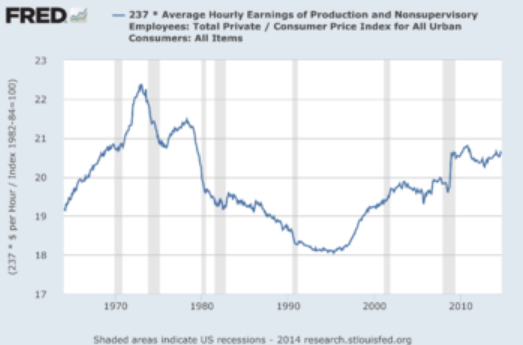
Granting unpaid leave to go try your own thing for a while is, from the employer's perspective, not any different. Some people never come back, most people do. The same is true for parental leave (many quit their jobs towards the end of their leave, if they had already been thinking about it).
Even when they aren't required to grant it, larger Swedish companies will often give you unpaid leave if you just ask. The fear is that otherwise you will quit. Hiring is hard here, so it's better to have a promise of someone coming back in 6 months than a job opening that can take 12 months to fill.
Sweden has an enormous market of consultancies compared to the U.S. for filling these temporary gaps. Obviously consultants are expensive and not trained on your projects, so it's not the same as a long-time employee, but it gives options to "control the bleeding."
This is what a strong economy actually looks like.
It's hard (in my experience) to get Americans to understand this, because our economy here has been so bad for so long, most people here have never experienced anything like this.
Is it actually though? Couldn't it also be a sign of an aging population? Sweden's population is growing, but it's mostly due to immigration. Considering the type of immigration that's mostly happening it's not bringing in lots of skilled workers.
No mention of wages and jobs.
In Electrical Engineering(US), its vicious the amount of competition trying to get me.
Vacation policy? Unpaid, but at 60$/hr, I just afford to take 3 weeks of vacation, but 2 weeks of holidays too.
However the thing I think that is more unique to Sweden and drives these kind of nice benefits is that it's really hard to get rid of an employee. Employees are protected so much with rules and regulations that even if you get let go you have a required three month grace period unless otherwise negotiated with the employee.
It's not uncommon I would say to see tech workers "fired" but then still on the payroll for an extra 2 months while they are arbetsbefriad (paid leave)
Pretty nice if you know how to game the system
I thought that a contractor is usually someone who is self-employed, whereas consultants are employed by a consultancy.
My employer struggles to find skilled people and when one guy on my team suddenly disappeared for 6 months it was definitely felt.
Before that I hadn't really grasped the idea yet. Even though I've lived in Sweden since I was a child. I just couldn't accept that you can duck out of your job for several months and then come back as if nothing happened.
I saw it as a sort of betrayal of your co-workers and duties.
And when your employer is already struggling, quietly, to find competent personnel, it really felt like a kick in the gut to lose one of the most competent resources in that team.
Of course that person came back and has always performed at a decent level.
Now I'm older and more mature, I have my own company, so I'm much more accepting of the privilege to take a break from my employer to develop my own business.
Unfortunately, and the article states this, there is an issue being in direct competition with your employer. Mine is a consultancy firm which means they do almost anything. They can purchase a solution from someone and re-sell it as their own. So it's very hard for me to start an IT business that does not compete with them.
It's a sword of damocles dangling over me right now, because I haven't revealed to my manager what I'm doing in my own free time yet. All I know for sure is that I haven't signed any contract preventing me from running my own business and there is a clause in the collective bargaining contract that states that I can't use any company resources, which is obvious.
If an American political party were TRULY pro-business and pro-entrepreneur, they'd get behind policies like this. They'd also support divorcing health care from employment, because holy COW how many folks would start a new venture IF ONLY they could afford private market insurance?
These are unpaid leaves, right?
I think it's a great idea, particularly for a business of a certain size. I know many of my peers leave their jobs because they are looking for an extended break. If they didn't have to leave, it could be a win for both employees and employers.
Yes.
You also get paid basic allocations similar to unemployment, unlike this system.
You only get it once though.
In Sweden you have a duty to be loyal to your employer, which means you are not allowed to plan and/or start a competing business during your employment. Your employer can sue you for violating your loyalty to your employer.
However this also means that you have to be able to define what your employers area of business is. Either you don't know it or they don't have one. Get their area of business defined.
This is the hard part for me because they do anything from hosting private clouds to buying a digital signage solution and re-selling it as their own.
My business is just consulting and developing. So far my job has been to develop a digital signage solution. Which would be in direct competition with them but I'm not left many options.
They even have a developer department. So the very nature of my employer makes it almost impossible for me to start anything in IT.
The new contract did have a section that stated essentially that anything an employee produces, on or off business hours, in or out of business locations, is owned by the employer.
I flat out refused to sign this and there was apparently no requirement for me to sign it. It was just presented to me digitally because a process had been started in their systems and signing that contract was part of the process.
If I'm forced to sign it I will request a new contract without that section in it. Because even before I had my own business I was writing open source code for open source projects that we use and rely on. So it's impossible for my employer to own that code.
It essentially specifies that the employer owns, but must pay a token cost for, "inventions" by an employee outside of his normal employment field and duties.
When you get hired you should _always_ make sure this is stricken by your contract.
> If I'm forced to sign it I will request a new contract without that section in it. Because even before I had my own business I was writing open source code for open source projects that we use and rely on. So it's impossible for my employer to own that code.
You need to _include_ a section that effectively negates 1949:345. Otherwise that law applies if nothing else is stated in the contract.
What happens if you work another job and invent things there? Do the companies own each other’s stuff?
I like to frame it in terms of reputation risk to the company. If they own the contents of people's creative hobbies outside of work then I am happy to put "Copyright $COMPANY" in big letters on my amateur porn website... Surprisingly few companies have thought about it that way.
What does this mean?
However I did sign a forced arbitration clause which is equally BS.
You know, you don't have to sign those.
I always cross out those and tell them to send it back when its fixed. Only my first job I was afraid to do this.
Not if the policy causes more inefficiencies itself. If people can, at will, take 6 months off, then all companies need to plan for more redundancy. This is obviously inefficient. So it ends up being a question of whether the benefits outweigh the negatives.
Considering that Sweden isn't exactly topping the charts in economic growth or wealth or GDP per capita or disposable income, I'm not sure whether this system is good in the long run.
Plus, GDP per capita doesn't capture some very important aspects of of what makes people live better lives, eg job security, not being afraid of health issues, leisure time, etc.
Probably not many? The US seems to dominate in start up compared to Canada or Europe (free healthcare).
In theory this shouldn't be much of a problem because all jobs should be on permanent basis by default and fixed-term contracts should be only for very special purposes. In practice this is not enforced and especially for lower paying jobs (and some even higher educated fields, such as teachers or nurses) its quite common not to get permanent contracts at all.
Because of this, there's almost a new social class of permanent contract workers who have great benefits and programs, and beneath them a constantly growing underclass on temp contracts, shitty working conditions and little benefits. It's sort of absurd that some paper pusher can get paid for doing any studies they wish more than a cleaner or store clerk gets paid while working.
The systems were largely created before the neoliberal era started in Nordic countries in the 90's or so when employer protection was very strong across the board. But as the protection has crumbled for the "underclass", the system starts to at times look something like the olden privileges of the higher castes.
This gave me a chuckle. To most people who aren't on HN a software service, no matter the size, is a major business undertaking.
I have a friend who started a pilates studio. She loves pilates and the startup costs are minimal - a few thousand dollars total mostly for a small inventory of yoga pants and athleisure gear to sell. She quit her finance job to get it off the ground thinking it would take at least a year. It took her six weeks to have enough membership subscriptions to make her business profitable. She's a brilliant businesswoman and was working the front desk at a pilates studio and teaching a few classes. After three months she was understandably very bored. Her company still hadn't found a replacement for her so she hired a college kid to sit at the front desk and went right back to work.
There are a lot of "analog" small businesses people could get off the ground in 6 months I just think they aren't the sort we're used to hearing about here because HN is so tech focused.
And then what do you do with the replacement once the original guy is back?
Overall though, I would agree that benefits overweight potential problems.
Once its an accepted pattern, there are fewer surprises, and most people are understanding.
A possible argument against the system is that there are many temp working contracts to fill in for the fulltimers on leave.
Also, what sort of employer benefits are provided during these periods? I'm assuming Sweden has socialized medicine so employers aren't on the hook, but that'd be a major reason why it couldn't work in the US.
The problem with hiring is from what I've seen not due to ageing population. Instead, due to very protective employment regulation employers in Sweden are absurdly slow and picky when hiring. Resulting in a very large temp staffing sector. They are also surprisingly conservative in expectations.
Contrasting anecdotal rant:
In 2014-2018 I was trying to help a Swedish company get a tech dev project going. They needed to bring in about five experts. For years this project was delayed until it was no longer relevant, because they had a pointlessly limited view on who they needed to hire, at what cost and under which structure. They would not accept a 15% salary increase above their opinion of the norm, and neither a distributed project nor a collaborative partner network construct. This loss of opportunity was huge for them.
During the same time I was staffing, running, and completing two projects in Switzerland, total of 25ppl. No issues, quick handling, excellent outcome. The Swiss investors understood that it's ok to run a project distributed across five countries and pay an extra 20-50% if it's difficult to find good people locally in a given field. Skill and speed is more important than location, cost, surname, language[2], etc.
This is not the only such situation I've come across in Sweden. I work as an R&D consultant specialised in setting up and running distributed collaborative high risk tech projects. Despite being a native Swede it's easier for me to run projects in Switzerland than in Sweden. Kind of sad.
For your second point:
For skilled immigrants (stem university degree) the situation is quite good.
From what I've heard, 2nd-3rd generation immigrants and onward tend to outperform the "native" population. This may change in Sweden after the large influx of unskilled refugees in the last 20-30 years, vs the predominantly work based immigration of 1950-1980s.
Statistically [1]: Sweden has one of the highest gaps in unemployment between European and non-European unskilled immigrants. If you're uneducated you _really_ should migrate to somewhere else if you _ever_ want to get a job.
1: https://en.wikipedia.org/api/rest_v1/page/graph/png/Immigrat...
2: as long as they know English well enough :)
In the accounting world we have employees that we call 'contractors' but they aren't self-employed. Rather, they are employed by a specific accounting staffing agency that contracts with our firm to fill positions temporarily.
Sometimes contractors are employed by the company they are working with directly but the position isn't guaranteed to last before
Basically, like much of the English language, there isn't a hard rule. I imagine there are country, regional, and industry specific uses for the terms. There may have once been a hard distinction, but misuse of terms eventually permeates into local parlance, which gives way to a new accepted use of the term.
You have a good point. My wife started teaching piano lessons after I quit my job, and her studio was at full capacity before my business was making any money. She's been at it for a while, but like your friend she's also experiencing a loss of motivation to continue doing it.
You're right that single person & analog face-to-face services are very easy businesses to start. I have to wonder if those are the kind that Sweden is actually encouraging with their leave program. These kinds of businesses don't scale at all, there's a growth wall that most people never get over, even when they're among the few that survive the motivation problem. This is especially true when the business is initially launched as a personal service and needs very little planning or investment.
I wish there was something like this in my country as well.
Speaking as an employer, what my employees get up to in their own time is their business as long as they get their work done when they're supposed to.
In theory, yes, In practice, nearly every single US employer has this somewhere in their contract automatically by default -- the only way a company doesn't, is if someone explicitly got it removed.
Also, in much of the US, the clause is enforceable, so companies have basically no incentive to remove it.
I suspect employers love restricting your right to have a side hustle so that they absolutely totally own you. If you have no other means of income besides your job they can lean on you pretty hard and there isn't much you can do about it if you like having a roof over your head.
When did that start? I left EE in about 2006 because I felt like all the employers were very demanding of specific skillsets and treated engineers like they were easily replaceable.
Of course, every job I've ever been in has been terrible about redundancy, and when people start leaving, usually it's the people with the most domain knowledge, and so you get a big gut punch right away, and then it snowballs as more work and responsibilities get put on other people and they end up leaving once they've had enough or found something better, and it just keeps increasing until you're basically totally screwed but hey, you're saving money by not having to pay all these employees anymore, and that's all your stockholders are going to see for the first year until your company completely falls apart.
Of course, not trapping women in domestic servitude is a good thing, but making it (on average) necessary for two people to work to afford a home when before it took one is a bad thing.
Alternative is 'trapping them' (horrible choice of words btw) into corporate servitude. Which of the two is better? Which of the two is better for children?
trapping in corporate. Trapping in corporate grants economic independence.
Which means, depending on the family situation, it may be better for the children... it means the woman has the ability to run away if she needs to.
Not saying its a perfect system, or that it should be a binary choice (it shouldn't be), but of the binary choice, one is blatantly better.
The choice should be there for men and women to work or rear. Applying that freedom appropriately is the individual's responsibility.
Any reason you used the term servitude which implies a negative connotation, when many women were happy with that arrangement? It also implies none of the women received positive utility from staying at home with the kids and it was always a chore, which seems a little ridiculous.
We should be embracing every opportunity for more personal involvement with our children and family, not calling it servitude. It does all families, past, present and future, a huge disservice.
But in 1973, it fell almost exclusively to the female parent, whether it was what she wanted or not. Many women may well have been happy with that arrangement, but practically no men would have "received positive utility". And either there's something unique about the Y chromosome that makes it impossible for them to enjoy that, or a lot of women weren't so much "happy" as "accepting".
We should indeed embrace opportunities for more personal involvement in families -- for both parents. Generous leave is a big start on that. But "100% leave, as long as you're female" is not.
https://www.cfr.org/blog/mapping-capital-flows-us-over-last-...
http://www.smashcompany.com/wp-content/uploads/2017/12/Scree...
A few other graphs I collected on my weblog are here:
http://www.smashcompany.com/business/is-it-useful-to-have-a-...
http://www.smashcompany.com/philosophy/do-men-become-warlike...
http://www.smashcompany.com/philosophy/marriage-peaked-in-19...
A real weak economy would look like Japan, Ukraine, Russia, Zimbabwe, etc.
Life for the laborer has been under systemic attack since Reagan, but the US economy as a whole has been doing swimmingly.
Replace capitalist with monopolist and I'd agree.
How many capitalists make losses for 20 years and not only stay in their job, but actually become the world's richest person? Where would Uber be if they couldn't use VC money to undercut taxi companies, and subsidize hundreds of millions in losses. And let's not even get started on the issue of offshore tax avoidance, something your local hardware store will never have access to.
Looking at wages alone is only half the picture.
This has changed, but it reveals a lot. It also might relate to why it's so hard to find teachers for the price government is accustomed to paying - if you were a well-educated woman in the 1950's you had far fewer options (aka bargaining power) than you do today, and teaching was likely to be one of the few options with a bit of prestige and mental stimulation available to you.
It's true that women weren't FORCED to not work, but to suggest that they didn't face a strong disadvantage is disingenuous. Hell, it's still a rampant problem - how many tech bros get off an interview and then say "ah but she's 32, she'll want to take maternity soon". This is a good reason for making maternity and paternity leave equal, incidentally...
https://www.nytimes.com/2018/06/26/podcasts/the-daily/pregna...
Though for all that, my wife stays home with our kid by choice. She went back to work when our daughter was 6 months old, and after six months of barely seeing her outside of the weekends she just couldn't bear it (I didn't much like it either). The only reason we can do that is because I have a good paying job in tech making something over the 90th percentile of incomes in my country. I wish other people had that choice. Hell, I wish I had that choice. But few do.
It is when you are absolutely economically dependent on the outside of the home work, from which you are functionally excluded, of a partner for survival, when even searching for an alternative in the same line is grounds for termination without support, and where the one on whom you are dependent has a legal right to use you sexually without consent (criminalization of marital rape in the US began in the mid-1970s after the mass entry of women into the workforce)? I think “domestic servitude” is an overly positive euphemistic description of the condition women were generally trapped in before their out-of-the-home work became normalized.
But.
There are women (and men) who would prefer to work in the home and they should be free to do so. It's demeaning to equate a person's effort in homemaking with servitude. There is not something inherently inferior about maintaining a home and it's only a perverse economic system rooted in traditional misogyny that tells us otherwise.
As I said initially, the choice should be there. The social and institutional compulsion obviously should not.
No one did that upthread. Someone compared the condition women were trapped in prior to the normalization of their choice to work in the general market as being trapped in domestic servitude. This is not equivalent to equating freely-chosen homemaking with domestic servitude.
Corporate servitude also sucks but that's a result of nimby housing cartels (you're competing with two income households for homes).