It's easy to sit in a developed western country, buying products from other countries, and then complain about their emissions. I'm glad that we're trying to be responsible. It may not be enough or not the right way to do it (some thoughts on this?), but it's something.
I'm not sure how it's being protected though.
OTOH the earth has been getting greener recently:
https://www.theglobeandmail.com/opinion/we-are-making-the-gl...
https://www.sciencedaily.com/releases/2010/02/100201171641.h...
They marketed it in an "own a piece of the rainforest" way and kid me was super stoked about the idea of owning a piece of rainforest, imagining how I would be living there.
I think it might have been Yps [0], but I'm not 100% certain.
That's why we need a carbon tax. To force people to.
Help me find a consumer toaster made in the United States. I searched for six months and only found ones made in China.
If I want a giant hotel toaster, there is an American option. But nothing sized for a household kitchen.
There are lots of people who make efforts to buy domestically. But so much manufacturing has gone to China that for some items there is no alternative.
If you're familiar with the history of industrialism, all currently clean and rich countries went through a phase of horrible dirtiness as they rose out of awful poverty.
Fortunately, China seems to go through the same steps as the west 3-5 times faster than we did.
Sometimes, the only way out is through!
if you want to reduce emissions stop consuming
Doing what you suggest would not necessarily have any impact on emissions (as they might just shift to another country) while ensuring that 1.3 billion people remain poor and that their country remains undeveloped.
Far better to impose strict requirements on production methods. But if that is more expensive there should also be financial help available to countries that may not afford it.
There are better solutions that don't involve trading human suffering for environmental protection.
Is everything made in China uniformally disastrous for the environment?
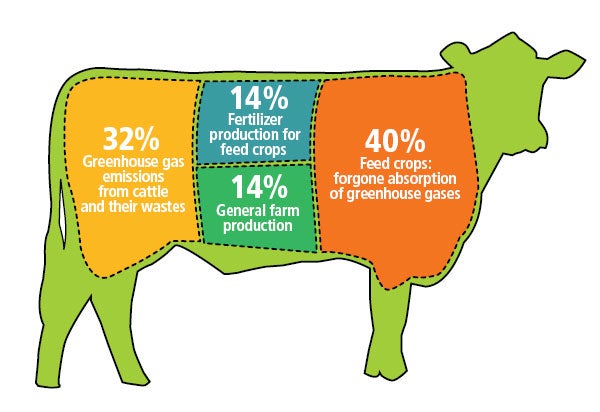
I was under the impression the easiest way for people, who live in developed nations, to reduce emissions is to eat less meat?
Granted if you really really want to reduce your personal emissions, stop using technology from post-1950, maybe buy some land...
Poor people have been put in a position where they really don't have a lot of options. Blaming poor Westerners is like blaming a child for their parent's bad spending habits.
At least in Spain, a tremendous percentage of land is put at the service of mankind. The dehesas give cork, honey, acorns to feed the pigs, and grass for the cattle.
The situation where developing countries need to conserve their land in a natural state in the interest of biodiversity and climate reminds me a game of Civilization where you are no longer allowed to exploit them to your advantage (with good reason!). We need to keep this land intact, but the only way to do it is to make conservation more valuable than exploitation.
"..
To offset their own carbon emissions, European companies have been overpaying China to incinerate a powerful greenhouse gas known as hfc 23.
And in a bizarre twist, those payments have spurred the manufacture of a harmful refrigerant that is being smuggled into the U.S. and used illegally.
…"
https://e360.yale.edu/features/perverse_co2_payments_send_fl...
A somewhat similar initiative regarding the Yasuni rainforest in Equador unfortunately went nowhere a couple of years ago because rich countries weren't willing enough to pay.
It's usually countered by saying "that oil would get pumped anyway, better us doing it 'cause our oil sector has the smallest CO2 impact per barrel of oil pumped" or something along those lines.
A decent argument, but it hinges on a massive "what if".
Just like europe loves to pretend it is lowering emissions when it's just shifting manufacturing to china, norway loves to pretend to be environmenally friendly with its oil money.
If europe or norway truly cared about emissions or the environment, they'd end global trade and drilling for oil, but they aren't going to give up their luxurious first world lifestyle are they?
Edit: To everyone downvoting, how about this scenario. We give norway $1 billion for them to shut down their oil rigs? Surely norway will sacrifice their economic wealth and prosperity to help the environment right? Or do we only expect that from poor countries?
When I was in southern Germany I did notice how cultivated the land was. There were a few patches of trees but they didn’t look like old growth forests. Even the hills were cultivated into farmland.
Costa Rica is a good example of developing a country who wants to keep their natural resources in tact. 25% of their land are national parks.
Wild boars scare me much more than black bears.
Yeah, keep this in mind; big parts of Europe are hundreds of years after a gradual deforestation. Europe, mostly Western, is highly cultivated. Mind you, thanks to that we're also very efficient in agriculture - NL, despite being one of the smallest countries in the world, is also the second biggest agricultural export country in the world.
They agreed to merely postpone it for a year https://www.reuters.com/article/us-rwe-lignite-hambach/germa...
Actually a great part of European biodiversity depends on the cultivation of the land. The natural state would be forests and swamps. Grazing leads to open lands with a multitude of grasses, other small plants, bushes, hedges and solitary huge trees, which support different insects and birds.
In Germany we have a biome type, Heide (seems to correspond to heath [0]), that was created by degrading the land by removing the good topsoil to fertilize fields (as opposed to field rotation which was used in the south), and which is now a valuable habitat for many species.
However, much of this also depends on a non-intensive cultivation, where less-than-ideal areas (rocky, too steep, too wet..) are left alone or only used occasionally (eg to cut the hedges). This kind of use is going down, which is ap problem.
Another thing that changed my mind in the last few years: Even the Amazon region, which in the West has this aura of untouched wilderness, was recently found to have been heavily populated and changed by humans in the past, eg to make the ground more fertile in some areas. The key is to work with the forest, not against it, and there is so much we can do.
https://en.wikipedia.org/wiki/Species_reintroduction#Europe
Hypocritical seems a bit strong though. The extinctions in europe happened a long time ago, those people are dead. Conservation may stand in the way of a particular guy's dinner but it's not like shooting all the gorillas is the key to Uganda getting to first-world living standards -- the advice that they are worth more alive than dead is probably sound.
What has been wiped out? We do have wolves and bears.
Clearing your land for agriculture only benefits a select few. It is not a good way to grow into a first world economy.
Bringing up what Europeans did 1000-500 years ago is not a good analogy.
But you shouldn't assume that there are no poisonous snakes. That's not true even in the most cultivated parts - many snakes do pretty well regardless.
Here's how we're monetizing conservation locally:
The other blurb[2] I read recently was about Maya Bay. A situation like this is a bit more amenable to ecotourism and whatnot than palm plantation... but still it's a daunting task to try to preserve the environment in a country that's very dependent upon it for short-term sustenance.
1: https://www.theguardian.com/news/2019/feb/19/palm-oil-ingred...
2: https://www.bbc.co.uk/news/resources/idt-sh/the_beach_nobody...
The whole point is that it isn't realistic to assume that it's possible to quit oil overnight, buy it's very possible to mitigate its effect by converting some externalities to a concrete price tag and thus creating incentives to abandon the use of at least some fossil fuels and to compensate those who contribute to invert the tendency.
How about this, if indonesia told norway to go to hell, cut down their forests, got rich and then in 20 years paid Laos $1 billion to spare their forests. Would we celebrate indonesia as great environmentalists? Of course not. We'd call them hypocrites, especially when the deforestation just moved to cambodia instead.
At the end of the day, this exercise is just wealthy european neocolonialists trying to feel better about themselves as they keep a underdeveloped country poor. While norway gets to destroy their and other countries resources to enrich itself, they use that ill gotten wealth to dupe poor countries to stay poor.
How about this, lets shift wealth instead. Tax all of europe X amount of money and shift that wealth to indonesia and ASEAN to achieve an equal living standard? This way, indonesia and ASEAN won't touch their forests or resources and their living standard will be equal to that of europe? Now that would make a real difference.
Of course it would mean europeans living standard would have to decline, but europeans (especially norwegians) are such environment loving saints right? They are willing to sacrifice right? Or are they greedy like the rest of us and want others to sacrifice while they themselves enjoy the good life?
Or how about this, we give norway $1 billion to shut down their oil industry? Do you think the norwegians would agree to that? Of course not.
Less than half of the exports from Norway are oil. It accounts to less than a quarter of revenue. See: https://www.norskpetroleum.no/en/economy/governments-revenue...
Nevermind that half of a nation's export or a quarter of a nation's revenue from a single source is a ridiculous amount, the money norway uses to play neocolonist comes from their sovereign wealth fund(s) which come entirely from oil.
Also, indonesia ( and ASEANs ) problem is poverty, education and economic development. That $1 billion is nothing in the greater scheme of things. Heck it probably made things worse because deforestation went elsewhere, indonesia's development was slightly stunted and indonesia will probably deforest at a greater rate in the future.
Maybe if norway truly cared, they will force netherlands to pay reparations for colonization to indonesia and hand over the assets of the largest oil company in the world ( royal dutch shell ) to indonesia so that indonesia could develop faster. The dutch got rich stealing oil from indonesia. Maybe return some of that back?
Or buying $1 billion in advertising for self-congratulatory purposes while making things worse is better.
What has fundamentally changed? Nothing. It's like a billionaire tossing a homeless man $1 and being celebrated for their charity. Especially so if the billionaire caused a financial crisis that cause the guy to lose his job, home and become homeless in the first place.
I'm sure the indonesians living in poverty are ecstatic that wealthy norwegians are using their oil money to toss them some crumbs.
Yes people keep saying that. However it is not an argument that should stop the debate. The difference is that palm oil production has a lot of issues due to the location: wildlife like orangutangs is killed, old rainforest is deforested, native people are displaced, and it occurs in very corrupted countries (Malaysia and Indonesia). While for example rapeseed oil production requires more land we don't for example here in Norway have those same issues with production as palm oil.
You're literally the most evil person I have ever seen on the internet. High IQ Europeans, who have secular values, who have the greatest respect for human rights, who invest a lot in their children, and who already suffer under an excessive regulatory/tax burden, do not owe the rest of the world anything.
If you don't want to be banned, you're welcome to email hn@ycombinator.com and give us reason to believe that you'll follow the rules in the future.
On the other hand, if a company would want to sell to EU, it would simply certify/prove that its supply chain follows the standards!
Between them, those 2 are most culpable in terms of greenhouse gas emissions.
If you are truly motivated by a genuine desire to address what IS the single most grevious threat, then you ought to agree.
Wholeheartedly.
If you're just going to harp on about China, and ignore the US as being equally the problem (and if we take history into account, the US is the BIGGEST problem), then there's another word for that motivation.
And that word is not "environmentalism"
I'd amend that a bit and say, "Blaming [poor] Westerners is like blaming a child for their parent's bad spending habits...".
Wealthy westerners and their policy decisions, as you rightly point out, are largely responsible for the current state of affairs vis-à-vis the economy.
That stat while true is very misleading. First of all that's based on money not volume. On top of that the majority of NL's agricultural export is due to the fact that Amsterdam is home to the largest flower/live plant market/exchange in the world. Most of those billions of dollars of exports are in the form of highly expensive decorative plants and/or their seeds/bulbs, not staple crops.
I guess that's all to say if the Netherlands sunk below the sea tomorrow the world would not suddenly be starving. Rich people just wouldn't get their flowers.
https://www.cbs.nl/en-gb/news/2019/03/agricultural-export-va...
https://www.nationalgeographic.com/content/dam/magazine/righ...
https://www.nationalgeographic.com/content/dam/magazine/righ...
The fact that we're putting acres and acres of farmland indoors leaves no room for wildlife of any kind -- including animals like birds that can happily exist alongside outdoor farms -- or migratory animals like deer, wolves, etc.
So, yeah, I think we have pretty big margins, TBH.
Just my personal hunch. I don't ask you to agree.
https://www.forbes.com/sites/rrapier/2017/10/24/yes-the-u-s-...
I don't believe this is correct in meaningful sense. Do you have any examples?
China assembles many components, but that's not something that can't be moved to elsewhere. Vietnam is already replacing China.
Best way to deal with exported CO2 emissions is to put carbon tax on imports and not to try to control where they are manufactured.
Vietnam doesn't seem to be really that different from China in politics, environment or other respects. It is hard to see how moving things from China to Vietnam is an improvement.
Japan is still the biggest exporter of passive components.
It's an improvement in the way that multiple competitors are almost always an improvement. Say the world wants to pressure China to reduce CO2 emissions or release the Uighurs from internment camps, having another producer of certain critical goods weakens their negotiating position.
Also Vietnam is a lot more likely to be open to democratic reforms than China is in the foreseeable future.
>Nearly all passives
Also this is not true.
Maybe we should increase tariffs on Chinese components to promote production elsewhere.
It's not just China, btw, there are pig farms in the USA with open sewage pools. But, cheaper meat!
I think we are mostly agreed but you seem to have been misreading my comments. My point is let indonesia do whatever it wants with its land to develop and get itself out of poverty. Norway should mind its own business. Considering your other comment, I think we can both agree on that.
I don’t care what you do with the taxes, the point is making sure that goods are priced appropriately.
Fund a UBI.
I'm fascinated at downvotes for this suggestion. What's actually wrong with spending part on lower impact infrastructure and part on a replacement for a broken welfare system?
International tax harmonisation is even harder.
:'(
Either way there were no hydrocarbon exports prior to early 1970s. Unless by "predecessors" you mean gen-x'ers.
While we’re doing that, maybe there should be a high speed rail from LA to San Fran!
Of course it does, if the price of CO2 is high enough. If I can capture 1.1 unit of CO2 per unit of CO2 released and it still makes me money, I'll use any energy available. This could happen if e.g. the government subsidizes carbon capture credits or simply if an efficient enough process exists.
On top of that, if the price is high enough it would be viable to build renewable energy solely for powering carbon capture.
All parties in the transaction (producer, middle men, end users) "should" be carbon taxed to some degree.
It's not obvious to me why you'd only want to carbon tax the consumer.
Similarly, in public debate there's a lot of finger pointing at oil companies. The public can be somewhat less vocal about wanting to carbon tax the demand side of the trade, of which they play a large role.
Carbon footprint describes where the source of CO2 pollution is. You can make plastics from all that oil you buy or burn it all, that's on you. If you do burn it, you become CO2 pollutant, really hard to see the controversial part here.
CO2 pollution is stored in the atmosphere, which is a shared global resource.
I'd argue that carbon taxing should be designed to discourage economic activity that directly or indirectly leads to greenhouse gas emissions, you need to disincentivise production as well as consumption as well as associated enabling activities such as shipping the stuff. Encourage all of these actors to do something else that results in lower net carbon emissions at the global system level.
Instead, push for a fee-and-dividend model – not entirely UBI, but similar in spirit. It's what most economists support, and it has enough bipartisan support [0] that there is actually a bill before Congress now that has a chance of passing.
[0] https://citizensclimatelobby.org/climate-solutions-caucus/
Being perfectly revenue neutral is NOT the aim. Dramatic and lasting behaviour change is, and enough redistribution that the solution doesn't create other huge problems.
If fee and dividend is what the US is most amenable to, so be it. The biggest advantage (for the US) of fee and dividend is that it seems the most US market friendly of the alternatives that have been widely discussed.
I have only ever heard it proposed in a US context. It's also the mechanism I know least about. Which is no reason at all not to try. Still, I'd be delighted to see the US, or anyone, successfully adopt it. It may even turn out to be the best of the proposed mechanisms.
The tax would price goods and services relative to their CO2. Hopefully some things like single use plastic, ICE cars, coal power would become impossible or very near so.
If you used some of the proceeds to start a UBI, it might pay to replace an ageing and creaking welfare and pension system. UBI might be suitable for a world with less job security for most, with many jobs potentially automated away and populations that are ageing rapidly.
It's the kind of thing governments do with their yearly budget to provide for citizens.
Spend it all on solar and wind power if you prefer, or the NHS; reopen some libraries. That the tax prices the impact correctly is the more important. Just so long as the govt doesn't decide to subsidise petrol with the proceeds. :p
Norway's oil fund pays pensions. Use this to fund something equivalently useful.
If the assertion that a carbon (or whatever else) tax is to cover the "cost" of externalities, then the money needs to go to actually addressing those externalities. Otherwise, it's just a lie to make a general tax more palatable.
It also runs into the problem that "sin taxes" have, namely that once a government entity has a consistent stream of income from such taxes that it can spend on its general expenditures, said entity has a perverse incentive to not curtail the activity below a certain point to avoid endangering that income stream.
> Norway's oil fund pays pensions.
Norway's oil fund is built up on royalties from exploration and extraction activity in Norwegian territory. It's not a tax on externalities.
No. We can address those externalities by creating low carbon buildings, energy, and other infrastructure. Those are mostly finite projects. Until we know how high carbon taxes must be to induce the required change, we might have far too little to fund even that, or much in excess. Just like it took many years (this time we need to go quicker) to understand the scale of the North Sea oil dividend. After some years we'll have converted much of that infrastructure and need more long term targets for that money. Being perfectly revenue neutral is NOT the aim. Dramatic and lasting behaviour change is.
It needs to avoid promoting extra spending that cancels out reductions achieved by the tax, and enough redistribution to compensate for the regressive nature of a big carbon tax on goods and services. We don't want people starving as a result. UBI seems it could fit nicely. Doing both seems in the best interest of the planet and UK. There may be better ways of achieving those two aims.
> It also runs into the problem that "sin taxes" have
Yet the UK has had no problem whatsoever, on both sides of the political divide, campaigning against smoking whilst having public health policies to promote quitting and increasing "sin" taxes way in excess of inflation yearly. Smoking rates have dropped to around 10%. Why can't this be exactly comparable and as successful? Sin taxes have quite definitely not had this problem for smoking. Smokers are an endangered species in the UK. A carbon tax seems perfectly analogous here, and ideally suitable for the European context.
> Norway's oil fund is built up on royalties .. It's not a tax on externalities
I am very well aware of that. I did not claim it was such a tax, and it doesn't matter in the least anyway. It was an example of a more intelligent use of a government windfall income.
Creating a long term fund to benefit the UK beats most of the alternatives, and certainly beats the Thatcherite model of pissing it away on tax cuts and consumer booms. Those are the very last things we need for this issue.
I've recently started hearing phrases like that despite technology X existing. What has changed recently that people have become so ignorant?
Have you ever thought of where all those fossil fuels came from? They had to be captured by plants without emitting more CO2 than they captured. The bigger problem with industrial CO2 capturing processes is that they merely capture it, they still have to store them for millions of years just like plants did when they were turned into coal or oil.
The energy requirements of sequestration processes may be significant. In one paper, sequestration consumed 25% of the plant's rated 600-megawatt output capacity. After adding CO2 capture and compression, the capacity of the coal-fired power plant is reduced to 457 MW.
https://en.wikipedia.org/wiki/Carbon_capture_and_storage#Ene...
You can even use it to pump more oil!
In carbon capture and sequestration enhanced oil recovery (CCS EOR), carbon dioxide is injected into an oil field to recover oil that is often never recovered using more traditional methods.
https://en.wikipedia.org/wiki/Carbon_capture_and_storage#Enh...
That's the problem already. We've had a CO2 price for a long time - but it's meaninglessly low. I can only presume because of lobbying from those with vested interests.
Unfortunately I could only find sources in french or hebrew but the amounts amassed by this operation is staggering.
[0]https://fr.m.wikipedia.org/wiki/Fraude_%C3%A0_la_TVA_sur_les...
Imho, government trying to sin-tax away CO2 is result of our failure to invest in technology solutions.
If their neighbors are buying cheap goods, they probably will too.
But middle-income families typically aren't going to spend 25-50% more on a comparable product to save on CO2.
There was a big push decades ago to buy American, but it largely failed because for the majority of people living paycheck to paycheck, spending 25-50% more to have an American flag sticker on your purchase wasn't worth it.
We need tariffs on imports from polluting countries.
So we need to redistribute the carbon tax as UBI. So people say “more carbon tax please!” Climate Justice. Contact Andrew Yang who is running for President and tell him his UBI needs to be funded with a carbon tax!
If they wanted to impose it on China's oil trade with Saudi or Russia, it would have to be done militarily.
And that still leaves the question how to impose a carbon tax on China's domestic coal and oil.
1. https://www2.gov.bc.ca/gov/content/environment/climate-chang...
Please correct me if I'm misunderstanding: 2/3rds of households would first have to pay up, and then they'll get more money back than they paid in? If that's true, it sounds like it would be instituting needless added complexity, with a layer added for politicians and bureaucrats to take a cut before giving it back.
Making huge amounts of overly cheap shite that doesn't last, or do the job properly is especially disastrous as it encourages waste.
Shipping huge amounts of stuff around the globe is disastrous.
Making stuff in places that don't yet have mature and tight environmental protections is disastrous. (Probably a significant reason it moved there in the first place)
I'd pay more for a MBP or another Thinkpad made in Greenock (where IBM used to make them), or anywhere in the EU. I'm in a minority so small it may as well not exist in wanting locally made stuff. For most stuff, I try not to buy at all, but I can rarely choose local any more.
Suppliers tend to cluster where manufacturers are, and import specialist parts. Of course as you just posted in the other comment, CO2 taxes reflecting the full environmental costs would tend to encourage more clustering, more local production, and generally buying less wastefully.
As popular as plague no doubt, but stuff needs to get expensive again. Perhaps better to say "expensive enough".
And yet the total CO2 contribution of the world-wide aviation industry is 'only' 2%.
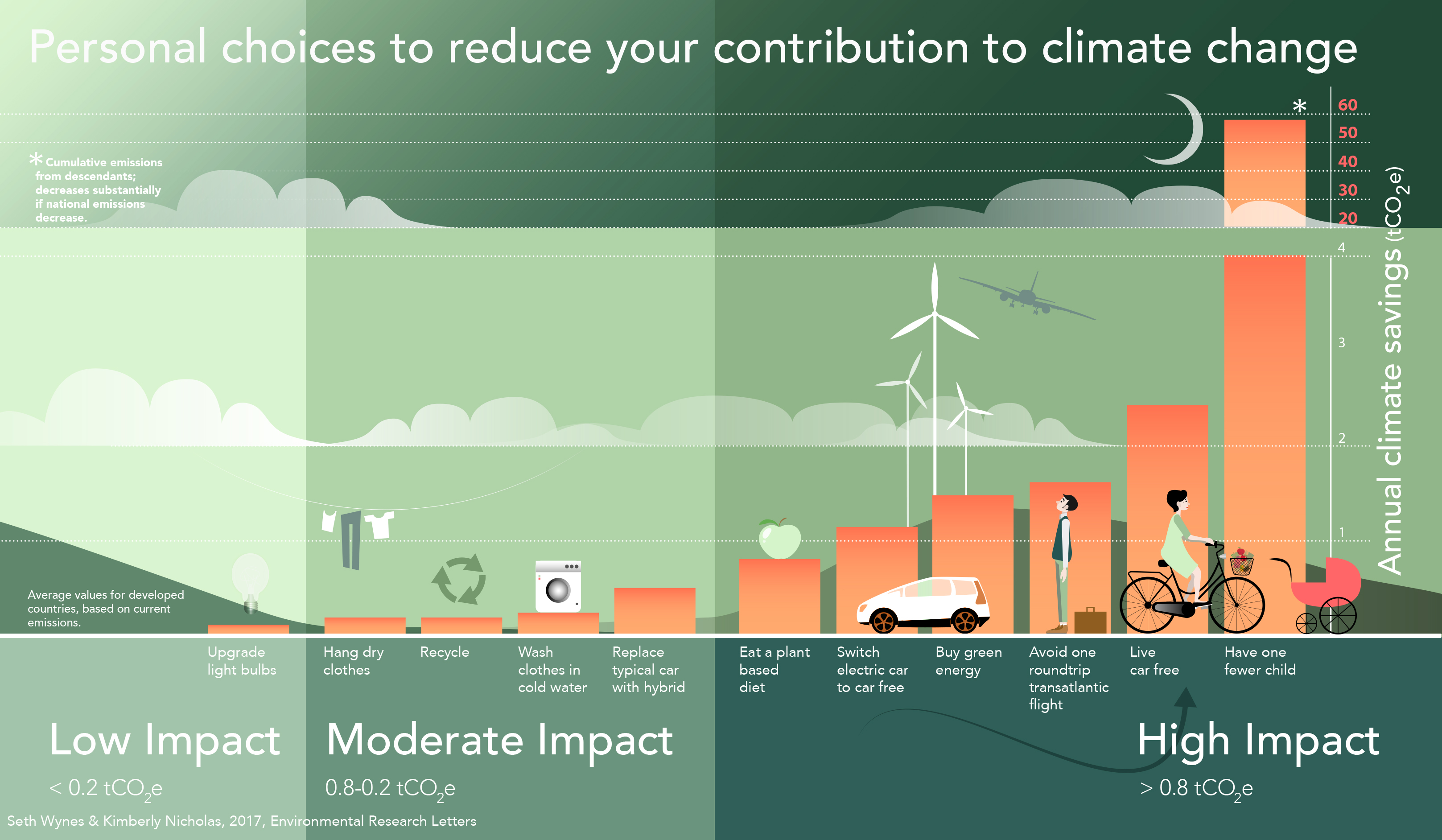
Based on that chart I would say having (more) children is by far the worst culprit. By now I'm really 100% convinced that the only way to save the earth is if everyone everywhere around the globe stops getting more than 2 children per couple, preferably not more than 1, so the world's population can shrink down back to somewhere around 1/10th of what it is now.
I'm 100% serious about this, and it makes me sad and angry nobody is actually really talking about this. Nothing we can do like eating less meat or skipping a holiday will help if the world's population doesn't shrink by a significant factor. It's a very unpopular opinion to have, because everyone likes children, they are the future, they are god's gift, it's a human right to make babies, bla bla, etc. But reduced to cold hard facts, there are simply way.too.many.people.
Yes I know this would absolutely kill our debt-based economies and probably significantly reduce the standard of living in many places, at least in the short-to-medium term, but that's a different topic. Completely destroying the earth will have much worse effect on the economy and standard of living anyway.
Well in some parts of the world people are already having less children. Even in Africa and Asia the birth rates are going down as people (women in particular) receive higher levels of education. So much so that in a few European nations the governments are actively encouraging couples to have more children. The most recent one I heard of is Hungary. I think the same is happening in some of the Scandinavian countries. In the far east (Korea if I'm not mistaken) there are even university courses on dating. In some of these places (Hungary in particular) the preferred approach is increase the birth rate as opposed to encouraging immigration to the country.
However, the contribution of children in the chart we are referring is dubious. The number is so high that I once googled and found what I think to be the original source. (A couple of swedish researches IIRC.)
They counted the children's and their descendants contributions and assigned them to parents for ongoing year.
There are many problems there. For example if the birth rate would be calculated as 2, the contribution would be infinite.
Also counting multiple generations is problematic, because if climate change is not mitigated within one generation we could be in for Mad Max * Water World.
https://en.wikipedia.org/wiki/Environmental_impact_of_aviati...
I also read somewhere that propeller based airplanes flying lower in the atmosphere would be better option for short haul flights.
The effect over time or not using rentals/other people's cars maybe?
Buy less products overall.
> I was under the impression the easiest way for people, who live in developed nations, to reduce emissions is to eat less meat?
The most effective thing is probably less carbon intensive transport (that means first and foremost flying). But less meat (or better no meat) is still among the more impactful things.
The cheap "fast-fashion" these days has a hidden cost you don't pay directly. And its HUGE.
The majority of people do not fly multiple times per week.
Having said that, I do agree with the main thrust of your comment: consume less.
http://www.greenrationbook.org.uk/resources/footprints-air-t... seems to disagee. In fact, driving a typical car for one year produces less CO2 than one long-distance flight per passenger.
That is... not exactly confidence inspiring. It may very well be a statistical fluke and the reality is much less reassuring.
Not saying we shouldn't research in that direction, but this looks way too early to be confident in it.
[1] https://animalscience.ucdavis.edu/news/research-led-ermias-k...
Beef however is one of the worst conversion methods in this regard, but animals like chickens and goats are quite efficient.
Shrimp is nevertheless popular however. We simply remove the parts for which we have cultural reservations.
So, where can I get insects that have been properly prepared, just like shrimp?
In addition, the amount of extra work for processing crickets made the project less than optimal at least for a small operation.
So if you have a 1% chance of getting caught, the fine needs to be 101x the tax.
This is why so many e.g. banking and consumer protection fines fail to achieve their goal - the cost of adhering is more than the probability of getting caught times the fine, so it's economically rational to not pay.
Well..chicken feathers and poop are fed to cows which are fed to people.
https://en.wikipedia.org/wiki/Poultry_litter#Use_as_cattle_f...
Pink slime can now be sold as beef mince in the US. How hard do you think it would be to get powdered cricket labelled as 'protein enhancer' or some such?
Plus people will happily eat things with cochineal [1] in it, so I can't see highly processed insect additives being a problem. Won't be called Cricket nuggets though.
As long as it isn't green. =]
If (in your justified pity for the poorest and second-poorest) you give everyone a free $1000, the equilibrium price will simply rise by $1000 leaving the same families struggling and homeless.
This is the model armchair economists use to explain reports that Bay Area employees paid 4x the national median household income can struggle to find housing.
Of course, if you instead think of Detroit, where many properties are abandoned and some change hands for as little as $500, the model is far less applicable.
*Assuming a simple model of a closed system where all houses are identical, there are no houses outside the system, no possibility of building new houses, and families are as densely packed as possible.
A UBI is simply a progressive tax to counteract the usual economic forces that let the richer get richer: they can afford bigger switching costs, they can afford to take more risks, they have amassed more patents and technology like AI, loyal engineers and so on.
UBI can be adjusted to simply redistribute the money in the system back so everyone has a floor, and can also afford to take risks without worrying about access to the expectations and necessities of modern life.
Sure inflation happens anyway. Everyone already eats. Giving everyone food stamps isn’t gonna change that.
https://slatestarcodex.com/2015/06/06/against-tulip-subsidie...
This part of your statement desperately requires citation and supporting logic.
Among other things to consider - Compare moving a ~80kg person and a ~13kg bike at 18kph
vs
moving an 80 kg person in one-300th (ish) of a ~300,000 kg plane (call it 1000 kg of plane per person) at 960 kph. 777 GTOW is ~335,000 kg
Now considering that drag is roughly proportional to the cube of velocity, and compare 18kph on a bike to 960 kph on a plane. We'll call it ~50 times faster to keep the math simple. Drag is now 50^3 greater for the plane, or 125,000 times greater.
So you're moving about ten times as much weight and need to overcome 125,000 times as much air resistance while doing it. I think it's fair to say that you can got a lot more miles per burrito on bike than plane.
(https://www.quora.com/Why-is-air-resistance-roughly-proporti...)
This is a shame, because I love traveling to faraway places. But it comes at enormous cost. A low-frills slow cruise ship (think cargo ship with beds, not the Queen Mary 2) might manage all right, but even that's not fantastic. Better electrified rail to replace overland flights would be a good starting point
edit: But then again emissions at that altitude have a larger warming effect..
What about alcohol consumption?
Is confectionary, eg. chocolate, lollies, ice cream, considers food waste for environmental purpose, given they are highly processed and completely uncessary from a nutritional perspective?
So if you commute 10 miles to work every day, they are similar.
https://link.springer.com/article/10.1007/s10811-016-0830-7
It would be a cheap food supplement since the methane inhibition required only about 2% seaweed in cattle food, which in turn implies a bromoform feed content of only about 35 parts per million. Though no doubt some farmers would prefer to be able to say that they add seaweed rather than a particular chemical to their cattle feed.
I wonder how many people are willing to eat less beef vs how many are willing to give in their once a year or less long-haul-flight holiday.
Obviously no consumer choice driven solution is going to work. The costs have to be included in the goods and services if we want any actual reduction.
The purpose of carbon tarrifs is to make foreign dirty-energy-intensive products less competitive, compared to less dirty-energy-intensive ones.
Because we already have a way of making domestic dirty-energy-intensive products less competitive. It works great. It's called a domestic carbon tax.
They remove the immediate complaint of "If we impose a local carbon tax on energy, foreign imports will outcompete us, because they don't have to pay it."
You're talking about "carbon tarrifs", which I've never heard of, and don't know what they are.
And we really want to add complexity and inconvenience to 2/3rds of households just so they can get their money back?
For most lower income households, they would actually be receiving a net increase in their income, since they emit less than the mean carbon output.
A carbon tax is not 'stopping trade'. It's an increase to the price of goods that are energy-intensive to manufacture, or ship.