>Women and racial minorities often do not get the same opportunities and they must overcome certain biases when they are hired or compete for promotions.
My problem with these kinds of "intrinsic biases" that white men are accused of is that they can only be shown to exist by accepting the fundamentally unproven assumption that we all enter the workforce equally capable in all industries, a position which is clearly untenable at a minimum because of cultural differences.
This is practically the definition of ideological, institutional bias, and the results will either be reduced efficiency across the workforce, or a violent swing of the ideological pendulum.
There are many factors for why women are paid less than men for the same type of position. Many of these factors have to do with hours worked and expectations around child rearing. And when this is taken out, the women are found to make as much or more than men.
My position can be summed up like this:
The corporate world is about 100 years old, with its crazy commutes and uses of energy just to sit in a chair. This comes at the expense of future generations (fossil fuels), and current family values (taking care of children, elderly, etc.)
Why do we say that women have to keep learning from men on how to move up the corporate ladder, work long hours and get paid more. Perhaps men should learn more from women about how to have a healthy work-life balance, take care of the kids more, and their parents.
Today's kids are overmedicated with methamphetamines for ADHD, there is an opiod crisis among adults, 1 in 4 middle aged women is on antidepressants, the elderly are in nursing homes.
The wages have stagnated largely because both sexes flooded the labor pool, globalization and outsourcing and automation caused everyone to go into a race to the bottom. Now both parents are working for corporations. Fewer working Americans are becoming parents. They're in a Red Queen rat race, 1/3 of Americans are one paycheck away from homelessness. Is this really the best outcome for Americans?
Today's world isn't that of your grandfather, the company man who had loyalty both ways for decades and got a pension. Today we have two year stints, gig economy, part time work.
Andrew Yang wants to do what Nixon almost did, and institute a UBI for all Americans like the Permanent Fund in Alaska (lowest inequality of all states, year after year).
Why do we think Corporate Careers should take so many of our hours a week? Why should we trade time with our children and elderly for more money, just to survive? In the past, indirectly, child rearing was valued because one of two parents simply didn't take the job, so there was less available labor, so one parent could pay for the whole thing.
The system is broken, and we are accomplices by talking about how women can match the men in their "career opportunities" of long hours, instead of talking about parental leave for men like in Scandinavian countries, making the school day shorter, etc.
Read this for more info: http://magarshak.com/blog/?p=286
[edit: minor wording change; why am I being downvoted? I'm seriously asking]
Unionize and wage equity magically disappears.
Gender or any other identity factor is then irrelevant if pay is based entirely upon candidate experience, right?
Edit: I have no knowledge of how Google handles salary. If anyone knows, feel free to share.
But I don't think most people go to an interview without having googled "how to ..." about the interview process first. Thus even those not naturally talented at negotiation have a reasonable chance at negotiating decently.
Talent/job competence + a little bit of research and preparation prior to interviewing will ensure superior results IMHO.
> it found that more men than women were receiving less money for doing similar work
NY Times needs to learn the difference between absolute numbers and rates. This is awful reporting.
So at the end of the day, they weren't severely underpaying employees.
Good to see a company take this step. I had this happen to me at one company I worked for... it actually resulted in a pay increase of over 4 bucks an hour, now THAT was nice!
Basically the real world is a lot more complicated than people think and there are many factors that lead to pay discrimination. Claiming that it is due to sexism is an oversimplification.
Ideally two individuals in the same or similar roles, with similar performance over time in that role, should have the same salary regardless of background or negotiation ability. The major issue with this is that you can't reduce pay of rockstar negotiators (who may or may not be rockstar performers), and a correction that pays everyone as much as the highest earning equivalent employee might be hard for even Google to swallow.
It's not difficult to understand why people believe this might be true, but it is difficult to understand why people accept this as fact when the empirical data of systematic underpayment isn't all that solid.
Doesn't sound like they were underpaying by very much...
A lot of people (men) here complaining about women getting things too easy in tech. Talk to a woman in tech. Look around you and see how many women there are. Men are still running the show.
Say I build some engine and buy a bunch of identical bolts I need: each one obviously costs the same. But now I'm building a business and need some human cogs to run it, why would I have to discuss the particular cost of each one?
Same work, same pay. But... unique person and custom pay? How do we reconcile this apparent contradiction?
If women were underpaid, things are less equal on average. If men were underpaid, as the study suggests, things are more equal on average. That said, would it be fair to keep underpaying some people in order to keep it more equal on average? I think not.
They needed to compare the number of men who were underpaid as a proportion of all men to the number of women who were underpaid as a proportion of all women.
Using bum-pulled numbers, your company has 1000 employees, 667 are men, and 333 women, and they all do pretty much the same job. Your payroll is $100M, and 70% of it goes to the male employees. The mean pay for men is $105k, and the mean pay for women is $90k. Mean pay is $100k--let's say this is fair pay for the work. Overall, the men are overpaid, and the women underpaid.
But the mean is a fool's game; the median is more telling. Now say 445 men get $90k, and 222 get $135k. 2/3 of men are underpaid. Now let's say 222 women get $101k, and 111 get $68k. 1/3 of women are underpaid.
On a per-person basis, a man working for the company is twice as likely to be underpaid as a woman, but the amount by which they would be underpaid is much less. Going by the aggregate numbers, one could say "men at Company X are overpaid, compared to the women" and then any given underpaid man might not even realize they are being underpaid, thanks to the misleading statistic. When one of the $68k-paid women complains (naturally, as the worst-off of the bunch), and the company analyzes its own payroll at a more detailed level, it realizes that men are more likely to be underpaid than women (and also that increasing its payroll by 8% would make no-one underpaid).
This quote would appear to sum up the entire debate, using the term generously.
There is a large and vocal minority in society who abuse the word "equality" to mean "more money and power for women". They don't care about equality. They want inequality, but they know they can't say that, so they simply redefine equality to mean inequality in the Orwellian style and carry on as if the language hadn't just been horribly violated.
Ms. Emerson should stop talking until she can say what she means, although given her job is 'diversity consulting' I'm going to guess she will never be able to say what she means.
>That is not the same as addressing “equity,” she said, which would involve examining the structural hurdles that women face as engineers.
Consider the following situation:
Men get promoted faster than women for similar work. They're seen as more assertive or something. Managers, noting the systemic inequality, take individual action to compensate women fairly for their contributions, despite the failure of the larger system.
The structural hurdle: that women find it more difficult to get promoted, is not addressed. And as a result, they end up paid less for similar work, despite attempts by ground level mangers to address the inequity.
The HN guidelines suggest that you
>Please respond to the strongest plausible interpretation of what someone says, not a weaker one that's easier to criticize. Assume good faith.
I think this should apply to articles posted as well.
Regardless, if she wants to define a word to mean "the structural hurdles that women face as engineers" specifically she should not criticise other people for using the word equality to mean equal treatment. She definitely has no right to claim those who disagree with her have a "flawed and incomplete" understanding of anything - she simply has no intellectual leg to stand on. Put differently, there is simply no plausible interpretation of what she's saying here that isn't a nasty attempt to manipulate the language.
Keeping digging this hole and see whose grave you find at the bottom...
Log in or create a free New York Times account to continue reading in private mode."
How obnoxious. (I think trying to make people using private browsing register is offensive. FWIW you can also stop the effect by blocking requests to their graphql subdomain.)
They don't give unlimited access to all content (recipes and crosswords are apparently excluded), but you can read all the articles you want.
This site looks like it has the rules more formalized, if you’re interested. I think it’s something most native English writers do without thinking by adulthood.
What about "remember that there are structural issues that affect women" isn't fighting for equal treatment? I'd think that an argument to reduce the structural issues that unfairly impact women would be seen as a move towards equality, but apparently you disagree? And further think it's nasty?
When women are getting paid more than men, there are no known explanations beyond sexism. Especially at Google who notoriously fired Damore for stating that maybe men and women have different preferences - it's pretty clear from the article, biased though it is, that the issue here is really Google managers systematically awarding pay increases to women rather than men, in order to try and boost their numbers.
It would help if you posted the empirical data you refer to.
There are some good studies on this subject that I've read over the years though, for instance one among lawyers in a firm in which women were paid about 2-3% lower than men, on average IIRC. But these often don't or can't take into account personality characteristics. For instance, women on average are more agreeable and so often don't negotiate as hard as men on their salary.
When controlling for all factors, wage differences largely disappear.
https://www.epi.org/publication/womens-work-and-the-gender-p...
The authors also conjecture that this is due to cultural biases, but obviously cannot prove this.
For instance, their overview that women arrive in college less interested in STEM, and they hint suggestively that this is due to discrimination. Except this hypothesis doesn't at all explain the gender equality paradox; in fact, it predicts the exact opposite of what we see.
Normally in science, a falsification this strong would immediately dismiss a hypothesis as a viable candidate theory. It's suggestive that it hasn't.
It turned out there WAS bias - in favor of the women!
"The lawsuit triggered a study. The study results showed that not only were women not discriminated against, but that women had a statistically significant advantage!
Here’s what happened. Some departments had high acceptance rates and some had low acceptance rates. Women applied to more competitive departments. Men applied to more accessible departments. Taken on the whole men had an advantage. When broken down per department it was women who were more favored."
There is simply not enough information presented in this article to know whether there is truly a gender bias (in either direction) regarding how Google pays their employees.
E.g.: Google is 70% men. At 100,000 employees: 70,000 Male 30,000 Female
If 5% of men are underpaid that's 3,500 men. If 10% of women are underpaid that's 3,000 women.
More men are underpaid (3,500 > 3,000). But women are twice as likely to be underpaid (10% > 5%).
Hmm...
"Men account for about 69 percent of the company’s work force, but they received a disproportionately higher percentage of the money. "
So, yes, we do have that information.
Human beings just have very strange presuppositions regarding probability and statistics that are almost always wrong.
Univariate analyses can hide lots of interesting things!
The real reason for the Berkeley study is that the seeming acceptance disparity worried administrators, who proactively asked Bickel to look into it. https://outline.com/2HMrKV
To support this claim the study pointed out that the percentage of male applicants _out of all male_ applicants that were granted admission was lower than the percentage for female applicants, for all (examined) departments.
However, according to the study, there were 8442 male applicants and 4321 female applicants. So while a larger proportion of female applicants were granted admission, it still meant that many fewer women were addmitted.
To clarify, a higher proportion of a smaller number can still be a smaller number. 5% of 1000 is 50, 10% of 100 is 10.
Imagine we split a pie in 10 pieces, you keep 8 and I keep 2. I eat my 2, you eat 4 of your 8 and then you accuse me of hogging the pie because I ate 100% of my share while you ate only half of yours.
That is what the study actually showed happenned with admissions in Berkeley.
_________________________
[1] Sex Bias in Graduate Admissions: Data from Berkeley
https://homepage.stat.uiowa.edu/~mbognar/1030/Bickel-Berkele...
Where does the study say that? I find it saying that 44 percent of male applicants and 35 percent of female applicants were admitted, when totaled over all 101 departments.
https://www.abc.net.au/news/2017-06-30/bilnd-recruitment-tri...
https://mobile.abc.net.au/news/2017-06-30/bilnd-recruitment-...
In a bid to eliminate sexism, thousands of public servants have been told to pick recruits who have had all mention of their gender and ethnic background stripped from their CVs
The trial found assigning a male name to a candidate made them 3.2 per cent less likely to get a job interview.
Adding a woman's name to a CV made the candidate 2.9 per cent more likely to get a foot in the door.
...
Leaders of the Australian public service will today be told to "hit pause" on blind recruitment trials.
https://data.oecd.org/earnwage/gender-wage-gap.htm
The countries with the highest wage gaps are the countries with the most equality in the workplace. Women in Korea are not treated poorly.
The important thing though is the people proposing that the wage gap is a problem has a solution. They are pushing equality of outcome. They want everyone to be paid exactly the same. That's the problem that they have. They don't care that they are comparing apples to oranges. They want pay to be exactly the same.
No one with a straight face can tell me women in entry level tech programs are not incredibly favored. All my below average coder friends that are women got awesome jobs with high salaries extremely easily. Yes, I talk with them and they agree with what I’m saying.
The actual discrimination against women comes in PhD programs, programs where their success is determined by 1 or 2 superiors (mostly men in advanced research programs), areas with primarily male coworkers, and creepy bosses. The area with most discrimination for women is in non major liberal cities. I went to the Midwest twice and saw more blatant sexism in the workforce than I have my entire life. 2 friends confided that they were asked to trade sexual favors for promotions albeit this was 20 years ago and that was the deciding factor for them moving to the Bay. These things are horrible and I can’t imagime the emotional trauma for that.
However, in the Bay Area and the majority of society the pendulum has swung way too far the other way. I don’t care if people think me sexist, these are my observations over my lifetime from both sides and unlesss convinced otherwise this is what I believe.
If you set initial salaries fairly with respect to gender but promote men more quickly, then you end up with a company where it looks like women are paid more when you control for job title.
Usually it's the opposite but for the same reason: women seem underpaid but when you correct for experience on the job, they make something like 98 cents on the dollar compared to men.
And I think someplace like Hacker news is exactly the right place for the community to discuss the many ways a company can get to a result like this - via Simpson's paradox, via differences in promotion velocity, or via simple economics, based on the fact diverse teams are desirable and women are more scarce.
Attacking someone for suggesting one not-yet-discussed possibility is not helpful to the discussion, imo.
a) Google is about 70% men; and b) The "error" in pay (eg how under- or over-paid you are) is randomly distributed
Then it will be trivially true that more men than women are underpaid
If you, in addition to this, assume some level of sex discrimination, such that in addition to (b) there is additional 'error' in womens' pay, depending on the relative strengths of each of these errors, the following two things can both be true at the same time:
1) A higher percentage of women are underpaid than are men. 2) Most of the people who are underpaid are men.
If this is surprising to anybody, they should be taking a remedial statistics class immediately.
To illustrate, assume that Google is 100 people: 30 women, 70 men. assume that 25% of men are underpaid, and 50% of women are underpaid.
That means that 0.2570 =~ 18 men and 0.530 = 15 women are underpaid.
That means that more men are underpaid than women.
That means that 18/(18+15)*100 =~ 55% of the people who are underpaid are men.
So in my hypothetical, is Google biased against men? Or is Google biased against women? Or is Google not biased at all?.
It says that the raises resulting from the study disproportionately went to men. Not just in absolute terms, but proportional terms:
> The study, which disproportionately led to pay raises for thousands of men, is done every year [...]
> In response to the study, Google gave $9.7 million in additional compensation to 10,677 employees for this year. Men account for about 69 percent of the company’s work force, but they received a higher percentage of the money.
> Within a few weeks of Ms. Ellis being hiring, Google hired a male engineer for her team who had also graduated from college four years earlier. But he was hired as a Level 4 employee, meaning he received a higher salary and had more opportunities for bonuses, raises and stock compensation, according to the suit. Other men on Ms. Ellis’s team whose qualifications were equal to or less than hers were also brought in at Level 4, the suit says.
This feels like a part of the issue, but could be really hard to analyze easily.
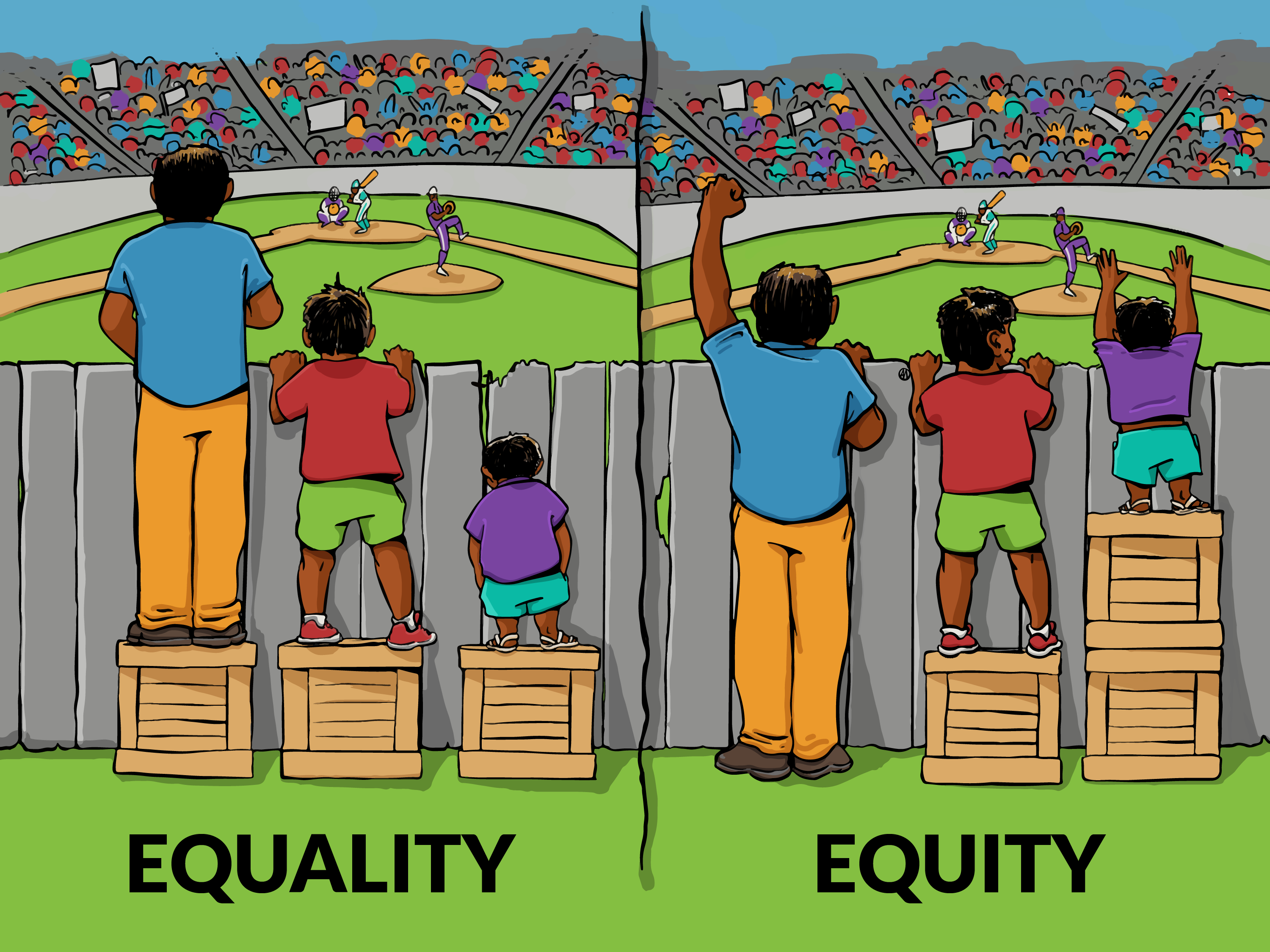
(Equity being what some here are referring to as 'equality in outcome'.)
In this image, it's hard to argue that equity isn't clearly better. In other cases like admissions, it's much more debatable, and personally I think equality ('in opportunity') makes more sense there.
[1] http://spiegel.de/international/zeitgeist/potsdam-university...
I agree with some previous posters that women may be more favoured by formal systems now, while men remain more favoured by informal systems.
I think that part of the issue is that there are more ways to be male and a successful senior engineer or team lead than there are female.
We tend to look towards people who are similar to ourselves to see how we should advance. There are many fewer female role models than there are male ones. Many women who make it to leadership positions are encouraged to act masculine.
Women who make discrimination claims that later ring false are usually villainized. I think it might be useful to think about why these might be occurring. In particular, I think women as a whole still feel a great deal more insecurity WRT their positions in the workplace. The equality that's been won in the last few decades has been to some extent manufactured, so it feels a lot more fragile.
I don't think that a good reaction to this news article is to feel upset that men are now being discriminated against.
Why not? It's good and bad news for men but men definitely shouldn't be discriminated against
It is not just about pay equity in a particular level. It is also about the ingress and egress rate of a level.
As the article mentions, some woman was hired as L3 while all of her co-workers were hired as L4. Was she overpaid as a L3? Maybe. But she was underpaid overall because she could've gotten L4.
Similarly, women and under represented minorities also face similar issues in promotions.
But the study did not tell the whole story of women at Google or in the technology industry more broadly, something that company officials acknowledged.
Most significantly, it did not address ingrained issues that, according to workplace experts, cannot be overcome simply by considering how much different people are paid for doing the same job: Women and racial minorities often do not get the same opportunities and they must overcome certain biases when they are hired or compete for promotions.
Etc.
1. In countries that empower women, they are less likely to choose math and science professions: https://www.theatlantic.com/science/archive/2018/02/the-more...
2. In the past 30 years women have made gains in traditionally male areas like law and medicine, but have gone backward in software engineering
3. Men are disproportionately on the autism spectrum
It seems to me that aiming for 50% female representation in software engineering is not necessarily something we should be aiming at
That can feel rather insulting and demoralizing, and why would anyone want to subject themselves to that? Instead many women just avoid HN—which in turn means that it becomes more male dominated, with more upvotes and mindshare to comments about experiences of "the other" that may not by particularly well informed—because it's not worth the time of a woman to even chime in.
Regardless of your opinions on these specific issues, this dynamic of driving away women decreases the likelihood of everyone gaining a well informed perspective. It doesn't just impact gender issues. It impacts discussions on the importance and potential markets of startups that provide products which aren't just male focused. And you can end up with more things like: https://www.theguardian.com/lifeandstyle/2019/feb/23/truth-w...
Not an easy dynamic to "fix", but a useful thing to remember when thinking about communities, incentives, and impacts...
Doesn't this imply that men, per capita, were being underpaid more than women?
For example, imagine a company with 7 male employees and 3 female employees. That company has 9 engineers and one administrative assistant. All the engineers are underpaid. The male engineers are underpaid by $1000 and the female engineers are underpaid by $1200. The administrative assistant is a woman who is fairly compensated. That means the men are underpaid by $7000 total and the women are underpaid by $2400 total. Men make up 70% of the employee workforce and are roughly 75% of the underpaid total. More men are underpaid than women. The per capita underpayment of men is $200 more than the underpayment of the average woman. There are plenty of ways to frame this data that make it look like men are the biggest victims and yet woman engineers are all payed $200 less than their male counterparts.
The article refers throughout to "numbers" rather than "proportions", or "ratios", "percentages" etc, meaning that it is actually a larger absolute number of men rather than a larger relative number of men who are underpaid, compared to women.
Most of google's engineers are men, so even if equal proportions of men and women were underpaid, the absolute number of men being underpaid would be higher.
Google obviously has people good enough with numbers to know this. However, it's perhaps not surprising to see that there seems no mention of it in the above article. Google is, after all, defending a lawsuit by some of its former female software engineers who allege they were underpaid compared to their male peers. There is a clear incentive to allow a certain lapse from google's usual pride in employing people who understand numbers.
> Men account for about 69 percent of the company’s work force, but they received a disproportionately higher percentage of the money.
So they were compensated out of proportion with their demographic makeup of the company--they made up a larger share but needed more money to "catch up."
These are openly meant to overpay some employees and underpay others. Though they can be coated in HR-speak to appear neutral and objective, the decisions that come out of them are typically arbitrary; they enforce biases of all kinds. So we should not be surprised at the results.
If women are disproportionately hired at lower levels, pay equity will still be _very_ off, even if the data says otherwise on the surface-level.
Ex: Woman w/ 4 years experience hired at T3. Man w/ 4 years experience hired at T4. Both are "in range" of their median comp per level, but the man is being paid more for his expertise.
Many tech workers think unions cap the maximum achievement and result in people getting underpaid. In reality, we're _already_ underpaid when you look at how much the ownership of a company gets. Additionally, Hollywood's unionization hasn't hurt their pay.
I'm not sure what this is supposed to mean. Korea most assuredly is not a country with "the most equality in the workplace". It routinely ranks as having the worst gender inequality of any developed nation, and one of the worst in the world generally. It came in 115th out of 149 countries in the World Economic Forum's 2018 Global Gender Gap Report* and has hovered around that number for years.
Your assertion is that Japan and Korea are highly discriminatory against women? That's certainly interesting and I'm not sure I can defend against that position. Perhaps women in japan and korea are extremely oppressed. This is certainly not what I thought after reading for example or just seeing what's portrayed in the media. https://en.wikipedia.org/wiki/Women_in_South_Korea
Meanwhile your source has Rwanda as #6 most equal. I'm very confused about what the data is saying. It's certainly feeling more like a checkbox list.
So let's look at Canada. Both my data and your data have them with poor performance. Mind you my data is just looking at wage gap.
Women in Canada for ECONOMIC PARTICIPATION AND OPPORTUNITY is 27th place behind Brunai and Ghana. This seems quite incorrect. Women have completely the same economic opportunity as men in Canada. So this is a debateable number. Women are educated BETTER than men and certainly work. So I'm not sure how this data was determined. The actual number should be showing discrimination against me.
Women in Canada are 1.0 for education. That's good. Like I just said https://www150.statcan.gc.ca/n1/pub/81-004-x/2008001/article... Women outnumber men. So this is actually false information. They capped the number wrongly at 1.0.
Women in Canada for HEALTH AND SURVIVAL aren't in the list? USA is in 71st place. I happen to know this statistic. Women live longer than men. So they cherry picked and removed this data? https://www150.statcan.gc.ca/n1/pub/82-624-x/2011001/article... This another number completely false.
Women in Canada for POLITICAL EMPOWERMENT are 21st place behind india and nambia. Except we live in a democratic society with no barriers. Women can run for politics. So this should be a 1.0.
So I guess in conclusion I find your study to be biased, false, and wrong.
Let me explain to you what's happening. Women have the CHOICE. They choose careers that they get paid less in. This is a good thing. They have the freedom. The gap is not a problem.
Yeah, I am not sure what to think of the data. It's not what I would expect.
How is US, Canada, Austria having such a large gender wage gap, followed by Canada.
Then Greece, Bulgaria and Romania are all the way on the left. Having lived in Eastern Europe, I would not consider it overall a bastion of women's equality and rights, not according to the West European standards at least. Granted though, during the Soviet times women and girls were studying math and science just as well as the boys even if not better and it was never specifically promoted or pushed via a "women in STEM" or such similar programs I have seen here, it just happened. Perhaps there is a remnant of that mentality and maybe there is something to be learned from there.
When you provide women the opportunity to become anything they want. They choose the careers that they choose. Which tend to me more social related careers. Teaching or nursing for example does not scale well; therefore salaries are limited.
Whereas men pick more "stuff" categories. It's men who work in STEM creating things. A car or an iphone is going to be generally speaking men who design it. These scale very well and salaries can be larger.
By these modern approaches that allow women to go into whatever they want to do. This is what creates the gender wage gap.
That's not a solution, that's another problem.
The mcdonalds cashier should not be compensated the same as someone like a neuroscientist.
If we get replicators invented and everyone can have whatever they please like in star trek. We still don't need communism. Capitalism will still work, stuff will just be free but if you want a PERSON to do something you still would need to pay.
Romania, Costa Rica, Luxembourg, Belgium, Bulgaria, Greece, Slovenia, Italy, Denmark, Turkey, Norway, New Zealand, Colombia, Malta, Hungary, Poland, France, Iceland, Ireland, Mexico, Spain, Lithuania, Cyprus, Netherlands, Portugal, Australia, Switzerland, Slovak Republic, Germany, Czech Republic, Austria, Finland, United Kingdom, Canada, United States, Chile, Latvia, Israel, Japan, Estonia, Korea.
See the pattern there? Neither do I. Usually there is some correlation by continent, cultural area, GDP, HDI, etc. In this case there seems to be nothing. Romania and Costa Rica and Luxembourg are the countries with the smallest wage gap; Netherlands, UK and US are way up there, in company of Chile, Canada and Estonia. Turkey is wedged right in between Denmark and Norway. Netherlands' pay gap is 4 times that of neighbouring Belgium. Mexico and Ireland are the same. Lithuania's gap is half that of Estonia and Latvia. Strange.
Do you know this for sure? Developed East Asian countries are some of the worst in terms of work equality for women, particularly if they want to have children. Not a good example to use.
Technically, everything could be equal, but men and women have much stronger gender roles there, it's very deeply ingrained into culture.
I'm not defending this at all however. I'm perfectly happy to believe that South Korea is worse than Saudi Arabia toward treatment of women.
I do not mean to belittle those career choices (if anything, I myself want to become a k12 school teacher at some point in life). But, there are a certain set of traits that are needed to excel at the 'prestigious' careers. Disposition towards hard work beyond the standard 9-5, an acumen for logical reasoning, ability to retain large quantities of information are all more rare than social skills and empathy, which take precedence in elementary teaching or nursing.
Our culture idolizes the hard working, career oriented person, that sacrifice other things in life to singularly chase this money and fame driven idea of success. This is irrespective of how physically/mentally healthy it is, or if it positively correlates to long term happiness.
IMO, it leads to an obsession to prove that men and women being equal, would have equal outcomes on this narrow benchmark for success. It both neglects the fact that that social norms haven't changed as much and that equal outcome is meaningless without context.
p.s: nice to see someone use 'beg the question' in the correct context.
More people are considered qualified as elementary school teachers than those qualified for university teaching. Same with nurses and doctors.
I'd be fine with a random anesthesiologist teaching my grade schooler, but I'd hesitate to have a random elementary school teacher giving him anesthesia.
Elementary school teaching: a teaching certificate.
University professor: PhD, pre-tenure work & published research (Note that there are less-qualified people teaching in universities that are compensated much less.)
Nurse practitioner: Master's degree (undergraduate plus 2 years)
Anesthesiologist: Undergraduate + medical degree (4 years) + residency (4 years) + possible specialty training.
Because of education level?
A university professor has a PHD. An elementary teacher has a bachelors degree.
If you think a PHD and a bachelors degree should be paid the same. That's perfectly fine, that's called communism. It's perfectly fine to be a communist.
In the end, we would get 5 to 10 times as many talk submissions from men, accept nearly all of the talks by women (often turning down higher quality talks from men) trying to get diversity numbers and have a much higher cancellation rate form the women for various reasons, especially money. If we were lucky we would get 20-30% women speakers when all of that was done. I've also been told by some diversity activists that, in order to get women to speak and to get higher percentages of women as speakers etc., unlike most of the men, you need to pay for their travel etc., offer free tickets for women attendees, consider offering stipends for women who speak etc..
Others, organizing other conferences have shared similar experiences. It's one thing to fight against blatant sexism which I'm for, but this is turning into something else.
It’s very simple what it’s become: sexist against men.
This is what happens when you aim for equality of outcome instead of equality of opportunity.
I believe we’re in a Kantian second stage. We were sexist against women. Now, we’re sexist against men. The hopeful third step
That said, I have come to see some pushes for diversity in tech as being extortionist. Some of the tactics used by some specific women who push for diversity in tech are blatantly self-serving like offering workplace diversity consulting but also naming and shaming corporations and individuals for lack of diversity.
Maybe it's the result of individuals asynchronously but collaboratively acting to get the most for their class of people. Since there isn't a "council of women in technology" that meets bi-weekly to decide what each speaker should do for each conference, the women speakers act independently much of the time. To get the best for women they know they have to ask for stuff: fees, travel, tickets for other women. Men are not going to just give it to them. They try to do their level best there every time they get an invite. Every so often -- through casual conversation, meet-ups, online communities, articles in magazines, letters to the editor -- there is a chance to communicate about what worked and what didn't. There isn't an easy way for communication to happen about the net effect of speakers' actions for a particular conference when it's happening, or even afterward. There is a ratchet effect and in, addition, a general sense that "there is still more to be done" for women in technology. When the next conference rolls around, still more is attempted...
My daughter who is finishing the primary school has recently asked me if it's okay if she doesn't like math, but likes animals and babies.
Sounds like some pressure is being applied...
edit: thanks for pointing out that I misread which type of pressure is being applied.
It's not that boys will all like math either, but society makes sure they can't like animals and babies. Higher expectations of children (within reason) typically leads to higher achievement.
Maybe, rightly so? It doesn't matter if you like reading, you need to learn it. For a toddler in 2019, I think coding and some math is getting close to this level of importance.
This describes basically every tech job I have ever had. Real life engineering woman here reporting in.
In 2014 I joined a series B startup as engineer #15 and was the only woman in the office other than the admin; food delivery dudes often brought things to my desk, assuming I must be the office mother. When I was late to work one day after being groped by a strange man on Caltrain, my supervisor questioned my commitment to meeting deadlines. When I moved on, they returned to being a 100% straight white male company.
In 2015, I was the first female engineering hire at the new office of a growing mid-size tech company. A second woman wasn't hired until we'd reached a headcount of about 20. Men, especially clients, often forgot my name. E.g. Janice vs Janet vs Jan (none of these my real name, but you get the idea. The point is that I wasn't important enough to these men to remember.)
Fast forward a few years. Now I am by far the most senior of four engineering ladies at the satellite campus of a household name tech company. Total headcount at this office is about 100 engineers.
I have never had a female manager.
For those keeping score, I have never worked anywhere with more than 5-10% female engineers. For my entire career, even as a noob, I have been the most senior female engineer I know.
I count myself lucky because I've never had to deal with anything resembling actual harassment. (It helps that I am not conventionally attractive). But there is a psychological burden of always feeling alone, always being the first or only, worrying that your actions will be taken to represent all people of your kind, and wondering if assholes in your midst think you've only got where you've gotten because you're a woman.
Your dismissive attitude toward women's supposed advantages is as common as it is damaging. Whatever unfair advantages you think your women colleagues have, unless you are black or latinx, it is unlikely you will ever experience the feelings of isolation and otherness that most women deal with throughout their tech careers.
Are you aware this kind of thing happens to everyone? Do you expect people to remember your name just because you're a woman? Or would you rather they remembered your name because you've accomplished something beyond the ordinary? I'm a black male, by the way.
Are these two things mutually exclusive? Women could both have the advantages outlined by OP and feel more isolated.
Honestly I'm terrible at names and people only remember mine because it's ethnic. I wouldn't read too much in clients not remembering your name correctly. Humans are generally just bad at names and it might not have anything to do with their perception of you.
I have to ask though, why do you think you were often one of the few/only women/woman at these shops. Did they actively try to recruit women? Did you see women get interviewed but who just didn't make the cut? The last time I was at a shop where they made me go through resumes, I rarely even saw women in the application stack.
I worked with an amazingly talented woman who started back in the day at RealMedia writing C++ codecs. She told me about several cases of harassment or even things like asking her to wear a certain dress a manager liked when she was at trade shows/booths.
I also worked with an English woman at the same company several years my senior, who's been both a developer and product manager, and who says she hasn't experienced that type of harassment while in the tech sector.
I hate anecdotal stuff like this though, because it just doesn't build a big enough picture, which is why actual studies are insightful.
But going back to my question: do you think these shops were actively discriminating against women, passively (subconsciously) discriminating or there simply weren't enough women applicants (they do tend to get sucked up by the big players like Google/Facebook/etc.)
I want to say sorry, and I will, but I know it's not personally my fault and I know it won't make much of a difference to your circumstances now or in the future. But still, I'm sorry you've had this experience.
I have to be honest and say this, but I think what you've experienced is very much an American culture kind-of-thing. Every time I read a comment like this, besides making me sad and angry, it tends to always come from somewhere in America.
I'm sure something similar has happened and continues to happen here in Australia, but I've seen little of it. That being said, as I sit here now in a very large, well known company, my line of sight gives me a head count of about 30 men and 2 women. This makes me sad and angry, too.
I don't know what to do about this besides encouraging women to come into the industry and protecting them in a none condescending, white-knight, women-are-weak sort of way...
However a distinction must be made between the formal systems (extremely sexist favouring women), informal systems (potentially extremely sexist favouring men) and workplace environment (women are continuously sexually propositioned; pretty overwhelming evidence for that IMO).
Making the formal systems sexist is a stupid response to the informal systems being sexist. I wish that people would stop advocating that and instead work on the informal issue - if it isn't due to innate ability (a safe bet) then there must be something that can be done. The propositioning thing is a bit of a poser though, it is so pervasive that I suspect it points to deeper issues.
Also the anecdotal evidence is that if propositioning was successfully stamped out that would do crazy things to the fabric of how relationships get established. Might be a net good or bad.
As far as trying to address the... over-solicitation issue, I am trying to be constructive with this set of suggestions.
  * Diversify corporate offices to promote mixing in to cities rather than within the company.
  * Have strong work life balance allowing external socialization.
  * Apply political and economic pressure on civic infrastructure to promote:
  * * mass transit (more, better, cleaner, safer)
  * * quantity and quality of housing (lower prices for all)
  * * "livable" cities in general
Specific incentives for FAMILIES (not just women) could include additional career help and planning:
  * Part time work, fully async, from 'home' (or a more local office sometimes) for moms/dads.
  * Remote 'first' (only?) participation; meetings online, rather than by the water-cooler.
  * Have a presence in a given region that is stable
* * with actual career paths in the area, allowing home-buying (rather than renting)(As a white, straight male,) I have absolutely no issue with a woman being offered a role over me as a tie-breaker or an epsilon-advantage. A company who would go significantly farther than that is one that I don’t want to work for anyway as they’re not interested in being competitive.
http://newsroom.ucla.edu/stories/cracking-the-code:-why-aren...
I wish that all people would be open minded and just treat everyone equally by default no matter what they look like, what genitalia they have or their wealth level.
Save the exclusion for people who show themselves to be *s (i.e. who cause harm to others). So ban smokers / drinkers from your wedding not men.
In France there is a dedicated system for engineering studies (Classes preparatoires + Grandes Ecoles).
You do 2 years of intensive Math and Physics (classe preparatoire), than pass a ranking exam, then go to the school of your choice provided you ranked high enough to get into this specific school.
Basically, the ratio was 1/3 women 2/3 men at the "classe preparatoire" stage, and overall it's the ratio for engineer when all specialties are mixed together.
But then you have disparities between fields, CS schools get between 10 to 15% of women while Chemistry is about 50%, other fields like Electronic, Civil Engineering, Applied Physics are roughly in the average of 30%. Only the schools to become a military officer have an higher disparity than CS (and the air branch is actually in the same area).
For those who can read French (or have the courage to decipher) the statistics are available here:
* http://www.scei-concours.fr/stat2018/mp.html (math dominant)
* http://www.scei-concours.fr/stat2018/pc.html (physic dominant)
* http://www.scei-concours.fr/stat2018/psi.html (technic and mechanic dominant)
(Hint: CS == Informatique (often abbreviated to "Info")
What's the percentage female graduates in STEM fields? The 57% may not be representative for the fields which matter for engineers. Not saying the delta is big, I honestly don't know and am curious.
https://nces.ed.gov/programs/digest/d18/tables/dt18_318.30.a...
In 2017 there were 133,761 Bachelor's degrees conferred in Engineering, 20% of which were conferred to women.
Computers: 71,420 degrees, 19% women
Math: 24,073 degrees, 42% women
Physical sciences: 31,268 degrees, 40% women
I know once-English majors with a similar story of a passion for what computing can reveal/create around a discipline that resulted in rich software careers. I am over a decade out of college, and in my personal experience passion for computing is more relevant than having a STEM background in software development. All this to say, I’m not sure % STEM focused is necessarily a reliable indicator of “future software engineer.”
https://www.catalyst.org/research/women-in-science-technolog...
The section entitled "Few Women Are Earning Degrees in STEM, Except in the Life Sciences" states that 35% of STEM undergrads are female. For engineering and computer-related bachelor's programs, this drops to ~18%(!).
Of course, this could have, and does[0] happen in the Bay Area, too - in just the last year even.
[0] https://www.nytimes.com/2018/05/21/technology/uber-sexual-ha...
I think the "me too" thing proved the coastal elite were part of the problem.
What is the graduation rate of women in STEM fields? 57% is not the graduation rate in STEM fields, which makes it sound like you are cherry picking statistics. What fields are all the women graduating in?
Aside from Google, the pay gap still exists and women earn less than men. The WP article estimates 94 cents on the dollar. https://en.wikipedia.org/wiki/Gender_pay_gap_in_the_United_S...
You're right that women are getting positive reinforcements, it's because (whether you agree with them or not) we have affirmative action programs for women. Affirmative actions always have and always will be debated to death, but the question you should be asking and answering before dismissing this issue is, if there's no affirmative action, how do you equalize opportunities for groups known to have been discriminated against? We already tried not having extra programs and not having extra awareness, and the result was lower pay. How would you correct this?
This sounds like an uneducated opinion. Sample size of 1: My department had maybe 1 female professor for every 10 male. The student ratio was pretty similar.
In your sample, you asked "your friends", which is a really biased sample. How did you meet them? Did you only meet them because they already had the high paying job? You aren't accounting for variables, and you are ignoring evidence.
https://www.theatlantic.com/science/archive/2018/02/the-more...
.... and yet, how many workplaces have an engineering team which are 50% female? 25% female? 10% female? 5% female?
This is because we used to have a female CIO that set diversity targets that were mandatory for all levels, so in less than 10 years we went from 15-20% females to 55-60% females by rejecting male new hires and promoting females by the dozen.
No one is forcing them to NOT join a STEM field. Everyone is telling them to specifically join STEM and giving likely billions of dollars in support aiding the increase.
All I can find is data from 2012[1], but <20% of engineering and computer science graduates are female. I help with interviews for the group I work in and just skimmed every job announcement (intern through senior level) to see the breakdown of who applied. In 5 years we had 81 people apply for jobs, which included only 3 women. Although I don't have access to any data, the previous job I had was similar: I estimate that I screened 30-40 candidates over 2 years and only one was female in that time.
Our job postings (and those of my previous employer) were generic descriptions of the work and benefits. Perhaps generic job descriptions are inherently hostile towards women?
[1] https://www.ncwit.org/sites/default/files/resources/girlsini...
It could be that fewer women are entering engineering fields at the top of the funnel (after high school). So every woman who applies for a job in the field could be getting one while on the whole, women still making up a tiny proportion of the workforce in that field.
In any case even if every engineering class in college has women in the majority, and every one of them is getting a job that a man previously held, it will still take a generation for parity to become visible in the workplace.
In fact, that seems to be the problem: no amount of discrimination against men resolves that women simply are choosing careers in a different distribution to what men do, but the only policy lever that can really be utilized is discrimination at various stages of education or employment.
This has left people aiming for a fantasy, and using increasingly aggressive discrimination to try and carry it out, biology be damned.
So you're saying, to achieve parity, we need 80-90% of STEM grads to be female and only 10% men?
Or do you think we should bypass the job interview process for women entirely, until we get a 50-50 ratio in software engineering teams?
Shouldn't we apply this to nurses and teachers (for male equality) as well? That is, have more accelerated job and education programs for men?
Though even if they were, maybe they are making a premium because they aren't adding sexism to their workplaces and exposing their company to the legal liabilities you are.
Because that’s happening all over lately.
Edit: I’m using “me” as an example, I’m obviously not going to do that but I’m trying to make a point that others who speak against the majority opinion absolutely might and there are bad actors who are trying to manipulate that with intersecrionality of their own kind. Just like being against sexism is intersectional with anti racism, gun control, pro choice etc. when someone gets sucked into something seemingly innocuous as this, it’s very likely they’ll start believing a whole lot of similar ideas. That can be good or bad I suppose.
He said they're his friends and they agree with him. Why would you assume that he's lying about people he knows?
> Though even if they were, maybe they are making a premium because they aren't adding sexism to their workplaces and exposing their company to the legal liabilities you are.
By being paid more than their male counterparts while being less qualified for the job, they most definitely are adding sexism to the work place.
Below average AND woman.
I worked for around 4 years before joining Google and was also hired as an L3. I'm male.
Two of my new grad friends were hired as L3's at Google too but make like 100k more than I do in total compensation. One is male and one is female.
I'm not saying there isn't sexism but I'm not really convinced by this example. It's pretty common that people get "demoted" when coming in from other companies.
I made the mistake of not getting competing offers (I wasn't actually looking to change jobs at the time).
So the L4 person probably had some better story/negotiation which allowed them to start at L4. It of course could be bias.
It was really frustrating for me to be at the same level as new grads, though on reflection, I was not at a the same level as other L4 employees around. Some transparency around these processes I think could help candidates a lot.
I think the bigger issue is that new-grad phds are almost always hired at L4. They are often less experienced at software engineering than someone with a bachelors and a few years of experience. So unless the person is being hired into an area that actually makes use of their phd, it seems that Google is just willing to pay for the title.
I asked my boss about this and he said it was because this was her first real job. When I reminded him that this was also my first real job he just said "that's different" without further explanation.
Also, a L3 at Google makes ~$200k a year. Someone getting paid that 4 years out of college is not being discriminated against.
You've spent four years of your career doing some crappy data entry job? Undershot. Rejected.
You've been running your own company after the college? Overshot. Rejected.
Salary transparency without job descriptions would be akin to showing house prices without describing house details - location, square footage, number of bedrooms, etc.
As a fun thought exercise, imagine that you were the head of a multi-national conglomerate (or working in the interests of a multinational conglomerate) who stood to gain from paying people as little as possible. Would it be in your best interest to: a) standardize pay fairly or b) convince some people that they were being mistreated to the benefit of some other people and watch them fight each other while you laughed from your corner office, puffing cigars lit off of $100 bills?
But that's not how a lot of jobs, software development included, work. It's entirely possible for someone fresh out of school to be a far more valuable team member than someone with ten years experience... yet we would point to a disparity in pay between those two people as [sexist, ageist, whatever-ist]. Now let an experienced employee find out they're getting paid less than someone with far less experience? Hooo boy, talk about creating a toxic environment.
there are plenty of environments where salaries are known and there is not more conflict than anywhere else. For example Congress staffers' salaries are public, there are huge pay differences for the same position but it sill works.
I think most arguments against transparency are spread by employers to keep the information asymmmwetry.In most markets the party that has more information will have the advantage.
Counter-example: pay on commission. Salespeople are "directly compared", but are not doing exactly the same work. Still, the work they are doing is fungible—you can compute the value in dollars both of closing one big account, or ten small accounts, and compare those.
This is essentially how a very small subset of IT people get paid, as well: vulnerability researchers, who make a living off of bug bounty programs.
Attempts have been made to expand this approach. Some FOSS projects have bounties on each issue, where whoever submits a PR for that issue (that gets merged) gets paid the bounty.
The question is how to scale this approach to work that requires more than a single person to complete. (I.e. how to distribute the "spoils" of a bounty among a team.) There are historical examples one could look at of bounty programs where the entrants were teams (e.g. the Netflix Prize), but IIRC in none of them were any of the teams really motivated by the bounty above all; rather, they were just in competition with the other teams to be the first ones to solve an eminently-achievable-but-challenging problem, and it was competition for competition's sake—essentially, a sport.
When I was in industry, our company was a 20-person R&D house that paid everyone equally, from new hires like me to founders of the company. And it worked great!
We would all occasionally compare over the years and it would always come up that there would be a small difference (<$1k) where someone happened to hit a lucky streak of getting promoted in a better % year, and people's feelings would be hurt.
Granted, that probabbly wouldn't stop recruiter spam and of course there is MUCH MORE to a good job than pay.
This is true of most models (in practice - any model which models salary in the real world) yet not every company is being accused of these payment discrimination lawsuits.
> In early 2005, as demand for Silicon Valley engineers began booming, Apple's Steve Jobs sealed a secret and illegal pact with Google's Eric Schmidt to artificially push their workers wages lower by agreeing not to recruit each other's employees, sharing wage scale information, and punishing violators.
https://pando.com/2014/01/23/the-techtopus-how-silicon-valle...
BTW, in the same vein the article could be titled "Google finds it is overpaying many men (or women)" - since unless everybody has the same salary, half of the workforce would be paid less than median - thus being underpaid - and half would be paid more - thus being overpaid. Well, there could be lucky ones being paid exactly the median, but they are too boring to write an article about them.
The media really needs to stop this practice of just saying "experts say" without any attribution.
I suggest when reading any article, when you read, "experts agree" or "sources say" or "critics have said" or "others are saying" -- just replace it with, "I, the author of this article, think ..."
Joelle Emerson, chief executive of Paradigm, a consulting company that advises companies on strategies for increasing diversity, said the pay gap correction only served “to benefit a group that is dramatically overrepresented in engineering, and that faces fewer barriers to access and opportunity in the field.”
Also, from the article:
“We know that’s only part of the story,” Lauren Barbato, Google’s lead analyst for pay equity, people analytics, wrote in a blog post set to be made public on Monday. “Because leveling, performance ratings, and promotion impact pay, this year, we are undertaking a comprehensive review of these processes to make sure the outcomes are fair and equitable for all employees.”
So...workplace experts said.
I don't think the context is completely unjustified. It just happens to be more complicated than this. The reason that women generally drifted into higher compensation compared to men was that their direct management chain was adjusting their compensation disproportionately (when measured in aggregate, across the company).
You could come up with a lot of explanations for this effect. Women could have been hired at lower levels than appropriate and were therefore outperforming men of the same level, for instance. Or, perhaps, there's a lot of emphasis in the company towards retaining and compensating women fairly, and the effect was that managers were primed to reflect that in their pay raises -- in other words, people were personally overcompensating for the intrinsic biases they were told that they had. Still another reason might be that women just make better engineers, in aggregate.
Google decided that the goal was "equity" here and decided to correct it, for better or worse, and yet it's false to say that we already understand the cause behind the disparity.
Or more broadly, supply/demand. There is a heavy demand for female tech workers, which tends to increase their salaries (both when hired and when countering outside offers).
As a young, middle class, educated, employed, healthy white male, I'm perceived as the "default settings" of society. No groups are advocating for me because I apparently already have plenty of support.
There's nothing I can do to celebrate who I am because the conversation is so zero-sum. If I'm a white guy making a lot of money in tech, I'm part of the problem.
It's exhausting. Instead of being a booster for causes I think are important, I just stay on the sidelines.
I wonder if all the upvoters are just quieter than the down voters.
"Instead many women just avoid HN" - based on a couple of your friends? I am sure lots of people, regardless of gender, avoid HN for a variety of reasons.
No one knows your gender on HN unless you tell them. There's no pictures or even real names to go by. Things get voted up based on merit.
You can have an accurate or inaccurate belief on a question of fact, but “accuracy” is not a measure that applies to matters of opinion.
So how do we solve this? How do we be more inclusive from day zero? Where does it all begin?
I think you'll find these problems stem much earlier in a man's life when the education system helps teach them to be men and helps women be women in the traditional sense. We're all placed in boxes and told to be a certain way.
So what do we do?
It seems like a ripe opportunity to create women-only HN.
Similarly, I think imagine Google will find similar flaws with how these numbers were generated.
Levels (on hiring) can be affected by negotiation. You can, quite literally, negotiate a better level before signing the employment contract.
Why Miss Ellis' level was only Level 3 and everyone around her seemed to be hired at a Level 4, I won't even presume to know but I think it is a disservice to argue over facets surrounding something not publicly known specifically because those facts aren't known.
For example, the man that was hired - after Ms. Ellis was hired - was also hired four years after he graduated university and came on at Level 4.
Did he graduate with a master's? Did he have the same (or more) experience dev'ing? Is there any other plausible reason than the nefarious one we assume?
If not, then, sure let's deride away.
If so, then are we saying that prior experience and education level[s] (or quality) should not matter? That there should be a "maximum minimum level" for all workers entering the force?
Step 1: Let's agree that this is a complicated problem, and that quick feel good knee jerk reactions may end up having negative impacts.
Step 2: Work on solutions to complicated problems.
Easier said than done, but few things worth doing are simple, and there's already a lot of people doing great work on sustainable, informed solutions (but too many people just going "lets pay everyone the same, its the only way to be fair!!!" hurting everyone else)
My observation is that news about men being disadvantaged comes out and people don't want to believe it.
I've seen people insinuate that the study was done by men and therefore the outcome would naturally happen. Another mocking that is was "scientific" and "numbers-based" Another claiming the women deserve more money. I bet if I challenged any of them they would claim to be attacked too.
Great point. Yeah I can see that happening.
As an example: a middle school dropout who self learned machine learning, became a master, published papers, worked at a successful startup etc, will likely be better paid than your average History PhD.
In a Chinese forum about knitting nonetheless
The data indicates that women are underrepresented in STEM field, but we can also argue that men are underrepresented in educational field. Why aren't there more women in fields like firefighters, oil rigs, dangerous jobs?
Fundamentally, men and women are different both biologically and psychologically. To generalize, men are more interested in things and engineering and women are more interested in people and relationship. But that doesn't mean their intelligences differ. Intelligence expresses itself in different ways.
If a little girl says to her parents that she likes math, it's not like her parents would say, "no, you can't like math, you should go play with your dolls, math is for boys".
We can't equalize outcomes, there's no way we can have 50/50 across every field. What we can do is to equalize opportunity and level the playing field. Accepting women or men for a job just for the same of equal representation at workforce instead of evaluate their abilities for the job is just plain irresponsible.
Why am I not a teacher but instead a programmer?
Money. I feel, as a male, I need to be the "bread winner". Sure, that's something society has imposed on me — or perhaps I allowed to impose on me. But there you are.
If other men feel as I do, they may be drawn away from the notoriously underpaid field of education.
Too bad. If money were not in the equation, I am fairly sure I would have found more personal satisfaction from that career than the one I chose.
Stable incomes are essential for most people's sanity. Always being at risk of having projects shift away from work you do, and to work other people do directly conflicts with that stability most people are looking for. You could be spending an incredible amount of time trying to catch up with another project, while still maintaining your own, all the while having the looming threat of not being able to pay your bills over you head.
Freelancer type pay isn't for everyone.
Which goes back to that issue of not having an objective measurement to pay by.
Distributions and nuanced statements are the crux of this entire matter, yet in these discussions they're cast away in favor of simplistic narratives. If you draw the metric this way, "men" are paid more. If you draw the metric that way, "women" are paid more, surprise! This is already headed down the path to madness!
Generalizations using scalar metrics (or even slightly more advanced higher moments) can only inform - they simply cannot form a basis for prescriptive policies to reform! We generally see sexism/racism/xxism as wrong because they ignore individuals in favor of broken-ass group-based narratives. Yet over the past several years this collectivist thinking has re-sprouted in full force, sanctioned as acceptable because it's "helping" - yet it's still fundamentally broken!
Specifically, every company's basic incentive is to cheap out on every single employee as much as possible without having them leave. They are taking advantage of every person's individual reluctance to fully negotiate, essentially arbitraging their human-emotional holdups. Is it terribly surprising that there are going to be wide disparities between what different personalities (regardless of but also including gender) are paid?
I don't think that's the conclusion being reached here. What I'm getting at is performance is a VERY hard thing to quantify to everyone's satisfaction (after all, I doubt anyone thinks that they aren't a valuable employee, and everyone has numerous examples of "well this other guy sucks, I'm much better than him"), but it has a major impact on pay.
But for this specific case, there's one of two things happening:
1. As another poster said, "men" is code for "men working under H1-B visas." 2. In an effort to not look sexist, Google let the pendulum swing the other way and pay women more out of general principle.
You're completely throwing context out of the window, though, and that's a dangerous precedent. Is the person making 300k in sales? Is the person making 32k merely the frontline helpdesk?
To try to "even it out, to decrease the dispairity, and - thus - the inequality" would mean the sales person and the helpdesk person making around 150k but only one of them is performing highly skilled, desired, sought-after work and the other is a generalist whom can easily be replaced. You intentionally devalue the sales person to add unwarranted value to the frontline helpdesk person.
So, your sales person leaves and your helpdesk person stays with your company until they either die or company runs under or what-have-you. They could improve themselves to move up the ranks but where's the onus for that, if they're already making gold bars, without having had to have done anything to actually earn that value?
The entire premise is wrought with problems because it doesn't address the principal fact that the desparities probably exist for a reason...
Why? That's far too simplistic. Are you comparing e.g. a senior engineer to a part time janitor? Why should their pay be closer?
Look at the position and demand for it. Comparing salary without context is a waste of time (unless you truly believe market forces shouldn't be relevant, but I think you'll have a hard time convincing people in the US to join your side.)
maybe because attacking them is not worth it?
This is an "inside" indicator, referencing that ol' ungenerous-but-pithy paraphrase of a since-disavowed Bill Gates quote regarding 640 kB of personal computer memory. It's like the phrase "modest proposal", in that you only know it's marking something as insincere with some out-of-band knowledge.
My dad wanted to go into art school, but he went into engineering instead, got a visa and moved our entire family to the US. I wanted to go into journalism, but my sister kept telling me I needed to think about my future family, so I went into Computer Science (I'm also in my 30s with no family .. so, yea).
How about instead of telling women they should go for higher paying jobs, we tell men it's okay to go after your dreams. How about we find a way to support artists so they're not selling everything under iTunes/Google/Amazon at a 30% cut!
There is a much bigger problem here of people taking jobs they know they'll probably be unhappy with because they need the money. We are a factory pipeline of misery.
> We are a factory pipeline of misery.
yep, but even to address that, you need to learn math, reading, and critical thinking.
and unfortunately our schools suck at all of them, and to change that you again need those.
(as a bit of an aside, I always wished at that time that people wouldn't push the issue. Bringing it to the forefront forced the topic, and one group of kids would "win" the argument at the expense of the other kids.)
In that paragraph, the authors state that they estimate the probability of admission of a female applicant "by multiplying the estimated probability of admission of any applicant (regardless of sex) to that department by the number of women applying to it", which I find reasonable.
However, immediately afterwards they compare that probability with the probability of an applicant being admitted given that the applicant is female. I quote from the end of the second column and the start of the third one:
"Thus, if the chances of getting into a department were one-half for all applicants to it, and 100 women applied, we would expect 50 women to be admitted if they were being treated just like the men".
In other words, bias depends on whether the proportion of applicants of one sex, out of all applicants of _that_ sex, was higher than the expectation formed for applicants of any sex. It's a little confusing and the language in the article is not very precise. But that's what's up.
Ah, I see; I was misunderstanding which part of the study you were referring to.
The only way to achieve an equal split with anything is to discriminate.
For two, it doesn't make people angry, it just confuses the issue.
If it seems like a literal boys club, maybe it's ok if organizers don't cajole women to attend, who don't seem to want to.
As I have said in other comments in this thread, there is simply not enough information in this article to say definitely whether there is any gender discrimination in pay at Google and if there is, what gender benefits from that discrimination. Too many people in these comments are approaching this article with biases of their own (on both sides).
I'm not sure if that's a good argument, because maybe male teachers and nurses are disadvantaged. I have no way to tell. Instead I think it's easier to agree that it's better for everyone when everything is merit-based, especially for outsiders who have a much harder time socially (because they're outsiders) than they do professionally (because businesses are usually more rational water cooler clubs, although neither are very rational overall). Not every woman wants to be a woman in tech, some people just want to be in tech.
I'm still available if she changes her mind one day!
I've seen this with people who are coders trying to force their kids to make websites (like they did when they were a kid). But guess what: maybe you did it because it was fun, but for her it's a chore because she didn't come up with the idea!
If she likes animals, show her science about animals. The math will come into play naturally. You could ask her about how many babies certain animals have each year. Let her find the problems that interest her, and show her that math is a tool that can solve those problems.
The Irish[1] and Italians[2] have something to say about this. In the past, the US has not been all that kind to non-Protestants in general. In particular, there used to be a strong anti-Catholic sentiment, so much so that it was one of the original "cornerstones" of the KKK.
> What's wrong with a conference for women, how exactly is that different than a conference for engineers, or a store for pet owners?
I can choose whether or not to be an engineer or a pet owner. I can't choose whether or not to be a man or a woman (gender reassignment surgery notwithstanding).
Right, those minority groups have been discriminated against. I think I screwed up my point; I was trying to point out that women have also been discriminated against, and that a conference for women doesn't equate to reverse discrimination nor is it remotely equal in magnitude to what women have gone through. The same does go for other historically discriminated groups.
> I can choose whether or not to be an engineer or a pet owner. I can't choose whether or not to be a man or a woman
That is true, but you can also choose whether to attend a conference without affecting your life, unlike having a job. Being born a male doesn't mean a product designed for women is some kind of discrimination against men, right? Not having a choice still doesn't explain what is wrong with a conference for women. Jobs and conferences aren't the same things; conferences are not paying people and do not directly represent social mobility or opportunity. What specifically is wrong with an event designed for females, and how is it different from a product specifically designed for women (or men, or children, or Irish people...)?
There are conferences for men too, notably not being complained about here: http://elitemanconference.com/ https://bettermanconference.com/ http://www.menstuff.org/
Now, of course as we see from the stats, anecdotes and other hints, we're pretty far from a women dominated higj tech sector, but there is already polarization. There are already women run companies actively trying to hire only women. This is not constructive on the long run. Just as the X-gender-only conferences.
I'm of course interested in arguments that say otherwise, so if you have, please share them.
Yes there is already polarization, the global polarization that exists already is known and documented to be in favor of men, on average. There is still a pay gap in favor of men. You’re trying to argue there is reverse discrimination, but without any evidence. There are some affirmative actions for women. Do you consider affirmative actions for women to be discrimination?
If a cultural polarization occurred naturally without any intentional effort, meaning people exhibited and acted on biases without knowing it, and it was hurting a class of people, what would you do to fix it?
> There are already women run companies actively trying to hire only women. This is not constructive on the long run. Just as the X-gender-only conferences.
Those seem like two different things to me. Do you see the same difference I do between a job that pays you and a product you have to pay for? While it depends quite a bit on what conference we’re talking about, I don’t see a general problem with conference products made for women. I don’t believe that is automatically discriminatory or polarizing. If you do, I’d like to hear more about what you think is wrong with it. Tampons are made for women, and I don’t know any men that are mad about it or think is polarizing.
There is a reason that there are laws surrounding job discrimination and no laws surrounding conference discrimination. It’s because it is perfectly fine to sell products to a specific audience.
Jobs are required by law to not discriminate, though I’m sure there are some jobs that require a woman and not a man. I wouldn’t be at all surprised if it was legal and acceptable to hire a woman to teach Women’s Studies.
Personally, I’ll wait to be concerned about jobs reserved for women until women are the majority of the workforce and management structure at all companies on average. Right now, they’re not.
So people just take whatever is offered. Because, there are tens of thousands of people applying for these jobs. Most of them are likely to better than you and they didn't crack all competitive coding style interview to land a job like you did. So people just find it hard to turn down the offer and take it.
It's only later do they realized they are not building the next search engine. Nor building the next gen e-commerce platform, but building Jsons and posting to dataservices. By then you are conditioned to free food and you are not comparing your salary with people outside but inside.
Its always hard to admit you didn't negotiate well or fell for the marketing appeal of the company. Its easy to find conspiracies and accuse others of malice. The later story is more appealing, makes you a victim and makes the other side look bad.
I don't speak for everyone obviously but the reason I took the offer is that it will still >50% what I was making previously. I didn't bother looking into how much other people make.
> It's only later do they realized they are not building the next search engine. Nor building the next gen e-commerce platform, but building Jsons and posting to dataservices. By then you are conditioned to free food and you are not comparing your salary with people outside but inside.
Somehow I feel you have a bone to pick? I've been on 3 different teams and this has not been my experience at all.
People at Google seem to be just like people at other companies. They're happy they have a good job but look forward to retirement.
>>People at Google seem to be just like people at other companies. They're happy they have a good job but look forward to retirement.
Not sure what's your point here. The whole reason this discussion seems to be happening is because a segment of people think that is not true.
If that is true in your case, why would you even argue? It does not even apply to you.
If a woman is promoted over a man in the name of gender equality, are his three daughters better off because of the new equality? Are "women" better off?
But you replace that with a need for a lot more knowledge of teaching and child psychology, so I'd say doing a good job is significantly harder even in the sense of requiring a lot of education.
Do they really though? In my experience, school teachers don't really have either and both are either learned on the job or academically taught when pursuing the major. Being a great teacher is tough, but very few teachers are actually great.
Being a university professor is IMO, among the hardest positions to get. In my experience, the smartest people I know are university professors.
If anything, many university professors are grossly underpaid (for what they offer) in exchange for job security and complete freedom to pursue what they love.
Also the original quote was university teaching. The whole professorship and tenure thing is a separate giant ball of complication, and you're right that all that non-teaching stuff is extremely difficult.
Maybe, but this highlights another problem in "soft" careers (social, marketing, teaching etc). It's very hard to objectively qualify candidates. In programming, it's easy: you can program, or not. If you can, the question is likely how fast can you learn new things, and how complex programs you can design & write. Good lawyers win cases. Good traders make money. And so on... How do you compare teachers, marketers (except bullshit "increased engagement by 1600%" claims on their CVs), etc?
So, why is this downvoted?
Even the most educated are still capable of bias, and many here do not like the opinion that it is possible that women differ from men in any significant ways.
Don't take the down-votes too personally. As long as you are posting constructive feedback with some evidence to your hypothesizes they will be appreciated by many even if the vote count doesn't make it appear to be so.
I think it strange that a liberal audience would dispute the fact that there are differences between men and women, even significant differences.
Much of what you've done at other companies, other on the Microsoft stack or open-source stack, doesn't transfer. Little of your tooling experience matters.
While you can jump from one Linux-and-Python-and-git-and-JIRA-based startup to another and hit the ground running, you'll be spending months ramping up at Google unless you've worked there before.
I'm not saying this is justified, especially when it comes to other ladders like graphic designers (where you see the same thing happening), but there does seem to be a certain logic to it.
I tend to think of it this way: Google has tens of thousands of engineers. That's an ecosystem the size of a few thousand startups, except stuffed into one company. It has its way of doing things, and to move up in this ecosystem you don't just master your own startup, you master the ecosystem around you.
That and a noticeable amount of elitism.
Say what you will about Google, but I don't think it's a very controversial opinion to say they do hire a lot of the best software engineers, and they are very good at it.
I'm sorry but that is completely the opposite.
In MLB and a lot of other sports now, every single play is tracked. Every player has rate and counting stats to measure efficiency and overall production in every category. Anyone in the world can subscribe to the tape library and watch your entire career on loop and analyze every single moment of your professional career.
No one can do anything like that in closed-source software. Infact, that is the big unsolved problem in tech hiring. No one can tell who the good devs are because your "track record", your resume is just not a reliable indicator of your ability.
One of the reasons I chose to join Google over another security-related company (that would have done little coding) was that I wanted to learn how to write software better. I've learned a lot about testing, understanding the reliability of distributed systems, writing code for maintainability, etc.
Employment prospects for scientists are absolutely dreadful (For someone spending years of training to acquire highly specialized, highly technical, highly difficult skills) compared to those of someone who can hack together a CRUD webapp.
> Women earned 57.3% of bachelor’s degrees in all fields in 2013 and 50.3% of science and engineering bachelor’s degrees.
Women earned 57.3% of bachelor’s degrees in all fields in 2013 and 50.3% of science and engineering bachelor’s degrees. However, women’s participation in science and engineering at the undergraduate level significantly differs by specific field of study. While women receive over half of bachelor’s degrees awarded in the biological sciences, they receive far fewer in the computer sciences (17.9%), engineering (19.3%), physical sciences (39%) and mathematics (43.1%).
More relevant points appear further down the page which illustrate what people talk about when they lament the underrepresentation of women in STEM:
Women make up half of the total U.S. college-educated workforce, but only 29% of the science and engineering workforce. Female scientists and engineers are concentrated in different occupations than are men, with relatively high shares of women in the social sciences (62%) and biological, agricultural, and environmental life sciences (48%) and relatively low shares in engineering (15%) and computer and mathematical sciences (25%).
For example:
35.2% of chemists are women;
11.1% of physicists and astronomers are women;
33.8% of environmental engineers are women;
22.7% of chemical engineers are women;
17.5% of civil, architectural, and sanitary engineers are women;
17.1% of industrial engineers are women;
10.7% of electrical or computer hardware engineers are women; and
7.9% of mechanical engineers are women.
And this is mostly on the ops side.
I've worked with people for almost a year without remembering their name, because I'm awful with names. They were also very quiet and introverted, rarely said much and I suspect that had something to do it.
I recommend starting out by assuming she has knowledge and experiences you don't have access to and learning from it, rather than trying to explain away this new information.
You could be experiencing this phenomenon for a handful of reasons, none of which being the reason you stated.
What is taught in 4th-5th grade math? Fractions? Decimals? Multiplication and division of larger numbers (maybe the accursed "Long Division")?
These are not exactly the most exciting or interesting things to learn... If I was a parent of this child, I'd take it as a notice that they are falling behind, probably from lousy teaching and parenting. It's not going to get any better by ignoring the problem. They've got another 8+ years of school to go, they aren't even halfway done. You need to show them why they can find it interesting, the same way you would show a student who really loves math why reading/writing is important. Or why history matters... If you just assume a 10 year old can fully decide what their adult self likes/doesn't like and what they need to know, then you are failing as a parent.
I ask because I remember saying stuff like this before I had kids. I don't anymore. I've tried to learn not to judge others parenting but hey that's just me.
No one, at least that I've seen. Is saying men don't like babies and animals too. There is nothing wrong with that. To assume that you have to like something based on your gender is ignorant.
To assume that you can't like what is "stereotypical" liked by your gender is equally ignorant.
People have a massive amount of fluctuation in what they like and don't like, part of being a parent is about recognizing the individual that your kid is and not pressing what YOU want on them, but balancing that with what's best for them based on what you know that they don't.
I also know that as a parent, you're always failing. You just do your best to fail as little as possible.
My understanding is that we're talking about the latter.
For example, women are over-represented among social science and biology graduates. Perhaps we should add a quota to make social science and biology graduates 50% men, then women blocked from social science and biology degrees would go into computer science instead and balance things out.
There is also a leaky pipeline where women e.g. study math but then go into teaching, which doesn't count as working in STEM. If we had a quota of 50% men in teaching, this would help make the pipeline leak less gender-biased.
Of course some women end up becoming stay at home moms, so we also need a quota where 50% of stay at home parents must be dads. You probably need the government to enforce that.
But if we have enough quotas to ensure 50% men in female dominated fields, then by elimination, those men have to come from currently male dominated fields, and the women pushed out by quotas have to go into male dominated fields, so things should even out.
Gaslighting is something that happens over a long period of time, with someone you know well and that you trust. The person you are defending is not going to be questioning their sanity or who they are as a person because of one HN post.
Asking someone to reconsider why they were treated a certain way by other people is not gaslighting. Calling someone a liar is not gaslighting. Countering someone's anecdotal evidence with your own is not gaslighting. Please stop trivializing the term, because it's a serious form of emotional and mental abuse, and you're downplaying its severity by tossing the word around like this.
I'm not blaming anyone, just trying to share another perspective. I personally think it's dangerous to think in black and white. I try to remain a healthy skeptic, and I'm welcome to new perspectives.
1) If we tell women their whole childhood that some jobs are for men and some are for women and vice versa for men then ask them when they turn 18 what job they want we'll get horrendously unequal outcomes even though people are completely free to choose.
2) Valuation of jobs is based partially on the view of the value of the work in addition to the actual value provided. e.g. there's huge amount of societal gain to be reaped by providing better education to our children but various forces keeps the wages to teachers depressed relative to the gains to be had from providing smaller classrooms. In a more solid sense it's much harder to evaluate the value provided by a better elementary school teacher because most of the metrics for success are either years in the future (wages, college graduation rates, etc) or tied up in a huge number of other influences.
These kinds of defuse benefit jobs are a lot of what have been traditionally gendered as women's jobs and in the past were just part of the huge unpaid work that women were expected to do and often are unfairly characterized as easier or less educated/lower skilled jobs. There's a whole gendered history tied up in just how we evaluate these jobs and their benefits.
2) Valuation doesn't always equate to monetary remuneration. For example (at least in Australia), police, teachers etc get FAR more leave and holidays compared to the rest of the country. That needs to be taken into account as part of the valuation. Stress also factors into why certain professions are "worth" more than others. IT is highly stressful, in comparison to other social professions.
This would make some sense if women had been in the workforce for centuries and were well-established in particular fields, but women have only been in the workforce for a relatively short period of time and the cultural influences that might direct them into one job over another are not even remotely strong enough to play the role you think they do. There is almost nothing except the non-stop message of "you can do anything you want to do" given to little girls today and they are electing to do what they want to do. To assume they are trapped by some sort of cultural force that prefers them to do medicine instead of engineering (neither of which existed as a female field prior to the 20th century) is nonsense. Today, most medical school and law school graduates are women. Most engineering graduates are men. Unless men are fiercely protecting engineering for some weird, inexplicable reason, it would seem like women have had their say and chosen what they want to do.
This is false on multiple levels. Functional water treatment have a much bigger effect on health then functional health care, but water treatment employees are paid far less than doctors. We can likely make a similar argument for sewer treatment, garbage collection and mortuaries. We can see similar disconnect between teachers and veterinarians, where those that work with our children are paid less than those working with our pets.
A large part of Marxism is the disconnection between pay and value. There is no easy answers and bias is a poor explanation in order to understand the issue.
2. Teachers in Ontario receive ~$140,000/year for 8 months of work, 5 hours a day. This is publicly available via the sunshine list. If you're using teachers as an example of bias. You're barking up the wrong tree here these inflated teacher wages raise the wages of women on average.
Furthermore, teachers are outside the standard capitalist system. If you want to use them as an example of valuation of you must support the privatization of teachers. I would support that idea. Might not end up well for those $140,000 teachers.
The point is though, women are not 100% teachers and the teacher unions are extremely strong; women and men are being paid the same as teachers.
"5 hours a day" because all the material and lesson plans just appears out of nowhere along with all the graded work and administrative work...
Also I'm very happy that Ontario seems to have a good grasp on the value of teaching but that REALLY isn't true in the US where our average salary in 2016-17 was ~$38k [0].
Also my point wasn't that women are being paid less as teacher but the kind of 'social jobs' typically filled by women that the OP was talking about are valued less. Gender equality within that job isn't particularly relevant there I was talking about the profession as a whole vs other professions.
[0] http://www.nea.org/home/2016-2017-average-starting-teacher-s...
But these numbers sure suggest that something is wrong with computer science departments.
Why? Why do men and women have to have the same preferences in what to study, in your opinion?
Does the fact that 78% of students in veterinary science are female "sure suggest" that something is wrong with veterinary science?
Since there are so many fields where women vastly outnumber men (and women significantly outnumber men overall in college) a corresponding skew in other fields is a necessary outcome: you simply run out of women to fill those seats, they are elsewhere.
Whereas we have pretty good evidence that by improving the signaling of ambient belonging for women we can significantly increase their interest in computer science: http://ilabs.uw.edu/sites/default/files/Cheryan_Meltzoff_Kim...
Few things with a biological mechanism are that easy to manipulate.
That "something" is almost certainly cultural, since there is little evidence that any group based genetic hypothesis has explanatory power, whereas cultural forces have clearly been shown to impact gender balance. e.g. the right to vote.
Of course, while a majority of ballet dancers are women the people who run ballets are almost entirely male, which should give you some insight into what is wrong with ballet.
Indeed, if you want to feel better about tech I have never heard of a tech company where developers were openly expected to sleep with the person running the team to get a promotion, so we are beating the New York City ballet by a mile.
The article says the opposite with regard to where the salary adjustments went:
> One effect of the adjustments was to create a pronounced imbalance in compensation among lower-level software engineers, one of Google’s largest job groups, with a large number of men identified as being underpaid compared with their female peers. To offset that, further adjustments were made. Google said it saw no pattern in the reasons women were receiving more discretionary pay.
1. The average under-compensated man had worked there longer or had been under-compensated longer
AND/OR
2. The average under-compensated man was in a higher paid role.
And I definitely would NOT expect someone without training to be an effective teacher. I'm in awe of what my kids' teachers are able to do. Classroom management is a skill that is incredibly difficult to master.
If a person has a bachelor's degree, they can get a Michigan interim teaching certificate by passing a test. https://www.teachercertificationdegrees.com/certification/mi... Permanent certification then requires 12 hours (1 semester full-time) of courses, or working toward a masters degree would probably give an immediate and permanent bump in pay.
Imagine a random liberal arts graduate: Would it be easier to go into elementary teaching in Michigan or software development?
The teachers I know personally obtained traditional four-plus-year bachelors degrees before applying for jobs. In most cases, they had to do a year or more of subbing before finding a permanent position.
(edit to add: education degrees are very hard to get done in four years, especially with the aiding, student teaching, etc.)
It is harder to measure a cost on society inflicted by poorly educated students than it is to measure the cost of buggy, failing commercial software. Also, students who were academic failures are not necessarily guaranteed to fail in life, since there are ways to succeed in life other than by being good at school subjects, whereas an incorrect software program can never succeed.
The same holds true even inside the same field. It depends whether you are near a cash cow or a cost center. Working on infrastructure, building tooling for other developers is not likely to be rewarded as well as writing code that could cost your company millions if there is a bug.
There are also differences in specialization. An average game dev is probably going to make less than an average mobile dev, who in turn is going to make less than what a random quant makes.
I actually believe a greater percentage of the population, by far, is CAPABLE of this, but very few choose a path that gives them a self idealization that they believe they can or want to be a computer expert of any sort.
Not many people can play bagpipes, so supply is low. But not many people will pay to hear bagpipes, so demand is low, too. Bagpiping doesn't pay well.
Nearly everyone needs food cooked, so demand is high. But nearly everyone can cook, so supply is high, too. Cooking doesn't pay well.
Not many people can do surgery, so supply is low. Many people need surgery, so demand is high. Surgery pays well.
Supply and demand explains why surgeons make more than teachers, why basketball stars make more than nurses, and why programmers make more than janitors. It isn't about how hard something is or how noble it is. It's just supply and demand.
These market distortions affect the prices and thus the salaries in various ways. Teacher shortages show that the wage is not sensitive to the supply and demand for teachers. Do people shop around for price on needed surgeries? Do they even know the price before receiving the surgery? Do they even pay the price of the surgery? (usually paying some subsidized part of a contractually limited price).
Basketball stars show another market distortion, particularly in college basketball. The player salary is not governed by supply and demand, but by the cartel of college sports (though colleges do compete on non-salary benefits they provide...)
You could assert that these factors just inflate or reduce the supply or the demand, but it's not simply "lots of people want but few provide therefore it pays well".
FTFY
Generally only specialized teaching areas require a master's degree.
A Bachelors and a teacher training program w/ possible test is generally sufficient - and you can usually begin teaching with an interim/provisional certificate, and work on the certification as you go.
https://www.teacher.org/how-to-become/ https://www.alleducationschools.com/teacher-certification/
Why do you think so?
Regardless of what criteria you use to split human groups, you get non-equal distributions, because people are different.
To me, exact equal balance everywhere would be a much stronger indication that indeed something very fishy is going on.
> any group based genetic hypothesis
Really? All children are born to women, none to men. Obviously cultural forces.
Most women prefer men as mates. Most men prefer women as mates. Obviously cultural forces.
Little infants and even little infant monkeys show gendered toy preferences. Obviously cultural forces.
Women vastly prefer early childhood education as a degree. Obviously cultural forces.
average STARTING salary -- I think you knew that and "conveniently" left out that one important word. Big difference.
A very brief look at your NEA source (i.e. the lobbying org for teachers, so of course it is biased) reveals that it is obviously flawed. $38+change is the average of each state's average salary -- like the Senate, it gives equal representation to California and to Wyoming. It's pretty easy to see that the most populous states tend to have averages above $38k, in fact many well above $40 (Cali, Texas, NY, PA) while many of the lowest salaries are from much smaller states (W.Va, Montana, Idaho). There is no way, if the state averages are accurate, that the national average is only $38+change. I think you know this too but choose to quote these stats verbatim anyway.
I will also note public school teachers have almost zero chance of getting fired, no worries about their "company" going out of business or bought out or taken over, and become eligible for generous pensions.
I guess you could say they just didn't choose to run for office. Or to get educated. The cross burning was coincidental.
But an election occurs and there's not a perfect representation of the people. Only 25% of the elected MPs are women. But there's no actual discrimination happening.
What's the fix? THERE IS NO FIX. It's exactly how it should be. We absolutely should not say 50% of MPs must be women. That is not how democracy works.
>Because at that point they lived in a democratic society with no barriers. They could run for political office. Under your definition, that's a 1.0.
Yes that is a 1.0. Was there discrimination? I'm sure there is still today. However there is no fix. That is a 1.0. We are equal.
We dont need to have a rule saying 50% of the elected positions must be black people. That would be discrimination and wrong.
Its very easy to think up improbable, and even impossible, hypothetical situations. This is one such hypothetical and it adds no value to this discussion. We live in a world with discrimination. What you're suggesting is as fantastical as imagining a country where everyone can fly and then asking what we would do for the car companies. It assumes so many unrealistic things that its not a good faith attempt at conversation.
Or another way of putting this is: I claim that your situation will occur with only some miniscule probability such that it is indistinguishable from impossible in practice. You're welcome to prove me wrong. But to be clear, I ask for a proof, and the burden is on you, to show that in a society truly free of discrimination, both de jure and de facto, that things would be as you claim with any regularity. Put plainly, such a feat isn't possible. So your hypothetical isn't worth spending time pondering.
>Was there discrimination? I'm sure there is still today.
Then it's not a 1.0. The WEF report is measuring discrimination, which you just said still exists. By your own admission, this shouldn't be a 1.0.
As for Rwanda, this is just plain absurd. This is at best a checkbox study where they are looking to confirm reverse sexism. Yes I did read Rwanda has significant reverse sexism. After the genocide their society was over 70% women and they elected leaders to provide sexist policies.
Reverse sexism is not an ideal to be aiming toward.
That would be an extreme abuse of democracy. If only 50% of ridings have a woman running. It would mean those riding automatically go to those women. Those ridings don't get to vote.
So yes, political empowerment only goes so in far as women having the right to run. Not confirmation bias; I simply believe in democracy.
I also note you never commented on the other points which were much more egregious and clearly make things appear much worse than it actually is.
I also go back and recalculate Canada's score. We are the MOST equal country surpassing Iceland and Rwanda by gigantic strides it also makes the study look pretty stupid because our equality is perfect and yet we have a large wage gap still.
This is because the gender wage gap isn't discrimination. It's entirely based on decisions made by women.
Why is that, though?
Are women not encouraged to pursue technology careers? Or are they being encouraged to chose other careers instead?
Are they driven away from it by a toxic work place culture?
Or just the perception of tech as having toxic workplace cultures?
Are women moving into roles with more flexibility because they are expected to take on more domestic duties?
Or my hunch... Do women just feel less comfortable entering an industry with such an unbalanced gender ratio to begin with, and it becomes a self perpetuating cycle?
You say Biology be damned, but I don't think it's settled that biology is the main factor here.
And I'm not saying it is or it isn't. I'm saying we don't know.
I used to work at school. Not for a long time, but enough to make some observations. One of them: school kids are passionate. If they're interested in something, no amount of persuasion, toxicity or whatever else will distract them.
What I don’t understand is why so many people insist that this must be the explanation, as if the current state of things is definitely a level playing field (or biased toward women) and the fact that there are so many more men in the field must therefore be due to something innate.
We’re only a few decades out from a time when women couldn’t open a bank account without their husband’s permission, and when raping a woman was perfectly legal as long as you were married to her. I think we should give it a little more time and effort before we declare that everything is now fair and any remaining discrepancies must be biological.
Or, like another commented suggested, maybe something about STEM appeals to men disproportionately.
If I had to guess, it's probably a combination of multiple factors. STEM isn't for everyone. But at a young age, more men are encouraged to pursue it. The high salary of tech jobs might attract men more than women, if men face more pressure to make a lot of money. Now you have a male dominated industry. And that starts to self perpetuate. Young boys see role models and women don't. Women outnumbered in male dominated workplaces become subject to more harassment. STEM starts to become a "man" thing, and less women feel like pursuing the career, especially when there are so many other occupations that seem more interesting. I think that's a plausible explanation for how we got to where we are today.
But nobody knows for sure. My point is, biology shouldn't be the default answer whenever we see gender gaps.
https://www.theatlantic.com/science/archive/2018/02/the-more...
Quote:
The upshot of this research is neither especially feminist nor especially sad: It’s not that gender equality discourages girls from pursuing science. It’s that it allows them not to if they’re not interested.
To answer that I would compare it to a field like finance, where people are well paid and over worked. I think the money comes first, then the men, and with them the bro culture. So my hunch is that men will disproportionately do anything for a dollar. And no-one notices because they are busy wondering where the women are.
This this is a minority, that stance does not generalize to people on the left in general.
Because historically the trends of CS grads proves this is a false statement [1] so I'm curious where this statement comes from.
[1] https://www.npr.org/sections/money/2014/10/21/357629765/when...
Biology is not "preventing" women, it's directing their inclination. Women have a ton of opportunities, and it's just as likely that as CS blew up they decided they didn't want to and didn't need to take on the long hours and relative social isolation that professional engineering entails.
And making biological arguments without any sort of citation or statistical inference is illinformed. You haven't explained what exactly caused the trend reversal in the 80s other than an incredibly strained appeal to biology, which also mischaracterizes software engineering as a whole. Professional engineering is hardly a socially isolated career.
Women’s interest in comp sci has experienced two booms and is otherwise somewhat stable.
This is very much a cultural issue- the messages women receive from their media sources rarely contain reinforcement towards technical excellence.
This is a frustration for technically oriented men, I believe, because we aren't directly the source of this disparity- I think the vast majority of STEMish career men would welcome more women into the fold as true peers, but are somewhat aggravated by messages that we are somehow directly responsible for large cultural forces we have little/no power over.
Its been positive to see more girls get into sports as that message has permeated into the culture. Hopeful an equivalent message about women and STEM will percolate into the larger collective id.
I would say this makes it more likely for people to be underpaid, especially when factoring in hours worked. See SpaceX for another example.
A company like Google, paying substantially over minimum wage, is probably not underpaying most employees systematically, almost by definition IMO.
I still agree that 'underpaid' is a difficult term here. Maybe the 80% are overpaid? The only hard fact in this example would be that the salary is more skewed than it should be for a 'fair' compensation.
Should the salary distribution mirror the talent distribution, or no?
I believe the productivity figures are at least a factor of 2, and probably a tail out to a factor of 10 or more versus the median developer (and then a left-going distribution under the median where a substaintial number of developers do not create any value at all). Under that set of beliefs, 20% making ~$150K and 80% making ~$200K is actually insufficient skew vs a “fair” system.
What is happening though is a flaw within our logical frameworks. Our cultural biases are making something evident.
If more women are underpaid than men, then that it is obviously and overtly a form of sexism... logically this implicates that If more men are underpaid than women then it is also sexism.
Instead of calling out the logical implication why do people jump to an illogical conclusion?
The question is now, do women experience sexism in terms of compensation at google or do men? Or do neither?
If the answer is neither than what does it mean when I see videos like this popping up all over my facebook feed? https://www.youtube.com/watch?v=3pQ-fUXAeCI
Is it that hard to believe that these deeply evolutionarily engrained practices have no effect on influencing how the different sexes value spending their time when we control for income gap disparity in choosing a profession w.r.t work life balance?
It takes a very specific type of person that enjoys staring intensely into a computer screen all day, lost in thought and confined in solitude while being unplugged from the human condition which can make you feel like a robot as the years progress.
Humans didn't evolve to sit in front of an artificial light source and forgo human interaction, regardless of gender or race.
Testosterone, causing male-female behavioral divergence in general. Excerpting from an email...
"The amount of eye-contact shown by infants at 12 months of age is inversely correlated with prenatal testosterone (Lutchmaya, Baron-Cohen & Raggett, submitted), and prenatal testosterone is higher in males than females." That study seems to be here: [1]. "The amount of eye contact varied quadratically with foetal testosterone level when data from both sexes was examined together, and when the data for the boys was examined alone."
(Why not for when the girls were examined alone? "This may be because there were only 30 girls in the sample, making the resulting model under-powered. A sample size of approximately 60 would be required to give the model a power of 0.8, assuming a similar effect size...")
There's another one about testosterone in girls [2]: "Here, we report that fetal testosterone measured from amniotic fluid relates positively to male-typical scores on a standardized questionnaire measure of sex-typical play in both boys and girls."
That study also references others that directly show cause-and-effect on other mammals: "For instance, in rodents and nonhuman primates, treating developing females with testosterone or other androgens increases male-typical play, whereas reducing androgens in developing males reduces it."
To me, the question isn't whether testosterone affects behavior, it's how much.
[1] http://docs.autismresearchcentre.com/papers/2002_Lutch_eyeco...
The other answer is that practically every behavior is influenced by a combination of hormones, genes, and environment. Everything from athletic skills, obesity, teeth health, stress, sleep, diet, honesty, politics, and so on. To quote a profession, free will likely do not exist and is only the result of all the different biological systems interacting with each other, the environment, and random chance.
> Which specific biological mechanism are you hypothesizing is responsible?
Apparently the only alternative to there being something wrong with CS departments in particular is a specific biological mechanism? How so? And somehow there must also be a "cultural construction" of CS that is "inalterable". Why?
How about there are cultural mechanisms that have nothing to do with CS departments? Is that a possibility? For just one example, just about every study (and there are tons) shows that a dramatic split in preferences is already present in schoolchildren at an early age. How, in your opinion, do CS departments at universities get to shape those preferences?
Also, I don't understand your apparent belief that if something is biological, it therefore must be unalterable (and the inverse that if something is alterable, it must therefore not be biological). Culture can override almost anything. Survival for example is a strong instinct, yet societies impose death penalties and create armies sending people into battle where they are likely to be killed. So is reproduction, yet some societies impose(d) single child policies.
These are very extreme examples, where even the strongest biological imperatives are overrides by strong societal coercion. But it shows that it would be trivial for society to override all other cultural or biological effects by simply mandating that enrolment be 50:50, and enforcing that mandate without compromise. Easy peasy, but is it something we want?
I think what we want is to maximise freedom, personal agency and potential for fulfilment, not enforcement of specific gender distributions.
You may ask how this is relevant. Well, it turns out that female participation is STEM fields is inversely correlated to the freedom and gender equality of the society, not positively as the blank-slate theorists posit. This is called the (STEM) gender equality paradox.
https://researchtheheadlines.org/2018/04/20/the-stem-gender-...
So yes, there is a large cultural effect, but it goes in the opposite direction. The usual counter to this is that "even in western societies equality isn't 100%", but this is irrelevant, because this is not about absolute values, but about the sign of the change of the dependent variable. And that is a simple boolean: positively or negatively correlated.
And yes, I know that "correlation doesn't imply causation", but that's not the issue here: a claim for causation (cultural forces causes unequal representation) is fairly thoroughly debunked when not even the claimed correlation shows up, and even more throughly debunked when a negative correlation shows up.
So unless some new and very compelling evidence shows up, the idea that the surrounding culture/society causes unequal representation is simply wrong, never mind this odd idea that somehow it is the fault of CS departments.
So if you want freedom, you get unequal distributions. If you want equal distributions, you must curtail freedom.
Another alternative to "something wrong in CS departments" is "something very right" in other departments. Take early childhood education. The skew is very much the same as in CS, just the other direction. So let's assume you have 100 women and 100 men and just these two choices for degree. If 80 of the 100 women go into education, only 20 are left to go into CS. Simple arithmetic.
Is it so unthinkable that women choose education degrees because they want to? And not because "hey, I really wanted to go into CS, but the conditions in the CS department are so horrible that I will settle for early childhood education instead"? And is it so unthinkable to posit both cultural and, yes, biological mechanisms why women might be more into early childhood education than men? Mechanisms that come into play as you remove societal pressures to do otherwise?
In fact, it turns out that a "people vs. things" preference difference is one of the stronger findings in psychology. It is present in infants of a few months. It is present in infant monkeys. It is of course, statistical in nature with large overlaps. Again, how does whatever is wrong with CS departments affect the preferences of infants and monkeys?
As to the study. I am not sure what they were trying to show, but (a) I've never seen CS departments decorated like that (b) it was all hypothetical situations that seem to have little to no bearing on actual decision making and (c) if the decor of the classrooms is the deciding factor in your study and career choices, .... ?
Oh, here's another fun one. A difference in ability and preferences that also has some explanatory power. It goes like this:
1. Men who score high on the math part of the SATs (or similar exams) usually score well only on the math part. On the other hand, women who score high on the math part usually also score well on the verbal part.
2. Irrespective of gender, people who score well on both verbal and math scores prefer non-STEM fields of study.
https://www.psychologytoday.com/us/blog/rabble-rouser/201707...
So men tend to flock into STEM fields because they have no alternatives.
Boys are statistically over prescribed ADD medication in schools because, studies show, teachers are more likely to write them up for being a distraction to class.
So, this thread says the daughter is being pushed to like math over animals, yet, you doubt that a son (there is no gender gap pre-high school in math, infact, females earn higher grades) is being pushed to study math over animals, recess, or babies.
https://www.esquire.com/news-politics/a32858/drugging-of-the...
https://insight.kellogg.northwestern.edu/article/women_and_m...
You are wrong in that my assertion about parenting and that the parent is the best fit to make that call.
Their claim of "If I was a parent of this child..." Is exactly the kind of stuff I'd spout before I had children. And in your comment you completely disregard this point I'm making.
So in a way, you aren't listening to my post very well, or giving me the benefit of the doubt. You don't address many of my points either, but dive right back into gender studies and ADD medication (over prescription of medication is a problem in our society in general).
Final thought.
>there is no gender gap pre-high school in math, infact, females earn higher grades
That is a gender gap, just not one where males are on top.
Edit: I'd also argue that trade schools are under-represented in our current education system, but that's kind of why I think it's up to the parent to make these calls rather than some person on the internet.
I think we're on the fluctuation - and the ways that we're taught in school. Anecdotally, I'm under the impression (based mostly on conversations with other now adults - and teachers) that "regular ed" likely wouldn't have unlocked the same passions that "gifted"/advanced classes opened in me.
To emphasize your note about failure, my education was so changed because I was allowed to fail (38% on a test in 3rd grade advanced math is a memory). Whether it's Mike Tyson, Wayne Gretzky, Lombari, Bruce Wayne, or parenting advice - if we take shots, we're going to fail, we're going to get punched in the face, but will we get back up, and most importantly, will our children, students do it again until they succeed their way.
[Though, after I type that, I remember the point of the OP, you don't have to like math, you often times don't even have to do it the prescribed way - but it's important to learn it, you'll one day apply the concepts -- even when dealing with babies or animals.]
This whole notion that the only way for someone who thinks they aren't paid enough to get a raise is to know everyone else's salary and then use that as leverage is absurd. If you feel like you aren't paid enough ask for a raise and explain why you feel that way. If you're turned down look for a different job that values you at a level you're comfortable with. If you still can't make the amount you desire maybe then it is time to check your own assumptions and see what you can do to provide more value so that you can get it in return.
People are trading their time based on certain assumptions, including the viability of the company; seeing the company's books is a vital way to do that.
"Trust me" is a shitty position for companies to put workers in, and yet we see again and again how they go under and leave people (individuals, families, etc) in the lurch.
Secrecy never benefits the person in the weaker position.
Now, developer 1 has a rage-boner because developer 2 is being paid more but there's the reason of his/her desirable skills being utilised in the role. Yet, developer 1 doesn't see this qualifiable reason and just sees this as being unfair/unequal.
Pay transparency would only exacerbate the current problems around pay, not help alleviate them.
Citations?
Plenty of situations? Where? Documented somewhere, I should hope, yeah?
Is that better dev from a subjective or an objective perspective?
The reason that I ask is because one dev can think that they're better than another and believe that they should be paid more but that could very well be the fault of fevered ego and not, necessarily, a reflection of reality, yeah?
Also, salary transparency wouldn't actually address anything. It would be a tool to address the salary issue with management and management (plus, HR) would address it, yeah?
Okay. Let's make a thought experiment.
  Company A. Senior Java Developer. $100K.
  Company B. Senior Java Developer. $120K.
Btw, note that this passage (that I also quoted yesterday for a comment of my own) is now nowhere to be found in the article, that has been heaviy edited since it was posted on HN.
It says no such thing. The "large number" of underpaid men is not being compared against the number of underpaid women.
The article still contains these quotes, which clearly establish that the equity pay raises went disproportionately to men:
> The study, which disproportionately led to pay raises for thousands of men [...]
> In response to the study, Google gave $9.7 million in additional compensation to 10,677 employees for this year. Men account for about 69 percent of the company’s work force, but they received a higher percentage of the money.
This sentence compares the number of men identified as underpaid to the number of women identified as underpaid.
>> The study, which disproportionately led to pay raises for thousands of men
"Disproportionate" is used to signify something that is "out of proportion", in a lay sense, not in the mathematical sense of the ratio between two numbers. It is not a mathematical term that signifies a comparison between percentages, as your comment seems to suggest.
>> they received a higher percentage of the money.
This says nothing about the proportion of men or women who were found to be underpaid. It refers to the percentage of men who received more money. The justification for that is that there are more men in the company.
In large companies with many career levels, the role level indicates the perceived value for the company. Then, the distribution within the level doesn't matter that much, as long as the difference between minimum and maximum pay is relatively small, and there is not much overlap to the neighborhood levels. Of course, there is no objective criterion what "relatively small" means in this context.
And, as the article already points out, this only covers fairness within the same level. Maybe even more important is if everybody is evaluated in the same way when it comes to career progress.
It seems most of the doctors in the article would prefer no medication for ADD though.
The first step to address issues is to gather relevant data so an informed decision can be made. right now we have only very incomplete data.
If a company underpays all its employees equally, it's still underpaying. Companies that do this are taking advantage of how people are not rational actors.
Supply and demand of willing free-will workers? Profitability of the company? Something else?
Or what a Wall Street hedge fund can pay?
Now I'm hearing that "it doesn't matter that there are significant numbers of both underpaid women and underpaid men" from you.
I guess it's not very clear to me what you think the issue is here.
I still don’t understand the thought experiment. How about: Car A costs $30000, Car B costs $50000. Which is the better value? Makes as little sense.
Market transparency that you mentioned earlier makes sense only for standardized goods/services. Software jobs are not standardized and many people don't want their colleagues to know how much their earn.
No, it is saying that the definition of "underpaid" is "making less money than women at the same level."
> This says nothing about the proportion of men or women who were found to be underpaid. It refers to the percentage of men who received more money. The justification for that is that there are more men in the company.
It says that men accounted for 69% of the work force, but received more than 69% of the money that went to equity raises.
I think that because it seems unlikely that we’ve managed to completely eliminate thousands of years’ worth of systemic sexism in such a short time. It’s highly improbable that, with so many things changing all the time, this just happens to be the moment when we’ve achieved a level playing field.
And to address the specific claim, why would being interested in people keep women away from computer jobs? It’s an intensely collaborative field. And why didn’t this keep women out of the field a few decades ago when women programmers were much more (relatively) numerous? If women are generally more interested in people and this drives sex disparities in different professions, why are there so few women in politics, the most people-heavy profession imaginable?
I think it's a good example, you (and GP) just missed the more interesting part: Nurses handle the patients on a more intimate level than doctors, and female nurses outnumber male nurses roughly 10:1 in the US.
https://www.kff.org/other/state-indicator/total-number-of-pr...
These people who insist the explanation comes down to preference are basing this on their own lived experience, on the women they've met and what their interests are. 18% just doesn't strike them as being out-of-the-ordinary.
The percentage of women who own a set of wrenches is even smaller. Should we assume that is also due to unjust influence?
Even if it were worth something, am I to believe that those people have never observed sexism? Regarding your bit about wrenches, have you never wandered into a toy store and seen the toy wrenches filed under “boys”?
^ That's like saying that two people can each be shorter than each other. It's not possible according to the way the "less than" function is defined.
Political campaigns have the same property in a lot of cases.
So long as people want to express their preferences in where they work based on the content of the work, the mission of the organization, the laptops they issue, or any other set of criteria, I think it's fair game that those choices tip the supply/demand relationship in or away from their favor.
That's the reason why it's criminal for employers to punish employees for discussing compensation with each other and why employers try their hardest to prevent that from happening.
I posit that in a lot of (most) companies profit is born wholly by the underpaid employees.
So the markets have been improperly functioning, this entire time, because they didn't have the relevant information...?
All public servants or just those paid by your statea and/or federal governments? Could you find out how much someone made at the NSA, for example?
>Sweden.
Tax returns are not the same as pay transparency. In premise, yes, in practice, no, because a tax return is based on taxable income only. So, let's say I have tax credits for having three kids. My taxable income would be vastly different from yours, if you have no kids.
>Buffer
Overflow...?
>Sweden.
You are conflating tax returns and taxable income. A tax return shows the salary AND the tax credits. https://www.reuters.com/article/us-panama-tax-nordics-idUSKC...
>Buffer
Forward movement, progress, shouldn’t be defined as updating who we discriminate against.
Progress would be to stop discriminating. Optimizing for equality of outcome seems to be causing discrimination. That doesn’t look like progress to me.
It's difficult to have a factual debate around workplace discrimination because anyone who suggests that women are being favoured, is instantly attacked by social justice activists who rely more on moral outrage rather than facts or logic. A lot of the discussion on this thread today would not be something that people would say out loud near coworkers.
I brought up dynamic systems to point out that this isn't and won't be a three-step process of "the extreme, the other extreme, the golden middle". This phenomenon is continuous and oscillating; more than that, it can be dampened, stable or runaway, and which of those it is, depends on a lot of factors. If we manage to dampen it down, then we'll have made progress.
For those who slept through the philosophy class, what these stages are?
So, you're a boring white male who works in one of these industries. You're told constantly that you benefit from "white male privilege". Your experience, the statistics, clearly show this to be bullst.
What do you do? Do you trust anything that other authority figures tell you? Of course not. So you stop your kids getting vaccinated and vote for your country to leave the EU because it means 350 million a week more for your National Health Service..
This is the trap progressives - whose number I count myself in - must do better to avoid if they want to progress towards a fairer and better world.
It's inherently hard. After all, statistically 9 out of 10 will match your expectations, but you should embrace the outliers, help them understand, that they're perfectly okay, and capable of doing whatever they think they want, be it guns, C++, teacher, nurse, etc.
People throw this accusation around all the time, but it doesn't make much sense. Outcomes are the only holistic way to measure opportunity.
If you're seeing one group getting lesser outcomes, there are only two possibilities: Their opportunities are being artificially limited somewhere, or one of the groups is simply better than the other. So if you really believe this is a meaningful distinction to draw — that measuring outcomes can't tell us about opportunity — what you're really saying is, "The groups who haven't traditionally been in power are in that position because they are innately less capable."
The More Gender Equality, the Fewer Women in STEM
https://www.theatlantic.com/science/archive/2018/02/the-more...
It's theoretically possible that women just generally suck at computers, but if that's someone's argument, I'd prefer they come out and actually make the argument instead of throwing around smokescreens about "equality of outcomes vs. equality of opportunity."
I'm sorry, but that's "not even wrong" as Pauli would say.
what you're really saying is, "The groups who haven't traditionally been in power are in that position because they are innately less capable."
Group cultures/subcultures can pass on knowledge, which can then provide advantages and then be transmitted to different groups. No racial or innate superiority or inferiority is needed for such an explanation. This is well corroborated by history. (See Thomas Sowell's Migrations And Cultures: A World View) An example of this is found in the German influences in Mexico, and the part of Monterrey one of my old hackerspace colleagues is from. He's quite proud of the progressive schooling he had and of the engineering culture there. (The story of German emigration has its stories of misfortune as well, including examples of German ethnic disadvantage as well.)
20th century hacker culture has its roots in the model railway building scene, which was largely a male space. There's nothing inherently male about model railway building or hacking itself, but there was something about the subculture which was. If we're to change this, then it shouldn't be done from the punitive and negative standpoint of blame, but from a positive view of transmission. No "inherent" or identitarian notions are needed at all.
Additionally, this is also affected by Simpson's paradox. Without conditioning on the correct causal effects, you may end up at exactly the opposite conclusion to the truth.
Women do yoga. Men do martial arts. Which is "better"? Which is the "lesser outcome"? None. It's just a difference (in preferences and therefore outcome).
Gender roles aren't so cut and dry any more. Given that, maybe outcomes should be considered independent of gender?
Hegel, when discussing his dialectic, ascribed it to Kant. Presumably to keep philosophy majors on their toes.
Yes, but you also don't need millions. Any measures of pay inequality will be skewed by extreme outcomes (as the distribution is floored), so people who decide they earn enough and prioritize time/family over further career progress will appear in statistics as "inequality" (edit: even though it's actually good that our society is so wealthy and productive that some people can afford to do that).
It's even worse than that. According to the same statistics, a person who bought a ticket for their favourite band's performance last night is worse off than a day before, whereas their favourite band are better off. In fact, the statistics would show that inequality increased dramatically last night, the band was famous and there were 10k+ people giving away their money, whereas - let's say, five - random guys got "significantly richer" at the same time.
The value of the emotional uplifting and sense of life after the gig? Nah, not an asset to rely upon in "strict" statistics.
What I'm talking about is a kind of "grassroots" disparity of opportunity. It's not necessarily the same as a "systemic" disparity of opportunity. The former can often be available to people who are literally poorer than the poor. (As has been the case for Chinese immigrants at times.) Irish Traditional music contains another example of the former.
Often, disparities can be a mix of these two things.
I agree with everything you said here, but you're presenting it as a disagreement, so I'm a little bit confused
I'm glad you're feeling a little bit confused. Often, this can be a good sign!
The problem with how such disparities are talked about and acted upon, is that the complexity of the situation is often downplayed or drastically underestimated, then combined with a punitive attitude of blame and compensation. This isn't how these things are known to work. The best way to transmit cultural knowledge is through some form of competition. (Friendly and peaceful are best, of course.)
An old schoolmate of mine who was at Google before the James Damore thing happened, was saying stuff just afterwards like, maybe it's time that males got stuff taken away from them.
All I said was that if you look at a group getting much worse outcomes and declare that their opportunities were at least as good as the group getting better outcomes, it logically follows that the members of the group are simply not capable.
Sorry, but it doesn't follow logically. I've dated two women who can code, and who can outperform students I've taught in that, but who don't like doing it at all. Their employment outcomes as programmers would be nil, because that's not what they want to do. People keep explaining this to you, and yet you keep coming out with, "it logically follows that the members of the group are simply not capable." I got a group of two who are capable, but have an outcome of zero. Proof by example, your logical assertion is wrong. (No guff about anecdotes vs. data. You're the one who said, "it logically follows," and even a group of two is enough to refute "logic.")
> Then again, it could just be that, feeling financially secure and on equal footing with men, some women will always choose to follow their passions, rather than whatever labor economists recommend. And those passions don’t always lie within science [or technology].
I had an ex-girlfriend who could code, but had no interest in doing that for a job. I'm currently married to a woman with 3 degrees, one of which is a PhD, and she also can code, but says she feels sorry for me, because it's my job.
If someone isn't interested in programming, they don't "suck" at it. They just don't do it.
Are you willing to walk up to his face and tell him that he "sucks" because he doesn't work as hard and doesn't have the same TC as I do?
To be frank, your posts are pretty denigrating to people who choose to have better work life balance. Not everyone sees their self worth in terms of dollars.
Outcome: The women working as programmers at FooSoft make on average 10% less than the men working there.
Possible reasons:
1. Lack of opportunity (e.g. people in power at FooSoft have bias against them makes it harder for them to have their contributions valued)
2. They just aren't as good as the men
3. They...have different interests in some way that apparently doesn't make them worse but does make them deserve to be paid less?
A quick search suggests that only 20% of programmers in general are female, but 30% of Google programmers are female. I'm not certain these numbers are accurate, but if they are, female programmers are over represented at Google.
That would mean Google hired a greater percentage of female programmers than male programmers. That is, if Google hired the top 0.1% of male programmers, they hired the top 0.15% of female programmers.
If we assume two groups have identical distribution of qualifications, the female programmers hired would have lower qualifications, as an obvious consequence of a hiring policy that favors women. That's not saying women are less qualified, it's saying that Google hires women who are less qualified because they want to hire more women than the 20% that sex-blind hiring would result in.
Outcome: Women working as programmers at FooSoft comprise 10% less of the workforce than men working there.
Possible reasons
1. Hiring bias
2. Not as qualified
3. Less applicants due to disinterest in programming as a vocation
This article is about a comprehensive review of salaries at Google that concluded that overall, women who achieved the same job levels as men were being paid more.
The opportunity vs. outcome question is applied to the question of representation. How many women should we expect to see at Google, across job levels, if the process for selecting and promoting people is fair?
This is weird. That's not how I read what leereeves wrote at all. Yet you repeatedly insist that's what he's saying. Are you perhaps projecting an opinion onto leereeves? Preferences can very much influence the outcomes of a training pipeline for a field. (I say this as someone who taught a class attended by Chic Tech students.) That's just common sense.
> When Google conducted a study recently to determine whether the company was underpaying women and members of minority groups, it found, to the surprise of just about everyone, that men were paid less money than women for doing similar work.
men were paid less money than women for doing similar work.
Going by the "logic" of outcomes being the "only holistic measure" this would indicate that Google is biased against male programmers within the context of the pool of available candidates. Yet if we change the scope of our consideration to that of the general population, Google would be biased against females.
Seems like the "only holistic measure" has some kind of issue with logical consistency. One has to be careful with how the population sample relates to the specific pipeline of available candidates. If one isn't careful, then the interpretation of the numbers might as well be fiction. You can't just stop at, "Does it match the general population? No? Then BIAS!"
That would be expecting Google to hire untrained people as programmers, which would be absurd.
If we compare with the general population, any bias found wouldn't be at Google, but in the school system, children's entertainment, parenting, or some other group that influences people long before they apply to Google.
The pool of programmers "In general" is not relevant for Google. They don't hire programmers in general, but are focused on a specific subset (usually from some big universities).
I think my hypothesis is simpler:
- Women are discriminated against in the industry as a whole
- Google actively discriminates in favor of women
It's discrimination both times.
When Google (and other top tech companies) actively discriminate in favor of women, that causes the appearance of discrimination elsewhere in the industry, because the top tech companies have taken more of the best female programmers and those who weren't hired by Google et al are, on average, worse than the men who weren't hired by Google et al.
And when I spoke about interests, I was discussing why few women choose to study computer science.
I would expect in 2019, that the industry as a whole discriminates in favor of women, but I'm just a layperson when it comes to that. Do you have citations?
- Google actively discriminates in favor of women
It's discrimination both times.
I agree.
This could even still be true at Google, though I don't have insight into whether or not it is. It seems at least plausible that Google has put systemic biases in place to balance out more diffuse bias among individual humans, but has done too thorough a job.
"Contrary to what we expected (and probably contrary to what you expected as well!), masking gender had no effect on interview performance with respect to any of the scoring criteria (would advance to next round, technical ability, problem solving ability). If anything, we started to notice some trends in the opposite direction of what we expected: for technical ability, it appeared that men who were modulated to sound like women did a bit better than unmodulated men and that women who were modulated to sound like men did a bit worse than unmodulated women. Though these trends weren’t statistically significant, I am mentioning them because they were unexpected and definitely something to watch for as we collect more data." http://blog.interviewing.io/we-built-voice-modulation-to-mas...
[1] https://medium.com/@jsmp/orchestrating-false-beliefs-about-g...