UPDATE: And this news website even detects if I use incognito mode: "To continue reading, please disable private/incognito mode, log in, or enroll as a member" omg
But the article is very light on details
(I am surfing from the EU)
Its also not free. Rational companies will apply a cost benefit analysis to GDPR compliance and some of them will determine it is better to block EU visitors than to do the GDPR work.
This is a real cost of the GDPR. If enforcement ticks up more companies will do the cost/benefit and some will decide to withdraw from the European internet. That leads to a more fractured web.
If you think there's a compelling business case for enabling European access, you may wish to contact the publisher.
I was able to eventually get past it using ABP by adding rules to block https://courier-api.dallasnews.com/v1/paywall/* and www.dallasnews.com###courier-iframe
If I were running this site as a business I would need to evaluate how much it would cost to bring, and keep, the site into compliance versus how much revenue I derive from European visitors. Don't give me the "it's simple if you aren't tracking people" line, either. It's not simple, and I'm not going to trust the health of a business to the interpretations of random Internet posters or the benevolence of regulars on the other side of an ocean.
I'm not defending the decision, I'm just providing a possible explanation as to why businesses, when faced with GDPR might choose to block EU users.
1. There have been 865 737 related ASRS reports since 1/1/2018
2. I don't know how to quickly separate out 737-MAX reports from the non 737-MAX reports, as the ASRS database doesn't include 737-MAX as an airplane type! From scanning, I can say that there are more than five MAX related reports, though.
[1] All 865 737 reports since 1/1/2018
CSV - http://s000.tinyupload.com/index.php?file_id=546686797940621...
DOC - http://s000.tinyupload.com/index.php?file_id=726497188798253...
[2] Airplane model filter with no MAX option: https://imgur.com/a/09rRtzX
[3] ASRS database: https://titan-server.arc.nasa.gov/ASRSPublicQueryWizard/Quer...
[4] Document linked in the article with plane models listed under 737-800 or 737-Next Generation Undifferentiated https://www.documentcloud.org/documents/5766398-ASRS-Reports...
1583028: B737 MAX-8 Captain reported the engine fuel burn was higher than expected. Maintenance confirms that several 737-MAXs are burning fuel faster than expected.
1593699: ATIS sheet fell through the slot forward of the center pedestal and the blank off plate. We had Maintenance come out to remove it. We discovered 20 other ATIS sheets mixed into the wiring. The aircraft is only six months old. Severe potential fire hazard!
1538699: B737 MAX pilots reported flying through the final approach course and descending below published altitudes due to confusion with the new style instrument displays.
1603376: B737 Captain reported the flight recorder light was inoperative, which led to the discovery that the flight data recorder was not installed.
Can anyone anyone with more experience with this say whether this is normal for a new aircraft? I get that it's easy to forget parts of the assembly process, but how do you put an aircraft into service without verifying that all the parts (especially important parts like this one) are installed?
1593017: B737MAX Captain expressed concern that some systems such as the MCAS are not fully described in the aircraft Flight Manual.
Edit: A CSV of all incidents that include "MAX" in their report text: https://pastebin.com/ezhffWRn
"737.{0,20}max" (case insensitive) yields 20. [0]
[0] CSV output: https://pastebin.com/87N023cx
"I had my first flight on the Max [to] ZZZ1. We found out we were scheduled to fly the aircraft on the way to the airport in the limo. We had a little time [to] review the essentials in the car. Otherwise we would have walked onto the plane cold.My post flight evaluation is that we lacked the knowledge to operate the aircraft in all weather and aircraft states safely.
The instrumentation is completely different - My scan was degraded, slow and labored having had no experience w/ the new ND (Navigation Display) and ADI (Attitude Director Indicator) presentations/format or functions (manipulation between the screens and systems pages were not provided in training materials. If they were, I had no recollection of that material).
We were unable to navigate to systems pages and lacked the knowledge of what systems information was available to us in the different phases of flight. Our weather radar competency was inadequate to safely navigate significant weather on that dark and stormy night. These are just a few issues that were not addressed in our training.
I recommend the following to help crews w/ their introductory flight on the Max:Email notification the day before the flight (the email should include: Links - Training Video, PSOB and QRG and all relevant updates/FAQ's)SME (Subject Matter Expert) Observer - the role of the SME is to introduce systems navigation, display management, answer general questions and provide standardized best practices to the next generation aircraft.Additionally, the SME will collect de-identified data to provide to the training department for analysis and dissemination to the line pilots regarding FAQs and know systems differences as well best practices in fly the new model aircraft."
[EDIT] Fixed ACN Number
As far as I am aware (totally a layperson), there have been potentially only 3 potential 737-MAX MCAS trim issue occurrences:
1. The Lion Air flight prior to the fatal lion air flight
2. The Lion air flight which crashed
3. The Ethiopian flight which crashed
Of course I don't think any of those 3 are absolutely confirmed, but I do think it seems likely the three had MCAS trim related issues. If the success rate for pilots dealing with this issue just 1 in 3, does that say anything regarding the MCAS issue difficulty/complexity or the skill/training of pilots?
ACN: 1597286
"Day 3 of 3 departing in a MAX 8 after a long overnight. I was well rested and had discussed the recent MAX 8 MCAS guidance with the Captain. On departure, we had strong crosswinds (gusts > 30 knots) directly off the right wing, however, no LLWS or Micro-burst activity was reported at the field. After verifying LNAV, selecting gear and flaps up, I set "UP" speed. The aircraft accelerated normally and the Captain engaged the "A" autopilot after reaching set speed. Within two to three seconds the aircraft pitched nose down bringing the VSI to approximately 1,200 to 1,500 FPM. I called "descending" just prior to the GPWS sounding "don't sink, don't sink." The Captain immediately disconnected the autopilot and pitched into a climb. The remainder of the flight was uneventful. We discussed the departure at length and I reviewed in my mind our automation setup and flight profile but can't think of any reason the aircraft would pitch nose down so aggressively."
ACN: 1597380
"It was day three of six for me and day three with very good FO (First Officer). Well rested, great rapport and above average Crew coordination. Knew we had a MAX. It was my leg, normal Ops Brief, plus I briefed our concerns with the MAX issues, bulletin, MCAS, stab trim cutout response etc. I mentioned I would engage autopilot sooner than usual (I generally hand fly to at least above 10,000 ft.) to remove the possible MCAS threat.
Weather was about 1000 OVC drizzle, temperature dropping and an occasional snow flake. I double checked with an additional personal walkaround just prior to push; a few drops of water on the aircraft but clean aircraft, no deice required. Strong crosswind and I asked Tug Driver to push a little more tail east so as not to have slow/hung start gusts 30+.
Wind and mechanical turbulence was noted. Careful engine warm times, normal flaps 5 takeoff in strong (appeared almost direct) crosswind. Departure was normal. Takeoff and climb in light to moderate turbulence. After flaps 1 to "up" and above clean "MASI up speed" with LNAV engaged I looked at and engaged A Autopilot. As I was returning to my PFD (Primary Flight Display) PM (Pilot Monitoring) called "DESCENDING" followed by almost an immediate: "DONT SINK DONT SINK!"
I immediately disconnected AP (Autopilot) (it WAS engaged as we got full horn etc.) and resumed climb. Now, I would generally assume it was my automation error, i.e., aircraft was trying to acquire a miss-commanded speed/no autothrottles, crossing restriction etc., but frankly neither of us could find an inappropriate setup error (not to say there wasn't one).
With the concerns with the MAX 8 nose down stuff, we both thought it appropriate to bring it to your attention. We discussed issue at length over the course of the return to ZZZ. Best guess from me is airspeed fluctuation due to mechanical shear/frontal passage that overwhelmed automation temporarily or something incorrectly setup in MCP (Mode Control Panel). PM's callout on "descending" was particularly quick and welcome as I was just coming back to my display after looking away. System and procedures coupled with CRM (Resource Management) trapped and mitigated issue."
ACN: 1593017
"The recently released 737 MAX8 Emergency Airworthiness Directive directs pilots how to deal with a known issue, but it does nothing to address the systems issues with the AOA system.
MCAS (Maneuvering Characteristics Augmentation System) is implemented on the 737 MAX to enhance pitch characteristics with flaps UP and at elevated angles of attack. The MCAS function commands nose down stabilizer to enhance pitch characteristics during steep turns with elevated load factors and during flaps up flight at airspeeds approaching stall. MCAS is activated without pilot input and only operates in manual, flaps up flight. The system is designed to allow the flight crew to use column trim switch or stabilizer aisle stand cutout switches to override MCAS input. The function is commanded by the Flight Control computer using input data from sensors and other airplane systems.
The MCAS function becomes active when the airplane Angle of Attack exceeds a threshold based on airspeed and altitude. Stabilizer incremental commands are limited to 2.5 degrees and are provided at a rate of 0.27 degrees per second. The magnitude of the stabilizer input is lower at high Mach number and greater at low Mach numbers. The function is reset once angle of attack falls below the Angle of Attack threshold or if manual stabilizer commands are provided by the flight crew. If the original elevated AOA condition persists, the MCAS function commands another incremental stabilizer nose down command according to current aircraft Mach number at actuation.
This description is not currently in the 737 Flight Manual Part 2, nor the Boeing FCOM, though it will be added to them soon. This communication highlights that an entire system is not described in our Flight Manual. This system is now the subject of an AD.
I think it is unconscionable that a manufacturer, the FAA, and the airlines would have pilots flying an airplane without adequately training, or even providing available resources and sufficient documentation to understand the highly complex systems that differentiate this aircraft from prior models. The fact that this airplane requires such jury rigging to fly is a red flag. Now we know the systems employed are error prone--even if the pilots aren't sure what those systems are, what redundancies are in place, and failure modes.
I am left to wonder: what else don't I know? The Flight Manual is inadequate and almost criminally insufficient. All airlines that operate the MAX must insist that Boeing incorporate ALL systems in their manuals."
(1) The third report says that MCAS only operates in manual flight. The second report appears to confirm that since the pilot says he engaged autopilot sooner than usual to remove the possible MCAS threat.
(2) However, both the first and second reports describe uncommanded pitch down events while in autopilot. That means there is another problem in addition to the MCAS issue, since the latter should not be engaged at all when in autopilot. (If the root problem is an unreliable angle of attack sensor, that would explain both issues, since the AoA sensor would be used by the autopilot as well as by the MCAS.)
(3) We have an aircraft type that is known to have repeated uncommanded pitch down events while in autopilot, and it's still flying. Unfortunately, we already have other aircraft types (from Airbus, not Boeing) that have the same known issue that have not been grounded either. So the system as a whole simply seems to accept the risk of this happening without warning, and hoping that pilots will be able to respond as these pilots did (well done to them) and avoid an actual incident.
"The fact that this airplane requires such jury rigging to fly is a red flag"
Notice they have never briefed you about this new system because they didn't want to retrain you.
You happily drive along the highway at 70mph when the system malfunctions and incorrectly thinks the car is over-steering left, so the steering wheel starts rotating clockwise. The car swiftly moves to the lane in your right as you use all your strength to prevent it and manage to bring the car back in the lane.
In the mean time all kind of lights and sounds go off on your cockpit. In 5 seconds, while you are trying to find out what to make out of all the lights flashing, the steering wheel starts turning the card right again. This time you are not so lucky and you crash into the truck on your right.
I'm not saying cars are safer. But using accident count per mileage seems a bit odd, especially when the most risky parts of flying are taking off and landing.
A plane travelling 400 more miles doesn't incur much more risk. But a car travelling 400 more miles incur a much bigger risk (e.g. fatigue, car malfunctioning). So, of course, the stats for planes is going to look much better.
I wonder if anyone has an insight into why we are using this metrics, and what is a better metrics?
IIRC, after the existence of MCAS was disclosed, the US pilots' unions were divided over this issue, with the union representing Southwest pilots castigating Boeing for its nondisclosure, while that representing United pilots did not consider it to be a big issue. Unfortunately, this article does not make it clear where pilots stand on issue 3, and the investigation of the Ethiopian Airlines crash might reveal additional issues.
The forthcoming software upgrade for MCAS certainly implies that there were improvements to be made.
To the uninitiated, it seems that problems in airline incidents used to revolve around mechanical failures, bad wiring, sensor malfunctions, toasted electronics causing smell of smoke and such. Plain and simple. Issue a fix in the design and apply to all planes of the same type, and you'll end up reducing the failure surface bit by bit.
I might be totally wrong about this because I don't track actual data. But if I've spotted the trend right it's scary because the problems are shifting into our space, i.e. software engineering. And being a software engineer, I know we're pretty much fucked at that point. We've only ever managed to write reliable and trustworthy software when we've split it into very tiny pieces that we can verify and kept the number of pieces small.
Maybe aviation computers used to be much simpler that they could be verified more throughoutly. Maybe airplanes used to have less features and they could keep the complexity sufficiently down and functionality orthogonal. Maybe there was enough human glue in between the systems so that there was a live sanity-check during flights and pilots could react properly if the computers didn't agree on something.
But now I sense a new category of error conditions that are eerily similar to what we've had in non-critical software for decades where assumptions are laid on top of other assumptions, and when they fail the whole stack comes crashing down. Only this time there might be a whole plane coming down instead of getting a curious SIGSEGV on the screen with a blinking cursor. It might start as an innocent "couldn't access flight plan because of wifi went down" but such interdependencies between certified and uncertified systems grow exponentially and this will snowball into the unmanageable very soon.
Is this a lot?
This is not actually any kind of right in the US. The airline can switch to using a MAX just before the flight boards without breaking any law or contract with you, and would not have to honor your request to travel on a non-MAX aircraft instead.
After the Lion Air crash the FAA released a Emergency Airworthiness Directive, these five comments are in response to that directive. That differentiates it from pilots that had a negative run-in with MCAS or other defects in the 737 Max 8 (which would be significant news).
This article might inform you pilots are unhappy, but that fact has been widely circulated elsewhere since the Lion Air crash. The fact that five pilots submitted official comments doesn't add to what we knew.
These comments for example wouldn't have helped inform the FAA's decisions, since the FAA told the pilots about the issues in the Emergency Airworthiness Directive that these comments are based upon.
"Boeing Co. withheld information about potential hazards associated with a new flight-control feature suspected of playing a role in last month's fatal Lion Air jet crash, according to safety experts involved in the investigation, as well as midlevel FAA officials and airline pilots."
"Safety experts involved in and tracking the investigation said that at U.S. carriers, neither airline managers nor pilots had been told such a system had been added to the latest 737 variant — and therefore aviators typically weren't prepared to cope with the possible risks."
It was very helpful for me to understand exactly what "runaway trim" meant. Essentially, it's a force (down or up) on the elevator on the horizontal stabilizer. The pilot still controls it from his yoke, but the more trim applied the more it pushes the result in a given direction. If the system applies trim consistently to push the nose down (to avoid what it thinks is an imminent staff), it will progressively more difficult for the pilot to counteract that and pitch up. Eventually, it's too much to handle.
This situation should be easily detectable, from what I understand, due to large wheels moving visibly in the center console, and the pilots can counteract the trim in a known procedure.
Sometimes clustering occurs, such as Maylasian airlines being shot down and lost in an ocean and never found. We didn't ground the whole airline.
I don't think the data prove airworthiness of the Max anymore.
What, except for the data of the two crashes happening? The person that wrote this statement is a fucking idiot.
Please learn some basic geography. Norway (and Switzerland) are not in the EU.
"Premature optimization is the root of all evil" -- KnuthBetween this and Tesla Autopilot I'm left speechless.
https://petitions.whitehouse.gov/petition/ground-boeing-737-...
https://www.change.org/p/your-government-ground-the-boeing-7...
So they lied. Even if it's safer to fly a SW max than AA.
> A spokesperson for Southwest Airlines told The News that it hasn't received any reports of issues with MCAS from its pilots, "nor do any of our thousands of data points from the aircraft indicate any issues with MCAS."
And hope Boeing is NOT simulating https://en.m.wikipedia.org/wiki/Cruise_control
> In order to increase fuel efficiency on the 737 MAX, the engine fan diameter was increased;
> "Premature optimization is the root of all evil" -- Knuth
At least you don't have to get a new endorsement on your license for every model of car.
In Germany, if you get your drivers license on an automatic car, then you are only allowed to drive automatic cars, and have to extend your license to drive manual cars.
MCAS doesn't behave like a runaway stabilizer. MCAS adjusts the trim periodically and will back off if you apply opposite trim.
The steps to deal with runaway trim are[1]:
1 Control column . . . . . . . . . . . . . . . . . Hold firmly
2 Autopilot (if engaged) . . . . . . . . . . . . . Disengage
Do not re-engage the autopilot
Control airplane pitch attitude manually with control column and main electric trim as needed.
3 If the runaway stops:
■ ■ ■ ■
1: http://www.737ng.co.uk/737-800%20Quick%20Reference%20Handboo...
That doesn't discount the fact that most of the risk is in take-off/landing, so if you use fleet-average statistics you'll bias the risk of short flights low and long flight high. Air safety studies do also use additional metrics like accidents/hour and accidents/segment, but those are mostly useful for comparing between different types of aviation.
Ignoring the silly ones (Space Shuttle, Skidiving and Paragliding), we see that Motorcycles are by far the most dangerous mode of transport, across all metrics. Buses do very well, only losing out to Aircraft on distance.
When you look at Aircraft by number of journeys, the risk is significantly higher - nearly 3 times higher than car journeys!
That said, there are othe factors to consider here: these metrics only track _deaths_. So non-fatal incidents (of which the majority involving cars are) aren't considered.
It seems, if the risk is based on the distance, then air is 60x safer. But, for per journeys, air travel is worse. For per hours, the air travel is only 3x safer.
The popularized concept of air travel's risk gave me the impression that air travel was sooo much safer than car. smh. If you asked me a month ago, I would say air travel should be, at least, 1000x safer than car.
I would point out that in a similar way few people drive between continents but flight is common.
https://www.bts.gov/content/fatality-rates-mode
For the sake of argument, assume cars travel an average of only 10 mph, and air carriers carry just 50 passengers (low estimates tilt the comparison in favor of cars). That would mean cars had 1.1 fatality for every 10 million hours in 2015. The corresponding figure has been between 0.0 and 0.6 for the last decade, and airlines come out way ahead even after amortizing the 5.8 from 2001 over the following years. And this is with very conservative assumptions.
On the other hand if you add in non-occupant deaths, the numbers might work out better for cars, even after using less conservative assumptions, once you amortize the non-occupant deaths from 9/11.
And traveling by air seems to be 3x more deadly than by car, if measuring by journey.
https://theaircurrent.com/aviation-safety/what-is-the-boeing...
A little scary?
Not according to Boeing... "Boeing has been developing a flight control software enhancement for the 737 MAX, designed to make an already safe aircraft even safer."[1]
To me an incredibly infuriating statement. The 737-MAX has a fatal crash rate of ~4 per million, when compared to .1 per million for the 737-NG models (40x). There is no currently flying major commercial aircraft which has a higher fatal crash rate than the 737-MAX [2] [3] Of course the MAX has a small sample size, but that's still not evidence of safety.
What data is Boeing looking at to show that their aircraft is considered a safe aircraft?
[1] https://boeing.mediaroom.com/news-releases-statements?item=1...
[2] https://finance.yahoo.com/news/boeing-737-crashes-liability-...
The reality is in a very short space of time two 737-MAX have fallen out of the sky.
You only have to look back at the McDonnell Douglas DC-10 to understand once a plane gets a bad reputation, it is doomed.
For an example of how this can go bad so very quickly, here in Australia this issue has become so new worthy, it's now been revealed one our major carriers is planning to introduce the 737-MAX in November.
I suspect just that little fact is going to become a major headache for that particular carrier.
If it fails this frequently, yes. Obviously pilots need to be informed about the failure modes of the planes they fly - but they also need to not be constantly subjected to them. Modern commercial aircraft are supposed to be waaay more reliable than this.
My question is, should the onus be on the pilots? Yes, they should know about it if they're going to be piloting an aircraft with it, but is this expected behavior? To me it seems more like a bug than expected behavior...why would you want to pitch downwards in a climb?
I don't really understand defense of Boeing in any scenario. This seems like a mistake in any case, whether it's just lack of instruction or documentation in the relevant flight manuals, or an outright system failure.
Because due to the different shape and position of the nacelles, there are aerodynamic effects that cause the plane to want to pitch up at high AoA. If you are already close to a stall condition, and you were caught unawares, bad times would be had.
The major issue though is pilots were left to 'just figure this out' instead of being informed of the change. I have a feeling Boeing felt justified doing this because they pitched it as a "reconfiguration" of an old airframe, not warranting any explanation.
As with any task I've attempted that involves deadly failure modes, this should have struck someone as being a terrible idea.
To avoid stalling?
> My company's error rates have increased on the "common fleet" by almost triple. [1]
The aircraft manufacturers and carriers want to get the most change with the least impact: updated jets with better gas mileage that don’t require pilots to retrain. It seems the FAA and other regulators have become too lenient in letting the manufacturers put significant changes into aircraft without requiring them to have different type ratings or at least add new training requirements.[2] Not communicating the MCAS changes seems to indicate a broken process at Boeing too.[3]
But you are also observing the Swiss cheese model of safety.[4] As the easier individual issues are fixed (mechanical) more difficult compound issues cause the accident, where multiple things (pilot training, bad communication, new system) all need to line up.
[1] https://news.ycombinator.com/item?id=19376565
[2] https://en.wikipedia.org/wiki/Type_rating
In addition, it seems like some pilots were motivated to submit reports on their MAX experiences due to the Lion Air incident.
I'm appalled at Boeing's response, and I agree with the Europeans, other countries, and Senator Cruz and others that the planes should probably be grounded, at least very briefly.
But the news reporting that an unknown-relative-to-other-planes percentage of complaints were filed by pilots, especially when those reports could theoretically be merely annoyed pilots responding to a perceived lack of training, or piling on after Lion Air, doesn't tell me a whole lot I didn't already know.
eg. search for ACN 1337942 here https://asrs.arc.nasa.gov/search/dbol.html (i'm too dumb to figure out how to link to a specific nasa report), and there's a report about the captain's side AOA vane being busted and causing the captain's stick shaker to vibrate constantly.
edit: here's another one: 1097906, talking about inconsistent airspeed readings between the captain and first officer and then on descent, the airspeed readings went super wonky and the plane pitched nose down.
Furthermore, the signature feature of the MCAS failure that downed the Lion Air flight was runaway trim, and there is no indication in this report that the crew had to take any action to stop it by disabling MCAS (setting STAB TRIM CUTOUT to CUTOUT, the documented procedure for doing so), or to restore the correct trim manually (as far as I know, it would not revert to the correct setting simply because MCAS was disabled.)
I'm wildly speculating here, but since wing loading is also a factor in calculating the angle of attack at which a potential stall condition could occur, I'm also wondering if it relies on the accuracy of the weight and balance the pilots enter into the flight computer. Pilots have missentered such critical information before.
From the reports:
Synopsis
B737MAX Captain reported an autopilot anomaly in which led to an undesired brief nose down situation.
Synopsis
B737 MAX First Officer reported that the aircraft pitched nose down after engaging autopilot on departure. Autopilot was disconnected and flight continued to destination.
A330 has figured in the incidents, but AFAIK the flight control software and angle of attack sensors that are implicated in those incidents are the same in all of the Airbus models.
> They never quite figured out the root cause of the un-commanded dives
Yes, they did. Read the "Conclusion" under the "Final Report" section. The "design limitation" they're referring to is that, first, the autopilot is not driven by an average or majority vote of the three angle of attack sensors, but by one of them only (which one depends on whether the captain or first officer's position engaged the autopilot), and second, the other two angle of attack sensor inputs are not used to check the sensor that is driving the autopilot, so if that sensor gives faulty input (the "multiple spikes" described), the faulty input is allowed to trigger uncommanded events such as the violent pitch down that happened on Quantas Flight 72.
What should happen is that the input from all three angle of attack sensors should be combined: as long as all three of them are within some tolerance, the average of the three becomes the angle of attack used to drive the autopilot. If one goes out of tolerance compared to the other two, its input is discarded until it comes back into tolerance (so "multiple spikes" from one sensor would simply be ignored). If it takes too long for the one sensor to come back into tolerance compared to the other two, that sensor gets ignored for the remainder of the flight and the pilots get notified. If it gets to a point where no two of the sensors are within tolerance of each other, the autopilot gets disengaged and a big red light goes on in the cockpit. I am unable to understand why that is not how the system is designed, but the investigation reports make clear that it isn't.
Wouldn't it fail preflight checklists? Depending on the country I'd have thought that's a "lose your license to operate" kinda deal??
Most likely, the part is pulled for maintenance and its not properly recorded. If its not properly recorded, the plane can be put back into service without the part that was removed.
Air Canada Flight 143 is an example of maintenance records not being kept properly. https://en.wikipedia.org/wiki/Gimli_Glider
So its not a new thing on the Max, its just expected to be more prominent.
4. If the runaway continues: STAB TRIM CUTOUT switches (both) . . . . . . . . . CUTOUT
If the runaway continues: Stabilizer trim wheel . . . . . . . . . . Grasp and hold
I don't see why someone would stop at step 3, given that the MCAS pause cycle is only 5 seconds long.
Because that's where many pilots would stop. The "runaway" stops when the pilot inputs opposite trim.
Regardless of the usual tone, I find this particular paragraph a fairly terrifying indictment of cockpit human factors across the board. Apparently it's not unusual for aircraft behave unusually with the pilots not understanding why - and the poor pilots "generally" blame themselves!
Aircraft have many states, and there is a lot of information to process to fly an aircraft, even in normal flight. When situations develop in real time, it takes a lot of mental horsepower to understand the situation and react appropriately. Despite all this, aviation is safer than driving a car.
It is one of the reasons I find aviation to be inspiring. Conscientious humans have mastered this unforgiving domain through effort and power of will. When you talk to a real pilot, there are certain mannerisms that they share that tend to show that the practice of flying really makes you a thoughtful person.
Absurd ideas, however in my mind without any evidence it is equally likely. They have the CVR and I'm sure very shortly we'll know for sure.
If it turns out to be MCAS then we can ground the fleet, the extra day of delay doesn't seem like the highest risk factor.
from https://en.wikipedia.org/wiki/Aviation_safety#Transport_comp...
So, insurers don't wanna use this death per distance.
As a technology such differentiated metrics helps to understand aspects of flying which is why broken metrics are used by the industry in more focused forums.
But I know that for instance there are plenty of alarms warning the pilots about the proximity to terrain.
Besides, there were excellent visibility conditions at the time of the accident so, even if the autopilot were able to drive the plane into ground, the pilots would have realized that not only by seeing the other instruments but looking through the window as well.
The available radar data also shows there's been a struggle to keep the airplane flying. An autopilot-controlled flight into terrain wouldn't show such pattern.
The MAX family has more powerful engines, and they are a bit projected ahead under the wings. This makes the plane susceptible to point its nose up during full throttle, which could lead to a stall.
This system shouldn't be confused with the regular autopilot. It plays a completely different role and, the way it's designed, it should engage only under very specific conditions.
The DC-10 deserved its ignominious reputation and the McDonnell-Douglas deserved every bit of the scorn they received and more.
The fact remains two brand new, state of the art aircraft have some how managed to fall out of the sky and the best the builder of the plane can offer is the plane is safest plane ever.
I don't see how that spin will not stick and I too suspect the public perception will grown to a point were this plane is also branded a lemon.
Many manufacturers will use different length driveshafts to each front wheel, maybe they'll use fancy mounting hardware, maybe they'll reduce the maximum power at low speeds, maybe they'll apply the brake on one wheel as you start to move in a direction other than where the steering wheel is pointed.
Let's say a car company put out a little front wheel drive car so powerful that simply applying the brakes or cutting power would make the car much less fun to drive. So let's say our miracle company decided to have the computer steer the car in the opposite direction when you press the accelerator pedal instead.
Then one day the dongle that determines how far you're pushing the accelerator pedal breaks. The wiper on one of the potentiometers is dirty and instead of sending no signal it's sending an erratic and inaccurate signal. It's not a problem for the engine computer, there are two pots and it's picked the good signal and limited engine power just in case. For some reason cruise control doesn't seem to work, but other than that the car seems to drive fine.
But the torque steer doohickey is using the bad signal. The bad signal is erratic and makes the computer think you're trying to accelerate rapidly and yanks the wheel to the left for no apparent reason. You yank the wheel in the other direction and the car drives fine for a bit so you continue. As you accelerate onto the freeway onramp it happens again. You yank the wheel the other way and keep going. Then you try to change lanes to pass a slow truck in front of you. It happens again, only this time as you're trying to turn left you can't counteract the insanity. Instead your car tries to make a ninety degree turn at freeway speeds.
  1. better driver training
  2. breathalyzer ignition interlocks
  3. speed limiters (even more reduced speed at night/rain)
  4. traffic light detection/automatic braking
  5. enforced following distance
Here's the top ten:
  1. Distracted Driving
  2. Drunk Driving
  3. Speeding
  4. Reckless Driving
  5. Rain
  6. Running Red Lights
  7. Night Driving
  8. Design Defects/Maintenace
  9. Tailgating
10. Wrong-Way Driving/ Improper TurnsThe latest crash certainly looks suspicious, but we don't really know yet, and the Lion Air crash occurred before the details about how MCAS could behave on sensor failure had been revealed. One would certainly hope that after this was revealed, all Max-8 pilots would be well prepared to recognize the situation and handle it, which might suggest that there is something more (or different) about this case (which could be worse news for Boeing).
Far from certain, becaus Boeing is selling and the companies indeed treat it as "the same plane like old" even if it obviously isn't:
For obvious reasons, pilots tend to take a keen interest in matters of aviation safety, so I wonder if this was not simply a repeat of the Lion Air crash (which, as I said elsewhere, might be even worse news for Boeing.)
[1] https://rgl.faa.gov/Regulatory_and_Guidance_Library/rgad.nsf...
Day 3 of 3 departing in a MAX 8 after a long overnight. I was well rested and had discussed the recent MAX 8 MCAS guidance with the Captain. On departure, we had strong crosswinds (gusts > 30 knots) directly off the right wing, however, no LLWS or Micro-burst activity was reported at the field. After verifying LNAV, selecting gear and flaps up, I set "UP" speed. The aircraft accelerated normally and the Captain engaged the "A" autopilot after reaching set speed. Within two to three seconds the aircraft pitched nose down bringing the VSI to approximately 1,200 to 1,500 FPM. I called "descending" just prior to the GPWS sounding "don't sink, don't sink." The Captain immediately disconnected the autopilot and pitched into a climb. The remainder of the flight was uneventful. We discussed the departure at length and I reviewed in my mind our automation setup and flight profile but can't think of any reason the aircraft would pitch nose down so aggressively.
This sounds very similar to the MCAS problems on the other flights, and these pilots were aware of MCAS (this is post Lion Air).
From what I understand, MCAS is a reasonable solution. Where it gets questionable is in not informing the pilots of this new system (but again, there were reasons for that, maybe as it turns out not good reasons), allowing the new system to override the yoke input (Boeing reasoned there was already a procedure for runaway trim pilots would follow), and keying the new system off a single AoA sensor and only having two AoA sensors total so it’s not clear what to do when they disagree.
Putting a longer undercarriage on an airplane is not a trivial matter. You have to design it, test it, get it certified (a new undercarriage raises obvious safety issues) and put it into production. It's not just the undercarriage - it won't fit into the existing wheel wells, and furthermore, the legs might have to be moved further out on the wing, and then you have to rework that, as well.
Perhaps, but it’s not unprecedented. The B2 stealth bomber, for example, famously lacks a vertical stabilizer (tail fin) and so is inherently unstable and relies on computerized control surfaces to maintain stable flight [1].
This seems to have worked fine, although the things definitely log way fewer flight hours than an airliner. I believe several other aircraft do this as well (fighter jets and such).
Still, the idea of it would give me the willies if I were in charge of flying one.
[1]: https://en.m.wikipedia.org/wiki/Northrop_Grumman_B-2_Spirit#...
One could see, though, how a Boeing engineer could point to the B2 and fighters that rely on software for safe flight and say “See? They do it and it’s fine!” as a justification. Not that I’m saying that makes it right.
https://www.quora.com/How-are-inherently-unstable-aircraft-s...
edit: oops someone already said this 30min ago
I have not read in detail yet about the proposed update to MCAS they are working on
I'd assume that when the 777's came out even pilots with experience on the 767 and other Boeing planes were still given ample training beforehand. The minor difference in the Max's model name disguises the seemingly large difference in their operation.
The determination to shoehorn what aerodynamically kind of is a new type of plane into the 737's type rating seems likely to be the root cause of these deaths.
Given that investigation in both accidents is still ongoing and all we know is wild speculation your conclusion is premature even though it finally may turn out to be true.
Ultimately Boeing and the airlines share responsibility for ensuring the training is adequate, thats why many airlines have lots of training that goes above and beyond what Boeing supplies.
Not that 90 minutes on a tablet constitutes a reasonable level of training though.
Why would boeings shuffle around such critical human+machine interfaces?
That model name would’ve been worse. The 737-800 is very commonly abbreviated to 738 in the industry (739 being 737-900, 744 being the 747-400, etc).
(Yes, that sorta stuff annoys me ;) e.g. people talking about v2.04 of $project, when they really mean v0.204 - sure, I get it, but at some point the searchability for issues on the internet is going to be screwed!)
Are these changes not noticeable until you're in the air or should pilots have been refusing to take off in a plane they're not familiar with?
I'm not familiar with the plane and I'm not a pilot, but from reading the report it sounds like they were able to do the checks OK – but that took time.
It also sounds like the instrumentation displays on the plane very helpfully have modes and some kind of menu system. The references to stages of flight make it sound like these modes become available dynamically. So it seems quite probable that it isn't possible to actually navigate the screens in the air in the same way as on the ground.
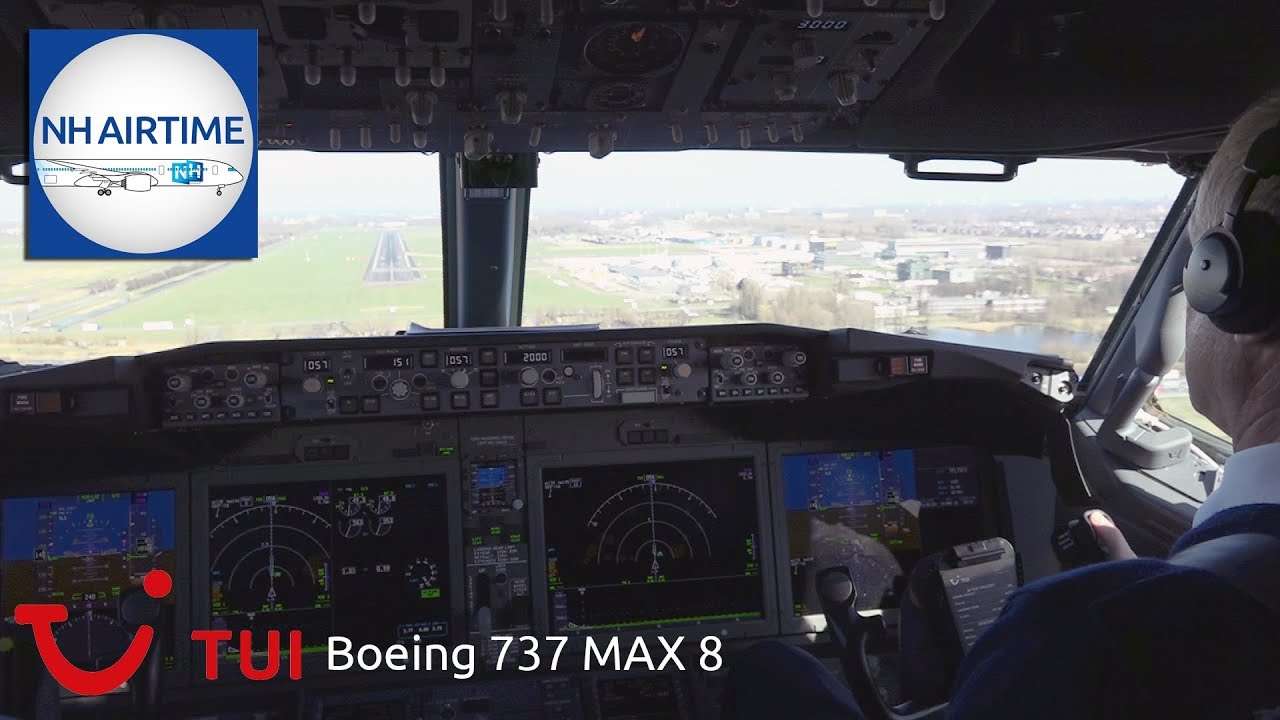
Compare the 737 MAX8 cockpit [0] with the 737-800 cockpit [1] and the 737-300 cockpit [2]. Then consider that all of these planes are under the same type rating [3] – so a pilot trained on one of them is good for all of them.
There's also a lot of commercial pressure on pilots to not refuse to take off in a plane – which could lead to bizarre consequences like the airline questioning their competence for their current type rating.
[0] https://i.ytimg.com/vi/tCXPJkC7ZwI/maxresdefault.jpg
[1] https://drscdn.500px.org/photo/35641948/m%3D2048_k%3D1_a%3D1...
[2] https://magazin.lufthansa.com/content/uploads/2016/07/Boeing...
Maybe that’s just me
However, Boeing seems to have marketed this plane under the regulatory fiction that it was the same plane as the 737, and that therefore no retraining was needed.
https://titan-server.arc.nasa.gov/ASRSPublicQueryWizard/Quer...
To build on what @ggm and @siwatanejo noted. The 737 debuted in 1967, so it is 52 years old now. The 737 MAX is 2 years old. In terms of number of issues per year since the aircraft was introduced the 737 is at ~15 incidents per year and the 737 MAX is at ~10/year. But as @ggm notes, it's important to look at when in the life cycle many of the non-MAX 737 incidents occurred.
Another way to look at this is by number of aircraft produced. The Boeing website[0] gives production numbers for various classes of the 737. In terms of incidence per number of aircraft delivered the non-max 737s have 0.082 incidents per delivered aircraft while the 737 MAX has 0.05 incidents per delivered aircraft.
Both of those suggest that the 737 MAX may not be any worse than the non-max 737s, but a more careful statistical analysis is probably necessary to draw strong conclusions.
[0] http://active.boeing.com/commercial/orders/displaystandardre...
The problem might not be with the plane per se but rather with Boeing rushing a bit and relying on the fact that “it basically the same plane but better so why would there be issues”.
"all new systems have bugs. this may not be unusual"
The 737 Max is an augmented version of the original.
Nothing is more infuriating than a UI redesign to fix what's not broken.
[0] https://arstechnica.com/information-technology/2017/11/uss-m...
Some reporter is wondering around the international car expo, discussing with various car makers. Mercedes tells him "our car is the most air-tight ever produced. It scored 24 on the cat test!" The reporter wonders - "cat test? what is that?" ""Oh, it's a novel test! We put the cat in the car, closed all of the windows and doors, and 24 hours later it drew its last breath".
Impressed, the reporter moves on to Ferrari. They tell him the same story - most airtight car ever made! He asks them knowingly - "How did the cat test go?" to which they proudly reply - "Oh, very well, very well! We put the cat in the car, closed all of the windows and doors, 12 hours later the poor thing was dead".
Next he wonders to the Renault-Dacia stand. They also tell him about the air-tightness of their car, again he asks how the cat test went. The Dacia representative beams: "Oh, wonderful! We put the cat in the car, closed all of the windows and doors, and wherever its head poked out, we quickly plastered over".
<90s Saturn> The panel gaps shrink in warm weather. </90s Saturn>
In case anyone was wondering that was actually a thing with early plastic body panels. They eventually refined it to the point where the gaps don't change noticeably and now pretty much every car has some plastic body panels.
1565207 At cruise flight, our Wi-Fi stopped working. I then saw that I was unable to access the Pilot Mobile app. Since I do not routinely copy the flight plan to iBook or acrobat (we are not required to do this), I was unable to access the flight plan. I've lost Wi-Fi before but not had this problem. Maybe it's a 737max thing. My First Officer had a copy on iBook and airdropped it to me. Later we were able to restore the Wi-Fi and I could login to pilot mobile but the [flight plan] was not there anymore.
It's time we make radio with the ATC VoIP. Just run an asterisk on the plane.
It's likely that people rewrote their memories of the event. It's also likely that the MCAS induced stresses on the plane caused a turbine flameout.
It wouldn't even be surprising if the aerodymanic stress had caused a breakup, though that doesn't seem to have happened judging by the crater.
2. Perhaps I'm misjudging, but the tone and perspective of pilot makes me worry for their approach and technical skills. Does not routinely copy to local device before takeoff? "Maybe it's a 737max thing"? Airdropping as a solution?
This does not smell off setting up for success... :<
I.e the airlines could save money on training.
The main design constraint on that bird was that it should pass most of the old paperwork so that Boeing nor airlines would need to go through expensive training and quification.
Yet, they modified the plane quite a bit - but they could not modernize several systems since they would have to then go through rigorous and expensive testing. ..
Nobody seems to underline this fact.
I bet that's the actual reason they didn't put the automatic pitch modification system to any documentation - it would not fit on the description of "just old 737 nothing new here hop in".
Really? Everything I heard so far sounds like the 737 MAX has a few new, unusual or counter intuitive features that require extra training, and that training material skimped on training for that.
> "just old 737 nothing new here hop in"
Am I correct in understanding that was a blatant lie?
It does not sound to me like lying, more like a confusion of project constraints. I.e. "make the plane better but don't touch this and this and this arbitrary system".
I think @ams6110 is saying that it may not be fair to identify the 737MAX as a completely new plane, since the 737MAX can be identified as more of an evolution of the 737 rather than a new, from-scratch plane design.
The oil, though, was interesting. The s-series engine had a design flaw with the oil control piston ring where it would get stuck in its groove due to carbon build-up. The engine would then start burning prodigious amounts of oil — mine burned 1 quart every 500 miles. I put the cheapest oil I could find in as a result and when I did a filter change I’d save the old oil to pour back into the engine (diluted — about 1 qt of old oil and 3 qts of new.). By the time I used up all of the old oil it was time to change filters again.
GM treated Saturn like a throwaway brand so they used them for a lot of R&D they didn't want to risk "important brands" over and consequently there's a bunch of random Saturn cars that have features that even some new cars don't have. My friend had one from the early 2000s that would vary radio volume with speed and window position.
A popular shade tree mechanic fix was to drill drain back holes in the oil control ring groove: https://m.youtube.com/watch?v=UrnblJ8VZtY
(Also, I don't agree that we only know "wild speculation" about the Lion Air crash. The investigators have told us much about the proximate cause of the crash, even though their final investigation is not yet complete.)
There may or may not be something inherently problematic about the way the MCAS works, but more thorough training would likely have lowered the chance of these accidents happening - having the same type rating was one of the root causes for the lacking training
It's a damning indictment of Boeing, and whichever authorities let them get away with it, that they pushed through an aircraft with a different pilot UI/UX knowing that pilots would then be under trained when using it: like someone said we train baristas better.
I've driven minibuses before and always ensure to get an hour of driving a new model before taking passengers.
That would seem to fall directly on the operator / carrier.
Boeing takes responsibility if the training manuals were not comprehensive. Aviation authorities take responsibility if they under-mandated training. But ultimately neither know a given carrier's scheduling and pilot allocation.
If the carrier was told by Boeing and the FAA that no additional training was needed, why would they use any different procedure.
At some point this falls back on nannyism. Either you have a functional company, where your employees are empowered to communicate internally, and your company does something about it... or you don't.
Boeing's job is to engineer the billion things required to keep an airplane flying. The government's job is to validate Boeing performed due diligence and mandate what training is required to the carriers. The carriers have a job too.
I wouldn't be surprised if Boeing pushed hard to have it same type certified. Why wouldn't they? Ultimately, regulatory agencies agreed. Maybe that was correct, maybe not.
But absolving the pilots' direct parent company of responsibility is bullshit. Aerospace is a different industry, but it's not that different vis what a healthy, functioning company does.
Of course, it'll fail at some point, but it's not like they were cut off from the world, they could have radioed for the information if the copilot didn't have it, or something.
My experience with WiFi routers is the opposite. I will wire anything important.
Especially if (a) it’s not part of your extensive checklists, which would reasonably be expected to be included if it was important, and (b) you’ve lost WiFi in other planes before without losing your flight plan.
I'd like to say an airplane might work better as a controlled environment than an office building, but probably not if you have 300 passengers in the back, half of whom have forgotten their MiFi devices running in their carryon.