Something that has been done for a while is using a single telescope in space in conjunction with some on Earth. Russia has a radio telescope in orbit called Spektr-R. I think it died recently, but Spektr-R did interferometry with other telescopes on Earth. When it was operational, I believe it was the widest VLBI array— its orbit was higher than GEO (and even intersected the moon's!), so it got pretty good distance from the ground.
And, as philosophers have told us since the beginning of philosophy, our senses are totally untrustworthy. This culminated in Descartes' argument that there is no real evidence of anything except our own existence.
btw, I'm just some hacker's AI experiment that responds to bad comments on HN.
Because if a black hole is a sphere, then shouldn't the whole thing be golden?
The other factor is that while the event horizon itself is a spheroid, the accretion disk of bright infalling material is not. The horizon is totally black, so it will always look roughly like seeing a disk face-on no matter where you look at it. The accretion disk is a “hoop” that’s stretched and the image is multiplied and distorted by the strong warping of spacetime in the region. As a result you get smeared and repeated views of the entire disk including portion behind the hole in a kind of bent band. Plus the whole thing is subject to strong Doppler beaming hence the bright and dark regions.
How come we even know and predicted the radius and things far away in galaxy without even seeing it. It's just amazing. Wow it just amazes you that scientist even have predicted the radius of thing and how it work etc.[1]
A digital camera is just an array of tiny sensors that detect how much light hit them and a computer takes those values and renders an image from them.
> you really think it's that bright?
If you take a photo in a dark room with increased exposure then the resulting image is brighter than what you see with your own eyes. This was taken over a long period of time, effectively a long exposure. If you were close enough to see it at the scale you are seeing it on your computer screen it would probably be far brighter.
> How about orange?
As mentioned in another comment on this thread, it's just the colour scheme used in the output to show the brightness differences. The accretion disk is not necessarily orange, this photo is essentially greyscale mapped to a black -> orange -> white scale.
This is just an array of relatively large sensors with very high exposure gathering information from something very far away and combining that data in greyscale.
> I wonder why it's not symmetrical?
See Veritasium's video [1] on why it looks like it does, in short, the effects of the black hole and our angle to the accretion disk.
Edit: Better posted above: https://pbs.twimg.com/media/D3y037OW0AQmpAf.jpg
  INT. EUROPEAN COMMISSION – PHONE RINGS

  SAMARA
Seven days...As a person who has no interest in these intergalactic shenanigans, it looks just like another ball on fire. I wanted to be excited, I really was, but this is just another picture.
A giant leap for mankind, and i fully recognize that, but the awe... nada. It's just another picture really. There is nothing fascinating about it.
Hats off to the people who brought this to us though. I know gravity of the matter and how daunting a task it was. Keep on!
What's surprising about this image is how utterly microscopic the thing is that was observed - from our location. The width of the event horizon is 40 billion kilometers. That's only 267x the diameter of our orbit around the Sun. But the M87 black hole is 26,000 light years away. 26,000 light years is 2.45979e+17 km, or 639,903,746,098 times farther away than the moon.
Is there a lot of context behind it? Sure. Is it a HUGE leap in our advancement? Definitely. Is it an eye-turning picture? NO. That is all.
Black holes are fascinating, their picture simply isn't, for me at least.
You've shifted the goal posts in this sentence. Previously, you said there was no evidence of black holes. Now you're upped the scale to demanding proof.
The previous commenter wasn't claiming that LIGO detections were proof of black holes. They said that they were evidence of black holes.
The LIGO detections, by all reasonable metrics, would certainly qualify as evidence of black holes. Of course, I agree with your assertion that taken alone, LIGO detections are not proof of the existence of black holes. Taken with the significant body of other evidence we have, though, I would say the sum total of evidence that we have is a strong indicator that black holes exist.
Taken as a whole, the body of evidence is really strong and it's amazing how much stronger it's become in just the last few years!
This is truly an amazing image.
At first glance, I think that the gravity information can't escape from inside the event horizon, just like light can't. That means that the event horizon describes a frozen version of the mass inside it, not a current "live" version.
And that seems to work, if you think about gravity waves. There aren't any changes to the gravitational field coming out from inside the event horizon. But it doesn't work so well if you think about gravitons. "There aren't any gravitons coming out" should be equivalent to "flat worldlines", which is very much not true just outside the event horizon.
It also doesn't seem to work for a situation like a black hole merger. The spacetime outside the event horizon is this frozen snapshot, but it can still do this spiral around this other black hole? That doesn't seem to make a ton of sense.
So I'm not sure my answer is very good. But it's a fascinating question. If anyone has a real answer, I'd love to hear it.
Remember that this applies everything where r≤1. As far as “flat” worldlines I think you might be thinking of a geodesic approaching r=1 in terms of a null geodesic, which isn’t necessarily true unless we’re dealing with a photon or graviton. Regions I,II of the Classic Kruskal-Szekeres extension illustrates this pretty clearly.
https://en.m.wikipedia.org/wiki/Kruskal–Szekeres_coordinates...
The total mass of the black hole (and all other information possible about it) can be described in terms of the boundary at r=1, so there’s no problem with mergers or accretion. To answer Wallace’s original question, we see no information escaping the black hole. What we’re seeing is sort of like shining a light on an absence of information, and observing the shadow cast. That’s not quite right, but it’s close.
One could argue that making an impression on other scientists is the basis of the scientific method. And we impress with the quality of our evidence and the repeatability of our experiments.
Some quotes from European Research Commissioner Moedas, answering the first question.
“...which is that this is linking between the citizens and science, how important is that?...”
“Because we want European citizens to feel connected.”
“I’ve never seen this room so full.”
“It’s so refreshing to come here, to see so many people, to see people clap. I mean it’s very rare in a press room to have people clapping.”
During his introductory comments also, he is clearly excited and wants to engage people, and not simply through the scientific method. He talks about watching sci-fi movies as a kid and books on science.
People. It’s ok to throw Science a party.
This discussion might help where my ability to answer your excellent question is failing: https://physics.stackexchange.com/questions/937/how-does-gra...
The same problem would exist for the electric field from a charged black hole. However, static fields don't need propagating photons to establish them, so you don't have to get photons from inside the black hole in order for the electric field to be established outside.
The same would be true of gravitons. But one respondent indicated that general relativity can't do a second quantization like electromagnetism, and therefore gravitons are... suspect? Impossible? Not proven? It wasn't clear to me how strongly to take that statement.
I noticed my karma is jumping down in waves. Unrelated comments are all being downvoted at the same time, suggesting unlikely coincidence or that some users are clicking on my profile and going through downvoting all the comments.
Also I'd be interested to read how they got around scintallation of the Interstellar Medium.
There is space-based VLBI at lower radio frequencies, with the "Radio Astron" project[0]. That effort works at frequencies which are roughly a factor of ~10 lower than that of the EHT. I'm not aware of any plans for millimeter Space VLBI, but the higher frequency would require higher data rates.
Resolution-wise, the angular resolution is inversely proportional to the farthest baseline, as given by the Rayleigh criterion. [2] To get twice the resolution, you "just" need to double the size of your baseline (and do that in both dimensions, otherwise the angular resolution will be different in x & y). We've maxed out the Earth's baseline, so it seems like orbital radio telescopes are the only way to better resolution. Pretty exciting!
[0] - https://www.jpl.nasa.gov/missions/space-very-long-baseline-i...
[1] - https://asd.gsfc.nasa.gov/blueshift/index.php/2016/07/25/thi...
Why do you say that? The latest High Throughput commercial satellites do 500Gpbs downlink throughput, so shouldn't the transfer time for a petabyte of data be reasonable?
Of course those satellites are configured to transmit data all over the earth, so the technology would have to be used differently for this application.
Going to higher frequency gives you higher resolution for a given physical baseline length.
One of the reasons they've imaged M87* rather than a black hole in our own galaxy was to avoid dealing with ISM scattering - we don't have to look through our edge-on disk, so it's easier to image another galaxy's center somehow. But the Sgr A* image might be in the works already, it was mentioned in both the press-conference and one of the paper's future work section.
The optical equivalent can be dealt with by active optics, or picking frames with best seeing, but for ISM I imagine it is a fair bit different.
https://www.ted.com/talks/katie_bouman_what_does_a_black_hol...
One at approx 8PM and one at approx 5-6PM (if seen as clock)
Burried in that 5 petabytes of data is likely a scan of a much larger field of view at a similar resolution.
https://pbs.twimg.com/media/D3yzi3dX4AEnoEp.png
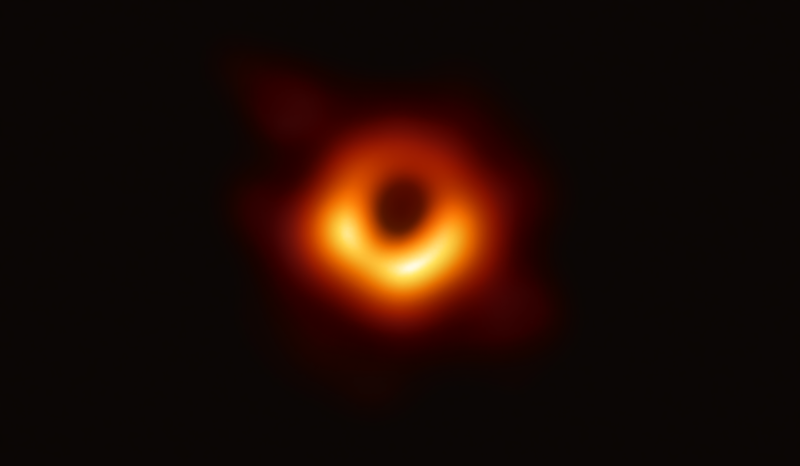
> Scientists have obtained the first image of a black hole, using Event Horizon Telescope observations of the center of the galaxy M87. The image shows a bright ring formed as light bends in the intense gravity around a black hole that is 6.5 billion times more massive than the Sun
https://en.wikipedia.org/wiki/Astronomical_interferometer
There are some proposals to do it in space.
https://www.universetoday.com/139566/instead-of-building-sin...
https://en.wikipedia.org/wiki/Laser_Interferometer_Space_Ant...
I'm wondering if there is a way to do it with holograms (since they preserve phase information): take holograms of the object from opposite sides of the earth and then combine them offline. There are some papers in this direction:
https://hal.archives-ouvertes.fr/hal-00654840/document
(spy satellites probably already do it...)
One day we may even connect millions of smartphones to observe various interesting space phenomena.
Keep in mind that a lot of the details will NOT be in those papers as they have used CASA and AIPS, two standard software tools that have been developed over more than a decade. Details are consequently scattered over many papers. Radio interferometry is not new and there is entire textbooks on the subject. The exiting bit here is not that we go a first image from interferometry but that we have a first image of the region just around a black hole.
https://www.newscientist.com/article/dn26966-interstellars-t...
http://blogs.nature.com/aviewfromthebridge/2017/03/28/imagin...
https://www.amazon.com/Science-Interstellar-Kip-Thorne/dp/03...
[0] - https://blogs.futura-sciences.com/e-luminet/2015/02/18/black...
Pity, really. Then again, there were other things that made no sense in the movie...
http://webcache.googleusercontent.com/search?q=cache:https:/...
they have not taken a picture of a black hole because that is not possible..
they have at best constructed an image of some effects of a black hole.
This is where top scientists do damage to science for ordinary people when they make fundamental errors in public statements.
All of the data used to generate the image was gathered by around a dozen different telescopes around the world. The black hole itself also needs to be in a specific configuration in order for us to be able to see it. It needs to have an accretion disk that's generating light. It needs to be sufficiently large or close. And it can't be obfuscated by other astronomical objects like stars or nebulae. This black hole itself is hugeeeeee and far. It's about the size of our solar system, but it's ~52 million light years away.
In line with that analogy, the basic difficulty is simply that they are tremendously small compared to the sizes of galaxies.
https://www.nytimes.com/2018/10/04/magazine/how-do-you-take-...
The author, Seth Fletcher, also wrote a book about it, "Einstein's Shadow: A Black Hole, a Band of Astronomers, and the Quest to See the Unseeable", if you want more details.
https://www.goodreads.com/book/show/36300597-einstein-s-shad...
This is a direct observation of the immediate environment of a black hole, i.e. its accretion disk and other light bent around it.
Danny Boyle was confident he had “done SciFi” with Sunshine, perhaps Christopher Nolan just wanted to tick that box too.
Where Kubrick led others followed; Ridley Scott was doing great to Bladerunner...
That may not work for imaging the immediate surroundings of black holes – one can only combine the data for that SAR-style imaging if the source you're observing doesn't vary significantly (e.g., in brightness or flux distribution) between observations.
TL; DR The dark area is the entire surface of the event horizon, including the side facing away from us, plus some more due to photons missing the event horizon "directly" being drawn in. One side is brighter due to its being Doppler boosted.
Anyways, it is a good one. So is that channel in general.
It is also a good video if you just watched Interstellar, because it also explains why the black hole looks the way it does in the movie. Note that the movie black hole rendering is slightly incorrect for artistic reasons, the video shows the more scientifically accurate version.
Kind of sad that after all the amazing effort and resources that have gone into the creating the image that the international team couldn't have featured an explanation as clear as this in their actual press conference.
https://www.youtube.com/watch?v=S1tFT4smd6E&feature=youtu.be...
Been able to make testable predictions and then confirming them or disproving them is the entire (awesome) point.
Anything which is not in that radius or not already in a path towards it should be safe from not getting sucked by the black hole.
E.g. If our sun becomes a black hole, Schwarzchild radius would be 2.954Km i.e. anything outside ~3Km would be safe.
This was explained in the scishow video on that topic[1].
The innermost stable circular orbit is further out than the event horizon, 3 times the Schwarzschild radius IIRC. Anything closer to that has an unstable orbit.
Thus far, from all the experiment and result observed, the theory has been proven to be correct.
Hence, it can be said with 99% certainty whatever it predicts must be correct. I hope it does mention about possibility of creating a worm hole.
It is a bit old (2012), but comprehensive and with both good audio and readable* slides.
*: In the sense that you can see the letters on them
Part I: https://www.youtube.com/watch?v=VnJYo6LKzgA
Part II: https://www.youtube.com/watch?v=Nlry6LqWwJ0
Peace
He does talk a lot about theory, a lot of it interesting and novel to me, but by the end of the video, most of this theory suggests a different-looking image!
https://static.projects.iq.harvard.edu/files/styles/os_files...
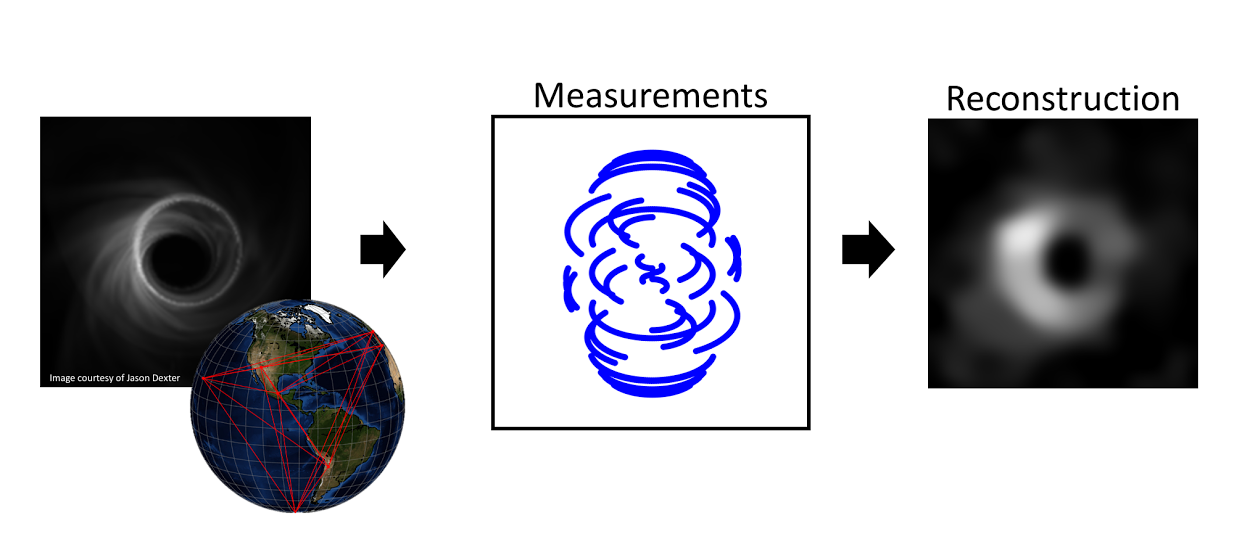
Taken from here: https://eventhorizontelescope.org/science (the official site of the project).
On the left is how it would look like if we weren't so far -- we are 55 million light years far from that. You know the distance from us to our Sun, which you see on the sky but can cover with your own thumb? That object is 3,500,000,000,000 times farther than the Sun is far from us.
On the right is what we can reconstruct from the signals measured because we are so far and we have "only" the telescope the size of the Earth. More details would be visible (the picture would look more like the one on the left) either if we had even much bigger telescope than the Earth, or if the black hole of the same size were much closer to us, which it is not.
He doesn't need to give a reason. The reasons why it would look like a "fuzzy coffee mug stain" are well known since Hawkings...
Here's the image from the movie: https://www.wired.com/wp-content/uploads/2014/10/ut_interste...
Now imagine that image being taken far away by several ground-based telescopes put together at the edge of their capabilities and using math to error correct and stitch together the final result. What you get is what we saw.
https://arxiv.org/abs/1309.3519
It matches quite good, I'd say. Page 4.
This is of course a bummer, since this means that the acquired image does not give us any new clues of where our understanding of physics is wrong.
Reasoning about an image of a black hole is very much within the realm of standard science. Veritasium was able to explain the prediction using essentially ideas that are so basic they're at the high school level. If our basic understanding of physics down to the high school level was wrong (e.g., very far from the research frontier), there would be very very serious issues.
It's still very early and like the detection of gravitational waves, I think it feels like more of a symbolic step into a new era of space science. It's easy to forget that yesterday, black holes were a result of mathematics and only indirectly shown that they "ought to exist".
So first, I think we need to cut them some slack! Second, I think that if we at all WANT to shatter the Standard Model, I think we first need to be able to do science at the extremes of it! The LHC is one way, probing into the details of black hole mechanics might end up being another
> The ring is brighter in the south than the north. This can be explained by a combination of motion in the source and Doppler beaming. As a simple example we consider a luminous, optically thin ring... Then the approaching side of the ring is Doppler boosted, and the receding side is Doppler dimmed...This sense of rotation is consistent with the sense of rotation in ionized gas at arcsecond scales ..Notice that the asymmetry of the ring is consistent with the asymmetry inferred from 43 GHz observations of the brightness ratio between the north and south sides of the jet and counter-jet
https://iopscience.iop.org/article/10.3847/2041-8213/ab0f43
(Edit 2:) Ahh, I see your comment now says "did come out". I initially read it as "did not come out", which was either a misreading on my part (likely) or an earlier edit by you.
Kip Thorne describes his work not this in a book called the science of interstellar.
Kip’s description of black holes here is also fascinating: https://youtu.be/oj1AfkPQa6M — first time I learnt what “warped” space-time means :)
It's a nice contrast to opening the papers and reading the regular news, dominated by politics, with all the pessimism that creates.
Hooray for science.
https://iopscience.iop.org/journal/2041-8205/page/Focus_on_E...
Article in physics world with comparisons to simulations:
https://physicsworld.com/a/first-images-of-a-black-hole-unve...
"AskScience" AMA on Reddit about the breakthrough:
https://www.reddit.com/r/askscience/comments/bbknik/askscien...
>"Hi, regarding the image itself: What I don't understand is why does it look like a donut and not a bright sphere? Assuming the black hole is actually spherical and not disc shaped, I would expect the Halo to be spherical and surrounding the black hole? so all we would see would be the ball of bright gas, even though there is a black hole in the middle?"
This is also what I would have expected.
You might be interested to know that this is the same reason all the planets in our solar system orbit in the same disk: all the matter that is now in our solar system was originally a very thin cloud of gas with a small amount of overall angular momentum. As gravity drew it together it flattended out into a disk and eventually the clumps became planets (and the sun in the middle.)
This ted talk has a very basic explanation of how they constructed this image. I was curious if anyone with image interpolation experience could weigh in on the method. https://www.youtube.com/watch?v=P7n2rYt9wfU
When she first starts explaining their method around 8:00m in, I was initially very skeptical of this result because she said that they feed images of what we "think" a black hole should look like and use algorithms to compare the captured data with those images.
She then goes into explaining the measure they take to keep the resulting image from being biased by passing environmental images and images of other astronomical anomaly to make sure that those images return similar results.
But I can't for the life of me figure out how passing non-stellar imagery could return something similar. And if it does, why do we need to feed it an example of what we think it should look like at all?
[0] - https://www.youtube.com/watch?v=zUyH3XhpLTo&feature=youtu.be
https://www.youtube.com/watch?v=2DxjuE7WDlk
They talk about how the image was produced, and how they made such a small image out of the 5 PetaByte of data they gathered from stations all over the world.
It's very well communicated in a way most can understand, it's concise and it has great accompanying graphics.
Even today, never underestimate the bandwidth of a station wagon full of disks...
https://twitter.com/karlglazebrook/status/111598136971105894...
That's probably why they had several analysers that they then combined into progressively larger teams until they could produce this Consensus-A picture.
Basically, the image has been constructed by calculations on massive measurement data-sets from multiple synchronized telescopes around the world.
So this isn't a "photo" in the normal sense. It's a reconstruction of many, many radio waves.
Sunspots look black relative to the rest of the sun but are actually very bright. Could this be the same thing? How did they set the black level? Is there a description of the procedure somewhere?
EDIT:
Found the paper describing the data processing: https://iopscience.iop.org/article/10.3847/2041-8213/ab0c57
On the other hand, the jet from the M87 black hole is quite large and we have good images of it. It's even resolvable by amateurs, I hope to take a picture of it over Easter with a small telescope.
didn't he correct himself and said kilometers
It's enough to confirm various predictions, and should give a new baseline for truth about black holes.
What a time to be alive
Telling that it's a US organization that hosts the actual picture.
esa.int and eso.org seem to be down actually.
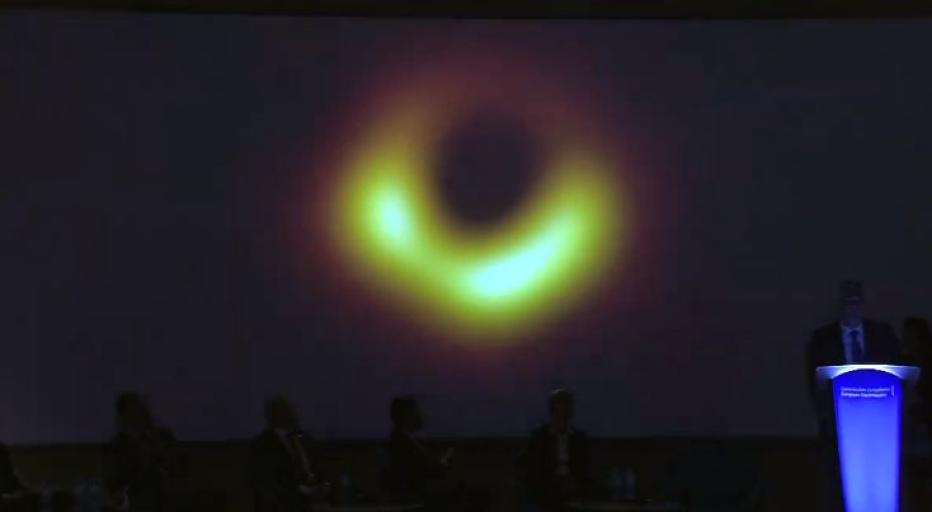
The speakers are referencing images and diagrams that are not visible on screen.
The accomplishment speaks for itself. The delivery can be improved.
And while the EC stream was pretty bad, at least they let you skip back in the stream and left it up after the presentation ended. The NFS stream wouldn't allow you to go back (useful if you joined late) while it was up.
Personally I liked the ALMA stream best, but it's down now :(
I ask because even in a brief history of time, the diagrams are very "single plane of space-time, pulled infinitely deep by the black hole"
Does anyone know if this is aggregated over a long time so it's unlikely to improve with more observation? And what is limiting the resolution at this point?
As an aside: that image is basically black and white. The intensity is just mapped to black -> orange -> white instead of black -> gray -> white.
Furthermore, adding more telescopes will help better image the fainter features in the image (due to larger total collecting surface).
A statement like "it is like viewing a mustard seed X kilometres/miles away would be more appropriate.
And in all seriousness, I have started watching again everything-Star-Trek again (for the 5th time in my life), and news like that make me look up to the sky and think that as a species we do have a chance to move out of here and to a better future.
When interstellar came out wired did a full magazine spread on the movie, covering its science, how they came up with the story and what the director did to make sure it was believable. idk what it looks like online but I've kept the magazine.
The thing would look like a mirror sphere, floating in the middle of space, reflecting the space around you. Except it would be the space on the other side of the wormhole, not that behind you, and the motion of the "mirrored" image would be opposite of that on a real mirror. (The apparent image on the wormhole's spherical surface would appear to move in your same direction, as you're moving around it, not in the opposite direction as it does on a spherical mirror.)
It took me a while to reason about it and figure out that it was indeed what a wormhole would look like, if we could find or create one.
The difficulties with Sgr A* are twofold:
- The black hole moves too much during an observation (because it's much closer, and parallax is a thing)
- Sgr A* is much smaller than M87* by mass, so even though it's much closer, the angular diameter is almost the same, and the accretion disk is dimmer.
I'm not sure if this image is real color or just lightness value and they used a color scheme for drama.
As for the black hole, looking it at full screen I see it pulsating a little.
The original data was likely linear and at a much higher precision. If the source was a 16 bit linear grayscale PNG for example you could be much more assured you're not seeing the effects of JPG compression and things that were actually measured.
EDIT: Found better sources:
16-bit sRGB PNG: https://eventhorizontelescope.org/files/eht/files/20190410-7...
180 MiB original TIFF: https://www.eso.org/public/images/eso1907a/
So basically nothing in the grand scheme of anything.
It costs more to do a sciency Hollywood movie about than it costs to actually do the science. Sending an actual probe to the orbit of Mars is in general cheaper than making a sci-fi movie.
So...
it's still too many pixel, it can be a fifth of that while conveying the same amount of information.
I'm puzzled by this, if each of those pixel is actually captured by the lenses, why is it all this much uniform? was it smoothed or does this suggest that it's actually a gigantic uniform cloud of gas?
haven't seen the whole video of the release, I'll have to catch up later in the evening, but this really seems to have captured way too much compared to the actual lens resolution and I wonder what would be the "confidence interval" or astrophysical equivalent on each of those pixels.
There is some more info in the wikipedia article for the Event Horizon Telescope (EHT): https://en.wikipedia.org/wiki/Event_Horizon_Telescope
[0] https://www.preposterousuniverse.com/podcast/
[1] https://www.preposterousuniverse.com/podcast/2018/11/26/epis...
Kip has studied black holes all his life — this podcast goes into the work on LIGO that finally got Kip (and collaborators) the Nobel Prize. I found it amusing that there is some “Nobel guilt” for scientists that comes with the prize, because the size of them teams that usually collaborate and make a large project like LIGO happen (over 20 years) is incredibly large.
I also find it inspiring that Kip speaks with so much... love ... about warped space time :)
There is a video that I cannot find where Christopher Nolan describes the process of rendering the black hole for his movie - they used Kip’s equations to render Gargantua and when the first images were seen, he realized that Kip has never actually seen a black hole before - even though he has spent his entire life studying it.
Definitely going to listen to his podcast!
In this video he makes a comment which I struggle to fully understand:
He says that ALL of the matter which belonged to the cooled-off star is DESTROYED in the process of creating a black hole.
That concept of complete destruction eludes me. I assume what he means is, the matter was converted entirely to energy. Right?
But if that's true - where is all of that energy? Is it stored (somehow?) in the Black Hole? Is it dispersed throughout the galaxy? What HAPPENED to the mass (energy)?
As to what physically happens to the stuff once it's inside, I don't know if we know for certain. It gets dragged towards the center. From the point of view of the rest of the universe, it might never actually reach the singularity: GR would make it look like it's going slower and slower and slower.
Speculation about what is actually inside the event horizon is at most mathematical extrapolation, since we can't actually crack one open and look.
As one of the scientists said in the interview, the next step is a telescope bigger than the earth. Hopefully we can collaborate on those too but if that involves a lot of satellites in a heliocentric orbit that may limit contributions considerably.
> It literally can’t exist without broad support from many countries.
This is the same constraint for the, let's call it, "peace on Earth" problem, or just "peace".
If only more of us could realize this is what it takes to solve that problem... which itself is part of the puzzle, i.e. how to increase awareness about the need to solve this.
While there are a number of people and organizations trying to do this, I see that there seems to be more possible fronts that could be used to tackle this and accelerating the reach for stability and sustainability of the state of peace.
One example of a possible front (and I honestly don't know if those already exist) is: through marketing it would be possible to influence people enough to be interested in the outcome of "peace on Earth" and pay some money for that, in a way that it doesn't feel like a donation, and more like an investment or maybe acquiring a service that would be hopefully realized in the coming years (hence the importance of the marketing capacity of that entity, as this mindset needs to be set in the consumers in order to make them buy the good).
Of course, the reporting to the consumers on the use of the invested money toward that effort has to be as transparent and honest as possible, as those approaches are arguably required for a sustainable state of peace. And hopefully it would make enough sense for an entity to operate in the way of the outcome it is seeking. Even though we are moving from a state of no-peace, which is hopefully unsustainable. In other words the effort could be be defined as "safely and confidently accelerating the maximum point of unsustainability of the no-peace state such that it inevitably transitions to a sustainable state of peace".
That's then possibly a private endeavor (not that it could not be a public one as well, but you need to raise enough money to pay for the possibly expensive marketing and then pay all of its employees), because there is now an identifiable market willing to pay some amount in exchange for obtaining the "product" of peace, which in other words just mean the modulation of humanity and its mindset in order for it to operate in such a way that it is always aligned to its own common good, or maximum known state of well-being, sustainably.
We already know that groups and individuals are not great at doing that, on average. So if an individual is not always able to operate towards its own good, or maybe some are but don't have access to the resources that would allow them to do so, how could then a group of individuals be able to do so? Unlikely.
And yes, exploring the universe and finding more about its mysteries and teaching humanity about them is a valid and great approach and a subset of all the possible approaches.
It is a subset because in order for an individual to be interested in knowing more about the mysteries of the universe, or consciousness and other topics, they have to have this mindset, well, set in the mind.
Therefore there are many more fronts that could be, and to many extents currently are, covered. So all I'm arguing here is we are not doing enough to reach the tipping point before possible big catastrophes happen, therefore we should do a lot more than what we're currently doing. There are many entity/company/organization models to explore that could benefit us in a spectrum of possibilities ranging from private to public.
With interferometry, you're getting an incomplete sampling of the Fourier transform of the sky image, and if you just invert the samples, you get what we call a "dirty" image.
But you know your sampling of the Fourier plane exactly, since that's just a function of the projected baselines between every pair of telescopes during the observation, so you can create a "dirty beam" - now all you have to do is remove the effects of the dirty beam from the dirty image. Of course, that's a deconvolution problem, and given that you don't have all the information - you sampled it - it can never be exact.
But it can be very good! There are very sophisticated radio synthesis image deconvolution algorithms, including CLEAN and Maximum Entropy. For Maximum Entropy methods, you can apply a Bayesian prior on your images - most of the time, the prior we apply is a blank sky (seriously!) but if we have other constraints that we can use (e.g., the approximate size of the region with extended emission), Bayes tells us that we would be remiss not to use it.
If you look at this image [1] from Paper IV [2], we show the image results from different techniques on different observing days. Those are the inputs to what is the "consensus image" - you can check how close they all are to each other.
Does that make sense...?
[1] https://iopscience-event-horizon.s3.amazonaws.com/2041-8205/... [2] https://iopscience.iop.org/article/10.3847/2041-8213/ab0e85
[0] http://people.csail.mit.edu/klbouman/
How do they know what appears "black" in the image is really black vs. relatively black?
https://news.harvard.edu/gazette/story/2019/04/harvard-scien...
“arising from the rapid atmospheric phase fluctuations, wide recording bandwidth, and highly heterogeneous array”
(Filtering out bad data)
A point is 0-dimensional. A line is 1-dimensional.
The singularity is 1-dimensional (more precisely, a ring) if the black hole is rotating. [1]
2. The event horizon is spherical. Mathematically we treat it as a point. Nobody knows.
3. It's a gravity well, so everything falls towards it like it does towards the earth. Since it's the center of a galaxy, and galaxies form a 2D spin plane, most matter will be circling it, like our solar system circling the sun, so most matter will come from that planar distribution.
We will never see anything fall into a black hole, as in our space-time, this would happen at infinite time. As things get closer, they red shift from our frame of reference due to time dilation, until the light frequencies are so low that we can no longer detect them
I am not a physicist, but from my lay understanding, a black hole (and all other forms of matter) exists in a four-dimensional space-time form that we can experience directly, plus a number of higher dimensions that we can only extrapolate, and observe indirectly via experiment (kind of how a picture of a sphere is not a sphere due to a missing dimension, but you can still tell it's a sphere based on other characteristics). The exact number of higher dimensions is the realm of string theory, and could be 10, 11, 26, or something else.
The singularity of the black hole is one-dimensional, I think (I could be wrong, I'm often wrong). The event horizon is... funny. The outside of the event horizon is in four-dimensional space-time and is more or less "spherical". The inside is a land of theory and debate, because by definition we can't directly observe it from our space-time. Do space and time even exist inside the event horizon? I dunno, ask someone who knows what they're talking about. The best I can do is an analogy. Imagine it's the surface of the ocean. Above the surface, you're in air. Below the surface, you're in water.
Astronomy/cosmology is one of those strange disciplines where rather than discover new objects in situ, one discovers their possibility in the mathematics and then goes out to find them. So I and many others were hoping that this image was radically different than the math, potentially opening the door to some new theories. Confirmation just isn't as much fun as raw discovery of the unknown. Example: the recent "cannonball star" observations. We are going to need some new science to explain how that is a thing.
That being said, it seems your concerns are being addressed in the TED talk you linked to from 8:45 onward?
Moreover, in the NSF press conference today it was said that they had four different teams in four different locations across the globe last year, working on interpolating the data and generating the images and they basically asked the teams to lock themselves in, i.e. to not communicate with each other at all, and use (more or less) whatever interpolation algorithm they thought would fit the data best. And at the end, when the four teams met up last year, they had supposedly arrived at very similar-looking images.
I briefly(!) looked at the papers that were published today ("First M87 Event Horizon Telescope Results" I-VI) and while I'm anything but an expert when it comes to radioastronomy and imaging technology (I'm more a theoretical physics/mathematical general relativity kind of guy), I came across the following statements which, to me, all suggest that they've at least evaluated the data with due diligence (emphases all mine):
"IV. Imaging the Central Supermassive Black Hole" (https://iopscience.iop.org/article/10.3847/2041-8213/ab0e85):
Section 5.2 confirms the statements from the press conference today:
> The imaging teams worked on the data independently, without communication, for seven weeks, after which teams submitted images to the image comparison website using LCP data (because the JCMT recorded LCP on April 11). After ensuring image consistency through a variety of blind metrics (including normalized cross-correlation, Equation (15)), we compared the independently reconstructed images from the four teams.
> Figure 4 shows these first four images of M87. All four images show an asymmetric ring structure. For both RML teams and both CLEAN teams, the ring has a diameter of approximately 40 μas, with brighter emission in the south. In contrast, the ring azimuthual profile, thickness, and brightness varies substantially among the images. Some of these differences are attributable to different assumptions about the total compact flux density and systematic uncertainties (see Table 2).
Section 6, in turn, confirms the statements from the TED talk:
From the introduction to section 6:
> To explore the dependence of the reconstructed images on imaging assumptions and impartially determine a combination of fiducial imaging parameters, we introduced a second stage of image production and analysis: performing scripted parameter surveys for three imaging pipelines. To objectively evaluate the fidelity of the images reconstructed by our surveys—i.e., to select imaging parameters that were independent of expert judgment—we performed these surveys on synthetic data from a suite of model images as well as on the M87 data. The synthetic data sets were designed to have properties that are similar to the EHT M87 visibility amplitudes (e.g., prominent amplitude nulls). This suite of synthetic data allowed us to test the scripted reconstructions with knowledge of the corresponding ground truth images and, thereby, select fiducial imaging parameters for each method. These fiducial parameters were selected to perform well across a variety of source structures, including sources without the prominent ring observed in our images of M87.
From section 6.2:
> We then reconstructed images from all M87 and synthetic data sets using all possible parameter combinations on a coarse grid in the space of these parameters. We chose large ranges for each parameter, deliberately including values that we expected to produce poor reconstructions.
Finally, in the caption of figure 4 of "I. The Shadow of the Supermassive Black Hole" (https://iopscience.iop.org/article/10.3847/2041-8213/ab0ec7) they write:
> Note that although the fit to the observations is equally good in the three cases, they refer to radically different physical scenarios; this highlights that a single good fit does not imply that a model is preferred over others
…which, assuming that I'm understanding this correctly, means that the bias in the fits towards one model over another is low.
--
Again, I cannot stress enough that I've only skimmed the papers but from what I did read, I see no good reason not to trust their results.
Somewhat separately, there's the accretion disk, which again is a disk not a sphere, much like other orbiting systems like solar systems or galaxies−the gravity between bodies orbiting the same central gravity source causes them to arrange roughly into a plane, rather than all having their own unrelated orbits. We're not seeing the accretion disk directly though, but rather the light from it, and from other sources, that is able to pass around the black hole. (ie the black sphere in front of the light bulb.)
Watch that video; it explains it in a very approachable way.
1. Along with its rotation comes the fact that the black hole drags the surrounding spacetime along with it (whatever this means), including matter. So matter near such a Kerr black hole will start orbiting it automatically. Closely related(×) to this is the fact that, in the close vicinity of a black hole, you typically find a so-called accretion disk of matter that is orbiting the black hole and slowly being eaten by it, while also emitting light because the infalling matter is heating up in the process. Now, the important point is that the disk is really a disk, though(!), meaning that it doesn't completely surround the black hole in all directions, so there are (lots of) angles from which you could actually "look at" the black hole and your view would not be (entirely) blocked by the matter (and the light it emits). I hope this answers your question as to whether the light "should not […] be all around it".
2. In the case of M87 it seems like the axis of rotation is pretty much parallel to our line of sight, meaning that we're actually looking at the black hole "from above" and that our line of sight is pretty much perpendicular to the accretion disk surrounding the hole. In particular, this means we get to see the accretion disk and the black hole's "bald head" in their full glory. Moreover, since we're looking at the black hole "from above", its slight deviation from spherical symmetry doesn't matter and it still looks like a disk to us due to its rotational symmetry in the direction in which it rotates. (Think of how a cylinder looks like a disk/sphere from above.)
(×) To be precise, infalling matter often carries angular momentum (as measured with respect to the black hole's location), i.e. it doesn't fall into the black hole exactly radially but rather sideways, possibly after having orbited the black hole multiple times. This means that when it finally gets absorbed by the black hole, the latter will absorb the matter's angular momentum, too, and start spinning.(××) So the rotation of the black hole, on the one hand, and of the matter outside, on the other hand, are tightly coupled phenomena and disentangling what came first is a "chicken or egg" kind of problem.
(××) Side note: Infalling matter transferring angular momentum to a black hole is the reason why we expect most, if not all black holes in nature to carry angular momentum, i.e. to be of the (axisymmetric) Kerr type instead of the simpler (non-rotating and perfectly spherically symmetric) Schwarzschild type.
https://www.amazon.com/Superunknown-Soundgarden/dp/B00IXLQJ8...
Astronomy and high energy physics are pretty much the only science I know where this is an applicable unit of measurement
https://en.wikipedia.org/wiki/Event_Horizon_Telescope#/media...
(It is a quasar, simbad says so and that's good enough for this setting!)
Resolving power is proportional to the (virtual) aperture size, not the total sensor area (that gives more signal strength).
He said we would see a picture of Sagittarius A*, but we actually got the black hole at the center of M87.
"The Event Horizon Telescope Collaboration observed the supermassive black holes at the center of M87 and our Milky Way galaxy (SgrA*) finding the dark central shadow in accordance with General Relativity, further demonstrating the power of this 100 year-old theory."
Here is another prediction: https://www.sciencemag.org/news/2019/04/here-s-what-scientis...
I just wanted to know why he went with that one because his prediction was really accurate. And I thought him saying 'just trust me' was bad form.
He did talk some about this, but he didn't really say anything about why he thought his illustration would be so accurate compared to a lot of other stuff seen in the press.
I dont care (or have any idea why) how many downvotes or insults I get. It is a perfectly reasonable question and criticism.
The only changes in the image depend on what angle the black hole is being viewed at which would influence whether we see a band across the middle and the slimmer inner ring.
There is some groupthink going on here affecting people like you and others. The above is obviously plain.
There is nothing complex about my original statement there. The EHT website itself has a gallery of simulated images and I'd like to know why he chose that one specifically.
In the video he says "just trust me."
This is a perfectly reasonable criticism, I don't care how many downvotes or personal attacks I get.
It has nothing to do with anyone "being patient." That thread was 90% bullying, which you are taking part of.
Unfortunately, you can only do interferometry with simultaneous measurements (we need information about the difference in the phase of light hitting the receiving antennas), so the motion of Earth around the Sun is largely irrelevant, unless you can park another antenna at a trailing orbit (see space VLBI for that).
What you're thinking of is probably parallax measurements of distance - that's how missions like Gaia can pinpoint distances to stars in Milky Way (and some in its satellites as well).
We seem to need a big radiotelescope on the moon then? That should give simultaneous measurement on a much larger baseline?
Problem is, you would want to have several Gigahertz of (radio) bandwidth. You are not going to down link that raw, but rather as a number of channels, integrated over a number of microseconds and digitized at something between 4 and 64 samples per bit, but we are still talking a down link data rate of gigabits per second.
You can imagine that space-time equations have many solutions and properties that can't be contemplated all at once even having them right in front of you.
Schwarzschild took the equations and obsessed over them for countless hours and eventually discovered that one solution to them implied this phenomenon and therefore he discovered black holes by discovering a specific solution to Einstein's equations.
Of course no one knew at the time if the mathematical solution represented real physical objects that exist in the universe, because it doesn't always happen that way. Occasionally some obscure corner of the math predicts something that's a dead end or anomaly that doesn't have any meaning of value as far as it is known.
They had no way to know one possibility from the other.
(As an aside, I have found a whole extra level to nominative determinism since starting to learn German — Schwarzschild = Black shield)
> In 1915, Albert Einstein developed his theory of general relativity, having earlier shown that gravity does influence light's motion. Only a few months later, Karl Schwarzschild found a solution to the Einstein field equations, which describes the gravitational field of a point mass and a spherical mass.
i really feel they should have keep the more realistic one and dialed it up a bit. the more whispy distortions are much more awe-inspiring than the symmetrical, oversaturated version.
the source paper: https://iopscience.iop.org/article/10.1088/0264-9381/32/6/06...
https://www.wired.com/2014/10/astrophysics-interstellar-blac...
> Nolan's story relied on time dilation: time passing at different rates for different characters. To make this scientifically plausible, Thorne told him, he'd need a massive black hole—in the movie it's called Gargantua—spinning at nearly the speed of light.
> ...
> Von Tunzelmann tried a tricky demo. She generated a flat, multicolored ring—a stand-in for the accretion disk—and positioned it around their spinning black hole. Something very, very weird happened. “We found that warping space around the black hole also warps the accretion disk,” Franklin says. “So rather than looking like Saturn's rings around a black sphere, the light creates this extraordinary halo.”
https://www.reddit.com/r/space/comments/bc343r/for_those_con...
One of my favorite talks ever is on this subject: https://www.youtube.com/watch?v=xAoljeRJ3lU
I don't know if an explicit formula for the colormap is given, but you can always do "xs = np.linspace(0,1,100); ys = { cm.hot(x):x for x in xs}" and recover an approximate inverse. Then apply this function to each pixel of the image.
This specific project is more European or even a world project than just US, if I understood correctly.
The thing is every time someone proposes the idea to slash the military budget to fund something else there are at least a hundred other people with a different idea on what to use the funds on. If the funds were spread over so many different projects you end up with an insignificant sum in each of them. Spending the money on military might be actually be advantageous because of large investments in new military technology end up benefiting the civilian sector. (Isn't that the point of the F-35?)
The same goals that US has could be achieved with orders of magnitude less military spending, while also reducing the risks for the whole humanity.
So every alternative to the current practices is infinitely better.
×) Counterexample: Consider the manifold M := R³\B, where B is the closed unit ball, equipped with the standard Euclidean metric. This manifold is certainly not Cauchy-complete and we can reach the singularity at r=1 in finite time. Now, if we had to define the dimension of the singularity, what dimension n should it have? n=2 (a sphere)? Maybe. At least we could extend M by the unit sphere to make it complete. But could the singularity also be a point (i.e. n=1)? Yes, certainly. By diffeomorphism invariance, we could simply find new coordinates and map R³\B to R³\{0}, so the singularity would suddenly become a point. So, as you can see, interpreting the singularity as a point or set of points that have a topological dimension doesn't work.
https://physics.stackexchange.com/a/194947
(I'm not a physicist.)
>A black hole itself (the singularity) is 1 dimensional - a single infinitesimal point.
In Euclidean geometry,
A cube is 3 dimensions.
A plane is 2 dimensions.
A line is 1 dimension.
A point is ...
> In this diagram the singularity is a line in spacetime i.e. a one dimensional object in spacetime.
is wrong or at least very misleading – the answer does (correctly) say that asking for the "dimensionality of a singularity […] is a meaningless question because the spacetime geometry is undefined at a singularity".
My thought process here is the following: The inside of an (eternal) black hole carries four (Schwarzschild) coordinates t, r, theta, phi – r now being timelike and confined to the interval (0, 2M) and t now being spacelike and being any real number. That is, depending on when (at what time t) you cross the event horizon, you end up at a different point in space. The singularity at r=0 is then a point in your future which, like your own death, you cannot actually see but which you will nevertheless hit in finite proper time.
So in this sense I'd say the volume is very finite (if we disregard the (trivially unbounded) spacelike coordinate t which, as mentioned before, simply corresponds to the time of entering the BH).
1. In the interior of the BH, the determinant of the metric is bounded since the Schwarzschild factors in the metric cancel out. So the volume measure doesn't do anything crazy as one gets closer to the singularity and boundedness of coordinates implies boundedness of the volume. Again, I'm disregarding the spacelike t coordinate because to me the relevant fact is that all matter reaches the singularity in finite proper time, so while we could theoretically stack lots of (actually, an infinite amount of) (massless) cubes inside a black hole, they would soon all get crushed.
2. Of course the situation is slightly different if we're talking about a growing black hole whose mass (and, therefore, radius) increases as we throw matter into it.
Now, if you're asking if, perhaps, the region isn't really black, but rather it's emitting some sort of small radiation relative to the bright region, it would be essentially impossible to know without much higher resolving powers (since it might even be indistinguishable from the background noise generated by the surrounding region). There is no way to really know if it's "perfectly black" vs. "orders of magnitude darker than the surrounding regions."
Of course they "invented" Newtonian black holes, not relativistic black holes.
Even so - well ahead of the rest.
> The approaching side of the large-scale jet in M87 is oriented west–northwest (position angle $\mathrm{PA}\approx 288^\circ ;$ in Paper VI this is called ${\mathrm{PA}}_{\mathrm{FJ}}$), or to the right and slightly up in the image.
On the other hand, "almost exactly from the top" is not the same as "exactly from the top".
"Third, adopting an inclination of 17° between the approaching jet and the line of sight (Walker et al. 2018), the west orientation of the jet, and a corotating disk model, matter in the bottom part of the image is moving toward the observer (clockwise rotation as seen from Earth). "
Perhaps you should post exactly what image you're talking about and what you think is different.
In the veritasium video the "coffee stain" was not really as blobby as the real image, but it seemed a lot closer than the smooth-gradiant, no blobbiness and no irregularities predictions.
I dont just mean the fuzziness from low resolution.
This isn't really a big deal, but it's also obvious that I am just stating plain facts about what is in these images.
At the time I saw this video when he said "you can be confident, because... (no reason given)" was really the thing that I thought was annoying.
I think you can see the differences in the images. They're not huge but the smooth gradiants vs irregularities/coffee stain/blobbiness is plain to see I think.
Edit: from the horses mouth himself, one of the lead researchers says he didn't expect the image to look like it did: https://youtu.be/ZrDhHDBHkQY
Some of the people here in other parts of this thread have been really offensive for this. It's honestly pretty ridiculous.
All the models are the same, and the real picture is "blobby" only because of the process in how it was taken. I think you are refusing to accept that but there's nothing else to say about it. It wasn't a direct photo, it was a complex assembly of several different radio telescopes around the world stitching data together. If we were actually next to it, it would very much look like the one from interstellar.
The video you linked isn't about the prediction being wrong, more that he just didn't expect to really see a black hole at all. Even though black holes are generally understood for decades, there's a certain shock and awe to seeing it real for the first time.
A thought experiment: imagine we have a clock, falling into Schwarzschild black hole. Obviously, any real clock would have some non-zero size in all space dimensions. Here we will be concerned with just two: r and any orthogonal one. So for simplicity let the clock be a simple rubber-like oscillating ring with a fixed k and infinite resistance to tearing. (You could also take infinite k, but I'd argue that would not be physically meaningful in this setup)
As the ring is closing to the r = 0, its oscillations will slow down and come to a halt due to physical stretching along the r dimension. What I am trying to say is that maybe these oscillations make more sense as the measure of time for the ring people, than what a numerical value of proper time tells us. In a similar way the time singularity at the horizon is nothing special for a freely falling observer.
I am unsure how to interpret the fact, that the number of oscillations per proper time unit is going down though. Seems to be quite the opposite of my original note about the volume, yet something is ringing.
Also, my complaint was in fact that I didnt know why Veritasium was confident in their prediction. This complaint is for a matter of fact completely consistent with one of the lead researchers outright saying they didn't know what to expect. I never said I was exclusively complaining about there being simulated models which have some differences. You and others criticized me after I said he should have substantiated why he was confident in his prediction. I gave what I believed was my the foremost reasoning for saying that.
I had little idea what the picture would look like...
I have no idea why you're so intent in disagreeing with me. I'm substantiating my ideas with facts. And saying 'just bbelieve me' I think is also bad form.
At this point I feek like your disagreement has to do with psychological or social biases unless you are able to address the factual content of my comment.
But the one thing you said that was interesting was about the blobbiness. I think what you are trying to saya is that it is fully expected by the researchers to be error. Do you have a good interview or other source on this?
However, as they mention in the press conference, Sgr A* moves a lot faster relative to us than M87, so it's much harder to take a still image. (In the press conference they used the example of trying to take a photo of a toddler with an exposure time of 8 hours.)
You mean: was eating something big 55 million years ago ;)
The Event Horizon Telescope is interesting because it is, in essence, a radio telescope that uses a "sensor" that is the size of the entire Earth. As such, it is able to make much higher resolution observations.
[1] https://en.wikipedia.org/wiki/Sagittarius_A*#/media/File:Clo...
[2] https://en.wikipedia.org/wiki/Sagittarius_A*#/media/File:X-R...