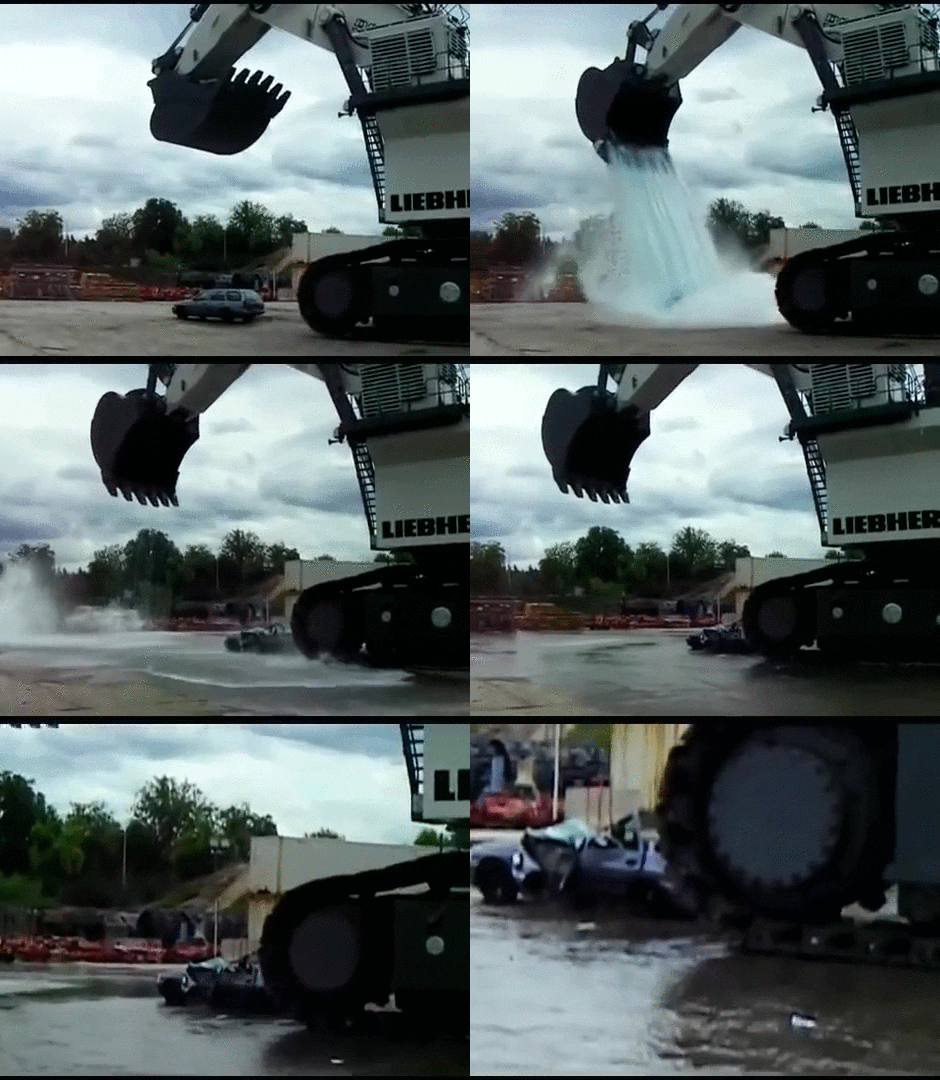
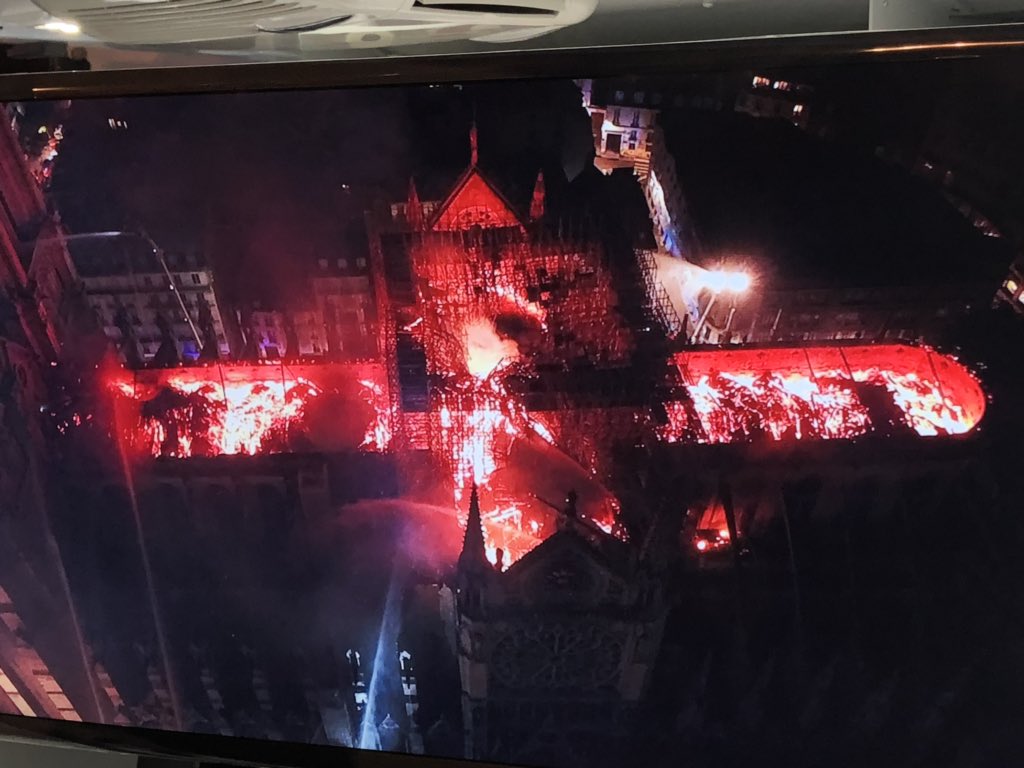
https://twitter.com/grouchybagels/status/1117852841530368000...
>...“The initiate was only half-right,” said Bawan to the emptiness. “True, the value lies not in carven oak, but neither does it lie in the shape of the carving; for both the real pillar and the virtual one may be lost, and the temple will be no poorer. But when wood first yields to metal, one more thing is made: and that is the sculptor.”
This building was a major achievement that inspired millions of people through centuries. It is a landmark of humanity. A simple physical fire will not destroy its legacy in our culture.
> Cathedral in Paris. Perhaps flying water tankers could be
> used to put it out. Must act quickly!
From what I understand about fires, a lot of damage also comes from the act of putting them out. If it doesn't have fire damage it will probably have water damage. Also, I imagine the stone may not appreciate rapid cooling.
> The Paris prosecutor's office said it has opened an
> inquiry into the incident.
[Pure speculation]: One of the first thoughts that came to mind is that this is deliberate. Specifically regarding the Yellow Vests protests that are still very much ongoing, despite reduced media attention [1]. Perhaps this was in anticipation of the debate results [2].
[1] https://www.bloomberg.com/news/articles/2019-04-13/yellow-ve...
[2] https://www.economist.com/europe/2019/04/13/emmanuel-macron-...
Though the fire seems quite intense, not sure how much will be preserved.
As much as rolling news has its issues, live television news from a reputable network is better.
https://image.cnbcfm.com/api/v1/image/105852910-155535029154...
The weight itself being a problem first off, as it could cause further damage and even make it easier for the fire to spread.
The rate of sublimation would be a problem too, as the outgassing could actually act as an insulating layer, preventing the heat of the fire from actually increasing the release of CO2 at a useful rate to displace the oxygen that is enabling the fire.
Additionally, normally it is recommended to work with dry ice in a well-ventilated environment. CO2 is toxic, and also displaces oxygen, creating a significant risk of asphyxiation. With very large volumes such as this, you cannot effectively ventilate, so this could cause risks for those in the surrounding environment, and also makes it impossible for firemen to work in the area. They can't exactly run in with masks and have tanks of oxygen strapped to their backs.
I always thought fire fighters do that routinely: breathe from tanks of either oxygen or oxygen mixed with other gases.
However, as CO2 sinks within normal atmosphere compared with smoke which typically rises, as the dry ice sublimates it becomes much more of a hazard for the area surrounding the fire.
For an extreme example of exposure to CO2, see the Lake Nyos disaster [1] that killed people & animals in an area 16 miles around the lake.
TL;DR - The danger of fire has always been an issue in the design and construction of these cathedrals.
"it is the largest fire service in Europe and the third largest urban fire service in the world, after the Tokyo Fire Department and New York City Fire Department. Its motto is "Save or Perish" (French "Sauver ou périr")."
I'm sure they have enough capacity.
Also you don't just drop water from planes above cities... this makes no sense.
Superb way to collapse the structure, incinerate/crush the firefighters, and endanger pretty much anyone around the area, all while leaving pretty much nothing to be saved. Say nothing of anyone that might be trapped in there.
If you drop water on a structure like this, you end up having a collapsed building that is also on fire.
Edit: Note the absolute phrasing of the parent comment and that the spray force in a strong downpour isn't much less than what's done with firefighting planes in situations that call for that level of pressure.
For getting a fire down you either have to prevent it from access to oxygen or prevent spreading.
A big fire like that can't be covered completely to be cut of from oxygen.
With fire control you can however try to cool down the areas close to inflammation to prevent further spreading. Save what can be saved, like the lower walls.
This is a _really_ hard fire to fight. Their first priority is going to be ensuring everyone is safe, and likely setting up interior and exterior positions where they intend to stop the fire from spreading (the areas that are already involved are a total loss, let them go and focus on saving what can be saved).
The correct question here is: what don’t I know about firefighting that would explain the actions of the firefighters here?
And what's the reason for not using water (or other) to put out the fire? I'm genuinely curious
Update: In the news they said that firefighters are entering the building to save as much art as possible before spraying water.
https://aleteia.org/2019/02/16/string-of-attacks-on-french-c...
There is nothing to be lost in waiting for actual investigative results. And, fwiw, the early images clearly point to the fire breaking out in the roof, where construction scaffolds are clearly visible in all the images.
https://www.washingtonpost.com/world/europe/pariss-notre-cat...
https://www.newsweek.com/spate-attacks-catholic-churches-fra...
https://en.wikipedia.org/wiki/Aleteia
seems like it's an almost official catholic source
What do you think is more likely? That there is not a single stream of water hitting it, or there are plenty of fire fighters at the scene you just happen not to have seen any pictures of them?
I saw on the live stream a couple of water jets, from aerial platforms, at the corners (probably as close as they could get with the trucks). But my guess is that most of the firefighting is happening on the ground level (some of it inside the building), out of sight from the distant cameras.
People are just commenting on what they see.
edit: I'm so sorry HN, apparently I offended people.
I have gone through this process last summer in my company and it's really frustrating when people spend energy on questioning everything you do instead of helping.
A DC-10 Air Tanker carries 12,000 US gallons https://en.wikipedia.org/wiki/DC-10_Air_Tanker
All said, that's 45.4 metric tons.
Go ahead, stand under one and let us know how it goes.
The difference would be like standing in the shower for 40 minutes, versus being hit my an entire tub full of water going at the same speed all at once.
I remember during the Khan Academy controversy a few years back, an educator commented on reddit about the difficulty in teaching some kids about rates. Some kids just don't get rates. They think of speed as something like "a feeling of intensity." They just don't have an abstract, generalized understanding of "N things per unit time."
Think about that for a moment. Think about all of the potential for miscommunication.
I'm comparing strong rain to water plane spray. Maybe the output of some would be too severe, but clearly some are suitable.
Got it. I learned something new today.
Lots of water at once versus less spread over a long time.
Often times people with no expertise can offer a helpful outside perspective. This is particularly true in cases where an exception to policy or historical process is what is holding things back. Because the ignorant person is not biased by current policies and processes. Now I'm wondering if everyone at work hates me for having this role.
This may be a role if 1) you actually listen very carefully and 2)things are not already on fire. There is a time for this but there are also times when you just have to let the experts do their thing.
One thing that always bugs me that consultants and advisers often show up during crisis and suck up a lot of energy that could be used for solving the problem. But as soon as the crisis is over and there is time to discuss ways to prevent future problems all the execs and consultants suddenly disappear.
Wouldn't the wind from the rotors increase the amount of oxygen?
Hopefully they already evacuated everyone.
The news streams just started showing water being put on it, looks like the smoke is dying down, hopefully they can save it!
But now that Trump has said it, a bazillion MAGAbots will be asking why they didn't use a plane, and start looking for a French conspiracy to destroy civilization or something.
https://www.youtube.com/watch?v=87hfWatbVPY
You people are all being ridiculous today.
Why don't you step back for a moment and just admit that given the premises
-Firefighting airplanes can effectively spray in a way that doesn't harm trees
-Buildings are fine in extended substantial downpours
That it must follow
-Spraying a building with a plane in such a configuration would not collapse it
Otherwise you are the clueless one. This is absurd. At least you downvoters (who are ignoring the site guidelines) are letting me see some aesthetically pleasing upvote configurations again when it goes back up, so I appreciate it.
"The weight of the water and the intensity of the drop at low altitude could indeed weaken the structure of Notre-Dame and result in collateral damage to the buildings in the vicinity."
So, yeah, I'm gonna trust the experts on this one, not random armchair Internet quarterbacking.
The facts stand, as have been reiterated in the thread above:
- Firefighting airplanes can effectively spray in a way that doesn't harm trees (by releasing the 12,000+ gallons over a very large area)
- Buildings are fine in extended substantial downpours (which is significantly less water per second than an air-tanker dump)
To your thought's end:
- Spraying a building with a plane in such a configuration would not collapse it
Yes, it's possible to spray the cathedral with water in such a way that it will not collapse it, but that configuration is that very little water gets on the cathedral, and is instead spread over pretty much the entire island in the Seine.
At this point in time, however, it likely doesn't matter. Since most of the building has collapsed already, due to the fire. Like we said it would.
The larger point is that by the time you release high enough to not concentrate a huge amount of force from the water on the building, you're just not doing that much, not that much more than a really heavy natural downpour for a few seconds (which wouldn't be nearly enough to put out a fire this large).
And the trees aren't an apt comparison because the trees aren't taking the brunt of the water; the ground is. However, the roof of the structure would be taking the entire brunt of the falling water. Several tens of thousands of pounds times whatever speed its falling at squared equals a lot of kinetic energy.
But sure, go ahead and retroactively correct yourself.
The restoration works that were under place are a result in part of our recommended actions.
The spire was incredible. It was one oak trunk, connected with a "Scarf Joint", or "Jupitre" in French (Bolt-of-lightning joint)
There were the names of the last guys to inspect it in the 1930s, engraved at the top. There was a french ww2 bullet embedded in the spire, presumably shot at a germany sniper who was in the spire...
Everything in the roof was antique wood. Anyone that went into the roof was paranoid of fire.
It's a very, very sad day.
As a celebration, I'm throwing up some photos that we'd never published from our study.
Can you perhaps comment on what restoration work may have caused this?
Over the weeks we'd spent on the spire, we photographed and documented literally every square centimeter of the spire and roof space.
Outside of its intrinsic value, the spire also held religious relics (Thorn from the Crown of Thorns etc..). They were apparently contained in the wind-vane on the top of the crow's nest.
We were unable to access the crow's nest - the last 3 ladder rungs (the spire had iron foot pegs every 50cm or so up one side) had been removed - ( presumably to stop people from getting to the relics ) - and there was no way we could get access without installing scaffolding.
There was so much hidden detail on the roof - works that would never be seen from the ground - invisible to everyone but the workers and artisans. Truly a loss.
As for the cause, there would be some solace in an 'unavoidable' situation - I just hope it wasn't someone discarding a cigarette butt.
The smell of the roof space was incredible - deep, wooden and wise.
To prevent fire, there was no electricity wires in attic, because the oak beams were extremely dry.
Where is that coming from?
I don't see any definitions that constrains antique to a specific time window, some definitions/laws include "at least 100 years old"
Antique: a work of art, piece of furniture, or decorative object made at an earlier period and according to various customs laws at least 100 years ago
> The 3-meter-tall statues are being sent to southwestern France for work that is part of a 6 million-euro ($6.8 million) renovation project on the cathedral spire and its 250 tons of lead.
https://www.sfgate.com/news/article/Cleaning-offers-rare-gli...
https://www.youtube.com/watch?v=VAzDXgxaq94
https://www.youtube.com/watch?v=W5wDX-pZLOs
It'll be decades, but if I'm very lucky enough to live very long, I may hear those peals myself.
On one of the sides I did - there were the traces of what we could only assume to be some type of explosion (probably a stray explosive from WW2 ..?).
There are also the eagles that were halfway up the spire. Curiously enough, there were six, each one had a number stamped on its head - if you traced the numbers, it made a star composed of 2 equilateral triangles.
It seems the North Tower has since caught fire as well - so the bells will have gone, and all of the stored relics too - so some photos of those.
It’s debatable, however, how much that means. I suspect it serves more of a symbolic purpose, as a kernel of truth to a shared future fiction that the building is at least partially “original”.
In terms of costs, I suspect integrating those structures is likely to be more expensive than rebuilding from scratch. The loss is also greater than just the building, as it contained a multitude of art, some of it part of the structure like the famous stained glass windows, some not.
Above the vaults of stone, a wooden frame supports the roof which is covered with metal (zinc). This is obviously lighter, and easier to build and to maintain than a roof made of stone. Unfortunately, after a few centuries it becomes extremely burnable.
As a rule of thumb, the water flow necessary to extinguish a burning structure is the volume of the structure (in feet) divided by 100. The resulting number is (in rough numbers) the amount of water you need, in gallons per minute. For a fire this size, you're looking at tens of thousands of gallons of water per minute. It's just not possible.
Yes, I know the Notre Dame will be built again. But that might not happen till after I am long gone.
The Cathedral of Notre Dame, Paris, Restored by Eugène-Emmanuel Viollet-le-Duc and Jean Baptiste Lassus -- http://www.victorianweb.org/art/architecture/vld/3.html
"The Commission on Historical Monuments approved most of Viollet-le-Duc's plans, but rejected his proposal to remove the choir built under Louis XIV. Viollet-le-Duc himself turned down a proposal to add two new spires atop the towers, arguing that such a monument "would be remarkable but would not be Notre Dame de Paris". Instead, he proposed to rebuild the original medieval spire and bell tower over the transept, which had been removed in 1786 because it was unstable in the wind."
https://en.wikipedia.org/wiki/Eug%C3%A8ne_Viollet-le-Duc#Not...
“And this has been standing here for centuries. The premier work of man perhaps in the whole Western world, and it’s without a signature: Chartres. A celebration to God’s glory and to the dignity of man. All that’s left, most artists seem to feel these days, is man. Naked, poor, forked radish. There aren’t any celebrations. Ours, the scientists keep telling us, is a universe which is disposable. You know, it might be just this one anonymous glory of all things, this rich stone forest, this epic chant, this gaiety, this grand, choiring shout of affirmation, which we choose when all our cities are dust, to stand intact, to mark where we have been, to testify to what we had it in us to accomplish.
Our works in stone, in paint, in print, are spared, some of them for a few decades or a millennium or two, but everything must finally fall in war or wear away into the ultimate and universal ash. The triumphs and the frauds, the treasures and the fakes. A fact of life. We’re going to die. ‘Be of good heart,’ cry the dead artists out of the living past. Our songs will all be silenced — but what of it? Go on singing. Maybe a man’s name doesn’t matter all that much.”
edit: "compared to the average person"
I'm currently reading a science fiction novel that has a scene of someone who just woke up from nearly 200 years of hibernation getting attacked by all sorts of futuristic machinery, due to a 200 year old assassination virus that was still running. It could find him using the inevitable everywhere surveillance (retina scans everywhere), and then use whatever to attack - automated flying cars, a robot waiter, even a couch massage unit.
No chance. Software gets abandoned all the time, and mostly for economic reasons.
Moore’s Law was coined almost 60 years ago. I think we are close to the wall of exponential growth in transistor density. Moore’s Law is what happens when a new field emerges and there is still low-hanging fruit to be plucked. If it takes about 60 years to run out of that, time is almost up.
However, as I watched it burn, the thought uppermost to my mind was the nearly 200 years it took to build, and therefore 200 years worth of sucking money and resources from the local (and probably some non-local) populace. And this during a period of history when many lived in abject poverty. How much more might have been added to society if those resources had been used to better effect?
It reminds me of how, even in modern times, the Catholic church has done much the same. My father grew up in the north eastern US in a poor urban area. His family was dirt poor and struggled to get 3 basic meals a day. Yet the local parish pressured, guilted, shamed, and instilled fear in the parishioners to get them to give 10% of their income to the church.
So yes, I mourn Notre Dame, but I can't separate it in my head from the financial predations of the church on its followers.
Locals report the damage may not have been as severe as feared. http://johannesviii.tumblr.com/post/184208321259/jonphaedrus...
First photographs from inside the building are encouraging: https://twitter.com/becket/status/1117919627642900480
The Photosynth TED talk uses Notre Dame as an example of reconstructing geometry from a random selection of photos.
https://www.ted.com/talks/blaise_aguera_y_arcas_demos_photos...
Skip to 3:45 or so.
Microsoft canned Photosynth and seemed to make very little effort to preserve all the content.
https://sketchfab.com/3d-models/portail-notre-dame-de-paris-...
https://www.youtube.com/watch?v=-nwEFCBLrdk
Its going to feel a little bit different building one of these now.
[0]: http://worldwartwo.filminspector.com/2014/07/shootout-at-col...
> Firefighters were rushing to try to contain a fire that has broken out at the cathedral, which police said began accidentally and was linked to building work at the site.
https://www.theguardian.com/world/2019/apr/15/notre-dame-fir...
To the conspiracy minded, facts only prove how deep the conspiracy goes.
That’s what I’m trying to preempt.
Remember the old saying: never ascribe to malice that which can be adequately explained by stupidity or incompetence.
We were drunk and it was dark and late. We hopped the iron fence in the back, and scaled the southern wall that runs along the nave, where the flying buttresses are.
To get to the top, you climbed the walls and roof outside the building until you reached the base of the spire, and then you climbed inside the spire up several stories linked by rough wooden ladders, and then you had to get out and climb outside again, on a series of metal hooks, to get to the top where you could touch a metal globe and cross.
There was very little security (just one trap door inside the spire that you had to climb through, where you had to make sure breaking an electrical current didn't set off an alarm).
It was all very old, obviously, and old in a way of places where no one ever goes. Little used, and therefore neglected. Was the wiring on the trapdoor well insulated? I doubt it.
There was a small group of climbers in Paris who knew about this. Maybe a couple dozen people. One of them would occasionally lead a small group of friends: free climbing to the top of one segment of the wall, and then letting down a rope to help up those behind.
Notre Dame is at the center of Paris. There is a bronze marker in front of the church called "kilometre zero," from which all distances along French national routes are measured. From the top of the spire, the city fanned out like petals around a pistil. Paris was made to be seen from that one point, where no one ever went except a few climbers and pigeons, and maybe an adventurous priest.
The climber who took us up to near the top of the spire lay himself down on a rafter in its hollow interior, above the void, and fell asleep. Like I said, we were drunk, and it was all very dumb and dangerous.
When we came back down, about a foot before the last person touched the ground again, his rope broke. He picked it up, stared at it for a second, murmured "C'est mort", and threw it away.
There are also probably concerns about thermal expansions as well. The stone might resettle a little bit differently.
My undergrad's main building - definitely nothing comparable to this cathedral, but from a time where fire fighting wasn't that great - went through this three times, and was always restored. It seems like this happened a lot, and was something builders considered.
"Must act quickly!" Ya think? Hopefully the fire department in Paris, France is listening for gems like that from out here in the boonies / the ghetto hemisphere. How many medieval churches are there on our whole continent? Call us if you want a church bombed.
(edited slightly in response to child comments)
Makes sense. French fire departments are branches of the military.
Edit: just the Parisian and one other fire service are set up this way.
(The news networks are pretty much as clueless to the situation as everyone else, so take with a grain of salt)
Edit: They are now spraying the stone structures.
That's only like six fire engines, looking up the stats. (But I don't know anything about fire fighting.)
Even if you had that pumping capacity on site, there's no way the municipal water supply could deliver that much water.
First, it's the temperature. A fire is extinguished in the first minutes; after a few hours, you can do nothing but contain it. It's the problem with roof fires: they burn for a long time without being seen, and are therefore powerful when visible.
The aerial tankers are at Nimes. Helicoptors are a little closer, but more in the south. If you use one or the other, it would take several hours.. After the detection of the fire, by which time it has grown in power.
Specific complication today: the discovery was at the end of the afternoon. The planes can't operate in night (experimentation is ongouging), especially in an environment as complex as Paris. Even if we send them, they couldn't intervene until tomorrow.
Second point: access. A roof, it's waterproof. An aerial tanker would douse the tiles or copper cover, but not a drop would arrive on the file except at the stage where the roof has already began to fall. Then, the plane could douse the flames. But it's much, much too late: by the time the first tiles fell, the carpentry would already be gravely weak. In fact, these fires only become visible when the damage is already profound.
Sending the aerial tankers over a building, that's already done. But for exterior fires. Under a roof, that isn't useful until the roof has already fallen. That's why these planes don't service this kind of fire. In fact, at the moment where one can still save the roof, these fires are only accessible by the interior.
That's the difficulty with the work of firefighting. If they could, they would love to intervene without plunging into the flames... But while it burns under a roof, it's necessary to go find the fire.
Correction after several reactions: when I speak of aircraft without precision, I think especially of helicopters. Canadair is clearly excluded by effect of its backwash, which can provoke a collapse of the carpentry, already severely weakened.
People also should know that simultaneous fires on multiple floors of multi-story buildings typically aren't possible to fight either, reducing possible efforts to containment and damage mitigation.
1. Cool an outer structure rapidly with lightweight/gently-applied, inert, high specific heat material from above.
2. Thixotropic gently-applied, inert, high specific heat material inner structure (possibly same as 1.).
> As a rule of thumb, the water flow necessary to extinguish a burning structure is the volume of the structure (in feet) divided by 100. The resulting number is (in rough numbers) the amount of water you need, in gallons per minute. For a fire this size, you're looking at tens of thousands of gallons of water per minute. It's just not possible.
I wonder if the fire could be covered with a huge tarpaulin or alike to try to suppress it.
There are four major phases in the life of a fire, incipient, growth, fully developed, and decay. Sprinklers are designed to keep a fire from progressing from incipient to growth. Once it makes that transition, the battle is lost.
I wonder if injecting large amounts of CO2 or N2 inside the structure would be feasible.
Water-soluble foam, which is much lighter weight and easier to produce in large volumes, is also known to be used to contain large fires, especially of oil / fuel.
Getting 10 engines there wouldn't be the issue. Supplying them with water would be. Given that it's an island, they would be limited to the capacity of the water main serving the island.
I would think that this type of event would bring the French together in a way like few other events could. I'd expect Gilets Jaunes movement to subside quickly.
Yes, today we are all French - and expect that we all want to see Our Lady rebuilt. Faster, better, stronger, and much more fire-retardant than in the past.
The Windsor Castle fire of 1992 was refurbished in 5 years, [0] and although a national treasure, it was not at the level of the Notre Dame. But it was rebuilt, and was even completed ahead of schedule.
The cost doesn't matter - it will probably be well over a billion. But you will see concerts, TV specials, and all sorts of fund raisers to rebuild her.
And in this you will see the best thing of all - the French (and even people like me who are only French on occasions like this) showing our love to rebuild her.
This is the message you should hold in your heart today - one of love and empathy, and dare I say, the grace of God that she was intended to foster.
[0] - https://en.wikipedia.org/wiki/1992_Windsor_Castle_fire
[0] - https://uk.reuters.com/article/uk-france-notredame-arnault/b...
The cathedral is made of stone. It will survive the fire and won't need to be rebuilt. "Just" a new roof will be needed and remediation for the fire. Just in quotes because clearly that's still a massive undertaking which will take years and a whole lot of dollars.
The spire is clearly a great loss. As are the statues that were on the roof. Hopefully the stained glass makes it out ok, but that's probably optimistic. There's also the artifacts and art work in the interior that will be damaged. But the iconic bell towers remain. The statues on the facade are likely undamaged. The interior nave and apse will survive. After restoration it will still be essentially the same even if we lose some irreplaceable artifacts.
https://www.rt.com/news/456629-french-catholic-churches-atta...
Yes.
https://news.nationalgeographic.com/2015/11/151105-gaudi-sag...
Also, from other threads in these comments:
https://en.wikipedia.org/wiki/Dresden_Frauenkirche#Reconstru...
https://www.bbc.com/news/uk-england-york-north-yorkshire-281...
With increases in wealth and technology, we could see even more monumental projects implemented by only fractions of society. Then, there's also China. There are serious proposals for China to unilaterally dig a tunnel to Taiwan. I suspect they're also serious about long term colonization of the Moon and Mars.
https://en.wikipedia.org/wiki/Basilica_of_Our_Lady_of_Licheń
They had a referendum asking the population to approve or not the construction? Or was it an autocratic entity (king and/or church) who decided?
Edit: Can anyone explain to me why this is getting downvoted?
Is there really a consensus that the current political climate is comparable to the cold war?
The cold war which is intertwined with the space race that put a man on the moon?
Wasn't it more that some kings or bishops got a big ego trip and the peasants had to do the work and got taxed?
Notre Dame will be fine.
It's way too early to say it 'will be fine'. A fire like this could destroy the entire structure.
Are we watching the same stream? The entire roof is gone already.
The walls maybe, but the roof is mostly wood, made 800+ years ago, it's gone, the statues, the drapes, the windows, the bells and the clock are gone forever.
Sadly, no, it won't. The area where the fire looks worst was already deteriorating significantly -- if you visited in recent years, you would have seen heavy duty nets and the like to control damaged masonry, for example -- and you have a lot of materials that are either combustible or at the very least susceptible to heat damage of one kind or another.
One of the great architectural wonders is falling apart before our eyes, and it is just very, very sad.
[Edit: Shortly after I wrote this, the spire fell. A spokesman for the cathedral has confirmed that they do not expect any of the timber interior to survive the fire. So, so sad.]
I kind am torn about your reasoning, but I understand it myself. If science and technology was paraded XYZ years earlier, wouldn't things be so much better? Except it's not that easy. Dumping a ton of gold in a pre-medieval economy is worthless. Dumping the right ideas instead (renaissance, medicine, industrialisation) would have been priceless. Though, I wonder, what could have happened if instead people were taxed 10% they invested that in other means -- wouldn't it be nice if it had compounded over all those years...
Heh. Try 13 million. :)
I’m an unbending agnostic, but I sometimes feel like I should go to church anyway, just to contribute to the social capital that Christianity generates.
Are all those photos available somewhere?
This allows free movement when the bells are ringing, without stressing the stones.
It was a priority to extinguish the north tower fire to prevent the bell structure from collapsing - the falling bells would have destroyed the stone structures on the way down, presumably triggering the collapse of both towers..
EDIT: I couldn't find the Sci-Am article, but it's interesting that the timeline of the Life After People television show, the middle of the St. Louis Arch is supposed to fall after 250 years, which matches the prediction of the earlier Sci-Am article. However, in the same timeline:
2000 Years: As it was after the ice age, Phoenix again becomes a vast savanna. Dolphins still remember their encounters with humans. Because it is basically held together by gravity, the medieval Cathedral of Notre Dame in Paris may still stand and be recognizable.
Google is especially guilty of this.
Protected from fungus (rot) and insects, wood can last indefinitely. How to achieve that, of course, varies widely.
Many Americans live in wooden houses that are much older than that. The biggest problem tends to be termites.
Along the same technical lines, have you read A Deepness in the Sky, by Vernor Vinge? I love the idea of "programmer-archeologist" on a 5000 year old spaceship.
I think the odds are much higher that we'll see the end of significant advancement in computing power than the odds that we'll see Linux pass into memory. In Vernor Vinge's marvelous novel A Deepness in the Sky, programmer-archeologists dig through millennia of software on a 5000 year old spaceship, but it's still running Unix underneath, because no one ever came up with anything better.
That gave a good chuckle. I'm delighted to give that book a go.
Also, York Minster (like, I suspect, Notre Dame) has world-class stonemasons and glaziers with expertise in medieval building methods, which certainly helps with the restoration.
Am I shocked and saddened for this fire? Yes of course, I lived on the Rue de Roi de Sicile - a few minutes walk. I've drawn it many times.
Do I have hope for the future of the installation? It's France: of course I do.
https://en.wikipedia.org/wiki/Dresden_Frauenkirche#Reconstru...
Similarly, I’d prefer a world without nail salons - logically speaking. To me, they’re pointless and stupidly wasteful, and here in California they’re everywhere. Yet thousands if not millions of people love to have their nails done. It makes them happy and gives them joy in a world that all too often shows its claws. So even if I had the power to banish them, I wouldn’t. I genuinely believe they make the world a better and more productive place. Just like cathedrals.
And as I think about it, it's not like the costs to build the Notre Dame cathedral were completely taken out of the economy, they would have gone to pay workers and suppliers that added to the economy, so I suppose I should temper my views with such thoughts.
EDIT: I added a few words to the grandparent post to try to make my intent clearer.
Actually I think I was, if anything, charitably conferring tons of undue respect on that guy, by calling him "our president," thereby not only acknowledging his office but accepting him as "ours," both of which are more than some are willing to do. Ya can't please some people I guess.
If you have a large amount of material be moderately hot, you'd need a lot of water to cool it. The thermal load is high.
I've been to many Catholic locales, and there are many poor Catholic artisans who would be willing to create beautiful Catholic art if they had resources. I'd rather they get the resources, than some secular artisan simply trying to copy Catholic art.
I would rather see resources go to actual Catholics to be used in an actual Catholic place of worship that is frequented and populated than to non-Catholic artisans attempting to mimick Catholic beauty to restore a building that is not actually used.
The fact is that the well-loved parish stands a chance of becoming a Notre Dame of the future, whereas, Notre Dame itself is likely to fade away and become a museum, unless the people of France actually decide to become Catholic again.
The truth is that, it was the underlying belief in the Catholic world view that made Notre Dame the legend it is today (the constant creation of beauty, the grandeur, the preservation through the ages). No amount of money to secular authorities can possibly recreate that exact mythos, whereas it could if sent to another diocese that still practiced.
EDIT: perhaps I'm wrong and Notre dame is more active than I thought and I just visited at a bad time, but from what I've read, there's not many actual Catholics in France, at least when compared to California.
It’s also a miserable stance to take while the place is still literally on fire.
We have a cold war going on between India and Pakistan, two nuclear powers, still, that involves nations housing 1.5 billion people combined.
We have a more and more polarized West that's basically fighting a bit of a civil cold war right now, "populism" against "progressivism" or whatever you'd like to call it.
Putin is the oldnew Enemy of every Western politician and pundit (exceptions prove the rule).
And we have a China that looks at all that and mostly quietly builds up their influence in the world, that one could consider a bit of an economic cold war.
Oh, and China is literally doing moonshots, too [1]. And so is India[2].
[1] https://en.wikipedia.org/wiki/Chinese_Lunar_Exploration_Prog...
https://en.wikipedia.org/wiki/Chinese_Lunar_Exploration_Prog...
I can't comprehend how anything else could come to mind.
What takes time is often the financing: there are churches in Germany where, to this day they are collecting money and constructing piece-by-piece. I don’t know how this will play out here. For example: how much is the Catholic Church still involved? But I would assume the French state to be somewhat generous.
The other potentially delaying question is how to reconstruct. Going for an exact replica often feels anachronistic and sometimes tacky. The German Reichstag, for example, was reconstructed with a rather modern glass rotunda, and feels like a great example of combining old and new. The World Trade Centre was replaced by something entirely new. If they decide to go in such a direction, some time will be spent on architects’ competitions.
The reconstruction will be a restoration, to what degree, it remains to be seen, for example Reims Cathedral roof was rebuilt using concrete for the structure, but the general appearance will remain the same.
The symbolic is rather different that of the Reichtag, the Reichtag being the symbol of a new state in the XIXe century, destroyed during its darkest hour, and finally reconstructed after the rebirth of Germany and the Reunification with a mix of old and new, By itself the Reichtag summarizes German history.
Nowadays churches in France belong to the city, not the Church. Which has led to many tragedies recently, with town halls (usually Communist) intentionally neglecting churches until there was no choice but to destroy them. I don't have any faith in the French state these days to be consistent with monuments.
Looking at some aerial pictures (https://pbs.twimg.com/media/D4OFOKMWkAEEHsz.jpg), it looks like the vault is holding except maybe for the section above the transept area (where the spire collapsed), but it has probably suffered, if not from the collapse of the roof, the heat has probably weakened it.
But yes, one or two decades of restoration is a realistic estimation, it's roughly what it took for other cathedrals to be restored (Rouen, Reims) after the World Wars (hopefully Notre-Dame will be in a better state after the disaster)
Hopefully things will move faster with Notre-Dame de Paris, but it'll take at least decades.
But in this kind of restoration, the devil is in the details, repairing the structure and rebuilding the roof and the spire will probably take around 8 to 10 years, if the vault is not in too bad of a shape, more otherwise. But repairing the the sculptures and decoration, with all their minutes details will take generations.
For these, what was not destroyed by the fire is probably heavily damaged by the tons of waters poured to save the edifice.
Respectfully, you have no idea what you are talking about. Nobody in Europe would consider tearing down the remaining structures and rebuilding from scratch because it's cheaper.
However, I'd like to use this opportunity to plug Valee's "Womp Womp". Check it out on Spotify!
https://images.scribblelive.com/2019/4/15/556d889a-06ba-4094...
You're absolutely right though, if you want big water, that's the way to get it. It's just that "big water" doesn't even begin to approach the scale of the water that would be necessary to directly fight this fire.
SFFD trucks have that capability, and it was used in the 1989 earthquake. It's intended for pulling water from the underground cisterns marked by a big ring of bricks in SF intersections.
Terrible for the equipment to run salt water, but they had to.
My understanding, which is probably quite out of date, is that it's mostly harbor firefighting boats which had this ability.
A coworker of mine points out that many of the San Francisco manholes are actually covers for cisterns of water, which exist primarily for fighting fires after an earthquake possibly takes out the water mains and starts many fires. I should hope that San Francisco fire trucks can draft water to use these.
London Fire Brigade for example has nine special pumps that can draw 2000 gallons a minute each from river or lake supplies. So that's 18,000 gallons a minute just from them.
And that's a smaller fire brigade than Paris.
There were notable logistical issues to get enough firefighters on-site given it’s an island, and there were a ton of people around when the fire broke out. They wound up having 400 firefighters on-site until midnight to get it under control and save the structure. I’m pretty confident they did all they could, and HN’s armchair firefighters aren’t likely to have done any better.
For anyone else confused: this earthquake was in San Francisco and this is about their Fire Department. It doesn't mean that French fire trucks have that capability 30 years later.
Park the truck next to the cistern. Connect a length of hose to the pump supply, drop the hose into the cistern. The pump will move water until it loses suction pressure.
The real world is complex. It's not all like software or taking multiple choice exams. Again the devil is in the details. Pay really close attention to the map legend. It looks like there's nearly 200 feet of distance from the closest water shown on that map and the nearest side of the cathedral. I really doubt that all fire trucks carry 200 feet of hard suction hose, or have pumps designed to draft through 200 feet of hard hose.
"The NFPA 1901, Standard for Automotive Fire Apparatus – Requires pumpers to carry: 15 feet of large soft sleeve hose or 20 feet of hard suction hose"
In real life, if you were going to draft in an environment like this, (leaving aside any reference to fire boats for a moment), you'd drive an engine to within 20' or so of the water, have it draft, and then relay water to the fire scene using (usually) 5" LDH. But sometimes even getting an engine to within 20' of the water can be a challenge, based on the geography and circumstances.
If the body of water you're drafting from is (strongly) subject to tides, that adds another complicating factor as your water source is now moving around, which could require constant re-positioning of the apparatus.
Lay people always see fires near large bodies of water and think "Why is water supply a problem, they're surrounded by water?!?" But it's often more complicated than that.
Source: was a firefighter and firefighting instructor for about a decade in a former life.
They're not going to take huge risks. Any environment that would be extremely dangerous would be an area where any art has already been destroyed.
How many human lives and human energy went into Notre Dame? How many lives would its continued existence inspire? Humans are far more temporary than art and culture. Art and culture connects us to the people that came before us.
It's a pretty personal question. I admire the archaeologist you described, but I believe no one should feel obligated to do the same thing.
I think that's the best explanation I've ever heard for why art and culture are so important.
PS: I had no idea it was so controversial to forgive people for not risking their lives for an inanimate object.
Some people will categorically shy away from any perceived risk to their own safety, even if the estimated chance of saving a valuable object is very high. At the other extreme, some people would endure suffering and death to save what they recognize as priceless artifacts of history and culture.
If your argument is that we shouldn't criticize people for choosing not risk their for inanimate objects, can you point to such criticism in this thread? I haven't seen any.
Put it this way... would you run into a burning building to try to save the Declaration of Independence? (Assuming you're an American) Would most firefighters? Seems reasonable to me. The art inside the Notre Dame is on that level of importance, to France and to civilization itself.
What matters about the DoI are the ideas, not the original piece of paper.
no piece of paper/art and especially national pride is worth someone's health
I live in fourth most visited city in Europe and I couldn't care less if most touristy church burned down, it's just church, people are overly dramatic, most important it's nobody died and whatever will be outcome life will go on tomorrow and in two weeks nobody will remember about it in news
I imagine even the most reticent would be jumping in on this one.
Sydney J. Harris
Americans are some of most obnoxiously nationalistic people I've ever encountered. Note: I've lived both in Paris, and also NY and California (14 years in the US). Only in the US do you hear mobs of nationalistic folk chanting "USA USA." I've never been in France or the UK and seen similar things. Think about things like Americans boycotting French Fries and calling them "Freedom Fries" when France decided not to join the illegal and immoral Iraq War.
This type of art is irreplaceable and art cannot walk away from the fire. At least we know it has zero chance of doing so, unless someone shows up
If they get 8 months of training before employment, I kinda hope they spend more time on the theory and practice of firefighting than being a soldier.
Just because you don't feel that way doesn't mean they're all wrong.
Notre Dame is...was...a medieval Roman Catholic cathedral in a postmodern secular country, desecrated rather than revered by the revolutionaries who built modern France.
And we are talking a building that has survived the French history, the Revolutionaries didn't destroy it, the Communards didn't destroy it (and the destruction in this event were quite extensive http://paris1900.lartnouveau.com/paris00/commune_destruction...). It's a testament of the culture importance of the building and the fact it far exceeds its religious function.
Disclaimer: French and living in Paris (I've not seen the fire however).
How much risk would you be willing to take to save the artworks of Notre Dame?
If there's even a small but significant risk to one's life then nobody should feel obligated to do it.
Either way: how did France (the nation) make any of these artworks? You could argue it was made by anyone in the spectrum ranging from "the artist" to "the humanity". Stopping at France seems arbitrary and a bit... nationalistic.
If any institution "made" them, it's the Catholic Church, not France.
[0] - https://www.cia.gov/library/publications/the-world-factbook/...
https://en.wikipedia.org/wiki/La%C3%AFcit%C3%A9
https://en.wikipedia.org/wiki/Dechristianization_of_France_d...
any sane parent would think twice risking his life over a THING. risking life to save other (strangers) lives it's questionable, risking life to save things it's just stupid
There's nothing unusual for being willing to die for a THING. Hell, people have sacrificed themselves in the millions for mere ideas. People fight to the death over tiny scraps of symbolic land.
It may seem stupid to you. It's stupid to me, too. But that's what people do. That's what people are.
as for saving someone's else child I would most likely not do it if I would calculate it's too risky for me (unless I would be stupid by instinct), if their own parent/guardian font care about their lives why should I? I don't expect other people saving my children. though it's not fair comparison,I am sure you have minute to decide if you save some piece of art work compared to split second decision to save living being
I also worked in past in insurance companies, after dealing with thousands of accidents my advice it's always run over animal, don't try to save it by avoiding it (unless it's boar or something similar comparable to concrete block/tree), try to fight your instinct, saw way too many dead people or in serious injury because they tried to save some stupid dog/fox etc and then crashed into some tree/building etc
If entering a burning building (which isn't actually _that_ risky) to salvage one-of-a-kind historic artifacts isn't something you would chose to do, that's fine. Don't label the actions of those that make a different choice "stupid".
The country and government being secular does not mean that the people left their Catholic roots behind. Atheist and religious French people share similar values and the past is very important to both.
To flip your point around, they'd save it because it's symbolically important. Same with the art in the Notre Dame.
I’ve literally been explaining that this whole time. Please try to read and comprehend things before issuing these vacuous replies.
Very fine people on all sides of course.
I must admit, you’re the first person I’ve ever heard refer to a USA chant as enchanting.
---
Edit: Someone on Reddit wrote a very interesting comment about its historical significance:
"Napoleon's coronation is incredibly recent in terms of Notre Dame's age. The amount of time between then and now represents less than 25% of the cathedral's existence.
It was built in 1163, one year after Genghis Khan's birth (or at least our best guess of his birth). Notre Dame predated Marco Polo and the founding of the Ottoman Empire by more than a century. It predates the creation of Islam. At the time of its construction, the best estimates for the global population are ~300 million (less than the current population of the United States). The cathedral was almost 200 years old when the Black Death destroyed a third of the world's population. The USA is currently younger than Notre Dame was when the Forbidden City was constructed in Beijing. It was 3 centuries old when Machu Picchu was built and Leonardo Da Vinci was born. It was over 400 years old when Shakespeare's Globe Theatre was built. It predated the original King James Version of the Bible by 450 years."
---
Among other relics, a piece of the Crown of Thorns was inside the Cathedral. I don't have a hard time picturing someone braving a blaze to save that.