Greed and corruption blew up South Korea’s nuclear industry(technologyreview.com) |
Greed and corruption blew up South Korea’s nuclear industry(technologyreview.com) |
- Environmental movement went anti-nuclear in the '70s for no particular reason.
- Fear Sells in the media. Nothing strikes fear like the invisible killer of radiation. Nuclear disasters get media attention like nothing else.
- Nuclear weapons are scary, and rightfully so. And they share a word in common with "nuclear power," so there you go.
Being tightly regulated and controlled by government makes an industry ripe for "corruption and greed" since it takes political connection and maneuvering to get things done.
It really is amazing, though, how much public image and politics can completely stall forward progress on a power source with so much promise.
If people want nuclear, the government has to provide the lion's share of the assistance to make it happen. Even then, there are no guarantees you'll be in love with what that looks like. At Vogtie for instance, the government has taken the unprecedented step of prohibiting future users of Vogtie power from ever switching to cheaper wind or coal alternatives. And that's on top of the government agreeing to pay over half of the initial construction costs. So you basically have government paying the lion's share of the tab, and mandating that everyone use it, and it's still over budget, late, and more expensive than wind and coal alternatives.
Too many analyses of nuclear power ignore the financial realities. Iowans choose wind, because it's cheaper than nuclear, solar, and coal. So they slap up windmills, and they have the old coal plants to fill in the gaps. Now Iowa was not trying to put its nuclear plants out of business, but as a consumer if you can choose an electricity bill at 2 cents per kWh, wouldn't you? Or would you continue to pay the minimum 8x 2 cents per kWh for nuclear? That's why nuclear is on the ropes in the US, if you give people a choice, they tend to vote with their wallets.
> and they have the old coal plants to fill in the gaps
...this is the problem with solar and most renewables. They have gaps.
The question, it seems to me, is are we in a fight for the survival of our species, or not? If we are, then we should pull all the stops. I want my grandchildren and their grandchildren to have a liveable planet. I'll pay the bloody premium to make that happen.
This is only now wit the current regulation and legal technology. There is no fundamental reason, that nuclear power production should be so expensive.
If we go from first principle, nuclear power requires the least amount of land, the least amount of resources and not a lot of people to run. It runs for very long time.
Nuclear plants were massively out-competing coal in the 80s until there was a huge regulatory changes that essentially killed the industry. Since then no new reactor technology has been license, pretty much all research has been killed, access to nuclear materials is basically impossible, almost no new nuclear plants were built.
And just as with anything else, higher production makes things efficient. If you build one nuclear plant ever 10 years its gone be very expensive. This has been proven for nuclear plants over and over, any place that attempted to build many found that you could actually build them pretty fast and cheap.
Also, there is a massive step up in our ability to improve nuclear power. Wind and solar will not get all that much better. With nuclear we are operating on 2% efficiency and we are having to build massive building and civil engineering to get it done. Even if we have know for 40-50 years that we could massively improve this technology, it just wasn't done. For example, having nuclear power plants that can load follow very effectively.
> That's why nuclear is on the ropes in the US, if you give people a choice, they tend to vote with their wallets.
If its all about cost then nothing competes with gas most of the time. If you take into account end-to-end cost of solar its quite a bit more expensive then people like to quote. In reality with intensive and tax credits, solar and wind would not be so successful outside of a few perfectly located places. And the cost goes up the closer you want to go to 100%. The approach the government likes of slowly getting utilities to up their % of green energy will run into more and more problems the longer it goes on.
I don't think that's quite accurate. It may be more accurate to say they were misinformed or miscalculated.
The reasons were that they believed, and many people still do, that nuclear was bad for the environment because:
1) It required mining to extract the resources necessary, and mining isn't exactly a green activity.
2) Nuclear disasters are unquestionably bad for the environment, and bad in an immediately visible way. (Compared to carbon, which takes many decades for the effects to take hold.)
3) There's a general sense that we don't know what to do with the nuclear waste.
To be clear, I 100% support nuclear power as the most pragmatic and environmentally friendly solution to our energy needs. But if we're going to tackle the political problem, we have to be honest about why that problem exists.
Incidentally the US raises the same objection over Iran's nuclear power program.
[] I don't know a word for the distinction I'm trying to get at here with "orthodox". I mean the way that various important technological niches seem to get a pass: e.g. optics (eyeglasses, cameras), and selective breeding of crop species. It's hard for me to imagine persistent enthusiasm for rumors that eyeglasses cause brain cancer in the way that rumors about low-intensity low-frequency EM radiation (from power lines to cell phones) persist. The distinction seems to be roughly "stuff descended from the early Industrial Revolution, the Scottish Enlightenment, and/or sufficiently hardcore scientific method that the Royal Society would be respectfully impressed."
[0] https://qz.com/1163140/us-nuclear-tests-killed-american-civi...
Now you're being specious. They share rather more than a word, they are based on the same physical process.
Nothing like that happens in a nuclear power station.
The perception of Three Mile Island was hilariously out of scale with the actual danger.
The regulatory overreaction was so big that since then basically the whole nuclear industry died and has been on life support for 30 years.
I think Nuclear energy also represent situations that are both hyper rewarding and hyper risky.
An oil tanker can spill millions of gallons off the coast but that can be cleaned up and the damage will repair. Meanwhile Chernobyl and Fukushima are still abandoned and under constant surveillance and there are still no firm dates for when it will be "safe" to live there.
People who study Nuclear Engineering tend to be targets of assassination / surveillance by sovereign nations (The US and Irael has an active history of eliminating Iranian Nuclear Engineers for example [1]) in an effort to avoid the creation of nuclear weapons or require levels of security and bureaucracy that you don't see elsewhere in the energy industry, scaring off potential candidates.
[1]https://en.wikipedia.org/wiki/Assassination_of_Iranian_nucle...
NO particular reason?
> Nothing strikes fear like the invisible killer of radiation. Nuclear disasters get media attention like nothing else.
Other than that, maybe.
Doesn't Korea have coal? Shows up as over a quarter of your generation. Have you been to a region that uses coal for energy generation and seen what it does to the land? Mining it causes heavy metal pollution of water that kills people, the fish pick up mercury and lead, and people consume the fish. Shouldn't you be more concerned about coal plants in China contaminating your waters?
EDIT: Korea study on mercury sources: https://reader.elsevier.com/reader/sd/pii/S1309104215302713
Rationally, there is little reason for the North Korean state to cause long term damage to a soil that they claim belongs to them, and also the number of such attacks is now close to zero, but as we all know this kind of fear will not go away.
Renewables could work as a replacement, but this may only further weaken South Korea's position in the energy sector in the 21st century. They have a large petroleum and natural gas refining sector, which as we know needs to be phased out. What will be their trajectory in this context?
>A similar reversal is beginning in China, until recently seen as nuclear energy’s biggest champion. There, as in South Korea, Fukushima awakened public fears and forced the government to adopt tougher safety standards, which now threaten to push the cost of nuclear power out of reach. Of the world’s other major producers of nuclear power, only Russia is still aggressively building more reactors...
I hope renewables and batteries play out.
Palo Verde is also overlarge and so dangerous with any external cooling possibilities (it's in the dessert), that US fighters regularly have to protect it from unknown planes flying nearby. Anti-Terror measures.
Both were labeled experimental and are extremely dangerous. South Texas just recently was very close to a meltdown during the Houston hurricane. The river nearby rose to the levels almost spilling over into their huge coolant pools. It was something like 40cm. They didn't utter a single word.
https://blog.dilbert.com/2019/04/30/episode-512-scott-adams-...
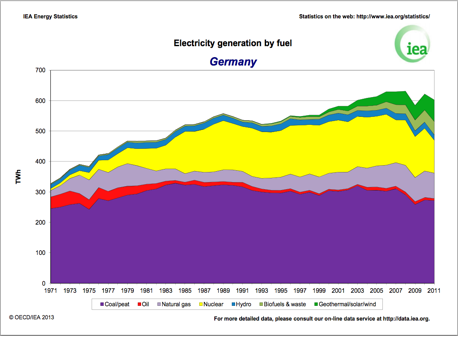
No. They can't as long as cheap energy storage on mass scales doesn't exist. Case in point: closing nuclear plants and replacing them with renewables is what Germany has been trying to do and has failed to do so far. They essentially replaced (and will continue to replace) nuclear by renewables paired with coal and gas plants running on standby. They can't cold start these plants fast enough to catch dips in energy production from renewables.
You simply can't replace a constant energy source (nuclear) by an intermittent one (most renewables).
I'm guessing South Korea will go the same route as "good example" Germany. Push renewables. Which translates to; close nuclear plants, invest heavily in solar and wind paired with gas and coal. End result: more CO2 emissions, higher consumer energy prices, but most importantly: a clean reputation through good intentions.
Renewables at this stage are more about politically correct marketing than about clean and safe energy.
It does, Tesla's grid-scale Powerwall made 25% of its cost in profits in 6 months (per https://insideevs.com/news/340702/tesla-powerpack-in-austral...).
Aside from using Powerwalls, us Europeans have extensive experience with using hydro pump storage.
Germany was the global top electricity exporter, by dollar value, in 2017 [0]. If that's what "failing" looks like, then maybe more countries should start "failing" like that?
In that context, coal and gas are only stop-gap technologies until storage technology and deployment has caught up, and coal is mostly only around for the same reasons as in the US: To not piss off the miners/lose those jobs.
[0] http://www.worldstopexports.com/electricity-exports-country/
"China is no stranger to nuclear power. The stated PRC goal is to raise domestic nuclear energy output from 43 gigawatts (GW) to 300 GW by 2030." https://www.forbes.com/sites/arielcohen/2019/04/25/china-ent...
> Officially China still sees nuclear power as a must-have. But unofficially, the technology is on a death watch. Experts, including some with links to the government, see China’s nuclear sector succumbing to the same problems affecting the West: the technology is too expensive, and the public doesn’t want it.
> The 2011 meltdown at Japan’s Fukushima Daiichi plant shocked Chinese officials and made a strong impression on many Chinese citizens. A government survey in August 2017 found that only 40% of the public supported nuclear power development.
> The bigger problem is financial. Reactors built with extra safety features and more robust cooling systems to avoid a Fukushima-like disaster are expensive, while the costs of wind and solar power continue to plummet: they are now 20% cheaper than electricity from new nuclear plants in China, according to Bloomberg New Energy Finance. Moreover, high construction costs make nuclear a risky investment.
China's electricity consumption growth is also rapidly slowing due to faltering economic growth.
I am not up to date with current projects.
> coal is mostly only around for the same reasons as in the US: To not piss off the miners/lose those jobs.
Totally agree, especially lignite heavy regions don't have a lot of other industry.
[0] select "import, export" at https://energy-charts.de/power.htm?source=all-sources&year=2...
Source?
https://en.wikipedia.org/wiki/Chernobyl_disaster
> the Chernobyl Nuclear Power Plant, near the now-abandoned town of Pripyat, in northern Soviet Ukraine.
Weapons:
https://www.latimes.com/archives/la-xpm-1986-10-03-mn-4176-s...
> In interviews, U.S. and West European officials said that some of the graphite reactors like the four at Chernobyl may be used to produce weapons-grade plutonium, but that their most likely military purpose is to make tritium, a rare isotope of hydrogen used in thermonuclear weapons.
Are you talking about the US or South Korea? China seems to be investing pretty hard into nuclear: https://en.wikipedia.org/wiki/Nuclear_power_in_China
But yes. By now, you can actually order pretty interesting reactors from China. Their Pebble Bed reactor is interesting.
Although [former NRC commissioner] Jaczko's account will become standard reading as an antinuclear book, his reasons have more to do with regulation than nuclear energy per se. Jaczko sees two paths ahead. One has a sustainable future with nuclear reactors that includes widespread recognition that accidents will happen and a greater commitment to safety. The other path is the one he witnessed as NRC chairman, featuring waning public trust in a secretive, uncooperative industry that regards safety regulations as unfair and cumbersome.
The problem that plagued the old Atomic Energy Commission [the predecessor agency to the NRC] — that the promoters and regulators were too cozy with each other — is clearly alive and well. Jaczko describes the relationship as a “corrupt, toxic environment.” It may be a hard warning to hear, but it comes from one who had a fuller view of the nuclear regulatory landscape than most.
https://news.gallup.com/poll/153452/americans-favor-nuclear-...
Can you source that claim? My personal experience is that people I encounter in the US are pretty nuclear-hostile, but that's just anecdotal.
Not to mention the ones that were started but never finished construction like the Virgil C. Summer plants.
Low renewable energy production is only a problem for maybe 20 days in a year and those days are not consecutive, they are randomly distributed over the year so gas or battery storage beyond 7 days isn't even needed. It wont be the end of the world as long as we can stop emitting CO2.
But people don't get as emotional about the resources required to build windmills (so long as it's not in my backyard) as they do about nuclear. And once a windmill or a dam or a solar farm has been built, there's a belief that there's no ongoing environmental damage. Whereas nuclear (and coal and gas) require ongoing resource extraction.
Again, I'm not the one making these arguments. I'm saying this is public perception. (Or at least my perception of public perception.) I happen to think the only environmentally responsible way to supply all the energy we need for 7 billion people (and growing), especially when more and more of those people are industrializing, is to go nuclear. Every other option seems like a guaranteed way to kill ourselves in the long run.
But you need massive amounts of battery storage to actually power a grid with windmills and solar plants (unless you have a bunch of coal and nuclear providing baseload power anyway). And batteries are consumables which require intensive mining.
For battery storage to be cost effective in general it has to be quite a bit cheaper than it currently is. The cost has been declining, but people who expect exponential curves to continue forever are generally disappointed. It may or may not hit a stable floor before the cost is low enough to actually replace baseload power generation. What it is likely to be good for is to get over the load hump between dusk and bedtime for solar -- but that requires a lot less storage than being able to carry the whole night. Especially in winter (when the nights are longer), and especially if we expect people to switch from carbon-based to electric heat.
The issue is we need to be building things to replace carbon right now. Even if batteries become cost effective in a decade or more, that's too late. And there is no guarantee of even that.
It's not like Germany just started building a lot of coal plants, to replace the closed nuclear plants.
What's left will be gas and renewables.
http://instituteforenergyresearch.org/wp-content/uploads/201...
I'll believe it when I see it. Also. What problem exactly is that supposed to solve?
I thought the whole energiewende stunt was about decreasing CO2 emissions. I'm not seeing this.
That's right. So why would you not decommission all of that incredibly expensive nuclear, and draw down your use of the coal plants to fill in the gaps? That's how most dispatch stacks work. It's just common sense. Consumers want to save money. Utilities want to make enough money.
There's just no way you use nuclear in any scenario you can come up with, unless the government is paying for it. Then you don't care, because you're not paying the costs.
No, you don't. The coal plant in another Alliant Energy area has been around since roughly 1900? or so. It's been updated several times. Never was there a need to rebuild from scratch any coal plant. (This is Madison Wi btw.) Now we stopped using coal there in 2011, (all gas now). But the point is, all the renovations are much cheaper than building a nuclear plant. Utilities around here, (the midwest), are run by old, stodgy, conservative guys who are generally not prone to rash action. There are very few executives around here who are going to build entirely new plants because the machinery in the old one has reached its end of service life. They are going to replace the machinery, at a fraction of the cost. I don't think executives in other parts of the nation are all that different in this regard. Now all that said, even if they did completely tear down and rebuild their plants, which they wouldn't, but even if they did, it would still be cheaper than building a nuclear plant.
So the coal plants are fine. And as I mentioned elsewhere, whatever you use to fill gaps will be a transitional technology. Wind turbines will become more efficient. (Work at lower windspeeds.) Pumped hydro storage will be built in new and innovative ways. What will fill the gaps in 2069 will bear little resemblance to what is filling the gaps in 2019. Because the new methods will likely be not only more clean, but much cheaper to boot.
And incidentally,
>You can't say that electricity from renewables is cheap without accounting for the cost of that standby capacity renewables require...
the 2 cents per kWh people see on their bill does factor in every source in the dispatch stack.
Up until now, baseload has been a convenient way to do that matching because baseload was usually the cheapest source of power.
Once baseload is no longer the cheapest source, it's time to re-evaluate that model. Also, when we have a global communication grid and lots of flexibility in our load schedule, it's also fine to re-evaluate how we are doing pricing for electricity.
That time is now. Utilities are highly regulated, and both utility and regulator are slow to adapt to the quickly changing technology that they're now confronting, after nearly a century of glacial technology change. But they will adapt. As we must not only change our economic mode but also become carbon neutral.
Those with huge capital investments may resist, but as you say, we can repurpose that old coal plant and reuse its connections to the grid, which are valuable and expensive to recreate. In Moss Landing, California, gas turbines are getting replaced by over a GWh of lithium ion battery. The change will happen as soon as utilities start bringing recent pricing into their planning process.
Not really the case. Renewable output does not fluctuate fast enough to require the fast response of batteries.
Fast responding storage, in the case of the UK pumped hydro, is usually needed due to thermal plants tripping and causing the grid frequency to suddenly nosedive.
Since when was natural gas ever good for base load? It's almost always used peak load because it spins up quickly.
Here's an article shared by Bill Gates last week: https://www.nytimes.com/2019/04/06/opinion/sunday/climate-ch...
Imho the way we've handled nuclear fission so far is far too reminiscent to other environmental disasters that took humanity decades to even recognize and finally act on, even when we had plenty of warnings from the very beginning [2].
[0] http://sitn.hms.harvard.edu/flash/2018/looking-trash-can-nuc...
[1] https://www.ncbi.nlm.nih.gov/pmc/articles/PMC2757021/
[2] https://en.wikipedia.org/wiki/Tetraethyllead#Controversy_and...
You have to be careful baseload power isn't the same thing as battery backed (time shifted) renewable power.
Coal and Nuclear baseload power exists for two reasons. Excess generating capacity at night. And the inability of coal and nuclear plants to shutdown. It's cheap because of oversupply. Time shifted renewable's is more expensive because of under supply.
Some percentage of base load power consumers are only in it for the balance sheet economics. If the pricing structure changes they'll shift their usage to the cheapest source.
Take away: Renewables don't need to generate as much baseload as coal and nuclear plants do now.
Think about it. Wind might be 30% or more of your dispatch and then it just disappears quickly (even with multiple forecast vendors you are lucky to have a 2 hour warning). At this point you have to either have a lot of headroom (excess thermal generation for times like this) or you hope you can startup a resource in time. Therefore you either need storage on a massive unheard of scale, very fast starting resources, or lots of thermal generation for those times of trouble. Another option would be drastically increasing the demand response in the region (basically shut all the A/C's off at a few universities for an hour or so).
Show me a powerful river than can be dammed with minimal to no impact to the ecology or the communities up- or down-stream of it, and you will have my support.
But is coal not one of the stops?
I guess you should help me understand. Why should we use nuclear instead of coal to fill the gaps? They both pollute. With wind providing the lion's share of the energy, the use of coal is drawn down considerably in any case. And coal is far less expensive than nuclear, even with the onerous regulations that have been slapped on it recently. So how are you going to sell nuclear to your consumers when your competitor may be selling a wind/coal package?
And as to the question of the long term, clearly that is using pumped hydro storage and other such technologies along with more efficient wind turbines. Both lowering the duration of gaps, and providing more power during gaps. So your nuclear or coal plant is, even in the optimistic case, transitional. Who's gonna put up money like that for a transitional technology without some kind of draconian government guarantees?
The idea that nuclear waste disposal is even remotely comparable to fossil fuel pollution is intellectually dishonest in the extreme. Coal plants pump toxic, carcinogenic, and radioactive waste directly into the atmosphere. Nuclear plants produce waste that can be sealed up and buried in a remote area. The hypothetical situations in which nuclear waste disposal could result in poisoning humans are borderline fantasy, usually involving societal collapse to such an extent that all records of the disposal sites are lost and some future civilization digs a mile deep in rural Finland for no conceivable reason.
In this "pulling out all the stops" scenario to stop climate change, only one of them pollute in ways that matter.
Unless you mean the CO2 emissions resulting from construction, etc. I admittedly don't know the numbers there, and I'd imagine a nuclear plant uses a LOT of concrete - but it's also very long lived, which means it should amortize and come out ahead of coal which produces CO2 in operation even if it produces more upfront.
All energy production creates pollution in construction. Nuclear is the only source I know of that can produce consistent and reliable energy without creating any emissions from operation.
What makes you think coal and nuclear are scalable? Gas has been the only option from the start and simply switching from coal to gas already results in a 50-60% CO2 reduction.
While currently most imports are from Russia,there‘s an effort to start building LNG terminals to be able to import from the US.
https://www.reuters.com/article/germany-lng/update-1-germany...
Part of this is appeasement to the US but it is a good backup to have.
https://www.lazard.com/perspective/levelized-cost-of-energy-...
Running existing coal and nuclear generation appears to be cheap (2nd chart), but new generation appears to be much more expensive (1st chart). The cost of Solar + Storage is low and dropping, and already beats the cost of new nuclear plants (4th chart).
BTW, I grew up on the east side of Madison, Cheers.
That's kind of the point. Better to have it and not need it than need it and not have it.
And even if batteries become cost effective in a decade or more, that's when people start installing them at scale. It's not as if you could replace the entire grid with them overnight either.
Even within regions it isn't a well-connected grid.
To give a specific quantitative example within Texas the generation network is modeled as several dozen individual markets (the "nodal market" concept) with generation and load grouped together to form nodes, which are mainly separated by key transmission congestion points.
Lack of transmission capacity sometimes leads to strange artifacts in pricing wind power in Texas, such as negative pricing (due to the Production Tax Credit lowering the floor below zero). These artifacts tend to go away as new transmission capacity comes online and paying loads in more distant markets become reachable.
The way dispatch is done is completely different than the way it was done 10 years ago and also completely different than the way it was designed in so many ways.