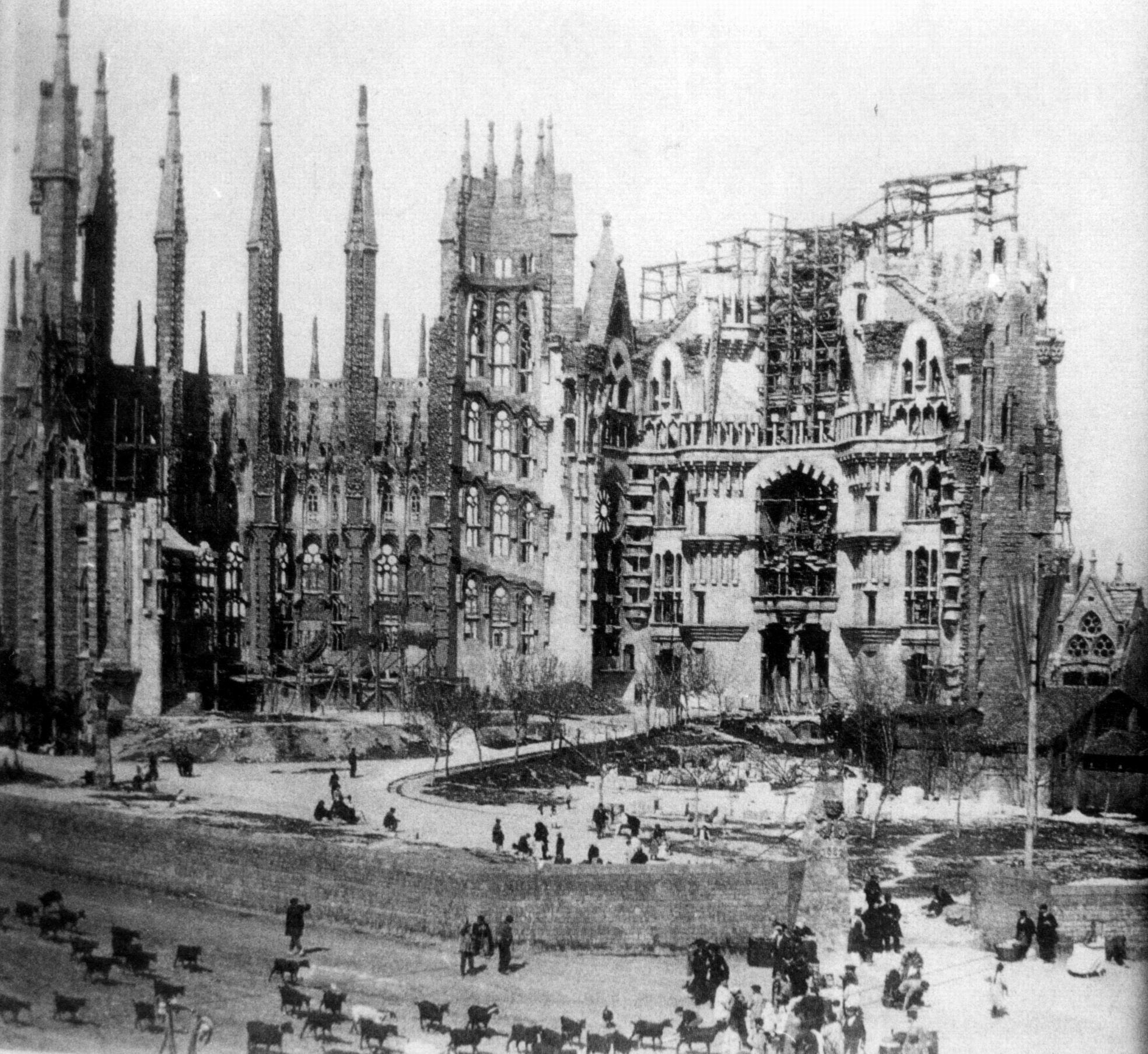
1915 http://suitelife.com/wp-content/uploads/2011/04/736px-Sagrad...
1915 https://upload.wikimedia.org/wikipedia/commons/5/5c/La_Sagra...
It doesn't matter how it got there, that history IS Spanish culture and it doesn't make anyone sympathetic to the outcome.
Its just "yep."
[1] https://memetician.livejournal.com/201202.html
[2] https://criticalista.com/2012/08/16/gaudis-hanging-chain-mod...
So I had to research that part on my own.
Trams at the time ran at around 10kph.
Supposedly he saw a tram coming, took a step back and got hit by another tram.
As his main concerns were architecture and the church, he looked homeless.
Some time after the accident, someone did call for a doctor who declared him dead.
Some time later, he was brought to a hospital, provided the care that a beggar would receive and died 3 days later. Only being identified some time after being admitted.
Given that it was 1926 and he was almost 74, it’s hard to say how much immediate care would have helped anyway.
Career goals. I feel like I'm already halfway there.
I took some photos but they definitely don't do it anywhere close to justice.
> Barcelona officials said the city will be paid 4.6 million euros ($5.2 million) in fees under an agreement negotiated with a foundation devoted to completing and preserving La Sagrada Familia.
However, the Sagrada Familia is already a massive benefit for the city due to the visitors it attracts. Its administrators could've just raised the middle finger and Barcelona would definitely not have tore it down nor stopped its construction.
Why did they enter the agreement then? The Sagrada Familia's original plans include a number of gardens that span outside of its current land. With this agreement in place, now the city can officially start making plans to eventually evict residents in the affected land space, freeing it up for the monument's gardens.
Why else would they demand $5.2M for a building permit.
Article itself [2]
[1] https://en.wikipedia.org/wiki/Sagrada_Fam%C3%ADlia#/media/Fi...
Although there’s a huge halo effect in terms of taxing nearby businesses too.
There are various live performances worth a listen.
I am linking just because this project is awesome and some moving music just makes sense.
Wikipedia contains a derivation: https://en.m.wikipedia.org/wiki/Catenary (the one on the German Wikipedia is a bit more explicit)
There are plenty of ways this can go wrong. The little weights Gaudí used might not correctly model the weight of the stone. The whole thing might be unstable under inevitable sideways forces from wind and such, although one could blow on the string model to make sure it doesn’t start swinging to approximate this. And the string model probably doesn’t say much about the distribution of compression loads in the stone, especially if the overall structure is not statically determinate.
This is only really relevant to cases where the loads are higher than the weight of the arch/chain (manmade arches typically are just symmetrical as the loads are far less than the arch's).
I'm sure someone here is capable of elegantly describing these loads in the language of math to describe the same conclusion. That's not really the why part, just a different language for explaining it.
Coming from a city that is having a bit of an identity crisis and relies heavily on tourist money, the impression I got of Barcelona is that the city itself is very much a theme park for English tourists. It really seemed like Catalan culture was whitewashed pretty successfully (e.g. pintxos everywhere). In terms of combating that theme-park mentality, Sagrada Família is certainly not where I'd start (then again I don't live in Barcelona).
Parc Güell was especially over the top and cartoonish, less in the architecture, but more in the throngs of selfie sticks. It's gone from a thoughtfully designed park to a caricature.
Sagrada Família was, OTOH, a pretty stark contrast. I did the self-guided audio tour and went up into the Nativity facade (not the newer one) and was just floored. I fully expected the audio tour to be full of self-promotion, but even the 99PI episode on Sagrada Família left me with the impression that Gaudí wanted to see SF completed and that currently painstaking effort is being made to keep things as true to his desires as possible.
Obviously things won't be done exactly as Gaudí would've done them, but that's an artifact of technology changing over time. Much like any other aged building, Sagrada Família would've needed a restoration at some point. For better or worse, the primary function of Sagrada Família is as a museum / tourist destination and it's been that way for many years.
Sagrada Familia may be an unhappy travesty, but every cathedral is, and few have such a consistent style. Even our cities are unhappy travesties, and I do not think that leaving the unfinished works of deceased architects unfinished would change that.
You have all the right to dislike how it is being done, and it may be not exactly what Gaudí thought, but trying to finish it was, in my opinion, the right decision. When you are in the middle of a task that will take generations, it makes sense trying to continue even if some accident happens, like your main architect getting killed by a tram or documents getting lost.
> every cathedral is
Actually, contemporary cathedrals (of which more than a few have been built in the XXth and XXIst centuries) are typically completed in a reasonable timeframe. 5 years for Moneo's Our Lady of the Angels; 3 years for Hartman's Cathedral of Christ the Light, and so on.
By the way, the Sagrada Família is not a cathedral, but a basilica, but that is neither here nor there :)
So leaving it as it was in 1926 would actually have been against Gaudí's will, and from that standpoint, continuing it was the right thing to do. I will not comment on decisions taken on the particular execution, as I don't have the knowledge, although as a layman I did like it a lot when I visited around 3 years ago.
NB, the line taken by the cables of a suspension bridge with a deck of uniform weight is a parabola. I think this is what causes the popular confusion.
(From the downvote, someone apparently didn't appreciate my asking).
In a hanging chain, the sum of the forces pulling down (due to gravity/load) and away from the end (due to tension) on a given link must point in a direction exactly opposite the angle of the next chain link toward the end. Else that chain link would rotate until the above is true.
In a stone arch, the sum of the forces pushing down (due to gravity/load) and toward the base (due to compression) on a given stone must point in a direction exactly equal to the next stone toward the base. Else that stone would rotate and the arch would break.
Imagine a single weight dangling from two strings of roughly equal lengths attached near other on the ceiling. The weight will swing if you blow on it. If you turn the strings into (lightweight) compression elements and turn the whole thing upside down, it will be a bipod. The weight will indeed be balanced, but any slight perturbation will knock it over or will at least require shear forces to avoid this fate.
Now try this with three strings. The weight will resist swinging if you blow on it, and the cathedralized version is a stable tripod.
Now try four strings. If the string model is imperfect, one string might be slack. If you cathedralize it, you get a quadropod, and, if the construction is at all imperfect, the loads on the four legs might be wildly different and, if it’s too far off, the structure might wobble. This structure is statically indeterminate.
There is, strictly speaking, nothing strictly wrong with static indeterminacy, but it makes the analysis considerably more complicated.
Another issue is that Gaudí used a bunch of little weights instead of weighted strings. This means that he’s modeling stone columns with all the weight concentrated in a few places, which isn’t quite right.