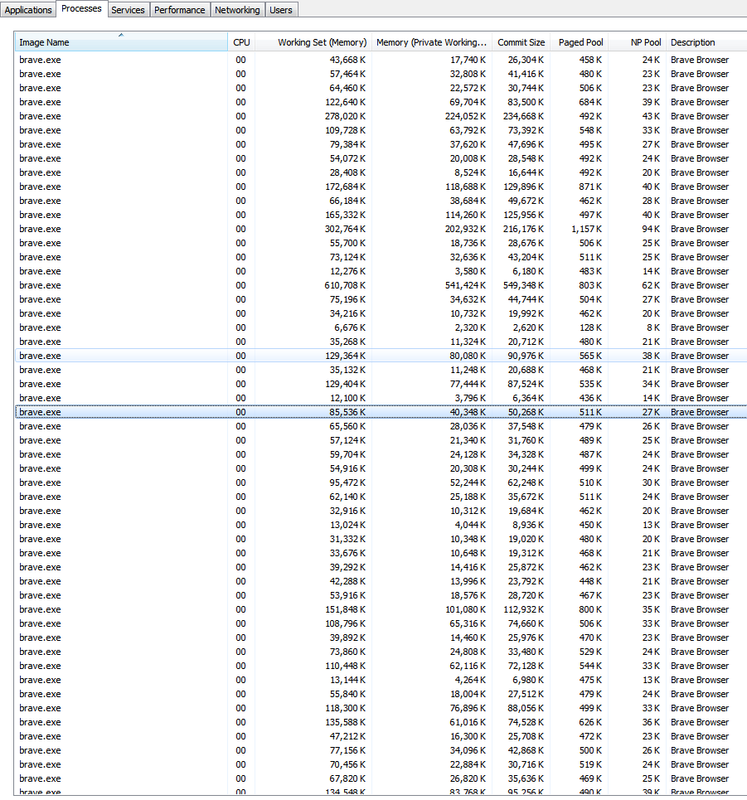
Installed it and then noticed in my firewall that it is
- trying to connect to a number of IPs owned by google, umm OK
- sending a multicast SSDP UDP request on port 1900 to 239.255.255.250
So googled that and got this page: https://community.brave.com/t/why-is-brave-issuing-upnp-disc...
Which basically tells you that the first thing Brave does is to try and detect what devices are in your local network.
... and that's where my Brave experiment ends.
edit:
Also note that uninstall is completely silent, no confirmation that it actually completed.
The uninstaller also leaves behind the updater utility AND the Windows Task scheduler tasks that run the updater.
The end
In evaluating Brave, you have to give it apples to apple comparison anyway. Brave vs. Chrome as its directly built on chromium. For compatibility, it shares the chrome app store too. I like to think of Brave as Chrome without most of Google but with all the benefits.
Anecdotally, I switched a colleague to Brave about 3 months ago. He decided to switch back to Chrome. Chrome was so much slower than Brave and added battery drain that he came back. I assume it was all the additional requests cut out (Google) or blocked by Brave (Adblocker).
Trust is something you have to earn. I do not install Chrome as I do not trust google. They have too much of my data already.
Brave claims at their main page:
"Brave is open source and built by a team of privacy focused, performance oriented pioneers of the web."
OK well they failed my 5 minute test.
Not having removed the SSDP parts is one thing.
Not uninstalling your updater after running uninstall is straight out sloppy.
There is controversy about how Brave does stuff, and I agree there is some sketchy stuff they are doing (replacing ads with their own). I'm glad they are giving us a choice, though, and exploring different options for sites being able to makes some money.
Does it make money by showing you ads?
Chrome: Yes Brave: Yes Firefox: No
If yes, then they need to track your behavior in detail. I'm sure you don't deserve to be tracked.
Seems like an unnecessary optimization, though I'm sure it was fun. I wrote one a little while back in C++ also[0]. It's not documented the best, but uses a kind of custom tree to match.
0 - https://github.com/cretz/doogie/blob/master/src/blocker_rule...
This has already happened: https://www.theregister.co.uk/2019/04/03/googles_widevine_dr...
> Developer Samuel Maddock found this out to his cost. He's been working on an open source Electron-based (Chromium) browser called Metastream that allows users to stream videos in sync with one another. It's designed to be a way for friends to watch shows together even when they're apart.
> But Google's Widevine DRM business doesn't want to work with him. After four months of waiting, the firm responded to his request to license their proprietary DRM code, in conjunction with the castLabs API, with a denial.
(edited: formatting)
https://docs.rs/regex/1.1.7/regex/struct.RegexSet.html
http://intel.github.io/hyperscan/dev-reference/intro.html#co...
Does it make money by showing you ads?
Chrome: Yes Brave: Yes Firefox: No
If yes, then they need to track your behavior in detail. I'm sure your family deserves more.
Give them Firefox, turn on Webrender (it's awesome even today - biggest speedup you can get in FF).
It's little touches like how you can't re-order extension buttons with a basic mouse drag - no, you have to go into 'Customize...', and that's so clunky and 2004. They have some more work to do to really make it competitive with the mighty Chrome.
So after all that time, Brave is the first browser registering my interest due to these regular news stories. I still use Google services, but I don't like their current dominant position in shaping how the web works. That's too much power.
I'm sure the more modern languages also help though, but I don't think that using a modern language is the major reason for the speedup.
It's a regular working process.. use a language that let you write ideas down and test them quick. Later reimplement them in assembly. I mean C.
Once they do, it'll be pretty amazing.
The pop up ads have been activated and I have been receiving the token for clicking, about $8 month worth of BAT. I am hoarding the tokens so that USD value might go up if the token moons together with bitcoin.
I would read that.
https://github.com/brave/brave-core/search?q=rust https://github.com/brave/adblock-rust-ffi https://github.com/brave/adblock-rust
Unfortunately Firefox is not a good match. I've tried the latest versions of Firefox and the developer edition, before using Brave and it still uses so much CPU in my macbook and the fan of the laptop sounds like an airplane is about to take off.
Edit: I have multiple Google accounts signed into. And also, it does not block all ads in GMail which uBlock on Chrome is able to.
Just out of curiosity, have you tried Firefox? I know it’s not perfect, but with minimal tweaking I think it’s very competitive.
I get around it with a too-big hammer and run Qubes. Brave in my personal Qube knows nothing about brave in my work Qube.
There's probably a better way.
In what situation would this "orders of magnitude slower" actually manifest itself as a perceptable delay?
Blocking ads and trackers by default is pretty much essential in 2019.
The myth about ad replacement doesn't seem to want to die though!
There is no ad replacement, though the roadmap says at some time in the future publishers who opt-in will have the option to have their ad-slots filled by Brave's privacy-respecting approach.
For now I think the only ad trials running are pop-up notifications if users opt-in, and that's only in a few markets at this stage.
Not something I plan to opt-in to, but looking forward to the Github / Reddit / Twitter tipping and integrated crypto wallet.
That's all rolling through in the next few months.
How is it better than a choice of plug-ins to block them?
Just want to reinforce this from my experience. I've been using Brave since before they were based on Chromium. And a lot of comments were saying that Brave replaces adds with their own. But I never saw that.
Now they have a feature you can opt-in, to see adds and get BATs for that. I actually wanted to test this and opted in, but still never seen an add. I guess my location is not yet included.
So at least based on my experience from using Brave for a long time - it's hard to get adds even if you want to.
I would be more open to trying/using brave if someone respectable packaged it. As of writing, not a single distro packages it. It would lower my barrier to entry a lot if it were packaged by debian/fedora/f-droid. It doesn't imply anything serious, just that it can be built from source and that it passed the distro's basic diligence and guidelines. This seems like low-hanging fruit from brave's standpoint, and yet multiple issues on their github tracker about packaging downstream have remained open for a while.
> It doesn't imply anything serious, just that it can be built from source and that it passed the distro's basic diligence and guidelines.
For a modern web browser it probably doesn't achieve the latter. Both Chromium and Firefox are too complex for Debian's meager backporting resources. So they make an exception to their guidelines and ship the LTS release. I suppose the userbase just hopes that bad things don't if the browser LTS upgrade happens before the OS's LTS upgrade is ready.
I mean, what is the "worst" stuff it doesn't have? Account sign in?
It seems like there are plenty of other Chromium embedders to get that without the sketchy stuff.
That's years ago, I believe, and there are still ad blockers that don't seem to accept compromise.
Over here brave just dumps itself on c: in win64
Brave's stated goal is to establish an alternative ad-based business model that's long-term viable without the user being tracked. Will this be successful? Who knows, but at least they're trying to find a business model that respects your privacy while being long-term sustainable. Firefox's model doesn't, at least the way it works now.
Of course, development costs a lot. They will not need to rely on Google in the future if more people donate to them regularly. Consider donating to Firefox.
Does it render text in an ugly manner?
Chrome: No
Safari: No
Firefox: Yes
The unfortunate thing is that many Firefox users prefer the Firefox text rendering.
There’s no solution to fix this (I’ve researched a lot). It’s just a divide in the users based upon preferences.
I'm not particularly impressed with their business. In fact I'm pretty disgusted with it.
https://brave.com/brave-ads-launch/
Users can then choose to contribute some or all of those funds back to the publishers/creators they visit that have signed up to Brave's platform. They try to do this all in as privacy-preserving a manner as possible.
In any case it's a great browser, at least better than Chrome when it comes to privacy, and I personally won't fall for the propaganda. Just like Tesla, there is a lot of "old" money that is threatened by the upstart so there is also a lot of negative sentiment.
"If a publisher has not verified ownership, then a user’s contributions will be held in reserve inside the browser for 90 days. The browser routinely updates an internal list of all verified publishers to determine whether a property can receive contributions. At the end of the 90 day period, any contributions marked for unverified publishers will be released back to the wallet. No funds leave the browser except to go to verified creators."
Previously:
"Previous versions ... would then hold contributed funds for those publishers in escrow until they’d verified. [And] Funds that were contributed from user-funded wallets will be held indefinitely, until the publisher verifies and transfers them to their own wallet."
That sounds like they had a suboptimal policy, realized it, and fixed it. If they _keep_ their 5% cut, or the interest on it, from contributions to unverified creators, I'll share your criticism.
But even if you're right, why is it unethical for me to install software on my own computer to render websites differently than the creator intended? For example, by removing ads? Or replacing ads with different ads? Or rendering all ads upside down?
Exploiting this grey area in the law will lead to a response from the courts and lawmakers. That response might well require that browsers display pages exactly as the publisher intends.
In other words, the end of ad blockers and other tools, thanks to Brave.
(Not at all unlikely given that Google seems to want that too.)
As for the hypothetical youtuber, they are always free to put product ads directly in their videos if they can/want to. However, if they can only make money via abusive 3rd party trackers, that's on them.
No clue about Safari but Firefox dies under these conditions, and I'm not interested in Chrome given not only Google but their 'vision' for the future of that browser including native anti-ad blocking. Opera was okay, but I enjoy the privacy features of Brave. Native ad-block, tracker blocking, etc that can all be customized per site in literally two clicks. Lion->Third Party Trackers for instance would allow me to enable third party trackers exclusively on Hacker News if, for some reason, I wanted to. Pretty cool stuff.
PS: using Brave browser, which is essentially a Chrome mod, also cements Google monopoly, indirectly.
Mozilla did a lot for so long, let's hope they can circle the issues and find resources to fix them.
Its like you never heard of Brave
You can just ask them to disable it and now you have your fictional higher standard team shrug emoji
I guess you did mention that you dont use Chrome, so this level of distrust is going to be foreign for most of us to relate to
- Remove the spacers next to the address bar. (I prefer having a huge address bar.)
- Install uBlock Origin, Bitwarden, and a few other extensions (GitHub Notifier, for example.) I don't use Firefox Sync right now, so I do this manually per install.
- Disable "Ctrl+Tab cycles through tabs in recently used order." I prefer the old Ctrl+Tab behavior where Ctrl+Tab moves right and Ctrl+Shift+Tab moves left.
- Set search to Duck Duck Go.
- Disable all Home content except Search.
- Disable browser, download, form and password history. Tweak content blocking settings a bit. (I generally 'block third party trackers' but I aspire to block all third party cookies if that ever becomes supported by most websites.)
Sometimes I also tweak other random things, like disabling the clipboard APIs entirely to avoid sites that attempt to add garbage to the end of copies. But realistically, these are the things that I usually keep the same. On portable devices I sometimes also enable permanent private mode, to keep even less sensitive data in storage.
src = fetchurl { url = "https://github.com/brave/brave-browser/releases/download/v${... sha256 = "1lbajxnxqkd422rckfjm65pwwzl66v7anq4jrzxi29d5x7abl3c1"; };
Also, bad look for nixos. I was curious about nixos too, but it'll have to be debian and fedora for now.
They certainly don't package Brave in any fashion, but if you were curious about NixOS, you might look at Guix System.
A reasonable person reading your comment would think you are claiming the Brave team added code to surveil your network. If they dig deeper through the link you provided, they learn that the reality is that they inherited code from the Chrome team that exists only to support Chromecast. The problem has been found, a bug has been filed and the feature will be removed.
But, most people won’t dig. They’ll take your comment at face value and walk away with a very different story than the reality.
Now I sound like I’m accusing you of being nefarious :p But, I don’t think you planned out spreading FUD. I think you were dissatisfied and wanted to share a strong version of your user story. Unfortunately, your story is so strongly worded that is ended up resembling techniques used by trolls.
What I did was try Brave out. I _want_ to like the product. On top of that I have a lot of respect for most of the people behind the project. As a security conscious person I looked at what kind of network activity there was on start.
After installing Brave, I notice things that IMO should not be there. After that I even spent the time to search what it was. The link mentioned by me in my post looks to me like it is a post at a forum from Brave. As someone who is not familiar to the project it is not clear that there is any bug report or bug filed, where do you see that?
There is also no indication to me that somebody from the Brave team replied to the post. There's 1 reply 6 days later, by an anonymous user, which explains what is going on, then 24 days later the thread is closed.
The reason I did not reproduce the text from the link is that it is pretty clearly stated down there. If I wanted to spread FUD I would not have provided the link.
I spend too much time arguing with trolls on the internet for fun. I don't think you intended to, but your post uses a lot of techniques widely used by trolls such as: linking to the complicated, full explanation while telling an edited, "technically true" version that can be misinterpreted by a low-effort reader. Having an escape hatch is very important to them.
Again, I don't think you are trolling. You just ticked off the checklist of a troll by accident. I'm only being a pest in the hopes that in the future you'll put more consideration into how your writing is interpreted by low-effort readers.
Text is such a crappy medium for casual conversation. It's amazing the internet hasn't burned itself down.
Calling out us HNers as mindless with your 4 month old account is a bad look.
Most of us that do not use Brave at this point do not necessarily use Chrome. In fact, those of us that care about the issues raised by the OP probably use Firefox and/or Chromium.
Only real hold out is Firefox even Microsoft buckled under the pressure. If we lose Firefox then in the future don't be surprised when Chromium support suddenly stops and only game left in town is Chrome.
Now all the nay sayers will come in defense of open source and my only response is: don't be so fast to forget "embrace, extend, and extinguish"
Safari is only ~4% of desktop/laptop browsing but over 20% of mobile and with mainstream users slowly moving to tablets over laptops this presents an important and large user base.
https://addons.mozilla.org/en-US/firefox/addon/react-devtool...
https://addons.mozilla.org/en-US/firefox/addon/reduxdevtools...
...And I don't really recall many issues.
Ever since WebExtensions, there's not really a good reason for the devtools to be much worse on Firefox.
If you have used these extensions and have issues, I'd love to hear them. I've done React/Redux dev on both and I don't notice things working significantly better in Chrome. (Admittedly, I haven't done any in a few months.)
The only real thing that gets me now is the lack of being able to inspect WebSocket frames. :(
Tom Scott was not happy with Brave. They were collecting ad revenue for Youtubers who had never opted into their platform.
He had to go make a stink to their CEO, and finally after lots of pushing back, the CEO ceded that maybe this is not the best thing to do!
Tom Scott ended up being happy with Brave resolving an early product misstep.
You should really be across an issue - and its resolution - before deciding to use it to cast shade on a software project.
For more reasonable-minded developer folk Eich addressed this again recently on Twitter: https://twitter.com/BrendanEich/status/1139384765700685824
The only related issue for me recently was a failure to restore a session after Firefox forced a restart for an update. That's the behavior that chases me back to Brave on other systems (where it's not as easy to `tabs.sh > current_tabs` just in case).
See e.g. https://bugs.chromium.org/p/chromium/issues/detail?id=824153 for some gory details.
Would it be nice to reject these donations? Sure. But we don't demand that with any other transmission service. If Eich and the user concede to the terms and if you accept the money, what is the problem moral or otherwise?
https://www.computerworld.com/article/3284076/brave-browser-...
And on their own site:
Your first link is to a tech journalist who misreports what we actually do, for reasons I cannot fathom and won't guess at.
Anyway, we do not replace publisher ads we block. Check it out for yourself.
>They monetize the content of others and don't tell them.
It sucks, but at the same time, if you're going to be an honest actor in crypto, you better cross every t and dot every i, because bad actors are everywhere and so smart people just assume bad faith and are arguably correct to do so.
https://www.reddit.com/r/Bitcoin/comments/aacw3h/im_creating...
> Brave will replace blocked ads with its own ads, taking a 15% cut of revenues.
> In practice, Brave just sounds like a cash-grab. Brave isn't just a glorified adblocker: after removing ads from a webpage, Brave then inserts its own programmatic ads. It sounds like these ads will be filled by ad networks that work with Brave directly, and Brave will somehow police these ads to make sure they're less invasive/malevolent than the original ads that were stripped out. In exchange, Brave will take a 15 percent cut of the ad revenue. Instead of using tracking cookies that follow you around the Internet, Brave will use your local browsing history to target ads.
https://arstechnica.com/information-technology/2016/01/mozil...
From my point of view it's essentially a scam on multiple levels:
1. It doesn't significantly change the Web - users will still look at ads.
2. Without providing anything of value (see 1), Brave gets a cut of publisher's ad revenue.
3. As incentive not to sue them into oblivion, Brave offers publishers a cut of the stolen revenue.
4. The whole thing is built on top of a sketchy cryptocoin system where a significant stake is owned by the developers.
And removing tracking from ads is a massive improvement on the status quo.
> Ads and trackers are blocked by default. You can allow ads and trackers in the preferences panel.
> Later, as mentioned above, Brave will let you opt into receiving a reduced ad load that comes without trackers, maintains your privacy and helps support the publishers you like.
Do you have any evidence that Brave's ads are not intended to be a replacement for traditional ads on publisher sites? What else would they be for?
And, regardless, the rest of my comment stands. It may be "better" to shows ads without tracking, but it's still rent-seeking in the ad blocking space. Ad blocking is a solved problem - just use uBlock origin.
Edit: from only a year ago:
> Brave will scrub sites of ads and ad tracking, then replace those ads with its own. Meanwhile, BATs will be awarded based on user attention, or put plainly, time spent viewing ads and content. Brave users who agree to receive ads will be rewarded with BATs. The tokens, in turn, will be exchanged between users, advertisers and site publishers.
https://www.computerworld.com/article/3284076/brave-browser-...
I bounced back and forth several times:
* I tried it for a month in January 2010, and went back to Firefox because Chrome was slower and less stable: https://www.jefftk.com/p/google-chrome
* I tried it for ~6m in 2011, and switched back to Firefox because I missed side tabs: https://www.jefftk.com/p/side-tabs
* In early 2012 I switched back to Chrome, despite the lack of side tabs (which I still miss dearly) because it was enough more performant.
(Disclosure: I work for Google)
* I trust Chrome more than Firefox on security
* I'm used to Chrome's debugging tools, and would need to learn Firefox's
* I use the Chrome password manager, and it would be annoying to switch
If Firefox were enough better I would still switch, but at this point my understanding is it's more like "Firefox is no longer slower than Chrome" not "Firefox is a step up from Chrome in the way Chrome once was from Firefox".
Perhaps there are tickets in the github repo to add this to mobile builds?
It's true that some compilers disable optimizations on certain undefined behavior to prevent unintuitive behavior (https://blog.regehr.org/archives/140) but that's unlikely to happen for data races or memory safety.
If people don't want to look at your ads they wont. Don't like it charge money.
A decade or so ago ad-blocking was extremely esoteric. Today it's reaching a majority on all devices excluding mobile. Though mobile will also likely follow a similar esoteric->majority trajectory. In any case it should be clear that the status quo of advertisements isn't going to last. Google trying to break ad-blocking in Chrome feels very much analogous to the old dinosaurs in the music industry trying to cling onto CDs. Users hate unsolicited ads and, in the end, it's a losing battle to try to force everybody to keep watching them.
The point of this is that that money you're being offered is money that would not exist otherwise. These people are not going to watch your ads, period. You're free to take it, and you're free to not take it - it'll eventually be returned to the people that wanted to give it to you. But complaining about it's very existence is peculiar. It's like if you only accept PayPal and I said I don't use PayPal but I'd be happy to send you money through e.g. Stripe. If you don't want to setup a Stripe account to accept my money then that's completely your choice, but to complain about it just seems petulant.
Why should we have to support their over priced office space?
One, Mozilla has multiple offices across the world; see https://www.mozilla.org/en-US/contact/spaces/
Two, a large percentage (perhaps even a majority?) work remotely.
This combination lets Mozilla hire talented people wherever they are.
(Disclosure: I work for Mozilla)
You don't have to support them, but if their product provides value to you, it's worth considering
That is, it's not about less good quality of life, just less high salary possible only in places with less high level of misc. inflation.
Plus passed some level, I doubt higher salaries make good corollary with high quality of life. Not that you can't have a sane happy life with a lot of money, of course. But : - it doesn't seem to to be a requirement, see for example the case of Matthieu Ricard[2] - large salary, or more generally acquiring a social status broadly recognized as great success doesn't prevent from terrible quality of life. Arguably, even you go with Camus saying "Un geste comme le suicide se prépare dans le silence du cœur au même titre qu’une grande oeuvre", not all people in [3] committed suicide out of a situation where they felt they had good quality of life.
[1] https://venturebeat.com/2018/03/23/duolingo-to-silicon-valle... [2] https://onbeing.org/programs/matthieu-ricard-happiness-as-hu... [3] https://en.wikipedia.org/wiki/List_of_suicides_in_the_21st_c...
If SV doesn't trigger that for you, think about, say, a non-profit headquartered in Monaco, that asks for donations so that its employees can have a nice home and QoL in Monaco with salaries several multiples of your own for comparable work.
I also agree with the upstream comments about UI clunkiness. There are a lot of things that irritate me about Firefox that Chromium just handles better.
Mostly little things like the "Recently Closed Tabs" menu is buried 6 levels deep in the "Library" menu. And the completion list that pops up when typing in the address bar always seems to miss pages I've visited but includes things that seem unrelated to what I'm typing in.
If you don't see them I could only guess that maybe you have an old version of the browser installed?
People bending themselves backwards to hate Brave for doing things that are really not that different from what the big boys do.
No, and they don't. See meta nosnippet and robots.txt.
If the big boys did what Brave did, they would be sued to oblivion.
What people like to imagine "not for profit" means is not what it means in practice.
[1] - https://assets.mozilla.net/annualreport/2016/2016_Mozilla_Fo...
The Linux foundation heads have a similar salary range, like many other foundations and it is not an issue.
"Not for profit" means with a public stated goal, means that your share holder will not suddenly overcome your company strategy and make you sell all your client data, or make you sell bananas, because "it's more profitable on short term".
That is not an hypothetical scenario, many IT companies already felt into this trap. The foundation model of Mozilla protect you against that. This is something that Brave company does not... And the position of its CEO on publicity does not reinforce my trust into that.
I don't get it. I would expect employees at a non-profit to be compensated along the same lines as those at a for-profit. It's a constant easy story for shitty journalism in the UK – "oh my god this head of a charity makes far less than the head of an equivalently–sized private company! what a bastard!"
https://addons.mozilla.org/en-US/firefox/addon/reload-in-add...
Or you can use the "double tap the dots menu" trick.
You might like it, though. I've used Brave's mobile sync and it works for bookmarks across devices quite well. It's surprisingly simple to set up, too. I don't fret much about forgetting whether I opened a tab on my phone or desktop if I remember to bookmark it.
That said, I still use KDE connect to send links to my primary Firefox instance and vice-versa, but the bookmark sync is in some ways more convenient. I'd imagine they'll eventually synchronize more things, like tabs.
The same happens when some sites require Chrome to work, blocking all the rest. In 2019 it's unacceptable
Because it's 100% just a missing feature in Firefox mobile, there's nothing website developers should add to "make it work" on it.
Future monetization: that was actually an incentive for me. Having been in the belly of the beast on ad-tech I'm cheering the new ad model Brave proposes for the industry.
If you're not aware how messed up the industry currently is, keep an eye on Ad Fraud Historian on Twitter: https://twitter.com/acfou.
On the crypto front, proposing ideas like staking / slashing on their extension store for extension authors is also very interesting: https://twitter.com/BrendanEich/status/1143630584310202369
The new browser wars are certainly spurring innovation again: good for everyone regardless of personal browser preferences.
OS certificate stores often come with the political baggage of the OS manufacturer. When a Chinese Gov't CA was found to have engaged in fraudulent behavior [0] Google and Firefox were quick to revoke/remove the CA cert from their products. Apple and Microsoft did not do the same, likely because they do not want to upset the Chinese Gov't. (IIRC Iphone users cannot even manually revoke CA's on their own phones.)
[0] https://en.wikipedia.org/wiki/China_Internet_Network_Informa...
Using the OS secure-store should be a preference option. The folks who don't want to use the "political baggage" of the OS manufacturer - as you put it - can continue to use their pristine gardens.
It would be nice however if Firefox had an option to use the OS store, including devices like yubikey.
The only argument that keeps coming up is that Brave has a built-in adblocker but it's not like installing ublock origin is very challenging in Firefox (and on top of that your extensions are automatically synchronized if you use the Sync feature) and the relatively blurry monetization scheme of Brave makes me think that in the long run this built-in ad-blocker might prove a liability more than a strength. I'll take my ad-blocking independent, third-party and non-profit, thank you.
I think the bigger issue is chrome implementing an new web feature that blink-fork2 and firefox dont agree with, that web devs start implementing anyway. Google controls web development more than they control browser development.
Theres also the WideVine argument, but for me personally I dont see why i need my primary browser to also play netflix. Its not that hard to open a separate netflix app/browser. The amount of drm encapsulated video I watch in my browser is minimal to none.
Edit: sure, there's perhaps 1% of alt-browser users who actively avoid all Google's services, but rest actually depend on them...
This means that if you send a meaningful patch, Google doesn't like it, but Microsoft and Apple do, it might get merged.
> chromium-backed Safari
Double whammy. Chromium runs on fork of WebKit which is Safari's engine.
The issue here is one party making money, without consent of any form, based on another party's published materials.
So, google’s search engine business?
That said, there is an argument to be made here. One that's included in the disputed EU copyright directive in the 'link tax'.
It shouldn't be illegal to not request certain parts of a site, and it shouldn't be illegal to choose not to render parts of a page. What should be illegal is taking credit for copyrighted material, and that's not what going on.
The issue here, as opposed to just stripping ads, is that a totally unrelated party is making money with ads.
IANAL, but I highly doubt that the government will mandate what browsers people run on their computers. Outside of North Korea, of course.
Unrestricted mathematics are too dangerous to be allowed to normal people.
Piracy is already considered theft. Viewing webpages without ads is basically “stealing” web content. I would not be surprised in the slightest if some big advertiser runs with this idea and lobbies for strict legislation. And they likely would succeed, quite honestly. Congress doesn’t understand adblocking or the internet, but they have a vague idea of digital piracy.
Brave and BAT is the most credible solution to this problem I’ve ever seen.
> They'll s/page_ads/brave_ads/
My point was that this literally does not happen. Brave does not insert ads into pages, ever, it only removes them. I'll admit I'm skeptical of the whole cryto-currency model, too, but I try to keep my points factually accurate.
Stop spreading FUD.
Even if I promise to give most of the money I make back to the original content creator, I really have no right to the small part I skim.
Update: Sorry didn't mean to suggest it was unethical for you to view a page any way you want, but I think the creators of the Brave browsers are scuzzy.
Update Two: I see now that Brave have updated the policy and will only collect funds for creators that have opted in.
It's not unethical for you to run that program, but what is being argued is that Brave (the company) is acting unethically, for example by taking donations on behalf of other people without their consent[0].
Just curious, what exact sentence(s) from the above links to the Brave website do you see contradicting this claim about "shadow wallets"? (if that's the correct wording)
When I read something like this, it almost sound like they're making wallets (without necessarily asking beforehand):
> If you own a website, or even just a blog or other sub-domain on a hosting site, we’ll create a site wallet for you.[0]
Am I reading that wrong?
Personally, I find it more than adequate, and I agree with their mission a lot more than the other browser vendors.
The only connection is that your browsing activity determines how much each content provider is owed.
In my opinion this is also the ideal system since it removes the fundamental problem of advertising. And that is that when a company relies on advertising, their customer is no longer the people visiting their site - but the advertisers they make money from. This can lead to advertiser influence slowly creeping into every aspect of the site, including the content that is created. By directing the ad revenue to the user who then directs it to sites (at their discretion) it keeps the benefits of "free" sites, while removing all the nastiness that generally comes with ad-based revenue systems by untangling the relationship between advertiser and content creator.
This is of course fallacious. But the reason for this is that not-for-profit and for-profit companies operate in mostly the same way. This is something that most people do not understand. This is precisely what I was aiming to point out to the person who initially said 'why would you ever contribute your time for free to a for-profit?' It's an intuitive, but incorrect understanding of the differences between the sort of a companies.
You’re suggesting it would be better if Mozilla did… what? Had no leadership team, perhaps using some kind of non traditional management structure? Paid their leadership team below-market rate? Or is it just the general idea that high-level leaders are paid too much throughout society, and that this needs to be fixed? (Which is totally true, but not at all specific to Mozilla).
Other recent bad decisions from them would include the decision to forcefully install a Mr. Robot related promo into the browser. And now most recently they plan to transition to a freemium model for FireFox where the regular FireFox will be free but "premium" features will now require a monthly fee. If you find these behaviors to those of a company who put mission ahead of profit, then we will have to simply agree to disagree.
They have all ingredients of a scam, including an ICO.
Being common doesn't mean it's not an issue.
A day job without hazard pay should never be making more than 5x median income.
https://serverfault.com/questions/722563/how-to-make-firefox...
Or am I totally misunderstanding this and that's something totally different?
Now, if they also did this for client-certificates then all the folks in companies that use corporate certificate-based single-sign-on can use FireFox!
Brave allows granular blocking on a per-site basis, with a simple in-browser UI on iOS. Do Safari content blockers work with Brave on iOS?
- make you a wallet and let you claim it later?
- keep the token?
Neither of these constitute a hostage situation. There's no buying in except the time it takes to move that token to an exchange and turn it into dollars or kgs of cocaine or whatever.
> - keep the token?
The problem is pretending to do the first while actually doing the latter (when the token isn't claimed after X days, etc...)
I still think it's less shady than the concept of advertising in the first place. I have yet to come across a satisfying definition of malware that doesn't also describe web advertising.
This means that advertising inherently is not something you "opt into" when you visit a page. You are being tracked everywhere you go.
That's the problem brave solves, but it accepts that removing ads without another system to reward content creators is important - hence BAT.
- Overuse of tracking, including nefarious attempts to de-anonymise users through excessive fingerprinting
- Crappy, distracting, in-your-face ads
- Ad networks serving malware (rare, obv)
If ad networks focussed on ridding the world of these issues, more people would be happy to let the ads through and help support content creators through ads.
All adds are subconscious manipulation.
I hate them, no matter if they track me or are in-your-face. I will always use an ad-blocker, but allow ads if a site asks me to do so, and I enjoy the content.
But I realize I'm probably in a minority here. Most users would not bother with adblockers if ads would not degrade the web experience so much.
If you don't put out videos tomorrow because of this I will watch someone else's content. If you produce something truly unique put it out there for money and I will make an informed choice on whether I want to pay for it.
Anything available on the web, an open platform, is free to view by design. To make it not free, you as a publisher are required to take extra steps which do not presume control over the client computer. If you don't like this, perhaps the web platform is not the one you intended to use.
Charge for it instead of uploading it to a platform that shows ads, OR upload it to a platform that can't be used with adblockers!
If not, what if I had a special pair of glasses that obscured such billboards or other physical advertising? It's not possible today, but not that hard to imagine in the near future.
How are these situations different from blocking ads on the web?
I would argue they are still comparable in terms of "autonomy of attention".
Was it immoral to tape a show and fast forward through the ads?
So why when my maximum benefit is blocking ads AND viewing content should I change my behavior.
Blocking ads has been a thing for 17 years and will probably be a thing for the next 17.
If you could force me to watch your ads you wouldn't have to ask