When I Took My Zipcar Into the Wilderness(theatlantic.com) |
When I Took My Zipcar Into the Wilderness(theatlantic.com) |
I lived in a condo building with an under ground parking lot in SF. A few times I rented a Zipcar and left it parked in the parking lot at my condo building.
About 50% of the time, the car would not unlock. In all cases, I successfully contacted Zipcar who informed me the only thing they could do is tow the car (usually 24+ hours later).
The parking lot had no cell service.
Other times I extended the car’s reservation on the iPhone app, but because there was no cell service, the internal Zipcar rfid didn’t get the updated reservation time; and the car locked me out after the original expiration time.
Zipcar probably realized they were losing money due to these issues, and banned me from using Zipcar forever.
Also: Never leave your Zipcar parked very long without cell service... the cellular unit will drain the car’s battery very quickly when it’s constantly searching for a signal...
50% is GP's after-the-fact description of how often the car failed to start. It's not an actual failure rate that GP knew about before they parked.
After a while of this, they banned me from the restaurant for ordering the tuna salad.”
based on the story above I agree, knowingly (and after a few occurrences you should understand there's a problem) damaging the service should lead to a ban or at least a warning.
You should be able to smell-test this fact by considering that your mobile weighs nothing and runs all day whereas a car battery weighs 20kg.
A low current is usually allowed (200mW is the top end in my experience), but anything over will, over time, sulfinate the plates in the battery and cause it too loose charge and capacity rapidly.
Generally if you want to run a low current device on a lead acid battery, you should use a deep cycle battery with plates designed for it. Starter battery have large, flat plates to carry a lot of current for only a few seconds tops, then be charged up again.
Your cellphone will also last a lot less than “all day” if you take it somewhere where it has to run the radio at full power to try to maintain a connection. I’ve seen otherwise reliable and long lasting phones easily end up burning 1% a minute in areas of really bad signal.
I could argue Zipcar has a deep integration problem needed to solve the out-of-comms scenario. They try to support several car vendors in order to have different car types (toyotas, mercedes, ford vans) which limits them to having this cellular-dependent setup. Whereas Reachnow (BMW), car2go / Sharenow (mercedes / smart), and limepod (fiat, for now) have limit the car type for better integration.
In a related front, a friend moved into an apartment building with some bluetooth-based laundry vending machines. The machine requires blootooth, and the payment is done via phone which requires a cellular connection. The laundry room (like any basement area) has a spotty cell connecition, so the friend does some weird positioning exercise to find the area where he can have a cellular connection while still being connected over bluetooth to the laundry machine. Strange future.
Sounds like it would have been easier to just rent another, closer car at that point, assuming you took your stuff with you since you couldn't lock it.
The cars have a key in the glove compartment. After you initially unlock it at the beginning of your reservation you take that key with you. You put it back in at the end of the reservation. In between you use it to unlock like a regular car key/fob.
Am I missing something here?
Edit:
https://support.zipcar.co.uk/hc/en-gb/articles/360001460928-...
> The key is in the glovebox in ALL vehicles. Throughout your reservation you should use the key to lock and unlock the doors. For a vehicle that has a start button instead of a key, the Zipcard or app can be used throughout the reservation to lock and unlock the doors.
OK so this situation is plausible when the car doesn't have an actual key.
Many of the reported issues seem to involve renewing an expired reservation. Also, how's your cell coverage there?
Of course, in one of the scenarios the article addresses - car battery failure in the middle of a wilderness - it doesn't matter whether it's a Zipcar or not, that's a serious problem for any car.
Did he mean that there is a solved and known way to get uniform national cell phone coverage without blackspots? If so, do you know more about what his solution was.
There's not some magic thing that everyone should be doing that will give 100% cell coverage.
It's a two way radio. The transmitter needs to talk to the phone. But the phone also needs to talk back.
Also carriers have different frequency spectrums allocated to them.
A carrier using 900MHz has to have fewer base stations than one operating using 1800MHz because lower frequencies transmit further.
They also are able to go underground and through walls better.
Justifying the business case to cover the low value (i.e. few customers) areas is another story. However, even here, it might be possible to justify it if the rest of the customer base sufficiently values wide coverage to pay a premium. Particularly if the competitors don't have the same level of coverage.
This seems like a major detail that should have been mentioned near the headline. Even if they got into the car, they would still have been stuck because the car battery was dead.
Every new technology comes with its own unique foibles and failure scenarios. One can easily imagine the very first automobile drivers getting frustrated by how their car becomes a useless lump of metal within minutes as soon as they run out of gas. "If I just had my trusty horse, this would never happen!" Fear mongering around these new failure modes makes for a fun pastime, but fundamentally pointless, unless we also consider the benefits they bring to the table.
Furthermore, mechanics are readily available in rural areas; and when horse transportation was common, farriers and vets were also common. These people drive out to your location and fix stuff, although you might need to walk to them without a phone. And any rural mechanic can hack a fix to the mechanical components of an internal combustion engine well enough to get it home.
So, if you accept Zipcar's terms of service ("don't remove our interlock / hack the ECU"), this is fundamentally different because it's a failure mode which only Zipcar can fix.
I guess mission failed then...
It is so easy to call something mission-critical. I am always tempted to ignore it when I hear it, because most of the time it is a red herring. Instead I use it as a launching off point for a conversation with clients about priorities for a given solution.
> But the problem with using services dependent on a network is that you are then dependent on the network.
This – for me – is the main problem with IoT devices, e.g., many privacy issues would go away if devices were designed to operate without needing to regularly “phone home” (excepting explicit, intentional data-mining by the manufacturer).
This is the sole reason why I do not buy IoT devices. I would love to have a resource which lists devices that do not try to contact the manufacturer over the internet
They’re also quite convenient since you can pick up and drop off the cars at almost any street or parking garage. Because Vancouver doesn’t (yet?) have Uber or Lyft, they serve a really important role here.
> I shudder to think about limping back to a trailhead with no more water in my backpack, only to find a car that would not start. Or getting locked out and marooned in Death Valley, perhaps with medicine trapped in the car.
Yep, "car died at the trailhead" is hardly a novel or Zipcar-specific problem. I've known plenty of people who camped for few days, packed up at dusk, and found themselves with a dead battery and no one around to jump it. Taking a Zipcar with essential medicine into Death Valley is a scary thought, but it's recklessness in a dangerous place rather than some esoteric flaw of Zipcar.
It's a shame, because there are real issues here. Lacking a physical carkey is a real drawback that means you can't wait in your dead car or open the hood to jump it. Having your car die in the woods because you exceeded your reservation time is bad for the user, the next user, and the company. But the article spins those narrow issues as life-or-death flaws, conflates "dead car" with "Zipcar broke", and puts "Zipcars normally work without service" down in paragraph seven after implying in paragraph two that this is a consistent problem.
How is that clickbait? Even the subheadline is a pretty fair description of events: "In an area without cellphone reception, I was unable to open the car."
The reception underground is nil, so it took me quite a while fiddling with phone position, with my arm through the entrance gate, to be able to get out...
* i.e. Car2Go, ConnectCar, MyWheels, Fetch, SnappCar
I'm reminded of European hotels that want you to leave the room key at the front desk.
On the other hand, the fuel payment card does missing - but at least Zipcar in the UK are efficient at refunding your own payment when provided with a receipt.
That people choose not to have it available isn’t completely the manufacturer or providers fault is it?
Can someone change the title to reflect that cell phone reception had nothing to do with the inability to open the car in this case?
All we know from that anecdote is that the car left him stranded in the garage and that he had no cell phone reception. Nothing of what is presented suggest that there is a directly causal relationship between those two circumstances. In fact, to the extent that it's described it's consistent with the situation referred to in the title of this post.
To make an uninformed guess, maybe the car battery drains quicker when cell reception is poor, but that's conjecture based on little information.
But, there is a mechanical backup with an ordinary car. In my 2012 Volvo, I can open the driver's door with the mechanical key. If the fob is ded, I can physically insert it and start the car. If the car is also dead, I have to sort that out to drive it, obviously.
I like to MTB and I used to climb, so I carry a backup battery that can start the engine if need be. But I appreciate that with a ZipCar, the whole point is that you don't need to go somewhere and pick up a mechanical key. So it's really the same risk profile as if I were to drive around with the key fob, but leave the mechanical key at home.
The other worrisome thing is if a car is designed that it needs the Internet to start. If you drive it somewhere remote, you have a problem. Or if there is a service outage, you have a problem.
If I buy another car, it will probably brag thatI can use my phone as my key. I will still want to carry the mechanical key, but my phone will then become a single point of failure. With my fob, and my 2012 car, I can start the car even if the fob battery dies. But if my phone dies, I will be SOL.
Luckily, said backup battery that I carry in my car has a USB port to recharge my phone. But even then, what if the network is down? Am I to trust Bluetooth to do its thing?
These failure modes require some thinking through before going anywhere remote. I'd want to work all this out before taking another driving holiday with my family.
Perhaps they could create an RFID token in their app and let the RFID-capable phones bear that to the car since it's much easier to move a phone than a car, not to mention potentially get wifi service where there is no cell service.
Is there a particular reason these services can't just leave the keys in the car? Theft?
So while there are keys in the car that you could have held onto to use during a cell service outage, you're told to never remove them from the vehicle.
- Use exponential backoff when looking for network (although I find this part of the story hard to believe, my phone survives much longer when there is no network)
- Have a larger grace period. Let the key card just work for an extra day or indefinitely if the car's last known location is not the garage. Charge the customer for the usage.
- Fail open especially if the battery is low. Once the car starts, you have all the electricity you need to do updates.
- Make the updates small and efficient, so long as a few signed UDP packets get through, you can update the schedule. You can even use SMS. Sync non critical things (e.g. logs) opportunistically and asynchronously.
When a battery was on the edge of failure, I was also amazed at how many days it continued to be able to start for, driving a mere 3 miles per say and starting it twice. The voltage gauge on an accessory I had would show the battery under 10 volts, I'd push the ignition button and silence would follow, then seconds later the faintest sound of an engine would start. Every day, for nearly an entire month of winter.
This also avoids some of the problems mentioned in the above article. I assume they have a remote-kill but unless there's a serious problem, you always have the keys so you can always start the car.
AFAIK they did not say you shouldn't park underground nor did they explain their various failure modes and how to avoid them.
What's the appropriate number of towings for one customer due to that customer's intentional actions before you kick them off the service?
Now that I think about it, I believe unlocking does work regardless of cell service (as long as you don't extend the reservation, and try to unlock it after the original reservation time ends).
I had the car towed twice:
1) First time, the car wouldn't start because the battery was dead while parked underground with no cell service.
2) Second time, the reservation was about to expire while parked without cell service, and I extended it on the app, but the car couldn't know that since the cellular unit couldn't phone home.
EDIT: For what it's worth, I don't blame Zipcar for banning an unprofitable customer. I acknowledge that i was definitely pushing my luck by parking there a 2nd time after the first incident.
In that case, yeah, they should ban "you".
I say they have tuna salad on the menu, but they apparently can't always serve it to everyone.
Your suggestion that he order something else to eat is like telling a ZipCar customer to move to a different condominium or whatever.
They don't "have" to do anything, provided they aren't discriminating against him on the basis of a prohibited factor like race or gender. Just as a restaurant doesn't have to serve you (subject to the same caveat).
But the important thing here to note is that the hypothetical restaurant has organized their business in such a way that some customers cannot get what they claim to serve, just as ZipCar has organized their business such that some customers cannot enjoy the service they claim to offer.
They don't have to do anything, but I object to blaming the customer for their choice to run their business in such a way that a very ordinary thing that some customers can do, others cannot.
It appears they're aware of the problem, but certain known issues prevent access (cellular unit draining car battery seems to be the common one and sounds like something that should be fixable).
Interestingly I've had the opposite experience (with a Pixel 2 XL, and before that a Nexus 6P). With both phones, when going on out-of-service hikes the battery drained significantly faster than usual -- despite not using the phone at all, I'd see a 40-50% power drain over ~8 hrs. Putting the phone in airplane mode when I knew I'd be out of service solved the problem, as expected.
And yes, I would have read it if the subheadline was instead something about modern cars that weren't zipcars that causes this to happen, because it's never been possible with a car I've owned and is pretty interesting.
I had totally overlooked this myself, thanks. If Zipcars without service are constantly phoning home and running down the battery, that could make the issue way more common, and explain why regularly-serviced cars still die on people pretty often. It would also escalate ZipCar's role from locking the car when the battery dies to actually killing the battery.
Beyond that, I do wish the social tie-in hadn't just been a line about networks failing us, but a more substantial look at the limitations of relying on power and data access. It's not just a sharing-economy issue; wholly-owned IoT devices, keyless-start cars, iPhones earbuds, etc. increasingly lack analog fallbacks. They're not just neglected when designing cheap IoT goods, they're being stripped out of existing products like phones and keyfobs for sleeker design.
It's a topic that's been on my mind a lot; whenever I travel abroad or to remote bits of the US, I notice that an increasing fraction of both services and products aren't viable. Beyond my inconvenience, it makes me wonder what will happen in 10 or 20 years. It's not uncommon to go somewhere remote and see everyone using the previous generation of products, either bought used or sold off cheap as they aged. But that's going to be increasingly impractical as those things demand nonstop data access.
I leave a phone plugged into my car's USB port 24x7 and the car has its own GSM modem too and obviously it starts right up every time.
But the ban also prevents that particular customer from receiving bad service. Some things are not meant to be.
Since the customer needs to use that lot, they would probably stop using ZipCar at that point—but that's better than being banned forever if their life situation changes.
> which any engineer worth their salt should’ve predicted - this is not rocket science
There are probably tons of other issues you don't know about. Making it work offline would probably increase the attack surface, &c.
Because companies routinely do the former.
EDIT: Actually, after you pick up the car and start driving it, you (un)lock the car using the keys that are in the glovebox. In principle, you should be able to drive into dead zones without an issue
Presumably it is easier for a human with a phone to move to a location with service than moving a locked car, usually just out of the cave you're in.
Even lithium cells already don't; high currents causes them to warm up, reducing capacity. So a device that draws 1 Watt will last longer than one that draws 10 Watts from a small lithium cell.
Lead Acid responds even worse, especially starter batteries, less so on deep cycle, and it's capacity rapidly changes, without temperature influence. A 1 Watt device might only last a day while it's fine starting up an engine with 10 times the total power consumption
This depends on just how dead it is on newer cars.
If it's able to run the electronics but just unable to crank enough to start, this can work. If it's dead enough that you can't unlock the doors it's probably also dead enough that the fuel pump, ECU, etc. aren't going to be able to do their thing.
Carbureted vehicles can be bump started from flat dead for the most part, but EFI and especially direct injected vehicles need some electricity to operate.
Edit: And upon reflection, maybe not. Because I'd have to pay someone to reset the computer.
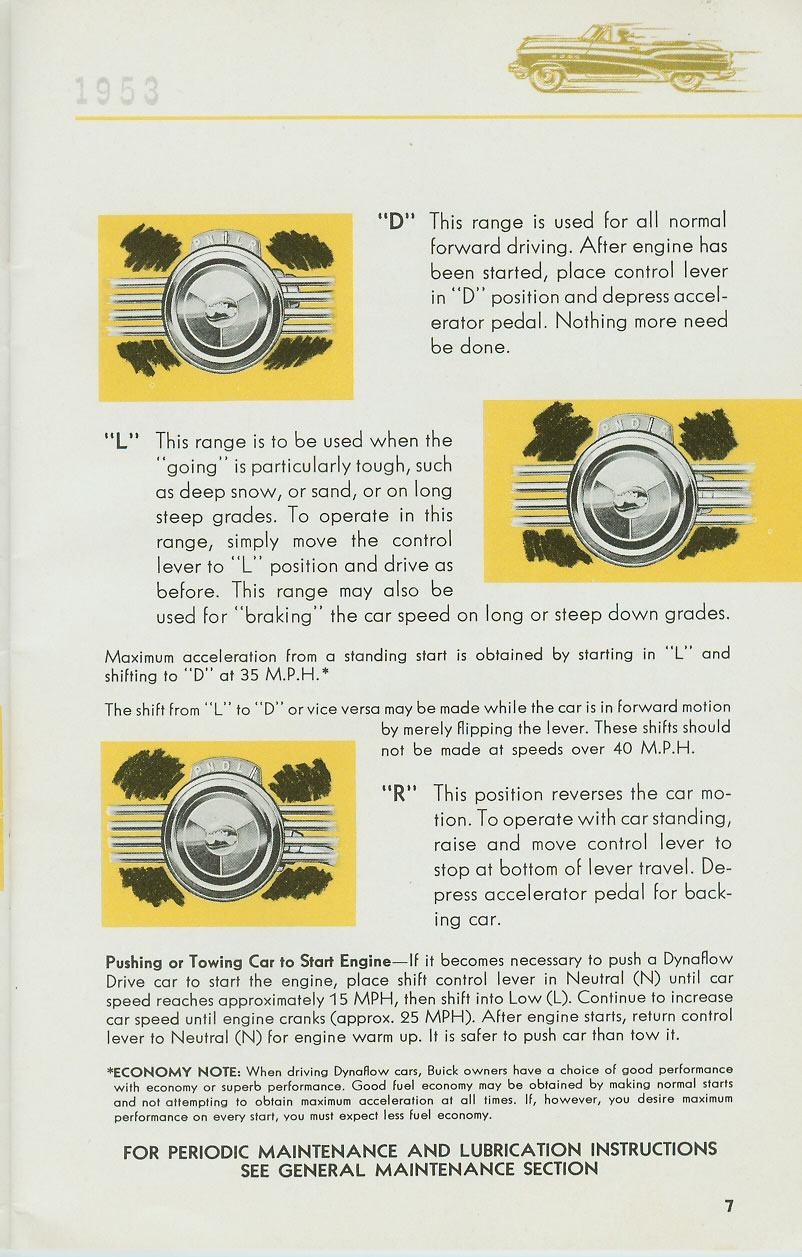
Edit: But wait a minute. If the vehicle is moving downhill, and you engage the clutch in first gear, the engine will be turning. And even if it's not firing, the alternator will also be turning. So you should have enough power for the computer, ignition and fuel pump. Or am I missing something?
http://oldcarmanualproject.com/manuals/Buick/1953/Owners/ima...
This feature disappeared in the early 60s for cost reasons.
Europe has a much higher take rate on manuals.
I'm not hard core enough to have a pre-computer vehicle, though.
With an EV yes, but not with an ICE. Just keep a jump box in your trunk.
The benefits of having a spare "jump box" in the trunk are obvious, but it's important to remember that this means carrying a dangerous amount of energy in form that is a very serious fire risk if anything damaged the battery.
I'm sure there are many other fantastic reasons to want access to your vehicle when the battery is flat.
If you can't open the car, you probably can't pop the hood latch to get a jump-start, which makes the difference between a tow and a simple drive to a store. And "stuck alone at the trailhead with a dead battery" is nothing new to hikers, but being able to spend the night in the car if you have to makes it a lot more pleasant.
Also, are there cars where you need the electronics to disengage the brakes?