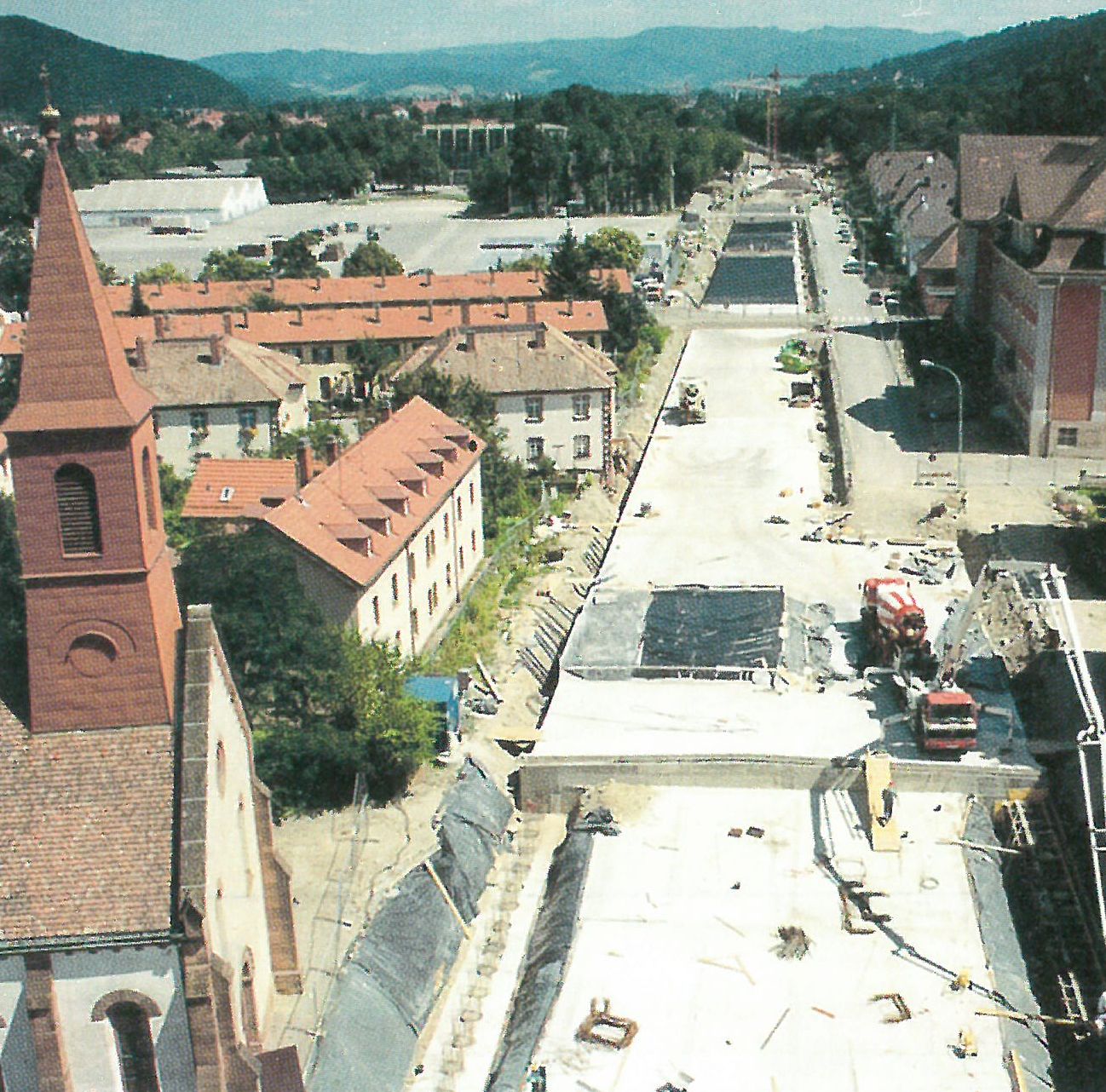
The A2 motorway no longer divides Maastricht(bicycledutch.wordpress.com) |
The A2 motorway no longer divides Maastricht(bicycledutch.wordpress.com) |
Maastricht uses to be the only traffic lights on route from Amsterdam to Paris. Yes. Traffic lights on a highway, in the middle of a city. As if the highway in the middle of a city wasn't annoyinh enough the traffic lights added some extra noise, fumes and pollution.
The new tunnel has been the most magnificent change I've ever seen. And IIRC the entire project was within budget and time.
Sounds like the beautiful little town of Bad Oeynhausen, which I came to loathe(a bit) - I used to drive several times a year from Amsterdam to Krakow(~1300km) and literally the moment you got off the ferry in Amsterdam you were on the motorway literally all the way to Krakow.....except for having to drive through the very city centre of Bad Oeynhausen, every single time. I think last time I did that trip last year there were some intensive roadworks in that area, maybe nowadays there is a way to drive around the town without getting off the autobahn.
It leads you around the town and it saves at least 20 minutes.
The journey through Maastricht over the highway generally wasn't all that bad, traffic would generally flow remarkably well. I think the primary concerns to put a tunnel in was pollution, noise and congestation.
That said, I think there was a KFC and a McDonalds there pretty much just off the road that you can stop at which was just about the right time when my bladder ran out of mileage.
It was nice to slow down and stop somewhere other than a motorway service station!
Town name checks out?
Google streetview has images taken last year and 2009, so you can see the diff yourself.
I know Belgian traffic can be hell but going through Maastricht on the way from Amsterdam to Paris would be quite the detour :)
This is an all too common sight in small town America, unfortunately.
Highways running directly through small towns seems almost the rule, not the exception.
Roads connect people. Towns are groups of people. Bigger roads connect larger groups of people. Bigger roads are the reasonable choice to convert to highways. People like/find utility in highways and roads, so they live near them.
It's an unfortunate extension of this logical process that results in 18-wheeler jake brakes thundering to a stop at the one red light in downtown Podunk, Nowhere at 3AM, on their way between Megatropolis and Port Industry, which leads to complaining at the town hall that they need "no engine braking" local ordinances and proposals that the 5-lane road speed limit should be reduced from 35 to 25. Nevermind that Podunk was established as a town because it was a convenient distance to stop at in horse-drawn buggies passing through 200 years ago between Megatropolis and Port Industry, and that every business in the town survives only because travelers stop there and inject money into the local economy...
Maybe at some point in the past, the major road should have been diverted around downtown by a half mile. But the local optimum the town currently sits at is far below the peak desirable state not because people love noise and pollution but because it's a straightfoward hill climb to the present state and it's hard to avoid that.
[1] There used to be parts which were also called N2, such as the part between Eindhoven and 's Hertogenbosch (Den Bosch). This has been rebuild and has become A2 somewhere in the 90s. After that project (I don't remember exactly when), they rebuild the N2 in Maastricht to become A2.
From TFA, "the one billion euro project is still ongoing, it will not be finished before 2026." There's plenty of time yet!
By contrast, the SR99 tunnel in Seattle was about 1/3 longer, cost $3-4 billion, depending on how lawsuits shake out, and has half the capacity (two levels with two lanes each). The Big Dig in Boston was the same length, and cost 22 times as much.
In timely news (another post on the front page), the A2 tunnel cost only modestly more than it’s costing San Francisco to simply reconfigure Market Street to shut down through traffic.
[0] https://www.stadttunnel-freiburg.de/sites/default/files/styl...
[1] http://www.daub-ita.de/fileadmin/images/daub/TunnelDB/UBD200...
Roughly 140,000 cars are crossing the city through the Autobahn per day.
[1]: (PDF, english) https://www.hamburg.de/contentblob/7896702/27d2e4d96831a306f...
https://www.cbsnews.com/news/worlds-largest-highway-overpass...
Pedestrians and nature need to be given a higher priority.
The feedback loops are all wrong for getting a high value tunnel under Boston. They are at least less wrong in "beer Europe"[0] + Scandinavia.
Massachusetts government "pays itself first" Massachusetts people consider the problem unsolvable and tolerates it. Netherlands and the adjacent parts of Europe (i.e I make no claims about construction projects in Italy) generally takes a hard line against anything that's not "pro-social" so heads would roll if politicians and bureaucrats misused their public works on graft like the Massholes do.
Source: Masshole who geeks out on government accountability
[0]https://eu.greekreporter.com/files/tearing-europe-apart1.jpg
https://www.austinmonitor.com/stories/2019/04/the-idea-to-bu...
I very much doubt it will come to fruition any time soon given the political climate.
All joking aside, if its not a toll road is not getting built in Austin. I'd love to Dig & Cap I-35 all the way to airport blvd.
Although if there's a part of the country that is suitable for boring, it's probably Maastricht, which is in the tiny part of the country that has actual hills.
What are they doing that they can end up with such a disparate outcome with regards to what most people expect from an ambitious public infrastructure project like that?
Like, I don't even think it's cynicism at this point that when you see they want to do something with the MTA or the Metro, they'll say it'll be X Billion and Y months, and you already know going into it that they're low by a factor of like 2-10x.
I guess the answer is "we have fuckups too but not all the time". Could it be the case though that the same holds for the US? I mean usually if something is on time and within budget it doesn't make the news just as much :D
I saw a documentary on the Dig and it was a lot more involved than I would have guessed. Route to the airport if I recall, and a tunnel under a river, and by 'under the river' I mean that pretty literally. The tunnel wasn't far below the riverbed due to other obstructions so they came in essentially from above to lay it. They filled most of an hour just talking about that section.
> US environmental law is much more generous in allowing for judicial review of decisionmaking by government agencies that is alleged to violate relevant environmental laws. It is also much more generous in allowing private parties to enforce environmental laws against other private parties who are alleged to have committed violations.
The US is unusual in the degree to which it allows private interests (environmentalists, landowners, etc.) to litigate and hold up projects that the government has already approved.
Perhaps this is just my perception, but I would say the difference is that European unions (at least northern European, can't speak to the rest of Europe) seem less inclined to engage in dodgy behaviour than their US counterparts. I'm specifically thinking about construction, ports, etc.
I mean the fact that there are people employed to literally do nothing, "because that job used to exist and must never go away" is one example of this. It's not something I've heard of happening in Europe to the same extent it seems to in the US.
It can go both ways, depending on how well things are thought out and executed. We have a lot of people who don't have realistic expectations and don't seem to realize that the Netherlands is largely made up out of artificially build nature which needs to be maintained and kept in check instead of left alone.
Salaries in San Francisco and Maastricht are widely different.
https://www.thebulletin.be/first-wildlife-bridge-over-brusse...
https://www.thebulletin.be/wildlife-crossing-flemish-brabant...
[0] https://www.google.com/maps/@52.1051185,5.3619931,3a,75y,296...
[1] https://www.independent.co.uk/news/world/europe/dutch-soldie...
https://www.seattletimes.com/seattle-news/its-a-long-time-co...
https://www.nationalgeographic.com/animals/2019/04/wildlife-...
Interesting. I found Liege to be a charming little city. The Calatrava train station is one of the most interesting stations in Europe in my opinion. The bike path along the river is quite nice as well. I didn't perceive the town was suffering economically. Would you mind elaborating? Genuinely curious.
Maastricht was always mostly pleasant, and Bad Oeyenhaus I typically use as an excuse to take a break at one of the McDonalds there.
It also makes a lot of sense: fruit brandies are made of fruit like wine, but are as strong as vodka.
Also, the end of the tunnels are a bit more out of the town centre than the road that was dead in the middle.
The alternative was to run the highway around the city, which is probably also cheaper. Though it's nice that they recovered some space and planted grass and trees over it.
The first phase of the Second Avenue subway cost $4.5 billion for just 2 miles, and took 10 years. The next 1.5 mile segment will cost $6 billion (that’s just the estimate) and take another 10 years. And that’s not even all that over budget or delayed.
I’ve never encountered a major public project in the US that was on budget and on time. I’m sure there are some, but that’s not the rule. Here in the DC area, we recently spent $150 million on a bus station (it’s a nice, 3 level bus station on existing public land). That was delayed and was $50 million over budget. The $6 million renovation project in the parking garage at the metro station nearest to me is years behind schedule. The purple line in Maryland is years late and billions over budget. The silver line in Virginia is years late and billions over budget.
Your “disaster” would be a miracle in a major US city. Such a miracle that few cities are even contemplating such things. DC, for example, is growing rapidly, and WMATA desperately needs another tunnel through downtown. And people are willing to spend that kind of money—WMATA just invested $6 billion and a decade constructing the silver line to Virginia. And Maryland is investing a similar amount in a light rail through the suburbs. But a downtown tunnel would be a $15+ billion, 20-year project here.
Granted, it doesn't face WMATA's absolutely insane leadership and funding structure, but it can be done, and even in one of the most complex jurisdictional messes in the US.
Electric cars cannot come soon enough.
One is that most rail traffic doesn't continu 24/7. A train comes by, the crossings open again and it's anormal road for 15 minutes until the next train.
Cars just run constantly. Cars also have exhausts that blast fumes in your face.
Furthermore the rails are usually 2 or 3 tracks next to each other outside the station. That's 20 meter or so vs a whopping 50m+ for a highway.
Yeah I never noticed this as much as the small city where I live now. Both bus stops (near home and near work) are next to a busy road, which is one thing, but one is also right before a traffic light, so lots of accelerating traffic. (The other one is right after, which is much better already.) I regularly hold my breath for a few seconds as a particularly bad cloud (invisibly) passes over me.
I sometimes wonder if, instead of speed limits, we need acceleration limits. Or just emission limits. Accelerate to highway speed in 50 seconds instead of in 20: so long as you're not in traffic that goes from 0 to 100 km/h every two minutes, it should hardly matter for your arrival time. Yet most of the time when I accelerate at a reasonable (not slow) speed onto the (uphill-going) highway, the person behind me thinks they should go alongside to accelerate 5% faster and lock me into the merging lane that is by now running out of space. Must spend 80% more CO2 for 20 seconds to arrive 4 seconds faster at the destination!
They are often lesser obstacles, since they were built when all other traffic was on foot or by horse, and routes for people had to be maintained. Some motorways were built without this consideration, in the period of 20th century motorcar idealism.
As such, railways are less of a dividing barrier.
Most likely the tunnel is really due two conflicting desires - wanting to remove stoplights from the A2 to expedited the flow of through traffic while not wanting to route A2 around the city's east perimeter where there is ample open land. Usually the city retailers and other businesses want to keep the central routing to prevent the development of competing business centers along perimeter highways.
All at <35km/h. Can't open my windows before ~10am.
Which can be a medicinal spring, but also other potentially beneficial effects [2], there are towns on the sea, which have the prefix "Seeheilbad" [3], which is purely based on the positive climatic effect of the nearby sea.
And then, this is Germany after all, there is a long list of other boxes that need to be ticked, see [4].
[1] https://de.wikipedia.org/wiki/Bad_(Kurort)
[2] https://de.wikipedia.org/wiki/Heilbad
Baden-Baden is the only one I know that comes close, and https://en.wikipedia.org/wiki/Baden-Baden#Name explains how it got that name. It's not the spa prefix, but part of the name proper.
Also, "Baden" is a region in the south-western state of Baden-Württemberg that probably has lent its name to other towns.
It is home to one of the two big dialect families in Baden-Würrtemberg: Badisch, the other being Schwäbisch/Swabian.
"In modern German, Baden is a noun meaning "bathing"[4] but Baden, the original name of the town, derives from an earlier plural form of Bad ("bath")"