The boss who put everyone on 70K(bbc.com) |
The boss who put everyone on 70K(bbc.com) |
Workers who feel they aren't being fairly compensated for their labor don't work as hard. They don't show as much attention to detail. They don't have any loyalty to their employers, who they perceive as exploiting them. They are much more likely to quit or leave at the first opportunity for any job that seems better. They aren't invested in good customer service. They grow to resent their employers when they work full time and still don't make enough to afford basic necessities.
Its no surprise to me that paying workers a living wage (or even something close) results in measurable benefits for a business, in a variety of ways (not to mention immeasurably improving the lives of employees).
Further (since this seems like such an alien concept to most high-wage, HN members) getting paid a decent wage also allows massive benefits to the economy and society at large. We're currently looking at a global pandemic with the coronavirus. Given the apparent virility, it seems inevitable that this virus will spread to every country in short order. Most low wage workers don't get sick leave. Many get fired even for taking unpaid sick days. These are your cashiers, your grocery store workers, the people who make your coffee - the service industry workers who make up the bulk of American labor. Even those workers who won't get fired for taking sick days, often can't afford it. We've all seen the stats about the huge number of Americans who cannot afford an emergency expense of a few hundred dollars. Staying home sick qualifies. The containment efforts we've seen in South Korea and Italy have (so far) largely failed - and these are countries with universal healthcare and worker protections that we don't have. Right now it costs $3,200 to get tested for the coronavirus in the United States. Not treated - just tested! Working people cannot afford this and will not get tested, or treated - which will make the crisis worse. How much will this crisis end up "costing" us in the long run? If not this one, how much will the next, inevitable one cost us, because working people don't have the income or benefits to take care of themselves?
Massive kudos to this guy for paying his workers a fair wage. Hopefully other employers are enlightened enough to follow his lead and do the same, with the understanding that paying adequate wages benefits not only their business, but society and the economy at large.
Not if their work doesn’t really differentiate the product. I have all the research I need about products from the internet, so I don’t need a store employee to sell me anything. Same with many other low paying positions. They are low paying because customers aren’t valuing the extra benefits of a non plug and play staff.
There are low-paying jobs for a variety of reasons, including in large part, corporate welfare for the largest employers, like Wal-Mart, which the government subsidies at taxpayer expense to facilitate the payment of starvation wages.
https://www.forbes.com/sites/clareoconnor/2014/04/15/report-...
As far having everything you need for your products due your internet research, I hope you will enjoy the coronavirus (or whatever other communicable disease you acquire) as an added bonus from low-wage workers who are unable to call in sick. The people who brew your coffee, make your sandwich, park your car or do a million other things that allow our society to function. Perhaps when your mother, your aunt or child dies because they were needlessly infected by a low-wage worker who couldn't afford to seek treatment or call in sick to work you will factor that "worth" into their perceived value.
As someone who worked retail in a music store, there's a whole lot of people who have no idea how to even begin finding what they like. Efficient customers like you are a minority.
I'm not sure which is more applicable:
1. Hurray, decency.
2. Shouldn't getting excited about what would've been middle-class income 70 years ago be a sign how far workers' pay has fallen?
The standard of living that 70k USD buys today is vastly better than what the median income bought in 1950.
(Of course, Seattle is rather expensive. The 70k USD would go much further in a city that didn't restrict residential construction so much.)
At any rate, the claim that "stuff" is more expensive because it is better implies that decades of technical improvements have resulted in no efficiency gains. At best, it implies the value per man hour has essentially remained flat. And since the option of buying lower priced versions of items has dispersed, we can never know if the higher quality item is fairly priced.
"Crunching the numbers" does not give details as to how he arrived to 70K. The article made a reference to report by Daniel Kahneman and Angus Deaton, but it is not clear.
Have I missed something?
Edit: I did the calculation backwards. Thanks to everyone who pointed that out.
Now compare with median annual incomes in 1950. Asking Google about '1950 median american income' gives 'Average family income in 1950 was $3,300.' Not quite what I wanted to know, but close enough. (We are looking at per worker income, and would probably be more interested in median than average.)
GP is probably also relating to what you can buy using 70k.
Now, without exact numbers, I can't say economically this or that.
But effectively this was not a zero sum game. The company was not paying more for the same outcome, they were paying more for more output.
The output of the company increased. This is how investments are usually supposed to work, you put money in, and reap profits.
What makes this a bit more difficult to gauge that it's likely the increased performance does not come from individual output, but from a better cohesion of the team which generally makes things always easier and efficient.
What people often get wrong is that they think about wages atomically - I pay this guy this much and he delivers this. Whereas when you are having a team of workers (whose job is not to be a mindless drone) and whose output depends on the co-operationnof the individuals, often the second order effects are more important.
For example: rewards. You give a huge reward to the single top performer in your company. What happens? Everybody becomes jealous of him, and some will feel cheated since they contributed heavily to the projects the individual participated in. Future collaboration will likely suffer.
In fields were output is purely of individual performance (some sales jobs, logging, etc) this calculus is of course different. In these situations the atomic cost analysis probably works.
Everything else being equal, an average business would be outcompeted if they did something like that.
If you still think what they are doing is efficient, take it further and further. Start increasing the salaries more and more. Very soon you will be able to afford one worker. A very expensive janitor maybe?
For Facebook, Google, Apple and Microsoft, not much would change, they don't employ that many people below the threshold, I think, unless you count the outsourced contractors that do moderation, annotation etc. This company's policy doesn't extend to the company they outsource the cleaning of their office to either, so that wouldn't be a fair comparison.
There are very few businesses who target the upper middle class or those with a little bit of disposable income that can afford to go above and beyond for their workers, like Nordstroms, Costco, Apple, Trader Joes, etc. If you notice, these businesses are all located on the rich side of town, and usually there's only 1 or 2 for medium size cities.
You simply won't survive as a business if you pay workers more hoping to get something out of them when the customers don't value it, and reality shows this. If you want to increase the standard of living for low wage workers, one needs to support politicians who will pass legislation mandating paid time off, de-coupling health insurance from employers, parental leave, increasing minimum and overtime wages, reducing # of hours before overtime kicks in, etc.
This isn't a problem a single business can solve, it's a society wide issue that needs a society wide solution.
(The article implies it's for 'Americans'. But it's just not very precise.)
> Everything else being equal, an average business would be outcompeted if they did something like that.
You're operating using an oversimple mental model. For instance: you appear to believe a person will make a fixed contribution in a role, regardless of their wage. That's obviously false when you consider things like the demotivating effects of being underpaid or under-appreciated.
(Though not sure about workers per household.)
> [...] it's increasing because more people in a household are working.
More people are working outside the house and participating in the market economy. Women worked before, domestic chores don't show up in these statistics.
Presumably they produce a lot more working outside the house: to estimate a monetary value of what they did before compare with the prevailing wages for nannies and housekeepers.
> Looking outside of him and caring for other people more than himself, sacrificing himself for others.
(But in addition, there are those restrictions on housing supply that I already mentioned.)
You are right about insulin probably not having gotten much better. There's a few other goods like that as well. Some of those problems are self-inflicted. Eg education is much more costly these days, too.
Who claimed that stuff is more expensive because it's better?
Taking hedonic adjustments into account when producing inflation numbers is the proper thing to do. Productivity improvements would then show up by decreases in the price level measured like that. We can see that for eg computers. A good enough desktop computer today costs less in nominal dollars than in the early 90s, despite being enormously more powerful.
Yes, you are right that we can not buy many of the crappier things any more. That's partially down to regulation, but also down to there just not being enough demand for lots of crappy stuff to keep production at scale running.
So that makes calculating the price level harder. The usual work-around is to only look at adjustments from one year to the next, and chain them.
Another workaround is to go with the Big Mac index. (https://en.wikipedia.org/wiki/Big_Mac_Index) That index is a bit of a joke, since it just measure the price of a Big Mac. But it's surprisingly useful for what it is.
Any commodity TV is immediately beyond-economic-repair, IMO.
1 - https://www.bestbuy.com/site/samsung-50-class-led-nu6900-ser... (literally the first search result I found)
Ignoring the big 'if': most goods today are better than what we had in 1950. Especially if you compare the quality of goods that required the median worker to work the same amount of hours.
The 'junk' you talk about takes minutes of work to earn enough to buy. And most of the time, that's good enough. The stuff that you spend a few hours of pay on, is mostly so much better.
Another commenter already pointed out that the example of repairability don't really hold up. It's mostly because wages have increased that repairing those things doesn't make much sense any more.
Just think how much time even well-to-do middle class women used to spent on darning socks and mending clothing. Basic clothing is too cheap to measure these days.
Cars need much less maintenance these days.
It's easy to view the past with rose tinted lenses. But most things were really crappy.
See https://www.gwern.net/Improvements for more on this perspective:
> clothing has become almost “too cheap to meter”; the idea of, say, darning socks is completely alien3, clothing companies routinely burn millions of pounds of clothes because it’s cheaper than the cost of selling them, and Africa is flooded by discards.
> materials science has produced constant visible-yet-invisible improvements in textiles yielding, among other things, far better insulated (and cheaper) winter jackets: instead of choosing between winter coats which make you look like the Stay Puft Marshmallow Man or freezing (and if you get wet, freezing anyway) or exotic ultra-expensive garments aimed at mountain climbers, you can now buy ordinary (and much cheaper) winter coats which are amazingly thin and work even better to keep you warm—so much so that you have to be careful to not buy too well-insulated a coat, lest you swelter at the slightest exertion and be placed between the Scylla of overheating & the Charybdis of opening your coat to the freezing air to cool.
I submitted Gwern's piece at https://news.ycombinator.com/item?id=22441865
The more expensive insulins that are on the market have different effect profiles that (somewhat) simplify managing blood sugar.
If you look at inflation only, that is equivalent to saying that workers should have gained absolutely nothing from technology and efficiency gains made in the past 70 years. But obviously we know that workers are far more productive today than they were in the 50s, and the extra productivity per worker is reflected in GDP.
I'd be curious to see the numbers for my assumption, though.
But yeah, the original comment we are replying to doesn't have much going for it.
[0] https://www.businessinsider.com/if-people-knew-the-actual-in...
In any case, I agree that inflation (or more precisely, the price level) is a finicky statistic to agree on. So if you are making an argument, it's better if you can avoid inflation.
Eg people like to argue whether median real income has stagnated or not. And that crucially hinges on inflation. But what they actually want to talk about seems to be whether workers get 'exploited' more. So we can instead look at the labour share of GDP over time. No inflation adjustment necessary.
The article you linked to is somewhat hilarious. It suggests eg China is cooperating with the US in massaging American inflation numbers. (See point 2 in their list.)
An extreme example - there is a reason a SEAL team is called a team.
This is the problem with wage discussions. People equate a measurable commodity like gasoline to the number of hours worked at a specific job.
Sometimes this is a sufficient analogue, but often times reward mechanisms are more complex than that. There is a good reason rewards mechanisms in jobs are a lively field of academic study. People just forget this does not only apply to top managers.
I appreciate there is a bit of a difference with a team of people. But generally how else are you going to gauge the compensation of any individual reliably other than market rate?
This approach has shown to substantially improve my quality of life.
If you were a business owner, what would be the correct referral market rate if the people whose compensation you are gauging is a tight knit team with years of experience on your specific business and customer needs?
> And places that pay everyone a reasonable wage at least tend to have that more often than other places.
I've seen almost no evidence of this other than at the real extremes. Maybe it is differences in the UK market vs elsewhere but typically you won't find a big difference in rate between one contract and another in roughly the same locale with everything else being equal.
99.5+% of people are better off economically and time-wise to throw away any out-of-warranty TV undiagnosed and buy new.
>cars need much less maintenance these days.
And, especially if you lived somewhere with snow and salt on the roads, they mostly lasted about 50K miles before they rusted out. Growing up, it was an unusual car that made it to 100K.
That said, minor repairs of otherwise functional gear can make sense. I'm generally in agreement on electronics. But I fairly commonly repair or have repaired hiking or camping gear for example that just needs some stitching to get back in working condition.
In the anecdata department, the last time I took something into REI to be repaired they told me they didn't do that any longer and to send it to Rainy Pass in Seattle.
Documentation helps, but people knowing their way around the code is better.
Software engineering is mainly knowledge work. This means the majority of work consists not of building stuff, but acquiring and organising knowledge. I've read somewhere that about 50% of the job is gathering information.
When a person leaves after having spent two years at a company, it might look like you get to keep everything they've been working on, but this is far from true. If the 50% assumption is correct, a person leaving after two years means you throw a full year of work into the dump. This is a huge cost, but it's hidden.
The code is there and (presumably) in source control. It really isn't that difficult for someone to get the source, compile it and fire up the debugger and carry on where the previous person left off.
There is so much implicit knowledge that goes into the finals source artifact that is not spelled out.
I had an interview at a this week for my next contract where they made redundant most of their employees as the business decided to just go with turnkey applications.
They will get someone like me in for 3 to 6 months to do application maintenance on anything they can't replace. This will be stuff like implementing stuff from penetration-testing, upgrading the applications and documenting missing bits and pieces and letting the business know what needs doing and where.
I don't need a pension being paid, no HR overhead (they can just ask me to leave whenever pretty much). I will be able to gleen enough from the business and their IT to piece the bits together. This is literally my bread and butter.
Who’s consuming the code? Who are the stakeholders? How does this component integrate into the full picture of the application? How do I need to talk to that person that I really need to change something?
However unless building the tech is the business you are seen just as a cost to the business in most circumstances.
How are you going to discover that from just the sources without any institutional knowledge? It sounds to me this applies only to a specific niche you've managed to find. I.e. you get only those gigs where institutional knowledge is not paramount as the employers who need deep domain knowledge are not even trying to hire you. I don't mean this in a deragoratory sense - it sounds to me you provide great value to your employers - but just in that you work in a specific market segment and what is true in your segment might not hold in others.
> I don't mean this in a deragoratory sense - it sounds to me you provide great value to your employers - but just in that you work in a specific market segment and what is true in your segment might not hold in others.
I've worked in many different sectors. Normally fintech though.
Dan Price really is like what is presented in this article. He actually cares about his employees and is being genuine here. He's a good person, making a private business decision to increase the pay of frankly his lowest paid workers.
In a city where the average tech worker earns $275k a year, he believes its the right thing to do to make sure everyone that works for him at Gravity can earn enough to afford rent, food, and some fun.
Say what you will about the merits of decision, but it takes real leadership to make it and stand by it. I happen to think he's doing the right thing and I hope other companies choose to follow suit.
He really does come across as great guy. If I was more local I would probably look to work for him.
Like, I could see somebody not feeling like that's fair so I'm wondering how the morale was impacted by that.
I need to move to bay area this year. thats my sole mission this year.
I think I remember reading that Americans, on average, have $700k saved up for retirement. When I dug further into the data, the median was many multiples less than that.
I’d add Portland, Austin, Minneapolis, etc. to your consideration. Comp is 25% lower, but cost of living is even lower than that.
"There is one rule for the industrialist and that is: make the best quality goods possible at the lowest cost possible, paying the highest wages possible."
-Henry Ford
I chat with 2 russian chaps working on the technicalities of that challange (coding the model in sofware) they had an interesting thing in common. They both had parents who tried to work the paper administration in soviet days. They told their kids countless horror stories about misplacing a bit of paper excluding entire regions from goods, like no shots. The parents were extreamely entugiastic about computers when they came onto stage. That! That is what we needeed!
It’s in the title. ‘Everyone on 70k’ is a pay cut if you were in more than 70k, as any professional would be. It’s clearly wrong as it doesn’t make any sense, but that’s the source they were referring to.
I spent the first several years of my career working in academia for a poverty level wage.
I can confirm from my own experience that when you worry about not being able to pay rent and all the bills, it's very difficult to be productive, much less in a job that requires any kind of focus or creative thinking.
Some articles that talk about the other side:
https://www.bloomberg.com/features/2015-gravity-ceo-dan-pric...
https://www.hundredeightydegrees.com/investigation/2018/2/27...
“Gravity’s 2014 profit was $2.2 million, Price adds. At private companies with sales like Gravity’s total revenue, salary and bonus for the top quartile of CEOs is $710,000, according to Chief Executive magazine’s annual compensation survey. At companies with sales like Gravity’s net revenue, the top quartile pay falls to about $373,000. At companies with a similar number of employees as Gravity, the top quartile of CEOs makes $470,000 in salary and bonus. The CEO of JetPay, a publicly traded competitor that processes a similar volume as Gravity, received $355,000 in 2014.“
Yet his comp was $1.1MM?
“Price signed with the talent agency William Morris Endeavor Entertainment and now charges as much as $20,000 per speech, Pirkle says.”
Or his obvious avoidance to answering the direct questions. It’s cool what he did, but I don’t trust the guy. Or at least I doubt his motives are so honorable. Perhaps I’m too cynical.
It’s been 5 years, or $150k each, and there’s been no apparent bad news. What more do you need?
Have you changed in the last 5 years?
The hiring quality will also increased. For example, with a 40k salary, the company could hire someone with 5 years of experience, with 70k, they can find someone with 10 years of experience.
So in a few years the company will get rid of low performance and hired more skilled workers and the salary vs skill will match the market rate again. (with a few exceptions)
When they stop growing and increased competition will cut into their margins, and especially if they start losing money. At that point, they'll be looking at efficiencies everywhere - and those expensive employees will probably be laid off.
The mentality of these people...!
Not people you want in your company
As senior employees, maybe they had stakes in the company. Maybe they didn't want to go through the above.
I have hard time believing this.
Not sure if this means ALL of his stock, but this doesn't seem to be the same thing.
But what works in a group smaller than Dunbar's Number[1] may not quite scale up.
Don't let that Politician Obfuscating Near You (PONY) con you into believing otherwise.
Real systems usually are mixes. E.g. Soviet system is largely slavery plus some bits of capitalism and a lot of propaganda to cover the monastery aspect. Or a capitalist company with a visionary leader may be quite a monastery too.
Now, the most pleasant way to work is indeed a monastery, but the one that scales well is capitalism :) Slavery is inferior on both counts, but may work when there's no way to add economic interest.
Scaling above that starts to require some external management structure (your corporation).
Then there is the military (retired Navy here) where there is an explicit hierarchy and a Uniform Code of Military Justice to as an external driver.
Hence the authoritarian fascination with military terms. If that's your thing, then organizing society like some vast bipedal ant colony seems attractive.
> in Seattle that wasn't enough to afford a decent home.
Because the population in Seattle has grown by leaps and bounds, if everyone could afford one of the supply of homes, the prices would go up until demand equals supply.
>make building affordable units a higher roi than building luxury units, etc.
Every luxury unit that is built lessens the pressure on housing demand.
So the key is: just build more housing.
However- it still needs to be said that we really ought to fight to create an economic system in which everyone has the means to have a comfortable life, even if individuals that make it up are not virtuous. Because this kind of story is a rarity, and the market will certainly punish him for his generosity.
Why do you think everyone should have the means to have a "comfortable" life? Perhaps you mean means to meet necessities? If not, what does "comfortable" mean to you? Additionally, why do you think that the means are not there today?
1) Him making $1million salary at a small-medium company is quite a bit, but that may be because ...
2) ... the company is clearly making a lot of money (as in a lot of profit) and/or growing quickly. When you're growing and making huge profits at a software company, you can afford to pay above the market rate because you have spare cash. At some point that will change. The growth rate will plateau and they will cut salaries (maybe not for existing employees, but for new hires), or layoff expensive staff.
But props to Dan to get this done when he had the chance to.
37signals would be proud.
If you decentivize the most productive people, then you might hurt the rest of the company.
Journalism shouldn’t give coverage intended to benefit a company. But it’s just as important they don’t forgo telling a story they consider interesting just because it might incidentally benefit the subject.
It's interesting but sad watching that creativity vanish as the rents rise. There's more money here now, but less creativity.
I think this apparent contradiction is resolved by asking "who had the time to be creative?". When rents were low, artists could make ends meet and still have time to create. As rents are rising, the artists are pushed out, or forced to spend more time making money. The new tenants are people earning decent money, who again are either working too hard to create, or are not "artistic" in that sense (me included).
The old squats and communal housing are being redeveloped, the graffiti-covered walls are being repainted so the houses they cover keep their value. The focus moves from "poor but sexy" to "let's make lots of money". Everyone is richer, except the culture.
It's a concern that spans decades.
https://www.cbc.ca/archives/the-last-days-of-toronto-s-low-r... — This article dates to the 80's and its tone is the very same.
(Canada's lost sweetheart PM hopeful is interviewed in one of the videos when he was a Toronto city councilor. Such a loss. He really had his finger on the pulse)
Seems like we are regressing from artists back to "mathematicks". Hopefully we don't regress further into "Politicks and War".
― Virginia Woolf, A Room of One's Own
>Shafts were driven down into the ground and galleries opened where slaves, chained, naked, and branded, worked the seams illuminated only by guttering oil lamps. An unrecorded number were children. It was a miserable, dangerous, and brief life. [0]
It is always the most comfortable that consume the most vivid persecution porn. Feminists seem to have been doing this for a century longer than the The Handmaid's Tale, which was my introduction to that brand of mental illness.
[0] The Rise of Athens: The Story of the World’s Greatest Civilisation
Not only do you worry about your own small income; but grants, scholarships, registration fees and a myriad of other things have in recent times become volatile and can be taken away from year to year.
Most of the issues is due to 1) our government being corrupt and 2) promises the government made about free education.
I am not against free education, but I am against impoverished professors.
This is why I decided to side-step academia. It is delaying my PhD by probably 3–7 years (I am at year 2's start now) but it's better than having in theory 100% time spent on a PhD but actually worrying about the University and your peers, your own future, etc. in reality.
Welcome to the sad reality of academia almost everywhere in the world. (sigh)
Basically in order to be productive under those circumstances you have to ignore reality, which can be problematic for the people around you.
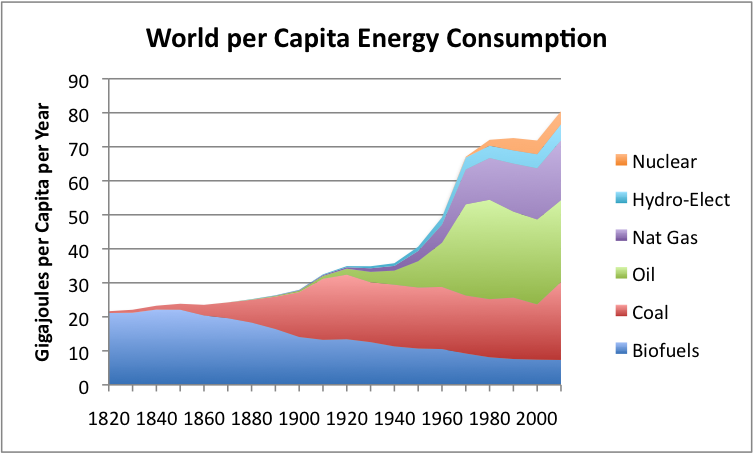
But at the same time everything is relative on your perception of reality. We spend today 50-100 times more energy per person that people 100 years ago, and most of those people were happy.
We upgraded our expectations, specially because of mass media and advertisements and feel always dissatisfied because they will compare us with people that have more than we have.
Obviously, the more materially rich your society is, the better the latter deal is, but happiness comes from feelings of safety, not being overworked, and solid social ties.
https://www.eia.gov/totalenergy/data/annual/showtext.php?t=p...
https://en.wikipedia.org/wiki/1920_United_States_Census
In 2018 the United States consumed 101.2 quadrillion BTU of primary energy, with a population of 327 million.
https://flowcharts.llnl.gov/content/assets/images/charts/Ene...
https://www.worldometers.info/world-population/us-population...
Primary energy consumption per capita in the United States increased about 54% in the last 100 years, not 5000%.
Global energy consumption per capita has grown by nearly 300% since 1920:
http://theoildrum.com/files/per-capita-world-energy-by-sourc...
This is still much less than 5000%.
I’m asking out of general curiosity and not snark, but is there a reliable source to this?
A cursory search on my end didn’t return anything. I often wonder if the obsession with “happiness” is a relatively recent phenomenon borne of our own privilege.
my mum has not been financially stable for over a decade. in this time she has been starting to "reset" what she finds acceptable. just recently she had to downsize her house and she has already focused on only what I can describe are ways to spend money to avoid reality. she recently listed a train of things she wants to do to her new house that sounds like she wants to stay there for the rest of her life. when asked about the conflict between staying and her next year goals is met with internal strife. she couldn't accept the fact that she needed to use what little money she had to lift herself out of her situation. instead she put priority on installing a dishwasher in her 600sqft apt to help the next person.
your brain is the greatest troll ever to exist
100 years ago was 1920. That is two years after WWI. That is destroyed countries moving from crisis to crisis, veterans struggling to become part of society ...
citation?
I am scared of losing my job though, because of a lapse in mental health or whatever. Not because my expectations are high, but because I'm afraid of having to sell my house in a hurry and move into a small apartment with my wife and my 3 children, as well as the feelings of failure and shame.
Is that known?
Expectations are also imposed. We have to commute to our jobs and pay for our apartments that conform to building codes.
Lacking money occupies your mind, you just tend to forget if money isn't a problem anymore.
To me that's the main benefit of earning more. Sure, it's nice to be able to buy more expensive things overall, and e.g. be able to travel more, but I find more value in the many tiny day to day improvements that individually sound trivial, such as not having to budget when at the grocery store. It's a few minutes here and a few minutes there extra where my mind is free to relax or focus on more interesting things, and it really adds up.
There was a year in my youth when I had a big economic setback, and suddenly had to budget my day to day expenses again, and frankly, the time I lost that I had to spend thinking about money, from the small things like how much I could afford to spend for lunch to how to cover rent, was exhausting, and a very stark reminder of how easy my life had become prior to that. And I've never experienced true poverty - I always had multiple safety nets; I'd never have starved, for example.
I think the mental exhaustion from dealing with a strained economy is one of those things people who haven't experienced it tend to don't get when trying to imagine what life is like for people who have little money.
Not disagreeing, just trying to add some complexion.
Poverty may even trigger creativity at times. But stress is the major impediment, and therefore living in long-term poverty does not favor sustained creativity.
"I must study politics and war, that our sons may have liberty to study mathematics and philosophy. Our sons ought to study mathematics and philosophy, geography, natural history and naval architecture, navigation, commerce and agriculture in order to give their children a right to study painting, poetry, music, architecture, statuary, tapestry and porcelain.”
Like Maslow's hierarchy of needs... generally people have to expend their creative thought on how to provide for themselves before they have the opportunity to use that thought in more expansive ways.
Do a Dan Price and you jump start people's ability to settle the lower levels of needs and be able to make more choices.
water / food / electricity doesn't total high for my needs, rent on the other hand
I guess that's why artists lives in old buildings sometimes..
ps: also, call me crazy, but I think in a hunter settings you'd have more time to wander and create than todays city life. As long as there's enough rabbits around to grab ..
https://en.wikipedia.org/wiki/Henry_Cavendish
This guy managed to get a measurement of G (the one from high school physics) in his basement IIRC.
It's a shame that so often that thing seems to be how to pay rent on time, or being able to provide for your familiy financially.
Who was paying you and could you not go do something else for money?
0:
I also "lost" a lot of money this week, but I'm not leveraged and I have positive monthly cashflow, so it's no big deal. I just bought a little more of my favorite broad market etf than usual and went back to my life.
Although we are the exception not the rule. My last job had me running around exhausted and I thought being super productive would increase my bonus (narrator: it didn't)
I'm with you for the second part, I think the results can be looked at independently. However, I don't think one good deed should excuse past bad behavior and one should be careful about glorifying someone to the extent that we ignore their misdeeds.
I really hope that was intentional.
The article specified that "two senior Gravity employees also resigned in protest". Do you have a source for "a lot of the high performers" outside of those two?
It sounds to me like it worked out for the company, regardless of the CEO's personal goings-on. It's a win for the idea that if you pay all your employees reasonably, they won't just fall back and let the company crumble. I think it's really important to point and show that this initiative, which so many people derided as ridiculous and guaranteed to fail, actually worked.
I'm not sure what value the "high performer" qualification has in this instance. They were the highest paid, but I don't think we have any guarantees to their actual output. If the CEO is an untrustworthy agent (as some of the stories make him out to be) how can we trust any of the valuations of his employees?
https://www.bloomberg.com/features/2015-gravity-ceo-dan-pric.... https://www.hundredeightydegrees.com/investigation/2018/2/27....
https://www.bloomberg.com/features/2015-gravity-ceo-dan-pric...
https://www.hundredeightydegrees.com/investigation/2018/2/27...
https://www.bloomberg.com/features/2015-gravity-ceo-dan-pric...
source: https://www.geekwire.com/2016/dan-price-70k-ceo-prevails-sui...
> Lucas Price served the suit on his brother prior to the $70,000 announcement, and the core allegations related to the preceding years. The suit alleged that Dan Price used his majority control of the company to pay himself excessive compensation, manipulate valuations of the company to his financial benefit, and charge hundreds of thousands of dollars in personal expenses to the company.
FWIW, Dan Price (owner of Gravity) is the real deal.
While I no longer work there, I am proud of what he is doing. He is a capitalist, making a decision as a private business owner to help improve the lives of his employees earning < $70k (in the expensive Seattle area mind you) by reducing his own compensation.
That's true. We need to build more units. But for the price of one luxury unit we could have 1.N affordable units.
Also, building luxury units often displaces existing residents and replaces them. Yes that might be necessary, but it also should be humane -- it's not acceptable to just evict everyone on a block and shrug. We need to be aware of the impact of evicting families in the name of progress.
It boggles my mind how people spin the stories to protect professional landlords, a class that does nothing but extracts productivity.
It's one thing to aspire to have a good life. And totally different to derive your happiness from watching others suffer.
I grew up in Norway; incidentally, one of the most famous Norwegian novels is the semi-autobiographical "Sult" (literally "Hunger") by Knut Hamsun, describing a young writers descent into madness as the hunger grips him as he wanders around in what is now Oslo.
But I've also seen the flip side, where you spend so much time worrying about money or acquiring a semblance of security that everything else gets pushed aside.
So I guess it depends which part of world you talk about, tho none of it sounds perfect.
The data seems to show that improving those indicators seems to increase happiness up to a certain level, after which they have much more marginal effects. One theory is that once basic needs are met, happiness becomes "relative" to the people around you, so rich countries/societies getting richer doesn't further improve happiness.
I can't speak to what was going on 100 years ago but based on the above I'd imagine they were a lot less happy than we are now - as a lot of people were not having their basic needs met.
But then again, we will never know about extremely creative yet poor people who are struggling to make ends meet and wasting their precious mental energy on things others take for granted.
But that does not discredit the original point (to which I was agreeing), that being poor is not an impediment to creativity.
Would be hard pressed to do that as I don't come from a place of privilege. Check your assumptions.
On top of that being broke and exhausted makes it difficult for people to change what they are doing. If you can't go two weeks without a paycheck, how are you going to switch jobs, etc..
and no i don't recommend anyone doing what i did, but basic technical analysis said to sell [or buy puts] last week and with enough time watching markets you will know when an oversold relief rally is due [including mini rallies within overall downtrends]
If you've got existing, working infrastructure built out for population X, you have a lot more building to do to support 5X. Often that requires tearing down existing, functional infrastructure and replacing with larger.
I don't really see your argument. The per capita expenditure should be the same or less.
If really necessary, just charge real estate developers for it.
That allows you to save a bit on the roads and sewers on a per capita basis.
Power plants are usually handled by the market already.
That's basically a position that makes money go away as an immediate problem, and then the rest of the appeal is having one's hobby as one's job. Scientific freedom and intrinsic value.
And immediately allow that it's not the sole metric.
Subcontracted workers are technically not employees of Google, therefore can be disregarded when making claims about the min salary of employees.
It's all a bit tongue in cheek and silly.
It does have some real world consequences because of some regulation that requires companies to publish some information about the ratio between CEO pay to lowest paid employee.
But as we noted here, who is officially an employee and who ain't is flexible.
Uber and eBay and Amazon are an even more extreme example: Uber drivers and eBay sellers are at the heart of what makes those companies tick. But they are not employees.
I disagree. What you say is true in a lot of cases [1], but you're devaluing personal growth way too much. This guy's "one good deed" was a drastic and radical break with his misdeed of overpaying himself. He deserves all the glory he can get for that.
[1] For instance: a businessman who spent his life exploiting thousands to make himself rich, who then engages in some half-ass charity at the end of his life.
"In journalism, we recognize a kind of hierarchy of fame among the famous. We measure it in two ways: by the length of an obituary and by how far in advance it is prepared. Presidents, former presidents, and certain heads of state are at the top of the chain."
- Walter Cronkite Quotes
American - Journalist November 4, 1916 - July 17, 2009
Of course, if you are not profitable...
Which it seems like it must not be due to owner renting out his house and crying at a new car. Maybe not profitable due to the salary expense?...
(Though if we could generate them out of thin air, that would be great, too. Simple way to shore up the tax base.)
So how is it? Dig up the street and build taller flats (oh no, digging up streets is expensive!), or commit to suburban sprawl (oh no, spreading infrastructure wide is expensive!). Pick your poison; either way people are going to have the infrastructure they need in one place or another, unless you kill them off.
Nevermind the the third and obvious alternative of expanding the city with high density buildings and new infrastructure to support it. You don't have to interconnect every sewer pipe in town just because.
Also: if necessary, do charge the developers, and use that to finance the upgrading work and perhaps some modest handouts to existing residents to compensate them for the trouble. (Perhaps have different parts of the city compete in an auction on who would accept the smallest handout to be upgraded first. Allow negative bids as well, in case some parts of the city positively want the upgrade.)
There is a pressing and urgent need for more housing, but there is also a huge eviction crisis in those same cities.
So what can we do?
Public housing/Public funding for housing -- fund both capital and operations publicly, paying developers more to incentivize building non-luxury units.
Tax empty units -- Taxing units that are empty reduces speculation in homes. It should not be financially possible to buy housing and leave it empty as a way to store value.
Rent Control -- Limiting rent increases tenant control over a neighborhood, limiting the amount of speculation and acting like a bit of a brake on market rate.
Build More -- Upzoning, especially with regulations that require more units per lot and require moving tenants to equivalent units while construction is ongoing. It's no good to tear down a bunch of townhouses and put in an apartment building with the same number of units.
Eliminate minimum parking -- Parking takes a massive amount of space. Especially in an urban core. Use that space for housing people not cars.
Decommodify Housing -- Make it less profitable to be a landlord. Give tenants right of first refusal in the sale of their buildings, form housing coops, guarantee tenants representation in legal battles, create stricter laws around evictions. If it's less appealing to treat housing like a commodity, it's easier to push for housing as a right. All of these things are about making small chips away from the power of landlords to extract rents.
Affordable Foreclosure Insurance -- Insurance helps ensure people can stay in their homes, upkeep their homes, and continue to contribute to the neighborhood. Reduces the amount of home flipping pushing prices upwards.
Community Land Trusts -- There are groups that buy land/houses and sell/rent them at below market rates (with the rider that the property must be sold later at below market rates.) In Seattle, for example: http://www.homesteadclt.org/ By putting downward pressure on market rates, you further decommodify housing and make it easier to push for reforms that make the ROI better for housing more people rather than more luxuriously.
Stiffer Penalties for failing to upkeep apartments -- When apartments fall into disrepair, whole buildings need to be taken offline or people refuse to live there. Requiring high standards in maintaining apartments ensures that the housing we do have doesn't get taken out of circulation too early.
Edit: I'm assuming you asked in good faith. I don't think we need to do all of the above. I don't think we can do all of the above right away. But combinations of the above I think are achievable and could lead to better communities. Happy to discuss any of them more, provide more resources, etc.
Would call center staff, receptionists etc not be professionals (I.e. is there a use of the term I'm not aware of?). Is it people doing work requiring degrees?
Are you just asking what a 'professional' is? As in you're not a native speaker?
The etymology is from 'someone who has professed vows' and traditionally means someone who's part of some kind of learned society. In the past it was classes like doctors, lawyers, religious ministers. Over the industrial revolution it began to include engineers. Engineers used to be part of learned societies (I am, as a software engineer), but now it's more relaxed in many places, with software engineering being at the extreme end of relaxed.
So not call centre staff, because that's not part of any learned society and are not part of a career that would traditionally have been so but has become more relaxed.
Wikipedia explains well https://en.wikipedia.org/wiki/Professional.
Are you confusing the term with just 'anyone who works for a living'? That's not what 'professional' means.
Indeed.
> Are you confusing the term with just 'anyone who works for a living'? That's not what 'professional' means.
That's how it's commonly used in sports, perhaps that's where I got it from. I'd call any athlete who performs their sport for a living "professional", not because they are e.g. part of a specific league, but exactly because they can do it for a living.
But regardless: which people in a typical company would be the professionals? People with protected titles (Lawyers, etc)? How do e.g. Engineers fit in?
To a certain extent, I think you are guilty of relaxing the definition just as you accuse the OP of doing.
Strictly defined “professional engineers” are licensed and do take those vows of ethical behavior. However, the vast majority of people claiming an engineer title do not meet this criteria. While somewhat pedantic, it does carry legal meaning. Some states have even brought lawsuits in this regard, although I think they were ruled against.
Imagine the stereotypical Asian immigrant middle-class parents and if there's a profession they'd be absolutely thrilled for their kid to go into, that's likely professional class. The happier these imaginary people are, the more solidly professional class it is.
The difference, in my uneducated opinion: commercial and retail space in those cities goes up. It is not strictly at street level, as in Toronto. Look up and you will see signs for bunny cafes, stationery, restaurants, all kinds of small/odd fashion stores...
All the condo districts in Toronto look the same: a small sliver of retail on the ground floor, invariably Rexall, Rabba's, or Aromas. And that's pretty much it.
Would love to hear from someone more familiar with urban planning on this topic.
Most cities have problems with staying creative in the face of high rents because most artist jobs pay very poorly (unless you're one of the few who makes it big). It's pretty terrible that musicians, writers, painters and sculptors tend to be in salary brackets where they can never retire and never own a home unless they become huge.
The art and culture of a city will suffer greatly if the next generation of artists is entirely forced into corporate jobs with part time on art. This is even more true if those jobs require creativity reducing the creative energy available for art.
Parkdale still has its moments but even it is being hit now and Little Tibet is feeling that sting.
There's constant [sad/angry] joking about every block consisting of Shopper's Drug Mart, Rexall, Starbucks, and bubble tea. It's not at all that bad yet, but it's also not as much of a satire as it sounds, sadly.
These days my partner and I have been strongly considering a move to Hamilton if we can sort it out with our work.
Where are the artists going to?
Where are the places that used to be rich, but are becoming "poor but sexy"?
The savvy ones scrounged up enough to buy property and either hold out their with less of a community, or they sell and move and just do their own thing.
In Ontario, there isn't a cheaper place for quite an expanse. Hamilton or other smaller cities are a bit of the last holdouts. But because of some of the exodus from Toronto (and like cities) they are being bought up and redeveloped as well.
Some escape to small towns, but those usually stay small and grow sleepy even though they're interesting places.
I've always worked a day job, even at my most active, so I've kind of had one foot in both worlds.
Cities were attractive because people were close together—there was variety, word could get around. They were vivacious. It would be terrible to see that completely snuffed out.
oh, you said poor AND sexy...
funny enough though, as oil and gas declines in importance (and loud, oxygen-sucking volume) some new and preexisting voices are getting an opportunity to emerge. We're young, educated and ambitious so despite poor economic fundamentals I'm bullish ...
I also am fairly certain its total comp and not salary...
My end goal is to move to the Okanagan and get a remote job where I could get similar pay to Vancouver with much lower living costs.
> But regardless: which people in a typical company would be the professionals? People with protected titles (Lawyers, etc)? How do e.g. Engineers fit in?
People who's careers would traditionally have been part of learned societies that you had to profess vows to get into, and then careers that have grown up around that.
Lawyers, engineers, HR, marketing (there are learned societies for HR and marketing), etc.
There are political volunteer call center workers aiding the campaign of their favored candidate.
A barber is probably even qualified (which the call centre worker may not be), but it's a vocational qualification; cutting hair is their vocation; it isn't a profession.
Also, as others have pointed out, certain components of total compensation, like various forms of 'equity' in the employer company, are not reasonably equivalent to cash, and no one could feasibly evaluate the cash value at any particular moment in time given all of the relevant variables needed to even estimate those cash values.