Also maybe a lot of American students aren’t aware of this, but there are many “needs based” government scholarships out there that can make your state university effectively free to attend. I attended a state university from 08-12 and didn’t pay a dime, thanks to the Pell Grant and some needs-based scholarships from my state (Arizona Assurance).
It seems like the rough spot with regards to paying for college is being too rich to qualify for the needs-based scholarships and too poor to have your parents be able to afford everything. For that, I sympathize and would probably recommend the community college approach.
That being said, I disagree with your advice in two cases:
1) Most top schools offer free tuition if your family income is below a generous threshold (like $150k). If you can get into Stanford and meet this criteria, it's cheaper than your local community college.
2) If you are studying a technical field, even if you are average, a degree has greater ROI than just about anything else. You can pay off your debt in the first few years out of school and continue earning dividends for the rest of your life.
If you are an average student and studying a non-technical field, then the decision is not as clear.
What's the downside to going to a community college? Where I grew up the credits were transferable.
They did say, "Most people spend the first two years figuring stuff out". I went to college knowing I wanted to study computers, but didn't know what specifically. If I changed fields I'd still have the first 2 years to pay back.
I wish I had gone to a community college first. I overpaid for a worse educational experience. There was too much competition for core classes. So you had to wait semesters to get in. When you did get in the class sizes were much larger. Equivalent, transferrable classes were available, cheaper, and had smaller class sizes at nearby community colleges.
He said the first two years. In a lot of cases you can still get the same 4-year degree with two years of CC if done properly, which would actually result in a higher ROI.
This is only a few private schools doing this and they account for well under 1% of all people attending university in the US so not really relevant.
> 2) If you are studying a technical field, even if you are average, a degree has greater ROI than just about anything else. You can pay off your debt in the first few years out of school and continue earning dividends for the rest of your life.
You're still getting a degree. I work/have worked with people who went to MIT, Harvard, Yale, etc. and the degree only mattered for them in the case they wanted to do research or for their first job. Beyond that it has very little value in the job market. The fact that I got to the same place they did without a degree also says something.
tl;dr you're choosing to disagree with good general advice because it doesn't account for 0.02% of americans
Once you do that, you don't have to take GE classes at most UCs and CSUs.
Transfer students typically take IGETC classes at community college, which is what allows them to graduate in 2 years once they transfer.
I realized I could take these classes while in high school and so I finished all my IGETC classes while in high school. It did a middle college program my senior year, but even if I didn't I probably could still finished IGETC, by taking community college classes online and using AP scores.
This allowed me to graduate in 2.5 years from UC Berkeley with a CS degree. I didn't have to take any GE classes at all in college (though of course I could've if I wanted to). I then paid off my student debt after a couple months of starting my first job.
This is the best of both worlds: don't spend two years at a CC (which was never too fun for me) and also graduate early from whatever college you go to.
This trick worked for me because I knew from the start I wanted to go to Cal or another UC. If my goal was to go to a private or Ivy League school, this wouldn't have worked.
I do kind of regret not applying to Stanford or any Ivy League schools, but I think going hundreds of thousands of dollars in debt to go to a more prestigious school, and having to stay there longer, just isn't worth it. I would've gone to Cal even if I got into these schools for this reason.
Especially as someone who wants to start a startup, this much debt will make you a lot less willing and able to take risks.
And oh man, IGETC is bringing back some memories.
The resource I found useful for CC students in California was the https://assist.org tool to 1:1 map out your CC units against your CSU/UC credits so you are in and out of there efficiently (or better yet, are able to sign a guaranteed transfer agreement which can relieve some long-term stress about the admissions process).
Bonus points -- at least when I was at CC, I recall SATs were not required (although I had done them during high school), nor were the foreign language requirements quite as stringent!
Graduation rates are drastically lower from community colleges.
There is vastly less academic support available.
The people around you will be vastly less ambitious. This will rub off on you.
Yes 4 year university is now overpriced in America. But if you can, go to a 4 year university.
Yes maybe go to an in-state university instead of out of state if that is cheaper, or go where you get the best financial aid.
My peers at a top 10 public school didn't get nearly the pre-engineering education I got at a nearby community college.
Primarily because their core courses (math, physics, chemistry) were weed out courses for engineering and med school with 200-300 people in them. In contrast, my core courses had about 20-40 people in them.
Note, I am not claiming any prescience here. I didn't have a choice in the matter. I started my pre-engineering slog at Math 085 (Pre-Algebra 2, I think) at CC after four years in the Army.
Circumstances are much different for my kids, one went to Westpoint (USMA) and the other is going to a big state school, but she is in their honors college. So, honor college courses and AP credits have enabled her to bypass the weed-out jumbo core classes. And, I am paying for everything so loans are not a concern for her.
how is that a useful metric for anything, really?
Look how many extra programs pull people into community colleges, and look at the difference in accessibility between community colleges and universities.
A stay-at-home mother isn't going to be eyeballing Stanford as a viable way to get her nursing degree with night classes. In the same instance, a stay-at-home mother who is using community college in order to get a degree necessarily has a lot more difficulty in managing her time and money than a university aged adult being sent to university by their parents with far fewer personal responsibilities and burdens.
The stay-at-home mother will necessarily have higher drop-out rates just simply from things that exist as burdens in their life from the get-go. As will the displaced worker who is being funded by the state for re-training at their local colleges.
University life is designed to reduce burden on the student in order to facilitate their learning. Comparing metrics like drop-out rates between universities and community colleges is wholly unfair. They both result in degrees, but they serve (mostly) different communities of people.
The typical alternative that people need to be guided away from is one of the for-profit "career" schools that doesn't have transferable credits and is way more expensive than community college.
Most community college people I have encountered are extremely ambitious — they are working full time while busting ass to achieve in school. The myth that community college is a bastion of the academically weak is wrong. I saw plenty of people at my prestigious school with ambitions that centered around parties and getting laid.
Some of the best professors I had were at the community college I attended before transferring to a much larger 4 year school. The class sizes were smaller and they had more time to help their students than their 4 year school counterparts.
I love to hire folks, even new graduates, who did the CC-to-UC track, and am sorry than many are embarrassed about it. They tend to have better focus and be more fun to work with.
I have a couple of friends who teach at CC in the Bay Area, one of whom was previously an assistant prof at Stanford for a couple of years.* They both have told me that they like the CC Because the students want to be there, do their homework, and want to learn. I remember as a TA that many Stanford students didn’t seem all that dedicated to doing their homework unless it counted in the grade, though all of them were smart and interesting.
* I believe Stanford didn’t value his contributions and encouraged him to seek alternative employment. This was a long time ago.
Or at least, that's how I think it is. Your mileage may vary, so if you have a scholarship offer, check the rules for that scholarship rather than listening to me.
Where I went, the Student Affairs office knew more about scholarships than the financial aid office.
I got a full ride to a decent state university but I wasted the first 3/4 trying to figure everything out myself because my high school college advisors were useless and because my parents had never been to college so they couldn’t help me out either.
Going to community college first is cheaper and oftentimes, some professors I had at university showed up in community to teach The same courses so it’s better value too.
I remember the stigma about going to community college (even in the Bay Area, California) when all my high school peers were going straight to Stanford, UC Berkeley, Brown, etc.
But I remember that the CC classes were tough, afforded me a ton of independence and personal responsibility, and to my surprise, found my professors were also concurrently teaching at Stanford or UC Berkeley.
The CC had guaranteed transfer agreements with certain University of California (UC) campuses, and also had a neat program called https://assist.org which allows students to be smart about mapping the relevant CC courses with the equivalent [transferable] courses at the 4-year institution of choice.
I saved a ton of money, worked my way through CC, took a gap year to work full-time to save up (and/or internships to build my resume), and was able to graduate UC in only 1.5 years afterwards (while also working on campus). E.g. 2 years CC + 1.5 years UC.
Sure, I missed out on some college experiences, but I matured quick, it allowed me to ride out the recession into a very strong position, and I cannot recommend it enough to young folks today. Especially today.
For those wondering, I graduated into a down market, but ended up in various tech and engineering positions, with no discernible difference between my peers who had gone straight to Stanford or Brown or wherever else -- and in most cases, I somehow [luckily?] ended up faring a lot better than most of them.
Lastly -- your resume will only reflect the diploma from the 4-year institution, not that anyone's asked, but you do not get put into a second-tier or second-class position because you started at a CC and transferred into a UC or 4-year, which I recall, was one of my early worries when I was starting.
I'd love to reverse the stigma about CC's, because I'm immensely proud whenever I see other CC success stories -- it is the path less taken, and in many cases a lot harder upfront because of that stigma and the amount of independence and personal responsibility involved -- but I think the dividends can be rewarding long-term.
High academic caliber peers are easily available online.
Personally, my college experience was mainly useful for discovering that my college experience wasn't going to be very useful for me.
(Mildly interesting: The author seems to be this woman. https://www.insidehighered.com/news/2020/02/17/la-verne-seek...)
It’s a good point: this year and next will have an unusually high percentage of pass/fail options, but networking will be quite restricted.
Get a job? Fresh out of high school kidd are going to have a hard time finding gainful employment for awhile, especially in the hardest hit areas.
Volunteer for a political campaign? Meh. That isn't much of a substitute, even if it has its own intrinsic value.
Why not encourage kids to instead look for schools that have been doing distance learning for years, or starting at a local community college instead? Its a heck of a lot less expensive (addressing the articles risk of investment point) and they are far less likely to take the money you ponied up for dormitory living while kicking you out.
How is that an option, do they house and feed you if you vomubt for a political campaign?
In software I feel a strong guild/apprenticeship program could solve this.
It might be the right decision to make, but it would be absolutely catastrophic for most schools.
And the same goes double for encouraging degreeless 18yos to skip getting paid entirely and volunteer. That's rich kid stuff.
And:
There are other important, worthwhile things to do if you take a semester or even a full year off
And:
If you defer or postpone, what’s the worst that can happen
Anyone who ends up not bothering with it at all will at least have great reason for not having a degree - well I was all set to go to such and such, but then coronavirus, so I started work for a while instead, and just really got into the whole working hard thing...
Part of the problem is that the US is not spending enough taxpayer money into education. If the US spends a portion of it military budget 570B$ to enhance education spending 70B$ problem could be massively reduced. To compare Germany military spending 50B€ and education 130B€.
This frees you up to do some of these other things that article suggests, while still getting credits under your belt.
My alma mater, Purdue, permits incoming freshmen to take a gap year (but not purely due to Coronavirus [0]). During that year, the would-be freshmen may not take >=12 credit hours of courses or else their admission will be rescinded and the freshmen would be required to reapply as a transfer student [1].
This will not make a difference for institutions like Harvard, Yale, Stanford with huge endowment funds. But it may break the back of many a poorer college. The 2020-21 academic year is going to be very interesting...
college students are not at risk to begin with - I'd recommend waiting closer to mid summer
it might be the best time to attend college, fewer people enrolled, getting more attention from educators etc
Then they go home for break...
https://www.cdc.gov/nchs/nvss/vsrr/COVID19/
If you are a college student the risk of dying of alcohol poisoning is higher than of COVID-19.
Janitors can work at night. Cafeterias can be take out. Profs can be on a screen or given early retirement. I realize it is an inconvience, but how about students first for the first time in a long while.
We collectively are safer if the college kids are away at school and not infecting grandma.
Recommendations to be politically active regardless of the cause and position sound rather vacuous. Or rather - sound like someone has an opinion, but not the guts to voice their opinion.
Anyway, the main problem is the debt issue. If students going into the first year of University (or "college") did not have to pay for it, it wouldn't be such a gamble.
So, here's the political cause to pursue:
* Occupy your university campuses, state parliaments and governors' offices, together with existing and other incoming students, to
* Demand tuition-free higher education and free/discounted housing for students, in both "private" and state/federal-state-owned institutions, effective immediately. And let the federal government do some "quantitative easing" to pay for that - which they seem to have no problem doing ten times over to cover the financiers' losses.
Even in regular times, this is not an outlandish demand and not even revolutionary; it's a meaningful but not earth-shattering reform. In these times and with the Corona crisis it is closer than usual to achievability, especially w.r.t. the potential of mobilizing students.
PS - If organized labor in the US had not been so week, an alliance on common demands would have been quite relevant, but at the moment it's not a realistic recommendation.
2. I don't know what US colleges are like; but - higher education is to a great extent its own rewards. Of course, if you're doing it for the diploma and the chance to score a better job, then it's a different kettle of fish.
Not that any university should behave this way; I'm asking if any quality ones would be.
(In principle, the rich ones like Harvard could, but they won't either. Falling enrollments just wouldn't look good.)
Giving online courses a try seems like a good idea.
Perhaps a better approach would be to plan safe working conditions instead.
https://www.upi.com/Top_News/US/2020/04/18/COVID-19-Survivor...
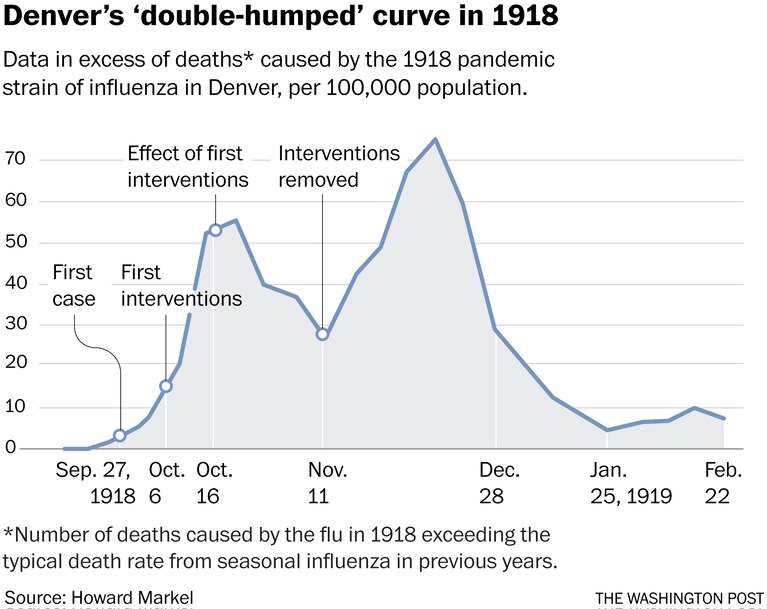
Not to mention: Denver had a significant spike in 1918 when interventions were removed.
https://pbs.twimg.com/media/EVHzq2AWkAEhbJo.jpg
Note: I didn't locate this image on WashPo's site.
I agree with you 100% but think the prospects of returning are not nearly as dire as some are making it out to be. I also think it depends a lot on the institution.
A lot of schools are going to reopen in the fall. By then there will be incredibly extensive testing and lockdowns will be mostly gone by a couple of months at least. If the quarantines continue the economic losses will boil over and there will be riots. There will be an increase in cases in the summer and then it will subside.
Many schools won't have any choice but to reopen. When they do, they'll probably offer extensive testing to incoming students as a service, probably some sort of current-status test as well as antibody test, as a courtesy and safety matter. They'll also make it incredibly easy to get for students who return, and will probably have a lot of policies in place to allow students on campus, and probably will have some kind of hybrid system in place where smaller seminars and classes will meet normally, but other things will kind of be pushed to a combination of online classes and smaller in-person classes. Large lectures will be gone for year or so, which probably should have been the case anyway. Students will be on campus again, but will be offered a lot of health services and courses won't be quite the same. Sports might be on hold in the fall.
College age students are probably the lowest risk of COVID complications of any age group, which will ease concerns about pandemics.
The bottom line is it doesn't matter what 20-year professors say. The students don't have anything else to do, and for a lot of them, they're not spending their own money anyway, or it's money that's all in the future in the form of debt. So rather than sitting at home, with their parents they tried to escape, they'll return. Open the doors and they will come.
Besides this, the feds will throw money at the universities like there's no tomorrow as a way of stimulating whatever they can. It's easy to politically justify. There won't be many strings attach to bring needed reforms (for example, eliminating indirect funds on grants) as now is not the time to ratchet down the screws. As a result the inexorable march toward nationalized higher education will continue even more among R1 institutions.
Smaller schools might struggle if they don't have enough money, and public unis being screwed by states or municipalities already (Arizona, as an example) will be in crisis. But many others will grumble and panic and then be fine.
I wish like hell this crisis would instigate a lot of changes to the bullshit that is higher ed at the moment, but it will not. And I disagree with Prof. Klein in her advice, at least as blanket advice that applies to everyone: students should consider their unique situation, as every case will be different in these times.
Honest question here. Are professor really well payed?
Facilities cannot cost that much.
What does it really cost to park a campus in "summer mode" a while longer?
Most don't go into hibernation at all I grew up in Ithaca NY and both Cornell and Ithaca College ran summer camp programs through the summer. I later went to school in VA and saw the same thing -- tons of folks using the Uni even during the "off" season.
Summer school classes went all summer and there were always non-trivial amounts of students on campus, including living in dorms.
Research didn't just stop because the students went away -- in many cases the research kicked into high gear since the profs didn't have to teach.
Colleges with agriculture programs don't just let their fields die during the summer; same for schools that have restaurant or hospitality management programs.
You already have a job and your boss has made you a developer. One thing you'll get in school that you won't get on the job, in general, is algorithm training. This is an important step for developing the best code you can and being exposed to weird and different ways to write things. This is important.
I personally do not see a real advantage to going to an elite school, depending on how you define elite school. If you're speaking Ivy League or some school that's world renowned, then no, that's not really important, I don't think. You already have contacts in the industry and there are "lesser" schools that are still pretty great.
Your company might be willing to pay for your college education. It almost certainly won't be from MIT; but, it could greatly reduce the costs you're worried about.
The next thing to consider is future employment, not this employment. Future companies that you work for may want you to have a degree or look down on you for your lack of one. Lacking particularly impressive projects or lots of random technologies on your resume may cause this.
Whether you decide that's going to matter or not is up to you; but, I think the one thing you should make sure you have experience in, either way, are the classes seen as less important for day to day development: your algorithm classes, discrete math classes, and similar. You can get much of that education online and for either free (YouTube, etc) or through educational sites like Pluralsight.
YouTube, online material, and actual experience of trial and error will take you a long way without a degree. You probably also don’t want to work someplace that prioritizes a degree over experience. Don’t forget to network: that’s the biggest ROI you’ll ever have. It’s who you know, not what you know. Two cents from 20+ years.
I've looked at and talked to a lot of different people at different universities in comp sci bachelors. For the most part the curriculum is the same. What sets some schools apart are what you do on the side and general academic environment.
Some people might say that going to university just for the sake of a degree might be a waste, but again this depends on you and your circumstances. There are companies that only hire people with a degree. It's a stupid way to make a hiring decision, but here we are.
I've actually just finished my masters degree in info systems and can definitely understand your thought process. Let me know if you have any other questions. More than happy to help.
Even if you do decide to go to college, I think you'd get a lot more out of it after having worked in the real world for some amount of time--in college it really helps to be good at deciding what to spend your time on, and exposure to what non-college life is like will help a lot with that. I know lots of people who got a ton out of gap years and no one who regrets it.
(I wrote more advice here: https://www.benkuhn.net/college/ )
On the other hand, if you've been accepted to some expensive private school that isn't a household name (sorry WashU, Drexel, Dukes of the world) you might be better off skipping the debt and going to a credible state school.
The framework I would use here is: is this a reversible or irreversible decision? Some factors I would consider:
- Do you think you will enjoy it? For me, it was four years of responsibility (buying groceries, doing my own laundry, learning to cook) but also four years of freedom (choosing my own bedtime, dating without being judged by parents).
- Can you defer an offer / reapply next year? (Ask the admissions department; most of the time the answer is yes, but there are details.)
- Do you have peers from high school that are going this year? (No one I knew was still hanging out with their high school friends after Thanksgiving, but I found it helped with the loneliness of the first week of living in dorms.)
- Do you have a place to live if you don't go to college? (Does your job cover rent for your own place? Alternatively, are you on good enough terms with your parents to stay in your bedroom / in their basement?)
- Would inertia lead you to never go to college? You may find it harder to go to college once you have a comfortable adult quality of life. If this happens to you, would you regret it?
- Will you have opportunities to socialize in college? (Dorms, student clubs, student newspapers, etc.)
- Do you think the job market will have recovered by the time you graduate? (I started my Bachelor's in 2009. On the other hand, folks are saying that the current recession is worse than the '08 crisis.) Where is the breakeven point for lifetime earnings between current job versus post-college job with college debt?
- What are plausible bad-case outcomes for each path, and how can you mitigate the downsides? Time-box this to maybe an hour of research: you want to be emotionally prepared for this possibility but not let it become all-consuming anxiety. (Consider: What does the world look like if we don't find a vaccine?)
College is four years of fun anyway, not everything needs to be about progressing your career.
The best pre-university advice I received was "if you can't decide, get some life experience first, since a huge percentage of people spend four years studying something then discover they dislike or aren't motivated by, then have to start from scratch and change professions".
We should all aim to study every day at a pace, breadth and currency that is unsupported formally. Set aside time to learn every day, and you will always be wise. You are perhaps most successful if you learn throughout most of the day.
The real job of upper management in the 20th and 21st century is to learn things, because change is the constant thing that's going on. - Alan Kay (2017)
Right - and if you're a recent high school grad with the grades to go to a good state school (not just Berkeley or whatever) and a desire to be around your peers while fully dedicating yourself to your education, you're not really in the target audience for community college.
A professor who hears about a scholarship, or a department head who emails their staff, generally doesn't think to include the financial aid office, or any other office in the university.
There are plenty of scholarships, just the communication about them is extremely poor. You have to get on every mailing list your university has, and constantly ask professors if they've heard about any scholarships.
Many of the scholarships I got were from companies or organizations that reached out directly to professors.
And we were all non-gregarious nerds. I wonder if that is why?
My university was quite large, with about 4,000 undergrads and about the same number of grad students. My high school was about 40 students a year (240 total) and I am barely in contact with any of them.
It makes sense that an acceptance is good for 3 months, and then you’ll need to reapply after that. If you went to a new school, the reapplication process is different.
Nature: Antibody tests suggest that coronavirus infections vastly exceed official counts https://www.nature.com/articles/d41586-020-01095-0
SFGate / Stanford: Study investigates if COVID-19 came to Calif. in fall 2019 https://web.archive.org/web/20200408180013/https://www.sfgat...
From the very article you linked (did you actually read it?): "'At the moment, we think there is no danger of further secondary or tertiary transmission,' Kwon said." We had 8 new cases today, and 6 were from Americans/Europeans entering the country. Given that I lived in Korea for two years and have a fair amount of friends and family there, I am a bit familiar with their situation.
Howard Markel, M.D., Ph.D. of the University of Michigan Center for the History of Medicine talks about the 2nd hump:
https://www.mdlinx.com/physiciansense/covid-19-is-a-second-p...
vs. it looks like about 4.8% from Germany. Maybe there’s some discrepancy in how those numbers are calculated, but they’re at least not wildly different.
From attached link most of the spending is on state and local level.
>Federal education spending: The federal government had little involvement in education in the early 20th century. This changed in the 1930s when federal education spending increased from less than 0.05 percent of GDP to over 0.3 percent of GDP. Federal education spending decreased during World War II but then increased to a peak of 1.03 percent of GDP in 1949 as it funded education for veterans in the GI Bill. Federal education spending declined in the 1950s to 0.3 percent of GDP, but began an increase in the mid 1960s reaching a peak of 1.2 percent of GDP in 1979. Thereafter federal education spending declined to about 0.6 to 0.7 percent of GDP in the 1980s and 1990s before increasing modestly to nearly 0.8 percent of GDP in the 2000s.
> In the early 2010s federal education spending declined to 0.7 percent in 2015, and is expected to be 0.5 percent GDP by 2020.
It doesn’t list case fatality rate, so your argument is just like everyone who says “the flu is deadlier than COVID”. Flu cases aren’t growing exponentially.
Nothing is ever 100% but if the rest of the population had the same characteristics as the youth there would be no reason for a lockdown to begin with. We are talking about death rates of 1 in 100K cases.
For young people the flu is far more dangerous than COVID-19. Of course for alarmists this is heresy that should be never talked about.
Whether or not you agree with apprenticeship systems being good or bad, it is clear that the GP comment on FOSS being a replacement for an apprenticeship system is wrong.
As feedback, I would feel safer if you used the name "1918 Pandemic" rather than naming viruses where they might have came from. I have personally seen and been targeted by daily overt acts of aggression (in San Francisco, no less) because of these kinds of false associations.
On the topic of how geographic disease names have often been used in racist or at least nationalistic ways, check out this hilarious map of the geographic distribution of names for "syphilis": https://digg.com/2017/syphilis-name-map
I think I can count on one hand the kids who actually transferred to a 4-year university and finished their bachelors degree.
I guess dropping out of a community college is a less costly misfire than dropping out of an expensive 4-year university, but anecdotally the people who went straight to university tended to stay there and finish. Obviously, this wasn't a controlled study and the university crew were probably more academically-minded to start with, but it is an observation.
I think there are many positives to attend a community college first but there are also several drawbacks that need to be acknowledged.
My daughter's freshmen dorm roommate should have stayed home. She spent much of her time pining for her boyfriend at home, rarely doing anything outside of class. She got pregnant by the boyfriend and now is dropped out. Kind of a bummer really, she is an under-represented minority who had a full-ride for Chemical Engineering.
Overspending to make a big commitment to something in the hopes that leads to success is generally, on average, terrible advice, in my opinion, even if you think there's some example of it working for somebody at some time.
I agree with the parent comment, the people in community college will tend to be less ambitious and it will likely affect you. This is not a knock on community college folks, it's just different people have different priorities.
I do think that there are many states with excellent public universities that are a comparably great bargain, especially if you can get scholarships.
I never even realized there was this negativity towards community college until recently, but I suspect it at some level amounts to astroturfing by their competitors, the miserable for-profit career schools that are everywhere. People will make bad decisions; I did after high school, but it's unconscionable to play on their vanity or low self esteem, telling them they're not good enough for a real college or that a real college isn't good enough for them, either way.
No but I want to work on the things they're working on.
As much as I despise the absolute scam that's peddled by universities, and dont think they're for everyone, they can still open up a lot of opportunities that would otherwise be inaccessible or highly difficult to access. OTOH If all you're worried about is money, then yeah no, you probably don't want to waste your time there
Going to school in another country that’s more reasonable about costs (Europe comes to mind) is also an option.
Consider more efficient paths to the end state you desire is all I’m suggesting.
I still get inquiries from Amazon and Facebook for roles. Not Google, but I’d never work for them anyway (nor Facebook or Amazon, for completeness).
I also intend to run for public office, which has age constraints, but no educational requirement.
Maybe that doesn't matter in CS/programming, but it does in lots of other (e.g. Engineering/Science) disciplines.
Based on everything I've seen over my roughly 20-year career in academia, plus the 18 years before that living in that world (my parents are both professors), what you get from going to Stanford, MIT, Harvard, Yale, and all the other "Big Name" schools is just that: the name.
The education you get there is not better than the education you can get at a small liberal arts college—in fact, it's often worse, because you're just one of tens of thousands, lost in the crowd, and you're extremely unlikely to get one-on-one attention from the professor if you have any trouble with the material.
Small liberal-arts colleges, on the other hand, so long as you're avoiding the ones that are specifically party schools, generally tend to focus much more on the teaching aspect, and especially on the personal attention aspect.
For more specialized degrees like engineering you may need to narrow your pool of those schools to find one that has a good program, but there are enough that unless your field (at undergrad level) is suuuuper-niche, you're very likely to be able to find one that works for you.
And while it's not universally true, they tend to be pretty good about taking transfer students.
So I find your comments quite curious. Nowadays I tell my younger cousins and nephews/neices to research the faculties in colleges they are applying to and look at the quality and impact of their publications.
The big thing you get besides ‘the name’ is your relations and links to your cohort. That really helps get good jobs!
I was an arrogant superstar before I went to MIT. It wasn't that I thought that I was worth more than other students, but I felt my classes were a bit below me. I got all As, except for a B or B+ in my Intro to World Politics class at the UofM. As I remember, the way honors GPAs were calculated, I my GPA was above 4.0 at the UofM. In my high school "Enriched Chemistry" class (one level above honors, no extra GPA boost beyond, but all the kids there really wanted to learn), after I caught a couple of mistakes in exams, the teacher started marking my Scan-Tron answer sheets as the exam answer key, and in class, the whole class would together grade my exams the day after the exam to make sure the answer key was correct. There was one exam where the second-highest score was 90/100, so the teacher just added 10 points to everyone's score. At some point, I made one mistake the whole semester, so I ended the semester 9 points above 100%. At the UofM in my honors mathematics course, I was being graded on attendance and felt it was a bit of a waste of my time. I would read a newspaper in class. One day, the TA asked a couple times if anyone knew the answer to a problem, and I made a bit of a show of folding up my newspaper and proceeding to answer the question nobody else could answer. The honors math professor took me out into the hallway and proceeded to tell me "I don't care who you are. I don't care what kind of grades you get. If you bring a newspaper to class one more time, I'll have you thrown out of the program."
MIT was another level of challenges and expectations. Most of the kids there were used to being at the top of their class and getting cut a bit of slack from the teachers/administration because they were head-and-shoulders above their peers in high school. For most of us, it was a big ego hit and a big adjustment having to work very hard just to get a median grade.
The instruction at MIT was top-notch, but the real value was increased expectations, and excellent peers for both competition and support.
On the flip side, the ego hit is soul-crushing for some students.
The honors programs of state schools definitely have students every bit as smart and capable as people at MIT. The extra level of competition and expectations at MIT really does help some people shine, though. Also, the name is helpful as there's a pretty high minimum bar for getting an MIT degree. You might not be getting the best by hiring the MIT grad, but you're hiring someone who's pretty good.
That being said, I hope the age of GitHub, HackerRank, etc. diminishes the effects of brand-name schooling. I had a friend back in my honors math classes who also got into MIT, but couldn't justify the expense due to his dad being a welder and his mom a homemaker. MIT offered him a lot of loans and grants, but he got a full scholarship at the UofM honors program and could live at home while going to school.
Absolutely false for STEM fields. Except for Stanford/MIT your flagship public school is probably a better tech school than any other private name-brand school. Yale is an ordinary tech school, with several public schools (Berkeley, UCLA, UCSB, UWash, UIUC, UMich, Ohio State, Penn State, Wisc-Mad off the top of my head) being significantly better and cheaper. And all will allow you in from community colleges.
I got to take relevant classes (CS) in my very first quarter of college. The first two years it was a 50/50 split. The biggest benefit was being among smart, interesting people. College was way better than any previous educational experience, by far.
That being said I didn't experience waiting for core classes. The class sizes were typically very large though. Taking these on the side at a community college while attending a 4 year college sounds like a good idea. I'm just opposed to putting everything on hold for 2 years to do basic classes. I don't think a community college is the place to explore interests.
To be transparent, I went to a community college for 2 years and honestly can't recommend it enough for the reasons listed by the OP. I learned a lot better in the small class setting, and a good ratio of my professors were actually good at teaching (unlike the university I ended up going to where teaching was a necessary evil for professors).
In my state a 2 year community college degree allowed you to transfer as a 3rd year student into any state university. You could also pick and choose individual classes, but they may not transfer directly. I believe a lot of states are like this. The only thing you have to be careful about is if you want to transfer out of state. Schools aren't incentivized to allow you to transfer credits (or test out of classes).
I just wanted to let others know that's an option and it shouldn't be stigmatized. I think I was a little too arrogant to pursue community college classes and because of my frustrations with the university I left.
But delaying electives for two years would put you at a significant disadvantage in technical fields, imo. Not to mention the basic classes (math, physics, etc) will be a joke at a community college so you will have a weaker background.
Depends on the quality of the school. If it's a top school then transferring can be difficult, you lose on networking opportunities (with students and professors), potential internships/summer research and arguably get a weaker education (although, true, it matters less the first couple years). I've taken courses at a community college and at a top school, the later was much more rigorous and fast moving.
Where I grew up a 2 year degree allowed you to transfer as a 3rd year student at any university in that state. The other option was to take specific credits at a CC and credit them to university (I believe degree focused classes were excluded from transferring in). At least looking at my program, none of your degree focused classes started until the 3rd year. All of the gen-ed classes were massive at the university. So a lot of opportunities for networking are minimized (unless it was around an extra-curricular activity).
My path was going to a university for a couple years. I ignored CC classes because I was a bit too arrogant, but left that university because of the BS. Much of that could have been avoided by taking some classes at the local CC. I ended up moving states to pursue a career and planned to get a degree if I hadn't started a career by the time I qualified for in-state tuition--but I never made it back to school.
Since then I've had the opportunity to interview college grads. That process has made me question the quality of many top school's education.
I don't think one path is better than another. I just wanted to let people know the 4-year university path isn't the only option. I wish I had finished a degree. I've poured over friend's class notes from college and grad school and wish I had the opportunity to take those classes.
Agreed, that was my experience. Added on top of the limited slots for upper division transfer to a highly desirable school I was in the most impacted major of all and its unbelievably hard to transfer even if you meet all the criteria and you're already in the system.
The amount of BS posturing that takes place to have to 'justify' your acceptance to just want to get in and out and graduate is unfathomable when dealing with administration/acceptance committees, especially if they know they can use your spot to bring in International students that pay upwards of 5x more than you.
Personally, I still regret when I think of the business opportunities I turned down, ultimately motorsports was a better monetary investment then a career in the Life Sciences after the financial crises as cruel luck would have it.
I learned then that doing the seemingly safe, prudent and pragmatic thing isn't always the route you want to take in Life and that following the herd is seldom as rewarding as promised. At least if you fail following your own instinct it will be on your terms and hopefully provide you with a solid foundation and skill set to rebuild if/when needed. In addition to a richer Life experience.
Personally I'm a proponent of apprenticeships and online learning/certifications, which I think is where Universalizes are going to have to migrate towards for a majority of their programs if they have any chance of surviving this post-corona World in the long run.
One would imagine in a fair world if you applied as a Freshman and as a Junior you'd have a higher chance of being accepted, if Junior applicants had a higher graduation rate they would bias accordingly, or if they started getting more Junior applications they would find more spots.
Its pretty corrupt, I already spoke on my first hand experience in other threads, but just look at what the recent admissions scandal yielded:
https://www.justice.gov/usao-ma/investigations-college-admis...
The one at USC was the most blatant of all in my opinion:
https://www.latimes.com/california/story/2020-04-01/usc-admi...
Sorry if this sounds harsh, also I'm not trying to deliberately shit on my uni education, but let's just say I didn't find it great for many reasons. One course by a "leading expert" could have been pretty great, just that it was done in not so stellar English (the prof was German, so am I) and so it wasn't so great to understand.
If you just show up to learn and don't plan to stay in academia there (do a PhD, get to know the faculty) I really don't see a point.
A university having a prestigious name is not synonymous with having Nobel Prize winners and influential professors. Hell, one of the professors at the small liberal arts college I work at is a Pulitzer Prize winning poet.
I want to be very clear that I'm not saying "you shouldn't go to these schools"—I'm saying "if you go to these schools, recognize that what you're getting that you won't get anywhere else is not a better education, it's the school's name."
The classes at my uni could move at a more intense pace than other schools, and the problem sets and exams were also more difficult, given the academic aptitude of my class. Go on the MIT Open Courseware web site, and take a look at the physics problem sets to get an example. I'm not sure there are too many other freshman physics classes that require pulling all-nighters to solve the challenge problems.
Sure, I could always challenge myself more wherever environment I was in (I taught myself linear algebra and C++ coding in high school, even though nobody I knew in real-life could help), but there is a LOT said to be surrounded by peer pressure, mentorship from world-class professors, and other motivated, top-notch students with the same drive for success. I would not have pushed myself to do better to the extent that I did at my uni.
That said, brand matters.
MIT now invests incredibly heavily in brand development, compromising integrity, research quality, and teaching-and-learning. For grads, that's paid off. My degree has gone up in value a lot over the years.
https://youtu.be/rIAZJNe7YtE?t=6418
I've been conflicted with MIT as an institution ever since the death of Aaron Swartz, it stood by and then participated in what ultimately took the life of a great member of the hacker/tech community, but I understand and accept that so many great minds go there to create some of the greatest innovation the Human Species' is capable of.
It was sad to hear Eric's plight was the same trivial political non-sense and administrative corruption that I encountered in the low tier State Schools I attended, his impact was far greater to say the least of course. Which apparently also the case with Harvard. This seems systemic, and not just a prestige campus based occurrence.
The closest I ever got to MIT was a clim co-lab project I was involved in that was accepted into the finalist rounds in sustainability and presented on campus at the awards.
I couldn't attend the event as I was working on my startup in CO, so I didn't see it from within; but I was told by the project lead that it was a great experience, even if nothing really came of it--there is lots of hand shaking, but ultimately prize winners are given a small token sum, not really even seed money to get a project off the ground so the best thing you can do is network for well endowed collaborative partners and find leads for real funding.
The leadership is overrun by brand-focused, power-seeking, money-grubbing sleaze-balls. That's drifted down, taking over some parts of the Institute, and leaving others okay-ish. But if left unchecked, it will take over the whole thing and ruin it.
We definitely still need a place in the world where nerds can do their thing.
It's hard for me to express how much less visible MIT was when I went there, and how much higher the quality of the research was as well. When I applied, scientists respected it, but popular audiences confused MIT with ITT. A highly-branded high-dollar MIT of the type we have today brings in the wrong sorts of people. Nerds have no chance of competing with them for power, and they have no chance of competing with nerds for intellectual curiosity.
But I think the time for taking back MIT may have passed.
Aaron Swartz is far from the worst thing that happened at MIT; things like that now happen regularly. MIT "wised up" to the use of NDAs and non-disparage agreements in protecting its branding.