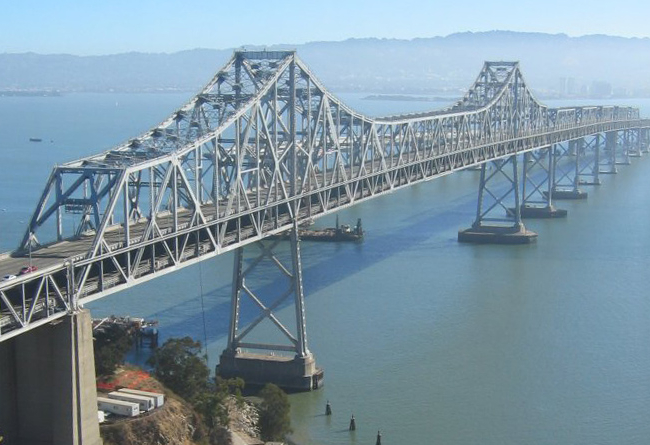
I wonder if you can hear it from top of Mount Tamalpais?
Bridge engineer cares to enlighten me/us?
I once ripped this mix from, I think it was di.fm or soma.fm, called 'Quiet ambient preceding magnetic storm', but the only hdd it was on broke.
Should be glorious
https://www.exploratorium.edu/visit/wave-organ/
Be sure to review the first one on yelp after the second confirms.
https://www.theguardian.com/us-news/2020/jun/06/golden-gate-...
From your article: "The wind retrofit project is designed to make the Bridge more aerodynamic under high wind conditions and is necessary to ensure the safety and structural integrity of the Bridge for generations to come,” Cosulich-Schwartz said."
This statement doesn't agree with the video's rationale for updating the railings. I'm guessing the new suicide net increased the wind loading, so the handrail had to be modified to reduce its wind loading. Without the suicide net project, I doubt the handrails would be changed. But the suicide net project is contentious politically, so they cannot admit this.
The new handrail uses long, unsupported plates. The old handrail was far more rigid:
https://www.bontena.com/contents/2018/12/Interview-with-Rick...
https://en.wikipedia.org/wiki/San_Francisco%E2%80%93Oakland_...
You have to admit the old eastern span was just ugly.
So then someone would need to custom manufacturer all of those pieces of rubber and then they would all need to be jammed in there. But then the weather would probably degrade then over time.
I just wonder how many millions are going to be spent on mitigating this.
Makes me almost happy for my hearing loss from attending a Jack White concert in a tiny bar where he maxed out the sound system. Although that’s probably worse off.
https://seaonc-assets.s3.amazonaws.com/uploads/2018/05/Old-E...
Paint the old one orange and it'll look the same.
It might be in your case that water hammer is triggering an oscillation in ... something. A valve, pipes that arn't strapped down?
There could be a dead end in the system (essentially a hammer arrester) that is full of air which water is sloshing into and shaking in the process.
What I think I'd try to do is isolate the cause. E.g. if you turn off the service valve into the house can you trigger it by opening and closing the hydrant?
Maybe you are triggering a _pump_ upstream from you?
In any case, if pipes are shaking or the pressure is obviously spiking then it increases the risk of failure... so it's not something that I'd personally want to ignore.
What you're describing might be along the same principles but much larger, or it might be something else, but in any event it sounds serious. (No pun intended.)
Get a second opinion before a pipe bursts or comes loose, eh? If by "the outside hydrant" you mean a fire hydrant then I would call the city too.
Any chance of a video or audio clip?
Live on an acreage, and the outside hydrant is mine by the garden. Right by the well, which is a tube extending 111' straight down to a submersible pump.
In the utility room, the water service comes into a pressure tank. We just replaced the tank, and the sound began after that. The plumber insisted it was unrelated. Maybe a relief valve there would help...just a guess.
If there's no vibration that you can feel then it's probably alright. Flutes don't fall apart from their own sound. But we're talking about your plumbing here, where a failure can be expensive and inconvenient, so "probably" isn't that reassuring. It's just not supposed to be doing that.
> We just replaced the tank, and the sound began after that. The plumber insisted it was unrelated.
It's not impossible (that they're unrelated) but that sounds to me like the obvious culprit, eh?
It took me and my neighbours a month to find the source of a hum that was resonating with our windows. It was torture, with midnight walks and lurking around potential sources, mapping nearby industrial sites, and questioning our sanity, while our windows were vibrating without a stop. We were very lucky to track it down to a badly installed air conditioning vent 200 m away.
1. A few years ago I spent some time in Falmouth, MA and there was an ongoing battle over newly installed wind turbines. The humming sound was getting to people, including to the point where they were getting headaches. Some people heard it and others didn't. The locals were going to war with the initiative. This article reminded me of that and I checked in on the ordeal. Looks like they shuttered the project and have started dismantling the turbines. It seems like a total failure: https://www.wsj.com/articles/a-green-new-deal-in-profile-115...
2. I was on a solo canoe trip in a remote part of Maine a couple of weekends ago and I kept hearing the sound of a motor start up and then die down. I heard it multiple times along a 25 or so mile stretch of water with the only other sounds being birds, moose rumbling in the woods, and beavers slapping the water with their tails. I chalked the sound up to some wind turbines I had seen on my drive up there and felt justifiably annoyed at the encroachment of the industrial world into my backwoods trip. I did some research when I got home and it turned out that I was hearing ruffed grouse "drumming" to mark their territory. In retrospect, it's an amazing sound: https://youtu.be/q0obByQW23k?t=21
https://www.quietpc.com/nf-a12x25-5v
https://cougargaming.com/us/products/cooling/cfd_red_led_fan...
I found my trail journal entry about this: https://www.trailjournals.com/journal/entry/14113
Finally, at one point I asked a group of other thru hikers if they had experienced it, and they all excitedly nodded, but none of us knew the source. Finally, some local day hiker said “oh, it’s probably just a grouse”. And the mystery was solved. Many of us were very confused for months!
Surely this was an issue with these specific turbines, right? Not a problem with all of them?
Sure, yes. The annoyance is justifiable. And I do not mean to come off as combative. I just wanted to say that our alternative forms of energy also encroach on the natural world in other ways (climate change, dirty mining, etc). So while turbines might more viscerally feel like an encroachment on nature, we must remember that they may displace some more destructive form of energy generation. I am not equipped to argue definitively that they are better, just that the visibility of wind turbines might influence our perception of them.
Every single time.
Kinda soothing, really. Just soft, deep thumps.
I was never able to identify it, and searching online gave me nothing.
It’s always the same length, about a second. It’ll come in pulses of 2 or 3 usually. Spread out a few minutes a part. It definitely sounds like an electronic sound. Almost like a sci fi satellite sound but deep in the water far away. Or maybe a far away whale mourning or something.
I just traveled for 3 months and heard it spread across 10 cities.
It’s very weird...
Any idea what you'd use to track down very low frequency noise sources(i.e. 15-60Hz)? I don't think a lot of sensors do well in that range.
I checked everything, but nothing. Asked my grandparents about it, but they couldn't hear any noises. Finally I got a friend over, and he could hear it clear as day.
One day I noticed my grandmothers hearing aids lying in a casing, and it turns out those were the source of noise. She'd forget to take out the batteries, and they would create a negative feedback-loop that came and went.
It's why kids could hear the whine of CRTs and their parents were completely oblivious, etc.
I feel like I wasted a bunch of perfectly good political capital at work in my fight with building management to get them to fix the lights. They finally replaced them with ballast-free LEDs after six months.
Could also be electronic noise. I wonder what the machine is.
The local council didn’t really care when I told them. It doesn’t bother me too much because I get up quite early anyhow, but I imagine this truck would manage to bother a rather large number of people every week. I wonder if the sound will go away next time it’s serviced.
I tried using baudline[1] (a 20-year-old program!) but it didn't work out-of-the-box on my current Linux installation. Instead I found something called Sonic Visualizer[2], which, while not real-time, worked out of the box. Using Pulse Audio 'pavucontrol' it was easy to configure Sonic Visualizer to use as its input the 'monitor' channel, i.e. capturing the audio while the video played on Twitter.
I'd love to get baudline working again since it's able to run in realtime.
It looks like the main tone is at 440 Hz and tones at 400 and 480 Hz come and go. Not sure what to conclude from this. :-)
The largest tuning fork in the world! [1]
UPDATE: The sound is intentional. Or, at least, known about in advance.
According to a statement Saturday morning by Paolo Cosulich-Schwartz of the Bridge District, "The Golden Gate Bridge has started to sing. The new musical tones coming from the bridge are a known and inevitable phenomenon that stem from our wind retrofit during very high winds." Cosulich-Schwartz adds: "As part of the design process, the District did extensive studies on the impacts of the project, including wind tunnel testing of a scale model of the Golden Gate Bridge under high winds." Those tests, seen in a video here, showed that the bridge "would begin to hum" when air passed through it more freely.
Thank you for sharing.
https://en.wikipedia.org/wiki/Aeolian_harp
https://www.youtube.com/watch?v=CtzSm76ppS4
They are pretty cool art installations. The Golden Gate bridge may now be the largest such installation ever built!
I can’t believe it’s the bridge.
Spat out my drink at this comment.
To get direction and location, you need acoustic samples from multiple widely-spaced locations, all synchronized. Human ears are not wide enough apart to directionalize low frequencies, but with a baseline of tens or hundreds of meters from separate cell phones, it's not hard. Run a correlator, line up the samples, compute the hyperbolas of constant time offset, (like GPS and LORAN) and find the target.
This needs an app with timing accurate to a millisecond or so. Can you get that from cell phones? The built-in clock synchronization isn't that good. The GPS receiver has more accurate time, but you may not be able to get at that.
Given that it was intentional, what makes you think it'll be "fixed"?
I remember years ago I had the idea that if you could design construction equipment to rotate/oscillate/whatever at frequencies that were harmonic with each other, construction noise would become musical, almost like a very loud set of wind chimes.
[1] Normally one every 5-10 minutes from 0500 to 23000 since we're on Heathrow approach and not far off City's path.
i found a couple more video examples of accidental acoustic wind effects in architecture -- but it looks like these aren't as ever-present and loud as the Golden Gate Bridge is right now.
Beetham Tower - Manchester, UK: https://www.youtube.com/watch?v=Y8-MrU6lpwg
Freedom Tower - NYC, USA: https://www.youtube.com/watch?time_continue=25&v=nkjA3BvvOuw
in the Beetham Tower case, apparently the architect lives in the tower's penthouse. i bet they're frustrated that none of the fixes have completely remedied the problem.
links from: https://gizmodo.com/when-buildings-howl-a-primer-on-architec...
People who live nearby don't notice it (strange looks if you point it out) but I think it's sad that it's impossible to escape the constant noise in certain places.
My prediction is this will be added to the long history of engineering disasters. It's OK, this is how we learn.
Here's another video I found:
https://en.m.wikipedia.org/wiki/Tacoma_Narrows_Bridge_(1940)
Pretty sure every bridge engineer knows that one. Amusing that the lesson didn't generalize.
    |     |     |
    -------------
| | |Running a brace might not be a bad idea, but i could imagine that it might just double the octave, and make it a bit quieter
What errors are you getting? You're right it doesn't work OOTB, I needed to fiddle with it a bit.
Yes, it cannot be a 24/7 thing, the harp/bridge is too loud. Also, putting resonances into a suspension bridge is likely to be unsafe.
That said, like the chiming of church bells in a village, it may be used selectively. I can imagine some Burners quickly putting up an adjustable mechanism to have the bridge sing/chime.
Something that can point into the wind correctly (to some degree) and then be readjusted to turn off. Possibly to make more than just one note, like a carillon of bells in a bell tower.
Maybe at the tops of the hour it can turn on/off, like a church bell, to signal the time. Or on special occasions like New Years Eve, the 4th of July, etc. Or for swearings-in of a mayor's term, etc. Heck, even as a warning system for earthquakes.
Having that loud of an instrument, powered by the wind, and then controlled by a few hundred actuators or a bridge-worker/bell-ringer moving steel beams in and out, it's just too good of an idea.
If something like that could be made to work, on such an iconic bridge, well, that's a whole new industry. People have done 'love locks' for years now, chiming bridges would be a great idea too.
If you really want to help build a dystopia, you’d probably have a bright future in advertising. Apparently electric car noises were less about safety than branding.
Some of the car manufacturers wanted their cars to blast sound logos all the time, but they were afraid the first movers would be lined up against the wall and shot.
Electric cars were the perfect excuse to do it anyway and blame regulators, so their lobbyists made it happen in the name of safety.
A solution like this could resolve many of the lingering "hum" cases. Often they are only heard by a few people, and those in charge of environmental control don't tend to take it seriously because "they don't hear it", or because they or the higher-ups are hiding something.
Acoustic consultants are extremely expensive, may require many hours if the sound is only apparent during random hours, and even then may come up with nothing.
An app that would at least be able to give a good estimate of the direction from where a sound is coming would be extremely helpful.
Bluetooth/wifi is good for at least a few meters, and should have latency of around a ms. Should be pretty easy to synchronize via that.
Amusingly, data collection would be easier with analog technology. Get some VHS walkie-talkies, and, at the base station, feed all the channels into a multitrack tape recorder like musicians use. No sync problems.
My two favorite examples were:
The Therac-25 — it’s just frontend GUI code. Why test it? What could go wrong?
The Siberian gas pipeline explosion of ‘82 — not technically an accident, but it shows the problem with testing untrustworthy code to correctness. It was also the biggest non-nuclear man-made explosion, at least at the time.
The Russians had stolen some pipeline schematics from US companies. The theft was discovered before they stole the control software. Instead of stopping the software from being stolen, US intelligence modified it so an integer would overflow after a year (or two) of operation. The Russian economy would be ruined if the pipeline wasn’t operational in less time than it would take the bug to trigger, so it wouldn’t show up in testing.
When it triggered, it slammed a bunch of valves shut, causing multiple parts of the network to explode at the same time.
The US military’s seismologists detected it, and thought the Russians had detonated a new type of nuclear weapon. The military was going to escalate until the intelligence service told them they were responsible for the blast.
Here’s a decent list of other incidents:
https://royal.pingdom.com/10-historical-software-bugs-with-e...
I highlighted an example of a more catastrophic mistake, familiar to engineers, which was apparently forgotten in this case. Bridges are resonant structures; this is 100% predictable through modeling but that was not done.
Sibling comments point out the Hyatt walkway (news to me, I only took first year mech eng but learned about "galloping Gertie" in elementary school because it was a local and recent catastrophe). Other comments note that the construction crew must have noticed. That this was not escalated points to a communication breakdown similar to the root cause of the Hyatt walkway.
From your links you can see that a 140mm computer fan at 1000RPM is noisier than a 120mm fan at 1200RPM. Even if the motor is quieter at the lower RPM, increasing the blade size is more than able to compensate and make it overall noisier, even with dimples and owl-wing tricks.
And it's not only the decibels that are the issue necessarily but also the frequencies which can propagate quite far and by all accounts are pretty disturbing. That low frequency hum that the blades produce by simply displacing air while they move is not a problem with a computer fan's tiny blades. And turbines come in farms.
(FWIW she's a very nice lady and has long since sold the house and moved away. I told her I had done that at one point and she just chuckled and didn't care)
I’d bet die grinder. They’re not used all the time, and they have VERY high rpm sounds which are always terrible.
Earlier music is sometimes performed down around A=390.
I wonder what it's like to try to pull a signal up there.
Your comment brings up memories of Lighthouse Beach in Chatham, which has a ton of warnings about Great White Sharks due to the prevalence of seals in the waters. Beautiful place. If the sharks don't get you the radio frequencies will I guess.
Modern transmitters are tuned and filtered so they can coexist with everything else.
1. The beep was very long - maybe a second or two - much longer than smoke alarms. 2. I could hear it blocks away from my apartment. No smoke alarm chirp would carry that far.
The main drawback is that you may have to wait a while between updates.
Headed back up there in a couple days. Hope to hear the grouse pounding their wings, the moose walking through the water, and a wolf howling away.
This is purely speculation from my side of course, as I've never been there.
https://en.wikipedia.org/wiki/Load_management#Ripple_control
EDIT:
Cliche as it as, the fish bites at Landfall are pretty good! And it was always fun to swing by the aquarium after hours and listen to the seals bumping around in their pool. It's a beautiful place to visit if you ever get a chance.
You see... it's the Curse of Chappaquidick. The sound isn't just the breeze passing through turbines. It's the wailing of the immortal soul of Mary Jo Kopechne, her soul mercifully freed from the watery depths but bound to the wind.
Her soul, unable to find rest so long as the negligent and wealthy haunt her resting place, now eternally floats upon the wind... from Chappaquidick into the Vineyard Sound... across Penzance Point... into the Bay, and back out to sea.
But her spirit is not unkind or unfair. She has no discontent for teachers, scientists, artists, or sailors. They cannot hear her. They say... that only the truly wealthy can hear her cries.
Mimicry is a powerful thing
https://theconversation.com/lyrebirds-mimicking-chainsaws-fa...
More details and maps here: https://www.facebook.com/williamp/posts/10106726609193073
Yup, the tone at 0:08 is pretty much the exact tone I heard. Mind-blowing. Never would have imagined that's what a fog horn sounded like. I expected them to all be much deeper tones like the ones that come a few seconds later. I guess there must be weird acoustic qualities that make only the higher toned ones carry into Nob Hill.
As of 8 years ago, they were using the FA-232 model fog horn, the circuitry was designed in the '70s and uses discrete BJTs on the boards to generate the tone and drive the "speaker".
ALSA can either do in-kernel OSS emulation (loaded via eg `modprobe -a snd-{pcm,mixer}-oss`), or shim the existence of /dev/audio via an LD_PRELOADed library by doing `aoss baudline`.
PulseAudio offers a userspace LD_PRELOAD shim as well, via `padsp baudline`. I have no experience with this approach (nothing I'm running has pulled in PulseAudio yet).
On my end the userspace approach just gives me "No such device or address SNDCTL_DSP_SETFMT", which I don't have a solution for. I suspect it's because either my hardware (HP EliteBook 8470p, IDT 92HD81B1X5 codec) or kernel (Debian 10, 4.19) are sufficiently new they're confusing the program. The kernel OSS emulation works for me though. If this is a hardware quirk the userspace method may work for you; the other path would be bisecting the kernel to see where it "broke".
Next up I got a lot of "/dev/audio requested fragsize ignored". If you don't get this error (and it Just Works), you can stop reading now :) but http://www.baudline.com/faq.html#fragsize_ignored explains that this is basically fixed by tweaking a bunch of settings to see what sticks. I must admit that after reading "first try this option... then try this one... then this one... then try all possible combinations of all three..." I immediately went "haha nope" and headscratched to see how I might make the computer make the effort - because, you know, it probably wouldn't work anyway and all that.
Because this old program is using Motif, the ASCII contents of the (what I presume are) PolyText8 X11 requests are visible in strace :D so it's possible to use grep to identify the "requested fragsize ignored" dialog boxes being created. For some reason repeatedly starting and killing the program in a tight loop makes the message box occasionally appear with 0x0 width/height and no contents (yay, race conditions...), but grepping for the title ("error message") instead always works.
Identifying successful loading is a good question, but if we define "successful" as "isn't promptly SIGPIPEed by grep exiting on first match within like 50ms", we can wrap the grep with `timeout` to kill the program on successful run within 500-1000ms, with a nonzero exit status.
Putting those two ideas together and shoving in all the possible parameter permutations, we get:
  fragsize=({1..10}); infrags=(1 2 4 8 16 32 64 128 256 512); samplerate=(4000 5512 8000 11025 12000 16000 22050         \
  24000 32000 44100 48000 64000 88200 96000 176400 192000); samplerate=($(printf '%s\n' ${samplerate[@]} | tac)); i=1;   \
  t=$((${#fragsize[@]}*${#infrags[@]}*${#samplerate[@]})); for FS in ${fragsize[@]}; do for IF in ${infrags[@]};         \
  do for SR in ${samplerate[@]}; do c="./baudline -fragsize $FS -infrags $IF -samplerate $SR"; printf "\r%-55s (%s)\e[K" \
  "$c" "$(((i*100)/t))%  $i/$t"; DISPLAY=:1 sh -c "timeout 0.5 strace -s999 $c -iconic" 2>&1 | grep -q 'error message'   \
  -m1; (($? != 0)) && echo -e "\r$c\e[K"; echo "$c" >> baudline-ok.txt; ((i++)); done; done; done; echo
It assumes ./baudline is in the current dir.
On my midrange i5 with an HDD, a timeout of 500ms (the '...timeout 0.5 strace...' bit) is adequate. If it thinks all runs are successful this may need to be made longer, like `timeout 1` (1 second).
The contents of `samplerate=(...)` were fished out of `./baudline -sysinfo`. Your output from that command may be different, in which case you might substitute that instead. FWIW I have the `... | tac` bit in to reverse this simply because higher sample rates are better, and if you want to ^C it early you get bigger sample rates first :D
With the above parameters (fragsize 1-10, infrags =Nx2 from 1 to 512, 16 samplerates) there are 1,600 iterations, and it takes about ~5 minutes. My laptop's fan kicks in :)
Because of all the flickering (<--note!--) from the program being repeatedly started and exited 1,000+ times, I added DISPLAY=:1 to start it in a nested X session so you can minimize the X server window and continue with other things. I use Xvnc; Xnest or Xephyr are possible alternatives. I also noticed the convenient -iconic parameter, and verified that if you start a window manager (I tested openbox) in the nested X server it starts/quits slightly faster. You don't need to bother with an extra X server and windowmanager; just remove the DISPLAY=:1 bit and wait for everything to finish. Note that the window opening/closing will completely steal all input focus and make work temporarily impossible.
When trying to optimize the first version of the above script I decided to try and launch the program with all possible parameters simultaneously >:D. Theoretically/technically speaking this should have simply made the hardware get very overloaded and slow for a period, and maybe swap; what actually happened is that I ended up having to start over from scratch because the kernel hard froze :D (it was indeed a hard lockup, there's no panic info in syslog :( ). I might try doing that again at some point, looks like ALSA and/or my audio driver have a few chinks in the armor there. FWIW, I've run the above script (which is decidedly non-parallel, of course) many times while I was fiddling with the status bits, and had no lockups; but Baudline may also do interesting things on your hardware when launched 1,600 times in rapid succession. ¯\_(ツ)_/¯
(You're probably fine, just :w / ^S first)
Caveat emptor (and major confuzlement): This program is very weird. Yesterday it worked with a samplerate of 11025Hz. Today it only likes 8000Hz. I have no idea why. Different parameters may work on different days??
GLHF! And let me know how it goes :D
FWIW, my big hope is that we can reconfigure our economy to work without conflicting with those wins. (The climate is still changing, so we have to reconfigure anyway.)
Giant stationary installations with very loud noises tend to cause weird noise issues. It's a lot of unfocused, or weirdly focused sonic energy that can't be heard from a little further away, but at exactly the right (well, wrong) place, it can get re-focused, leading to a droning noise that starts and stops unexpectedly. A good example that shows this phenomenon is real, despite being invisible is the Listening Vessels[0] exhibit at the Exploratorium or similar, with two giant parabolic sound reflectors.
For the wind farm, the issue isn't just turbines, but that specific turbine, down to the serial number and the serial number plate, at that exact location, temperature, humidity, causing a resonance in a specific resident's door, miles away. The resident may be able to replace, eg, the door, but often there are factors outside of the resident's control that contribute to the issue. Like the siding on the neighbor's house, or where their car is parked.
Ideally an acoustical consultant would be brought in during the design stage (just like SREs should be brought in during the design phase of a new service and not 5 minutes before it goes live), but that almost never happens, as we see (well hear) here.
At least in this case the noise can be heard by everybody. Imagine this noise coming off the bridge, but it's only audible from your bedroom Tuesdays when its cloudy. And none of your neighbors can hear it. You'd think you'd gone mad!
[0] https://www.exploratorium.edu/exhibits/listening-vessels
Noise studies by qualified acoustical engineers are the rule not the exception in many jurisdictions.[1] But these only go so far, because the model of the predicted noise emissions from the as-yet-unbuilt turbine is only so detailed.
For what it's worth, no matter how much engineering you do there are always people who think they can hear something that can't be measured and won't be convinced otherwise.
On the other hand, a thing that really does reduce complaints is paying a community dividend to everyone who lives nearby (instead of just paying the owners of the actual land under the turbines).
It’s a horrible feeling, especially since people don’t believe you. It can hardly be measured, because people with the correct equipment don’t pay attention to you and other people think you’re crazy.
Actually, if anybody has more information on how would I go around fixing this issue or which party should I raise this with, I would welcome that. It’s been more than a decade but the turbine is still there even though affected people have moved out.
German researches recorded the sleep patterns of 397 residents in areas where there was previously no mobile reception. After erecting 10 towers, many people complained about a change in sleep patterns. 5 of the 10 towers were turned off though so had no actual effect. Just the believe was enough to cause problems. [0]
I guess this is complicated by the fact that the speed of sound through the ground is ~6km/s. Rather faster than the speed of sound through the air. Multiplying those errors by 20... but 200 meters of error isn't that bad. A powerful local network with no latency would then be enough to isolate further.
Anyways, turns out that you can get gps time on androids, so this should be solvable with much better latency https://stackoverflow.com/questions/7017069/gps-time-in-andr...
It’s pretty easy to do with NTP synced devices. I’m lucky enough to have a fleet of devices sync with GPS and the PPS signal. It’s pretty amazing to/fun to do latency tests, you grab a time stamp and ship it to far side and time stamp the arrival. Voila single direction latency measurements.
Now I never leave the dock without one of those portable car-starting batteries, completely disconnected from everything.
We had a very similar story, except we were the first to rent the boat at the start of the season and the battery bank hadn't been very well tested before they gave it to us -- a few had gone off over the winter. They drove out from HQ, replaced the bad ones with fresh stock from their van, and sent us on our way.
I went as far as lodging an official complaint and was told that to deal with capacity trains are running more often and faster than they have in the past, hence the increased noise. Furthermore due to the Northern Line having been built before environmental noise regulations were passed, it's exempted so Transport for London aren't planning on doing much about it.
At the risk of sounding like a curmudgeon - between always on ear buds and mass transit noise we're risking a generation of kids suffering hearing loss well before their time.
Although I also have sensitive ears. :/
https://sf.curbed.com/2018/6/11/17449460/bart-screen-convers...
My understanding was that all rail systems since roughly forever use tapered wheels. Primarily to reduce wear, by having the tapered wheels self center instead of grinding against the track.
It's really odd that they seem to just roll that out in 2017?
That's crazy. That means that the wheels are actually slipping when going around a corner, because the wheels are all the same diameter. Unlike conical wheels, which are essentially self-steering.
Here's a great explanation by Richard Feynman: https://youtu.be/WAwDvbIfkos
How could the BART trains possibly have cylindrical wheels? Conical wheels have been used on trains for ages, so that's seems weird. But doing some research, it seems that, yes, they were cylindrical:
> Queensland Railways, for its first hundred years, used cylindrical wheels and vertical rails. With non-inclined rails and cylindrical wheels, the wheel squeal from trains taking curves on that railway was slight. After adopting coned wheels and inclined rails from the mid 1980s, the wheel squeal from trains curving at the same location and at the same speed decreased immensely. Some modern systems, such as Bay Area Rapid Transit (BART) in San Francisco, use cylindrical wheels and flat-topped rails; BART is now switching to conical tread to reduce the noise caused by flange/rail contact and loss of adhesion of one of the wheels on curves.
-- https://en.wikipedia.org/wiki/Wheelset_(rail_transport)#Semi...
Of course, the BART system simply fails to do the maintenance. I used to commute through the transbay tube and would happily join a class action suit over the hearing loss.
"I sailed from Deptford, April 9th, 1772, but got no farther than Woolwich, where I was detained by easterly winds till the 23d, when the ship fell down to Long Reach, and the next day was joined by the Adventure. Here both ships received on board their powder, guns, gunners' stores, and marines."
[http://gutenberg.net.au/ebooks/e00044.html]
So the "Resolution" managed about 8km on the day of departure from the London naval dockyard, then remained anchored in the river for 13 days waiting for the wind to change direction, finally managing 16km to the victualling dock.