- There is mixed evidence that there are actually shortages in STEM - People are graduating from STEM fields at a rather high rate than in the past, but only half of them end up utilizing their degree; in sectors such as IT, one reason being why graduates aren't entering the field is due to a lack of job openings - Despite all the clamor about "shortages," some STEM fields pay embarrassingly low, and in fact pay STEM workers less than they have in the past - There is no requirement that entities show proof of workforce shortage before hiring workers on H-1B visas - Some workplaces have already had American workers train in their H1-B visa replacements and then were out of a job
Not in the article, but some of my own experiences having been in the STEM field - Many internationals seeking to get hired in the US STEM force don't actually have the "everyday technology" that the US uses, such as in molecular biology labs; this means quite a lot goes into training H1-B visa holders. Couple that with poor English-speaking skills. I found myself having to explain to an H1-B visa holder what a "pen" was, or a "shelf." Granted, some H1-B visa holders underwent formal education in the US, obtaining PhDs and whatnot, so you'd imagine their English would be better, however... - Many countries look down on the US. I have worked for many foreign employers in STEM, and have been insulted just for being an American, and their views of America are largely stereotyped (Americans love guns, they eat hamburgers and pizza and are fat, etc.) - It changes the workplace culture; I've worked in a variety of STEM environments that had a lot of internationals, and more than once I was out-grouped for being an American. I have had opportunities closed off to me simply because my group's sense of belonging was rooted in being "non-American." This was detrimental to my aspirations in entering the STEM field as an American.
I don't believe there is a shortage in STEM. The fact that it's hard to even get a well-paying job in STEM, especially tenure positions in STEM, and that once you do land a STEM position you can face discrimination for being an American in AMERICA, H1B visas should be obsolete.
Get rid of the internationals. Focus on your American workforce and create incentives to enter STEM. Create a better system for learning math, and inspiring aspirations in science Create environments that will nurture American students instead of block their opportunities. Give Americans a chance to contribute to their economy instead of shoveling money down the pockets of people who don't even like America or Americans and would go back home if they could.
Many laws are written to deligate rule making authority to the executive branch, clearly the president has ultimate authority there. Perhaps you want the legslative branch to write more specific language?
it's not like immigration is bad or anything but the balance is screwed up and and it's causing long term damage it's bad for immigrants and bad for americans
BTW 500k people on the H1B1 visa is a hell lot of "skilled people": https://www.nytimes.com/2020/05/12/us/foreign-workers-visas-...
About time US companies realize that they need to have more fault tolerance to support their employees by open more global offices. This is especially true because the world outside is becoming more competitive and erratic business decisions like this will destroy product competitiveness.
As for foreign companies/entrepreneurs/would be business owners with capital, the US is shut. There is no need to do business here.
A lot of people have a plan to make a bunch of money for 10-20 years and then go back and be entreprenerial in their home countries etc. Canada may (or may not) be a better permanent home, but if the goal is to make a bunch of money, that's not the best place to do it.
Is there a minimum asset requirement? Is there a requirement that to apply have have to have been there for 3-5 years? An English language test? I don’t know for sure; asking.
If the legslative branch deligates the rule making to the executive branch, then take it up with the legslative branch... right? Blaiming the executive branch seems pointless. Am I missing something?
The Constitution is the law of the land. Are you referring to the Magna Carta?
Humans have inalienable rights, can we agree?
I believe people have the inaleinable right to "Life, Liberty and the pursuit of Happiness"... someone could call that a partisan policy objective.
[0]: https://um.dk/da/nyheder-fra-udenrigsministeriet/newsdisplay...
[1]: https://www.regeringen.se/pressmeddelanden/2020/06/ud-avrada...
Those three companies control a significant amount of what people see online.
Censoring trump is the nuclear option.
So what qualifies the shortage? Is it like agriculture where Americans are too entitled for the work? Are Americans viewed as generally too low quality?
2. No real investment/push into learning legacy langauges.
3. Philippines/Indian BPO encourage and actually train on the job. If you look at accenture/whatever agency, even IBM, they'll guarantee a job in that country if they stick with the on the job training. In those countries, entry level, know nothing developers make $500/$1000 a month, best, vs being experienced in the USA and making a minimum of $5000. 6-12K/yr is waaayyy cheaper then, 70K/yr. I feel like it's employer idea of infinite monkey theorem.
It's not entitlement, it's that in the USA, employers have to compete and everyone can easily get a job in IT that isn't even programming for $40-50k, think of help desk. All you have to do is show up, restart a few computers, and be relatable.
I knew a kid who could program reasonably, was pretty smart but didn't go to college. Got "hired" somewhere on help desk, was on a training contract for 3 months (he was just doing normal work, no pay), offered minimum wage job at end, didn't get paid for overtime, and got fired when he wanted to leave work at 6 because he had arranged to meet family for his birthday.
I think many people significantly understate how bad the US job market is for a very significant minority of people.
Also, you are massively overstating how good development is in the Phillippines or India. India churns out masses of CS grads who have never seen a computer. The economics of training are different US/India but the incentive there is the low wage. Remove that low wage incentive, and companies I think there will be investment into US citizens.
(Btw, where I am there are for-profit companies that train ex-army people to do software development...it works pretty well...but no-one asks: why aren't tech companies doing this? Like these companies employ people on very exploitative contracts, why don't companies just do this themselves? There is something wrong with how tech companies are run).
Isn’t that irrelevant? People working in the US on an H1B are not earning such low foreign wages.
There's already a shortage of devs of course in he US. Plenty of companies have thousands of openings even in the pandemic - of course there are places that stopped hiring or even shutdown and people lost jobs.
If you lower the labor pool size, pay should go up, ease of employment should go up for those who can work here. There's already a shortage of engineers in those special fields like cobol. So it will be even harder for banks for hire for them if you can't get say people from India to move here and work on that. If you are working on a modern language with modern tools, libs etc (c++ or java) why would you want to go back to that old world where there were probably not tests, automation like we have today? If you have 10 years exp in one of the say top 10 tech cities in the us you are probably making at least 300k. I just don't see banks hiring someone like me and paying me enough more to match that far less desirable job. So that leads to banks only having a hiring pool of people who will work for less for various reasons (location, less exp, not interested or trained on c++).
I think this will just lead to more outsourcing to other countries, even though that has its own +/-, and imagine a world where some large us banks lost so much tech ability they are dependent on people in other countries (maybe already happened).
Why is there such a shortage given the high wages, population size, access to education, and so forth?
I suspect, contrary to many people’s desires, this is ultimately not a conversation about economics but a conversation on absent discipline and self motivation.
— https://americanaffairsjournal.org/2019/02/americas-stem-cri...
'How and Why Government, Universities, and Industry Create Domestic Labor Shortages of Scientists and High-Tech Workers'
https://www.ineteconomics.org/uploads/papers/Weinstein-GUI_N...
There's a giant shortage of capable devs. i'm from the us in case it matters to you but in my 25+ years as a professional engineer across a few fangs, midsize and several startups all those companies wanted to hire every capable dev they could find. Microsoft used to have 5k plus openings when I was there and the other fang had similar. We hired all over the world and the us. We never hired as many as we wanted. New college students grads could make over 100k and we still couldn't hire all we wanted.
I worked on creative, original software. I think there is a hiring area that could be impacted by large number of immigrants in tech and that is more IT like positions. There's an oversupply in my experience of people that put software packages together, keep the it infrastructure of a company running - those are crucial jobs too, just like devs writing original software, but there's a lot fewer people in it support and maybe that's part of the issue.
Here are the trends I am observing from the comments of this thread:
* Immigrants in the US on visas earn less than US citizens. I have seen no data on this. How much less do immigrant software engineers earn as a percentage?
* Any evidence discrediting knowledge worker shortage is centered on academics. I am a senior software developer with 20 years experience at one of the largest and wealthiest employers in the US. Despite that I have no formal education in the subject matter. I am either entirely self taught or in some other disciplines trained by the military. So it seems, from my perspective, centering the discussion to academics is just a distraction.
Companies just have lots of choices. It is too hard to employ an American, maybe they need to get up to speed, they need to be paid more. Immigrants will live 10 to an apartment, they can be disposed of quickly, they do anything to keep their job because they don't want to get deported...I mean...who would you rather employ?
I have seen this in other countries. I remember reading about a Greek charity teaching computer science to illegal immigrants...most of those people were leaving countries where youth unemployment was actually LOWER than Greece. Another good example is Monzo (although a terribly managed company), they grew by just hiring all the CS wizards couldn't have done the job.
Call it nativist or whatever...it is a tragedy when people or companies are allowed to shed their responsibilities to the societies in which they live. It is very possible, it is just most tech companies are very bad at hiring/employee development (and why do they have to be good when you have H1B).
If you need them , then let them work remotely and pay them fair wages as they would have received in the US and let them contribute their tax to their own country.
Either way it’s a win.
I wonder what suspending Visas means in so far as remote working is a thing.
But sadly, Politics are focused to win the election and next elections. Populism and non-populism, left and right, social-networks and media, we all made it so hard for experts and scientist to be heard and to be trusted. We are so loud that we are only hearing ourselves. We can talk non-sense with insufficient knowledge and call it open discussion.
Many people who do end up getting kicked out will probably take their jobs with them back home, especially in tech.
This makes it easy for companies to outsource work.
When all employees are remote what's the value in bringing someone onshore? And once jobs are outsourced I don't think they will come back.
So this could be marginally beneficial for onshore workers or it could be very bad.
Bad for america, good for the rest of the world though- maybe by restricting American foreign policy we’ll see more competition for SV open up globally.
If she is infected and hospitalized, I have to quit my job and leave my home to spend last moments with her. Fuck Trump.
the amount of layoffs and unemployment since covid 19. this move is not to please you. it is to please the American people. only employers will care. the middle/working class American won't care (this is the biggest voting bloc that Trump needs)
this is a persuasion for Nov.
Could it also tell us something about interest in the field generally?
We also see significant immigrant ratios in entrepreneurial ventures: "Immigrants are “almost twice as likely” as native-born Americans to become entrepreneurs, according to the Ewing Marion Kauffman Foundation." --- https://www.forbes.com/sites/stuartanderson/2018/10/25/55-of...
What about academics and non-profits?
> which stuntnts the growth of these countries and yes you do increase the misery of the other citizen who is left in that countries
So, are you suggesting that each country imprison all their individuals and extract value for itself? Absurd.
[1] https://www.latimes.com/opinion/op-ed/la-oe-sapolsky-culture...
What I am telling that the current H1B system in US does not benefit anyone exception for the employer and probably enslaved employee. The original motivation behind the program is decent - let the really outstanding specialists to develop more (as US provides more opportunities for the top people), but what it become is essentially stripping the countries of intellectual power in bulk, and using back in US for a cheap price, basically enslaving them, by locking them via H1Bs. American workforce suffers, because they are under constant stress for being replaced by cheap H1Bs, the poor countries suffer, because of brain drain, world becomes more unequal, USA becomes more unequal.
I never said nothing about "imprisonment" - most of poor countries are not prisons, and especially not for IT specialists, who can have some decent quality of live with their salaries. And the only hope for "the prisons" as you mentioned before to improve, is to keep their intellectuals in.
This proves my point, you think like a collectivist, the individual doesn't matter much to you. Besides, the reason I posted that article is because I wanted to give you some reference to understand the construct I'm talking about (a bit of "meta" so to speak), so that you can orient your thinking and it didn't have anything to do with Sapolsky or his "importance" (seems like this matters to you more than actual facts). It seems like you're a collectivist AND not intellectually curious (they usually go hand in hand though).
Your grammar and "philosophy" sounds very Asian. Most of your thinking revolves around "for the greater good (of the country)". Your determination of the "border" for benefiting from "greater good" seems arbitrary, why not the whole world?
As an individualist, my advice to you is: do whatever feels right to you. If you're truly for the greater good of the country, who are you to decide what the country has to do? and why should I care about your opinion? whats the proof that what you say is actually happening?
There are companies like Cognizant/InfoSys/Tata/... whose business model is based on abusing the H1B system, and that's obviously wrong and I'm quite surprised they get away with it. I'm not defending that.
To those who broadly argue against skilled visas, consider this: Most H1B immigrants are between 20-30 age range. The prime age to join the workforce. Think how much investment you have to make on a child's health care and education to make them into a highly skilled workforce. It would at least cost you 1$M and probably much more. Now all these immigrants have learned your language, passed job interviews, and are competing to come to your country to give you 1$M and help your economy. Why would you not want that? People seem to think that number of jobs is a limited constant and if you stop immigrants that will have a positive effect on the economy. But in reality companies can simply just scale. If they have more workforce they can do more. Things get done faster and they just make more profit. Stopping immigration obviously would dent the economical growth. Never mind that many top tech companies in the US were founded by immigrants or children of immigrants.
To those who say we must invest in local workforce, I wonder why would you have to stop immigration to start investing in local workforce? As if allowing immigration would reduce the amount of money for investment, while in reality immigrants pay taxes. I personally have paid hundreds of thousands of dollars in taxes so far. I'd be happy if this money was used to educate the American workforce. However I know that it doesn't. I would like to see that change.
Education is the key to local talent, and is the key to equality. Yet, what has the US done to make our education better?
It explains a non-trivial logical connection, showing how something that could look unpopular from the surface, would pay off in the long run. Except you cannot make comments like this in public anymore. Because all it takes is an angry mob leader shouting "%USERNAME% is %CLICHE%ist" and that's it. Your employer fires you, your friends abandon you, you are socially bankrupt in an instant.
There are many bright people our there with great perspectives to share. Except they have to maintain radio silence, because they are not willing to take that risk. So the only voices to be heard are the most extreme ones that have nothing to lose.
I sincerely hope we can overcome this and get people to discuss problems and work together on solving them before our civilization sinks into medieval barbarism.
The war on drugs - have unfairly targeted minorities breaking up families and when they get out of jail, its harder to get a job because of their criminal record. No matter how good the education system is, if the students home life is unstable, education suffers.
Government funding through court ordered fines and tickets that also cause people to enter the criminal justice system when they can’t afford to pay. They end up in jail and lose their jobs. Again an unstable home life.
Lack of affordable higher education. Also, colleges love to give spots to non US citizens because they pay the full tuition costs.
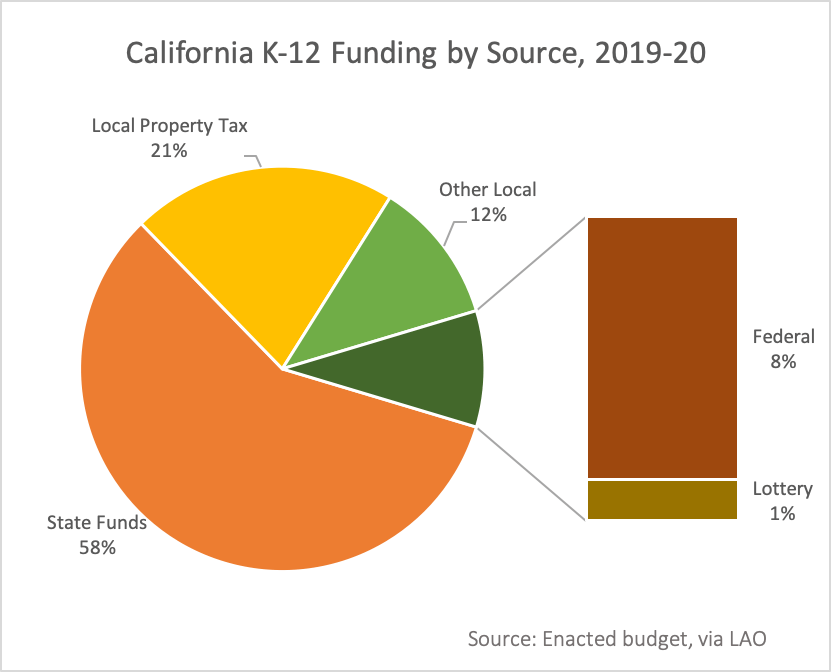
Education funding is based on local property taxes. The rich get richer and the poor get poorer.
Growing up in a poor area, I went to some of the "worst" schools you can imagine (one even had to get shut down) and I had one of the most inspiring history teachers there, that I still remember to this day. And all the other teachers were great too. It's not the fault of the teachers when students are too busy pencil fighting and throwing basketballs at the teacher's head, rather than studying.
What on earth do you mean with "low quality education"? I certainly didn't see that in the worse schools I went to. I think people misunderstand term "bad schools" and take it literally to mean that the schools are bad. this is completely incorrect. When people say "bad schools" it means the students who went to the school performed bad on standardized tests. It's not a reflection of teachers, or schools or funding. I went to such schools and still did just fine, so did many others.
As some one who worked in US and returned to India. Let me tell you immigrants will support this as soon as they get their US passports and Green Cards.
It's just which side of the fence you sit on. Once these people have a stake in your country, they magically shift their loyalties to the exact opposite position to what they had before.
In India itself, many of these elites oppose policies like Right to Education Act. knowing well they can fund their kids higher education in foreign countries, and eventually their kids getting settled in US. They don't want poor people to have literacy or any edge in education. Meaning, less competition the better. Why work for Right to Education, when your kids go to expensive private schools, tuitions, coaching classes and then foreign universities, with jobs and citizenships overseas. You want less competition and lesser poor people and underprivileged people studying so that more opportunities are freed up for your kids.
People are deeply selfish at a personal level and unless they have a stake they feel no need to change. I honestly feel things in India will improve with fewer visas. People will work for good domestic education facilities once they realize they are trapped in their own country.
At this point, more money is not going to help. Education in the US is fundamentally broken. Combination of "no child is left behind" and standardized testing (because everything else will be called discrimination) ensures uniformly bad results. If you pour more money in, it's just going to be wasted on bureaucracy and busywork.
So H1-B is actually a great idea. If we can't educate, let's attract well-educated people from elsewhere. They want to live here, so we can choose.
We don't mind buying electronics made in China because they can do it better and cheaper, why not do the same with people. Finland seems to be doing just fine with education at a fraction of US cost, let the market do its thing and flex the comparative advantage.
We have the technology to amplify a great teacher's lecture to millions. However, the education system relies on the model of interactive lectures given to a class of people of whom many are not acutely interested in the subject. Following that lecture, parents are drafted as involuntary teachers to help their kids with homework. If the student's parents have sufficient background, this works. Else, we end up with the situation where students continue to fall behind as their parents are unable to teach them.
We need to bootstrap our students' learning to the minimally accepted level that sustains self-directed learning. I would define that as mastery of arithmetics as first phase and algebra as second phase. However, we are talking about mastery that does not require a review, which means spending more time on in-depth training without jumping ahead.
Such classes should be separate from mainstream math classes so as to not to bore those of us who already have achieved that mastery.
I am working on this.
What you are saying is how can the US turn their bottom tier performers to match this
Nothing lights a fire under your ass as realizing you are a layoff away from leaving the country and having to start over
You need to change the cultural mindset. You need to build more colleges. Computer science programs are already maxed out. You need more professors.
Good parents with good parenting skills raise good kids. Bad parents/single parents - it is much harder to raise kids and give them good education.
if you want reforms - you need to adopt Scandinavian policies in America (high taxes, universal healthcare, universal childare, universal K-12, universal college system) - that way it will be easier to raise well educated kids
Majority H1B from India and China are stuck in green card backlog; with the current immigration system, they will never get the green card. Option for them is to stay in the USA on H1B in green card waiting queue or return home. (I do not think this is right or wrong people who are stuck in the queue, they chose to come to the USA and work here, it is up to that person to decide if they want to stay or go back or go to another country). After returning to home country from the USA, Social Security and Medicare deducted is a contribution to the USA (I am not saying this is right or wrong, just a fact).
The only requirements to meet is 10 years of work in the US (i.e. "40 quarters of coverage (QC's)"). I spoke to someone from India sometime ago, who had come to the US in their late 40s or early 50s. They were planning on going back to India after they had accrued 10 years of tax-paying years in the US, so they could collect on Social Security Old-Age when they retired in India.
With the exception of a few countries,the US government will in fact directly deposit money in your foreign bank account. [a] You don't need to have any ties to the US. The whole thing is actually quite profitable, if you've only worked in the US for 10 years. Per the formula [b], if they earned $130k per year, in 10 years they made $1.3 million (and contributed $198,900 at 15.3% in FICA taxes), which divided by 420 yields $3,095 - the AIME (Average Indexed Monthly Earnings). The benefits payable for it is: 960 x 0.9 + (3095-960) x 0.32 = $1,547. They can get $1,547 from age 67. If they live until 87, that's 20 years. And 20 * 12 * 1547 = $371,280.
All other federal benefits, plus the other programs funded by FICA taxes (ie OADSI / SSI + Medicare taxes) including SSI, the other parts of OADSI, and of course Medicare, are not available to non-resident non-citizens (with a few exceptions).
It would seem reasonable to place an intake limit of 10% from any one country, and limiting males to a maximum of 49%.
Right now, lets be honest, the H1B is giant immigration scheme for Indian males to get into the USA: 75% of applicants are Indian, and roughly 70% of applicants are male.
https://tech.economictimes.indiatimes.com/news/people/three-...
https://www.computerworld.com/article/3050365/how-many-h-1b-...
With these kind of diversity requirements, it would also be much harder for crooked companies like Infosys to racially discriminate against non-Indians:
https://economictimes.indiatimes.com/tech/ites/infosys-faces...
The green card lottery visa has diversity metrics built into it explicitly, which is probably why it receives minimal negative attention.
I feel less positive about the program these days given that a number of companies have made it a point of pride to emphasize hiring of "diverse" employees, which seems in reality to be a pretext for H1B hiring that would not otherwise happen. This stings a little bit for me personally, as it's become clear that I'm losing some jobs to H1Bs. And I'm sure it really stings for native techies that can't find work during this incipient economic depression. (I'm old enough that being whacked by H1Bs just means unexpected early retirement.)
For whatever reasons, I suspect the American base will continue to hollow out and turn into something different. It's a bit like British cuisine, which has (in my impression) been essentially overrun by Indian cuisine and that of other countries. Is that bad? I guess it depends on your point of view.
Anyway, as long as the hiring is legal, I'm good with it. Certainly I've never met a colleague from another country that I didn't enjoy working with.
If the concern is with abuse, then let's crack down on that.
Even big tech companies like Amazon and Facebook hire h1b workers so they can create sweatshop environments. H1b workers are afraid of being deported if they do not perform well, and a certain percentage of workers are forced to be on the PIP plan every year in the stack ranking.
Can even lead to suicides or suicide attempts. Ex:
https://www.cnbc.com/2019/10/15/facebook-employee-i-was-fire... https://www.businessinsider.com/amazon-employees-share-thoug...
There are no H-1B immigrants.
There may be H-1B holders who plan to become immigrants, but H-1B is a nonimmigrant work visa.
> Now all these immigrants have learned your language, passed job interviews, and are competing to come to your country to give you 1$M and help your economy.
No, they are competing to come and reduce the market clearing cost of labor and increase the returns to capital in our economy. Which is good for you if you are (1) one of the incoming laborers, or (2) a person whose main interaction with the US economy is via capital investment, not labor income.
> To those who say we must invest in local workforce, I wonder why would you have to stop immigration to start investing in local workforce?
You don't have to stop immigration.
You do, on the other hand, need to stop importing labor in a manner specifically and selectively designed to avoid upward pressure on wages (and thereby, stop the incentive to develop domestic supply) for high-skill, high-demand positions and to terminate temporary residency when it no longer serves that purpose.
Or, you need to better capture the returns produced by those means and direct them to domestic workforce development.
I'm one of the most pro-immigrant and pro-immigration and anti-Trump, people you’ll find, and I would shed not a single tear if Trump managed to permanently kill, rather than merely temporarily suspend, the H-1B program.
I'm not saying I'm not against people who are abusing H1B. That should be banned NOW.
this part is completely wrong: "If they have more workforce they can do more".
The demand for labor is not determined by the supply of labor, it's determined by the demand for those products. When companies higher engineers for example, they don't just go, "hey, we just had two brilliant engineers interview, so instead of highering 1, we'll higher 2." It never works that way. Companies need the amount of labor they need, and not one person more.
The reality is there's a vast oversupply of labor right now in most fields. Wages have been stagnant for a long time. And even in the bay area, average engineering salaries lag behind the local COL.
Furthermore, the US simply won't allow for enough housing to be built. Even with the population we currently have, there's no where near enough housing. this problem is only getting worse. Sure, it's just politics, it's a choice voters have made, but we're stuck with that choice. And, having more immigrants/increasing population makes it worse.
A friend of mine last year got a job as a L5 at Google, for around $380k a year in total ($190k base + $28.5k bonus + approx $160k stock). Plus a sign-on of $50k. First year pay is $430k. He's not doing rocket science, or managing. He's an individual contributor writing back end code.
Meanwhile, there are folks doing a similar jobs in Canada, who are making 100k CAD (on the high end), which is $73k USD. And the cost of living in big cities in Canada is shockingly high.
Now, you were saying something about bay area salaries being low? The salaries are, if anything, over the top insanely high.
Also, I'm trying to understand why companies go through all the processing delays, legal costs, frequent unjust denials since 2017, to hire someone who is not a citizen, while paying them well above the median for the job, if there is a supposed oversupply of talented top-tier skilled people who are looking for a job. The truth i that oversupply myth is just a lie, spun by people with anti-immigrant animus, plain and simple.
I can't fathom the head space you would have to be in to think that salaries are low. Incredible arrogance and entitlement, combined with a generous dose of xenophobia probably. Instead of being thankful, there are people who want to cut off / deport / exclude people from working in the US (and I mean people making these high salaries).
Also, I know a lot of H-1B holders with high salaries. I myself am one of them. (In fact I don't know any low-paid H-1B holders, but my social circles are all folks working at top companies or friends from other social groups.) The intense amount of hatred for immigrants on HN always continues to appall and amaze me.
I usually tend to refrain from commenting on these threads, because the toxic amount of contempt and hatred for immigrants that I come across in these threads is extremely upsetting, but sometimes it's better to speak up, than be silent.
> the US simply won't allow for enough housing to be built
You don't see the connection here? Why do you think there will be enough housing even with less immigration? The "housing must increase value at all costs" mantra is responsible for this.
[0] https://247wallst.com/housing/2019/09/30/there-are-over-17-m...
[1] https://endhomelessness.org/homelessness-in-america/homeless...
[0] https://www.uscis.gov/working-united-states/temporary-worker... [1] https://www.wsj.com/articles/a-new-look-at-the-h-1b-visa-pro... [2] https://www.sciencemag.org/careers/2015/05/economists-h-1b-v...
This is completely wrong. Jobs are zero-sum. One H1-B worker hired is one lost American job opportunity. It's not that hard to understand and taxes have nothing to do with this. Yes, companies can scale jobs but how often are they doing this and how does it help if they are also scaling up the number of H1-B workers?
In addition, this line of reasoning totally discounts the very real benefit of foreign transfer payments from workers in the United States to their international families, often supporting large extended families.
The end result looks similar but motivation matters.
Let me fix that for you:
Think how much investment you miss out on — investment in a child's education to make them into a citizen who will carry your country's patrimony into the following generation.
"A comprehensive literature review, in conjunction with employment statistics, newspaper articles, and our own interviews with company recruiters, reveals a significant heterogeneity in the STEM labor market: the academic sector is generally oversupplied, while the government sector and private industry have shortages in specific areas."
https://www.bls.gov/opub/mlr/2015/article/stem-crisis-or-ste...
"Our examination shows that the STEM shortage in the United States is largely overblown. Guestworker programs are in need of reform, but any changes should make sure that guestworkers are not lower-paid substitutes for domestic workers."
https://bloustein.rutgers.edu/new-analysis-finds-no-shortage...
"Sixty percent of H-1B positions certified by the U.S. Department of Labor are assigned wage levels well below the local median wage for the occupation."
https://www.epi.org/publication/h-1b-visas-and-prevailing-wa...
https://www.h1bdata.org/employers
Employer Name Employees Hired (All Years) Infosys Limited 182,945 Tata Consultancy Services Limited 102,722 Deloitte Consulting Llp 65,976 Wipro Limited 63,354 Accenture Llp 51,360 Ibm India Private Limited 47,839 Capgemini America Inc 40,954 Microsoft Corporation 40,828 Ernst Young Us Llp 38,631 Cognizant Technology Solutions Us Corp 34,138
What if, instead of bowing to corporate greed which cares not a bit for our country or our people, we actually invested in our own population and trained them to do the jobs H1-B workers currently do.
Scaling back H1-B in this way is the common sense approach. And it benefits other countries too by reducing brain drain.
It's a win-win.
So the stated solution is to do away with the visa and send those people back to their home countries.
So why does anyone believe that when those people go back to their home countries, their employers would choose to hire someone else instead of keeping the same people hired at a fraction of the cost?
I mean, people seem to think that companies would be unhappy about paying someone 75k/yr who was costing them over 200k/yr (salary + payroll taxes, etc) in the US.
It makes absolutely no sense that the job would go to an American. The likelihood is that the job would remain with the same person but now they would pay taxes and spend dollars in their home countries at a fraction of the cost.
US firms have a very long way to fall before they get even the least unattractive, relatively. A young person emigrating from Germany to the US working in a (now) good tech job there making 150,000 plus benefits will be out-earning their age cohort back in Germany 2-3x at the start of their career. Heck even at 120,000 that's likely 2-3x what a somebody with a Bachelor's here would get. That's a tremendous difference no career-focussed person would shy away from wanting.
Canada has already been benefiting from the recent restrictions on work visas and rejecting visas for no reason, for example by saying a forensic pathologist isn't a specialty occupation.
https://www.npr.org/2020/01/27/799402801/canada-wins-u-s-los...
https://insights.dice.com/2020/02/11/canada-continues-benefi...
So it doesn’t affect current visa holders in the country unless they travel outside the country and have to enter back.
Need to see what are the broad exceptions.
The order is not expected to immediately affect anyone already in the United States.
I want to ask a question to those who feel that I should not be here. Why is it wrong for someone like me to move from my home country legally as a student, then decide to work and live here, since it is legal and that option is provided by the government. My employer is also willing to bear all costs of making that happen. Of course, USA is a great country, maybe the greatest, and people want to live and work here. Is it wrong to have such a desire, and go about fulfilling it in a legal way? I am genuinely interested to know, since I get the feeling that folks like me aren't exactly welcome, and would like to understand why that is.
On the ethical side of things, I have wondered if I have denied an American citizen a good life.I get the feeling that maybe I have, by the mere fact of me existing and being present in this country, since I haven't misrepresented, lied or cheated anyone to get my job. I have no doubt that given enough time, my company will find someone like me, but how long it will take is anyone's guess.
A lot of Americans have been taught that the U.S is the land of opportunity, a place where anyone can come and through hard work can make something out of themselves. What people probably imagine when they think about this is poor immigrants coming and starting from the bottom, starting in food service jobs or doing janitorial work or something and working their way up. That's the American dream they were told about. None of them would imagine that through an H1B visa, we'd be allowing some of the most highly educated immigrants from other countries to come and immediately work in high level positions with salaries of 6 or even 7 figures.
I find it understandable that some amount of Americans feel that this is wrong and that they were told a lie.
If you think someone made an erroneous comment, it would be good to correct them by replying to it, or just summarize the common misconceptions and share your expertise in a top level comment.
Saying that people are making dumb comments, I know how it works, but then not following up, is not in the spirit of HN
L1s also look like they're geared towards essentially overseas managers moving to the US, particularly in the case of a single international company moving their executives around physically.
Look, my honest opinion is the abuses are generally bad, especially for immigrants who are being put in bad situations which because yet another thing the companies have as leverage over them, but then the people who should be targeted are the companies who are abusing the system, not the programs themselves which hurts everyone, especially the immigrants.
It is so much easier to send one/two americans as expats to India/East Europe to manage outsourced staff and the trend will just accelerate.
With the exception of MSFT, all of these are "consulting firms" or "service" providers.
So while everyone is having "ideological, values" based discussions, here is what is really happening
Employer Name Employees Hired (All Years)
Infosys Limited 182,945
Tata Consultancy Services Limited 102,722
Deloitte Consulting Llp 65,976
Wipro Limited 63,354
Accenture Llp 51,360
Ibm India Private Limited 47,839
Capgemini America Inc 40,954
Microsoft Corporation 40,828
Ernst Young Us Llp 38,631
Cognizant Technology Solutions Us Corp 34,138
Perhaps this is where H1-B restrictions need to be focused. No third-party employment.
Right now the US is winning because of such a high concentration of talented software engineers compared to the rest of the world. It’s the same reason why there is only one Hollywood, the same goes for Silicon Valley. If you prevent people from coming here, the top companies will find them in their own countries and then those are jobs lost forever. And then the drain begins. This is a stupid self-defeating move by a self-defeating president.
Once in the ambulance the paramedic started asking me where I am from and if I came in on one of "those visas".
I was afraid I was about to die, and this fucker was being xenophobic.
The way he talked about the Visas, gave me the impression of someone who has been conditioned to believe that "those Visas" are evil.
Or maybe I completely misread it, and he was just trying to make conversation as you said, to calm me down. But choosing the Visa subject seemed quite odd. Usually when I mention my home country people chose a subject like history, mythology, holidays or current affairs.
Feels like this is just going to accelerate the moves we've seen in the Bay Area towards companies going fully remote.
If this happens, the administration could see a lot of that money just leave the country altogether.
No way they're going to make an exception for that
Going by these numbers (WARNING: PDF download): https://immigrationhistory.org/wp-content/uploads/2019/03/h-...
That shows what a short-sighted move this is on the part of the administration - just re-election theater, I guess.
I'm not calling for open doors to everyone, this certainly needs a balanced approach. However, with such suspensions I think we seem to be going one extreme path. Global talent has helped develop industries and businesses here. Increasing restrictions to this extent and suspending these visas is going to push this talent out and promising businesses who want to get the best talent to work with them, will not-immediately but definitely follow their way out too. I hope the people who are celebrating this, at-least for a few minutes, come out of the myopic view and look at the long term economic consequences.
what you are talking about would require a rule-making process and/or statutory change. they are going to try that, but it will take longer and will be subject to judicial review.
AC21 lets you change employers without waiting for the petition to be approved. that's statutory. much harder to change as it would require Congress.
eventually, your visa label will expire. after that, if you need to travel overseas, you will need a new visa label and under this proposed exec order, if it's still active you will not be able to return. so you will have to avoid overseas travel entirely until the ban is lifted.
I personally feel that the H1-B system needs to be rethought to encourage a healthier but not at the expense of bringing hard working immigrants into this country.
I suspect if you now do the calculation after adding the fees companies are required to pay the government, along with the lawyers fees most companies have to pay for an H1B visa holder, both of which in most cases will be closer to $10k per year, the H1B earners will be completely in line with the occupation they are employed in.
If you make the knowledge worker that any country ought to want a citizen he will naturally demand a market wage.
The visa workers are second-class citizens and exploited by companies to keep cost low. It undermines all workers and in the long run undermines all nations involved. Take the US's relationship with China manufacturing where China has some of the worst pollution and is one of the largest world polluters as they do not adhere to any of the same regulations that nations of the west adhere to.
Currently there is the narrative that the US has a shortage of talented STEM. This is untrue. The shortage is due to a skewed labor market that suppresses opportunity for US citizens in the same way that a US manufacturer wouldn't be able to compete against a Chinese manufacturer not because we don't have the technology, demand, or resources, but that the difference in regulations makes it more costly.
These are the same people who claim that people should immigrate legally, but then close all legal avenues of immigrating.
Eliminate H1B and expand green cards for skilled people who want to live here.
(Lottery is difficult to win due to rampant abuse by certain Indian-US outsourcing companies)
For H1b, you can at least change jobs. An L1 cannot change jobs at all. So, you are completely at the mercy of your employer. Fortunately my employer is benign, but that is not the case for everyone.
Having a proper points system (not one that is easily gamed) and giving people a greencard to enable them to change jobs would be a much better system. This would prevent low-skilled workers and the suppression of US salaries. And if there is a high demand, the US can just take those with the highest points (as the Australian system does).
There are two very good systems: 1. Australian 189 permanent resident system. Example of points:
https://www.am22tech.com/au/australia-points-calculator-for-...
There is limited positions, so only those with the highest points are selected.
(Compared to H1b where the bar is low and people are selected via lottery. This incentivises outsourcing companies to have 4 people apply for every one true position).
2. Japan's point-based high skill visa (Technical stream)
http://www.immi-moj.go.jp/newimmiact_3/en/system/index.html
Processing time for this is 5 days guaranteed and very easy to apply for (I got mine in 4 days).
This is not permanent residence, but you can apply for permanent residence after 1 year.
One means they want to limit immigration of brown people to as close to zero as possible while allowing white people from Europe with money to move here. Where they can't outright forbid anyone except white Europeans they want to increase the difficulty and bureaucracy to the point where virtually nobody gets through. If it takes 10 years to become a citizen great. If it takes 30 better. Let em die waiting.
Two lives in a fantasy land of law and order where the non criminal types could just queue up and prove that they are the right type of people and follow the law. In this fantasy land type one doesn't exist and the people sneaking in are proven to be bad people by the act of breaking the law. These people live in a world where the law exists to protect and privilege them and anyone not following it is clearly transgressing.
Virtually nobody whom we citizens are descended from waited 10 years, hired a lawyer, and filled out paperwork in triplicate and both types are hypocrites who are themselves a disease on the body politic. If you hear someone talking about how they are for "legal immigration" unfriend them, block them, don't hire them, don't associate. You can't fix them so contain the cancer.
The "Fixed pie fallacy" [1] is probably both one of the most important tenants of modern policy-making, yet it's rarely explicitly discussed or debated.
Cyclone_, your thinking relies on this fallacy, namely that if one person is working a job, that's one less job available. [2]
In reality, there is quite a bit of empirical research that indicates when people work (especially highly skilled jobs like in tech), it does not reduce (and may even increase) the jobs available to others [3].
1. https://en.wikipedia.org/wiki/Lump_of_labour_fallacy 2. https://www.nytimes.com/2003/10/07/opinion/lumps-of-labor.ht... 3. https://siepr.stanford.edu/sites/default/files/publications/...
On a high salary and with the promise of being sponsored for a green card.
I got my green card just before covid impacted the USA and still have a pretty high salary (in the same range of my US born colleagues).
I already had a great job in my home country, I was not going to come to the USA to be paid a pittance.
Yeah, there is abuse of the green card system but it is in place because there aren't enough skilled workers in the USA.
1. SV/FAANGs, like elite colleges, only hire some very small percentage of people who apply. Many people who are perfectly well qualified and have successful careers otherwise get denied employment.
2. The market cap of these FAANGs is in the trillions. Between talent and capital, there's literally no problem they can't solve (they can solve problems about cyber bullying, trolling, etc but their business relies on it.. so it's not really a "problem" per se).
3. There are SO MANY underprivileged and/or poor kids in SV, LA, Pittsburgh, all the places where tech companies reside. Saying there aren't enough skilled workers in the US is kind of dishonestly true, as they have tons of applications from many qualified people.. many of whom with some training and support may very well become highly qualified....
4. ...They could literally invest some of those trillions to build a pipeline from these areas, develop talent locally - or at least domestically.
So much of tech is about solving problems with the resources you have. Opening up broadly to a global labor supply removes the constraint on that resource, and therefore don't need to innovate or find clever ways to make it work. Now, they are companies that have only one duty - deliver profit to shareholders - and that's fine and how companies should be run. But public policy needs to exist to serve the interest of the people, and for the most part - not entirely - H1B has been to serve the interest of executives in Big Tech.
Also, finally, Trump is absolutely awful, horrid, all that. A broken clock is right twice a day though, and this is one of the few possibly accidental things he's done that isn't a complete self-shot to the head.
So why are the big tech corporations that are constantly virtue signalling about Black Lives Matter and social justice not simply training American engineers (not specifically black, but people coming from poor socioeconomic backgrounds, which would definitely include many African-Americans). Why do they bring Indian or Chinese engineers?
America does not lack people, it has good universities. It could certainly train a local workforce. Providing good jobs to those communities would do wonders to reduce criminality, drug abuse and various issues.
Who's this "our people" you're talking about?
As a US citizen, I consider every person in the world as part of my people, and I don't begrudge any individual coming and working or training in the US.
The more people, from whichever country, have access to good education and good jobs, the better.
Good education and jobs should not be reserved for people who happen to live or be born in a particular place, be descended from particular people, nor just those who managed to get certain bureaucratic paperwork.
Every time you file an H1B Visa, you pay something called a ACWIA Fee (“American Competitiveness and Workforce Improvement Act of 1998”). For employers who have between 1-25 full-time workers, the American Competitiveness and Workforce Improvement Act fee is $750. For employers with 26 or more full-time employees, the fee is $1,500. [1] This fee was established to fund training and education programs administered by the Department of Labor.
As of 2018, there were 420K active H1B visas in the USA. These people need to renew their visas every 3 years (most are Indians and they can never become PR in their lifetime). So that means 300-630 million USD is being added to this fund on a recurring basis over a 3 year period.
I wonder where all that money went.
Oh wait...
That’s a very interesting thing, I had no idea. So a sensible thing to do would be to increase that fee substantially and have it go straight to subsidizing degree programs that aren’t creating enough home grown talent.
In other words, the company should expect to pay close to market rate per H1B plus the fee.
We remove the incentives to abuse the program for cost reduction, and straight up use the fees to fund college.
That brings me to some weird job posts that I keep seeing for some large bank. The role was for ‘Specialist’ developer, and I wonder if it really is some specialist role that they can’t fill in a major city (seemed like typical web developer stuff).
Shrugs, say it ain’t so, would hate to know that’s how it’s being gamed.
The couch cushions maybe?
You are looking at the top 100 companies and their full-time employees but not at the 1000s of vendor-employer ponzi scheme/scams that happen every day in the form of contractors who apply with fake resumes, take proxy interviews and outsource the assigned work to someone in India. Doesn't stop there, the dependents of those do a unlicensed food selling, baby sitting, work in local stores, what not. The hard to digest fact is the student who comes on F1 visa, succumbs to the pressure of 90 days period to get into a job to maintain the visa status joins a consultancy company, which starts the game. These consultancies market the candidate with high experience fake resume, arranges proxy candidate to take interviews, even Falsify the requirement of GC/citizenship candidate requirement - all these to charge the client a 100$/hr and pay a mere 40$/hr to the candidate through their sister companies acting as layers. A honest try from USCIS to do a quick scan in containing these will drop at least 50% of H1B lottery applications, void 30% of the consulting company licenses and also help the right talent to get an opportunity. If you are a gov/USCIS rep, drop me an email I'll be more than happy to provide more details, and possible ways of catching the wrong ones.
Once you let employees freedom, the market will take care of the salary. I also understand that employers invest in the visa application and relocation of people, so it should be fair to them as well. This can solved by having a period (1-year is pretty reasonable) that prohibits new visa holders from moving companies.
Personal experience in my part of the world seems to suggest that it is cost. Permanent employees are expensive and H1B's are so terrified of losing employment they are willing to work around the clock and for less.
I would like to see the whole program gone. I don't believe it is being used as it was intended.
I know for a fact that in my industry (not in SV) H1-B wages are lower, going off both public data and conversations I've had with H1-B coworkers, many who I consider my friends.
As a side note, I don't blame H1-B workers at all for coming here. They're generally great developers and great people.
There huge nuance which is missed when talking about H1bs ... there are body shops which do cut wages and should be stopped. However the immigration system in USA needs significant reform as well. It’s hard already to build a life for your family with a normal 3 year lease ( h1b duration) for this kind of misinformed political rhetoric to have unintended consequences.
Much of the H1B candidates out there are graduates of american universities that are trying to take the next step to be in America. We should be embracing these people where possible, not villanizing them. Make it so the chop shops can be weeded out, not the good people that are forced to work under them due to a broken system.
Also, many jobs require base salaries that are VERY in line with the market, if not higher, as a financial check to the Employer to make sure they want said (H1B) candidate. We had trouble finding a JR DevOps person, basically forced to go H1B, and a JR in the midwest was going to cost us 95K with little experience. That was widly out of line for a JR devops candidate
https://www.forbes.com/sites/stuartanderson/2020/06/11/unemp...
These number are said to underestimate the true unemployment numbers.
U.S. should focus on American unemployment numbers.
Also stronger labor laws instead of gutting them, actually enforcing them instead of shanking the agencies responsible for them, and actually hitting guilty corporations where it hurts instead of handing out "cost of doing business" jokes.
And prosecuting guilty management as well. Middle manager 8374 might be less eager to ask for bullshit job requirements designed to only fit a specific H1B if their n+1 to 6 have just gotten years in the slammer for labor fraud.
If you want to see a more fair and competitive workforce, give H1-B visa holders more freedom to switch jobs without risk of losing their visa.
Except for the individuals. US educated students who want to remain in the US, work, and raise a family are now basically being told to go back. Or people who prefer the US for non-monetary reasons (crazy thought, I know).
But what I find interesting is that programs like the diversity visa (DV) lottery with even more relaxed requirements or even illegal immigration don't get scrutinized as much as H1-B. I wonder if it's because H1-B workers primarily compete for well-paying white collar jobs while most DV winners and illegal immigrants go for blue-collar jobs.
I don't know what local laws would apply, but I imagine that the same laws that have to do with equal pay can be made generic so that it applies to everyone for a position. In the end you should be paid for your value, not for your gender, color of your skin or the place you were born.
Wishful thinking under the current administration.
Agree that domestic training should be invested.
Edit: sorry, clarified Apple not SV as a whole - and it was a Vice Or Vox article, so I should probably know better.
Who doesn't like free things?
a) Outsourcing generally produces lower quality result
b) You do not have an H1B leverage.
To be blunt, a nation's citizens and permanent residents' rights to economic prosperity outweigh any temporary worker's right to continued employment. Yes it may be viewed as cruel in the individual case, but the point of these visas are not to provide a vehicle for those workers to come live in the USA. They're meant to fill a need for companies that cannot find qualified workers.
In a country facing a staggering unemployment rate, continued job losses, and possible long term recession, it'd be malfeasance on the part of any public official to magnify the problem by allowing more workers to enter and compete against its own permanent residents.
It's not pretty. It's reality.
In actuality additional workers demand lots of things themselves that create net jobs. If more people within the carrying capacity of the environment/structures decreased economic prosperity every country in the world would be looking to shrink their birthrate as much as possible so that the decreasing population could have an increasingly large share of the fixed prosperity. We know of course that the reverse is true.
The fact that you're defending their cruelty because of the economy (that they fucked up!) is immensely disappointing.
We live in a capitalist economy which follows pretty simple supply and demand curves. Where there is a demand (cheap labor) there will always be a supply (even if it's the black market). Arresting sex workers doesn't stop people from hiring them, and arresting drug users doesn't stop the dealers.
Immigrants don't come to the US because it's fun or easy, there come here because there are companies willing to hire them, legally or not. So if there are too many H-1B holders competing with Americans, why not make it harder for companies to hire them over an equally qualified American, or punish the company for abusing the visa system just to get cheaper labor? Same with illegal immigration, why not fine or shut down businesses that hire illegal immigrants?
You say it's not pretty it's just reality and I accept that reality... but it's also needlessly cruel to punish job seekers and not the companies who are enticing them to come here.
I see this type of measure as something that has a xenophobic base. The economic problem can be approached by applying sanctions to companies that use visas for cheap labor, not to the immigrants. But that type of action will be seen from a part of the US society as anti-capitalist because it attacks companies and businesses. So a big chunk of the society prefers the xenophobic idea of blaming the immigrants because they "steal" the job positions, but very little is said about the companies that abuse from cheap labor to be competitive.
This. All my adult life(15 years) I have worked and lived here and my parents are old and you never know what can happen with current pandemic. Being from India the green card wait is over 11 years and increasing so I keep waiting. There needs to be a distinction between legit employers and ones who abuse the system.
But, for the long term, this country really needs to start preventing "new" immigrants from coming because the US can't house enough people. Enough housing is not allowed to be built, so it doesn't make sense to keep having an expanding population in that type of situation.
Maybe not all, but I think many of them are. The "cruelty is the point" to quote Adam Serwer.
Canada on the other hand gives you PR on entry if you're skilled enough.
Money doesn't matter if it becomes an eternal struggle or impossible to maintain legal status.
#1 could change, some tech companies have started to realize they can offer more remote jobs and save money while offering salaries that are still very competitive to anyone not living in the Bay Area. #2 was already problematic before Trump. #3 is often better outside the US.
[0] https://www.theglobeandmail.com/world/us-politics/article-tr...
But as long as the discrepancy exists, then it seems like there would be a tremendous benefit in allowing people to freely immigrate, even for those already at the destination. Fear of immigrants is based on the idea that they will work for less, but if it's still more than they were making, then the competitive situation for labor has improved, as long as one accepts that it is a global market. I wish there was a way to get political traction for this, as a self-interested goal for American (or other developed country) workers.
And from a parent point of view, why would I want my kids to waste his or her time in school learning very little, and then to spend my own time tutoring them? All I want is my teachers to do their job, and do it decently.
You're lucky to have great teachers, and I just think we need more of such kind. As for bad schools, let me give you a few examples and you can check out the documentary Waiting For "Superman" to get a more grim picture.
- Did you know that teachers in some Cupertino schools asked parents to grade student homework?
- Did you know that a straight-A student who graduated high school in NYC couldn't pass the math placement exam in The City College of New York? I mean, placement test in a college, how hard could that be, right? The story was featured in NYT, IIRC, a few years ago.
- Did you know that only 48% of public school students who took the California Assessment of Student Performance and Progress (CAASPP) met or exceeded grade-level standard in 2016. And we're talking about CAASPP, a standard that is really not that high.
- Did you know that SAT is not differentiating to say the least, yet the average score of SAT math in California is merely 536. Pathetic, shall we say?
- Did you know that elite students in the Bay Area routinely completed more than 10 AP classes, yet the average students could barely understand Algebra 1?
And now let me give a few counter examples to show what good teachers can do to students:
1. All 14 students in Jaime Escalante's class passed AP Calculus I back in 1982, even though the school was in a hood. The success was so shocking that people thought the students cheated.
2. KIPP. Merely extending the school time to 6:00pm and offering classes in summer helped students stay in school and make steady progress towards entering college.
3. Schools in other countries. Take the schools in China, for instance. Teachers enforce cultures. Great scientists and philosophers and writers become household names because of them. They form research groups to continuously improve teaching materials. Better ways to teach, better problem sets, better projects, and better exams. It is widely assumed that teachers are better problem solvers than students in China. Can we assume that in the US?
By the way, a student doing well in standard test may not be a good student, but a student who does not do well in standard test is definitely not good academically. I don't really see why people keep blaming standard test for student's miserable scores. Do we really think these students could solve much harder free-form problems when they can't eve deal with much easier standard test? There is a reason that multiple-choice problems are the easiest ones in other country's college entrance exams. It suffices to say that if students in a school couldn't even pass standard tests, then the school has failed the students.
Mushy peas, on the other hand, are probably unsalvageable. Except, maybe, with a nice curry sauce... :-)
Despite the USA spending a ton of money, it doesn't curate quality education.
The entire system needs to be reworked.
I know there are some classes for stuff like electronics and mechanics, but why not offer more career based classes?
I think the requirement for more advanced computer classes has come down, don't need a AP calc/trig credit to take a basic programming class anymore (it's been well over 20 years since I graduated).
The only reason that students have to study highly simplified models is that the real-world is too complex. Without years of study of "simplistic physics" in high school, there is just no way that one can learn rigid-body mechanics. Without years of practice on algebra 1/2 in high school, an ordinary kid will have no hope of understanding calculus, and without understanding calculus, the kid loses hope of understanding stats, and without understanding stats, the kid loses hope of understanding machine learning, and without understanding machine learning, the kid won't be able to jump on the gravy train of being a machine learning researcher. And now should the kid cry wolf the world is not fair and the system is rigged? Of course, this is an extreme example and there are thousands of other professions. All I'm saying is that sometimes a subject looks hard and mundane and pointless, but it is actually useful in the long run.
And as specific as Math on Money? It's nice to have, but it's not necessary. I have no problem studying on my own the theory of options and quantitive finance even though I had no idea how money worked. But I have strong background in math, in stats, and in computer science, and some background in economics. And really, such fundamentals carries me a long way.
But then they decided they could add a machine learning tag to it, and it was fine.
Oh, and I have to pay taxes to a government that actively torments me with ever changing requirements and absurdity.
And I don't get to vote or own property on my current Visa.
This is why I push for the opening of offices outside the US in every company I work in.
That’s between untrue and misleading. The state allocates a very large share of the total education funding among counties, but it does not allocate the funding counties have (whether from the state or from local funds) by line item.
I'm not saying there aren't Americans who could do my job, but I have been on the hiring side since joining and there is clearly enough demand for labour in the market right now that it is hard for them to hire qualified people at all, let alone qualified Americans. Employees in this field just have so many options that companies have to go to pretty significant lengths to get who they want. And I know Americans coming from my background and working in the same field and I can tell you I am not being underpaid relative to them.
That's literally one of the requirements for the Visa, the minimum has been repeatedly raised to address this problem.
So? Want to explain that to me?
It can also serve as a way for third party to earn a sizable chunk of that persons wages which would be a less likely scenario for someone hired stateside.
And here’s the kicker. An H1B employee costs a company a lot more than a resident because of government fees and lawyer costs.
So if you have a citizen and an H1B holder drawing the same salary, it actually means the company values the H1B holder far more than they do the citizen.
How is fraud a problem with the visa or the visa holder?
I am not american so not 100% certain, but from what I can see, the public education system in the USA is not that great and universities are way too costly compared with the rest of the world.
I 100% agree that there is a huge diversity in tech problem.
Not all of that problem is about hiring POCs either, a female friend of mine had to flee a job because none of her colleagues would accept to have a woman as their manager (that's in 2020 in the SV..)
>So why are the big tech corporations that are constantly virtue signalling about Black Lives Matter
You are answering yourself, virtue signaling is cheap. I can talk for my own company. They were happy enough to talk about the importance of BLM, but less interested in taking concrete steps.
I fully believe that companies should encourage their engineers to participate in mentorship programs. I highly doubt that it would magically solve systemic racism but it would be a relatively cheap way to find and hire junior engineers and good PR.
I have no specific knowledge of the wording of the treaty, but it seems highly likely that the leader of any of the 3 countries could suspend the visa.
A cousin of mine used to do staffing for highly specialized roles in the auto industry and the TN was very important in the Detroit/Windsor metro area. I don't think it is used in tech anywhere near as much as it is used elsewhere; since it is clear that the current administration is just looking for ways to give the tech industry a hard time, it seems unlikely that TN would be a target.
On the other hand, the method for getting a TN visa is very much different than other visas. A Mexican citizen coming into the US has a fair amount of advanced paperwork required but otherwise has almost no problem. A Canadian citizen just shows up at the border with a job offer, a detailed description of the job and proof of the education requirements. The immigration officer makes the determination on the spot and they either walk through or turn around! The administration could quietly issue guidance to immigration officers about how strict they need to be, and you might end up with very similar effects without all the publicity of an executive order.
India holds 17% of the world's population. Any program that is designed for diversity would have a 15-20% Indian population. That is much smaller than the current number, and in fact it would be a fairly different set of Indians: victims of sexism, casteism, "colorism", etc.
This could work out pretty well. Indian social inequalities would be reduced, US tech companies would get an infusion of extremely diverse workers on strong career tracks. If you believe that diversity is good for the workforce, this would be a huge boost.
But the straight/cis/brahmin/male Indians would get mad.
edit: literally, do the math, 420K+ active H1-Bs, they should be at least making upwards of 70K per year, tax revenues should be upwards of a few billion dollars every year.
I know in my Metro area the more affluent parts of the city, love breaking off into their own city to keep their money even more localized.
It does not, not even per pupil since there is a 20% supplement for each designated “high needs” pupil, and additional funds iif “high needs” pupils exceed a certain threshold.
It allocates the state funds that make up the vast majority of education funding among the counties. It doesn't specifically direct how counties spend the money.
[1]https://www.theweek.in/news/world/2020/06/22/american-dream-...
So it seems plausible -- but these aren't people cynically exploiting Canada as a hop on the way to the US, they're people who were born outside Canada but moved to Canada as children and grew up Canadian.
Is that my post or my parent's post? Fwiw I'm well aware of Canada's property bubble but I'm sure that has more to do with foreign capital outflows than local talent being pushed out the market.
Thus, if they go home, they will not likely be "lifting their country out of poverty"—they will just be stuck in one of the jobs that is available there. Low-skill, low-pay jobs, without any prospect for advancing to something more like they would be able to do here.
I don't know to what extent this is true, but this is my understanding of their post.
(The counterpoint to this, which the GP didn't talk about, is that this person is still likely to be able to retrain and be productive in that society in other ways.)
I speculate this is what’s going to happen. When there’s enough backlash, they will clear up the language or ease some restrictions. Meanwhile, people who really need to go out of the country or are re-entering have their lives and careers ruined, probably irreversibly.
During the initial roll out of Trump's travel ban, it seems like they seriously considered, and perhaps initially intended for it to affect Green Card holders as well. Perhaps the public reaction was what changed their mind. Perhaps public feedback could change it this time too.
https://www.cnn.com/2017/01/29/politics/donald-trump-travel-...
Did you try increasing salaries until you could find applicants. I'm virtually certain that you did not.
What you mean is that you couldn't find American workers at the price you were willing to pay, and because you weren't willing to pay the market price, you found another market.
If you could hire 20 people on H-1Bs but you only have enough money to hire 10 local people. You have displaced 10 American workers.
We've had a massive energy boom in the C20th, and grown fat from it, and now realise that's not sustainable for the planet. We can't continue that growth.
Robotisation will continue the current trend of increasing the wealth gap. And we don't have the energy or resources to just buy our way out of it by making more and more junk to sell (as per C20th).
Yes more immigration, or more pay for immigrants, increases demand from them for "middle class" luxuries (and reduces the ability of the native population in general to pay; but doesn't reduce the desire, and debt fills that gap), but we need to take the limitations of the planet in to account and realise resources aren't as infinite as they seemed - that means it has to be treated as zero sum, and indeed with restrictions on energy/resources that debt won't be there to cover things.
On top of this the ability for the Western nations to control others, and live better off their labour, seems to be finally ending.
IMO if we in the West want to maintain our current standards of living we'll need to entirely curtail population growth. Redistribution is going to hit hard, except for the robot owners who will get richer.
Regular Westerners (the 99%), to my view, will have a taste of living in a World where others have the wealth, and we don't have resources (skilled labour in particular) to bargain with - the elite won't need most of us. Heavy immigration can be a foretaste of that. Skilled immigrants allow the elite to bypass negotiation with their own populations (that might lead to democratisation of roboticisation benefits) whilst simultaneously leaving home countries devoid of skills and ripe for exploitation, not by nations but by the Capitalists.
/rant
Whereas we don't need ANY of them and can vote away their wealth and their power. If needed we could lop off their heads but we won't need to as its far easier and more defensible to lop off their wealth.
Not everything about "my feels" is without consequence. Try and be a human being. Have some empathy.
It's good to talk about our feelings and try to be considered to each other, but we should put facts and reason above feelings, which are not objective, otherwise we are doomed as society.
Having said that, if I would see my employee talk to a customer like this, I would definitely ask them to be more professional and discreet. Either here, in US, or back in my home country, where I think xenophobia is worse.
If the patient has an adverse outcome and it comes out that a question like this was asked, you can bet someone will try to convince a jury that that was the case. You think the ambulance company wants to waste months or years in litigation?
At best, the paramedic was a moron asking a pointless question in an emergency situation. And alienating the patient, potentially worsening their condition. As an employer, I'd put them on a PIP immediately.
At worst they've opened up the company to a multi-million dollar suit.
This is literally what the H-1B visa program does, it makes companies jump through hoops to hire someone from overseas. The path of least resistance is definitely hiring a citizen where they don’t need to worry about getting a visa.
Can you point to something you've said that's resulted in the problem you've described?
Generally I've seen people reach for "cancel culture" when:
1. Fear-mongering the left over perceived injustice.
2. Defending bad takes by tone-policing any disagreement.
Can you point to a comment by john_moscow where they've been 'cancelled'? Or maybe a comment by you?
A highly effective education system that really gets the best out of every person involved is also going to be selective, it is going to group people into different classes based on ability, and the resulting output is going to be highly offensive to the militant people who right now are literally doing their best to take over American cities.
So no, we can't fix this problem. We can spend more on it, but ultimately all of that money is just IOUs against a decaying system that demands everyone be equal, even if that lowest common denominator means all but the super-rich end up living in a favela within a few decades.
Economies are complex, counter-intuitive feedback machines, but the "supply and demand" model fits the last 40 years of data, while the "floats all boats" model really doesn't.
"Lump of labor is a fallacy, honest!" sure sounds like the kind of opinion I could get a good penny for if I were an enterprising economist, though.
"More than half of the top American tech companies were founded by immigrants or the children of immigrants"
https://www.cnbc.com/2018/05/30/us-tech-companies-founded-by...
Recent immigrants were responsible for creating tens of thousands of jobs, most of them for Americans.
Software isn't a zero-sum game even on a country level and certainly US benefits enormously because companies like Apple, Google, Facebook, Twitter, Netflix etc. are global giants but employ massive amounts of highly paid people in US.
In any case, immigration is the least upsetting globalization policy IMO: it is exactly what it says on the tin, almost everyone agrees that too little or too much is bad, and the amount can be tuned using quotas. H1B, however, is not that. It pretends to be about scarce skillsets (which enter this calculation one way) when it's actually usually about standard skillsets (which enter the calculation in another). Further, it suppresses the bargaining ability of the people subjected to it, depressing wages for both them those they compete with. Worse still is "regulatory arbitrage" where low tariffs encourage companies to bypass environmental, safety, and labor regulation by shipping manufacturing (or what have you) overseas. I prefer immigration to both H1Bs and regulatory arbitrage, and not by a small margin.
As a more general point, exponential growth is one helluva drug and truly does create a "floats all boats" environment, but different economics apply once an economic sector plateaus. Those economics look much closer to zero-sum. Zero-growth = zero-sum. Low growth is low sum. That's why what happened to American manufacturing over the last 20 years is a good model for what happens to American software over the next 20, if we aren't careful.
We've had it good in software, but we're no longer in the phase where we can pretend the sigmoid is a neverending exponential.
I don't think this is too hard to imagine applying to a person living long term in Japan and definitely not hard to imagine in the US, where there are no true "Americans" in the first place, apart from maybe the indigenous peoples.
A nationalist is focused on 1 nation.
And indeed, when I see someone in pain or anxiety, I'm often tempted to just make small talk on any subject I can think of, to distract them. I usually don't, to avoid offense. But I think they'd suffer less if I did, no matter how stupid my words.
But I don’t know, if I told you I was from Greece, would my visa be the first think that would pop into your mind for small talk?
On the other hand, yeah, the could simply have been a jackass. Greeks, though? Who doesn't love the Greeks? The Turks, I guess, but in America, I think they are well-regarded.
But most of the "IT" work done by InfoSys and others are things that can practically be done by Americans as well. It would take training, but it wouldn't take a degree from a top university.
So - companies like InfoSys and Tata are a good place to start.
People like Zuck aren’t advocating for more h1bs under current rules out of the goodness of their hearts.
You can argue FB (and other FAANG companies) can just pay more. But 1) the FAANG compensation is already plenty high and 2) the talent pool is finite, and if FB pulls more from the local pool there is just less left for other companies. As it is less well known tech companies were (pre covid anyways) already having a hard time hiring because they can't afford to pay FAANG comp. Theoretically if you get rid of H1B workers and force up top end compensation, then we'll just have less workers available for the lower tier companies.
https://redbus2us.com/h1b-visa-petition-filing-deadline-is-i....
Regarding suspending H1Bs here is some not so breaking news: people on those visas are targeting jobs where no qualified people exist to fill them. Those people, by coming to the US create real value and increase the economic output of the US. They are also, in general, really smart people that fuel innovation. If you kill innovation the US is done.
So if they were approved in April, and the OPT doesn't expire before October, they can keep working and simply switch to H1-B status in October.
So it most likely prevents every approved visa holder for this year cycle.
2/3/4 -> FAANG have a ton of money but no incentive at all to spend it on philanthropy. I wish it was not the case, but their only job is to make their investors happy.
3 - is it dishonest ? For sure there are some kids in SV, LA,etc that could work in tech if they got the education but the thing is, they didn't. Also, local talent is never going to compare to the global one.
I would love to see laws pushing FAANG and co to invest in philanthropic causes. Heck, I would not even mind if this was based on taxation. But cutting H1B is not going to solve any of these problems.
Let's just have a thought experiment (maybe we'll see what happens if the ban continues) - what will Big Tech do if H1B is not a thing anymore?
Second thought experiment - who benefits most from H1B? First of all, the H1B holders themselves. Second, the tech industry itself. Further out from that benefits are less clear and more mixed. We are a nation of immigrants seeking opportunity, immigration is important to this country. Immigrants brings a lot of economic and cultural benefits, and we must always fight bigotry and discrimination towards our immigrants. But there is also much more complexity surrounding immigration policies, and they have their cost, too.
second, it's not about hatred for immigrants. It's just about jobs and housing. And, there's simply not enough of those to go around.
I mean, sure we could have more immigrants. But, make no mistake, it will reduce the amount high end jobs available and reduce the housing supply even more.
And, actually, most blue states are very welcoming to new immigrants which is especially ironic since they're the ones that don't want to support the housing growth needed to house an increase in population.
Your entire post seems fairly out of touch. You're talking about Google L5, basically the top 1% of H1-B jobs in the US.
> Also, I'm trying to understand why companies go through all the processing delays, legal costs, frequent unjust denials since 2017, to hire someone who is not a citizen, while paying them well above the median for the job, if there is a supposed oversupply of talented top-tier skilled people who are looking for a job. The truth i that oversupply myth is just a lie, spun by people with anti-immigrant animus, plain and simple.
Just because you can't understand it, doesn't mean it's not happening. I have personally witnessed the oddly-specific job requirement postings, and have had friends who worked at some of these consulting companies as H1-B. Things are very different outside of the top tech companies. There is absolutely abuse happening. This is not some "anti-immigrant animus". This is happening. It's frankly ridiculous that you blame this on xenophobia on HN of all places.
I can't fathom the head space you would have to be to believe there isn't widespread H1-B abuse after reading countless articles and comments about it. Incredible arrogance and entitlement, combined with a generous dose of disdain for citizens wanting to protect their country from abuse probably.
Criticism of a widely abused immigration system and the companies that abuse it is not anti-immigrant sentiment.
There are many ways this power is collected and maintained through the prison-industrial complex, including creating mass media images that keep alive stereotypes of people of color, poor people, queer people, immigrants, youth, and other oppressed communities as criminal, delinquent, or deviant.
This power is also maintained by earning profits for private companies that deal with prisons and police forces; helping earn political gains for “tough on crime” politicians; increasing the influence of prison guard and police unions; and eliminating social and political dissent by oppressed communities that make demands for self-determination in the US.
If mass media images are a problem then why do these groups not join Trump saying MSM is problematic and untrustworthy?
For profit prisons are more efficient, because the government can’t run anything without substantial cost. So privatizing prisons saves costs.
Perhaps take a look at Norway's system.
The reason we DON'T do that is because state prisons are glorified slave rackets. The very existence of for-profit prisons is an obscenity that will be seen as being as barbaric as slavery in the long run.
For profit prisons are more cost effective than government run prisons. We are a capitalist society, people seek profit here, including the entirety of the country.
In order for the HB1 program to pass muster, and validate its value for US citizens, people taking advantage of HB1 must put into the US least as much as they are taking out.
I dont see US citizens emmigrating / benefitting from similar benefits at foreign countries, like those given by HB1s within the US. In fact, as far as i know, there are no USA emigres going to india to work, drawing india SS retirement benefits, for example.
In other words, the HB1 program is asymetrical. Americans put in a lot more than they get out of it.
As such, the only logical thing for the HB1 to be discontinued.
A doctor leaves college maybe with 500k dollars in debt in the US, doctors in most other countries graduate with little or no debt at all: you could import thousands if not 100's of thousands of doctors willing to work a fraction of the current doctor's rate, thus making it cheaper for patients.
> And if they were, it's not like the money is "lost" in any way, as it goes back into local businesses which "stimulates" the economy and creates local jobs
Which money? I fear this is the broken window fallacy Bastiat liked to talk about.
It's almost like the SV's previous gentleman agreement of non-poaching got replaced with "hey, let's use H1Bs, sure we might have to pay near market rates, but at least we can tie them down for at least 3/5 years without any option of leaving".
And most people don't "seek profit" here in their day to day lives. That's zero-sum idiocy.
Overstaying your Visa is illegal. I know ICE isn't going to knock on your door right away, but it's going to negatively affect future Visa applications (visiting also requires a Visa).
Work authorization and visa are not technically same. You can stay in the country legally even with expired visa (the one pasted in the passport) but with work authorization approval documents extending the same visa category or another category.
No - you need to maintain status, not visa. For H-1 workers and F-1 students, staying on expired visa is quite common and legal - as long as they do the paperwork to maintain their status.
If they leave the US to visit another country while maintaining a legal status, then they cannot return without applying for the visa.
For H-1 workers and students, a visa is only relevant for border crossings.
Your legal status is shown in your I-94. You can get into the country in a status, and adjust to another, without having a visa to reflect the new status.
If you leave the country and want to get back in, however, you need to have the right visa.
Again, a visa is only required to have a CBP officer admit you into the country in a specific status. After getting in, it does not have much importance.
What Trump is trying to do is, hack his way into enforcing the policies he thinks it is a good idea. Since SCOTUS gave him a carte blanche with respect to admitting aliens into the country, in order to stop H1B, he is using the same legislation. That lets him only to stop people from getting in; other ways of stopping it either takes time or needs to go through Congress.
From a pure economics view: it does because it constrains the supply of labor. Sure, many (most?) people would probably stay and not not go back, but there's always going to be a few who do go back. That constrains the labor supply, which in theory will raise the price of labor for everyone still here, mostly natives.
Well technically it was announced in advance, so they could conceivably fly back and avoid the restrictions.
>causes problem for both the individual and the employer, especially if that person is in a critical role and now unable to do their job.
I imagine that's what the exemptions are for. Also, if your goal is to reduce the amount of foreign workers, I'd imagine that "shock" of someone leaving is going to be present regardless of how it's implemented.
So exclusion of immigrants can reverse this, lowering fulfillment and reducing financial wealth.
Any ideas how those finances look in USA?
Whether or not it's cruel is orthogonal to whether it helps native workers. Summarily executing all visa holders is also cruel, but would probably also help native workers by constraining supply.
That will fix it.
What I mean to say is that 99.9% of those programs are just abusing the system (even if 10% of them started out with honest intentions).
Because it's very difficult. Even then Zenefits' co-founder (Laks Srini) started on an H-1B.[1]
What's that saying? "Entrepreneurship uh...finds a way."
1. https://www.computerworld.com/article/2852250/silicon-valley...
Here are comments from just one user on HN (who was sadly banned), but who is/was on the H-1B, who owns a $1.15 home, has an American kid, has lived in the US for 17 years, and makes $650K a year:
1) https://news.ycombinator.com/item?id=20473537
2) https://news.ycombinator.com/item?id=19993373
3) https://news.ycombinator.com/item?id=19944062
4) https://news.ycombinator.com/item?id=19525820
5) https://news.ycombinator.com/item?id=19222618
The laws of U.S. that were written by Congress, make it practically impossible for India-born to ever become citizens or even permanent residents through the EB2 or EB routes. This is large topic, I've covered in some of my previous comments like: https://news.ycombinator.com/item?id=19857687 (short comment) or https://news.ycombinator.com/item?id=19857878 (long comment).
I think you should be embarrassed at edgelord takes like "I don’t see the value an impoverished set of humans can provide" [1], and I don't have any interest in talking with far-right extremists. Bye.
https://www.forbes.com/sites/stuartanderson/2020/06/11/unemp...
Plenty of education and skill in the USA that doesn't have a fitting job (right now) to put that to use.
Say there are 100000 MBA's but you need someone who knows how to run a kubernetes cluster with a custom syscall shim for a modified kernel and there is someone in Norway who knows how to do that. Even combining all those college graduates combined with all their business education wouldn't be useful for such a role, but that Norwegian person would be. But you still want to stop H-1B?
If this is objection, why not just raise the minimum salary requirements to 100k instead of banning it? Most Silicon Valley companies would easily meet it.
The difference here is that America has a large 'labour' pool, but the roles you need filled aren't as much just clocking in and out doing some random task, but have requirements that are harder to meet and apparently aren't met by the available Americans. Assuming malice isn't very constructive and to do something about it that actually helps anything needs some backing information.
The other way around: most people don't really want to work in the USA and will only go if the money is right. This also means that the company in the USA that is trying to find someone to fill a gap in their needs might have to spend twice as much getting their problem solved. At the same time, the amount of Americans asked to work outside of the USA is rather low as there aren't that many special skilled people that aren't already available. If you check out the sources listed at the WikiPedia page at https://en.wikipedia.org/wiki/American_diaspora you'll find that a lot of emigration happens for other reasons, and only a small part is related to special skills needed in emerging markets (which are markets that need a lot of skilled people but are not very attractive to a lot of people due to cultural differences or stability worries).
The average engineer at these companies is not all that competent, the interview process is very noisy. I know many people barely able to write basic stuff like fizzbuzz, lots of them slither their way into middle or upper management.
For the purposes of this debate, "Americans" means citizens and those that can vote, the ones to whom the government answers.
Why can't we discuss the legitimacy of the government?
You're better off leaving the country because life without a Visa will be difficult and will eventually result in your arrest when your I-94 expires.
Are you already tired of "helping" others? Don't forget that we aren't trying to cooperate for a very long time as it may seem to be. We aren't still great at doing it either.
What may seem to be broken to you isn't wrong in essence. We should help each other. We should support each other. And less poverty is better for all of us. Maybe we should just do it differently. Perhaps the way we are doing it isn't good and we should find a better way to do it.
That's a bit of a stretch, don't you think? Bonded laborers were forbidden to leave their jobs under penalty of the law (like actual prison time). H-1B holders are free to leave any time, they just experience a massive drop in income.
I think you meant "socialist".
what's different now? they're legally required to do both as of now.
Are you telling me that the H1-B that is hired doesn't do any work and free-loading off the American economy without paying any taxes (like Social Security, which they don't get to access).
Could you share what that job posting was? I'd love to look at it, if you suspect a violation, you should report it.
And the second part, I’m guessing most people don’t work then?
I’m mostly being suspicious of corporations that have over 50% of their staff as h1bs or off shore. I feel that’s probably set up that way for one of the common reasons in business ($$$$).
Just trying to learn how the math works out. I have no doubt Google is hiring the very best worldwide, but I have sincere suspicions that your average enterprise found a way to keep tech costs down by using these loopholes.
Also to your last point, this is something no one can prove. How am I going to prove that a company can hire that talent locally? They’ll just say they met with candidates and they weren’t up to snuff. You can’t prove anything in that situation, all you can really do is look at the numbers from a bird’s eye view and see that hey, over half your staff is world class rare talent apparently.
So, you're telling me that they're gonna pay the same amount they'd pay for a local employee PLUS the H1-B overhead, just to hire a foreign worker?
Put yourself in the shoes of the employer, what are you to gain from this? (hint: it sure isn't monetary)
To me, what you mention seems like veiled xenophobia, I hope I'm wrong.
Posting this again from another thread: > Employers must attest to the Department of Labor that they will pay wages to the H-1B nonimmigrant workers that are at least equal to the actual wage paid by the employer to other workers with similar experience and qualifications for the job in question, or the prevailing wage for the occupation in the area of intended employment – whichever is greater.
Also, those mass layoffs you reference are rather recent and doesn't seem to have anything to do with this specific visa system. At the same time, the pool of available people might suddenly exist now, and that means that a company that needs someone with those skills now has a native worker available instead of having to search for people elsewhere. H-1B workers that were laid off have to exit the USA so it's not like they will add to that pool.
That said, it is still possible that those laid off people were selected to let go because their stills aren't as needed as others inside that company (i.e. positions that only exist due to scale). That doesn't mean those people happen to be the ones that you'd need to seek someone else for. Assuming that all tech people have identical skills doesn't help the conversation.
That's always true. You don't need to provide particulars.
Also how would you transition to another visa when applications are suspended? You'll have to live in the United States without a job in the hopes the suspension is lifted before your I-94 expires.
The I94 expiration case can happen in practice. I don't know all possible cases, but at least for H1B done through change of status, you are not required to get a visa as long as you do not leave the country. And no, you r I-94 does not expire for three years, so it is entirely possible to complete a whole H1B period without a visa.
> You are still conflating legal status and visa in an improper way.
I am and you should speak to your immigration lawyer if your visa is expiring.
1) H1B's get salaries that are comparable to US engineer salaries.
2) A middleman takes a big bite out of that, the engineer thus takes home less.
3) H1B's are essentially like most immigrants, indentured servants who have no freedom to leave their employers, thus have little leverage asking for promotions or even autonomy as an employee.
4) Companies probably are most aware of 3) but it seems like at least for FAANG the biggest factor is they don't want to invest in training people and rather want people who already are skilled and such. It's probably true if you draw your net very tightly yes anyone can find that there aren't enough qualified workers out there who won't demand I guess near half a mill salaries.
source: https://www.dol.gov/agencies/whd/immigration/h1b
According to you, L&T were taking a cut out of the wages. Honestly, you should blow the whistle. L&T or whatever that middleman company is, they need to shutdown their H1-B program.
It is simply illegal otherwise.
How so? Presumably he signed his contract in India - how would his company enforce it?
It's possible (maybe even likely) that title deflation is happening, but based on my experience the salaries are definitely in line with the pay ranges for each job title (I worked at Amazon for 3 and a half years, so I have some first and second hand information on pay.)
If nothing else it's a great resource to see the unfiltered payscale at SV companies.
Many SV companies are in constant need of more skilled engineers.
Since the H1B visa can be transferred, when I arrived in the USA, nothing would have prevented me from going door to door and find a better paying job. Especially in the SV where there are tons of companies hiring.
So companies have a good incentive to give you a fair salary.
This is not true for all visas. In particular there is one visa (sorry can't remember its name off the top of my head) that is an "international transfer visa" : you work for one year for the company in a foreign country and then you can move to the USA while continuing to work for that company. It is pretty easy to get that visa but it is also very hard to transfer it to another company afaik.
Hiring is also a bit broken in our industry. The thing is, it is often pretty hard to distinguish what makes a good or a bad engineer. This being said, there are just not enough skilled engineers in the USA.
It would absolutely be possible to hire more local engineers and train them on the job but that would cost a lot of time for uncertain results. Companies prefer to hire engineers that can already be pretty productive from day 1.
Americans are plenty smart, but they are only 4% of the world population. American companies compete on an international stage and not having access to the other 96% of talent would be a competitive disadvantage.
It'd be really interesting to see data on how often H1B's change jobs compared to the rest of the population.
At the price point you wanted. A pool of eager H1Bs reduces the need for companies on the same block to be competitive on wages.
https://h1bdata.info/index.php?em=netflix&year=2020
https://h1bdata.info/index.php?em=apple&year=2020
All reputable Silicon Valley companies pay people exactly the same whether they are on a visa, have a green card, or are a US citizen.
This doesn't include stock so maybe double that number for TC.
https://h1bdata.info/index.php?em=STRATEGIC+STAFFING+IT+INC&...
Shut them down. Enforce the law.
https://www.dol.gov/agencies/whd/immigration/h1b
FYI for the rest: the user-ids in green means that they created their account recently.
For the most part, sure, it should be cost prohibitive. I think companies should go out and find the best talent, they should try to do it locally, and if they can’t, paying the little overhead is nothing when you realize you just filled the role with world class talent.
It seems odd to have cost be a factor when you are basically saying you had to search the world to fill the role.
I personally don’t believe most companies need to scour the world to fill most roles. For those that do, they won’t scoff at the price. This will at least eliminate the arbitrage that is rampant in the global economy.
Lets be honest, a country's wealth is determined by how widespread the customer base is for the goods and services that originate within it. Economies of a majority of countries aren't closed loops, they're built on trade, selling goods and services that the rest of the world would pay a premium for would make it wealthy.
Considering that, it's only fitting that they would want to hire world-class talent.
America has a lot to offer, and part of the tax is you must support American workers first.
If India and China is the better place to work, better salaries, better consumer market, better infrastructure, better freedoms, better everything - feel free to operate from those places and respect the offerings of the people of that country, and please, put them first.
But don’t take advantage of the offerings of a place like Germany, while taking advantage of the lack of worker rights in China, while paying taxes in the Caribbean. This is taking advantage of every loophole imaginable.
Social Darwinism is entirely based on misunderstandings of science and history. It is a dead-end philosophy, and needs to be eradicated with knowledge, replaced by the spreading of compassion and cooperation wherever it is found.
Also I would love some papers on how natural selection is no longer valid, this sounds like pure opinion.
Believe me, this is precisely what has been happening, and now it's only going to be accelerated. You'll get your wish sooner than you expected.
(Sorry, not trying to be a jerk, but it is quite nuanced and I don't remember the details).
It’s both obvious and not at the same time, how does that work?
A common immigration path is F1(Student) -> OPT -> H1B Status. If the person was already in the US(because they're going to a US college) then they would be given H1B status(read: no visa). Getting a H1B visa from the US consulate would be required IFF they: 1) Weren't already in the US, 2) Need to leave and reenter the US.
If the person is _already_ in the US when they receive H1B Status then they don't need to receive a visa. Not having a visa is not illegal or affect work status. A visa simply allows ingress and egress in/out of the country and does not confer work authorization(which is what an H1b "Status" does).
Source: I've gone through this process, and from a family of attorneys.
I am going through F1->H1B process. I do not have an H1B visa, and I have a document that tells me I am allowed to stay in the country in the H1B status between a time period, and you are telling me I am in trouble because I do not have a visa. Ok, I suppose.
So yeah, it's a problem.
A company hires someone out of college, trains them and has them working and integrating into the company for about a year and a half, but then the government, because of a literal lottery, requires them to randomly replace them with someone else.
And you’re surprised a company that has spent all that money and resources on hiring someone and with the known hit or miss nature of hiring wouldn’t want to replace them with a random new candidate?
Edit: And it gets better. They don’t need to replace the person if someone else accepts the job. They need to get rid of that employee who they are happy enough to be spending tens of thousands of dollars on that they wouldn’t need to on their citizen counterpart, even if their possible replacement didn’t accept the job. Merely if the possible replacement’s resume fit the minimum requirements of the job.
That’s why companies rewrite the position to be hyper specific. Because if there is anyone else available eho can meet the bare minimum who applies for the job, even if they aren’t interested in it and will never accept an offer, they are required to get rid of their existing multi year employee who they are happy with.
I'm not unbiased: I'm a former H1B visa holder and wasn't underpaid at all. I promise you we exist! It's not a fun situation to be in... if you have a pending green card application (up to a certain point in the process) you can't change jobs easily. And if you come from some countries (India, in particular) you have a wait of ten years or more before receiving your green card.
It feels like a collision of a bunch of otherwise unrelated decisions that ultimately harms both immigrant and native workers and only benefits companies. It's all fixable, but like so many things in the US right now, not politically possible.
The abuse happens through contractors.
Companies hiring full time H1B employees directly will not save money because there is no incentive to and they have to pay the government additional fees simply for the H1B visa, and they have to almost certainly have an immigration team, or at a bar minimum a lawyer on retainer to keep up with the immigration stuff.
My company applied for an employee I manager’s permanent residency (she is on an H1B visa which has a limit of 6 years unless you apply for a permanent residency). The application process costs the company 30k on a one time basis, including fees to the government, lawyer fees, and associated expenses.
There are companies who found the absolute best in the world that they have to have. So they need that H1-B to get the job done and hire the best person.
Then there are companies who just want to contract out super cheap labor, so they do thousands of H1-B applications hoping a few hundred make it through, then the they charge a local rate, but pay the employee a fraction and reap the profits.
Personally, I can't take time out of my job to train employees - which in our case could easily take three months. I can't even imagine us finding and hiring some at this time. These guys are an absolute asset to the company.
We are in the health IT sector and you may not know this (because it surprises most everyone) but there is an absolute revolution happening in healthcare. We're approaching version 5 of FHIR. And I'd guess 99% of the devs on HN are like "what the heck is FHIR". It's a core standard for exchanging healthcare data. And it's literally the tip of an iceberg. And that's my personal dilemma as a lead developer.
Speaking of skill growth, devs attended FHIR Dev Days last week, CCDA Implementation-athon a few weeks before that, and the FHIR Connectathon a week before that.
None of us are in the office and since we have formed personal relationships over the last few years we know how to "get stuff done". AFAIK we treat every employee well enough they have few reasons to leave. Now is not the time for us to lose a dev. Any dev.
I just ask the government to stop being jerks and let us ride out this covid year without too much more upset...
Also, the vast majority of people on H1-Bs that I've worked with are quite... average. It's nothing against them, but I doubt they were blowing people away in the interview. Many of them do have better attitudes, though.
That's not to say that there aren't exceptional examples, or a given candidate was bad, but we absolutely could of hired some kid from university, or a mid-senior level from a US company. They just tend to have more demands.
It's not exactly a secret the main reason for the program, is to lower wages here. ie. keep the wages of nationals in check. Of course, you also get access to a better deal on labor, and people that want the job very badly.
I could be off base, but many of the people I've worked with on H1-Bs simply cause less political problems. It's not necessarily a cultural thing, as I'm including many different countries. They have the threat of deportation hanging over their head.
If it's in excess of $300k for all roles it sounds like a Netflix type company or Netflix itself. I highly doubt nobody wants to work for that company.
A small list of things that people may consider:
- competitive salary. 300k is one thing in (for example) Kansas City, but completely another in the Bay Area or New York City where it's not uncommon for senior roles to deliver at least a third again, if not more.
- the ethics of the company - does it engage in questionable behaviour? For example spying on users, building weapons, formenting unrest via algorithmic news feeds and so forth?
- the fundamental health of the company from a financial and existential perspective.
- does the company have a local reputation for being a poor place to work? For example, is it a bureaucracy where no-one can get anything done? Does it have a notoriously poor work-life balance, "face time" expectations, a culture where the loudest or most senior voice always prevails in decisions? What does Glassdoor (or levels.fyi) say about it?
- are the technologies you're hiring for overly specific? Are your job ads a buzzword bingo of "nice to have" frameworks, libraries or practices? Do the ads make it clear that experience in them is not required, provided you can learn them quickly thanks to experience of concepts or adjacent technologies?
What exactly does the work involve, if it is so difficult to either find candidates or give a candidate with some missing skills a few weeks to learn something new?
Still feel free to see my response just below. That said I'm not management but our devs are smart and knowledgeable and I'm sure are getting offers from other companies. And I like to think they are treated well and I hope I get to work with them for a long time to come.
Now, if the business can survive in the meantime is a different matter. But the business has no choice in the matter. And the business is not alone in the matter. Which probably makes that a moot point too.
I don't claim that it will be easy. "I can't train people" doesn't compel me as a broadly satisfactory counterargument for the above reasons. That sentiment itself is not charitable making it hard for me to read it charitably.
Its not in salary that you see the money. The savings are in training and legal costs.
The average tenure of an HB1 is much longer than a US citizen. Turnover is lower for obvious reasons.
Threats of litigation , etc are much lower too. I havent seen a single HB1 sue their employer. Similarly, i have seen multiple US citizens sue employers, and almost always without merit (often it was to stave off termination, retaliate, etc).
There is alson some risk in a US worker. There is a lot of entitlement even at the high end. I have seen many native engineers and even PMs hit bars every other afternoon...on a 3pm weekday. These were people close to 200k year.
The HB1 is a shield against that risk (or poor hiring), and thats savings too
That is probably because other countries make it even harder for people to immigrate.
Can you please show me how it's obvious?
your words:
> I'm not referring to a deep secret. This is well documented. Just search the Internet for H1-B "prevailing wage" loophole and you'll find some.
and in the next sentence you seem to imply that it is not obvious, again your words:
> but it is quite nuanced and I don't remember the details
Nowhere did I say it. Definitely not in this statement:
> I'm not referring to a deep secret. This is well documented. Just search the Internet for H1-B "prevailing wage" loophole and you'll find some.
I suggest that if you want to have a fruitful discussion, you not put words into people's mouths.
* A "loophole" is easily searchable on the internet, and that I'll find "some"
* You don't believe that is "obvious"
<scratches head> You ok, my dude?
I’m flooding this thread a bit, but I’ve always been a little confused by the consultancy firms. Is there a clear difference between off shoring and H1B? Or is it mostly the same thing for these companies, with different margins for each.
So the H-1Bs are loss leaders with actual money being made in offshoring instead.
But the client often has their own employees on H-1B visas as well. This is unrelated to either offshoring/consulting.
Eg. Take a company like Apple. Apple hires employees on H-1B visas and pays them well.
But also Apple uses consulting firms (both US-based and offshored) for specific projects/functions. These workers are not Apple employees. They are employees of the consulting company -- or in some cases, there is a chain of contracts where they are employed by one company, which contracts them out to a consulting firm, which then contracts them out to end client (Apple).
I've never seen "could-have" (hyphenated) though. I don't think that's right either.