Boeing 747s receive software updates over floppy disks(theregister.com) |
Boeing 747s receive software updates over floppy disks(theregister.com) |
i work for aerospace, and this is fairly typical -- albeit not floppy disk examples, but we keep a bunch of old laptops running win 7 and other examples around, hound around for them and spare parts. these machines are off the network, etc.
these systems were developed 20+ years ago and per contract the a manufacture is obligated to maintain them for the service life, so unless these are obsoleted these are to last 20-30+ years.
the costs associated of porting all tools from win 7 to a newer system and re-verifying 50K+ test cases to do a similarity analysis run into astronomical in terms of $ and months (years) of work. no one really wants to poke that bear so you have situations like these.
Because I've seen a bit of that and it's what makes the world go round. There's certainly a lot of bad/crazy stuff out there but wonder if the ephemeral fashions of today will stand the tests of time.
The client has started internal projects to replace it 3x over and each has been cancelled; sum total spent on the cancelled projects easily exceeds what I charged by an order of magnitude. In retrospect I didn't charge nearly enough back then! If only I could have used a SAAS model.
After you've lived through it, a decade is a very short span of time. If you don't have to think about whether or not something is going to break, you have more free cycles to think about something else that needs doing.
That was probably my first real bit of production code, it (un)fortunately replaced half a floor of people with one man, who faithfully clicked those buttons every first midnight for the next 10 years before he retired. It was then automated by the couple of South African contractors that replaced the NYC-based app development team.
The company spent about 12 years automating away almost every job except management.
I managed to get it running on the latest security release of 7.1 with a few days of work (I had to make code changes in the framework I used that weren't supported in PHP 7 anymore). If they want future security upgrades, it's going to require a even more significant rewrite of the software because it relies on old PHP behaviours that have been removed in recent releases.
So, I completely understand why 20 year old systems would still rely on floppy disks.
The only thing that would have been good is to know in advance which ones will last that long - one was a temporary proof of concept!
That said, most of my career has been in embedded systems, so this kind of lifetime isn't really unusual.
> Because I've seen a bit of that and it's what makes the world go round. There's certainly a lot of bad/crazy stuff out there but wonder if the ephemeral fashions of today will stand the tests of time.
Not many, I'd wager. I've even seem a few people argue here (IIRC) that backwards compatibility is an antipattern, which is the thing that allows systems to function on scales longer than an ephemeral fashion.
Did that a lot when I was working at a major US bank (JP Morgan). All the critical software I worked on was planned for 10-20 years in my mind. Some of the work was upgrading/rewriting ancient things that have been there for 15 years, sometimes mostly untouched. Wrote some blog posts about it.
The most remarkable legacy system I have seen : That one was 13 years old, upgraded and half rewritten with bug to bug compatibility, 99% sure it will still be there in 13 years. https://thehftguy.com/2020/07/09/the-most-remarkable-legacy-...
Retired the last Perl software in the bank, rewrote in python and made sure it works on 2.6 and 2.7 and 3.7 to cover the upcoming decade. That software was handling in the order of a trillion dollars per day, wouldn't be surprised if it's still there in 30 years. https://thehftguy.com/2020/06/26/are-banks-still-using-perl-...
I'm also curious about the work/personal split here. I have a small handful of things at home I first wrote around 10-12 years ago that I still use and tweak, but have only been working professionally for about 9 years (and have worked on things in that time I personally fully expect to hit 20-30 years).
There's a lot of infrastructure stuff that dates back 12 years, when we standardised the entire place on ubuntu (804) for linux (and got rid of solaris at the same time).
That's all fairly new though. A lot of broadcast equipment still in use store config on 3.5" floppy disks, and I saw a windows 3.1 machine still running in a branch office about 18 months ago.
What I would claim - is that people who targeted Win95 for equipment that had to last decades never bothered to understand how software ecosystem works. They just "threw it together"...
That said - the floppy disks isn't that bad, per se. I would have expected Boeing to be smart enough to expose a data loading interface, that can read something "as if it was a floppy disk"... But then I look af 737 and Boeing's failure to deliver a crew space launch vehicle - and get reminded that they only exist because US government literally props it up.
The backend of the dmd D compiler was originally developed in 1983. Of course, it's been through a lot of dramatic changes.
I had a lot of joy recently reading the Voyager 1 image decompression routines and some X11 window manager sources.
There is still Itanium hardware running on Windows Server 2008 R2 (Same Kernel as Win 7) and it's supported until at least 2025.
Safety critical and big enterprise software contracts are often written to keep the system running and updated with minimal changes and cost "Until the iron gets tired".
It’ll most likely become more and more costly, as you won’t be able to buy offline version of some complement, and keep it working on your support device for 30 years. You’ll need to build all of them yourself. And that will also most likely mean it’ll be less reliable.
I guess I was thinking laptops running DOS, like the ones used to interface with the Mclaren F1 (supercar) computer.
While I'm not surprised per se (seen it enough here and in the industry), it does make me sad and worried about the industry.
This short-term thinking is starting to break everything. How many things sold today depend on some smartphone app? What is the chance that said app will be available or able to run in ten years? Thirty years? I'll bet big money on zero percent chance.
I once heard, that is the reason why many airplanes still have a "no smoking" light switch in the cockpit although it does not do anything anymore.
And pretty major pieces that get replaced with nothing breaking noticeably.
A better analogy would be like swapping the engines for electric drive props mid-flight, while other team is replacing most of the wings, but keeping the control surfaces in place.
Now, the cargo service would've been killed, and you'd have 3 mostly equivalent screens to choose from to watch movies during your flight.
Maybe I misunderstood something, but do you really need some specific, old hardware to run win 7? I thought you are going to say DOS or something older than win 98.
All in all I can’t understand how one can look at the state of the airline manufacturing in the past 50 years and decide that less regulation is needed. Except for the MAX 8, phenomenal gains in airline safety have been gained over this time period, throwing all that away so that it’s easier to upgrade some old hardware seems incredibly foolish.
A better measure is passenger deaths per kilometer.
https://commons.wikimedia.org/wiki/File:Fatalities_per_reven...
It's been on a steady, large decline since the 1970s. Even with the 737 MAX crashes, it's an incredibly safe way to travel.
In the last ten years, one passenger has died on a US carrier due to an aircraft issue. (https://en.wikipedia.org/wiki/Southwest_Airlines_Flight_1380)
Airplane engines literally flying off the plane during takeoff because the airlines got to do whatever they wanted for servicing it instead of the recommended method because maintenance time.
https://en.wikipedia.org/wiki/American_Airlines_Flight_191
Boeing and Airbus and CRJ/Bombadier/NowAirbus have done a -really- friggin good job in the past 2 decades.
Why the hell would they need to upgrade something as non-essential as a floppy system? To What? Why does it matter if it works? Introducing uncertainty to a system to just make it "new" is spoken like a web dev and not like an aerospace engineer (and I'm a web dev).
In node land you get blasted if you don't stay current (because something will rely on something newer and you'll get upgrade hell'd at once instead of piecemeal).
There are no new versions of GQL that people need to upgrade to. Nor is their version of node going off LTS in 2 years.
Then, in 1995, Raytheon came out with Block III updates, which replaced the entire trunk filled with hardware (about as crowded as a standard engine bay of a modern car) with about 3 PC graphics cards-sized modules, each with an NSN price tag of $170,000 per (don’t worry, you’re paying for the IP, not the physical cards themselves, which iirc were MIL-spec versions of your standed PCI card from back then).
Made my job as a tech so easy, since the launchers never really broke down much after that, save for a hydraulic leak or two out in Dugway or White Sands during a shoot or Red Flag exercises at Nellis AFB. Didn’t see aliens out there but quite a lot of Soviet gear, which we acquired shortly after the USSR’s downfall. MiGs are really cool and reliable, though pilot/user comfort/convenience was not on their MVP list.
There are 12 countries (including some rich ones) listed as using the Phase 1 upgrade of the missile, which is presumably still full of vacuum tubes [1]. This is the 30 year old upgrade to a missile developed 60 years ago.
[0] https://en.wikipedia.org/wiki/MIM-23_Hawk#Development [1] https://en.wikipedia.org/wiki/MIM-23_Hawk#Phase_I
This is why we don't have decent public health care. That's obscene.
You need to ship at least 50 of these devices to break even. To get a proper margin and cover all the other costs (manufacturing, sales, marketing, compliance, accounting, yada), you're probably going to need to create and sell a couple hundred, every year.
Was it secure? Yes.
So, what's the problem? Updating 30-year-old gear with media from its era seems to make sense.
If they were really wedded to digital media and needed to bridge that gap, Sony used to make a floppy disk that you could jam a memory stick into and it would read in a normal 3½ inch floppy drive. Very cool gadget.
Are they really that robust? Was I just storing them stupidly maybe? Or maybe it was because all the ones we had were used ones from work.
CDRs are next level in terms of unreliability. Last year I discovered that almost none of the CDRs I'd burned in the early to mid noughties remain readable: simply had to destroy them.
Eventually, sourcing replacement media and drives.
It has a great number of hardware mods that give it a display and a rotary encoder for better disk selection: https://github.com/keirf/FlashFloppy/wiki/Hardware-Mods
More modern aircraft use things like USB sticks but often with old file formats and they can’t use a stick bigger than 2GB (actually hard to find if you want to buy one). Aviation engineering vastly prefers “old but works” over “new and fancy” and this article is just one detailed example of that.
Even if it became a problem, you reasonably have the margins to ask a manufacturer to setup an assembly line and run a new batch just for you - the only downside is that you're likely spending a lot of warehouse space to house the new parts.
If the software doing the load is performing its integrity checks to a sufficiently high standard, then I don't see why using a 3.5" floppy disk would be a problem.
F-16s still use PCMCIA cards to load combat flight plans. Obsolete, but small and reliable. Also big enough to handle on a flight line while wearing gloves. An SD card would be too small. A USB stick might accidentally get plugged into something it shouldn't be plugged into.
PCMCIA cards may be. Floppy disks are not reliable at all. But I assume there will be safeguards in place.
"...Then there was the computing power on the aircraft—or lack thereof. It was a Commodore 64 with wings on it ...For example: the mission computer loaded off of magnetic tape.
That magnetic-tape computer had so little memory that its crew had to switch programs depending on what the jet was doing at the moment—the RIO would hit a switch to bring up the bombing program, and then after the bomb-dropping ended, they’d reload the air-to-air program"
https://nationalinterest.org/blog/buzz/navy-deathmatch-f-14-...
It was very old so, yes, I'm sure it had plenty of limitation though.
https://www.nytimes.com/2019/10/24/us/nuclear-weapons-floppy...
So probably an SD card adapter.
By the 787 they were working to replace this all with code signing.
ETA: This bears repeating: aircraft have interlocks. There is a sensor that tells you that the plane is parked (wheels on ground) and there are connections, maintenance, and administrative changes that cannot be made unless this is the case.
Nobody is going replace the maps with Rick Astley somewhere over the Pacific at 3 am.
At my first job, I kept a 5¼" floppy with "only copy of important data" written on the label hanging off my filing cabinet with a magnet.
Luckily we convinced the owner to update their avionics and now it uses... CDs? DVDs? A laptop? I honestly don't know. Something that isn't ZIP disks. We also have aircraft that need floppy disks.
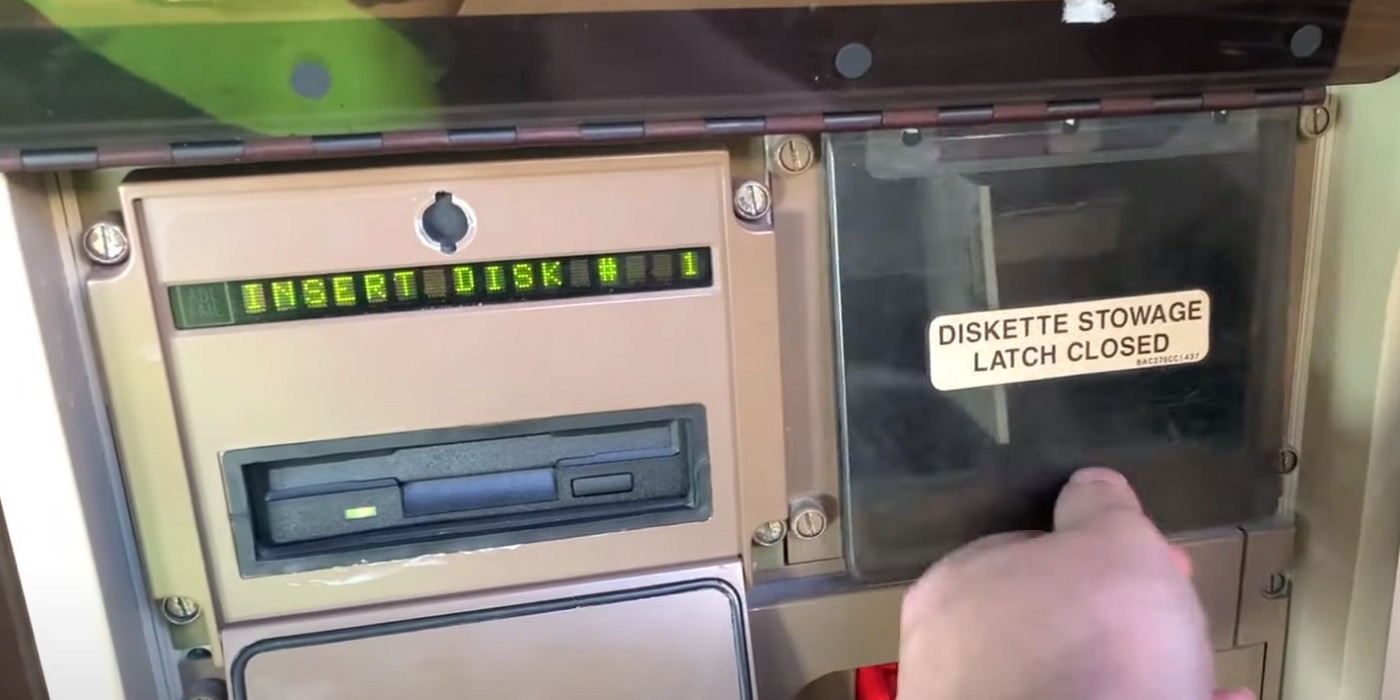
The display says "INSERT DISK #1" so probably at least two, and it looks like there's a place for maybe a dozen under the "diskette stowage latch":
https://regmedia.co.uk/2020/08/10/b744navdatafloppydrive.jpg
https://twitter.com/harrymccracken/status/940263706444754945...
Well now I'm having flashbacks of installing "Strike Commander".
(By the time I was done I didn't have enough disks, so I had to go to the lab in the middle)
> "Aircraft themselves are really expensive beasts, you know," said Lomas as he filmed inside the big Boeing. "Even if you had all the will in the world, airlines and manufacturers won't just let you pentest an aircraft because [they] don't know what state you're going to leave it in."
From what I understood, there is (was) a real danger of a part that was used in a stress test ending up in a bin full of spares. So every 'part' has an identifier, responsible parties, and a tagging system that keeps the streams from ever crossing. A floppy is physical, so they just did the same thing.
Imagine trying to convince a bunch of people who have always ever done things physically to use electronic distribution.
I assume they don't have to go through certification for the loading device(the floppy drive), just the process of loading data instead (through the emulator)
I read something similar about the computers that control the US nuclear arsenal: They're extremely primitive and can only be updated by floppy disks.
Although the most annoying issue is usually related to SD cards. Most SD Cards these days are usually "SDHC" or "SDXC" cards and formatting them to a 2GB partition doesn't actually work.
Less regulation = rich founder kids gets lambos + utter destruction of society = good :thumbsup:
I dunno. I could easily see taking decently made hardware to the 20 year mark.
I only had about 15 floppies between me and my roommate. I remember getting the "a" series of disks and then the "d" series for development and so on. I had to run back and forth to the computer lab about 5 times over the weekend.
Taking it to the extreme - will CPUs in 30 years be cloud connected and require my service provider to work? Would OS be? Or scheduler? Or terminal? Or dynamic linker for libraries? Or IPC framework?
How much of that stuff will companies need to build in the future themselves? It's not like software will get simpler, so they won't need it.
The point is that systems like this go through various analyses before being built. Reliance on outside services/components is one of those analyses.
Let's say that a critical component is an online service. Someone will do the analysis of what happens when that service goes away. If the outcome is that you can expect to failover to something else with acceptable degradation of performance, then the service might be used. If not, then the choice is find a more reliable service, build it yourself or do without the feature. And those last two choices will themselves be subject to another analysis.
One of the nice things about capitalism is that if there's a profitable gap in products/services, that gap will eventually be filled. All new CPUs need to cloud connected and require a service provider, but there's a big industry that can't deal with that? I guarantee that someone will corner that market and start building CPUs that don't need to be cloud connected and require a service provider. Either that, or sufficiently reliable cloud services, tailored to that market, will appear.
And this isn't only talking about software you put on the devices. Developer environment is going to degrade even more and more. It's already bad experience to develop stuff for things that need long term support, and with cloud trends, it'll only get worse, as set of tools that you could possibly use will reduce.
Not very. There's significant wear and tear from the drive head, to the point that you could see it with the naked eye after a while.
If you are not using them frequently, storing under ideal conditions, than maybe. I've been able to read floppies a decade after they were written. Not for long though. Drive required cleaning afterwards too.
Certainly 5.25" floppies from the late 80s and early 90s were nearly bulletproof in my experience. 1.2MB was a bit flakier than the 360KB though. All were still perfectly readable 20 years later, though at this point they all got thrown in the bin due to their obsolescence!
Of course, back then I knew enough to spend a bit more on the good quality ones, so that could have something to do with it.
If I'm not mistaken, we even gave them our code back in 2009 or 2010.
s/for now/forever
Must be some cognitive blind spot.
How does your "better" passenger-deaths-per-km measure account for these deaths? (And what is it superior to, exactly?)
1. Arguably this is the cost of regulations not being followed properly
2. This is an extra-ordinary circumstance that is costing much more than a regular plane would cost to get certified and fly (see point 1)
3. You are drastically underestimating the cost to the industry both in terms of reduced customer confidence, hull losses (~$100mil an airplane), and increased insurance premiums if we were to continue flying the Max 8.
But honestly, I'm having a really hard time understanding what your point is. Are you asserting that we should just fly the Max 8 and not worry about it? Are you asserting that airplanes aren't safer now? What are you getting at?
Pretty much any other form of transit, safety-wise.
https://en.wikipedia.org/wiki/Aviation_safety#United_States
> The number of deaths per passenger-mile on commercial airlines in the United States between 2000 and 2010 was about 0.2 deaths per 10 billion passenger-miles. For driving, the rate was 150 per 10 billion vehicle-miles for 2000 : 750 times higher per mile than for flying in a commercial airplane.
> How does your "better" passenger-deaths-per-km measure account for these deaths?
You propose a silly metric. Car accidents cost $871 billion a year. https://www.pbs.org/newshour/nation/motor-vehicle-crashes-u-...
The engine literally exploded, and they made it home via the rest of the plane OK (minus the unfortunate passenger).
It has zero comments, the code was inefficient, the variable names are things like "theThing" (it's the best I could do at the time) and "database" is just a series of text files carefully read/written to on the disk.
In some cases we had to have contingency plans for the software and data in case the company goes out of business within the coming 15 years.
Next I worked in advertisement, where clients spent similar sums as the above for cross media campaigns lasting maybe 14 days
That was quite the interesting contrast work wise :)