Samsung TV owners complain about increasingly obtrusive ads(flatpanelshd.com) |
Samsung TV owners complain about increasingly obtrusive ads(flatpanelshd.com) |
What's a good competitor that doesn't do this? Sony?
It may not work for the smart tv case, but I imagine a device or filter program that I can plug in that detects ads with a neutral network. It wouldn't turn off the ads, but instead transform them into unpleasant imagery that creates incredibly negative brand images. It would be designed to permanently subconsciously tarnish a brand.
McDonald's human trafficking
Nike genocide
Spouse-beating Walmart
Coca-cola rotten corpse
I want to deploy this widely to destroy advertising. If ads got detected and replaced with images designed to embed and evoke negative reactions, advertisers would stop.
We need something this drastic to fight back.
hopefully it ends badly for them on the long term
I only use my TV to watch YouTube or Amazon Prime through the PS4. But as I'm burning enough time on that (the first one) already on my phone, maybe I should buy/build in aquarium in that place, once the TV dies. Probably more relaxing in the end. And ads-free for sure!
Samsung is cut from the same cloth as Apple. Huge advertising budgets to get the sale. Abuse of customers after purchase.
Every SciFi movie: The only use they can think of for AR is Ads
Of course, it's showing you advertising, that's what the internet is for according to the advertising scum of the world.
Maybe don't buy a 'smart' TV next time?
Anyone have recommendations for units they've bought this way? I've avoided upgrading my super old LCD because at least my current one is somewhat stupid and so long as I don't connect it to the network it mostly does what I bought it for: display the pixels.
I use few year old Sony like that, couldn't care less about any of these complaints. It requires trips to PC to manage content, which I think is the biggest hurdle of this approach for lazy couch potatoes.
:-s
I declined everything and hooked it up to my Apple TV. Super happy.
Not to mention, the ads on the home screen are less intrusive and far less numerous than on Comcast's cable box.
Isn't Comcast also a paid service? You (US) get ads in tv broadcast you pay for?
I haven't seen any TV broadcast for over 10 years now, my TV has only chromecast and it only plays what I stream to it.
Ill let my TV be a dumb TV that I can simply send a signal to.
It would only be fair to let people know what to expect!
Basic cable box (used rarely), roku, and PS4 provide plenty of "smarts" for me.
I tried cutting the cable two years ago and went back last year. Live sports isn't there yet.
I'm happy with my LG TV, which the only "ads" they have are:
- Highlighting new "TV Channels" which is ... acceptable. I don't know why anyone would want/care about the Hyundai TV channel
- installing Disney+ automatically
I have a feeling this will last about as long as it takes for consumers to get a sense for what models come with ads. No one wants this on a device they already paid for.
Yes I could disconnect it from the network but that would defeat one of the reasons I did buy it and which was mentioned in reviews: high-quality built in apps for Netflix and other services.
I might still be naive, but my point was more that I’m having trouble imagining how the reputational damage to Samsung here wouldn’t, ultimately, impact sales. If I was thinking of buying a Samsung TV and my neighbor told me that his suddenly started throwing ads in his face, I’d never consider anything from Samsung.
It might take a little time for the word to spread, but am I wrong in assuming this tactic will turn out to be disastrously unpopular with consumers?
It's not smart to buy "smart" appliances, since any intelligence they have will work towards the interests of the companies that made them, not the purchasor.
https://www.samsung.com/us/business/products/displays/4k-uhd...
I hope it's only a matter of time.
you'll be thrilled how much data these "smart" tvs collect when you plug it to your local DNS server.
You were able to block everything in the past but no longer. Samsung catched on and now serves some ads over the same domains they distribute their firmware updates, install apps, get the program guide, and check the online status.
If you block those domains the Samsung TV loses most of its internet features and also seems to go crazy and requests all domains multiple times per second, defeating deep sleep of the TV.
I happen to only use my tv as a single input HDMI display, using my Roku for everything. I suppose they could still force ads in that situation, but I assume they haven't yet.
Building apps into a TV is a really nice idea, but there has to be a better way.
I think: monitor + DVB decoder + Raspberry PI.
It will be the end of privacy completely. EVERYTHING always on and serving ads, collecting telemetry and logging everything. There will be no way to shut them down.
My TV has been relieved of all internet connection privileges, and it's staying that way.
[1] https://www.samsung.com/uk/support/tv-audio-video/how-do-i-u...
Most people already don't care and happily connect everything to their Wi-Fi. Those that do care and now setup firewalls/piholes/etc. on their Wi-Fi will learn to snip the coax/desolder/drill out the 5G antenna in the future.
To turn everything on, I press a button on the Apple TV remote and everything is up and running within five seconds or so (from standby/sleep mode). Powering off the Apple TV also turns off the display and the receiver via HDMI CEC.
Commercial TVs aimed at the digital signage market are an alternative option to a large monitor, especially at larger sizes. They're less likely to spew advertising than consumer Smart TVs, but are probably less likely to stay clean than a monitor with no Internet connectivity.
I use a Linux PC as a media decode device. It works, but I have no interest in 4K (hardware video decode is sketchy on Linux, which makes 4K difficult) or paid streaming services (if I wanted to watch sewage I'd take up urban exploration into wastewater facilities).
Commercial TVs aimed at the digital signage market
are an alternative option to a large monitor,
especially at larger sizes
I've seen it mentioned that they tend to lack features like HDR and may not have remote controls. Any other downsides?
I would be fine with the lack of a remote, and probably even HDR. I would also be willing to pay a bit of a premium over consumer TVs.
However, information on these displays is pretty tough to come by. I browse home theater type forums/subreddits from time to time and don't see people really talking about using them in the home.
edit: Also, aside from netflix, a local plex server with rtorrent/irssi to auto-download tv series I followl
They are not "smart", but less is better, so in terms of OS functionaliry, privacy, and user experience; they top the charts.
It's kinda sad that people are just now noticing how bad the ads are. They were bad back 6+ years ago - especially when they tried to sneak ads into videos played back from plex.
That’s the only way I see a golden goose killing ux change making into one of the industry leading products in a cut throat ever changing sector.
I’ll now browse the comments to see if any other plausible explanations have been presented.
The good news is you can block the ads. Here are some domains I've blocked in my router. They might not all be necessary to block, but they don't seem to break anything else (except perhaps Disney+) and they do stop the ads from appearing.
(Note: The only ad I was seeing was an additional ad box that was inserted as one of the sources on the source selector. It was only an issue if you were going from display to the TV's settings because it had inserted itself in between the two, and you could accidentally click on it. Blocking the following domains got rid of This.)
samsungads.com
ads.samsung.com
www.samsungotn.net
www.samsungrm.net
gpm.samsungqbe.com
samsungacr.com
samsungcloudsolution.com
samsungcloudsolution.net
samsungotn.net
The bad news is that the Disney+ app may not function properly if you block these domains. The obvious workaround is to use Disney+ from a browser, but that produces surprising results with this TV. Certain video sources, such as Disney+ or the trailers on IMDB, cause my Samsung TV to flash the following message:
"We are adjusting the picture quality for you to experience a better uhd screen. You can change the settings in Settings > General > External Device Manager > HDMI UHD color"
The screen then goes black and the only way to restore function is to unplug the HDMI cable and plug it back in. Very annoying.
The message describes settings that exist in the TV's configuration exactly as described, so it's definitely an error message produced by the TV set. Unfortunately, the settings referenced do nothing to eliminate this bug.
I've contacted Samsung's tech support a couple of times and they're utterly clueless about this issue. (Note: Not many people may report this error message because if flashes so fast that you need to photograph the screen in order to read it, and you have to have fast reflexes to do even that!)
All in all, despite the quality of the screen, these unresolved issues mean I will probably not buy another Samsung TV and recommend that others avoid this brand as well.
At this point, is it even possible to buy a high quality tv that isn't a smart tv? And will these smart TVs work properly if you keep them disconnected from the internet?
(Side note: this is why TVs are so much cheaper now, isn't it?)
The end.
Smart TVs can go to hell. Arguably updating the firmware wasn't even worth doing but whatever.
Seems dumb. Seeing this link has already made me to decide I actually won't buy a Samsung tv. I'll just get something else.
If we truly go the road of the dodo, I'll just make a side business rewiring "smart" tvs.
Second issue is that the average consumer wants smart TV's – they like that everything is integrated in the TV. Less remotes, less cabling etc.
As someone who doesn't really use the "smarts" on my smart TV, I'd quite like a well engineered (hardware + software), privacy preserving, smart TV. I see the appeal of an all-integrated solution. But none exists; most of the time the software is either garbage, or runs as if it was meant to run on hardware a few generations in the future. And as for privacy... sadly, few on both sides of the market prioritise it :(
Unfortunately they probably don't get the extra revenue from ads to be able to get placement in stores like Best Buy.
An additional benefit is that you get to log internet traffic and get shocked as you find out what your devices are really up to.
To block ads that are served over whitelisted / not blocked domains I’d need some kind of deep packet inspection. I’m not sure this kind of filtering even exists / would work as a lot of the ad traffic I see is served over https.
I imagine that would be the next logical step that device manufactures will go to to combat consumers setting up pi-holes.
You could stop the device from initiating a tunnel by blocking the appropriate ports and protocols.
Although if I found out a device was going to these lengths and wasn’t open source, I don’t think I’d want it on my network.
Anyone remembers that TV screen in the wonderful Idiocracy docu... er.. movie? That is going to happen, soon or later.
https://i2.wp.com/scifiinterfaces.com/wp-content/uploads/201...
Excellent capture! Personally I'd wish for a "fan-edit" of that, melded with Wall-E :)
-AppleTV will not do this, and likely never will -iPhones do not have ads all over them put in place by the carriers (I still can’t believe this happened)
Before the great unplugging, I set the Internet connection on the TV to be to my iPhone. I almost never have my iPhone hotspot turned on, so I could do TV updates when needed, otherwise starve it for an Internet connection.
BTW, no TV works for us because we stream to my wife’s large iPad Pro and she bought a fancy stand that can position the iPad anywhere in space. We site next to each other and place the iPad just under three feet away. We like this setup.
[1]NextDNS https://nextdns.io/?from=rj4b2nfn
The issue is the built in youtube app constantly had to be logged out and back in. Otherwise advertisements start to show. Sometimes as often as wcey 4 minutes. And they are the worst sorts of advertisements geared to kids to ask parents to buy pointless plastic shit.
I am failey sure this bug is not being fixed because it would lower somebodiws revenue, or metric.
I seriously doubt this is true. It's probably rational behaviour for Samsung to push this trend as far as it goes and then retreat a little if negative reaction shows in the bottom line. Or maybe limit the offending products to lower price category.
The options seem very limited. I may end up using a computer monitor with a streaming box and or a tv tumer card on an old computer. I already have a good OTA signal from an outdoor antenna that is used by the main TV in the house and can easily run a splitter.
Any low cost recommendations?
If it involves code it is going to be terrible for the customer.
It's pricier, e.g. 55" 4k is $3000 CAD, but worth the privacy. We actually got some large ones at a discount because they were all 1080p, and for meeting rooms, nobody needs Powerpoint or Word in 4K, so it was perfect. Just a thought if anyone is looking for good quality TV sets. I also think the limited warranty starts at 3 years.
[0]: https://www.samsung.com/us/business/products/displays/pro-tv...
[1]: https://www.samsung.com/us/business/products/displays/4k-uhd...
Amazon has a bunch of affordable models from Samsung. Haven't clicked through them all but here's a 65" with HDR for $600.
https://www.amazon.com/Samsung-Business-Software-Speakers-LH...
However, it's probably not the sort of "dumb" TV we want:
    Setup your TV with custom content quickly
    and easily using the Biz TV app - available
    for Android and iOS
I guess image quality and response time might be sub-par too compared to a top-of-the-line consumer-grade TV.
They often have serial ports behind them, that serves as the remote control. They may support HDMI CEC for it as well?
Also, Apple‘s streaming services being ever more annoyingly shoved in your face on menu screens.
Some people might not be comfortable with this, or not even trust them to begin with. I personally don't mind paying but there's no way in hell I am providing any personal information to Google.
Then again, I don't have a TV for the exact reason listed in this article, I use a big monitor.
I don’t remember where I read this, but a United Labs for information security is overdue.
It won’t directly help with ad injection, but I think the security implications will put a damper on some of this (the cost of maintaining their firmware which Samsung barely does).
Anyone that researches can get a TV without ads for hundreds of dollars.
I don't buy anything from Samsung, it sounds like a user issue. Samsung is notorious for being awful.
I have a feeling that's about 95+% of consumers.
From what I learned so far the difficulties are: [please also correct me on these]
- stand is not included (need to buy that separately / do a wall mount)
- hard to find a seller
- prices are higher than for equivalent consumer TVs
- brightness is higher -> more power consumption
- there is no antenna (terrestial DVB-T/T2, satellite input) so you have to drive content from USB or PC / Raspberry / xxxCast dongle
The benefit is that you get a "dumb" panel with no spying, ads, software taking snapshots of what you watch. The TV is then also designed to last more hours - commercial panels are on 20h/day.
Make sure they actually do what you want, even things that every consumer model has had for years. The situation may have improved in the last year. Also, I only looked at 82-85” models, so the situation may be better on smaller models.
for example, Samsung QP82R is an 8k "TV" for €3500.
My worry is can I it decode all standard codecs from USB source? Apparently Samsung in 2017 removed DTS and DivX /Xvid support. Decoding on the TV is key as only then you get the best motion interpolation algorithms. Playing from Raspberry via HDMI you don't get these.
- There are more difficult to buy, as they are a b2b product, but on amazon they sell some models.
- brightness is higher, depending on the purpose of the monitor, there are monitors for sun facing storefronts, which are way brighter, but those also have fans and are noisier. The ones purposed for indoor are more or less the same brightness of the tvs, and sometimes have sensors for changing the brightness depending the environment, which is actually a plus. - no antenna, some offer iptv, and others actually are android or linux based, so you may even install some apps, but you must configure them manually so much easier to use an external player.
- they are tougher panels, but they are designed for showing ads and static content, so no dark blacks, less contrast and usually less colour gamut coverage.
- not many 4k panels, the are designed to see from a distance, so many are fhd instead of 4k.
- another drawback is that many doesn't have speakers, so you have to hook up your own sound system.
Anyway, I'm in front of a storefront samsung om55n and watched some content and it's ludicrous, at night and the room seems illuminated like during the day.
Samsung also has a business line of tvs, are more like the domestic ones but designed for longer operating times and you can configure them to show slideshows or to have a ticker overlaped. They use the same basic tizen system, but the home screes is different and I doubt you will find ads on them.
Whats more it constantly installs some partner apps and puts them for quick start into the menu sometimes removing the applications i actually use from there in the process. I prefer using these apps for Netflix and co but every time i plugged it into the ether i feel like i should not and a fear of it getting even worse somehow.
Then, for the "Samsung Home" app that you can't move from spot number 1 that shows "Featured content" when you cursor over it, set up parental controls and lock access to that app. It will still be there, but it won't show anything when you navigate past it.
Does it now even still do the ACR? Are they going to retroactively install me ads? Are there specific domain names one should block? Alternative firmwares?
For all of them, their main money maker is ads on free video content. Most of them have a channel/section filled with free tv shows/movies (usuaully b level content) and they make the majority of their revenue showing ads on this content.
I was stunned by the prominence and intrusiveness by the ads on my Roku, even with already knowing it calls home several times a minute.
Once everything was back up and running things were back to normal. My setup is a dumb Spectre with a great screen with a Roku connected for Netflix and Plex/Jellyfin. Combined with a pi-hole it makes for a pretty clean experience.
I don't think I'm buying things based on ads, at all, but the adtech guys would surely disagree. I also find it hard to square the near universal loathing of ads with the draw of Times Square. I too enjoyed the lights of the ads.
At home I don't have a smart TV (I use a JVC video projector and they've resisted adding those kind of useless feature so far) but my parents use a smart TV connected to an apple TV and so I'm curious what happens there.
I do wonder what kind of content it can detect and in which modes.
At least when I subscribe to a SaaS and they roll out changes I dislike, I can choose to stop paying them and move to a competitor.
Non security updates should always be opt-in.
But this is the same thing, the market is repeatedly told to ask for smart devices, even when dumb TV is all the users need.
for myself, having no 4k hdr, no netflix, apple tv, youtube, bbc, and many others is a deal breaker when it comes to buying a new tv.
Personally, I would pay more for a TV without this functionality. I'm running one of the last "dumb" consumer TVs, from 2015.
But the overwhelming majority of consumers just want smart TV stuff built right into their TVs.
It's like power windows and air conditioning in cars. They used to be premium features. Now, you really can't buy a car without them, at least in the USA.
(Pedantry note: As late as ~2014, you could still buy a Nissan Versa with manual windows; perhaps it's still possible)
Same happens to screen in cars.
But on the other hand, the argument "I paid all this money and I still get ads" is honestly something I've been hearing about cable companies for decades. In the end, if something can make money (as in, people will pay) that's sadly the way it will go.
I leave the intelligence to other devices which I connect to the TV.
Price != performance
There's absolutely no after thought to this decision - If I paid 1000s of dollars for an "idiot box" that's supposed to reproduce faithfully the signal that I pass it, showing ads is unacceptable, no matter what the context or reasoning is.
This is one of the reasons I paid the premium and went for a Sony instead. They haven't done anything stupid like this yet, and I don't use smart features on the TV anyway, so I don't plan on updating the software either. Hopefully they face backlash over this stupidity and this doesn't go on to become a norm.
That would be really, really terrible.
A: ...and in conclusion, it's a win-win situation. Users will benefit from ads and our revenue will go up.
B: People don't like ads on their TV.
A: But they do. I refer you to slides 18 through 25 where you can see engagement metrics for our ad rollout on the old model. If people wouldn't like ads they wouldn't be clicking on them so much .
B: I don't like ads. Do you like ads on your TV?
A: No.
B: Does anyone here like ads?
A: That's not the point. No-one here is in our target group or representative of our user behaviors.
C: Ok, if there are no more objections we're going with A's plan then. B, can I see you in my office after we finish here?
The reason they predict their revenue will go up (which it will, at least in the short term until the market adjusts) is because they have a lot of customers already lined up to pay them to show ads on their TVs.
Those customers' marketing departments decided to pay money to include their ads on TVs because a similar process was followed and they (rightfully) predict that they will get "engagement" on those ads (which the marketing department will rely on to justify or increase their salaries).
The problem is that this "engagement" will mostly be just annoyed customers mis-clicking or trying whatever it takes to dismiss the ad and not actually intending to purchase the advertised product, thus not contributing to the company's end goal of selling more product.
I am not convinced that the majority of the advertising & marketing initiatives out there actually translate to more profit. Marketing departments will brag about "conversions" all day long but how many of those are either accidental clicks or people who were already determined to purchase your product anyway (looking at the companies who buy Google AdWords on their own brand - if someone's searching for your brand on Google your website will already be the top result - a click on the ad is not a true "conversion" in this case and is just wasted money).
Ultimately, people have a finite amount of time and disposable money, and throwing more ads at this "problem" won't solve it. Your conversions will go up because of accidental clicks (and your marketing department will capitalize on that to justify their salaries/raises), but that doesn't magically give the consumer more money to actually go and buy your product so your profits will not increase.
It's the same thing in the airline industry - people will complain all day long about legroom and being treated as cattle, but the next time they buy a ticket they vote with their wallets when they sort the flight list by price and choose the cheapest option.
There was this article a while back I read that talked about how native peoples made poisonous foods edible. Some processes were extremely convoluted and unreasonable, but it worked, and efforts by a "reasonable" man to make the process more efficient would have certainly doomed the whole tribe.
Examples like that really make me question the idea that an efficient economy is the best economy (let alone if capitalism and free markets are ideal).
"It is difficult to get a man to understand something when his salary depends upon his not understanding it."
—Upton Sinclair
B: I don't like ads. Do you like ads on your TV?
A: Yes of course I do. If you don't like ads on your TV why are you working here.
B: Does anyone here like ads?
A+group: yes of course we all like ads (lying in a meeting is not a crime, and occurs all over the world)
C: ok no objections, we love it! Ship it!
A, C gets a paycheck at the end of the day.
B gets fired if they don't change their mind.
Big companies need to have an ombudsman department who have the explicit job of reviewing all these schemes and nixing any that will likely lose customers.
Yep, sounds about right.
“Why do we need to track users?” “To give them recommendations!” “But this wall you’re using takes 4 seconds to load. Do you think this improves user experience?” “Yes, because the content is adjusted for the user. Besides, we did a test and 96% clicks accept, so the users don’t mind” “Where is the decline button?” “...” “There is no other option. You have accept, or you have to hse settings with 100 checkboxes. I’m surprised 4% even bothered to check these!” “Yeah but most just accept, so they don’t mind, and users really want the targeted content”
If I have to add it, I’ll at least make sure it won’t take freaking 4 seconds to load.
"We need to think of our devices as small hyper local billboards with untapped potential"
This is not really Sony's fault but rather Google's but it still leaves a bad taste in my mouth…
https://9to5google.com/2020/08/18/android-tv-homescreen-ads-...
I plugged in my Apple TV instead.
Every now and then the Android TV pops up when I turn the TV on and asks me to complete the set up. I always tell it to fuck off.
So far, no ads. It'll stay that way till the TV eventually dies - without ever connecting to the internet.
Just don't connect it to the Internet.
The bigger problem is that at some point there will not be any "idiot box" models at all. The TVs will refuse to work if they aren't seeing the Internet. Then we'll be truly fucked.
What if Samsung decides that it will try to connect to open networks for updates or what not? What then? Ask your neighbour to install PiHole on his network? No. This is an example of a game of cat and mouse that shouldn't exist - you pay money for a TV and that's not enough? You giving them your money is not enough and so they decide to shove ads down your throat because profits.
Simple solution would be just not to buy Samsung.
The forced login is likely illegal, because there is no mention of a requirement for a Google account in their marketing materials or on their sales pages.
The device stays perfectly functional if the the network connection is cut off within seconds after signing in, and the account can be removed after the setup is complete. The only drawback is that you can't update apps from Google Play, unless you add a Google account again.
We're closer to that than you think. My Philips Ambilight television (purchased this year) throws a popup every few weeks already complaining that I've not completed setup and connected it to the internet.
As sold as I am on Ambilight (it is actually brilliant), I wont be buying another Philips television.
Or maybe we (the tech community) just agree on one model and produce an open source firmware. If you look at MagicLantern for Canon, you'll see how amazingly far people will go to control their hardware.
One also has to be cognizant of HDMI Ethernet in case of "unintended" connectivity:
* https://en.wikipedia.org/wiki/HDMI#HDMI_Ethernet_and_Audio_R...
Also Netflix experience with Chromecast is mostly superior to smart TVs, because it will not play anything while you just try to find something worth watching.
Connecting Chromecast to the soundbar also gives ability to listen to music from Youtube, without running display. It wastes bandwith however.
EDIT: I wrote "beamer" instead of "projector" at first
Haha, just wait until 4g/5g will become so cheap that TVs will have them built in for doing software updates and sending telemetry when offline :)
sure, the monitor was atleast 25% more expensive than a similar screen with a smart-tv function in it, but I think it's worth it.
There was a company that made just a good tv, no smarts, but I can't find it right offhand. It think it was a european company
see https://www.reddit.com/r/privacy/comments/bpr6xs/if_you_choo...
Wait until they start including a cellular modem that can't be turned off.
Oh they have. Many times over. Two instances affected me[1][2] and that was enough to swear me off all Sony products for the last 10 years. Only now am I contemplating buying from Sony again (a PS5). I don't think any multinational company is above trading their customers needs for a few extra quid.
[1] Sony BMG copy protection rootkit scandal: https://en.wikipedia.org/wiki/Sony_BMG_copy_protection_rootk...
[2] Removal of "Other OS" feature from Playstation 3's after users had already bought them: https://www.pcworld.com/article/3088169/sony-agrees-to-pay-m...
https://streamingclarity.com/android-tv-staff-pick-highlight...
They have the same contempt for software that they do on their phones.
They NEVER update their firmware. It's amazingly slow and latent.
When they DO occasionally update they usually break things that were working or remote features you used.
About 2 years ago they implemented some weird/stupid popover commercial thing which you could eventually disable but they hid the feature.
I'd be watching Game of Thrones or something and in the middle of the show they'd bring up a popup for a new TV show or something along those lines.
NEVER buy a TV. Even better. They are all horrible. I thought that TVs would be a thing of the past like landline phones, but looks like I was wrong. It's incredible that the gullible are swarming to "smart" TVs.
Usually I disagree about niche hardware in this way (for example, usual mentions about a similar approach for phones and laptops), but the dumb screen might just be dumb and cheap enough to make work at this limited scale?
It can be done, I think, but it has to be VERY well funded - you need to send salespeople / lobbyists to the various on- and offline shops selling TVs, you need "SEO experts" to try and beat the competition's "SEO experts" on the internet and e.g. Amazon's search results, and you need a legal team to help with the inevitable heap of lawsuits you'll get (patents, design infringement, etc). And then you'll have to deal with the competition pushing the prices of their devices below yours; Samsung can afford to sell TVs below market value for decades if need be, JUST to push out that shitty newcomer that does ad-free TVs, and they'll make money off of the ads + subscription services they offer in the meantime.
They should feel social pressure to backpedal this stupid decision by hurting their marketing for fear to be known as the brand that has ADS in their television sets.
That rarely works. For each consumer that has the time and understanding to not buy the brand there is a thousand that are not aware. The way to go is lobbying for stronger regulations and to limit where Ads and recollection of data can be done.
Day after day we have more and more connected devices. Samsung is the tip of the iceberg, even if there was consumer backslash for one company the problem will still be there.
The "home screen" of the TV (where it goes when you turn it on) was always the chromecast, which as I'm sure most people have seen, is rather nice; just endless pictures of art and landscapes, like a screensaver.
One day it updated without my consent, and that screen was replaced with Vizio's, I dont know, some piece of shit interface no human being on the planet wants. Ads for Crackle and other Vizio tvs mostly. Its so bad.
So, I'm never buying another Vizio TV.
The last update also broke hardware video decoding for a whole range of h264 videos as well as pushing some kind of weird 3rd party that seems to be something that basically monitor everything you do with your TV. It was advertised as a feature to access the TV guide.
My next TV will not be a so-called "smart" TV and not certainly not a Sony.
By now, it doesn't really matter which brand you use. I have analyzed Samsung, Sony, LG and Philips and ALL of them send data about your usage to NetEase in China and ALL of them have ToS that say that they might record your voice and store it for improving their AI or whatever. Plus all of them shove suggested apps in your face, so I'd say it is only a matter of time until all of them show more aggressive ads.
But if you fully wipe it and then keep it fully offline, most TVs have a great screen and they can be configured with "gaming mode" to work like a low-latency HDMI / DisplayPort display. And without internet, there are not ads :) and no forced (useless) updates.
BTW, my LG OLED is completely ad-free, defaults to using HDMI port 1 and even has GSYNC. Just connect any barebone with an NVIDIA card and you have 100% control over what you see.
Never buy a consumer product that expects an Internet connection.
At least I know it's possible on all Sony AndroidTV models and most Samsung models (not sure about their latest Tizen).
I own a 2012, 60" Sony Bravia and the picture quality is stil superb compared to recent models (except OLED). Its HD and not 4K, but it makes no difference, my eyesight is not getting any better and I might use it for the next 5 to 10 years probably. It's internet capabilities are laughable, pre-smart TV. Picked it up for 100 quid second hand, no doubt some idiot replaced it with a "smart" piece of junk with thinner frame, less durable LEDs, and now, good God, mandatory advertising.
I'd like separate boxes for video display, video signal switching, audio signal switching, stereo and surround sound decoding, speaker driving, OTA TV tuning, AM radio, FM radio.
I want these boxes to all support a common control protocol, with another box or boxes handling controlling the system.
My current system with a receiver that is 8 years old and a TV that is around 3 or 4 years old is fine, except for three things: (1) the receiver cannot handle 4K video, (2) the receiver does not work with any voice assistants, and (3) the TV does not work with any voice assistants.
With a modular system, I'd just replace the video switching with a 4K switching box, and replace the control box with one that supports a voice assistant (or add another control box...no reason a module system has to have only one such box).
With the current approach, I'd have to replace the receiver and the TV for that.
I've considered upgrading to 4K many times. But I take comfort in knowing the TV I have now is not screwing me over. The thought of having to thoroughly research the TVs of today is enough for me to stick with it. Heck, my eyes probably can't see the 4K improvements from across the room anyway.
For instance, when an older PlayStation (3?) in an update made it so that one could no longer run Linux (which was advertised as possible), I know of people that got to return it and get their money back after the Norwegian Consumer Council ruled against Sony.
1. The Netflix/Prime Video etc apps are snappier because of the beefier SoC
2. Content looks better, because DLSS does a better job at upscaling than the TV's native upscaler
3. I can use it to stream games from my PC, which is making me reconsider buying one of the new consoles just for couch gaming since I could spend the money on a new GPU to upgrade my rig an just stream from there.
And as you mentioned, the presence of HDMI CEC makes remotes rather interchangeable
I also didn't connect the antenna cable and didn't even notice during the entirety of the (Italian) lockdown since I never watch "normal" TV. At this point I wish it could be possible to get TVs without a tuner, I could stop paying the TV taxes!
Luckily, Samsung was awesome about it and I was able to RMA through Best Buy, who just gave me my money back. I took that cash, put a bit on top, and bought an LG OLED. Best decision ever. OLED is absolutely dominant in TVs these days.
> Your browser is not Javascript enable or you have turn it off. We recommend you to activate for better security reason@SYSLOG: INTERNAL ERROR[2]
Oh well, if it's for better security reason, then… /s
Gimme a boring TV with open firmware so I can flash it with Linux or better yet, no need for firmware, just a few video ports and a power switch. I'll feed it with my video signal of choice.
Then a phone with stock android or ability to flash Linux or whatever with hardware kill switches because you cant trust anything electronic these days.
Then I'll take a car with a steering wheel, two pedals and a double din opening on the dash and some HVAC topped off with a downloadable service manual right from the manufactures website please.
I'm tired of feeling this technology anxiety where I'm supposed to just give up my rights and dignity and capitulate to the corporate gods. Go away already.
Yes, the xbox and PS4 home screens have 'ads' (promoted games and stuff mostly), but they're not 1/10th as annoying in my opinion. And Microsoft and Sony have a much higher likelihood of keeping the operating systems properly patched and up to date on a 5, 10 year time scale.
1. why?
2. the ps4/xbox pale in comparison to my lg's apps. functionalities, quality of streams, the voice search. they're all much better on the lg apps.
  - vcfd1.giraffic.net, vcfd2.giraffic.net: adaptive Video acceleration (seems to be used for internet TV)
  - GB.lgtvsdp.com, ngfts.lge.com: don't know what this does.
  - GB.ibs.lgappstv.com: needed to download apps and updates
  - snu.lge.com: used to check for software updates?
  - lgtvonline.lge.com: likely for the TV recommendations feature that remembers what you watch and gives you recommendations based on it
  - GB.info.lgsmartad.com: ads
  - yahoo.com: no idea why the TV needs to talk to yahoo. Blocked.
- facebook.com: why!? Blocked.I'm shocked that you don't want facebook to know your viewing habits to show you more relevant ads. Its a feature to improve the ad experience for the users.
Also, sounds like a case of optimization creep - "I know a way to get even more revenue, we just sign up with this $more_shady_ad_network!". Displaying more and more creepy ads, no-one decreasing ads since they don't want to be the one decreasing ad revenue.
What? A month? Sale of goods act.
Then there's quite generous warranty for 2 years, up to 3 years, but that's when things break.
In addition, I think this also includes if a sold item is unfit for advertised use, or perhaps even if substantially changed during ownership (eg Samsung mandatorily introducing ads), but I've never had to use that so don't know).
The panel was thin (with almost no bezels), the picture quality was superb and I was sold on the "Smart TV" features like having built in access to Netflix, etc. For a while it was great, then I noticed the ads showing up on the bottom left of the bottom menu. Now my TV is as slow as molasses and I hate it. Picture quality is still good, but Samsung ruined it with their software. I refuse to purchase another Samsung TV which really frustrates me because I love their panels.
I'm currently looking to disable the internet on it and use a Fire Stick, Roku, or other. Anyone have any suggestions?
200 years ago it was probably legal for a food company to put a bit of cocaine in the food to make it more addictive. Nowadays I think you would go to jail for that.
Similarly, if we ever make it to the year 2220, the act of making a product that forces users to view certain content or that spies on users will be something you go to jail for, not something that gets you a promotion.
All the technical fixes that people are proposing (disconnect internet, pi hole, etc) are bandaid solutions and eventually the companies will bother to break those fixes. The company is a million times more powerful than any given individual and individuals are uncoordinated, so absent regulation the individuals will maximally lose the game - Black-Mirror-esque
On top of all these ads and snooping, there are so few TVs with a smooth, responsive UI. Seriously, even in top brands the UI chugs along at a snail's pace. And most of the time the UI design itself is terrible.
Who cares about 8K if the UI takes 8 seconds to load.
Volume controls used to be instantaneous. Why the degradation of user experience alongside incredible progress in technology?
I myself was a pretty loyal customer up until very recently when it came time to buy a TV and I specifically wanted one without ads ruining the experience.
I'm reasonably certain this will make this many peoples last Samsung TV.
Their corporate executives clearly have no ethics whatsoever.
But that's not the only problem. My coworkers have been to Samsung's headquarters and worked on their core IT infrastructure. They both rattled off an endless horror show of security lapses and outright violations of common sense that would make your eyes pop out of your head.
There is zero chance that your data is "safe" with Samsung. None. They will get hacked. They're almost certainly hacked already, and don't know it. Or they know it and simply don't care.
I would never personally buy any product from Samsung at this point.
My s8 will be my last Samsung phone unless they stop shoving ads into everything.
It's a good illustration of why privacy is so complicated: most people wouldn't think that in buying a TV they're compromising their privacy because they don't know about ACR and such. The manufacturers, of course, know all about it, but it's not in their interest to share the information - specifically, to do so in a way that empowers the consumer to make an educated decision at purchase time. (Or am I wrong and they do in fact explain everything "on the box"? I haven't had to buy a TV in a long time.)
As a side note, they do not make a "dumb" TV anymore. I feel like this is a huge market opportunity for a manufacturer to make one as I and many others would be very interested in one. I don't want google play or any tracking crapware on my TV and can gate these things with either apple TV or Roku/media server.
But then the adverts started. We paid $3000 for this TV. Not a low end “ad-supported tv” The only way to “opt out” is to disable the “smart” TV function which I have done. Any smarts now comes from my Apple TV which does not thrust averts in my face. Needless to say, my last Samsung purchase ever.
[1] https://gist.github.com/zaerl/e3c24a9c21e5c15138e92a43ccd534...
One click and no more ads:
Buyer BEWARE!
- This thing has an anti virus scanner installed
- There is a task manager that shows you the current cpu and memory consumption
- Disabling automatic brightness adaption requires you to enter the debug menu which you can only enter via a normal remote and not the included smart remote (which costs 50 to replace and does not have any number keys!). So I had to buy one off amazon. If you don’t do that you _will_ notice annoying brightness changes.
- Oh and also disable everything with auto or smart in the picture settings
I bought an AppleTV even before the Samsung arrived. Worth it.
And friends don’t let friends connect their TVs to WiFi
Pro tip: if your work uses TVs in meeting rooms and the font looks weird, adjust the sharpness.
After I found that out everything in previous meeting rooms made sense. When you unbox a normal TV for computer use you gotta turn down the sharpness and nobody does
True, not like this. But they've done worse things: https://en.wikipedia.org/wiki/Sony_rootkit
After all, most people don't even know what a rootkit is, so why should they care about it?
Often, despite the ~10% user/activity loss, profit is increased by increasing ad load. And this is in tech contexts like web browser/smartphone/music-streaming where switches and upgrades are pretty easy and often done anyway. The loss from equivalent ad burdens on TVs is probably much less. (People replace their smartphones more often than their TVs!) The ad revenue also lets them discount the upfront price of TVs (I think I saw an article on HN that the discount due to advertising is at least $50/set?). And then there's the time-value of money: $1 up front in exchange for $1.10 of lost sales 10 years from now when they (maybe) buy an alternative brand is a pretty sweet deal for the seller.
Some consumers may hate ads like poison. But most of them are just fine with it, and prefer the micropayments to the macropayments, as it were.
It seems like the smart thing would be to have ads by default but allow the customer to turn them off. Most consumers would leave them on and be fine with it (like you said) and the haters would be happy too.
https://en.wikipedia.org/wiki/Sony_BMG_copy_protection_rootk...
https://www.networkworld.com/article/2998251/sony-bmg-rootki...
https://www.schneier.com/blog/archives/2005/11/sonys_drm_roo...
For users it doesn't really matter why an annoying feature hasn't been implemented, they don't have a say in that anyway. Most likely Sony is just lagging behind a few months or years in that regard. Enjoy while it lasts ;)
Sony just pushed an update to the homescreen of android TVs that pushes ads for shows and services on the very top of the screen.
I knew something was fucky when smart TVs started to be sold for less than the dumb ones - all things being even, smart TVs had to cost more to produce, so something had to be subsidizing the prices.
Google is purely Ad company and is worth a trillion. Here is your context and reasoning, combined.
Ads are not shown, when the TV is asked to "reproduce faithfully the signal that I pass it". And the TV is sold on its ability to show all sorts of things that are not just the signal passed to it. Like Netflix and Amazon Prime and all the menus related to those services.
The Ads are shown when the TV is asked to show its menu of applications and features.
Still not great, but not at all what you are implying.
I went with the opposite approach- I paid the small bucks to buy an Avera display, and connect it to my own media box. Also, a decent soundbar, because the built-in speakers are terrible. Now I have better sound than any built-in speakers at any price, a decent display, and the best "smart" features (with no ads), all for a price much lower than a "Smart" TV.
Do we have any evidence Samsung TV sales have taken a hit from these measures?
The sheer amount of content available these days is probably what you are noticing regarding dramas / films; I can remember very few decent Hollywood films recently as utter garbage seems to make billions of dollars, so the studios believe it's what people want.
It isn't a new issue though - "Penny Dreadfuls" were the old poor-quality entertainment of yesteryear where I suspect people were saying the same things that we are saying now. The only difference now is the availability of immense volumes of instantly accessible tripe.
As for political messaging, I am entirely apolitical but do see a lot of ideologies being promoted/pushed in programmes, with an opposing stance on any "modern" issue descending rapidly into a shouting match instead of a reasonable, logical debate; it then turns into a witch hunt regarding the opposing party's behaviour instead of a balanced discussion of the first issue raised. Exercise your free will and turn the rubbish off like I do!
That's increasingly difficult, e.g. HDMI offers ethernet communication. I also don't think salespeople care to be informed well enough on this feature. It seems that the last resort is digging through the user manuals found on the internet before the purchase.
If the manufacturers start adding a 4G modem to their devices then that might change things. Hopefully the economics of that never work out.
If the tv can’t load the ads it also cannot show them.
although those devices might also have their own privacy issues. :/ best of the bunch i guess?
until all TVs will have built-in 5G SIM
They could easily be delivering ads and siphoning user metrics with 3G, 4G, or LTE sims today.
Don't believe coverage maps from wireless companies - 5% will get reception at best.
I always suspected something like this, but never went through the effort of checking.
Did you by chance document and publish your analysis somewhere?
If they do this with TV sets sold in the EU, then unless they offer some opt-out mechanism (actually, opt-IN, but whatever) directly on the TV set, this is a blatant GDPR violation.
My only concern is the longevity of OLED.
lg seems to have the best OS and the best panels.
So if I turn it off while on HDMI 3, it turns on to HDMI 3. If I turn off to antenna, it turns on to antenna.
Only irritation I really have with it is that it's run into the odd error and will reboot suddenly. :|
EDIT: Actually, I'm not sure if I got it to default to HDMI but I did definitely get it to show something other than no signal. Try using the picture frame feature (where it shows art in a picture frame). After so doing, I think it at least defaults to the picture frame. I also have a Roku connected that seems to be capable of telling the TV "hey switch to me", so sometimes I get the Roku HDMI and sometimes I get picture frame, but at least I never get No Signal anymore.
If they want to collect air quality stats from my location they should pay me for that data.
From their perspective, they probably gave you a discount for your data. See also https://www.businessinsider.com/smart-tv-data-collection-adv...
This is a nice trite trope, but getting an affordable TV without these features might be nearly impossible for most people these days.
But he hates it because there's a million buttons and menus to navigate, when all he wants is to type in the channel numbers.
It even needed a firmware update out of the box and he didn't have a clue why a TV would need new software and immediately panicked and refused to use the thing until we drove 150 miles to accept the update for him
We just wanted a TV that receives terrestrial TV and has a couple of HDMI ports for his DVR which he knows how to use without over complex menus, is that so much to ask?
It is not a question about affordable TV. The only ones that does not have smart features (as far as I can identify) are the cheapest LCD ones at the bottom of the price list.
The best alternatives that I can find is projectors or monitors, as those seems to so far not expect an Internet connection.
Finally, there is a 30 second "sponsorship punishment" if it sees you have brought a product competing with its sponsor.
So say the sponsor is Coke and it sees a 2 liter bottle of pepsi in your home. It displays something literally equivalent to (not in exactly so many words) "we are punishing you for bringing pepsi into our home, because our sponsor is coke." It then counts down a 30 second punishment timer. As a shopper you dont have THAT strong of a preference between coke and pepsi. So the next time you need to watch a movie on the dictator (name of TV set) you buy coke that night instead of pepsi.
Does that cross a line? How would you legislate against it? Devices shall not act as slave owners over humans who have bought them?
Well, um....
So I am going to say, for the technically inclined its time to chase down your router firewall logs and find where the TV is going to for ads and block the IP or port range. Would be curious what the TV does, properly engineered it should just act as if its not connected at all.
This would not be without precedent. Some Samsung TVs already refuse to exit setup mode if they can't connect to the Internet after initial power-on to geo-lookup their IP to make sure that they're being used in the country they're sold for.
The best solution for streaming is a low-end PC with hardware video decoding and the ability to run Ublock Origin.
.
.
.
Edit: I see from other comments that Samsung TVs already go into degraded functionality mode if they can't connect to their ad servers, and already serve some ads from endpoints used for necessary functionality.
However recently I wanted to setup my home automation system to automatically turn the TV off when I go to bed or outside, and for that I needed to connect it to the home network.
I solved this by confguring the router firewall to drop any package from the TV to the internet. It works!
Integration brings unneeded obsolescence and reduces choice and control. May be hard to avoid in space constrained phones but should not be needed on tvs.
If it becomes impossible to buy a TV that doesn't just display what I chose by the time this one is due for replacement, I'll take a device sold as a computer monitor instead. Or a projector. Maybe I'll pay extra, but I'll be fine with that.
I recently bought a Sony TV, it's an amazing display but I have zero patience for their janky android flavoured UI.
I never setup wifi, I have 3x HDMI ports connected:
1x port for a cable set top box
1x port with a raspberry pi running OSMC
1x port with a google Chromecast
I will use the cable for local news or documentaries. For Youtube/Netflix/Spotify streaming, I will use the Chromecast dongle. I use the OSMC media center for torrents, internet radio and some live TV channels from my home country.
It sounds convoluted but I find it easier to just toogle HDMI ports and have a solution that is optimal for I want to do, rather than to try use any of the solutions out there that claim they can do everything but end up falling short.
Also, be aware that systems can still try and resolve IPs using a different mechanism (e.g. if too many people start DNS blocking) or worse hardcode IPs. Pi-hole cannot sort those out. You'll need a more advanced firewall. Something like pfsense or the like.
I mean, normal TV it's 90% ads 10% content, do we need to watch even more ads?
Anyone has any idea on how adding a filter like AdBlocker to your router? Never thought about this but it's getting useful af.
Frustratingly, recently the latest Plex app stopped working with the block rules I had in place, so I've had to allow through a lot more of the TV's traffic to samsung domains than I'd like.
My primary annoyance is Samsung's monitoring of what I do on my TV, and secondarily their IPTV service, which it seems to default to on startup (I only use apps and PC/game console sources, the TV isn't plugged into or tuned for any channels).
Realistically I need to switch to a Shield TV and hope that nVidia's privacy policies are better... and never buy a samsung tv ever again.
Yet another example of the customer coming last.
The vast majority of consumers don't care about this. They're trying to get the biggest screen for the least money. And TV manufacturers are giving it to them.
However, to remain price competitive with the other TVs on the shelf in WalMart, they need to rely on ad revenue. So, we get TVs with ads.
This isn't a dystopian thing forced upon us by evil TV manufacturers. This is a dystopian thing we've asked for.
You may be right, but how exactly is someone meant to make an informed decision when they don't know what their TV is doing? It's unreasonable to expect the average person on the street to be an expert on the subject and to have fully researched everything before walking into a store, so if the TV's packaging doesn't say anything about the subject, how do they learn?
> However, to remain price competitive with the other TVs on the shelf in WalMart, they need to rely on ad revenue.
Which other TVs are you referring to? And is this really the case or are you speculating? Surely a company the size of Samsung can be competitive without having to resort to this sort of activity?
For all the bad press it got, I'm happy to have GDPR because it very firmly puts the consumers in control of their data.
Enforcement isn't fully there yet, but with Oracle getting sued and pulling the plug on the European side of their Blukai data sales business things are moving in the right direction.
My old Sony Bravia with android tv didn't even honour my DHCP DNS settings so I made the firewall reroute all the requests to my internal dns for "pi-holeing".
GDPR is a massive win for consumers, enforcement will come it just takes time :)
One of the perks of living in Canada is I am sure this would never happen here in my lifetime.
No idea if it's full of some sort of baked in ads because, after the initial setup, I've used it exclusively as... a TV. It turns on, shows me things I give it over HDMI, and turns off. I haven't actually seen the menu/apps/whatever after the first day.
It's not optimal, I'd rather it just be a dumb TV obviously, but in a sea of bad options it's been... fine.
I guess we're supposed to think "movie buffs who really know their stuff." When the reality is "[Sales] staff picks."
I disagree with describing this as 'generous'. A TV manufacturer should guarantee that the TV will not develop a manufacturing defect for a minimum of 3 years, if not longer. I have CRTs that lasted decades (plural) without issue, while I've had multiple LCDs fail in under a decade.
There's nothing generous going on here, they're systematically making inferior products in order to drive an increase in sales.
So I might end up buying a Samsung OLED panel, but not in the form of a Samsung Television.
Plus, this is how I learned that Phillips is just a brand of a Chinese company now.
And where the regions do get relevant again is for the legality of it. If it's an EU company doing such data extraction, they would be swiftly punished for it. Same I presume for the US. So I would assume that they are using a Chinese intermediary for the data to avoid / delay the legal consequences from it.
I love your optimism. Will a random company be punished? Probably, will a powerful company or more importantly a government agency be meaningfully punished and forced to desist? Never in a million years.
That's the difference then. I have a Bravia and use the Android TV functionality. It started showing ads on the home screen earlier this year and I can't figure out a way to disable them and still be able to use the apps I actually want to use. If the ads had been there on day one, I would have been tempted to return the TV.
We need companies to rise up against this bullshit. It won't matter until the customer base is educated in privacy.
We need a massive campaign to spread privacy awareness. Only then, there could be a market. Apple can afford to do this because they're big and they already have a customer base. A mid-sized company trying to sell privacy oriented products in a mass market is going to be left in the dust.
The society continues to regress. No one cares.
A sad world we live in when you have to fight the devices you paid for.
I did a firmware upgrade and just disconnected from the internet right after. I also don't use the built in apps, because let's be honest, compared to an AppleTV, all SmartTV apps are basically garbage. I understand that the AppleTV is somewhat expensive, but it's my baseline for the quality I'd expect from a SmartTV.
Netflix on the AppleTV, starts instantly, and you're browsing the content endlessly after 20 sec. Start Netflix on the TV it self, that will take a few minutes.
I returned a Bose speaker when it stopped letting you cast to it without their app, and have returned my Ring external camera when they removed customisable motion zones (I need to block a specific tree that moves in the wind). Plus more.
I’ve never had a problem doing so, I’m always polite and just explain that it’s no longer as advertised and print out the product update notes showing that they removed/changed x or y feature.
Unfortunately, NextDNS will not show from what device a blocked request came unless you give it a name in the app, and of course there is no NextDNS app for Samsung TV's. Some suspicious domains I see often in my logs:
samsungads.com tvx.adgrx.com samsungcloudsolution.net
But, in short, I have loaded NextDNS with the most common blocklists (EasyList, Anudeep etc.) and added the "Samsung" list. Result is: no ads anywhere on my 2018 smart tv.
> Roku is hard at work turning its TV platform into a "next-generation ad platform" [0] while Amazon has been showing ads on FireTV devices for years. Most of these platforms have also been confirmed to use ACR, just like Samsung.
https://www.flatpanelshd.com/news.php?subaction=showfull&id=...)
Apple TV seems to be the only reasonable option at this point.
You can install it without an account, plug in an antenna and go to town. You can even connect it to wifi then use Youtube or Netflix. Haven't seen any funky ads.
My only peeve is that the controller doesn't have a full number pad which makes it a little derpy for the older generation.
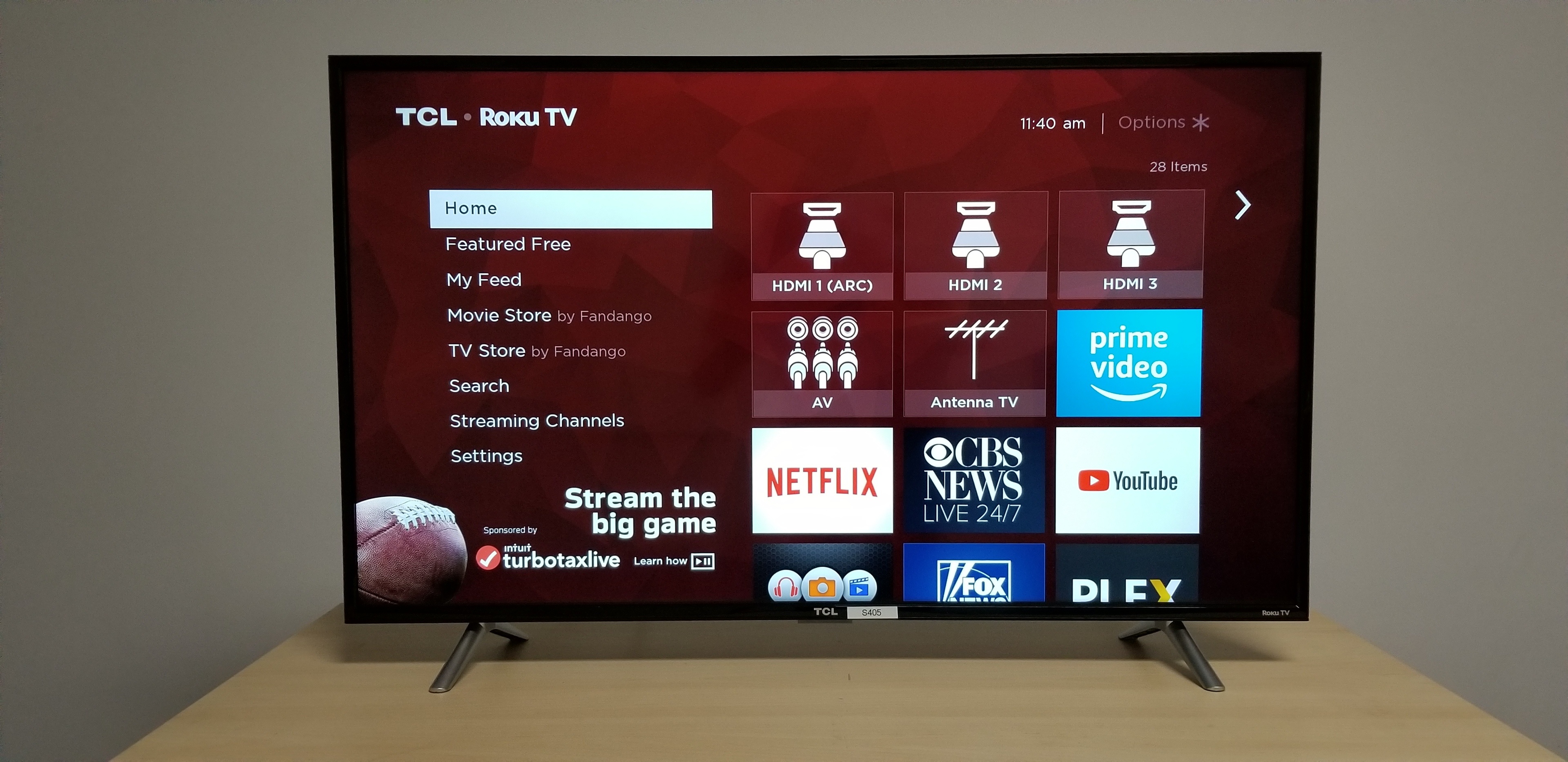
[0] https://www.rtings.com/tv/tests/ads-in-smart-tv
[1] https://i.rtings.com/images/reviews/tv/tcl/s405/s405-ads-lar...
Solvable by tape, but doing that blocks the IR sensor.
That screen has no business connecting to the internet.
Even better is a home projector.
The color resolution is also great for movies.
These only flow in one direction though - from the source to the sink
    It's unreasonable to expect the average person
    on the street to be an expert on the subject and
    to have fully researched everything before walking
    into a store, so if the TV's packaging doesn't say
    anything about the subject, how do they learn?
The solution depends on who you ask.
Some would say that it's up to the consumer to be educated. Like you, I don't think this is realistic. It's not realistic to expect every consumer to become an expert in the nuances of every single thing they might buy.
Others would say that if it's really important to customers, we'll vote with our dollars and demand alternatives to the current situation.
Some would say that the government should ban the practice or at least require some sort of very clear disclosure.
What would you like to see?
But you can forget about common TV features like HDR support, DTS/DD audio decoding, usable remotes and other useful features.
https://www.samsung.com/us/business/products/displays/4k-uhd...
If I'm not mistaken the LG ones were significantly more expensive than their consumer counterparts, but those Samsung ones don't seem all that much more expensive.
Best part is, the TVs are essentially subsidized by ACR and selling your data so you’re getting a deal by not paying the “data tax.”
Jobs which require a belief to perform sincerely, select people who hold that belief sincerely.
This principle should undo a lot of cynicism. Yes, eg., people in marketing often "really believe" their efforts are a net-positive, and no it isn't often, "mere cynicism" on their part.
Rather, what has happened, is that most who view marketing cynically, do not take a job in it.
We often misidentify this process of selecting for sincerity as a psychological-reality in those who are selected. Marketers "make money through cynical means" whilst sincerely believing they don't.
If they can pull it off for more sophisticated integrated solutions like phones, tablets and laptops, I'd have thought that a TV brand would be even easier.
Surely buying a commodity panel off of an existing OEM would negate a lot of the legal issues, and going DTC to the kinds of people who are specifically looking for a dumb TV is quite a decent niche to market to?
I've been running a BenQ w1070 since 2013 and couldn't be happier
Chances are good the TVs of the future will just display full screen error messages if they haven’t been able to upload your content engagement metrics in the last 15 minutes.
I've heard LG OLEDs run a pixel refresher when "off".
> Beamer
> Video projector, a pseudo-Anglicism in a number of languages including German, Dutch, Latvian and Swiss French
For my Roku I have setup a redirection for all DNS port queries to my pihole as some app developers are getting wise to this and using their own DNS.
It won't be long until they encrypt this traffic and lock us out completely though.
Also, if you really enjoy Ambilight, there's a (kinda expensive) solution to get it on any TV now: https://www.techradar.com/news/philips-hue-now-lets-you-turn...
I retract my statement.
Edit: I purchased a 2019 TCL 50S425 and also don't see any ads...
Nice thing about OpenWRT is being able to block homescreen ads when the TV is online with the adblock package since DNS filtering will do the trick fortunately.
This is not a rationalization for garbage design, but at least it isn't as much of a black box as people might think.
It literally just bricked my test iPhone SE.
After the upgrade completed there is an only an option to put in a email/password for icloud and there is no "skip" or "do later" button I could find.
I'm pretty derpy but I can tell you it is true.
has this been removed? It might be getting into GDPR violation territory.
Dark patterns... I can see why the older generation is scared of the hardware.
If you don't plug it into the internet it's not going to be a smart tv
Could replace the remote with a Old Person Remote perhaps.
Just looked for a random tv, it has a normal remote to me https://ao.com/product/vel50fo01uk-veltech-tv-black-66496-10... scroll right on the photos
I still use my Chromecast for Youtube, because the UI in a browser isn't great for couch use. On the CC, multiple people can add videos to the playback queue, I haven't found a good replacement for that yet.
For anything longer than a typical Youtube video, it's not an issue finding a movie and starting it from a wireless keyboard.
Our current TV is a 42" LG that I got for free from work. It's old enough to not have any "smart" features, it has no networking at all. The picture quality is great and no ghosting unlike a lot of older LCDs. I am not looking forward to the day I eventually have to replace it.
I just found out this weekend; with an older, cca 2013-ish samsung tv, connected to a network that has OpenWRT router with Adblock, and forced redirect of all port 53, 853 traffic to the local resolver. It cannot resolve its mothership (the rules were already in the Adblock list, I didn't add anything). The TV shows up a messagebox that it cannot to the Internet and asking the user to check the connection.
The local DLNA sources work.
Otherwise, there is really no point to go with 4K, you can find lousy encoded content for any resolution. There is a strong trend in underground rips to provide highly compressed 1080 content that looks more blocky than its 720 equivalent of the same total file size.
https://help.netflix.com/en/node/306
I honestly don't really know, video encoding is not my thing.
On what grounds would a punishment timer be illegal?
There was literally a Black Mirror episode about something very similar.
It is literally possible for a television to include a punishment timer (as in, it is pretty trivial to code up, if the device isn't rooted.) What happens if a company sells one that literally identifies shopping and uses a punishment timer for people who buy a competitor to their sponsor instead of their sponsor? can you make it illegal?
While I’m at it I may as well complain about the google assistant support using my home mini. While nvidia advertises this as a feature, it often works much worse than it did on my cheap old chromecast so that’s quite disappointing. For example, the shield will launch the Netflix overview for a show when asked to play it but won’t actually start the show until you wait for the auto preview to start or you explicitly ask it to press play.
Overall, I guess I’m just not as thrilled with this device as everyone else seems to be. I kind of wish I had just gone with the Apple TV at this point so that I could ditch airplay on my TV which is the only reason I have it connected to the internet at all.
Have you streamed yet or it’s just an option right now? Something I’m considering but I’ve not looked into. Wondering about lag, and if I have to run upstairs to my pc to start games etc.
I hope I have time to try it more before the weekend, but the results are promising.
Oh, I thought it was obvious since we're talking about a Shield Pro but now I think it's worth mentioning that my PC has a Nvidia card (an RTX2060), so I'm using nvidia's native streaming support. It's also worth noting that an OSS client exists (Moonlight), so the Shield could be replaced by, say, a Raspberry Pi 4
With the PS5 controller having a microphone array built in, I won’t be purchasing, which makes me sad as I’ve been gaming since the ZX Spectrum. Also Sony injecting their ads into the PS4 home-screen which will no doubt carry over to the PS5. Gah. But on a positive note, those new AMD offerings...
Biggest obstacle here was the wifi in this house is unreliable. We tried getting a wifi extender and even a new wireless router but we kept getting latency issues. We opted to get a powerline adapter for a stable connection. MOCA is also worth looking into if connectivity is a problem.
And finally, running to the other room to start games. Again, this is steam, but I'm guessing shield has the same limitation: if your system isn't logged in or the screen is locked, you will probably have problems starting games remotely in those cases. You'll want to setup remote desktop almost for sure (you can VNC or there's a way to logout of RDP too without locking the screen automatically). I also have a Wake on LAN shortcut setup to wake the PC up remotely.
Finally, sometimes games won't pipe audio remotely because they don't switch to the "virtual streaming audio device" these apps use properly. As far as I can tell this is on a game-by-game basis and depends how they coded it, but for that I have a pretty ridiculous work around (I remotely start a command line tool via openssh to force the audio device to "steam streaming speakers" then restart the game after that). The games with these problems seem pretty rare though, I'd say maybe 5% of the games I've tried.
Overall it's awesome and I glad I spent a day or two figuring it out. I don't get noticeable lag and I can stream pretty much any game to my living room on the TV now. Also got a "Couchmaster" for a kb/mouse setup. I can also emulate things like Wii U games and stream them remotely to the TV like having an actual system.
Hope this helps.
You can launch the games directly from the Shield if they appear in GeForce Now on your PC. They usually show up automatically, the only issue being UWP games (like Hellblade I mentioned early), the workaround there is to create a normal shortcut to the game and add that to GeForce, manually.
The Shield network troubleshooter tells me I have 1ms latency even on wifi but still, maybe it would be better wired. I have no easy way to run an ethernet cable to the TV.
It's still the best gaming-on-TV experience out of the stuff I have in my TV cabinet (PS4 Pro and Xbox One). It's not an higher resolution, but render quality is way better and it has a much more stable framerate. Too bad it's noisier than even the ps4 :D
You can get the version that phones home or you can pay extra for the version that doesn't.
I suppose the problem is that they'd make this transparent and there would likely be a bit of backlash ... thank goodness that regulatory agencies have our best interests at heart /s
I originally bought Kindles without ads, but for my third Kindle I decided to buy it with ads to see how bad they were. You can pay the extra later to get rid of ads, so if it turns out buying the version with ads was a mistake it is easy to fix it.
I don't see the sleep screen except briefly between the time I open the cover and the time the Kindle wakes up. I'm rarely on the home screen. I do almost all book shopping on my computer rather than on my Kindle. Thus I almost never actually see an ad, and when I do it is almost always not interfering with what I'm there to do.
The few ads that I do briefly see in those rare times I'm not in a book or in my library are static images without sound. For the sleep screen it is usually an ad for a book and the image is the book cover, which is often actually nice to look at.
After actually seeing the ads, I now feel like I wasted my money buying the ad-free versions for my first two Kindles.
The vast majority of people just don't care and want the most TV for the least money.
It's a "tyranny of the majority" kind of situation. For TV manufacturers, it's not worth catering to the tiny minority of customers who think like us.
It is entirely possible there are other factors as to why we are not buying from them right now, such as supplier-related issues unbeknownst to us.
In short, the economy is more complex than claiming "demand" and saying we are done.
Yes, admittedly this is anecdotal, but I am talking about an extended family/social circle of hundreds of people over the course of quite a few years. The odds of it being a massively unrepresentative sample are rather low.
Let's turn it around. How do you know that people are concerned about data collection?
All available evidence points to my assertion being correct. All sorts of "smart" devices, chock full of phone-home tracking, are flying off the shelves. There are alternatives, but they are quite niche.
In any case, all you need is one model with a decent screen and broken certificate pinning and I'm good for the 3-5 years that the TV will last.
And until then, I'd assume that Nvidia sees the market demand for big TV-like PC screens and outcompetes the TV manufacturers.
1. Order TV.
2. test if it works without agreeing to anything and without internet.
3. return if that's not the case.
I have yet to accept EULA on samsung on anything and it works...
Right now the ACR is troubling. Telling a remote server what you're watching... Only solution I found - not connected + hdmi to Linux box I control.
It is very hard to win against hostile design.
The factory I work at had large one scattered around to show line information. Some of the information is safety critical and so if it is inyeruped with an ad there will be legal issues.
You'll get the first month for free, when you sign up for the 2-year plan for 19.99$/month right now!!
Frankly, we don't miss the TV channels. Streaming works okayish for the public channels, but we rarely bother.
The TV is just a dumb screen connected to a receiver, which has the HTPC as input as well as record player.
So the only thing a 'TV' offers me is its screen. Is that any different from a high end computer monitor these days? Is there a difference based on the viewing distance perhaps?
Using a TV which adjusts the brightness depending on what's displayed can be very unpleasant when trying to do computer work on it. E.g. opening or closing a window may cause other windows to abruptly change brightness. Scrolling through a document may cause the brightness to vary.
Sort of makes sense because a lot of people don't care about or plain don't want speakers on their monitor.
That or you put in an iCloud account at some point but it did not get removed successfully.
iOS 14 merges the 'not now' from iOS 13 into a 'forgot my account or don't set up now'.
I've done this with one other Kindle and several other people have done it based on my experience and they've all gotten ads removed for free and some have gotten store credit in various amounts.
I didn't even mention why I wanted the ads gone, I just asked how to remove them and they gave me free books and a typically $20 upgrade for free.
There was a time that the Kindle ads were actually appropriate. I've even purchased the odd sci-fi book that showed up on the wake screen. But that's been a couple of years. Now I get the same bodice-rippers you're seeing. What a waste; Amazon has my book purchase history going back 20 years, and that is what you're showing me? Do your advertising customers know this? Because, shallow guy that I am, I read sci-fi, philosophy, and books on distance running. That's pretty much it. I did read part of a Danielle Steele book (imagine GPT-3 wrote a romance novel...) 35 years ago when I was married to a woman who read those, but I doubt Amazon knows that.
It's definitely not for the consumer's benefit in most cases. No one is going to die because your Smart Keurig or 5G-TV goes unpatched for a month. Hopefully we can avoid the slippery slope and realize that these devices' internet capabilities are not for us - they are primarily for data collection/advertising purposes.
see https://www.reddit.com/r/privacy/comments/bpr6xs/if_you_choo...
My next idea - Faraday cages for smart TVs
(I disconnected the antenna on my OnStar, yet found it still connecting to cell towers successfully from time to time. The resister solved that.)
Real solution is regulation. But that can only happen if the outcry is large enough. Having two revenue streams is always going to be better than one.
But that information is never available at the point of purchase so most people get the surprise of see ads when they had no idea that was even a thing.
- You can buy the device for $X, and it’s marked as being sold “with special offers” (a euphemism for ads that would be more explicit in an ideal world)
- You can buy the device for $X + $Y, and it’s marked as being sold “without special offers”
- You can buy the device for $X “with special offers” today, but you can spend $Y once you have the device to “disable special offers”
This case is pretty terrible because Samsung isn’t giving buyers the ability to pay them the $10 directly to disable ads while not being up-front about whether or not ads will be served.
- You can buy the device for $X “with special offers” today, then hack it and remove the "special offers".
I don't know how prevalent this is, but wonder if it's a consideration in deciding on the "money to disable ads" strategy.
Do any of the airfare search sites allow you to sort/filter by legroom? I would love that feature.
I built my own router with a raspberry pi. I installed pi-hole and use that as a dns resolver. I then use an iptables rule to NAT / forward all dns traffic on port 53 to the pi-hole resolver, similar to how ISPs often intercept dns requests. This prevents IOT devices from bypassing the dns server configured via my DHCP. Letting pi-hole block the requests helps prevent errors from dns request timeouts.
The only complaint is from my wife who sometimes Googles stuff and clicks on the top result, which is often an ad and will end up blocked. She now has to scroll down a bit to the real results.
Upon discovering the ads I was gonna return mine for a comparable LG, until I learned LG also have ads—at least this way I can pretend I'm not being taken for a ride.
At the time I didn't have any external devices capable of 4K Netflix or YouTube; now I do I should factory reset the TV and set it up without network access,
If it stops working after return period I call under warranty that it stopped working (2 years), they are forced to fix the issue.
Explain the issue, explain you cannot connect to the internet.
If it doesn't work, forward the whole info to the customer protection bureau if you're in the EU.
Edit: I will test this out by setting a date far in the future when I buy new equipment (will also hopefully cause SSL failures due to expired certificates internally in the firmware)
The "smart" functionality is how they achieve low prices. They subsidize the cost of the TV by selling your usage data. They may have deals with app providers as well - similar to how the price of a consumer laptop is subsidized by preloaded crapware.
American tried. American failed. Nobody was willing to pay more.
https://www.nytimes.com/2000/02/04/business/american-air-to-...
United Premium, United Premium Plus, Delta Premium Select, American Airlines Premium Economy, Lufthansa Premium Economy, Alaska Airlines Premium Class, Air France Premium Economy, Air China Premium Economy...
tl;dr: when it comes to crappy airline service, the fault, dear Brutus, is not in our regulators, but ourselves.
Airline tickets are the same: I know I’ll be treated like shit, nickel and dimed, and have no legroom so why wouldn’t I be looking for the cheapest ticket?
If someone would roll out such a feature, I'd use the hell out of just as soon as I feel like packing my butt into a petri-dish again.
The three big mainline carriers offer coach seats with extra legroom on most domestic flights (branded as Delta Comfort+, United Economy Plus, and American Main Cabin Extra).
I cannot imagine a worse idea.
IoT devices are the richest source of hosts available for botnet operators to compromise because they are numerous and famously insecure. Today it's lightbulbs and security cameras. Tomorrow you wish it to be pacemakers and Toyotas?
We already know it is functionally impossible to write bug-free code which is also useful. We also know that attackers relentlessly probe systems until (that is a _when_, not an _if_) a weakness is found to exploit to gain control of that device. It is possible to write provably-correct code, but so far only for somewhat trivial applications.
Until this fundamental problem of software security can be solved, an air gap is the _only_ reliable thing that can protect life-critical software from external remote attack.
But critical components should be designed as simple as possible, and be thoroughly tested before device release. Releasing garbage and then patching it OTA doesn't really work for safety critical things. Not so long ago cars didn't have capability to upgrade (firmware on mask ROMs) and I don't think something horribly bad happened.
It really captures the inanity of a person who just sits around crunching numbers all day and killing off people’s beloved products and showing small percentage quarterly gains... while destroying goodwill and long term customer loyalty in the process.
[1] https://slatestarcodex.com/2019/06/04/book-review-the-secret...
Now, the models that the somewhat sophisticated supermarkets use don't fit on a spreadsheet, and really try to guess which items really are people's favorites, look at profit margins, and risks of people just going to a different supermarket altogether because the competitor down the street still has your favorite, or charges 30% less for it. They check what happens when a product isn't in stock, or when a competitor has a significant discount. It's a difficult optimization problem, given all the differences among people's shopping lists.
Having a favorite product get discontinued sucks: It happens to me at least a couple of times a year, and sometimes straight from the manufacturer, so I can't even buy it online. But don't imagine that every supermarket out there is run by teams swimming in money. It's an extremely competitive business with many players, and there's not that much of a difference between the way the small chains run their operations today and having to close down because the lower prices of a larger competitor dropped sales just enough that they are losing money.
Oh, no doubt. I'm not saying the spreadsheet guys aren't needed. They clearly are because competition is so stiff. So the reason store A needs spreadsheet guys is because store B has them. All of the spreadsheet guys, collectively, lock the grocery stores into a race to the bottom.
I'm complaining about the existence of spreadsheet guys in the first place. Pulling back a little bit, maybe we need to question whether technology is always beneficial to society? Maybe some technology is inherently worse for society but we can't get rid of it because it's now locked into the market.
My corner grocery (run by a family that lives a couple blocks away) did the same thing - they dropped the soy milk brand I like. I asked about it, and they brought it back.
I think they do cost more on average than HugeCo (if you use the HugeCo surveillance/loyalty card), which also theoretically has a larger selection, etc.
But for some weird reason the store that sells me what I want gets my business.
They even have other customer-service oriented niceties, such as the fact that you don't have to put your groceries on a belt at checkout -- instead their carts are designed so that the cashier pulls directly from the cart, they go into bags that then get put into another cart for you to take out of the store. Little things like that make me wonder why these concepts haven't caught on. (Same with Aldi's letting their cashiers sit on a stool -- employee friendly, and doesn't interfere with the customer).
Likewise, there's no such thing as "the best product" at a supermarket. Everyone has their own spread of products and if you cancel low-performing product lines, sometimes it has unexpected effects. (Anecdatum: We used to exclusively do grocery shopping at Woolworths until they stopped selling the cans of chilli beans that we use for nachos. Now we do maybe 1/4 of our grocery shopping at Coles instead, costing Woolworths thousands of dollars a year in lost sales, just because we needed some chilli beans and might as well get the rest of our groceries while we're there.)
I think the core observation behind the job of the spreadsheet guys is that, at scale, the choices within a family of products will approximate a normal distribution - so there will be a "best product" within each family; with a limited shelf space and a lot of different products to sell, this gives them a clear way to optimize for maximum revenue.
- Sent from my Xperia Compact
[1] https://en.wikipedia.org/wiki/Format_war
[2] https://en.wikipedia.org/wiki/List_of_obsolete_technology
[3] https://en.wikipedia.org/wiki/Fad
and so on, I fail to see a reason for some of those failures. Seems arbitrary/random to me.
I just thought it was crappy that Motorola was actually providing phones with the features people were asking for (In the Droid days, people wanted physical keyboards, and the Droid Turbo offered insane battery life and a damn near bullet-proof screen), but they seemed to be commercial failures.
FWIW, I use a Pixel 3 now, which seems to be doing okay, but still not near the success of iPhone and Galaxy.
I don't really follow this line of thinking.
Of course, knowing the real reason is preferable, but not always possible, especially in a premodern setting. Before the discovery of prions nobody really knew why cannibalism is dangerous, yet it was a taboo in most of the civilized world.
Samsung learned from the industry represented here and it’s disconcerting to observe the lack of self-awareness in the vitriol being leveled at them from here. Equally disconcerting is that the same people rending their clothes over this probably overlook their Gmail messages being scanned and ads in their inbox, but a television, mein gott, a bridge too far.
This is your world, HN. We all live in it now. Sucks, no?
If their $300 bargain basement basement tv was ads supported to keep the price low, eeh, maybe.
But that isn't the case here.
Consumer Gmail is free. If Office 365 premium ever starts showing ads, people will also become upset.
And Microsoft will do nothing about it because people will use it anyways.
Not everyone on HN works in adtech, and very likely none of the people in this thread do either.
Or to put it another way, they are implementing communism by other means, with the same bad outcomes for the masses.
What difference is "Strategische Konzernentwicklung/corporate development/group development" to a Soviet 5-year plan, aggravated by quarterly reviews and HFT?
Gennadiy Gosplanovich would approve with a hysteric laugh.
I know. Been in several of them. Fortunately got out :)
edit: Of course you could call me a stoned hippie leftover from the 70ies, but that really was before my time. I'd counter that with management is on coke, crack or other medications which influence empathy in a bad way. Simple as that.
(Now playing "Ka-Ching!" with a pitchfork on the karmic harp)
When I was buying my Paperwhite, I just ordered the ad-free version from amazon (.com or .co.uk, don't remember which). And then a couple co-workers (agreed, computer people, but very much not the type that's into tinkering or cracking software) looked at me with surprise, because it turns out everyone does the "standard" route - order "special offers" from amazon.de, and save money while getting an ad-free Kindle, because AFAIR initially the special offers didn't even display in Poland, and when they did, apparently everyone knew how to jump some hoops to get rid of them.
I'm just waiting for smart devices to start doing that instead, forcing me to set up full SSL filtering until they start doing encrypted SNI :/
Back two jobs ago, we had international customers with somewhat high demand to ship our people all across the world on, sometimes on a moment's notice. I had to fly out 4 or 5 times in the span of two years, but some of my colleagues could do more than that in under a year. Somehow, the flights were almost always the cheapest airline available, and the cheapest seats available. The co-workers who flew frequently, including my boss, were all using the accumulating miles to bump themselves a class up.
well. I'm a nokia 5.3 owner now. It's big, but ticks all the other boxes & is cheap...
As a trivial example, just looking at the profitability of individual items would lead them to discontinue selling milk (I mean, there's no profit in it so why bother?) because it's generally used as a loss leader.
The loss leader in this scenario is the "milk" family, not a particular brand of milk.
"Amazing! The smaller we make the 'X' button, the more people love them!"
TuneIn does this.
- same color background
- in the wrong corner (users expect the "X" in the upper right hand corner). I've seen the "X" in the wrong corner and some other icon in the right hand corner. People reflexive will click in the upper right hand corner and open the ad by mistake
- I've seen where you have to click on text instead of the "X", clicking on the "X" just opens the ad
- Also very small, 1-2 pixel "X" so literally one pixel off and you've opened the ad
- I don't remember what company did this, but they would pop the ad and after three seconds, it would reload, all but a few pixels higher so when you're in the process of closing the window, it would reload and then you'd open the ad by mistake because the "X" is in the wrong place now.
I've seen a lot more devious stuff but the sad thing is, I have decent vision. How do these dark patterns affect people who have impaired vision or other issues with their vision? How infuriating it is it for them to deal with this BS? I can't imagine.
Of course now I'm part of the problem, because some asshole has a graph that shows that (a suspiciously small fraction of) users are able to opt-out so there's no legal liability for having the ads that way.
I think anyone with some experience in that type of software would intuitively understand the negative user experience described here.
Seems like a pretty straightforward case of the classic "Unless their salary depends on not understanding" rather than some opaque wall of unknowable unpredictable consequences.
Sounds like yet another case of, "Lies, damned lies, and statistics."
Except that Google lets anyone else advertise in that slot above your brand. And as we've seen some companies can confuse the customers and steal them away in such an ad.
If we tacitly accept a search engine allowing such phishing expeditions in those ads, then this kind of spending is the necessary and only step companies can take.
I’m actually considering whether it would be a good thing if the app stores would verify government applications and perhaps not even allow ads on queries which have results that include governmental apps...
"Hey, have you seen the new COVID-19 contact tracing app? It's named TikTok-19".
Could be a true conversion given that all competitors are paying adwords on your brand name search also. If you don't have them you will probably appear after a long list of competitors with really personalized clickbait titles prompting your customers to compare you with them
Google has devolved into a shitty search engine even ignoring the advertising. Someone please build a search engine comparable to google in the mid-2000s. No duckduckgo isn't it.
Pro tip: if the competitor uses your trademark in their ad copy, you can do a takedown notice and usually the ads will be removed.
The dominance of this kind of surveillance capitalist or ad-saturated model everywhere is a side effect of extreme wealth inequality and a generally demand constrained economy.
There are a few good reasons to do this:
1. Competitors will bid on your brand name. Your ad for your own brand name will have a higher quality score and be very cheap, driving up the price for the competitors.
2. So much of a SERP is below the fold that there is value to being as close to the top of the page as possible.
This sounds like customers will eventually choose less shady brands in a year or two, when in reality all brands will actual race to the bottom together.
The big companies have people who check if the ads are working. Every have the clerk ask for your zip code? That is because they are checking if the ad sent to some zip codes worked. It is noisy data, but statistics is all about finding signal in noisy data.
https://www.adexchanger.com/ad-exchange-news/the-marketers-g...
That’s odd. You’ve never read a valley S-1, I take it?
Instead I will recommend Sony or LG now
The kinds of "feature" we are talking about with the Samsung TV here and other so-called smart devices will stop me from buying those products in the first place. But then I also don't use Windows 10 for my main PC because I think I should control my PC and not whoever happened to write the OS I'm running, so apparently I'm an outlier.
- Brand awareness is one thing, but it feels companies are more interested in saturating consumers with advertising. That saturation is something entirely different.
- Advertising can present information to base purchasing decisions upon, but rarely does in most media. While advertising should never be the sole source of that information, it would be far more effective for brand or product awareness.
We all know this, but we ignore it. Branding for brandings sake == lying to customers.
Heck the yoga app I use I saw through a mobile ad. Same deal for the fitness app I use (BodBot, awesome app, check it out!)
I've gotten onboard Kickstarters from ads, and I've bought keto cereal from an ad I saw.
99.999% of most ads I ignore, but sometimes ads are really well targeted and actually show me something I want.
(None of these ads were on a tv in any way...)
It is really fun to take someone there who has never been in one before, and watch as they get overwhelmed. Just the fact that there are 3 aisles of frozen pizzas... and the cheese coolers run at least half way down the width of the store.
Oh, and the employees are friendly -- I wonder if the fact that it is employee owned helps there (or how the employee ownership works).
Edit: do a video search for Woodman's, someone has posted a video of traveling the store on a scooter, you can get a good idea of the size of it.
It's so much better than the "Smart" Samsung TV it is plugged into that it's not even funny.
The remote control has touch. I can use my phone to type text input. It's fast. It's elegant and slick. It has no ads. It has options that I care about. It doesn't waste my time with options I don't care about.
The Samsung TV on the other hand was a flagship model. Top of the line. Best of the best. Just a few years ago.
Now? It is unusable. It is beyond slow. Two to three second response time. Text input is just torture. Netflix crashes. YouTube mangles HDR in some weird way that makes people look like they were drawn by a kid with crayons.
It's shocking to me that you can pay thousands of dollars to Samsung and have them destroy your investment with "updates", whereas you can pay a few hundred dollars to Apple and have a slick product that improves over time.
What I don't understand is the executives at other companies. Companies that aren't the #1 biggest in the world. How do they not get it!? Just copy Apple! Stop fucking over your customers, and maybe they'll give you more money! I know I give Apple more money every year!
It's not that hard. It really isn't.
>Support for the Ambient mode Headlines Service is scheduled to end on September 30, 2020. We thank you for using the service and we look forward to providing an improved alternative in the near future
I'm not going to buy a new TV every year. "Smart" features that are discontinued after ~1 year are worse than worthless, it's just clutter in the menus at this point.
Also crazy are hardcoded "Netflix", "Rakuten" and "Amazon" buttons on the Samsung remote, you just know that they will stop working at some point.
Now you could argue as to whether you want Netflix preinstalled on your TV, but while most smart features of smart TVs are useless, having Netflix is useful for many users.
Text input.
All the letters lined alphabetically with only left-right movement allowed. Takes ages to input anything. Also no corrections allowed. I actually exit appleTV and use the built in TV apps for when I need youtube and the like, because their input mechanism is not insane.
I know there is a remote app for iPhones, but you do provide an actual remote, make it work ffs.
If they had a 2D text input they wouldn't be able to do momentum in swiping as well as horizontal (side effect of the horrible remote), but more importantly, the primary text input on Apple TV is voice, in the moment just hold the Siri button. It takes in letters over voice too. Worlds faster than any other input on tv. No wonder they prioritized on it.
The last glyph in the row of letters is the delete key.
I have a bunch of aTVs, and while they’re the best boxes I’ve used, there’s definitely some ads baked in, and in prominent placements.
- The TV app started out as a directory + recommendation engine for services you had “connected” to the app; it’s turned into a series of pitches for Apple TV+ and Apple’s “Channels” feature. These placements are below-the-fold, but the default behavior has the “TV” button on the remote bring up that app (although you can change this to display the home screen). - In the top banner, the TV & Music apps will (by default) auto-play trailers and music videos (on mute). You can disable that behavior for the TV app, and it’ll revert to displaying your watch queue.
No one uses the trackpad on their playstation controllers, why did apple run with the same idea?
I'm a big fan of the Roku boxes.
I found the support article from Sony on this:
https://www.sony.com/electronics/support/articles/00225587
If this is a TV that is used by very young children, ads with blood splatter as shown in their example seem pretty tasteless.
Google's page on the introduction of ads has the same thing - an ad for Sesame Street followed up with the ad containing blood splatter.
https://blog.google/products/android-tv/find-new-faves-faste...
> A3: No, the suggestions cannot be removed.
I keep hoping someone will file a class action over this. These dumbfuck ads just appeared one day on my Bravia X900E, about a year after purchase. I didn't opt in to this and I wouldn't have bought the damn thing if this "feature" existed at the time. Sign me up for the class!
Honestly, that's the thing I hate most about the Fire Stick, and why I don't use it's discovery feature at all... I don't want to see promotions for 4,000 services I don't subscribe to. Sure, if I search for a specific show, I don't mind results from those services ... but as general adverts for shows? No thank you.
- Remove the “TV” app from the top bar. - You can change the behavior from the “Settings” app to show your “TV” app’s watch queue instead of trailers.
You can’t disable the Music app videos, though.
Unless you mean trailers for whatever the cursor is on, inside of an app like Netflix? If so, some of those can be disabled, but I actually like them—they're "ads" for content that I already have access to but may not have known about otherwise.
Also great solution for cheap subsidized TVs where they are banking on your connecting to your network so only charge $100.
Plug in an apple TV and you are set.
https://tidbits.com/2020/01/16/why-is-the-apple-tv-constantl...
Smart TV manufacturers are relying on the ongoing revenue from their software side nowadays, so they’ll usually mandate setting up an internet connection as part of the device setup process, and then only give you the option to change networks instead of disabling it outright.
If you’re tech savvy, you can take measures against this, but it’s not going to be simple for most folks.
You also have to worry about ethernet-over-HDMI unintentionally exposing the TV to the wider internet.
I ended up with an AppleTV. So far, if it plays on my phone, it will play on the TV, too.
I have a Philips smart TV, so far it has no ads and just mildly annoying bugs, nothing really disruptive. But mine is an old model, it looks like the new ones aren't like that anymore.
A few years ago I brought some TVs to use as monitors because they were much better fit than the actual thing. Now it looks like the trends reversed, and I'll have to start buying monitors to use as TVs. Is there a good TV receptor that I can plug in a Raspberry Pi?
Disabling them is also fairly easy, and if you don't use the TV app, they go away entirely.
(Even so, what you describe still happens on occasion for me, but it helps)
Anyways, it's good for the cashier too, because time for smalltalk, maybe sipping some drink, or such.
To be up to date, it's your fate...to wait!
I often think that they are the source of endless waste and inefficiency, because they are working against each other and none of them stocks everything.
Personally I'd prefer fewer larger ones which stock really everything in every variety, instead of many smaller ones which don't.
This are really so called first world problems, it's still a cornucopia, though one could argue about the nutritional/health implications also. But again, 1st world problem.
You've linked to SSC; Scott Alexander has a whole other essay on precisely this family of problems: https://slatestarcodex.com/2014/07/30/meditations-on-moloch/.
Yes, squeeze that marginal profit, please. I was born in communism, and guess what, we did not have 20 flavors of yogurt to choose from, or supermarkets for that matter. In Eastern Europe we counted ourselves very lucky to have plain yogurt, which was rationed.
Joy and happiness aren't the point, those are just nice to have. Putting food on the table is the point.
And having a flavor of yogurt discontinued, out of dozens, due to profit margins, is a first world problem and it affects only the rich.
I was born at the tail end of communism in my region so I haven't experienced the worst parts, but the 20+ years of market optimization in the food space that I actually remember went primarily into variety. There was no point in those 20 years where quality food was scarce or even too expensive for most.
I have people in my family who worked in grocery stores some years ago, when the market managed to optimize these jobs to the point there were a step away from modern slavery. Fortunately, a few large scandals over events like a pregnant employee losing child due to workload made the regulators clean the space up. Today, a chain store employee in Poland earns a reasonable salary and has hard, but not backbreaking work conditions.
There is a point past which things get too optimized, and there is no loss in preventing or reversing that.
(partially kidding, but only partially.)
I'm starting to suspect that the loudest voices are cats who have either learned to type or to pay for lobbyists, trying to push your feline agenda on the rest of us.
On the other hand, we have to keep the toilet seat down or they'll try to drink toilet water.
Apps which lay their buttons out contrary to the conventions of their platform are evil. Apps which randomize the positions of their buttons are unspeakably worse.
I always, always thought this is what X buttons do, so I was simply closing the tab :))
That could be a movie about absurdity and meaninglessness of life...
But what if I need to input a language that's not supported or I just don't want to yell at my TV to search a video?
Of course, if you don't have your phone nearby it might suck but let's be realistic, how often you don't have your phone close by when watching TV?
P.S.: Yes, I know, if you are an Android user there is no way out and Apple sucks for that, not defending them at all.
There are actually many times I don't have my phone with me while watching TV. I carry it with me everywhere all day, but I try to keep it on the table most of the time when at home.
The difference from Samsung is that the ads on the LGs are in the same place they've always been (on the smart tv menu overlay), they've never been obtrusive, and they're always in some way connected to video content (usually VOD movies that you can purchase through one of the streaming apps, or adds for streaming apps you can install on the TV).
I’m more excited about the HDMI 2.1 and variable refresh for the new Nvidia cards.
I took that stupid TV off the network as soon as I could.
I think the manufacturers are all as bad as each other. My current Panasonic TV will refuse to load any of the "smart" apps (even Netflix) if it cannot reach Panasonic's servers, which means the entire TV becomes useless as an Internet device (no Netflix or ANY streaming services) if Panasonic has a server issue (which they sometimes do).
Might revert to VHS at this rate.
I didn't push it again because in about 2015 I found that if you push it, it locks up for exactly 30s, which is how long it takes to hit the network timeout and say "Updates are available for your Samsung Smart TV." and then allow you to use the ancient web browser or Netflix or other smart apps. I did try a couple years ago, on a whim, but apparently the update servers have moved and even when plugged into Ethernet it can't actually update.
Everything currently runs through the Roku, the Blu-ray player, or a component-to-HDMI dongle for the Wii, but if I didn't have the Roku I'd have a motivation to update so that Netflix would work without a 30-second delay (and I'd be unsurprised if Netflix wasn't backwards compatible with their 2012 client from a Samsung TV). However, the picture is fine, so it keeps on chugging.
The app asks once per month if I would consider seeing an ad to support the developer. I usually watch one ad a day, as a rule, because it's the best way to do this. I've clicked on those ads, and have actually made purchases from those ads (it was for a product I was already researching and probably going to buy, but I clicked through the ad when I finally purchased it).
More apps need that level of respect for their users' time.
Windows 3.11 / 95 UI seems such a good idea by comparison to today's UIs - checkboxes with obvious tick marks or X marks in them, radio buttons, buttons that look like actual buttons, scrollbars you can see without having to flail the mouse around just for them to appear, scrollbars that go the right way when you use the mouse wheel (ok that was Windows 98), maximise buttons that actually maximised a window without having to hold alt like on macOS these days...
Fact check. You cannot make an X with anything less than 3 pixels. ;)
``` *:not(.videoContainer){ background-color: black!important; color: black!important; } img { display:none!important; } ```
An x requires at least 3×3 pixels.
Also, as a side note, Vudu is like the one app from that era that still works.
Check what network activity it is engaging in. You'll be disappointed, I am sure. Seems dialling home is the new thing to do on every single device these days. Data vacuuming the entire human population just because they can.
I begun suspecting that one day when my wife was preparing dinner. Soon after she took the meat from the fridge to work on it, our baby started crying and making noise for absolutely no reason. My wife immediately dropped everything and went to investigate, and the cat used this opportunity to attempt to steal our dinner meat.
Ever since, I've been noticing many more cases where the baby and the cat are either simultaneously attempting to do things they're not allowed to, or the baby starts distracting us while the cat goes out to carry out some mischief. It's all coordinated too well to be happenstance.
But I have come to believe they are far smarter than me, particularly with scheming methods of sneaking around to quietly appear when they can get food. One used to push donut boxes off the side so that they would burst open, and would then run off with a donut. I have no idea why he wanted to eat donuts. He also tried to eat bread through the wrapper. Or they fein illness. Our one cat had an operation on his leg so we put a little box as a stepping stone so that he could get onto the bed, and then onto the window sill. Turns out he didn't need it at all and could jump perfectly fine, but would still use the box all the time.
They're really clever, just not at jigsaws or sudoku.
I don't need a dedicated TV keyboard. As I said, I work around it by using the TV apps, but it's annoying, and the most annoying part is that it's probably annoying on purpose to get people more on their phone.
And, Apple should be better at UI design than this. They were once, and not that long ago, but I think the UI team they've had for the last, oh, let's say seven or eight years -- going back semi-arbitrarily to iOS 7, but steadily infecting all other platforms -- have prioritized aesthetics over usability.
So I would agree with their design decision: make an elegant remote, use voice dictation for search and the like, if you need a keyboard, use your iPhone, and if you are not happy with that, get a dedicated keyboard. If you are not happy with THAT, well ...
You may want to get an external device (Roku, Chromecast, Apple TV, or other media server) and plug that into your HDMI if you use the network from apps on the TV.
What can the apps on your TV do that a $40 Amazon Fire stick ($50 if you want 4K) can't?
I'd rather hook up an old laptop to my TV and use that to watch media than use the apps on my TV and deal with all the bullshit that TV manufacturers are doing when you connect the TV to the network.
But I can understand where you're coming from, I am just very frustrated that this user-interface-design-genius trillion dollar company can not change the input mechanism of one of their most used product from the:
a b c d e [f] g h i j k etc... Backspace
model with only <-> movement and no way to make an input correction other than backspace, to something like:
  a b  c  d  Backspace
  e f [g] h  forward
  i j  k  l  backward
  m n  o  p
The problem is cats are really good at hiding pain - being physically able to jump doesn't mean it isn't uncomfortable or painful for him.
We have a pair of very senior cats (18/19ish years old) and make sure the house has little staircases dotted around to make getting on to their regular lounging spots easier, as we noticed they prefer to use a step if something happened to be available - while they are still fairly mobile, I suspect they are developing some level of arthritis. Given they've been good companions for nearly two decades it's the least we can do to make sure they're comfortable.