As with many other aspects of holistic health, it's incredible how Western medicine has ignored verifiable scientific evidence about the wide range of health benefits one can derive from these breathing techniques.
A smattering of advice from the book:
* Breathe through your nose, NOT your mouth (except when talking).
* Breathe slowly, softly, not (necessarily) deeply. Optimal breath rate is roughly 5.5s inhale, 5.5s exhale, 5.5 breaths per minute, 5.5 L of air inhaled.
* * Many people tend to over-breathe, which has a number of detriments, including stimulating anxiety.
* As with most aspects of health, the body does best with most-of-the-time low stress (see above "Breath slowly") punctuated by short intense intervals of high stress. Wim Hof breathing is the high stress workout that exercises your breathing system and builds breath flexibility.
* Chew tough stuff, exercise your jaw. This can help build wider mouths (new bone growth!) and open up your airways.
[0] https://www.amazon.com/Breath-New-Science-Lost-Art/dp/073521...
Do you have a citation for that? Jaw bone pretty much stops growing in your late teens.
Increasing bone density is not the same as actual bone growth. By that rational doing deadlifts would stimulate your leg bones to continue grow which is obviously untrue.
I'd recommend watching this interview between John Mew (orthodontist) and Bret Weinstein too: https://youtu.be/JYpPu-NrYSI
I have bruxism. My doctor told me specifically to not chew excessively.
Also, despite the bruxism over a period of >20 years, I don't have a wide mouth :(
Do you have an evil twin that doesn't have bruxism?
One of the primary reasons I like to eat meat (am nearly vegetarian and happy that way) or chew gum its good for your brains -- other than respectively B12 and fresh breath.
Also, I recently read a translation and comment of the first speech by Buddha after enlightment. At it's most basic, the Wim Hof and Buddha's teaching seem very similar: make a continuous effort to face the uncomfortable. The main difference is in the way they go about it and the end goals. Wim Hof is just providing a very straightforward method to systematically face discomfort (in the form of cold), whereas Buddha gives a slightly more complicated method, but with the goal of reaching full detachment (Nirvana). You can also do both together.
I really think you don't know what you are babbling about.
The only thing this test might be interpreted as is that the assumption that brown fat correlates with physical cold resistance capabilities might be wrong.
https://www.capradio.org/articles/2017/07/28/breath-holding-...
- Hyperventilating, then holding your breath underwater can easily be deadly.
- Doing the same without hyperventilation is much safer.
The difference lies in the fact that our ability to sense our limits are almost entirely due to CO2 buildup. We actually almost can't tell when we run out of oxygen, it's why pilots are fine one second and pass out the next when they don't notice that the oxygen runs out (https://www.youtube.com/watch?v=kUfF2MTnqAw).
Hyperventilating reduces your CO2 but leaves oxygen saturation almost unaffected, which for an unexperienced person is equivalent to doing a blind walk next to a cliff, and removing the barrier.
https://www.chicagotribune.com/nation-world/ct-navy-seals-dr...
What worked better than cold shower was Ice bath in the frozen lake. I were very skeptical at the practice first but oh boy, the sudden freezing shock really do wake some survival instinct inside you out, and your mind becomes really sharp. Until you keep doing it to a point of dizziness reminiscent of certain highs. If you are going to try cold shower, ice lake bath with sauna is also a experience worth trying out!
It didn't help him get out of depression, but sure did energize him more for a brief period of time in his life. (until his routine collapsed)
1. How warm -60c felt after walking around in -130c for a few minutes in just shorts and shoes.
2. How much I wanted to run once I got out of the chamber. I was not a runner and I never liked running but I really wanted to run.
I kind of want to do it again to feel that high. Cold showers got a smaller reaction but something similar.
I need to get back into cold showers again but I definitely felt best when I was doing cold showers, it's a cheap trade of a few minutes of unpleasantness for such a mood boost but it's hard convincing yourself to do it first thing in the morning though.
There are trained/certified shamans who offer kambo ceremonies.
I'm finally going to put my wetsuit on, as the other day was VERY intense, but the benefits of being in cold water are incredible. I am an absolute convert. The high is comparable to certain A class drugs, it's the best thing I've done in years, and you get to stay fit as well.
https://www.youtube.com/watch?v=VaMjhwFE1Zw&feature=emb_logo
Repeat above 4-5 times. Optional: On the last rep, see how many push ups you can do when you fully exhale. Most people can do 30 to 50% past their max.
It was written by an investigative journalist that was initially skeptic of the method, and decided to debunk the myth.
[1] What Doesn't Kill Us: How Freezing Water, Extreme Altitude, and Environmental Conditioning Will Renew Our Lost Evolutionary Strength
https://www.amazon.com/What-Doesnt-Kill-Environmental-Condit...
I had to figure this stuff out on my own. So I support mr. Hof in what he is doing: If he can inspire someone to try these simple techniques out then it might help others like it helped me.
From the abstract:
"Our results provide compelling evidence for the primacy of the brain (CNS) rather than the body (peripheral mechanisms) in mediating the Iceman’s responses to cold exposure. They also suggest the compelling possibility that the WHM might allow practitioners to develop higher level of control over key components of the autonomous system, with implications for lifestyle interventions that might ameliorate multiple clinical syndromes."
I was doing cold exposure for a while, plunging palms and heels into water with ice. At first I could hold it a little there, but the duration was increasing with time. It's comfy to do while using laptop, mind doesn't focus on the hell going below :)
There's something to be said for that. And there's something to be said for putting on sunblock.
The two aren't mutually exclusive; both have their benefits.
That's a very scientific assessment of the stuff.
Also, why haven’t malignant melanoma rates gone down as sunscreen adoption has increased?
Not taking a particular stance, just asking questions.
Im a sceptical person and don't trust anything unless I see the benefits of any activity unless I see the change right before my eyes. For some reason I stuck to Pranayama and did it every day for a year or so. I observed a marked improvement in my lung capacity and my ability to hold breath underwater (I used to compete with my friends in the swimming pool and would always stay underwater for much longer than them). Also, whenever I'm in any stressful situation (like just before an exam or interview), I used to do the breathing exercise for a couple of seconds (breathe in through one nostril and exhale through the other and vice versa) and all my stress used to vanish and my mind would become very calm and sharp. Not sure why I stopped practicing it but I need to get back into it.
https://www.meetup.com/Wim-Hof-Method-Bay-Area/events/vjpnhr...
http://www.yogebooks.com/english/atkinson/1903sciencebreath....
If you are walking outside in t-shirt only, it is harder to get back to warm place when you suddenly feel cold or shivering. With cold shower, you just turn it off.
>Wim Hof's teachings about breath work and the health benefits of cold plunges have attracted millions of followers who swear it has cured everything from depression to diabetes and makes them happier and stronger.
If it cured diabetes, certainly there is a way to scientifically confirm this rather than merely "swearing" it is so.
And if it did, that would be a breakthrough of unthinkable proportions.
So, can we get some evidence rather than hearsay?
In fairness, I was rather sleep deprived at that time.
Then I got used to it.
Then I couldn't stop because my skin feels different, better.
Now I tell everyone I Wim Hoffed the whole thing, so I'm cool.
>It has similarities to Tibetan Tummo meditation and pranayama, both of which employ breathing techniques.[25]
https://en.wikipedia.org/wiki/Tummo
I won’t say he appropriated it, because he is quite open about it and adapted it, but it did not originate with him.
But when I talked to him, he told us (part of the Radboud experiment in 2014, I think) that he just jumped into cold water and was forced to learn how to breath in such a way that he wouldn't freak out.
Note/edit: As you can see from my writing my memory isn't pinpoint accurate. Given that the article was published in 2014 [1], I'm sure I'm probably wrong in the year when I talked to him as it then most likely would've been April 2013 since I had to keep the results of the study a secret for at least a year.
He has a deep intellectual and experiential understanding of the Suttas.
It's enlightenment.
Interesting; got a link?
Ṭhānissaro Bhikkhu's translations of the pāli Canon are usually sensible: https://www.dhammatalks.org/suttas/SN/SN56_11.html
or Bhikkhu Bodhi: https://www.budsas.org/ebud/ebsut001.htm
There are also translations around that come via the Chinese cannon instead.
The suttas are probably very hard to understand without background knowledge or commentary (or, really, actual practice), but of course I don't know which of the commentaries GP refers to. The dhammacakkappavattana sutta, being one of the important/famous ones, has truly voluminous commentary from truly voluminous sources.
GP refers to "continuous effort to face the uncomfortable". I'm not sure that I'd use that sentence to summarise the Buddhas teaching to be honest. But I suppose that it could be a reference to the 6th limb of the noble eightfold path (right-effort), or the 7th (right-mindfulness), or to the 1st noble truth (the truth of unsatisfactoriness/ suffering).
https://en.wikipedia.org/wiki/Noble_Eightfold_Path
First sermon aside, his last words also, as given in the maha-parinibbana sutta, were to be "heedful" or to "strive diligently".
Here's an amazon link to the book: https://www.amazon.com/dp/159030764X/ref=cm_sw_r_cp_awdb_btf...
"make a continuous effort to face the uncomfortable"
That's not the Buddhist teaching. The Buddhist teaching is apathy to everything via lack of desire.
"but with the goal of reaching full detachment (Nirvana). You can also do both together."
The stated goal of Buddhism is lack of desire. The stated goal of modern meditation is a reduction in cortisol/blood pressure(source: Altered Traits) and improvements in the frontal cortex(source: Kelly McGonigal). Neither of these work better than medicine for the former or say, athletic training, for the latter.
Meditation is magic to HN. It's weird. I am also sure 90% of people claiming it's magic have it done it for a week of something - if you did it long enough, you would know it does nothing.
Bring the downvotes (though I challenge you to try to reply what you disagree with, if you do). The author of Altered Traits, who spent a lifetime researching meditation, still ended up taking blood pressure meds after his retreats failed to lower his BP.
No, actually not as that is totally and utterly physically and mentally impossible. Your body and your mind are _made_ to desire and act, there is no sense in denying this and Buddha sure as hell did not.
What you're looking for is lack of attachment. Desire is no problem, it's the attachment to it (and it's the same with everything). The belief in an I that is doing the desiring, that is what is causing trouble, not desire itself. It is nature doing its thing, there is no problem there.
First, Buddhism is a term that includes a huge range of religions and practices derived from Buddha's teachings.
Second, I don't know what form of Buddhism you are talking about, but Buddha certainly didn't teach apathy, in fact one of the biggest emphasis in his teaching was compassion, which is pretty much the opposite of apathy.
One of the problems, at least in English, in understanding Buddha's teachings, is translation. The words he originally used to describe what he felt and what to do about it, have no direct translation into English.
In my case, before reading a book about Buddha's teaching, I understood the goal of Buddhism as the "cessation of suffering". But while reading the book and doing some meditation, I've come to understand it in slightly different terms that I can't fully describe with words because it's a range of feelings and reactions within me (body and mind) that now I interpret as the stated "suffering", even though it is not really suffering.
> Meditation is magic to HN.
I can't speak for HN. Personally, meditation has helped me calm down and be aware of my mood changes. It took me years to take up the practice, trying different things on and off.
Also, be aware that "meditation" is a bit like saying "exercise", there are thousands of different ways of doing it. Some you might like, other you might totally hate.
If you really want to know, I encourage you to dig deeper, there's a lot to discover.
I did this because I got sick and tired of catching a cold every year and having a very high fever (39 to 41 C all the time). I blamed having being overperscribed antibiotics as a child, which at the time I believed had weakened my immune system. That was probably nonsense, although it's true that when I was a kid it was common to give kids antibiotics for viral infections, so I got a lot of antibiotics for no good reason at all. I figured that exposing myself to cold would help me build up my immune system again. Also probably nonsense.
I can't tell if anything changed by what I was doing. I never felt any different from doing it, not "more alive" etc as others report. I got over my colds with high fever but that was most probably because I grew up (I think adults don't get such high temperatures from a cold as kids do). I sure got lots of strange looks and people kept asking me whether I'm a) cold and b) mad.
I didn't use any breathing techniques or meditation or anything like that. I didn't particularly exercise much, though I was a strong lad at the time (now, not so much). I think I just sort of willed myself to do it and did it and then realised it wasn't that hard after all. I think the true secret, the real lesson, is that we are made to withstand a lot more cold than we think and we're just used to being warm a lot more than we were meant to be if we lived without all our technology. Except of course we don't have to be cold because we have all that technology. So there's no reason for breathing exercises and so on to learn how to withstand the cold. That's what our brains are for.
Also, don't follow gurus.
I'm one anecdotal data point:
Never heard of this guy, but the cold shower thing just sounded plausible enough that I figured I'd try it.
Not even the whole thing cold -- I start off with a hot shower and then just drop it for the last minute or so, as long as I can stand.
And -- it's CRAZY. After getting the regular yearly colds that I just presumed were a part of life...they just stopped. I haven't had any sort of cough/cold sickness at ALL going on about 3 years.
I am going to commit to doing this again tomorrow, though, because I remember that it makes me feel good.
The same thing happened to me after age 34 for some reason. It's been years so far. I haven't done any breathing exercises though.
Maybe I was doing it wrong but I do not know how - I started with just showering my legs with lukewarm water and progressed to colder water and longer time gradually, very slowly. However, it never made me feel as good as some people here descibe. Sometimes I felt slightly refreshed during the summer but more often I just felt cold and stiff and I had strong desire to return to bed to warm up but I could not do that and I had to sit in my office cold and miserable for hours.
Maybe cold showers are not for everybody?
Eat less processed foods. Go for a walk. Stand up and stretch occasionally. Take the stairs. Lift some weights.
All will improve your life and are trivially achieved by almost everyone. Yet too many people - perhaps most - choose not to do any of these.
[1] https://ohnopodcast.com/investigations/2020/7/19/ross-and-ca...
I've perviously never been able to meditate (or self-hypnotise) my brain would always conspire against me and race with millions of thoughts.
When I tried the Wim Hoff breathing methods, everything was suddenly quiet. This in turn has made a lot of other small things in my life easier.
The claims may be overblown and some of the science dubious - but being able to reclaim some additional control over my brain has, to me, been worth the "risk" of trying breathing in a funny manner once a day.
A friend of mine tried it after being curious about my experiences for months, and immediately sent me a text message saying thanks.
I think perhaps it hasn't seen mass adoption because most people face some kind of psychological barrier in trying it either from fear, or seeing it as quackery and a waste of time. Coupled with mainstream medicine being reluctant to recommend something with relatively little supporting evidence (I guess). While Wim himself has succeeded in making money from it, it is also something that is difficult to patent and sell - unlike a pill (no big-phrama conspiracies here - just money is always a motivator)
I would say it requires a level of discipline and interest in "doing work" that most people don't have, so even if it is as revolutionary as claimed, I wouldn't be at all surprised that not everybody is following the method.
People are lazy. This is quite simply a truth, especially with regards to the USA.
If you're not from the USA, we have this absolutely fucking unfathomable obesity epidemic going on. It doesn't get talked about very much. 95%+ of the time, weight regulation is one of the simplest things we know of. Calories in and calories out.
Anyways, nobody really gives a fuck about that and will die on the hill of stating it's incorrect. They will then go on to buy the newest ONE PILL DOCTORS DONT WANT YOU TO KNOW ABOUT TO LOSE YOUR FAT OVERNIGHT for $19.95(x # payments) year after year, new pill doctors don't want you to know about after new pill doctors don't want you to know about, and still be obese, wondering why they specifically can't lose weight - science must just be against them.
Ranting about US citizens obesity aside, the tl:dr - Wim Hof most definitely isn't some ridiculously revolutionary thing, but for many it's damn helpful towards their life, but it also takes time and effort to do, which many people aren't disciplined enough to stick to. Also, you have to read. Believe it or not, large amount of people don't like reading lmao.
https://scienceofparkinsons.com/2020/02/06/wim-hof/
My conclusion is that some effects are very real, according to best available science. But You have to filter that from Wim Hof's persona & explanation style, which to me often feels very hand-wavy & daresay sometimes even esoteric & his explanations/rationalisations are sometimes clearly off. (e.g. he often says that the breathwork/hyperventilation increases amount of oxygen delivered to cells, while in reality it is the opposite due to Bohr effect). But he imo definitely is onto something with the practice.
Placebo, make-believe and self-dellusion often work, especially for the kind of people looking into a miracle cure, which is what such leaders tend to accrue...
You make an overgeneralized claim ("this is all") and give no evidence.
There is an extreme amount of evidence on the contrary that the WHM has a lot of novel scientific elements to it. See [1] as an example.
Medlife crisis also did a good nuanced video on it [2].
[1] https://www.pnas.org/content/111/20/7379
[2] https://www.youtube.com/watch?v=D6EPuUdIC1E&ab_channel=Medli...
Which is a bit chilling, pardon the pun.
No one is "cured" of type II diabetes (exception: gestational diabetes). The best you can hope for is not to have to take meds, but the price you pay is an exercise regimen and an extremely disciplined diet (I haven't eaten rice, bread, pasta, or potatoes in 9 years). I don't take meds.
It's currently available on the NHS in the UK: https://www.england.nhs.uk/diabetes/treatment-care/low-calor...
I read somewhere that N. Vittal, a prominent Indian civil servant, controlled his diabetes by walking a lot, daily.
https://en.m.wikipedia.org/wiki/N._Vittal
>and an extremely disciplined diet (I haven't eaten rice, bread, pasta, or potatoes in 9 years).
What about other forms of wheat products like semolina, couscous, etc? Other cereal grains?
I'm sure there's _some_ benefit to breathing techniques, but I wouldn't be surprised if they were at about the level of 'general exercise and wellbeing'.
I know a few people who have went to certified Wim Hof training weekends. Doesn't sound like my cup of tea.
Bone _growth_ during childhood and early adulthood is mostly hormone regulated AFAIK.
There is nothing that I know that supports that earlier claim that chewing hard things makes your jaw bone 'grow'.
Hmmmm. Biltong.
I'm drooling.
Wikipedia states that no pharmokinetic studies have been done on this "Kambo cleanse". https://en.m.wikipedia.org/wiki/Kambo_cleanse
Things do not exist in a vacuum, though. Especially something such as breath would be pretty universal despite in what cultural context.
When I lived in Berlin, I would run in the mornings in the winter... it'd be below freezing. 1st 5 minutes I'd be cold, but once I started running-running, I was warm and the temps didn't bother me.
Then I'd come home, shower, breakfast and ride my bike to the office. I'd be cold.
As in, don't do it gradually.
Drop it INSTANTLY and just see how long you can last, even if it's only a few seconds. I know at first I was like okay, 5 seconds f* this.
But then you can make it a bit of a game for yourself, and after a while it just becomes habit.
(and fyi, I live in Florida, so staying in longer is much easier-- But I can say this switch made me change from dreading visiting relatives up North because that would ALWAYS make me sick --- to "aww yeah super cold showers in the morning," and you know, not getting sick.)
https://www.bbc.co.uk/religion/religions/buddhism/beliefs/fo...
This is the first random "source" I pulled up, every other will say the same.
https://www.accesstoinsight.org/lib/authors/harris/bl141.htm...
Yes, and Krishna says basically the same to Arjuna in the Bhagavad Gita:
Abhyaasa and vairaagya - practice and dispassion (same as detachment):
https://www.google.com/search?q=abhyasa+vairagya+bhagavad+gi...
[0] https://youtu.be/D6EPuUdIC1E?t=2215 (timestamped to the conclusions)
> In contrast, in trained individuals, practicing the learned breathing techniques resulted in an immediate and profound decrease of pCO2 and bicarbonate, and an increase in pH (reaching up to 7.75 in individual subjects; Fig. 2 and Movie S2), indicating acute respiratory alkalosis.
I'm not a doctor, but since I was part of the study and asked them a lot of questions, I can sort of interpret what they found, which is that your CO2 levels drop (among other things).
With the WHM breathing technique that means you'll be getting into a territory of prolonged oxygen deprivation. In my case I'd be holding my breath for 3 minutes (while completely breathing out beforehand, without the WHM, I could only hold my breath for 20 seconds).
They measured that while doing the WHM your adrenaline level is on average higher than your peak adrenaline level while you're bungee jumping.
> Epinephrine levels in trained individuals were even higher than those reported in a recent study in which acute stress elicited by a bungee jump was found to suppress cytokine production by leukocytes ex vivo stimulated with LPS (13).
It might be in the article, but my suspicion is that this is because of prolonged oxygen deprivation. See also Fig 3A for how high the adrenaline levels got.
So to me it's clear that the WHM gives you a lot of adrenaline. What does adrenaline do? Well, it makes you numb, it acts as a painkiller in the sense that it makes you feel less (again not a doctor, but based on my limited knowledge this is a fact). So that's one reason why it's easier to jump into really cold water.
Moreover, it yields some evidence to some "mind over body" claims. It isn't really mind over body, it's adrenaline that can be conjured consciously at will. I'm speaking also from personal experience [1].
[1] I've done this at many Dutch dance festivals (e.g. Liquicity, Mysteryland). Instead of taking drugs, I'd do the WHM to spike my adrenaline levels as high as possible and had a great time.
I seem to recall that earlier in the book he describes some research that documented this effect, but I don't have a reference.
Do this laying down. You are essentially hyperventilating. By the 35th cycle, you should be feeling very lightheaded, possibly seeing stars. You absolutely can pass out or at least fall down during this process. Do it laying down or at least sitting so you don't injure yourself. Obviously, definitely don't do this in the water (you don't do the breathing exercises and ice baths at the same time).
The inhale through your nose you do fully, really trying to get as much air into your lungs as possible. The exhale that follows is really just a matter of relaxing everything and letting your ribcage collapse back down and the air leave; you shouldn't be pushing it out.
If you've never done it before, it can be fun to have a clock or timer going where you can see it. See how long you can comfortably hold your breath before that urge to inhale comes. You'll be amazed. Similar techniques to this breathing exercise (hyperventilating to lower the carbon dioxide levels in your blood) are one of the ways magicians like Houdini and others that do underwater escapes can hold their breath for so long (of course, don't try that at home).
Them being outliers does not debunk notion of sport and training generally.
I and many others on the site prefer to view it in this form. If you have show-dead on and some minimum number of HN points (30?) you can "vouch" to revive a killed comment. I thought this particular example would have been better handled with a downvote-of-disagreement rather than a flag, so I vouched for it. I can understand mettamage's reaction, though, and don't blame him for flagging it.
Edit: unflagged and downvoted. I'll let the original comment stand as I can't edit it anyway.
> What about other forms of wheat products like semolina, couscous, etc? Other cereal grains?
I stay away from them, but I haven't done a rigorous study. I know that, as far as diabetes is concerned, white rice is terrible for you, and brown rice is just as bad.
In general the only carbo-foods I'm comfortable with are legumes (beans) because their carbs take longer to digest.
- 1 pint milk - coffee - 1/4 cup oatmeal
During the day, a big salad consisting of the following:
- kale - romaine lettuce - baby spinach - butter lettuce - arugula - carrots - mushrooms - sweet potato ribbons (uncooked) - shaved parmesan cheese - sunflower seeds - pumpkin seeds - peanuts - salt - pepper - unbelievable amounts of olive oil - avocado
Snacks:
- apples (1 or 2) - blueberries
Once a week I might have eggs & bacon, or a quest bar (low carb), or diet soda (I still have a sweet tooth)
Out of curiosity, how come?
I have a close relative who has kidney disease and was forced to cut all salt from their diet. I cook for them (I don't mind unsalted food myself). I think I understand a thing or two about such a drastic change to one's lifestyle. It's not an easy thing. My relative was mad for everything salty - cheese, cured meats, chips, everything. But they have found the discipline to cut it all off. Unfortunately, cutting salt from one's diet doesn't bring kidney disease into remission. I don't believe anything does :/ Anyway, more power to you and all that.
The 4 noble truths / the 8-fold path are a breath of fresh air in comparison.
2. Lacking desire and detachment from desire is pure semantics, as the goal is not to desire the object of your desire. See how redundant that statement is?
Essentially, Buddhism is about apathy. Why? Because poor people in India at the time of the rich-kid prince had no way to address suffering through action.
Being a Christian monk / ascetic is the same thing as being a Buddhist - escape from the real world.
--- "cessation of desire but detachment from that desire" "but detachment from that desire"
So, "a lack of desire for the object of desire", to address your quote specifically and stress what I said above.
Technically the goal is to be able to freely choose what to do when the desire arises (instead of having a knee-jerk reaction pattern), which is very different than not having the desire.
The problem I see here is that you are trying to use words to completely define something which cannot be fully expressed in words. Buddha's teaching requires practice, not intellectual or philosophical "understanding" of the words. When you start practicing and develop awareness of the things that happen within your mind and body, only then you truly get to "know" (experience) the difference between desire and detachment from desire.
> Essentially, Buddhism is about apathy. Why? Because poor people in India at the time of the rich-kid prince had no way to address suffering through action.
In a purely philosophical, sociological or historical sense, maybe you are right. But the intention and the practice of Buddha's teachings are most definitely not about apathy in any way, even if the words can be somehow thought of as meaning that. Again, the issue is that you truly need to experience these things within you to really know them.
2.) Also notably, neither study nor wiki claim that both brothers had equal resistance to cold.
3.) Lastly, Wim Hof claim is not so much that "gradually increasing exposure" makes him better at cold, his claim is that he found breathing techniques and has batter control over body functions. That may or may not be bullshit, but again, study is not disproving that.
Here I am going to quote exact same study:
> Core temperature decreased in both subjects with a smaller decrease (−0.18°C) in subject A compared to subject B (−0.40°C). As the accuracy of the measurement is ±0.1°C and due to the small range within core temperature is held, we interpreted the difference of −0.22°C as physiologically different. There was a clear difference in cold sensation and comfort between both subjects. [...] Furthermore, subject A reported that he was comfortable with these temperatures during the entire experiment, whereas subject B felt between uncomfortable and very uncomfortable. Cold exposure slightly increased heart rate in subject A (baseline: 46 beats/min versus cold: 52 beats/min), whereas it slightly decreased in subject B (baseline: 51 beats/min versus cold: 47 beats/min).
tldr; some physiological responses were different and one brother felt uncomfortable while the other felt ok.
Edit: here is direct link to study quoted on wikipedia: https://www.ncbi.nlm.nih.gov/pmc/articles/PMC4094425/
However I should note that I randomly ended up in one of his workshops years back and he actually did claim that gradually increasing exposure does make you better at cold. It wasn’t the main thing but he did claim it.
This claim is true in the broad sense, but not just from gradual exposure. In the Marine Corps, I went through quite a bit of training in dealing with cold conditions. There are specific training requirements for cold exposure, and a tried and true methodology for increasing a person's capacity for dealing with the cold.
Biologically, your body will naturally adjust to a climate over time. This occurs when living in warmer or cooler conditions for a period of time. The main controls are metabolism speed, sweat threshold, and activity level.
One of the key ways to quickly adjust to a new climate is by a forced activity level in it. When we'd train in a new climate, we'd always start by doing forced marches during the peak condition (hottest or coldest time of day, depending on which condition we were unused to) for a day or two, then move on to runs, then to actual mission based training. On the first day or two, we'd all be shivering, miserable, joints swollen, etc... By day 3 or 4, that would all go away. You're still uncomfortable, but your body has adjusted.
Once you leave that climate, your resistance to the extreme temperature slowly fades (as you're adjusting to a new climate), but it seems to me that I still carry a bit of resistance to the extreme.
We'd do refreshers whenever we got the chance, taking people on "polar bear runs" in the middle of the night in the desert, in shorts and t-shirts, and that would help sustain the resistance to the cold.
> However I should note that I randomly ended up in one of his workshops years back and he actually did claim that gradually increasing exposure does make you better at cold. It wasn’t the main thing but he did claim it.
Ah, ok. I personally find that part uncontroversial, winter swimming clubs are pretty much thing where I live and they claim same thing. The thing I perceived as controversial/disbelieved were breathing techniques, superior body control and wild health benefits. Again, winter swimming clubs here claim health benefits too, but you are supposed to become less vulnerable to common cold and such rather then curing diabetes or cancer.
Replace it with pure make-believe of "feeling better" (as opposed to any physiological improvement).
Negative thinking can have a detrimental effect on physical health - usually labelled as stress. It seems completely reasonable that positive thinking could have positive heath benefits (assuming that our base line is somewhere in the middle between positive and negative). We should be investigating the mechanisms and encouraging people to do what has positive results.
Homeopathy sounds like a lot quackery to me, but if it works (via placebo or otherwise) and can improve peoples outcomes in a cost effective manner, then I am all for it.
But this doesn't mean they're cured. For example, they can't binge on chocolate cake or pizza.
Instead, rather than using medicine to control their blood sugar, they use a strict diet & exercise.
I'm a type II diabetic, and when I saw my doctor with a good A1c (5.8), she said, "Another doctor wouldn't be able to tell you were diabetic looking at these numbers. But make no mistake: you can't go back to your old ways of eating, or else it'll all come back. Those days are over."
My metabolism is permanently broken. The symptoms are in remission, but I'm by no means cured.
Does that mean the same as cured?
Edit: The linked article says:
>and even achieve remission (no longer have diabetes)
> a temporary diminution of the severity of disease or pain.
My understanding is that after the treatment, and while in remission, people would need to maintain a healthy lifestyle to avoid relapse. It's still early days for this treatment so I'd guess that they're being cautious with their language.
Sure. But that's neither here nor there, as bathing in ice cold water is not the mechanism - positive thinking is.
The idea that the Hof's regime did it, is what's the dellusion.
When I was diagnosed with type 2 diabetes, I had to switch to a low-cab diet (which cut out a huge swath of processed foods), and I dropped from 170 lbs. to 150 lbs. in a few weeks. And I wasn't trying to lose weight—it just came off.
I'd like to see a citation for this claim and how it was measured. People in Vietnam seemed much more up and active than people in America and they're much slimmer despite drinks there being sweeter than pure syrup in America.
I was a little skeptical myself. "data from the step-counting app Azumio Argus" - they counted steps. I can see how they might walk less as everyone gets around by motor scooter there which often involves less walking that using a car as you can normally park the thing at your destination rather than schlepping around looking for a car park. But I wouldn't really call them sedentary - they are quite a hard working bunch on average.
https://www.thedailymeal.com/travel/american-foods-banned-ot...
or being told that common healthy foods we enjoy in Europe, Australia etc are dangerous and to be avoided;
https://www.cdc.gov/foodsafety/communication/oysters-and-vib...
Maybe ignorance/functional illiteracy of knowing how to read a nutritional label is a slightly more sound argument. Food deserts are a legitimate issue too. However, simply not caring is quite prevalent.
The stuff you buy off the shelves is either cheap or healthy, rarely both.
This is a really poor argument.
Aldi spaghetti sauces have ~10g sugars compared to a bottle of coke having ~65g sugars. Look into how many people are using Aldi's spaghetti sauces vs how many people are guzzling coke.
Is over sugarized shit literally everywhere in the U.S.? Yes.
Can you genuinely not find anything without? No.
It is not hard. It's really, really not. As somebody else mentioned, lobbying in the U.S. e.g. the Food Pyramid was an obvious disaster that did nothing good for the situation.
However, that can't be a coverall excuse.
It's further complicated by the fact that there is no functional epistemology of nutrition in the US; previous attempts to create one such as the "Food Pyramid" were heavily financed by food lobbying groups and are now distrusted. This leads to things like people deciding that carbohydrates are universally bad because removing deep fried potatos from their diet makes them feel better; or people swearing by vegetarianism because for the first time since childhood they stopped eating "Meat.jpg" like you find in hotdogs etc. Or people swearing by low fat diets because they stopped eating icecream deep fried in margarine.
There is also no underlying national food tradition; I live in South East Asia and in this country there is a strong tradition of eating steamed rice and steamed chicken as a staple food, as well as steamed eggs and seafood (shellfish, pan fried fish,etc) This means that with no nutritional knowledge the diet here is considerably better than the average person in the US.
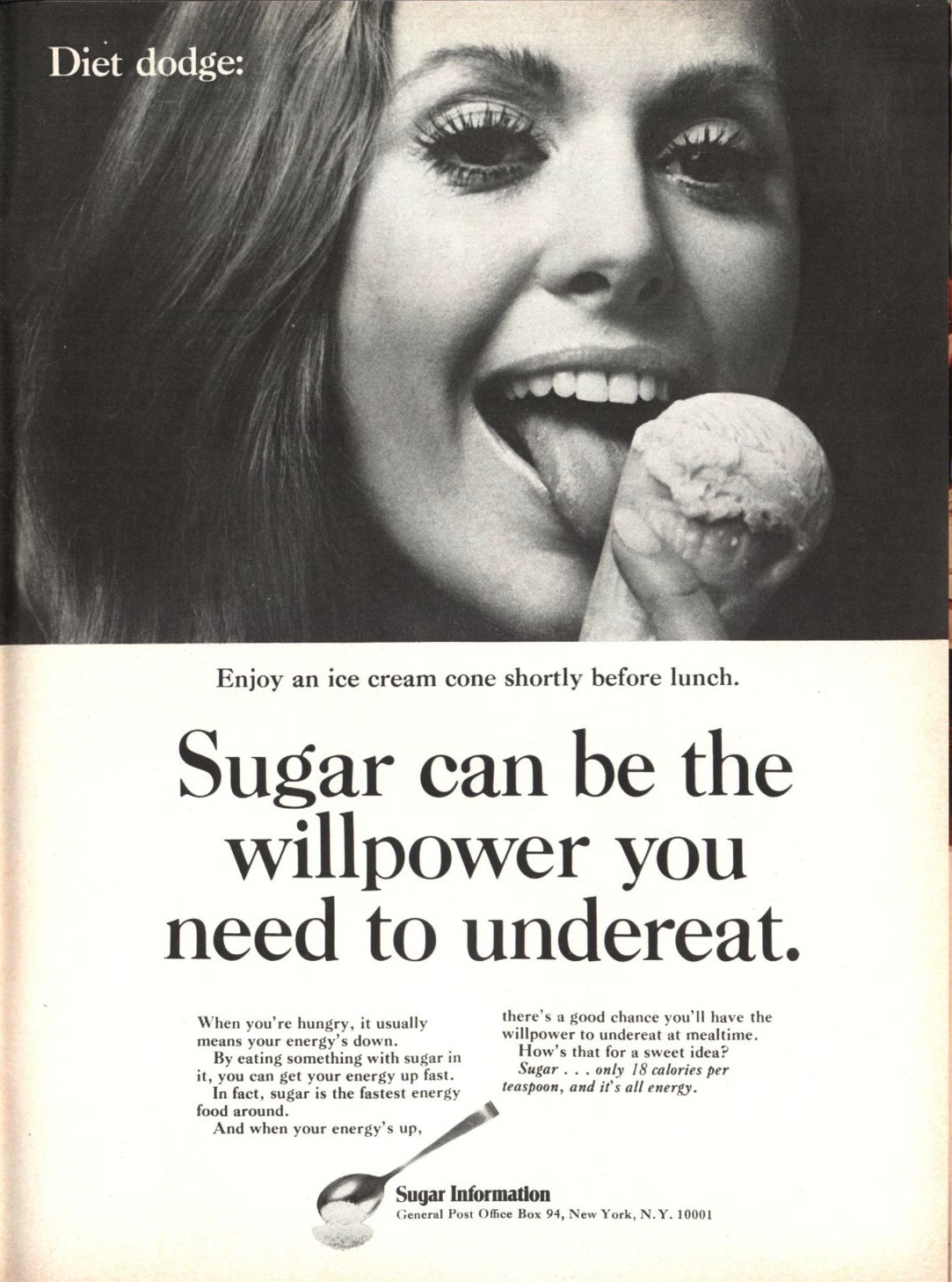
I'm not making excuses here - it's more that unless you come from a privileged or niche background, especially before the internet, you would think this is normal. Imagine as a woman going to your GP doctor for a checkup in the 1980s and having them suggest you start eating spoonfuls of pure refined white sugar to help you control your appetite. Similar modern examples include the popularity of "Bubble tea" which should almost be regarded as a poison
It's not that its hard to find non-sugar food - it's hard to KNOW that's what you're meant to do, even in the most educated first world countries.
https://api.time.com/wp-content/uploads/2015/10/19710510.jpe...
I'll cede that I misspoke when I said it couldn't be found at all, but it certainly takes more effort.
IIRC most western countries are vastly over-caloried, and have a roughly inverse relationship between BMI and income too.
You can literally throw sugar canes into a juicing machine and it has less sugar content than a can of coca cola
https://www.nhs.uk/conditions/tooth-decay/
"Tooth decay is damage to a tooth caused by dental plaque turning sugars into acid."
https://www.nhs.uk/change4life/food-facts/sugar
https://www.health.com/condition/type-2-diabetes/high-blood-...