All-time greatest failed Internet startup(quora.com) |
All-time greatest failed Internet startup(quora.com) |
"They ditched a perfectly working MySQL application and migrated to Oracle which caused them to hire Oracle consultants $2000 per day and spend millions on Oracle big-iron."
Reminds me of when the ads manager at Google decided we needed to ditch MySQL and get a "real database" for the ads system. "Real database" in that case meant Sybase, but it was still a barely mitigated disaster. Sometimes it seems as if the "real" databases are just a colossal scam.
"In 2000 they were doing around $24 million per quarter with a gross margin of 21%."
Wow. How could you get off to a start like that and blow it all?
There you go, now you've heard a good thing about the father of MS SQL Server.
Admittedly, all databases have their quirks. I use SQLite for a multi-process app suite, and get "database is locked" rather frequently. At least my app now knows how to retry transactions. Most of the apps using "real databases" fall over as soon as a transaction fails. "Internal server error, please retry later." Uh, no... transactions are supposed to fail. Even reads.
But I digress.
http://www.wired.com/techbiz/media/news/2000/03/35043
Right now it is hard to compete with bing.com, losing 2.5 billion per year.
I hope I don't find myself looking back in another decade or two and and sighing over the semantic web being too far ahead of its time.
I'm still impressed by the VA Linux IPO:
For a time there, I worked for UNext, an online University who decided that it was not enough that their site was powered by Broadvision (using highpriced broadvision consultants), but that their Intranet needed to run on broadvision as well. Oh swell!!
On top of that, they decided to contract those consultants straight out of Broadvision Inc itself, at over $300 an hour.
The CEO drove one of the $100k Mercedes Jeep type SUVs, imported ofcourse.
Not soon after, I left Chicago to go back to the Valley. And they ran out of money soon after.
I'd like to add WinStar, they had people going pretty much door to door in Manhattan selling services, I got a pretty decent free lunch off them.
I'd also nominate GovWorks, not huge in terms of money burned or technical blunders, but I credit the movie startup.com for really exposing some sheer ineptitude.
Edit: How could I forget Globix, the colo that had a coffee shop and a gym.
http://www.amazon.com/Boo-Hoo-Dot-com-Concept-Catastrophe/dp...
http://www.nytimes.com/2002/07/16/business/technology-briefi...
--- none of above would have happened, had they hired professional managers, not a bunch of children willing to spend every single dime on anything other than business itself.
apply that list to any business, including apple, google, microsoft, oracle, groupon, you name it, the result would be the same disaster as with etoys.
Before I start, you can get it here: http://sourceforge.net/projects/gzigzag/files/gzigzag/0.6.3/...
You have to use it (in Gzz) to understand it.
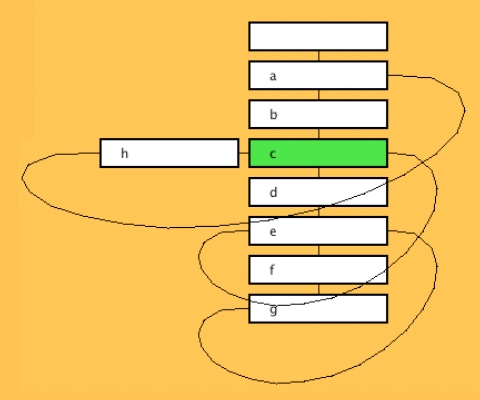
It's like Excel in that there are connected 'cells' (called that in Excel and Zigzag), but instead of being in a grid, they can be connected via a link to another cell. A link is either - or +, and the link has a dimension (eg, d.1 or d.name, or d.date). A cell has a string of text as its value.
So say we have 2 cells (which are numbered uniquely), cell 1 and 2. "1+d.1" points to 2, while "2-d.1" points to 1. Cell 1's text is "Here" and cell 2's text is "There".
The final element is that there is a cursor, which sits on a cell, and the program follows all the links from the cursor and draws them onto a canvas, and then shows it.
The user interface lets you make links, break links, edit the text in the cell, delete a cell, and show cells adjacent to the cursor cell. Another aspect is that the screen draws 3 dimensions, and you can toggle the ones shown. This is because showing every dimension is impossible, so we view a subset. It's not a static environment: rather, you make new cells, link them all together, etc.
http://xanadu.com/zigzag/ZZdnld/zzRefDef/pic24-bettersharedl...
My work was making a C version. Existing versions were a Perl version (the original prototype) and Gzz (an excellent Java version).
I should have improved Gzz instead of making my own version, but porting it from Perl to C was a good learning experience.
I then made a Lisp version which works great.
Finally, one challenge was getting Ted to accept my innovations and new features, but that isn't easy, so I had to stop working on my version of Zigzag, and maybe even stop using it.
EDIT: I see that a sibling poster named him.