This whole ad driven attention economy is probably as dangerous of an invention as nuclear weapons. We're caught in a state of psychosis and individually none of us can do anything to fight the billions of dollars spent on advertising that tries to make us feel inadequate. Targeted ads and recommendation engines need to be banned. I know some people say they like them, and some people also say they like tobacco but we generally agree it's bad for us. Companies will find other ways to innovate. Content curation, organization, and quality will become more valuable and eventually the experience will be better.
I say this because half-hearted measures like the one in the article are not going to make any difference when the entire business model of the internet is clickbait.
I don't see how you can "ban ads" without instituting totalitarian dictatorship.
Targeted arguments are a core part of political campaigning and polarization has been increasing in the US for decades, even before the internet.
My pet solution would to switch to a multi-party system that isolates rather than amplifies fringe voices. In germany people can look at what AfD and Die Linke have to say without having to choose between them.
I use a screen for coding work, HN breaks, shopping, civic life like bills, and the occasional stream binge. Outside work, maybe 5-10 hours week.
Otherwise I write creatively on paper, learned guitar, share digitally via point-to-point, and leave my house often for no reason most of the time.
Personally I have a hard time buying into anything you say being some sort of obligation, and more of a repeated hand me down habit.
Google's search ads used to be displayed based on the keywords being searched, rather than the user viewing them. Facebook based on what you've "liked". Amazon and eBay based on what you've bought before on their sites.
Go back to targeting ads based on page context and explicitly provided information (search queries, what I actually enter into my "profile", etc), rather than machine surveillance and inferences.
The goal of any social platform should be healthy engagement. Where is the research that this change will foster that? Twitter isn't really the place to be testing half-baked ideas.
Also, misinformation is coming from mainstream media as well as conspiracy theorists. At least conspiracy theorists are trying to find the truth. Twitter doesn't seem to acknowledge that, so what we're doing is creating digital totalitarianism? That's their great idea?
Additionally, if the media makes the wrong call due to insufficient evidence at the time or bias, then they could take a hit to their reputation.
It will almost become tactical for the original posters to hold back evidence and wait for their "misinformation" categorisation and then to "disprove" this to make the censors look like liars.
Does that ever happen? It seems they're exempt from repercussions.
Related: Why unmoderated online forums always degenerate into fascism
https://www.salon.com/2019/08/05/why-unmoderated-online-foru...
Twitter isn’t removing these tweets, just adding their own messages. That is, they are responding to free speech with their own free speech.
If they use this feature on high-profile figures it’s even better: free speech to authority.
Twitter is not free speech system to begin with so ”free speech” purists are not obligated to be ok with this unless the whole platform is based on free speech. In that kind of system any user would be able to prompt any popup for any user when they are about to like any tweet. Now only twitter has that power.
Do you think even free speech purists can see the danger in allowing too much influence concentrated in too few hands?
Yes, this is unironically a good thing.
It means that Twitter is acting as a publisher rather than a neutral channel but nobody is willing to pretend that corporations are neutral anyway.
Doubt that would've gone over well.
The premise of democracy rests upon the concept of free and open debate. If we cannot trust the public to consume information without hand holding, why should we trust them to vote on issues which impact our lives and property? Ironically, censorship is enacted in the name of protecting democracy.
Twitter and Facebook are part of "the public". You are even using right now a website very heavy on "censorship", or how I call it "moderation". If you don't follow HN guidelines you will be silenced. The efforts by members of public to reduce spread of misinformation and polarization is part of why we should trust in public to handle information. But if you do not like HN, Twitter, Facebook you can look for another website.
Apparently Parler is getting recently popular as an alternative to Twitter and Facebook moderation: https://en.wikipedia.org/wiki/Parler
Completely the opposite experience of what quite literally is the first sentence on their homepage:
> Speak freely and express yourself openly, without fear of being “deplatformed” for your views.
HNs guidelines appear to be "put some effort into what you say and don't fight." They're not censoring any particular set of ideas.
>I'd love a filter where Twitter only shows real people who have verified their ID with a passport. No companies, no bots.
This is the big-tech equivalent of saying "we might be joking or being cheeky when we ban someone" just to add more legal ambiguity and grey areas when it comes to explaining why they banned / flagged something or let something be allowed.
That said, when the losing candidate declares victory on a platform, then alleges fraud, citing nothing, it's not even really the time for abstract philosophy.
And there's "misinformation", the bane of agenda setters.
This will be selectively applied.
Why is this so complicated?
Who checks the fact checkers?
This indicates the dramatic damage done to news organisations when they have been caught in egregious lies and falsehoods, again and again.
Remember, when Twitter cites "official sources", it doesn't mean it's correct, or even that it's not totally fabricated. It means it's probably partisan-slanted "news" written by discredited media organisations.
Even news organisations that are generally trusted on HN have enormous bias and propensity for lies.
Such as the Washington Post falsely claiming Russia hacked critical US energy infrastructure, then retracting the fabricated claim altogether. [2] Or NPR claiming the victim driver of a vehicle during a protest who was attacked violently by gun-wielding assailants was a "right-wing extremist", which was nuked without retraction (they did not apologise for the slanderous claim). [3] [4]
The Associated Press, a self-claimed non-partisan news organisation, falsely claimed the Trump campaign detained 100,000 migrant children, while the actual truth was that it was orchestrated during the Obama administration. Reuters, AFP and NPR also participated in this fabrication. [5] [6] [7]
[1] https://www.journalism.org/2020/01/24/u-s-media-polarization...
[2] https://yro.slashdot.org/story/16/12/31/1533245/washington-p...
[3] https://pbs.twimg.com/media/EbEIlsUUcAACYht?format=jpg&name=...
[4] https://www.wave3.com/2020/06/18/protesters-arrested-followi...
[5] https://abcstlouis.com/news/nation-world/retractions-issued-...
[6] https://finance.yahoo.com/news/multiple-outlets-retract-stor...
[7] https://www.imediaethics.org/ap-afp-reuters-npr-retract-chil...
The mainstream media?
"If the news are fake imagine history".
People need to understand that NO ONE can define what is "misinformation" because all sides have incentives to lie.
This is purely thought policing.
>conspiracy theorists are trying to find the truth
Some of the biggest conspiracy theories that flourish on the web are the result of viral, provably false, information. These people are not truth-seekers, there is no proper research or scientific method - it's instead the equivalent of the supermarket tabloid taken to the extreme: QAnon, flat earthers, 5G cancer, etc.
I have no interest in defending the Trump administration except to point out that what you are supporting is, in fact, a hypocrisy. I can think of four examples which I know are hypocrisies that make it through the supposed "fake news" filter.
1) Russiagate, an unsubstantiated hoax promoted in the media for 3 years leading to countless defamatory attacks on Trump, and millions of dollars spent on investigations.
2) Cambridge Analytica, a tactic used by Obama's campaign which was praised in 2011 as being a new progressive way to reach voters, and then miraculously became an act of corruption when Trump did the same thing in 2016.
3) "Mostly peaceful protests", an ongoing gross misrepresentation of what normal people would call riots.
4) "Trump supporters are racist white men", an ongoing smear of the Trump administration and emotional abuse towards the Trump base (or anyone who doesn't buy into the narrative), which has been proven absolutely false by the latest election.
So which is it? You do or you don't want a newsfeed flooded with false/defamatory information? Just allow the stuff you don't personally see as false/defamatory?
This is an extremely dangerous problem, and people need to start waking up to it instead of thinking they got it all figured out, as if Alex Jones yelling at frogs is the reason everything is falling apart.
The fragmentation of reality which we're seeing (Trumpers, leftists, QAnon, flat earth, 5G, etc.) will NOT be solved by slowing down how fast people can "like" something. The entire internet is broken, and the social media platforms need massive rewiring. We need to properly research the ways the current platforms poison discourse, and find remedies that work to dissolve fragmentation and help people communicate better.
Currently, things are rapidly spinning out of control, and the social media platforms have decided to opt for totalitarianism. As they ban and hamstring everyone who doesn't buy in, good or bad, those people will find each other on the decentralized internet. This is creating a powder-keg for narrative chaos and conflict.
It doesn't take much to push people back into this primal level of thinking. We are predisposed to follow a charismatic leader, predisposed to follow a religion and adhere to it without any weighing of its systems with that of other religions or thinking critically about our beliefs, predisposed to fear the unknown 'other' rather than welcome them and their ideas. Millions of years of selective pressures have created who we are and how we behave toward one another, it's no surprise that there are some serious growing pains toward adapting to this new world where we attempt to treat others as equals rather than threats. Same sex marriage was only legalized five years ago in the US, after all.
No, the phenomenon that lasted really only a few years was due to the fact that the first Diasporas kicked off of those sites (or that left due to crack downs on their expression) were existing hateful communities. There's a name for the effect that I can't quite remember, but basically new communities are unsavory at first because they're made up of the unsavory characters that are unwelcome at the other communities, and this prevents their growth.
Thankfully we are currently seeing that effect wind down as well. With the increase in moderation beyond plainly hateful content, now to anything a site deems unlikeable, you're seeing those Diasporas become less and less unsavory and more mainstream sets of ideas are being discussed on the newer forums.
I regard articles like the one you linked as yellow journalism, designed to discredit people's desire to collect and discuss ideas online, freely, and argue in favor of places where ideas cannot be discussed freely. If there is any one thing that causes sites to become hateful, it is the need for the site to promote "engaging" content for as profit, something you are less likely to see on newer sites with less commercial pressure.
Those platforms, from the topic oriented platforms, to digg & reddit all stressed moderation. What's new is this idea that any sort of moderation is an infringement of free speech and content platforms should moderate as little as possible. Moderation used to be far stricter when platforms were smaller.
You still don't get it that _NO ONE_ can claim they know what is/is not fake news because everyone has their own incentives.
This is precisely why it's important that Twitter calls out when things are stated as fact without evidence. Twitter never actually say things are fake; they say things are baseless and without evidence. If you want to post things that are influential you simply need to back that claim up with something that people can verify from a trustworthy source - 'fake news' will still be posted because sometimes even a trusted source gets it wrong, but it'll happen far less often. That's the goal.
Suggesting that we should all adopt Nietzsche's perspectivist approach where "there are no facts, only interpretations" is entirely unhelpful. You can't run a functioning society if you have to accept literally every batshit mental theory as "well it might be right, we can't ever know for sure". If there is no evidence, you can say something is fake. You just have to accept that maybe 0.1% of the time you'll be wrong.
> Officials in Michigan reported on Tuesday that citizens of Flint, a predominantly black city, were receiving calls telling them to vote Wednesday, and not on election day. The calls are now being investigated by the FBI.
That is misinformation, no ifs, no buts.
In the early 2000's Americans were lied into the Iraq war, with multiple newspapers practically begging [0] for war, and critics were the ones on the correct side of history. If that happened in 2021, would the critics be silenced, have warnings on all of their tweets, and be told that they're supporting conspiracy theories? Questioning the official narrative of power is becoming wrongthink.
Who's deciding what's wrong and right?
[0] https://www.washingtonpost.com/archive/opinions/2003/02/06/i...
Have you been arguing with OP before? Or is this just how you address people in general? It doesn't set a very nice tone.
In this case, twitter. And it's fine to disagree with the fact checkers.
Example: The famous photo of Anderson Cooper standing in a ditch, pretending as if there was a catstrophic flood. (Really, the water was only a few inches deep.) Would Twitter flag that one?
It's a given they'd flag Trump a bunch. How about Joe Biden saying he would not ban fracking? Would Twitter flag that one?
Twitter is going to have a very hard time making anybody happy with this idea.
In 2016, you had a guy jokingly claim that he was ripping republican ballots in Ohio. This tweet spread like wildfire, and caused an unimaginable headache for the secretary of state as the right-wing media went wild on the story. I'm not surprised Twitter is taking such heavy handed action given that they will be directly in the cross hairs if a story like that ever happens again. No "replacement" would be immune from this issue.
I also don't think anybody would choose to be censored, that doesn't make sense. Maybe you could offer optional spam or misinformation filters, but why would anybody force them one themselves? Twitter and Facebook also employ "fact checking services", which would simply be applied voluntarily to other networks.
I also think the problem is way overblown. On Twitter you can choose who to follow. If select the right people, you won't get the misinformation spam.
I never claimed a replacement could be built in a weekend, and the incentives are exactly part of the problem and part of my question. It seems technically possible to built something like Twitter on a distributed basis with nobody having centralized control, but it probably wouldn't be as snappy as Twitter. People stay on Twitter out of convenience, and also because of the network effect. You would have to make lots of people switch at the same time. That is the challenge.
It was trending on product hunt yesterday and many alternatives are created every week.
I don't understand people on HN. They don't want mainstream social media but won't try these smaller alternatives because they are not mainstream. Seems pretty contradictory, no?
This isn't a real alternative because it doesn't have [insert the reason why people here hate twitter or Facebook]
For a thing to be a better alternative it would need to have structural differences that ensure it will not devolve as Twitter has. Gab is essentially a carbon copy of Twitter, but for a different set of ideas.
Pleroma and Mastodon (as well as other ActivityPub enabled microblogging software) are the only real, better alternatives that exist right now.
> Gab is an English-language alt-tech social networking service known for its far-right userbase.[7] The site has been widely described as a safe haven for extremists including neo-Nazis, white supremacists, and the alt-right, and has attracted users and groups who have been banned from other social networks.[8][9][19] Gab states that it promotes free speech and individual liberty, although these statements have been criticized as being a shield for its alt-right ecosystem.[20][17][21] Antisemitism is a prominent part of the site's content, and the company itself has engaged in antisemitic commentary on Twitter.[23][24][25] Researchers have written that Gab has been "repeatedly linked to radicalization leading to real-world violent events".[26]
It's almost like there's a pattern of "free speech" alternatives turning into a cesspool.
No, it mostly reflects the rise of ideological tribalism supported by the rise of a diverse array of media outlets catering to (and reinforcing) preconceived biases (some originally driven by propaganda interests, but more driven by the business desire to capture a distinct demographic market for advertising; in the end, the interests overlap and coexist.)
Just catering to preconceived biases leads to basically good faith bias with a bit of manipulation. The current situation is well beyond that.
So based on your citations, "enormous" is roughly a handful between the thirty of them over the last decade?
Get some perspective, do you actually think the WaPo literally made up a story or do you think they (let's be uncharitable) ran with a story they should've done more due diligence on?
It's easy to see how a false story about a serious attack on US infrastructure could spark confrontation, or even more serious war (much like when NYT fabricated evidence that WMDs existed in Iraq).
No, it mostly reflects the rise of ideological tribalism supported by media outlets.
Also, people talk about "Fake news" from mainstream media, but actually, the examples of the mainstream media reporting literally incorreect information is pretty rare, and has real world consequences when it happens.
Sure. But if they choose to do that, it is not a place where you can expect to share ideas and have real discussions with people. It becomes a place where perception is crafted, something those of us who actually want to use the internet as opposed to a TV channel are trying to avoid.
I post "It's currently sunny where I live"
That's misinformation.
How can you even compare?
It's silly that there exist people in the modern age who still believe the news.
And it's these lying news (who are private owned) who define "misinformation".
Do people really believe that when a company says "we will become independent fact checkers" that that is even possible?
Did you learn nothing from your past experiences of what happens when a company says "we will become an independent fact checker, TRUST US, WE WILL NEVER LIE AND BE 100% HONEST AND OBJECTIVE".
But yes, generally, when a company promises to be your best buddy no strings attached it is time to get suspicious, and when someone believes them I begin to figure out if they're just naive or actually unintelligent.
Of course the above would not include abstractions like two parallel lines will never meet or overly simplistic hypotheticals.
[1] https://www.snopes.com/fact-check/anderson-cooper-hurricane/
It's a refuge for the people too deplorable to survive on an actual reputable site.
There are no down arrows on stories. They appear on comments after users reach a certain karma threshold, but never on direct replies.
I could probably say anything right now, and as long as I backed it up with data, or just thoughtfulness, I probably wouldn't be banned or censored here. I've never seen anything like that happen on this site. You can have free discussions here. You could, theoretically, have a free discussion on Twitter if you genuinely were not interested in discussing anything controversial. For most topics of disagreement though, on twitter you have to police your own speech.
Another way it does this is that there's no financial incentive to share "engaging" content and there's no algorithm to rank content. So it is not conducive to the viral spread of inflammatory content.
Keep in mind, most things we call "networks" are just single web sites. Most of the problem I believe stems from this confusion. AP is an actual network. It is what we have wanted to have on the internet for a very long time.
Nowadays even on topic discussion and critical and informed discussion of controversial topics is "moderated". In some communities it is so bad that even by the letter on topic discussion that deviates from some community orthodoxy is removed. Worse still, in a lot of cases groups of moderators share lists of people to crusade against.
The problem I have is that the old, actual definition of moderation is used to show how productive communities can exist, and then that is given as an justification for this new form of suppressive moderation that does not produce productive discussion.
The distinction must be made between moderation and control of narratives. You might not want to call it censorship because it isn't a government doing it, but it isn't the same as what internet perusers have always referred to when we use the word " moderation".
If you think platform moderation has changed, I think you're better off looking at public figure discourse/debates/pundits 30 years ago and compare it to now.
That's what's changed. Moderation is honestly much lighter now, it's just the noise that's a lot higher.
They should have the ability to see flagged content, especially content that got a good number of votes before flagging, you’d be surprised.
There's very little sport in defending an establishment or consensus position. As they say, if everyone is thinking the same thing, then someone isn't thinking. There's almost nothing to discuss if we all agree.
There's a fair amount of downvoted and flagged content I agree with. It doesn't stop me from reading it. Like Twitter's "fact checks", it draws my attention. There are some topics where even if I agree I can see how those who disagree are incapable of discussing it without devolving into an all out flame war.
The real horror show are HN's shadowbanned accounts. 99% of those are awful.
> We live in hypernormal times and few are equipped to make sense of it
EDIT: no, there are not "few" equipped. Because no one knows who is lying NO ONE is equipped.
>"Mostly peaceful protests", an ongoing gross misrepresentation of what normal people would call riots
That's a partisan, Fox News talking point. Statistically, the BLM protests were overwhelmingly peaceful. The news happens to focus on the small number that were not.
That's also an example of something which could be fairly, scientifically reported on. "Most protests were peaceful, and there were a few riots" is a good headline. "ANTIFA IS BURNING DOWN YOUR CITIES" is not.
If the latter gets better/viral newsfeed distribution than the first, then we have a serious problem.
Fragmentation of reality on the internet. There's no way around it because someone will just deny someone else's reality and substitute their own.
With intellectual honesty, the following can't be disputed:
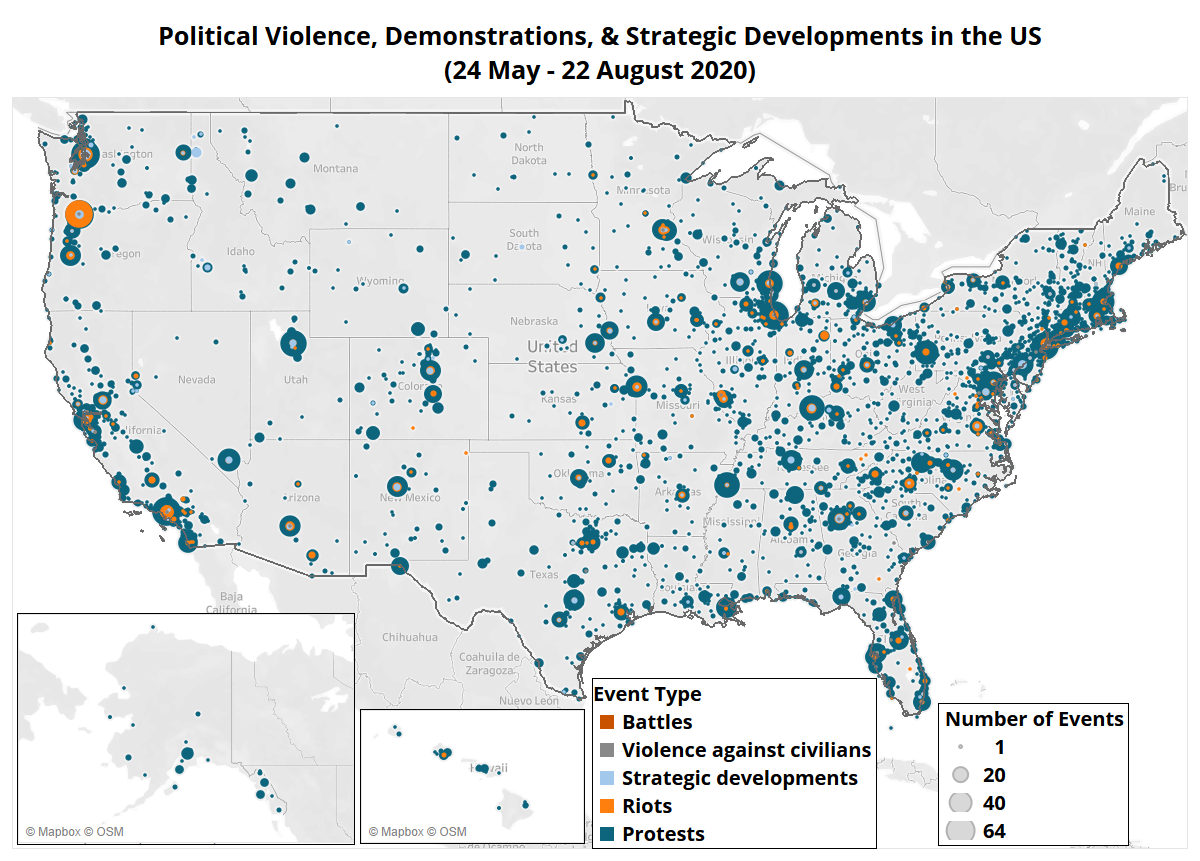
* "A few riots" is actually hundreds of riots over the longest sustained period of civil unrest in American history (besides the civil war). Here's a geographical chart of all protests and riots from May 2020 to August 2020: https://acleddata.com/acleddatanew/wp-content/uploads/2020/0...
* For the people living in Portland, Seattle, New York, and other major cities the rioters were/are a threatening presence. In Minneapolis alone, 1,500 locations were damaged or destroyed by rioters. https://www.startribune.com/minneapolis-st-paul-buildings-ar...
How does the information I just showed you present a picture in which "mostly peaceful protests" is the most accurate summary? What kind of information would it take to change your mind? Would that even be possible? Is this cherry picking?
I think on a forum like Hacker News we might actually get to the bottom of this particular point. But that's only because Hacker News isn't social media - it's a community based around tech, and it's heavily moderated. That changes the audience that will see our argument, and the entire dynamic of the dialogue.
I'm not here to argue about the riots or left/right politics. I'm just trying to show you that you are capable of being wrong, so stop trying to argue the politics and try to tackle the problem of how to end fragmentation.
That's quite a rude way to try to win an argument. And yes, you're cherry picking. Did you even read the article which contained the first image you linked?
"The vast majority of demonstration events associated with the BLM movement are non-violent (see map below). In more than 93% of all demonstrations connected to the movement, demonstrators have not engaged in violence or destructive activity. Peaceful protests are reported in over 2,400 distinct locations around the country. Violent demonstrations,4 meanwhile, have been limited to fewer than 220 locations — under 10% of the areas that experienced peaceful protests. In many urban areas like Portland, Oregon, for example, which has seen sustained unrest since Floyd’s killing, violent demonstrations are largely confined to specific blocks, rather than dispersed throughout the city"
https://acleddata.com/2020/09/03/demonstrations-political-vi...
This is not even close to true.
https://en.wikipedia.org/wiki/List_of_incidents_of_civil_unr...
Discussion becomes futile if we can't engage with good faith with those we disagree with. Assuming that someone's view is 'noise' is starting from a position of bad faith. If you take the position that you have an exclusive license on truthiness when debunking/disagreeing, then you're no better.
My previous example about the republican ballot shredding was one where a kid thought we would post a tweet that he was shredding ballots because he thought it would be funny. This not only caused an entire news cycle about how republicans that the entire process was unfair, but seriously called into the question the staff and security of those working on the elections. Many of them faced threats for an issue they didn’t know existed because of this tweet. Similarly if you have people showing up to pizza shops inciting violence because they believed Hillary Clinton was hiding children in the basement your platform will ultimately be seen as a conduit for this type behavior. It’s no different from yelling fire in a movie theater.
It doesn’t matter if you individually carefully select and get who you follow, you have to ensure everyone else acts accordingly - and as we can see they won’t.
You have to ask yourself if your platform was large enough to have these issues in the real world what would you do to minimize it - because if you don’t Congress will and the hammer of the state is very blunt.
Just saying "I wouldn't solve that problem" doesn't contribute in understanding how one can build more open platforms in the future.
Also there would be no reason to switch away from Twitter if you want to censor users anyway.
And I disagree that the spread of misinformation is such a huge issue as you make it out to be. Misinformation existed before the internet, it isn't caused by it. The internet makes it easier to double check information.
If watching a boy burn ballots makes people burn ballots, I don't think Twitter is the problem here. I think those people have some other deep seated problems. I'm sure I wouldn't burn ballots if I saw that video (I haven't).
In my own country we also saw protests after the death of George Floyd. These were dispersed forcefully by police, indirectly because of Corona restrictions. I do not think the police officers, who put their health and safety at risk, felt particularly peaceful when engaging huge crowds with batons and riot shields.
There were peaceful protests, and there were violent ones. There were orderly citizens as well as looters and rioters. The trend is what matters, the frequency. Imagine if 10% of a rock band's concerts resulted in venues being burnt down, people seriously hurt and even killed, would that band's concerts be considered peaceful?
I've seen videos from the affected cities and neighbourhoods, if that's what a peaceful America looks like then I hope they never experience commotion or unrest.
People that care deeply about free-speech tend to want a level playing ground for every person in a discussion, and to not have platforms that have a centralised bias for or against different messages or identities.
It's disingenuous to tell a bunch of people with principles towards discussions happening on a relatively level-playing ground ("fairness") that what they really wanted all along was a central authority fact-checking certain perspectives.
Free-speech is mainly about avoiding situations in which there is an authoritarian bias towards the speech of one group over another. It doesn't matter whether that bias is due to deletion, banning, shadow-banning, algorithmic/statistical manipulation, editorial notes, etc. All of these things are forms of bias that the powerful can use in an attempt to control the speech of others.
The thing is, most of us aren't purists at all. Many agree that there should be some limits to free speech, and that certain things like calls to violence, dehumanisation of people, disinformation that doesn't get corrected until too late, and so on, are big issues for democratic society. However, it would be better if we could discuss this, rather than having our position straw-manned into something contrary to its inner morality/logic, and then getting treated as if we are all strict adherents to this as opposed to practical people that try to balance it with other things.
A free-speech purist would recognize that these aren't “aurhorities”, they are actors exercising their free speech, and which people are free to not associate with by not choosing Twitter as a platform for their own (distribution or consumption of) speech.
Either Twitter is a place for us to speak or it is the blog of the moderation team. It cannot be both. If they want to caveat everything everyone says then you're right, the solution is to not use the site, but it isn't because we don't like what they're saying, it is because Twitter is no longer a website designed for people to have discussions with one another, it is a website designed for the owner to control the flow of ideas.
By that argument free-speech advocates would support the inclusion of intelligent design and flat earth into public schools. You seem to be constructing a strawman.
Freedom of speech does not exclude the possibility of explicitly labeling certain speech as wrong, and what twitter is doing here is definitely better that removing tweets outright.
It would be even better to explicitly include opposite sources when marking disinformation. The primary concern is that this "labeling" is just a prelude to removal.
> Free-speech is mainly about avoiding situations in which there is an authoritarian bias towards the speech of one group over another.
Allowing a heavily annotated of speech is a minimum guarantee of "freedom", and vastly better than outright suppression.
  > Freedom of speech does not exclude the possibility
  > of explicitly labeling certain speech as wrong,
  > and what twitter is doing here is definitely better
  > than removing tweets outright.
I disagreed with how the person I was responding to was formulating free speech, but think that there must be some middle path where we can be clear about why certain messages have disclaimers, and why certain people get banned, and what will get you banned, and how to get your account back if you've done nothing wrong, etc.
I also think that right now people complain about shadow-bans and so on, and I think these things are dangerous because they make people feel that authorities are conspiring against them.
Every free speech "purist" I've ever met limits their opinion of control to the government.
Free speech "purists" (which I think is a stupid term, one only ever used by critics) set the distinction at having power. Power to silence people. The saying is "speak truth to power", not "speak truth to elected bureaucrats."
  > Every free speech "purist" I've ever met limits
  > their opinion of control to the government.
There are people that have argued for free speech outside of this narrow lense. John Stuart Mill, one of the original advocates of free speech, argued against censorship by private parties.
He discussed the "the moral coercion of public opinion" and wrote that "the chief mischief of the legal penalties is that they strengthen the social stigma" and added that "It is that stigma which is really effective".
Twitter has a platform whose design inherently amplifies the voices of high-profile people, and consequently dampens the voices of the non-high-profile. Why be OK with that, and yet somehow not be OK with minor design adjustments that provide a small, partial, counterweight?
You cast this as a “special ability” but isn’t this simply the design of the platform, as decided by the people who control the platform, and whose job it is to decide what the platform is? And how is a platform design dictated by someone else for their own benefit somehow more valid?
Perhaps you don’t know, but as President, Trump is given special privileges on Twitter, and is exempt from virtually all the normal TOS. By basic fairness in free speech principles, you would be arguing that he be held to the same standard as everyone else. That would have had gotten him banned from Twitter a long time ago.
Anyway, just to clear your thinking, think of what a truly fair speech platform would be like. It would, e.g., ensure that any message I or you posted would be just as prominent as one Trump or other high-profile person posted. Of course, such platforms aren’t of interest to high-profile people. They want a platform like Twitter where the rules are tilted in their favor. The only thing being argued about here is how massively in their favor the platform is made. That’s fine, but it doesn’t have anything to do with free speech. You express a desire for a relatively level playing field, but if that’s the case, why even talk about Twitter, which has never been even remotely about that?
> straw-manned
I’m afraid you’re getting lost here. I’m not straw-manning you or anyone. You can have any stance you want. It’s just up to you to express it.
> Anyway, just to clear your thinking,
I wrote quite clearly that most people interested in free-speech aren't purists and might expect "limits to free speech" in certain circumstances, but that we'd like to discuss what this means with respect to the actual goal of a relatively level playing field for discussion.
You tell me that you've not strawmanned anybody, but within your first comment you wrote that "if you're a free speech purist you are OK with [Twitter] responding to free speech with their own free speech". This suggests that free speech is merely about being able to speak and that advocates would be happy for their speech to be stymied in other ways - and, in fact, pleased when all their speech has mandatory notices about its invalidity. Clearly this is not what free-speech advocates believe, so it certainly is straw-manning or as another put "some gymnastics".
Apart from that, the rest of what you said is relatively coherent and you did at least try to unpack the platform as-is.
It is true that the President of the United States is also an authority. However, are they an authority of Twitter? Well, they can't ban people or add editorial notes below the tweets of their opponents so perhaps not.
You also mention that "Trump is given special privileges on Twitter, and is exempt from virtually all the normal TOS", so shouldn't he be held to the same standard as everyone else? Well, yes. Why not?
As for whether new ways of adding editorial comment below people's tweets are "special abilities" I think so (because normal users can't do this).
However, I agree that Twitter was never "a free speech platform" and that by design it always amplified particular voices via crowd-sourcing. But, there is a difference between crowd-sourced amplification and centralised editorial oversight/amplification. While Twitter has "never been even remotely about [free speech]" the new features are clearly changing what it is from a crowd-sourced amplification platform to a platform with significant editorial oversight.
Is it better for there to be a centralised bias for or against different messages or identities or is it better for the bias to be crowd-sourced? Is the editorial oversight US-centric only? Who gets this power (e.g. governments, institutions, HR, etc)? When should there be limits to free speech? When some speech needs to be inhibited should this be done in the open or behind closed doors? Should infractions be explained? Does anybody get to break the rules?
I and many others would like if these questions could be answered by the big social networks. It's annoying when people simplify all of this into some primitive desire for everybody to be able to say whatever and have their voice amplified by a platform, since that is not what I am saying.
I do not suggest that. I am not trying narrowly define speech. My point is: It is free speech for someone to make claims about election fraud. It is also free speech for someone to refute those claims.
Why deny Twitter the right to their own editorial position, whatever its bias, while certain twitter users — with strong biases of their own — have free reign?
You seem to want to cast Twitter expressing their own position as inhibiting someone else’s free speech, but it’s just their own free speech. Free speech means you get to express yourself, not be free from contradiction.
On the other hand, there are many ways to stymie speech which don't involve outright supression. Some of the things that Twitter does to stop certain speech are better than other ways -- I think it's good when they can be explicit about what they are doing and why they are doing it. It might be better business for them to be non-partisan as they provide a platform for people across the world but that is also their choice.
However, if for example, I was an admin on HN and had some special ability to put emphasized disclaimers below your comments about how they were mistaken and you were wrong, I think you would be right to feel like I was biasing the discussion and that it was unfair. An advocate for free speech (to the extent that I am, and in the way that I am) might be against this, since it does not create a good environment for discussion (new arguments or new ideas).
As I said, it kind of depends on the particulars and the context, but I kind of think about it like a debate between two people overseen by a moderator. If the moderator is neutral it is preferred by the audience, and if it looks like unfair treatment by the moderator it could easily backfire. Of course, this metaphor is quite specific and not guaranteed to apply to all situations -- but, I think it should be considered, since it's not uncommon for grifters on Twitter to make a fuss about how they are being unfairly targeted, in order to persuade their audience that "the truth" is being hidden from them by an unchecked elite (this is along the lines of my first comment here: https://news.ycombinator.com/item?id=25044396).
That’s your opinion, but not one Twitter shares, apparently.
> Twitter is no longer a website designed for people to have discussions with one another
It is already not that. It was never that.
Twitter is a platform for stating things as fact without evidence. 120 (or whatever it is now) character limit is not suitable for having cogent conversations.
As for posting without space to have a cogent conversation, sure I can accept that. The answer is to not post that thing on Twitter. It isn't to just have the conversation anyway and ignore the fact that you're not providing evidence behind what you're saying. Twitter's 'censorship' of their platform doesn't stop anyone posting on different platforms that allow longer posts.
We're talking within the scopes of twitter as a communicative platform. Wether or not other platforms exist and how much more or less censorship and tokens you get is irrelivant to the discussion on wether it is morally right for twitter to flag tweets it deems 'misinformation' Twitter as a platform has no register of what they can and cannot judge. Twitter does not replicate ANY evidence on what they call misinformation. Twitter does not even provide proof on what they call misinformation. Just the label at the bottom. Twitter also categorises criticism on mainstream 'facts' as the same 'misinformation'
How would you like HN if ITT everyone disagreed with twitter censorship and you would be labelled on every post ITT as 'misinformation'? would you think that constitutes as a usefull HN guideline?
What will they go by when there are multiple versions of stories based on who you ask?
Will they block all the stories where there are anonymous sources?
Will they block all opinion pieces?
And no, lack of evidence doesn't make things fake. Lack of evidence is just lack of evidence. Even for things that may require evidence, evidence can always be found later or presented later. If Twitter had existed since the 60s, would it be right for them to block everything mentioning Higgs boson until evidence for it was found in 2012?
That's kind of the point I was making. Lack of evidence doesn't make something fake, but it doesn't make it true either. Twitter is pointing that out and telling people where things don't have evidence so they shouldn't automatically accept it as true (or fake). Where something is incredibly influential and could lead to violence I think Twitter should be wary about publishing it. People's safety is important, so while I don't think Twitter should block speech I do think putting a warning on it is reasonable.
If Twitter had existed since the 60s, would it be right for them to block everything mentioning Higgs boson until evidence for it was found in 2012?
Anyone with even the tiniest bit of science education talked about the Higgs Boson as a no more than a possibility and definitely not a fact until it was proved experimentally and the evidence was clear for anyone to see. If people had been saying it was definitely real then a skeptical warning that there wasn't any evidence to prove that might not have been a bad idea.
You're completely wrong on this one. Not only did physicists believe in the existence of Higgs boson, they built upon the premise that it existed for all those years.
Sometimes evidence is not always possible to present or just not practical. Also, there are various degrees of what kind of evidence is acceptable. The evidence required to publish a paper in a scientific journal is different from what is required to make a legal case or report in a magazine. So, with a premise of "requiring evidence", you can be very flexible in terms of what you allow and don't... which is what Twitter seems to be doing.
Trust is a massive optimization. You just have to accept that maybe 0.1% of the time you'll be wrong, and provide recourse.
For example, I see plenty of people touting the idea that everyone should be nice to one another. This is becoming a meme in society. I see the shittiest people wishing others to be nice to one another. It's become a cognitive dissonance.
It is only matter of time till being "nice" becomes state mandated in a country (US) where if I want to be a piece of shit, I can be a piece of shit. A lot of people in the states seem to genuinely not understand this concept.
I genuinely suggest burning down twitter.
/s