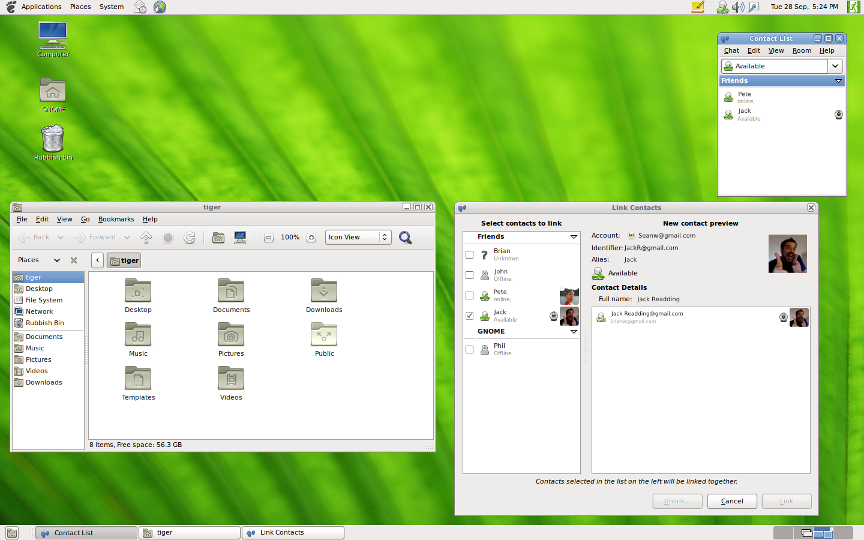
Gnome 40(forty.gnome.org) |
IIRC even KDE plasma worked. But these days there are a few KDE apps on the microsoft store or on kde.org.
Even if you could install that on windows (compiling everythong with cygwin?), it wouldn't really be windows, mind you.
laughs in Debian
So sad...
No idea if they still work.
https://www.microsoft.com/en-us/store/collections/windowsthe...
I use Mac OS daily on my work computer and Gnome daily on my personal computer. Yes, I know there are a lot of Linux open source applications that are not very polished, but the quality in Gnome and its core applications is extremely high. There are even some things that Gnome does better than Mac OS.
Now, you might not like Gnome and that's perfectly fine. Fortunately, Linux is the land of choice and there is an alternative for every person. It baffles me to come here and read so much negativity! Come on! this is a big milestone for a community that has been working a lot to bring you something of quality for free! They have been doing this for decades already and they have put a lot of effort and love into this. How many open source projects fail to abandonment after just a few months?
Why is it that so many people in internet communities such as HN can't take a minute to appreciate the effort and instead the only thing that they are motivated to do is to nit-pick something and trash. Criticism is always welcome, there are even some appropriate channels to do it, but seriously why is this the only thing that you are able to say about a community driven product? Why is there only space for negativity? Why not a small "thanks" or "I liked that feature" before your criticism? They are bringing this thing for you for free, why can't you at least say something nice?
My frustrations with GNOME are not about polish, they're about reliability. Users don't care about polish when they update their OS and suddenly wifi doesn't work. I sincerely hope GNOME is more reliable now than it was in the past.
To your general point (why attack the project): GNOME has a reputation (IMO deserved) for aggressively not caring about the opinions of users or outside projects (ex. https://news.ycombinator.com/item?id=23795901). So at some point it comes to "GNOME hates everyone else, so everyone else hates GNOME".
I think the only way to properly understand the topic would be to do surveys across different demographics, which I believe GNOME has done. It might feel like GNOME are ignoring "everyone" when everyone is the subset of it's users (or not of it's users) who frequent the same forums you do.
Specifically, I want to be able to click around on directories to choose where to save a file, type the file name, then press enter. This should save the file, not filter the directory listing.
Also, I don’t want it to default to overwriting some file I saved last week.
https://jayfax.neocities.org/mediocrity/gnome-has-no-thumbna...
Firstly, without major versions it does not single anything to end users and end developers. Is '40' still mostly compatible with the gnome 3.x.x API? Is there a major divergence between 40 and 41? Is 41 and 40 a total rewrite?
3.x.x works and there's a reason why. It conveys a lot of information quickly and is well understood.
reducing things down to a single number is meaningless and clearly branding drivel. I guess they want to obfuscate as much as possible and dumb things down for users like they have been doing for close to a decade.
Yawn
It looks like they’ve taken a lot of the best parts of MacOS and built something really nice atop it.
Realistically, how many people are using Gnome on touch screen displays? Personally I always use it on a laptop so 90% of their touch screen optimizations, like bloated bars, end up wasting screen real estate.
You can make your own themes pretty easily though, if you want to change the theme. There's some quite-good-but-not-quite-there macOS themes that aren't too bad, especially with the top menu bars that Ubuntu used to have.
I have no idea how you can productively work that way
The reason for getting 4K monitors is not to have less stuff that can make you productive visible
KDE 3.5 was the top of OSS desktops, in my opinion
Was looking for when this GNOME version will be integrated to Ubuntu to check them out, it will not land in the next Ubuntu version.
> Ubuntu 21.04 will NOT include GNOME 40. Bew Ubuntu releases typically include the newest GNOME release but this time it won’t. Why? Well, GNOME 40 features bold design changes that Ubuntu devs feel they need more time to ‘adapt’ to. [1]
Overall I like the refresh, but for me the real UX test is when you use it for a week/month. Will have to wait!
[1] https://www.omgubuntu.co.uk/2021/01/ubuntu-21-04-release-fea...
Overall system performance is fantastic so far with Fedora 34, super excited to keep tinkering with it.
Great work by the Gnome Team, and I'm super excited for the future of Gnome!
if the Pop!_Shell extensions get made mainline in addition to the changes here, I will probably go from disliking/tolerating vanilla GNOME to possibly daily driving.
Like on all the other desktops?
Currently, not all themes work properly with GTK 4, but they will eventually get there. Personally, I use the Mojave-gtk-theme. It wastes no space and is beautifully designed.
[edited for grammar]
It is possible to mitigate some of that inconvenience by using a theme where everything is scaled up (and there are tools to generate them), but there will be still GTK 2 software that looks bad.
Canonical, could you please make the Ubuntu font really-SIL-free, so that Cantarell can be taken behind the barn and shot? Pretty please?
Well the nice thing is Ubuntu never forces you to restart (unless _you_ want to use a newer kernel). You can always press "later" until you are done with the work you are doing.
Seems Gnome now has a bunch of those features. Are there any touchpads for which it's this well integrated and works? Or is it the same that it's always been: there's some kind of binary "gesture" recognizer that is then executed with a pretty animation?
This is one of the biggest things keeping me on macOS at the moment.
It can’t possibly be good on every device ever created, but it is pretty good I would say. Four-finger swipe up down works on gnome 3 already and it is a smooth motion, not a binary recognized thingy fortunately.
By contrast KDE/Qt has always had a stronger Win9x feel through and through.
I was able to download the debian source for a couple gtk applications (ie, gedit/pluma) and apply community sourced patches to them to get back the text/file path entry box. But there's no way I am going to be able to fix Gtk itself. And fixing every application on my system by compiling from source and making new debian packages, well, I might as well linux from scratch.
I'd be willing to donate a good chunk of money just to support "basic UX" improvements to FOSS software and toolkits like Gtk.
Should we start a "Fix the Gtk file chooser" Gofundme?
Does anyone know of an issue in their tracker with an official stance on it?
Because of the release of GNOME $next, and the lack of interest in maintainership of GNOME $prev, the gnome-core product is being closed. If you feel your bug is still of relevance to GNOME $next, please reopen it and refile it against a more appropriate component. Thanks...
[1] adapted from: https://www.jwz.org/doc/cadt.html
Both Google Chrome and Firefox use GTK's file picker (at least when "saving link as..." at least on Fedora 34 Prerelease) so what would you do for a web browser?
The workaround is that I must remember to hit Alt+N to focus on the filename box before typing. Usually I forget though.
Or maybe I'm misunderstanding.
Yes, "It's FOSS, go fork it" and all that malarkey.
Painting with broad strokes: MacOS and others make money on things being polished, consistent and understandable. They don't get to use their hacker blinders and say "Who needs a GUI for that" or act like Firefox and rearrange the UI every six months.
Thus, often times, the usability of OSes with a financial incentive for broad accessibility will be the most polished.
Ubuntu for a period wanted to break into the desktop OS market. They focused on polish and went so far as to create their own desktop environment (and display server)! They didn't fully succeed, but the point stands: There are many people outside the hacker community who are not going to write their own DE, who nevertheless hold the valid (and often, IMO, correct) opinion that Linux UIs blow more often than Windows/Mac.
PS: This isn't an argument about rights and obligations; I'm not saying randomGnomeDev123 has some moral obligation to do as randomUser345 asks. Just don't confuse "lack of obligation" with "being right".
This issue is one of the things that a normal, non-technical user would run into if they'd ever try Linux. If the file picker can't even get feature parity with Windows XP's, you're not attracting a lot of growth.
I'm fine with waiting for someone to eventually fix it in Gnome 8 or 9, but this is a real usability issue that indicates an entire area of the framework can use some work.
Good software design encompasses listening to and talking with users, and actually discovering what they need, where their pain points are, etc. They won't tell you explicitly.
Apart from being a software developer, i'm also a user of course. I use GNOME every day, and even though i'm affected by this, i haven't found the time, patience and dedication to actually go and try to fix it. I understand that the GNOME developers might not have the time either. But it's not like this issue does not exist, or that it's not important.
And if i, and many people who see this as an issue and could potentially fix it, don't do it, then how can we expect that non-technical users would?
I have tried to teach my mother how to copy files between devices countless times in Windows. It's not an easy task for someone who hasn't grown using a computer. I'd love to advocate for more people to use Linux, but i won't, because each little thing like not being able to see the image whumbnails when picking files can be a road-blocker for non-technical people, and add up quickly.
This is a useless viewpoint when the grief is held by mostly non-devs.
i couldn't care less about this "issue", which supposedly shows that desktop linux is a "joke". he's not really convincing.
(it would be a nice to have feature, yes. but his reaction is way overblown)
> This is why Free desktop operating systems are a joke and haven’t been popularly adopted [...] GtkFileChooser remains broken
There are many other issues with Gnome that actually is their decision and it is a problem. This specific one is a GTK issue. But for example their decision on window decoration in wayland is just wrong and makes the whole environment look weird[2].
Uh no. There have been at least 3 separate attempts at implementing this. One of them actually lives as a fork on github, and it works. None of them have been merged. The gtk devs don't care.
It should be annoying that the issue keeps coming up.
It's not a 'meme' that gnome lacks an extremely basic feature that is incredibly common in other GUIs.
To me it communicates no commitment to backwards compatibility, i.e. no semantic versioning. This might be enforceable if one is Apple, but doesn't sound good for an open-source platform.
> I guess they want to obfuscate as much as possible and dumb things down for users like they have been doing for close to a decade.
The Gnome project has done an enormous amount to push the open source and free desktop forward. The least we can do is not impute sinister motives to them. What do they stand to gain from "obfuscat[ing]" their version number when their code is all open source?
But the apps and the ecosystem really is ugly, messy and inconsistent. For example if you look at the controls you got with GTK out of the box in GTK3 era (when I last tried to build something with it) I remember huge paddings, unintuitive UX (the GTK file picker is the worst I've used) and poor layout controls. Go check out an app like https://inkscape.org and compare it to something like Illustrator or Gnome to Photoshop. The messy jumbled stacks of options with huge icons and paddings instead of being condensed and easy to use - most of it stems from GTK controls being bad.
Now this is all with a huge disclaimer that I haven't used a Linux desktop in over 5 years at this point, maybe things got better but I doubt it - I still use Inkscape for example from time to time and Gimp on OSX and putting the non-native issues aside the apps look terrible on their own because of what I already said.
I was mostly stricken with how much many of the features they are highlighting look straight out of stuff which was unveiled in MacOS about 5+ years ago. Extensive gesture support being a biggie.
from Palm
MacOS’s fundamental look has a pretty consistent chain all the way back to NextOS in the 90s. The Dock, the dot indicator, and many other core pieces are visible in versions of MacOS which predate the launch of webOS. MacOS borrows some bits from webOS as well, but the fundamental Dock layout is right out of NextStep.
If I'm switching windows and I'm not alt-tabbing, I usually just hit the super key and select the window from the thumbnails/previews.
I don't find that to be unproductive, but then, I haven't really been even trying to change the basics of my desktop or experimenting much in a while, so it might be that I've just settled for it to some extent.
If I had to first move the mouse to one location in order to get a list of windows, and then again to another location to select the window I want, I don't think that would work at all. But with a very easily accessible keyboard shortcut for the first part it does.
I often have several windows of the same application open at the same time (particularly browser and terminal). When I want to switch from say the IDE to the _right_ browser window, how do I do that in Gnome? (I use Workspace Matrix[0] as I'm a visual type, and that works for me, but perhaps there's a better way?)
I prefer a taskbar at the bottom with one button per window in it, so that I can have an overview of which windows are open, which document each has, and quickly switch to it with mouse (when not using alt+tab to switch between recent windows).
What I do not want is to have to activate something, or have some animation, first, before seeing what I want to navigate to.
I can't answer your other questions. Not only I don't have GNOME 40 but I greatly tweaked Ubuntu 20' GNOME to disable all animations, remove the launcher, move the top bar to the bottom, use those very same horizontal virtual desktops they introduced in 40 (hurrah) and add an old Windows like taskbar. It feels much more productive than the default settings.
However, often we don't need to do that because GNOME encourages us to spread our windows over several workspaces. The animation for switching workspaces is practically instantaneous.
Well, many of us use a single monitor or a laptop to get work done. Thus multiple workspaces make more sense.
Virual workspaces have been in Unix/Linux/X-Windows since the 90s (or even before) anyway.
>Do you guys actually use these features? I find the contextual switching distracting.
Yep.
Why would it be more distracting than looking to another monitor (and thus having to physically turn your gaze/neck as opposed to a single keyboard shortcut)?
For me, the purpose of multiple desktops is to reduce distration. Instead of many things visible to you all the time (in one or more monitors) and competing for your attention, you can have several things open, but only focus to one at a time, separate them by work, or program type, or workflow step, etc.
If my main desktop has tons of windows open, and the panel is crowded as heck with browser, file manager, text editor, and terminal windows (all of which can occupy all of your monitors when you're doing a given thing because there's that many of them), it's overwhelming. It's like browser tabs piling up out of control, except the tabs are also windows you have to maximize and minimize. Dedicating multiple desktop to multiple task (main, tinkering, work, etc.) is so much better.
I never use Launchpad, but Mission Control is the main way I switch between applications. I find it convenient that it’s bound (not sure if by default) to the “four fingers towards the screen” gesture on the trackpad.
I use multiple desktops constantly, it’s the main way I organize my work. I also find them convenient to switch between since they’re mapped to the sideways flick four fingers gesture. I guess using virtual desktops is something I was doing before I started using Macs anyway.
I keep most of my apps full screen which I guess fits this workflow better. Before I used Macs I was using tiling window managers on Linux such as AwesomeWM and XMonad, so I had some resistance to using full screen a lot, but somehow I adapted. My terminal is still tiled and it’s what matters the most.
In MacOS, other desktops feel like a background thing that it's easy to forget (kind of like having a process running on another `screen` session).
1: The widget in the bottom right corner https://help.gnome.org/misc/release-notes/2.32/figures/gnome...
In my opinion, your skepticism about the general appeal of these features seems reasonable. I would expect the average laptop owner uses these rarely if ever. People who spend a lot of time with their machine may use only one or two, I bet. Spotlight in particular seems to be eating Launchpad's lunch.
And I no longer use Mission Control/Expose, but I certainly did find it useful on smaller screens (I now use a comically large 43” 4k@1x).
Same with multiple desktops, and I’ve seen it used on nearly every screenshare I’ve been on this past year.
My workflow now is probably more fussy than it could be, but I pretty much just use cmd-~ and cmd-` now.
Edit to add: I think it also depends quite a bit on input device. Seeing others mention trackpad gestures, I remember finding Mission Control/multiple desktops much more useful when I primarily used my MBP on my lap.
The buttons and styles are a choice by the developers of the applications. Often, they follow the Gnome design language (which is good, because that's how most of the Gnome ecosystem delivers a unified experience), but very often they also make their own decisions about where the buttons go and what size they are. It's possible to change a lot of this with custom themes, but changing the size of components often breaks applications or layout because the developer did not intend the size to be changed.
I personally enjoy the look and feel of Gnome and I don't have any problems with the UI, but in the end my experience is dictated by the people behind the application. There are plenty of application on my system that don't follow the design language of my desktop environment, and if the Gnome design team redesigns their preferred UI, applications will have a mishmash of styles for at least a few years until things have stabilized.
Had the decorations been server side, then all that needed to happen was a quick change to the theme and maybe to the rendering components and the theme would've switched.
If your environment has a xdg portal port (KDE does), you can use the relevant portal. Set GTK_USE_PORTAL=1 , and then firefox uses the native file picker.
The save dialog can be expanded by default by tweaking it though: https://github.com/mathiasbynens/dotfiles/blob/master/.macos...
Sometimes a more direct approach is to use the action "Switch windows" by assigning it a shortcut Keyboard settings.
I like Gnome default, but KDE does most of what you described by default too.
I kept using GNOME fallback (or flashback?) until 2018 because it worked as I like. I knew there were GNOME shell extensions to suit my needs by then so I switched to GNOME shell with Ubuntu 18.04.
I never researched KDE so I don't know what became of it. A total change of DE is a big thing and could take a lot of time.
They are busy working on various things, this is certain, and these things are apparently more important for them. Like, well, GTK4.
I suppose most Red Hat customers are corporate, and when they ask for featureful Linux desktop, they likely mean playing nice with corporate systems. This is why Evince is such a good PDF viewer, compared to a lot of others; it can even fill in forms. This is why the file chooser without image preview is fine as is for corporate use, because I suppose that 0% of graphic designers choose a Linux machine in a corporate setting.
jwz was not talking about the age, he was talking about the issue of ignoring bugs to the point where they reach decades old, and often even then persist and go unfixed. Some bugs live multiple decades, across three different issue trackers, having to be reopened each time.
The fun fact is that he wrote this in 2003, about the GNOME developers. Not much has changed in 20 years, it seems.
That may not sound like much of a promise, but it is. Applications written for GNOME 2.x won't run under 3.x.
x would increment on the removal of a feature
y would increment on the addition or change of a feature
z would increment on a bug fix
dnf repoquery --whatdepends gtk4-0:4.1.2-1.fc35.x86_64
breeze-gtk-gtk4-0:5.21.3-1.fc35.noarch fcitx5-gtk4-0:5.0.4-1.fc35.x86_64 gnome-chess-0:40~alpha-1.fc35.x86_64 gnome-extensions-app-0:40.0~rc-1.fc35.x86_64 gnome-shell-0:40.0-1.fc35.x86_64 gtk4-devel-0:4.1.2-1.fc35.x86_64 ibus-gtk4-0:1.5.24-3.fc35.x86_64
dnf repoquery --whatdepends gtk3-0:3.24.27-1.fc35.x86_64
... everything else (100's of packages)
Software/package version numbers are just a marketing name. It's the ABI version number on the library (e.g. libgtk4.so.1 vs libgtk4.so.0) that needs to be changed if functions or parameters to functions in the original ABI in the older libgtk4.so.0 library are modified or deleted. It's very common to have two libraries of the same name being used side-by-side with some applications compiled against a newer ABI, and other applications compiled against an older ABI.
The problem with Gnome development is that library ABIs are just one of many interfaces used. There are also GSettings/dconf interfaces, D-Bus interfaces, file formats, etc on top of the usual conflicts in package dependencies (e.g. two packages wanting to write two different unversioned files to disk).
This is so frustrating! They never stop! I don't care for any of the new features, I just want things to continue working!
And they definitely did break from 3.0 to 4.0 as I experienced by simply trying to get a sample application from the docs running, and failed to.
Developers don't have an obligation to implement every feature request. Clearly this is a nothingburger
Hrm, I don't think so. It's probably more a matter of people that are accustomed to Gnome having accepted and/or habituated to the fact that it doesn't display thumbnails in the file manager. The same folks may have devised clever work arounds (opening the filesystem in a browser for example) or otherwise solved the problem in a way that it's not an impediment.
The problem with this line of thinking is that it ignores a huge cohort of potential adopters that would be stopped dead in their tracks at this issue. I think about scenarios where I might introduce an older family member to a Linux desktop for all the benefits it would bring (low cost, stable, secure, etc), and then how it would feel having to explain that they can't easily preview a photo when navigating the filesystem (like I was making excuses for a platform with a gaping hole).
In any system, it's heard to measure losses from things you don't have. A business might get that feedback from prospects that don't close, etc ("you don't have widget X, so we won't sign"), but it's harder to measure those feedback loops in the FOSS word. In short, I think not having this is a big deal, and folks that won't admit to that probably aren't considering a bunch of adoption that can't/won't happen until the issue is fixed.
Ah, there it is. It hasn't aggravated a developer enough, so it is a non-issue. And people wonder why the Linux Desktop is unpopular.
Probably redesigning the entire interface. "For your convenience".
UI designers are probably limited and there is just a lot of drama about the filechooser so it's easy to find other things to work on.
The current state of Apple App Store app is just the cherry on the top.
The problem is more with GTK design which is crap for 80% of PC applications with dense control layouts, the high padding touch style widgets it offers out of the box work for low density stuff not complex editors).
Even non-native OSX apps integrate into OS in a predictable manner (use toolbar, shortcuts, native file dialogs, etc.)
Nowdays I need to develop stuff that deploys to iOS so I'm kind of stuck on a mac.
KDE looks like you got stuck in an alternative reality and Windows 7 evolved differently. (And Windows 8/10 never happened)
I never really cared for the Windows UI.
You change the name. Like "Raku" instead of "Perl6". Once you've reached a certain level of stability and usage, any substantial breaking change is going to inevitably result in a fork, so embracing that up front is going to result in a much better experience.
Another great and more relevant example is browsers.
Thing about it is, it's the responsibility of the GNOME project. It's the responsibility of the developers that sign up to it. Each time GNOME has been improved, old problems still persist. It says something about a project and the integrity of the developers when they claim to increase usability and yet do not bother with longstanding problems.
The root of the problem is a certain mindset to development. One that is numerous and yet flawed.
"Move fast, break things! No time to fix them we have other concerns like- checks notes- revising every system menu to look slightly different. Hell yeah!! Wooh!"
The problem is that poor quality isn't the reason why they refuse. While not related to the file picker, I personally offered to port an important part of GTK3 to GTK4 (status icon support) and one of the maintainers told me flat out that he would not merge my work because "it was no longer in line with the direction GNOME is heading".
I suspect the real reason behind their refusal is purely subjective, unfortunately.
If you don't want to go through the trouble of becoming a committed long-term GTK maintainer yourself just to get this in, why not maintain that particular feature as a separate library?
Central design is somewhat restrictive but a bazaar style of development for everything will only result in chaos. The kernel itself has become pretty much cathedral at this point, and not having a central init system (which is quite good, I don’t see the blind hate towards it which is usually never justified on technical merit) would have set back whole of linux by many years.
As much as I dislike that Red Hat has a specific role in the linux desktop case, they do sponsor important work.
Are you a current Linux desktop user? How long have you been? What distros do you use?
If Gnome had just paused or become what MATE is today, would we be better off? If you were suddenly emperor of the Gnome Foundation, what would you direct them to do?
It's a lot easier for everyone if the app developers decide they're only going to support a small number of approved themes, or if the theme developers decide they're only going to support a small number of approved apps.