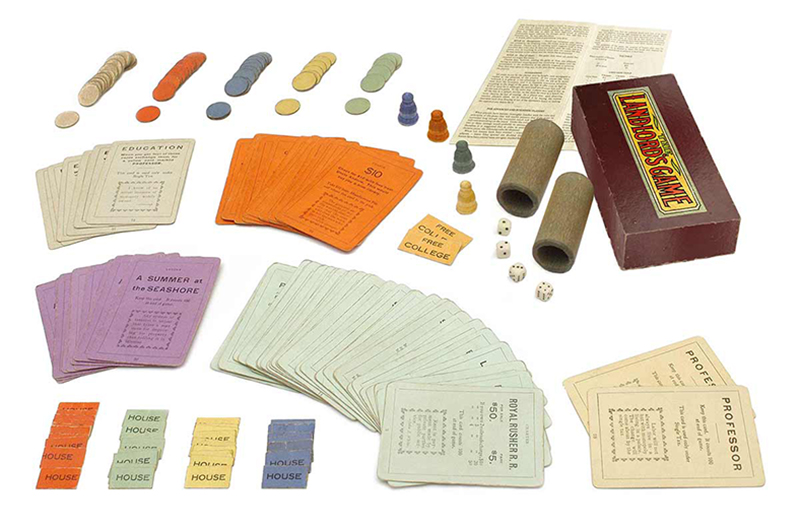
The Landlord's Game(en.wikipedia.org) |
The Landlord's Game(en.wikipedia.org) |
I can't remember one game that didn't feature (a) disputes about rules and the administration of the bank; (b) animosity and dissatisfaction upon exit; and (c) hollow emptiness for the (newly friendless)"winner".
Set a sensible exchange rate to real money and treat the Monopoly money as “chips”.
The tactics and strategy significantly change because there is real external value to the assets and currency - but only for the duration of the game.
Apart from anything else it means the game ends much faster.
Sometimes we become what we set out or destroy.
I am seeing bus stop ads here in Sydney with a tagline from a BTC exchange saying something like "If you're seeing bitcoin on a billboard, it's time to buy".
Now I'm hardly an astute investor but I thought the usual rule is that if your cabbie starts talking about it, it's time to get out of the market.
A tremendous amount of background on the Landlord's Game and Lizzie Maggie.
https://www.thegamecrafter.com/games/bay-area-regional-plann...
(via https://news.ycombinator.com/item?id=10685690, but no discussion there)
https://www.imdb.com/title/tt1250861/
I would have liked it to dwell more on the roots and the meta-level of what the game is trying to say, and how that seems to be missed by most people who play it. But was still a fun watch on a lazy weekend day.
Streaming free on Amazon Prime right now: https://watch.amazon.com/detail?gti=amzn1.dv.gti.1cad6f64-66...
Seems to be based on it. Don't know how closely it relates but it is CC-BY-NC-SA 4.0 licensed and you can just download it.
https://www.pbs.org/opb/historydetectives/investigation/earl...
That's... unfortunate.
[1]: https://commons.wikimedia.org/wiki/File:BoardGamePatentMagie...
[2]: https://smartasset.com/mortgage/price-to-rent-ratio-50-large...
>The 2018 median home value in San Francisco was $1,195,700, and the median annual rent was $22,560.//
So it's probably comparing cheap rental properties with expensive owner-occupied properties? That's likely not very useful as a statistic on it's own unless you've got the distribution of both. Better would be making a comparison of the rental price (including charges) vs TCO of ownership for directly comparable properties -- that would be a lot of work.
FWIW 10x price-to-rent isn't far off right in my area of my city in the UK. Houses prices and rental prices are high compared to wages, IMO.
https://astralcodexten.substack.com/p/your-book-review-progr...
(A bit long, but pretty comprehensive and hey, it's shorter than the actual book).
Take out "natural" and it seems like any non-inflationary cryptocurrency would be a target for a Georgist tax.
Georgism just makes so much sense because if "mother nature" (or "natural capital", if you want to sound less hippie) is not charging for the things we take from it, then we're basically stealing from it. Even if you're a hardcore capitalist, you have to agree that it's not truly capitalism if it's all based on stealing from the largest provider in the system.
https://news.ycombinator.com/item?id=16261425
A while ago (1999) I made a "Micropoly" board game about the Microsoft Monopoly, with cards for various dot-com companies (Copyleft (L) 1999 Free Monopoly Foundation), using an xml file to define the cards and board and an ugly Perl script to render them with PostScript!
http://donhopkins.com/home/Micropoly/
>Update: I've written an ugly "openopoly.pl" Perl script, and a "micropoly.xml" data file, that describes the specifics of the game. The Perl script reads in and parses the XML database, and writes out PostScript and HTML to render the graphics and web pages. It embeds EPS files with images and cartoons in the PostScript file, and then runs it all through GhostScript, to render out PDF and JPG files with the printable images of the board. It currently writes out one HTML file with links to the small and large pictures of all the property cards, and soon it will write out a web page for each property, and link them all together, as well as an image map for the entire board. Most of the logos, cartoons, and other graphics haven't been put in yet, but the basic functionality for producing the game is there. This is work in progress, but here's a preview of the automatically generated web page index of properties, the full sized board micropoly-board-whole.pdf [1,672k], the paginated board micropoly-board-split.pdf [10,028k, sorry but I'll optimize the PostScript not to draw clipped images and it will reduce in size], and the printable cards micropoly-cards.pdf [5087k], as well as the micropoly.xml file from which it was all generated.
http://donhopkins.com/home/Micropoly/micropoly.xml
http://donhopkins.com/home/Micropoly/micropoly-board-whole.p...
http://donhopkins.com/home/Micropoly/micropoly-cards.pdf
The idea (which I never finished but encourage anyone else to pick up and run with) was to develop a fully skinnable parametrizable Monopoly compatible game template (or variants like Anti-Monopoly), that you could print out and glue onto cardboard, or even play online!
http://donhopkins.com/home/Micropoly/notes.html
Monopoly is essentially the original "Open Source Game" designed by Elizabeth Magie and shared among Atlantic City Quakers. Then it was illegitimately taken over and patented by a giant corporation. Parker Brothers' story about Charles Darrow was marketing bullshit.
https://en.wikipedia.org/wiki/Lizzie_Magie
There's also an interesting story about Ralph Anspach's decade-long "Anti-Monopoly" lawsuit:
https://en.wikipedia.org/wiki/Ralph_Anspach
https://en.wikipedia.org/wiki/Anti-Monopoly
https://www.washingtoncitypaper.com/columns/straight-dope/ar...
https://en.wikipedia.org/wiki/History_of_the_board_game_Mono...
>Also in the 1970s, Professor Ralph Anspach, who had himself published a board game intended to illustrate the principles of both monopolies and trust busting, fought Parker Brothers and its then parent company, General Mills, over the copyright and trademarks of the Monopoly board game. Through the research of Anspach and others, much of the early history of the game was "rediscovered" and entered into official United States court records. Because of the lengthy court process, including appeals, the legal status of Parker Brothers' copyright and trademarks on the game was not settled until 1985. The game's name remains a registered trademark of Parker Brothers, as do its specific design elements; other elements of the game are still protected under copyright law. At the conclusion of the court case, the game's logo and graphic design elements became part of a larger Monopoly brand, licensed by Parker Brothers' parent companies onto a variety of items through the present day. Despite the "rediscovery" of the board game's early history in the 1970s and 1980s, and several books and journal articles on the subject, Hasbro (Parker Brothers' current parent company) did not acknowledge any of the game's history before Charles Darrow on its official Monopoly website as recently as June 2012. Nor did Hasbro acknowledge anyone other than Darrow in materials published or sponsored by them, at least as recently as 2009.
I'd love to see some examples of what specific laws would be implemented, what taxation would look like (in actual percentages and dollar amounts) and things like that to understand what a system could look like in action.
For real estate, at the optimum land rent, land would exchange hands at a value of roughly $0 (structures on top of the land would modify the total property value). Given the high transaction costs of land, and of changing ownership, there are other forces that shift the true land price away from $0 under a full LVT.
There would need to be exemptions or other ameliorating of the coercive effects of full-land-rent LVT for those living in a primary residence. Nobody wants to force grannies out of their homes, for example. But the coercive effect of land taxation would otherwise mean that land would be used far more productively, with more stable prices and above all more affordable prices. It would also require getting rid of density restrictions that are not based in actual health and safety (ie pretty much all of them). But even somewhat small changes in density can open up massively more land for use.
It doesn't take many homeowners to completely shut off the market for land and corner it all. Not many people watch zoning boards, and fewer pay attention to how limited land use is, and even fewer who are in power do not directly benefit by the massive bubble on land prices.
And we really do have a massive bubble on land prices due to rentierism. So any sane deflation is going to require a gradual phase-in of an LVT, with probably 2+ decades of gentle deflation of land prices. And as soon as that starts in, there are the makings of a tax revolt. In California, we have been suffering from the tax revolt of Prop 13 for 50 years, and we are barely seeing any cracks in the army of anti-tax Prop 13 supporters.
So the politics of a full LVT are extreme, especially in a land where every middle class person is supposed to own a bit of land and defend it like a castle, and often when that defense means stopping any change. A full-on LVT is meant precisely to stop land hoarding, so as long as a majority of people see that land is theirs' to hoard, it's unlikely that an LVT will be passed. Unless imposed from in high by a technocratic elite that's trying to maximize social benefit, rather than individuals looking only to maximize their sole benefit.
"The set had rules for two different games, anti-monopolist and a monopolist. The anti-monopolist rules reward all during wealth creation while the monopolist rules had the goal of forming monopolies and forcing opponents out of the game. A win in the anti-monopolist or Single Tax version (later called "Prosperity"), was when the player having the lowest monetary amount has doubled his original stake."
So a 1% land value tax would be $10,000 a year. A 3% LVT would eat up the entirety of the economic rent.
However, the yield on that property would go down from 4% per annum to 1% per annum, so the value of the land would drop.
Any politically realistic implementation would involve progressively increasing the LVT and reducing other taxes over time, so the first year might be 1% LVT, but eventually the price of the property would drop such that a 100% LVT wouldn't be unreasonable (although an 85% LVT or thereabouts is often thought to work better).
Actual percentages and dollar amounts is impossible to give in general, but the basic idea is that returns to pure ownership of land (without improvements) should approach zero. This should eliminate the risk-free speculative ownership of empty lots downtown that are just waiting to cash out on rising land prices due to improvements made by other capitalists and collected taxes.
I have to say, it's slightly funny to assume a multiplayer game that is entered by all the players with the clear and open intent to not follow the rules of the game.
it's great to be honest, the only way we played uno was with cheating (if you got caught, you lost the round tho)
it creates a lot of interesting cross round strategies; if you aren't close to victory in one round for example you can hide a good card and save it up for the round, for example. hiding a card or two would get you to uno quicker, but you'd have to play them at some later point or later ruond, and you couldn't win strictly by hiding because once uno is declared your count is fairly visible. but you can strategize and by deciding which card to drop open up more possibilities for matching your last card.
I suggest everyone should try a evening of full on cheating at a luck based game, it's super fun when everyone else is doing it too.
No, the anti-pattern is sprawl and living far from other people, impacting huge amounts of land at low density.
Look at any suburb in satellite view, and see how much area it takes to get to, say, 40 houses. Compare that to a standard apartment complex with park space. Now add in all the roads that are needed to service the suburban detached housing, which requires driving for every single trip be it kids going to school or picking up some groceries. Then all the extra insulation, building materials, roofing, needed to create housing that is still far less energy efficient to heat and cool than an apartment building.
There are two efficient living forms: 1) urban life where needs are mostly within walking distance (be it a town of 5,000 or 500,000 or 5,000,000), and 2) isolated farm life where you only go into town infrequently because it takes too long, and you're kids take the bus.
Suburban living promotes daily driving for every task. Check out this map of consumption-based carbon emissions, which roughly track with most other pollution:
https://coolclimate.berkeley.edu/maps
Georgist taxes greatly shrink those huge red belts that are in between cities and farmland.
(I do agree that would be more fun)
Monopoly being not zero sum among the players makes that...interesting. As well as transfers from losing players to the winner, there is also potential for net transfer to or from the bank. How do you handle that?
I think crypto has plenty of run left. It’s still a pain to buy. When your dentist is loading up his 401k with Bitcoin ETFs, that’s going to be the peak.
https://www.youtube.com/watch?v=sztf4hcGrB4&ab_channel=WestL...
It is said that the people are revolting!
You said it. They stink on ice!
My stripper friends first started asking me if they should buy cryptocurrencies in 2017. Had you bought btc at the $17k it was priced then, you'd have more than tripled your money in the following four years.
>If your cabbie understands BTC you might have a point. We aren't even close to there yet
The point is that the cabbie likely doesn't understand BTC. When an asset class becomes so popular that people who have no idea how it works are putting money into it and loudly campaigning for others to do the same that is a sign that you are in a bubble.
It doesn't necessarily mean that the bubble is about to pop. Some bubbles can last decades. See real estate in a variety of locations around the world as an example. However lot of dumb money (people who don't understand what they're buying) flowing into a thing because of fomo can be a predictor that prices are unsustainable.
It absolutely isn't a sign a of a bubble. There aren't many people that understand what they are investing in be it currency or Google. The success of the investment has nothing to do with the cabbies understanding. Taking his advice does.
It's really hard to spend money to catch up to the carbon emissions from fossil fuel activities like driving, heating, and flying.
[1] https://www.cnet.com/news/apple-iphone-x-environmental-repor...
P.S. See also this extensive map of carbon consumption per household that I posted in a different comment:
> "The average emissions in New York City are about 30 percent less than the U.S. average," said Dodman. "This is because the primary factors contributing to individuals' greenhouse gas emissions are their use of energy and transportation. New York City residents tend to have smaller dwellings than the average American, so their heating needs are less, and they are also more reliant on public transportation."
https://www.livescience.com/13772-city-slicker-country-bumpk...
If anything I think we should encourage rich people to give their money away (even if only to their children) since wealth consumed by a broader number of people leads to more happiness than if it's all consumed by one person. It's better for a $10 million fortune to be spent by 10 consecutive generations than for it to all be spent by the original owner.
Why should inheritance be any different?
I don't understand how you reach this conclusion. If the original owner spends all of it it enters a whole lot of more peoples pockets than his kids.
For 100% (or otherwise significant) inheritance tax, the issue is how to implement it. If you know it's happening, you'll just gift what you own to the preferred recipients before you die. If gifts are also 100% taxed, you sell your property to them (and then spring up a company and hire them to do "work", so they get the money back). If sale of property and work are 100% taxed, well, it's a very different kind of economy.
100% inheritance tax only hurts when someone dies unexpectedly. Others will be prepared with workarounds.
Where I live, both inheritance and gifts are taxed with very similar rates. Also, selling things under their market value is considered gifting (which sometimes gets interesting, for obvious reasons).
What about taking inheritance and gifts as ordinary income to the recipient? Ideally this would be coupled with a reform on capital gains tax, but even as is, should target high taxes only on large amounts or amounts given to people that are already rich.
There would certainly need to be some tweaks, but it should diminish the inherent injustice of inheritance.
You can treat all gifts a year or less before the date of death as inheritance. Many wealthy parents will be hesitant to give large amounts of money to children while in good health, as they're scared children won't care about them any more once they get their money.
Because we do not want to isolate children from their parents. A 100% inheritance tax is impossible from a practical standpoint.
>One person gets something for free,
Do you abandon your child as soon as it is born? Do you think your newborn should work and pay the bills? No, you support it for 18 years and let it grow as much as possible instead of considering your child something to be exploited for money.
> the other works and has to pay tax?
If you inherit something from someone, that person had to work and pay tax.
I can come up with good reasons for wealth taxes, I can come up with good reasons for abolishment of land ownership (replaced by a permanent lease model) or heavy taxation of land but I honestly cannot come up with any reason for inheritance taxes beyond jealousy, jealousy that other people had more fortunate parents than you and your selfish desire to drag them down. If everyone started off on an empty earth it would be fair, but it also would be equally bad for everyone, instead of bad for an unlucky minority. Being poor in the US is a blessing, being poor in India is not.
Especially when there is a fair solution to the wealth inequality problem. Simply split the wealth instead of giving it all to the first born son. If people are obscenely wealthy, let them have many children and let each of those children be less wealthy than their parents. If you must implement this with a tax, then set a maximum amount that a single person can receive through inheritance in a lifetime, say $1 billion and tax anything after that. Yes, that means Jeff Bezos will have to find 200 heirs or lose the money to the state. It would be in his best interest to reduce wealth inequality at the end of his life.
Untaxed inheritance perpetuates inequality. Inequalities are unfair and arguably damage our societies. Functioning societies aim to repair the damage by rebalancing structural inequalities. Hence inheritance tax. The children of the very wealthy aren’t being “abandoned”, they already have surpassing advantages while their parents are alive.
Centuries from now they'll probably consider what we're doing now to be absolutely barbaric and adjacent to plain old slavery.
You can argue that there are ways of taxation that are compatible with this idea and there are ways of taxation that are counterproductive but you cannot argue that the taxes shouldn't exist because that would mean no government which would mean no rule of law and no political environment in which an advanced economy can exist. Of course, the big problem is that many governments fail to live up to their responsibility. The US and EU countries' government may be failing their citizens, but not as much as many Asian, African or Latin American governments.
This ties up a lot of wealth in ways which slow down economic growth immensely.
We also modified the rules as kids. Who'd have thought the lack of houses was by design, and of it was, who could think it was a fair thing to do, cornering the market?
I certainly didn't think about the dynamics until I studied economics and read articles about how the game was designed. Only my later self, with a background in trading would recognise the rules for what they are, and the strategic possibilities.
In "Power Grid" (a power plant building game) the turn order is recalculated every round based on how well the player is doing, with the players doing worst getting more chances to bid in power plant auctions and being first to buy on the fuel market.
In "Flamme Rouge" (a cycling-themed game) a 'drafting' mechanic means the leading player has to add 'exhaustion' cards to their hand, much like riders in real races try to slipstream behind the race leaders.
In "Suburbia" (a city building game) victory points are 'population' but as you move up the population tracker, you cross red lines that reduce your income and reputation.
In 'Trans-America' (a railroad-building game) points are scored by connecting cities, and it's easy for a naive player to connect 4 cities before a lucky expert player connects 5 and ends the round. This creates the impression of a close game as the best and worst players will be within 20% of each other.
And of course, the other option is: A scoring system so baffling and opaque, nobody can work out who's in the lead until the calculators come out at the end.
Munchkin takes this to the extreme, where someone will perpetually be on the edge of winning and there are a variety of colorful ways to set them back. It's random and chaotic by design.
Monopoly doesn't really involve such a mechanic. You can refuse to trade with someone who is pulling ahead, but by that time it is more likely to be too late.
Generally, I'd say that if you have a game that regularly ends in close finishes it's likely either very random or it contains negative feedback loops.
In short, its a light wargame in which the players control the nations - but they are not the nations. They are investors who buy bonds in the nations and the player with most investments controls (governs) that nation. Controls shift during the game and war is _not_ the objective. Profiting from your nation(s) is.
Do check it out. The game is well reviewe and still critically underrated
The thing is, it's not usually such a zero-sum game as it is in Monopoly.
In better designed games, there's more opportunity cost associated when you start optimizing for something. Individual players can pursue their own, different strategies. A player who optimizes for "strategy A" might be weak to "strategy B." Getting the resources for "strategy B" might become easier, since there's less competition for them.
The trick to Monopoly is that there is no alternate strategy. Opting to (or being unable to) buy land doesn't open up some other path through which you can win - it just means you're going to lose.
Examples include: * Innovation * Wingspan * 7 Wonders * Brass: Birmingham (and the original Brass, too)
All really fun games, too.
I don't want to start a big argument, because I realize some people actually do like Monopoly as an artistic statement, but I've always felt that if a game is actually that universally misunderstood, it's not because it's brilliant -- it's because it's bad at demonstrating its core point.
One of the purposes of game design is to communicate something, whether that's an idea or an emotion or whatever. And Monopoly is a bad game at communicating. It doesn't add anything additional to anyone's understanding of Capitalism, it's only decipherable by people who already know what it's trying to say.
I have never, ever seen a child or an adult that was out-of-the-loop on Monopoly's origins walk away from the game saying "huh, that has some interesting parallels to the real world, I should read more about this."
There's also been another force "dulling" Monopoly's game design over time: most people don't learn Monopoly from the rules, they learn Monopoly from playing with others. There are a lot of viral (mimetic) multi-generation "house rules" that people learn from their families/peers/educators. There's also a couple of key clear rules that remain in the rulebook that people don't follow for a number of reasons, including essentially culturally "we forgot them".
(There's some interesting meta-commentary on Capitalism and its attempts at "fairness" band aids in the house rule dialects that have accumulated over time. There's some interesting meta-commentary on Capitalism regulations, banking, and/or dumb luck in the rules that have been "forgotten".)
In some ways, some of the almost willful cultural ignorance of the message of Monopoly is its own ironic statement on the systemic problems of Capitalism and how much people complicit in that system want to wish things fair or ignore their complicity and try to just cope with the problems and their fallout. I wouldn't necessarily call that "universally misunderstood", that's a pretty deep understanding, even if accidental. It's generally surprisingly easy to have conversations about it and "wake" people to Monopoly's origins and what it says about the game (and why they love/hate it) because even if they never thought "huh there are interesting parallels to real world Capitalism here" they can definitely see the parallels in hindsight if you want to talk about it.
For the current age I think it takes way too much patience. I think movies have changed like that too, the attention economy demands that you get to the point immediately. Heck, I can't even read articles that don't address their headline within the first three paragraphs.
No way for you to win if there’s another player who inherits a small fortune of existing properties on the board.
My memory might be inaccurate.
A common sentiment, and yet "Over 250 million sets of Monopoly have been sold since its invention and the game has been played by over half a billion people making it possibly the most popular board game in the world." [1]
Why?
[1] https://www.loc.gov/rr/business/businesshistory/December/mon...
> The set had rules for two different games, anti-monopolist and a monopolist. The anti-monopolist rules reward all during wealth creation while the monopolist rules had the goal of forming monopolies and forcing opponents out of the game.[3] A win in the anti-monopolist or Single Tax version (later called "Prosperity"), was when the player having the lowest monetary amount has doubled his original stake.
So one rules similar to modern day Monopoly. And one that teach us the virtues of "social policies". (can I say socialism here without being down voted to hell?)
And there was a clear intend to teach its players about "unfairness":
> The game was created to be a "practical demonstration of the present system of land grabbing with all its usual outcomes and consequences". She based the game on the economic principles of Georgism, a system proposed by Henry George, with the object of demonstrating how rents enrich property owners and impoverish tenants. She knew that some people could find it hard to understand why this happened and what might be done about it, and she thought that if Georgist ideas were put into the concrete form of a game, they might be easier to demonstrate. Magie also hoped that when played by children the game would provoke their natural suspicion of unfairness, and that they might carry this awareness into adulthood.
I've learned something today!
Also, I'm quite a fan of Georgism (tax bad behavior so heavy it disappears). For instance, I think we should georgize pollution and wealth hoarding.
The bottom line is, if someone wants to leave a significant inheritance to their (grand)children, there's little that can be done about it with tax policies only. By the time you have plugged all the holes to prevent inheritance, you've also prevented most of the things we consider necessary for the function of a capitalist free economy.
In market socialism the the difference from capitalism is stricter controls on business ownership (i.e. businesses must be coops or something along those lines).
I find it fascinating that the original Monopoly game was desgined to teach us the difference and how Georgism (taxing bad behavior) may be used by "the people/democracy" to ensure capitalism is not the outcome.
Also very telling that the game was thn ripped off, and got popular as Monopoly, where the only set of rules are the capitalistic ones.
The difference is that when you give money to your children, you're not getting any goods or services in exchange. The transaction is making them richer, but you poorer by the same amount.
(Also, later when the children pay a mechanic the amount of total tax paid will be the same.)
Maybe you are, maybe you aren't. What if my kid is a mechanic and does the work for me?
In chess, which doesn't have a clear comeback mechanic, this sometimes works out, since the impact of late game mistakes can vastly outperform early wins. So, comebacks are clearly and directly linked to the skill of the winning player making a mistake and the skill of the losing player being able to capitalize this mistake.
But even that direction doesn't come for free. As in such games skill is so important, inexperienced players fighting each other will have a lot of huge randomness in their outcomes and altogether the game only becomes fun once you reach a certain minimum skill level.
Last but not least, there are also alternatives to comebacks. For instance, in poker or pen&paper roleplaying games a factor of pure randomness is added. So, while on average the skilled players will have almost all the positive experiences that chess players have (they win more often, they have more clarity and control about the progress and current status mid-game), the unskilled players can sometimes make a lucky win which seems satisfying enough that some people get addicted to poker without ever gaining much skill.
As Monopoly also has a random element, I wonder if simply tuning the impact of randomness would make it more fun, allow for more lucky comebacks, etc. As a stupid example, maybe event cards could introduce property tax rates that stay until another event card alters them, or a renter being unhappy about the rental property won't pay the rent or even create costs through law-suits, required building repairs, or clean-ups.
I like games that have this feature, perhaps even more then a come-back mechanism.
In the game of go playing against a higher skilled player you usually have some portion of the board where you are doing better then expected. The higher skilled player might have actually "given" this result as a trade favorable to them, but that is usually not the perception of the lower skilled player.
In fact on a 19×19 board there are so many micro battles going on that the lower skilled player will usually get enough perceived good mini-results that it is enough to enjoy the game, despite knowing they will definitely loose in the end.
This is a very good point.
I play chess with my children a few times a year and I was subconsciously feeling that it is not that fun.
Only after watching The Queen's Gambit I realized that the fun is there, but out of reach for me.
If you trade with the winning player, they win faster. If you trade with players who are behind, it doesn't really change the outcome of the game (they will probably still be behind at the end of the game)
The only thing preventing that winning player from reaching 10 points is 2 stone and 3 wheat. So as long as no one gives the winning player those resources, the game continues.
Alternatively, the winning player can try to win on their own by massing up 20 other resources and trading 4 for 1. But everyone else can more efficiently get the resources they need by trading with each other, allowing for an innate comeback mechanic.
--------
At a minimum, that puts even the weakest players always in the position as kingmaker. So everyone has something to do at all stages of the game.
Sometimes I find all this money swirling around difficult to keep track of. It's easier to forget about money and look at what's happening to the goods and services. Ten families in $1 million houses get more happiness than one family in a $10 million house and nine homeless families. No matter how you shuffle the accounting around it has to add up to that same utility difference.
So if they go on more vacations, buy a flashy car, have more parties, you are saying that the Fed "takes that money straight back" and that it doesn't go to travel agencies, car dealers, caterers, party planners, service workers etc?
> Ten families in $1 million houses get more happiness than one family in a $10 million house and nine homeless families. No matter how you shuffle the accounting around it has to add up to that same utility difference.
Sure, and I reject your hypothetical and say it's better if 100 people live in $80k (after some tax) houses/condos than 1 in a $10M house, if we're just making things up.
They do get the money. But the world hasn't become any more productive; the number of goods and services being produced is still the same. So when they spend that money and consume goods and services, someone else must necessarily be consuming less.
Dominion is a deckbuilding game where you earn victory points by buying and keeping junk cards in your deck, so your deck gets worse as you score increases.
Suburbia reduces your income progressively as your population (score) increases (which also forces players to balance the two).
A number of games including Terra Mystica give turn order advantage to whoever passed their turn first in the previous round.
There are, of course, many more games that don't have such a mechanic, but rely on balancing the relative rewards of the various moves such that early turns are less about taking a lead and more about setting up which paths to victory you can attempt in later rounds, so the skill is in setting up a path that you're able to execute well and then executing it well.
It's very hard as a single player to beat a credit union. So the winning player will want to build some sort of alliance with at least some of the losers to make their coalition weaker, which will pull those players up the ladder and give them a chance, and so on. It creates a mostly good dynamic of cooperation for self-preservation.
In the end, one person wins, but it's often a close race.
(This works best if you play with the same crowd every time, because then people have reason to build trust with each other and won't suddenly default on a huge loan without feeling the consequences of it.)
The game seems to have earned a bad reputation, the prototype for the sort of game you shouldn't play anymore because everything from the last 25 years is better. I'm not sure this is deserved, but realistically my copy will probably end up collecting dust. After reading your comment, I hope not!
IIRC, you don’t need house rules for that, so long as “arbitrary contracts” covers future commitments for things otherwise legal to exchange (you do need house rules for such contracts to be self-enforcing, though.)
I remember playing a 3-player game of Root (which I highly recommend!) Player A ambushed me and managed to burn down my headquarters. At that point I realized I couldn't win, and I spent the rest of the game attacking A.
A complained that I was just throwing the game to B, which is exactly what happened. The kingmaker problem made A's decision into a huge blunder. If you don't pay attention to psychology in these games, you will lose.
There tend to be three kinds of kingmaking: revenge, social dynamics, and wanting to leave. All of them have something in common: they are done for reasons outside the gamespace. They're violating the boundaries of the game.
Revenge (what you did) is out-of-bounds because it's using the game to win future games rather than playing the current one.
Social dynamics and wanting to leave are out-of-bounds because they're using the game for rewards that have nothing to do with the game.
No, its not.
It is, of course, more desirable from the perspective of people who prefer that style of play that others conform to it, but it is in no way “essential”.
It may be beneficial to mutual enjoyment to have table agreement on metagame issues like this in advance (OTOH, one might do well to recognise the inherent incentive structure toward the metagame approach you decry in games which tend to produce a long, lingering defeat with no reasonable route to victory.)
I wasn't angry at my friend, and I wasn't personally seeking revenge. I was role-playing my cat army, which suddenly had its home city burned down. My cats certainly were seeking revenge.
In real life, facing an enemy who has nothing to lose can be highly dangerous, and creating such a situation is foolhardy. Why should a board game be different? Why play for second, when a more appealing alternate goal suggested itself?
More flights (its' virtue another discussion), more cars produced, more parties planned, food made, services rendered.
Of course production has gone up, and will continue when those people spend their money on their (smaller) houses etc.
And are you making your claim as a counterpoint to my scenario compared to inheritance? Because pushing money down the line to sit on it certainly does not make the world more productive.
That would only be possible if we had previously been using the labour and capital to produce those things at less than 100% efficiency. That's not what happens. Businesses will always have been trying to operate as efficiently as possible. When demand increases they either have to increase prices or increase supply. Increasing prices will mean that someone else doesn't get the good or service. Increasing supply will mean employing extra labour or capital that would otherwise have been used elsewhere. Either way, spending money doesn't cause total productivity to increase.
(Unless of course the Fed screwed up and put us in a deflationary recession. In which case, yeah, extra spending would help. But that's only if they screwed up. Normally, they have already optimised the variable you're trying to adjust. Adjusting it away from the optimum will just cause them to push it back.)
Or not used.
Throughout all of this, I don't generally disagree with your reasoning, but you're basing it all on assumptions I reject.
Georgism can be summarized as such: A person is entitled to exactly what he or she produces.
That’s the purest capitalism I’ve ever heard of. The scent of socialism you get is due to the examination that George provides of “exactly what he or she produces.”
Laborers are therefore entitled to all of their wages. Capitalists, who earn money by deploying capital (which is actually stored up labor) are entitled to all of their returns. Landlords, however, earn money by charging for access to something they did not produce - either to the “productive powers of nature” such as rivers, mines, farmable land, or to value created by the community surrounding a plot of land (such as education, cultural amenities, public transit, or private employment opportunities).
It’s really not socialist at all. It’s idealized capitalism.
Not only did they not produce it, in many places they (or the ancestors they inherited it from) actively stole it from the original inhabitants. e.g. The Inclosure Acts, Colonialism, etc.
If the moral position resonates, take it. If the economic position resonates, take it. If the political one resonates, take it. Each is very convincing by its own merits!
I'll think you'll find that Marx is pretty upset about labor not being entitled to what labor produces, as well. And while Marx is not all of socialism, I don't know anybody who says that Marxian thought is outside of socialism, and I've sought out lots of socialist thought that critiques Marx.
Most critiques of capitalism are that workers are not entitled to the fruits of their labor, that capital steals from them. So if saying that somebody is entitled to work and to keep their labor is capitalist, I'm having trouble understanding where you come from, and would like to hear more. In particular, I don't think George declares that capital is entitled to the fruits of others' labor, which is what you seem to be saying.
Georgism is about socializing land, about preventing people from hoarding it and the wealth it produces. Land is the one input to production that we can't make more of, so therefore hoarding it is by far the most harmful. It's about restoring commons, after the commons had been taken away and privatized. It's about restoring all land to some form of social control, no matter who owns it and how much that person owns. And it's about redistributing that wealth that people are unfairly taking from society when they pocket unearned land rents.
My problem with Georgism is that it tends to be politically unstable and lead to tax revolts. And my problem with the typical Marxist visions (Marx himself was not super prescriptive, but in that void, Marxist thought must expand upon Marx) is the tendency to dictators and totalitarianism, something which George also predicted.
I think George is extremely compatible with, and perhaps required for, the type of socialism that was sought in the Spanish revolution of 1936.
The fruits of labor that are not accounted for in a quid pro quo transaction with capital are those that go to land, for which there can be no quid pro quo transaction because you must occupy (and labor upon) land. If there were infinite land available, labor could simply move to that land and produce what they themselves can produce from nature with no gains going to capital because they need not employ capital to survive. If there were infinite land available, the only people who would choose to employ capital (or be employed by a capitalist, same thing) are those who believe the bigger pie is worth the smaller slice.
However we do not live in a world of infinite land, and so that calculus happens^ but it is coerced by the necessity to live and work on land owned by neither labor nor capital. Given that capitalists don't work directly on land and are generally "more efficient" (this is why capital is valuable, aka this efficiency is what capital is), the world becomes separated into those above the "rent line" and those below the "rent line," and there are far more capitalists above than below and far more laborers below than above. This creates tension between labor and capital, but neither of them are getting what they produce, but that's not because capital is stealing from labor - rather land is stealing from both, just capital has greater capacity to be stolen from before descending into poverty.
In any case:
* Not every point of an ideology is mutually exclusive of every point of every competitive ideology.
* Georgism is not about socializing land nor centralizing control. It is explicitly not about that. It is about socializing the gains on land produced by external factors (nearby public and private investment, technological improvements, etc)
* You mention Georgism tends to be politically unstable. Could you point to some historical examples you have in mind?
Economically the USSR had capital too, but it was mostly owned collectively (by the state).
Hence I define the two in terms of the people that actually own stuff.
it wasn't communist (defined as: no money, no classes, no state). it was commi thoug
> When I was thus swept into the Great Socialist revival of 1883, I found that five-sixths of those who were swept in with me had been converted by Henry George. This fact would have been more widely acknowledged had it not been that it was not possible for us to stop where Henry George had stopped. America, in spite of all its horrors of rampant Capitalism and industrial oppression, was, nevertheless, still a place for the individualist and the hustler. Every American who came over to London was amazed at the apathy, the cynical acceptance of poverty and servitude as inevitable, the cunning shuffling along with as little work as possible, that seemed to the visitor to explain our poverty, and moved him to say, "Serve us right!" If he had no money, he joyfully started hustling himself, and was only slowly starved and skinned into realizing that the net had been drawn close in England, the opportunities so exhaustively monopolized, the crowd so dense, that his hustling was only a means of sweating himself for the benefit of the owners of England, and that the English workman, with his wonderfully cultivated art of sparing "himself and extracting a bit of ransom here and a bit of charity there, had the true science of the situation. Henry George had no idea of this. He saw only the monstrous absurdity of the private appropriation of rent; and he believed that if you took that burden off the poor man's back, he could help himself out as easily as a pioneer on a pre-empted clearing. But the moment he took an Englishman to that point, the Englishman saw at once that the remedy was not so simple as that, and that the argument carried us much further, even to the point of total industrial reconstruction. Thus, George actually felt bound to attack the Socialism he himself had created; and the moment the antagonism was declared, and to be a Henry Georgite meant to be an anti-Socialist, some of the Socialists whom he had converted became ashamed of their origin, and concealed it; while others, including myself, had to fight hard against the Single Tax propaganda.
https://progressingamerica.blogspot.com/2017/03/george-berna...
My view of Georgism is not about a "single tax," but rather that land rents must be socialized, and in doing so, this will end up socializing land itself. Modern day Georgists (there are dozens!) are active in creating things like community land trusts. The idea really is to socialize land, the tax movement was just the policy instrument of the time. It's still a good policy instrument, I believe, towards ending private land ownership, and may do all of it.
It's politically unstable, because once you make landlords of all your people, unless they have the insight and the shared politics of needing to socialize land, you get tax revolts. Seeing massive tax increases, without seeing your imputed rent, turns the proletariat into the bourgeois. It's how California ended up with Prop 13. And landlord brain sets in quickly even for homeowners without properties they rent. Which is not to say that it couldn't potentially be politically stable, it's just that if the socialist movement of the 1800s didn't do it, it's going to probably be far harder now, when people are far more ignorant of the economic forces, and more focused on short term material gains (which absolutely must be made too).