This is Netanyahu's legacy, a proto dictator, arming dictators.
I'm convince pegasus was used against Israeli journalists, opposition leaders and law enforcement officials. Too bad our political system is still under his thumb and doesn't shed light on this crap even now that he's no longer PM.
> This is Netanyahu's legacy, a proto dictator, arming dictators.
Isn't the U.S selling arms to Saudi Arabia?
Not just in the region. In the 1970s, Israel worked with apartheid South Africa to develop nuclear weapons. South Africa has subsequently been disarmed, but Israel has not been.
Incidentally, in 1963 JFK was trying to stop Israel's nuclear weapons program because American intelligence had failed to turn up any evidence that other countries in the region were pursuing the same. In a letter to Ben-Gurion, JFK wrote:
> "I can well appreciate your concern for developments in the UAR. But I see no present or imminent nuclear threat to Israel from there. I am assured that our intelligence on this question is good and that the Egyptians do not presently have any installation comparable to Dimona, nor any facilities potentially capable of nuclear weapons production. But, of course, if you have information that would support a contrary conclusion, I should like to receive it from you through Ambassador Barbour. We have the capacity to check it."
Egypt never developed nuclear weapons.
> Isn't the U.S selling arms to Saudi Arabia?
How's that relevant? If you're fishing for hypocrisy, be assured I dislike the US take on democracy and it's leaders of late no less than Netanyahu.
But At least the US has a constitution, checks and balances. And a tradition of freedom and democracy. Israel has a growing population, the parts that grow are mostly lacking any sense of democratic values or tradition. Guess which electorate Netanyahu spurned and which he focused his Messiyah propaganda on.
It's easy to see that it's in my interest to kill a woman on an unlit street and nick her purse. What kind of argument is this??
It's especially aggravating since so much propaganda comes out touting Israel as a democracy and decrying the savage Palestinians for being a dictatorship.
The US and UK sell arms to all of these countries. That's not a good sign; the US even directly subsidizes the military and police of some of them. We like dictatorships that make our political donors money.
Lebanon used to be more democratic; Iran was democratic at one point. What happened to Mossadegh?
There is no need of official government approval to conduct such surveillance. It's enough to have weak access contol to such technologies, political roles within the agencies, and poor work ethics in civil servants: there alway will be someone with will and motive to act in favor of the system, off the record. Orban deliberately shaped the government this way.
FWIW I just see them use the money of others for their own purposes coactively and provoke a lot of polarization. Many times with bad intention for selfish interests. I am talking about ALL of them.
I think people should be able (Hungarian case at hand) to choose whether they want certain contents to be taught at certain age for their kids. No matter which ones. It should be a free to choose thing.
The minimum stuff we must all agree upon should be not killing, discriminating, etc. in legal terms. But when you try to force people to like or dislike something, instead of respecting others (whether they like or not other people ideas) then you have this highly polarized environment because you will always find the other half resisting, since it is imposed contents highly ideological.
I think that things could be way better with fewer of these people.
It's not a single "Apple music exploit", it's dozens of separate services. Music, messenger, safari, iOS, etc...
I never want to hear Apple cares about security again.
I could forgive 1 mistake, but this seems like negligence. (Don't put me down as a defender of MS or Android, but at least they don't use "Security" in their marketing)
From paragraph 10:
Much of the targeting outlined in this report involves Pegasus attacks targeting iOS devices. It is important to note that this does not necessarily reflect the relative security of iOS devices compared to Android devices, or other operating systems and phone manufacturers. In Amnesty International’s experience there are significantly more forensic traces accessible to investigators on Apple iOS devices than on stock Android devices, therefore our methodology is focused on the former. As a result, most recent cases of confirmed Pegasus infections have involved iPhones.https://telex.hu/english/2021/04/22/hungary-china-fudan-univ...
This (and the events of January 6th) are a good reminder that the law is worth the paper it's printed on if no one acts on it.
This is some kind of code injection attack that can go through a text message?
https://www.amnesty.org/en/latest/research/2021/07/forensic-...
The rest of it sounds like a Metasploit-esque framework along with some telemetry tools.
Nationalism is an ancient mentality, get rid of it and start moving into larger groups who can do more.
I keep reading about the North American Alliance in sci fi books, how long until the usa, canada and mexico combine to create a bigger economic block?
And what was the hand of the Israeli government in the deal-making? For instance, reports state that the spying in India began right after the India’s PM met with Netanyahu in 2017 [1] So was NSO actively backed by the government?
Sigh. So many questions.
[1] https://www.theguardian.com/news/2021/jul/19/key-modi-rival-...
There's literally no winning here. You can literally disconnect from the internet and they'll just target the people around you…
Isn't Android and iOS supposed to investigate what's the security vulnerability that allows the remote hacking through SMS and patch it?
Vulnerabilities, eh - 'flaws'?
Or backdoors there by design?
What's in a name?
There is a point where politics depend on good intent. It does not matter if it is the EU, USA or China. If there is a part of the population that is radicalized and hate rhetoric is used that will destabilize any society.
The main defense against this situation is that it does not work to improve citizens lives. It only benefits a small part of society and it will make the rest suffer. Hate calls for win-lose deals and an unproductive zero sum mentality. Hungarian business will suffer, and Hungarian workers will suffer. That is not sustainable long term.
EU can be improved, but if millions of citizens support a far-right government there is little to be done. Orbán is a problem, but that people follows him is another one. It will only make Hungary poorer and the EU poorer and more dangerous.
I'm going to point at this as an example of a very traditional, very political example unproductive thinking. One of the lessons people refuse to see in politics is that the people who vote for things they don't like might, potentially, be upset about something. There is a lack of reflection on how rational people might have ended up here.
I know nothing about Hungary. But I am quite confident that a happy, well organised society labouring under the grip of sound economic policies tends not to radicalise very easily. People get radicalised when it becomes obvious that politics as usual is not going to work out well for them. There are cases where the cause is lost and there is an intransigent radical group. Usually there is a long lead up to that of a group who is systemically not having their needs met.
It is totally correct that hate leads to win-lose deals. That seems like a very reasonable option to people if the alternative loving approach is a win-lose deal but with the winners and losers reversed.
All the other shit he does, they deem less important. It's ridiculous.
Hungary should go out of the EU or be forced out. The lack of obeying rules and abusing subsidies for own gain should be enough reason. Hungarians should outweigh pro's and cons, it's already a decade...
This pattern is attenuated when there's a reliable external source of energy. Hungary is not a closed system that will decay into entropy. It has regular funding from the EU which allows the disequilibrium to continue.
Oversimplified view. There was common interest of V4 against accepting refugees, but Czech & Slovak rep. generally support EU's side in judicial and media independence issues.
Elsewhere, German automakers have vast investments in the eastern EU and they have been holding Merkel back against Orban, together with conservative faction of CDU.
In Czechia, I wish that was true, but our current prime minister Andrej Babis is actually openly admiring Orban, and playing up the same nationalistic politics (before the upcoming elections in October). I am not sure he would necessarily support media and judicial independence if it came down to that.
Between this, Nord Stream 2, etc, Germany's commercial elite are having more and more to answer for...
Afaik Orban's party has won the last rounds of elections pretty conclusively, with no fraud allegations involved (unlike what currently happens in the US, I'm talking about election fraud allegations). What's with this "Belorussian-style regime" nonsense?
Since then they have taken even more control of the media, diverted the majority of EU and state funds to loyal businessmen (a regular gas-fitter became the wealthiest man in the country in a few short years, believed to be the straw man of Orban himself), filled all major positions with their own people (including most recently the high court), created laws directly against the civil society and LMBTQ+ people, stopped most of the funding to towns that have elected politicians from the opposition, taken control of all universities and actively worked on getting rid of CEU (one of the best, independent university, which was criticised due to being funded by George Soros), signed secret business deals for enormous amounts of money with Chinese and Russian interests that will almost certainly never be beneficial for Hungary, etc.
The comparison to Belarus is not correct in the sense that in Hungary violence has not been used (fortunately), but apart from that the governing party has done everything else they can to keep their power and crush everyone else.
"Belorussian-style regime", to name a few:
- control of state media packed with non-stop propaganda
- openly friendly towards dictators / other regimes
- suppressive, openly anti-liberal laws
You are partially right: they won the elections conclusively. However, their supermajority was due to fraud. I am not even sure whether that can even be called "allegations" at this point, it's more like "everyone knew on election night already but what could you do".
I think the best description of the events in English can be found at https://www.unhackdemocracy.eu/en/investigation Summary:
> Unhack Democracy’s year-long investigation into the April 2018 Hungarian Parliamentary elections indicates Prime Minister Viktor Orbán secured his one-seat supermajority thanks to a combination of outright fraud, gerrymandering and by engineering the electoral system.
> Our findings reveal extensive polling station irregularities including forged voter logs and intimidation of ballot counters; a suspicious ticket splitting rate twice as likely in areas where there we no opposition delegates; electoral clientelism involving large-scale vote buying and intimidation of voters, the unlawful transportation of voters from Ukraine, Romania and Serbia; missing absentee ballots; and a mysterious failure of national election software.
And the full version goes into "fake" parties and more.
https://en.wikipedia.org/wiki/Elections_in_Hungary#The_votin...
“Belorussian style regime” I assume is in reference to freedom of press/expression/artists/minorities etc in the country.
AFAIK Lukashenko also has some no-fraud elections under his belt. You don't need an election fraud to go from a democracy to a dictatorship.
Now all the major opposition parties have united into a single electoral slate for the next election. Primary elections are being held for the first time to determine the compositions of the electoral slate. One minor problem is that the coalition would be very incongruous. But hey, still gonna vote for them (personal opinion).
But while it is not a dictatorship, it is, as Orbán himself puts it, an "illiberal democracy". And the government's attitudes and laws create a ton of problems. And that's not even getting into the corruption and so on...
- The election system has been changed in a way that overcompensates the winner. Fidesz is supported by about 50% of the voting population, yet it has a 2/3-s supermajority which enables them to pass any law they wish without any resistance.
- Fidesz has built up a MASSIVE database of the voting population over the years, basically they can tell the voting preferences for each home address. There is video evidence of this, I am not talking out of my ass.
- Based on this database large scale gerrymandering took place in the past years.
- The governing body overseeing the elections is run by long standing Fidesz cadres. Many polling districts especially in rural areas only had Fidesz-affiliated polling-clerks during the last election.
- Thousands if not tens of thousands of Ukrainian citizens (many of whom have Hungarian ancestry, but many do not) have been registered in the Eastern part of the country with voting rights. They are eligible for pensions multiple times the amount they would receive from the Ukrainian government because of an old agreement made bw the Soviet Union and Hungary. In exchange they are voting for Fidesz. Again, this may sound like bullshit, but it is a documented fact.
- Small cities are told that they won't get any EU funding from the government if they elect a non-Fidesz mayor.
- There is a massive amount of very poor people dependent on government distributed "public work" in the countryside. It's basically modern day servitude. These people are also often threatened that if they vote the "wrong way" they will not get work.
- Most of the relevant news outlets (TV, Radio, Newspapers, online media) are owned by Fidesz-frienly businesspeople and they are in 24-7 propaganda mode. I am talking about 1950-s style Stalinist propaganda, not some kind of "pro-government bias". There have been by now basically one TV station and a handful of small websites left that are not controlled by Fidesz.
- And add to that that any opposition leader, any journalist critical towards Fidesz or any businessman who is not part of their circles can be monitored by these spy softwares and then you will understand what the term "hybrid regime" stands for.
Yes there are elections every four years, but they are just for show.
Orbán has integrated Hungarian industry deep into German supply chains and milks this fact as much as he can.
The EU just doesn't have a political culture where Hungarian press freedom is "our problem." It's more of a "very unfortunate, next" kind of issue. No more of an EU concern than Uzbek press freedom.
This doesn't compute. I agree. The EU clearly is a very political union. But that's how it is. Press freedoms, human rights or minority freedoms outside of the EU are more likely to become politically hot than inside it.
Maybe this will change over time, but the EU has a weird trajectory. I have no idea where it's going. For the most part, "culture war" issues don't seem to have a grasp on it... as they do on most polities.
You also have to remember that the EU is an union of sovereign countries. Plenty can be done by EU members where the EU is powerless. History shows that messing with France and Germany can be costly.
EU offers a lot to the Hungarian people in terms of travel, freedom of business, employment etc. In 10 years Orban likely will be gone. In the long run the liberal values of Europe will prevail.
And that's basically only the tip of the fuckberg that will be future migrations.
Helpless and hypocritical. If Orban rolls out surveillance he is a dictator. If UK or Germany do it, it's the noble fight against terrorists, pedophiles and kids downloading moviez from the internet.
I'm not sure if I would've liked en EU with stricter punitive measures over its member states before all this, but it's clear that the measures to prevent situations like these have all failed.
Poland has nothing to do with Orban and wants nothing to do with Orban. Unfortunately we have our own populists that like Orban wants to remodel our country to be easier for them to rule as they please. And results are similar as with Orban in Hungary and threats to that from EU are the same so cooperation against EU safeguards is kind of natural and spontaneous.
It is easy to blame some entity everyone knows exits, but at the same time, that entity is more like a group which doesn't fight back against it. Even if they fight back and criticize the government here and there, the latter own the media and that becomes a non-story.
Right wing governments always need a boogeyman to rally against. Today it is EU, LGBT+ groups, Roma etc. Tomorrow it might be you and me.
And you can look at it in a very different light if you see it as Hungary becoming a small vassal state of Germany (an autocracy helps it to stay that way, and German manufacturers want the situation to remain like this) rather than a "rogue fascist" state. Just follow the money.
If you look at things this way you expect to see a war of sphere of influence of big countries in the near future. I think the Balkans will be the next soft battlefield between German and Italian influence.
EU needs our country just to be minimally stable. Stable enough so millions of foreigners can come to their villas each summer, and as poor as possible so their money is worth more here. Whatever happens outside summer, that's not their problem. That includes tolerating far right politics, Christian fundamentalists and other lobbying groups, super corrupt politicians (better to say whole governments), huge government incurred debt, no freedom of the press or speech, and pretty much non-existing economy.
I'm sorry to say, but I'm sure that trouble is coming to this part of EU, maybe not in couple of years, but eventually surely will. The seeds of radicalization, corruption and all that nasty "us vs them" mentality were planted 20 years ago already. Only now they are starting to bear fruits.
Meanwhile, european people's appetite for "international" politics is been mostly satisfied with world politics... especially US politics, which was good and saucy for the last few years. The most animating issues of recent years have been: Trump, BLM related US politics, Israel-Palestine conflicts & climate change. Most of what happens in EU parliament attracts very little interest in the greater citizenship-journalism-politics sphere. National politics is, by far, still the main political sphere.
European politics rarely becomes primary news/politics "stories." That applies to both Hungary, within the Union and Belarus, an immediate neighbor. It also applies to Ukraine and the Russia-Ukraine conflict, which was largely about EU affiliation.
Notable exceptions are Brexit, peek refugee migration and the Greek/Euro crisis... 12 years ago. The ironic exception to "EU politics doesn't exist" is the nationalist, eu-skeptical camp which has been developing an EU-wide audience.
In any case, IDK if "helpless" is the right word. It's more like "uninterested." Hungarian freedom of the press and such just aren't on anyone's agenda. The fact that they're EU doesn't really mean much.
Do not get me wrong. I like the idea of EU. I see its benefits, but the idea ignores lessons of creating new federations. Apart from everything else, I doubt EU would be willing to do the same things US did to maintain its grip.
I think you meant war.
I think the EU is unwilling to make even non-bloody sacrifices, like the US did in the beginning at the Connecticut Compromise (1787). Basically as early as 11 years after the independence, the large US states relinquished a lot of power to the smaller states. With that compromise they gave 2 senators to each state, no matter how big or small it was.
I really don't see Germany relinquishing that much power, or France for that matter.
Also the EU cannot function like the US without the absolutely massive transfer of cash from rich to poor states.
A poor state in the US receives as much as 10k per person NET from the federal government https://worldpopulationreview.com/state-rankings/federal-aid... Imagine giving out 200 billions to Romania alone every year... At best we get 10 billions a year, but only for a limited time. In the previous budget we got like 3-5 billions a year. For those funds, the richer countries expect a lot of obedience in return, always dangling the threat of cutting the funds if we "don't behave".
Countries can only be kicked out of the EU with unanimity of all states except the one being kicked out. But Poland and Hungary have a pact to support each other, so that can't happen. I suspect though that if Hungary and Poland pissed off the EU in a big way, the other states would all leave and simultaneously form a new EU2021.
Can you give me some examples of the EU doing this?
My understanding is that nothing has happened on migration because there is no agreement.
Is Hungary a rogue state?
this is not going to last forever, its already diminished a lot since 2015
States that wear lots of lipstick? It's a word often mis-spelt.
Because outside of your bubble nobody wants this. A random person from Bulgaria is going to have a very different culture from a random person from Netherlands. What do you think happens with power in such conglomerate ?
If you want to see what happens when you create a forced conglomerate of different nations (but still more similar than EU member, languages were way closer and cultures were close as well) into a super state look up Yugoslavia.
And somehow me, a person from Denmark, has more cultural overlap with a hacker hipster from Mexico than most of my childhood classmates. And somehow I still coexist peacefully with my neighbors.
The internet and global travel are breaking down the national cultural barriers (largely induced/imposed by mass media). Meanwhile, power imbalance and widening gaps in the social fabric are increasing issues globally, even in monocultures and regardless of immigrants.
I think the points you raise are orthogonal. Except that you're most likely right that most people don't want this - because the illusion of the shared nation-culture and history has been so deeply imprinted in us by propaganda from the education system, the government, advertising, and media.
EU is made of countries and having countries merged does not mean that cultures has to be, actually hundrends of cultures and subcultures live together with other cultures in present countries, even as parts of nations, even inside cultures (subcultures).
It is a basic human need and necessity to collaborate, everybody wants and needs that!! (except those living in a lone grumpy bubble) Those not doing it are not really viable: see Yugoslavia. : )
The EU - and in fact many many countries with hudreds of years of success - is made of and founded by former arch enemies btw....
People need to think beyond these tribes and up it a level. A random person from Bulgaria is very similar to a random person from Netherlands. I welcome the day that our tribe is Earth...
This is just dismissively asserrting your opinion as if it were fact. Where are your statistics on this?
People group together with others that share certain cultural values. Ever since borders, passports and standard languages have been the norm, this has only been reinforced.
I don't feel culturally similar to many other European countries, most notable Hungary, Poland and some other countries that have been sliding towards the far right. I wouldn't want the people who voted Orban into power to outvote me, either.
Grand unification of humanity is a good ideal, one we should work towards, but it's not something that will be possible within our lifetimes. There are very practical reasons against the North American Alliance; for example, Canada has socialised healthcare, while you can't even get the suggestion off the ground in the US. Such political differences don't just disappear.
I don't want a European superstate because I disagree with most people that would live in it. My ideals would no longer be represented by my government. I think that's enough reason not to go for complete European unification. Opinions can change, so maybe some day we can all agree, but with Hungary fighting the free press and its people cheering Orban on, I can't say I expect this situation to change any time soon.
Maybe, but what "tribe" are you part of is completely fluid. Your tribe can be extremely inclusive or exclusive.
> Grand unification of humanity is a good ideal, one we should work towards, but it's not something that will be possible within our lifetimes.
And it is quite of inevitable as communication and travel becomes cheaper.
> I don't want a European superstate because I disagree with most people that would live in it. My ideals would no longer be represented by my government. I think that's enough reason not to go for complete European unification.
That is easily an argument against any form of government. No country would exist this way for good or bad. But they exists. As you said, bigger communities are a matter of time. What it would have been an impossible union 100 years ago it makes a lot of sense today.
This is "appeal to nature" nonsense. Tribalism, just like every other social behavior, can be learned and unlearned.
Imagine if someone was getting tribal along odd VS even apartment number or floor number. It would be seen as ridiculous just because it's not in line with the social construct indicating what to be tribal about.
> People group together with others that share certain cultural values.
By this logic, relocating across countries should be made illegal to prevent diluting culture. This would be ultranationalism.
> I don't feel culturally similar to many other European countries
Societies are not countries and are not people. We can be feel very disconnected from some societal values and yet find similar minded individuals in it.
> Grand unification of humanity is a good ideal, one we should work towards, but it's not something that will be possible within our lifetimes.
Citation needed. Humanity has never seen the level of culture and information sharing that is happening now.
For the first time in history some 15 years old girl in Vietnam can watch at a viral meme put on social media by an equally young boy from Canada. Practically for free and with no effort.
> Such political differences don't just disappear.
History shows otherwise. Big, unexpected grass-root social changes happen. Especially under the pressure from climate collapse and so on.
By nature or not by nature — they are in fact very tribal.
But I see this as an argument for the United States of Europe. Let's give tribalism to the people in the USE. Big _cultural_ autonomy for all the regions! The government should fund all the locals' funny dances, clothes, and rituals.
Having regional culture makes the average tribalist more happy than having nation wide culture, I believe.
Re: your comment, it's not only on nation level. People have tendency to form groups and build their identity on "us vs them" basis. That's why you have rivalries between football clubs from different cities etc.
Anyway, language and culture/history is a powerful thing that people can't get over in us-vs-them thinking. There's also business in play which collides with politics a lot. For example Germany are fine doing business with Russia, while for Poland, Lithuania and other Russia-bordering countries, RU is #1 evil and existential threat.
Because when the going gets really tough that abstract "human being" from across the Continent won't care at all about you, while at the same time the person geographically closer to you and who might belong to the same nation might prove to be a better ally. Just think of the Greece crisis of 2012 when the "human beings" from The Netherlands were generally just assholes to their fellow human beings who happened to live in Athens or in Thessaloniki.
Or think of the Greece crisis of 2012 when the “human beings” from Greece were generally just assholes to their fellow human beings who happened to live in Slovenia, Munich or Denmark. Note that the Greek crisis included a transfer from poorer Slovenia to the richer Greece. Note that Greeks as a nation has a high savings - the money has been within Greece jurisdiction all along. Note that Greece has a high corruption rate.
While the first statement stands, the use of Greek crisis of 2012 signifies the authority different jurisdictions have in aiming for effective administration.
First, money. Some parts of the EU are way richer than others, with superior welfare systems. If every EU citizen is to be truly equal, then that would mean same standards of government services and welfare everywhere, which would be costly to the richer states. Of course, alternatively we could lower standards everywhere, but that's not good for people.
Then there's cultural, economic, geolocial differences in general, higher corruption in many members states of east/south... Plenty of things to consider. Leaders in some parts of the EU really won't understand the situation in other parts, which makes any kind of centralized government problematic. Perhaps a very decentralized model could work though, but then again that's not much different from what we have now.
Also, nationalism is hardly "an ancient mentality". Healthy nationalism, a common idea and identity is something pretty much all well-functioning countries have. United States of Europe would never work without a common European identity, and controlled outer borders. Cultural differences between different parts of the world are still way too large for anything like democratic one world government to work.
In some sense, maybe... The foundations are ancient. But...
The "world order" where the globe is divided into nation states is quite new. Before that, multinational empires were the dominant mode. We tend to think of west european empires as the canonical: french, british and spanish. These empires had clear "home countries," so the dynamic was "nation ruling other nations."
Other empires were more ambiguous. EG the Austro Hungarian Empire & the Ottoman empires. They had capitals, centres of power and such. But, geographic and ethnic national boundaries were much fuzzier within these empires.
The border changes, forced migrations and ethnic cleansing that created the modern nation state world happened mostly within the last 100 years. Take Warsaw, for example. Before WW2, ethnic Poles were about 50% of the population. Jews & Germans were the next biggest groups. This was typical of european cities. After the war, Warsaw and Poland within its new borders was/is >90% Polish. Also typical. Meanwhile, countries like Yugoslavia, Czechoslovakia, Northern Ireland & Belgium that didn't fit into the "nation state" template were pretty unstable.
The USSR's dissolution pretty much cemented a world order where nation states dominate. That's recent.
What you are advocating for is, by some definition, the establishment of an EU Empire. Maybe a democratic empire is possible, but we don't really have example to draw on.
Nationalism is a very recent affair, the idea that people and not just the nobility have nations is a 19 century concept.
Is that right? Sounds like the opposite to me. The English King, German Kaiser and Russian Tsar during WWI were cousins.
https://www.history.co.uk/articles/the-kaiser-the-tsar-and-k...
Not just nationalism, but tribalism.
That's why the US has such an appalling record of bias. Each new wave of immigrants (not to mention the ones that were here, to start with, and those that were dragged over, against their will) has been met with torrents of hatred, abuse, and state-sanctioned terror. In most cases, it had little to do with skin color, and everything to do with cultural differences.
When I lived in Africa, I saw tribalism writ large. It gets bad. If we think it's only in the developing world, then we simply need to look at what happened to Yugoslavia, after Tito died.
I think that tribalism is in our DNA, and it takes a real, concerted, conscious, effort to fight it. That's hard, humbling, work, and most folks aren't up for it.
Externally-imposed structure (Tito) works, but it's a temporary band-aid.
Belonging to a trading bloc doesnt make you actually care about the other group.
Also, replacing "French" nationality with "EU nationality" doesnt get rid of nationalism it just scopes it at a larger level. There exist "EU nationalists" and to be honest, I find them as annoying as any other kind of nationalist.
EU nationalism is actually stronger than local nationalism in many circles - I rarely see comments defending any nation state here (except the Swiss, cough, cough, mostly kidding) but any criticism of the EU is met with zealotry.
More pragmatically, the EU makes little sense as anything but an economic block.
The notion that Germans and Greeks are going to accept real transfer payments, common taxation, common fiscal policy and similar rights to healthcare quality is basically ... bonkers. Germany would be the first to split.
I can think of a few reasons.
- It would erase culture, a slow process already ongoing. National identity, regional culture, etc would all go. - You'd have to reconcile the differences in rules, culture and law. Take drugs; the Netherlands is liberal with soft drugs, Portugal is more liberal with hard drugs, other countries still put you in jail for having any of those. Which one will it be? Who will pick what option? - Wealth disparity. Euro-skeptics have long complained about how much money the wealthy countries pay to Europe, and how much is funneled to the poorer countries. Make it one nation and every city, every farm, every individual will instantly demand to receive and be paid the same amount. Same complexities with health care / insurance, government stipends, benefits, taxes, etc.
Just abolishing nations is infeasible. Europe as it is is slowly turning its members into a more uniformized whole, but it can't be an overnight thing. And we have made some really big steps towards erasing borders; see the Schengen accord, removing border posts and customs between member states. See the Euro, removing barriers for moving money from one country to the next. And see the UK, who decided that was not to their benefit and removed themselves from the EU again.
Abolishing nations is totally feasible, what it is replaced with is just democracy on a local to global level.
It will take time but I have high hopes it will get there.
With the borders opened, it's very similar to what you describe. It just takes lots of time and stability which Orban and friends undermines all the time. That's why we can't have nice things.
Don't underestimate the power of cultural diversity, it's not like the US where everybody speaks English and you can fit in quite easily if you move a state or two.
In all seriousness, the issue is trust. And I have no idea how we could possibly get there as a human kind.
It might take a hundred or a thousand years, but that is where I'd like to see us go. And, it seems like that is where we are going given the global nature of business. Do you think people working at FB or Google who are working with people in 15+ countries don't realize how similar we all are? And, that this entire concept of nations is largely a farce?
I think emphasizing differences at the expense of commonalities is a huge mistake, just as much as disregarding those differences. Diversity in unity and unity in diversity, always a difficult balancing act.
An important part is the strong resistance to migrants, which would mean a great influx of mainly Arabs with an incompatible culture and religion compared to Europe.
Look to Sweden to see how it goes when you allow too many migrants into a European country.
On the other hand there are many serious problems with Orbáns rule, e.g. trying to control the free press, not respecting the rights of LGBT.
But to many hungarians it is better to have a controlled migration than all the listed downsides.
Many people in the west saw and see the eastern Europeans just as the eastern Europeans see the "Arabs".
I'd honestly rather see my tax money spent on helping a refugee from Africa than see it funneled to corrupt Orban in Hungary.
I don't think language differences are a problem. There are a couple of nations with multiple official languages.
But if you abolish these local governments as well, then you're basically imposing central diktats on a population, correct?
How do you resolve the dichotomy?
The "no-borders" people are as out of touch with reality as Orban, though in different extremes.
Whenever we will be able to colonize landmasses like the Moon or Mars, it would be possible that these kind of artificial communities could flurish. Colonisation will most likely be done by market-driven corporations, which could allege with these communities based on donations/taxation.
We are resilient and these current conflicts are merely the by product of growth, learning, and building a stronger community and culture.
Nationalism is the only rational mentality for long term sustainability.
A people should never be ruled by those who have no blood in the soil or by those who don't serve the needs of that people.
Nationalism is what makes great nations. You can forget about that for a while and play the game of the inevitable failure of multiculturalism, but it will always fail, you will always destroy society, and from the ashes, a cohesive, homogeneous people will reemerge to build back from the ashes of your stupidity as has always been done
In what way? It might change the cultural landscape but that happens all the time, even the most nationalistic state does not have the exact same culture it did 100 years ago. Old culture will go away to make place for a new one, or rather, culture is always evolving.
> You can forget about that for a while and play the game of the inevitable failure of multiculturalism, but it will always fail, you will always destroy society, and from the ashes, a cohesive, homogeneous people will reemerge to build back from the ashes of your stupidity as has always been done
Do you have any examples?
Globalism is one of the best things to happen to our planet. I look forward to the next 1,000 years and hopefully reaching a point where everyone realizes we have a responsibility to every other person on this planet, as well as the planet itself. And, that a base level of respect and acceptance should be granted to every person on this planet. Nationalism is an interesting step on which we climbed. But, it is an arbitrary marker to divide people and I look forward to history washing it away in xxx years.
I do not think people should be ruled, I think people should rule themselves through some form of democracy.
Are you advocating something other than democracy?
https://www.euractiv.com/section/politics/short_news/europea...
However, after Googling for an online source, I came across this article about another ultimatum for justice reform in 2017, and things only got worse after that :-/
Hopefully the UN gets enough funding to occupy the roles of state and municipal police soon. Then we can free the common man from the tyranny of local government.
Where do they get that right? By treaty?
Or perhaps the European Court of Justice simply 'ruled' that it's laws were 'supreme' in a bizarre act of defining it's own jurisdiction outside of treaty agreements?
Europeans never agreed to give the ECJ supremacy. The ECJ just 'took' that power.
It's a baffling bit of legal history [1][2] and it demonstrates just how powerful these institutions can become outside of democratic norms.
A quote: "The principle was derived from an interpretation of the European Court of Justice, which ruled that European law has priority over any contravening national law, including the constitution of a member state itself. The majority of national courts have generally recognized and accepted this principle, except for the part where European law outranks a member state's constitution. As a result, national courts have also reversed the right to review the conformity of EU law with national constitutional law."
Because of this and the resulting vaguery, it's still not always perfectly clear which 'court' is supreme in exactly what ways.
The Germans resolve that EU laws cannot contradict their Basic Law - to be determined by their own Supreme Court, which is kind of a backwards way of saying 'our national courts still have supremacy'.
It would be pretty interesting to see Poland take on the ECJ in this case, because it might cause an EU level constitutional crisis as they'd probably challenge the legitimacy of the 'Supremacy' ruling from 1964 that set the precedent.
It's not as clear cut as the headlines would have us believe, like for example a US State taking on the Supreme Court.
Even in Canada, the provincial leaders invoke Constitutional shenanigans to make up their own laws that can't be rescinded by the constitution.
We'll have to see what happens.
[1] https://eur-lex.europa.eu/summary/glossary/primacy_of_eu_law...
[2] https://en.wikipedia.org/wiki/Primacy_of_European_Union_law
They would have to leave the EU first, which they are free to do at any time. Of course, then they would also not get any membership benefits.
If you don't want that part of the deal, you shouldn't get the money either.
My feeling is that even most of his voters don't like him, they just hate change more.
Orbán too little "woke" ? One would say "EU is a cancer for european nations and people", I strongly think that this techno-totalitarist institution is on the brink of total collapse. Brexit first, Hungary, Poland, I sure hope France is next with our "startup nation" CEO.
French people voted NO to EU in 2005, it was forced upon us. You may argue as much as you want EU and its supra-national institutions are not a democratic process.
If EU was good for Europe, US would not have set it up back in the days. Everything is about power. Before it was power of nations, now it is obviously power from a selected few over the mass, supra-national oligarchy.
And I'm not even defending android, I'm attacking Apples unethical marketing practices of claiming security and privacy, but failing.
So I guess strategically for Israel, making nukes was a mistake.
BTW, is it rouge (as in French for red) or rogue?
Just look at the Brexit shitshow and that was only a country leaving.
And besides that, the EU has never been about controlling national governments. The common values thing it's something new they brought to the table because they want to expand their powers.
> - openly friendly towards dictators / other regimes
Trump cuddling with Kim-Jong Un and being a good buddy of Putins.
> - suppressive, openly anti-liberal laws
US Republicans are working on overturning Roe v. Wade, opening the door to more anti-liberal laws. Heck, in some states, women have to drive hundreds of miles to the next abortion clinic and risk getting intimidated by big guys with guns on their way in. Cause freedom.
> - control of state media packed with non-stop propaganda
I give you that, the non-stop propaganda in the US is privatized, e.g. Fox News, Washington Post, OANN, MSNBC, etc. Still propaganda.
Merkel actively lobbied for the corrupt Wirecard company in front of China officials while the company had been under investigation, afaik the highest Greek official has done no such vile and corrupt things. Unfortunately what Merkel did does not get counted in various "corruption charts" for various reasons (Orientalism being just one of them).
There can exist nationalist monarchies, just the thing keeping then bound is not that they are the same rulers subjects.
Note that either of these would be unlikely to succeed. Just about every EU state has survived numerous occupations; some partitions; some ceased to be nation states. How can you possibly hope to force them to see themselves as Europeans first and nation A second? If anything, force or even threat of force will likely result further digging in.
Overall, I agree with your post though. I personally think both France and Germany simply use EU framework for their own purposes ( Germany actually just had an interesting case that may finally shed some light over whether EU law is above German law -- that should be fun to watch - https://www.theguardian.com/world/2021/jun/09/eu-launches-le...).
As much as I would like this to be true, I don't think it is. In practice - and to a certain extent also in theory, if you at least add add some nuance - in every democratic country the majority has power to decide who's granted full rights and value, and who isn't (think of voting rights for inmates or immigrants, right to be elected, right to obtain a job etc.). Even when the constitution sets those rights "in stone", a vast majority has the legal right to change the constitution.
Update: part of the nuance is that democracies won't technically change the value of a person, to use your term. But by removing their rights, the effects are hardly different.
I wonder what will happen to Croatia, politically, in the future, when the young there find themselves priced out of their own country by richer foreigners.
Seems like uncontrolled capitalism has enabled a form of economic colonialism, as proven further by the money printer let loose during Coving, making the rich richer and the poor poorer, to which the response is always "that's just how the free market works".
I mostly blame the government for it. If we had a better economy we could compete and the prices for us locals wouldn't be prohibitively expensive. But no, our government (and most of opposition) is a corrupt criminal organization so there is no way out of it. We're just getting poorer and poorer relatively speaking unfortunately.
> It should be noted that the primacy of EU law only applies where EU countries have ceded sovereignty to the EU — fields such as the single market, environment, transport, etc. However, it does not apply in areas such as social policy and taxation.
Not so much. It was 'ceded' when the ECJ 'took' the power. 'Ceding' wasn't a vote or referendum, it was more or less recognizing the ECJ's power grab. Justices in the national courts started 'recognizing' the ruling, and because France has a weird constitutional basis in 1958 which recognizes treaties above their own law ... ECJ becomes the supreme court.
Nobody voted for it. There was no specific legislation. There was no specific treaty. It just happened like legal dominos falling over one another after a niche court ruling.
In Germany, we are not really sure what the situation is. The Germans said that their federal court could 'review' ECJ rulings, but never did. So what is the legal standing? Well the FCC (Germany) finally did take an ECJ case to task in 2020 and now ECJ Supremacy will be tested.
It's basically crazy that in 2021 nobody really knows who the Supreme Court is in Europe and in what areas. Here is the case. [1]
By the way - the French recognition of ECJ rulings depends on reciprocity, meaning, they only respect the rulings if the other states do. If Germany decides that it's courts have jurisdiction in Germany ... then this puts France's recognition of ECJ in jeopardy. (They did a constitutional review 20 years ago and had to ensure this 'reciprocity' which will be called into question by this Germany 2020 FCC case.)
It's basically kind of absurd that there is this much ambiguity in one of the major pillars of liberal democracy.
2) Yes, as you point out, the ECJ specific areas, but notably, the 'The Charter of Fundamental Rights of the European Union' is a vague, and therefore very widely scoping document. In Canada, after the introduction of such a charter, a whole host of laws where overthrown and the Supreme Court changes their minds about things and do as they please with vague wording such as 'freedom of expression and conscience' etc.. So this brings up some complicated questions for the EU as well on this. Rulings on this charter can delve into anything.
[1] https://www.clydeco.com/en/insights/2020/05/germanys-federal...
> And a tradition of freedom and democracy
The U.S was a de facto apartheid state until the 60s. The UK castrated gays up until quite recently. Liberal democracy as we know it today is quite new. I'm not a Netanyahu fan, quite far from it, but bias is bias.
And marketing prioritized over quality
To your point:
But what kind of human are they? Do they share belief A? Do they use position B on Tuesdays? Do they not associate with Cs? Do they have righteous gene D?
I'd like to see a shared believe that we are all human beings who are not that different in the grand scheme of things. And that everyone is worth a base level of respect. That seems like a good place to aim for.
And... still thinking on this one... but I think that the quickest way to lose that base level of respect is if you are someone who advocates that someone else is not worthy of that base level of respect. I am blown away by how many people define themselves by who they hate/dislike/don't-understand, and somehow that becomes a rally cry for their identity. It is a weird mentality.
The conflict between being in society and an individual is a hard one. I always like to imagine a global system where you opt into a legal system / social contract of your choice. I'll take Shite law, or I'll take the American society contract, or I'll take Chinese CCP contract, or Nordic contract....
If people they don't like the laws they've committed themselves to, they can choose not to follow them anymore. However, the advantages they receive in return, in this case the freedoms and economic benefits of being in the EU, will also disappear if they decide to play by their own rules. With the massive benefits Poland has gotten from the EU, I don't think it's in their interest to leave, especially since it doesn't have the negotiating power the UK had (and Brexit has been a series of catastrophes nonetheless).
Nobody is forcing these people to follow foreign laws, it's just that they want the benefits without doing anything in return. The EU is not just a trade bloc, it's an institution to create a shared European ideal. They may not like the deal, but they're free to refuse it and negotiate a better one.
This is either not true or impossible to tell because Polish constitution was really poorly written with very many issues being delegated to lower acts. The Constitutional Tribunal gets to freely decide what is or isn't against the constitution and current Tribunal judges are favourable to the gov.
It's as if the US constitution was stitched from multiple Commerce Clauses. The SCOTUS could rewrite it on the fly (they already do to some extent).
They're written by the politicians who were voted into power and who have certain vested interests in voting them. They were not voted by a population, sorry.
Yeah, then you will all become yanks with government in Washington you can't vote for (why are we suddenly talking about the UN?)
Lebanon used to be a state. More democratic? Perhaps.
>What happened to Mossadegh?
One of the first things Mossadegh did was to suspend elections because the opposition was winning too much.
Yes, but he was talking about before that wasn't he? Iran was a democracy (flawed, but still) before the US–UK alliance overthrew the parliamentary system and installed a puppet dictator, to keep stealing their oil.
"The reign of Reza Shah was totalitarian and dictatorial at a time when totalitarian governments and dictatorships were common in the Middle East and the world[8] and the Universal Declaration of Human Rights was some years in the future."
(Pole and Hungarian — two brothers, good for saber and for glass.)
Some countries in the EU have better relations than others. Czechs and Slovaks, the three Baltic nations, and Poland and Hungary. Things must get really bad before they will stop having each other's back on the international scene.
This is a historical and diplomatic fact that must be taken into account when conflicts arise.
That said, I would welcome a citation supporting this assertion. My personal experience is very different and I do not want to swap anecdata.
How does EU "fight" that? By playing for the long run: freedom of movement, cultural exchange, freedom of business. In the long term this leads to a more liberal society, regardless of counter movements.
Does spain is included in your non-nationalistic western europe? A state where old fascist are still in charge in justice, police and army? Who cheeringly cracked down on catalonia who dared to organize a referendum on independence?
Or, well france. Who declared as a first move of presidency of EU to make french the standard working language of the EU?
Nationalism isn't restricted to eastern europe.
UK says hi!
There are independence tensions within European countries (eg. Spain/Basque, UK/Scotland).
You have to be a blind idealist to think this would work. There are going to be a lot of crisis scenarios for EU in the next few decades, refugees being the looming one EU failed to reach a consensus on and botched previously (that helped radicalise parts of it like Hungary and further alienated UK). The pending post COVID inflation/economic shock could also storm the Euro zone, Greece is still devastated from the "bailouts" in the financial crisis.
You are confusing independence from nationalism. They are very different things and you can have the first without the second.
Measures were not dictated by EU, each country decided it's own policy.
In Orban like states you loose that free access to all media and you are forced into the state one.
For those that are not aware countries that were under former Soviet boots all have a state television, which is the default source of information for older people (they are used to it), whichever party wins the elections sets up this TV broadcast to their liking.
All other TV broadcasters need to have a special privilege approved by the state - do you see what can happen here?
Most countries in the world have state-owned television.
> In Orban like states you loose that free access to all media and you are forced into the state one.
So many people own smartphones and have internet access. Even older ones, who learn to use them faster than PCs. People can consume whatever media they want. And people can certainly teach their parents how to consume non-government news.
Overall the EU has about the same number of procedures open against Germany as they do against Poland, both are pretty high on the list Germany is #5 Poland is #4.
Those in the EU suing Germany for its court decision here are actually German, and are only doing this to establish legal precedent.
This makes it a completely different situation than what’s going on with Hungary and Poland.
There is a lot of friction when changing tribes. Especially if it means changing your religion, language and culture. Few people can make that jump.
I would not call this "completely fluid".
Cheap travel and social networks made it possible.
We are doing it right now on HN.
But European electorates as such (and we are talking about the EU here) do not, in the big picture, resemble this self-selected elite, and elected politicians must take that into account or risk growth of populist parties thriving on topics where the general population and the elite disagrees.
The only reason these countries are now “hostile” is because the EU and the West have changed.
And that doesn't change the fact that there is a very strong anti EU sentiment among the Eastern European population. Did the EU screw them? They did not. Who did? Those same politicians now blaming EU for 30 years of their own corruption, suppression of freedoms, stalling and maintaining status quo.
Here we had war which ended 26 fucking years ago. No war can do as much damage as corruption and incompetence. And somehow EU gets blamed for it. I understand that EU is no saint, but what we have here is a disaster happening in slow motion.
If the EU were more decentralized, none of these political parties would exist.
Hopefully nationalism crushes this perverse anti Western virus which has taken over the once greatest nations in the world
Being totally against the EU, i think full on nationalism is wrong too. We life on one big spaceship and with that, we should have one organizing (not governing entity) like the UN was once meant to be.
EDIT: As mentioned below, desire to misbehave was certainly at the root of the secession, but in practice even after the war was won the federal government wasn't able to impose its will particularly effectively.
( Speaking as a citizen of Belgium)
Hungary is a net receiver of direct money subsidies. The fact is most of it is stolen by government-aligned forces within economy, this is a well-oiled machine in place for a long time. Western companies come to Hungary because its cheap force, despite being generally lower quality than west, many of which would be rather unemployed otherwise and probably migrate west or live miserable life on social support.
The simple problem is, and that's not just Hungary but all countries in the east, there aren't enough big domestic companies that would be successful and employ people. Most failed long time ago, most really skilled people went west since life is simply so much better elsewhere. Why bother with corrupt semi-dictators, when you can thrive in fair and just society not so far.
If you have kids/plan them, its a no brainer - all parents want the best for their kids, and giving them such a bad starting position in life in a fucked up corrupt primitive environment like eastern Europe is really just selfish acting at best. I know what I am talking about, I am coming from one of those places. Its not about how many good things are still there, but the amount of bad, and not just some top politics. Society is rotten on many, if not all levels. And there is no hope for change, not for the better for sure.
Eastern Europe, like many other poor places in the world, is depleted of human capital because its simply such a crappy place to live. Its not a conspiracy, rather result of people wanting better lives for themselves and their children.
What makes you think that it's crappy place to live (e.g Poland)? except politics
I doubt the average Hungarian is of "lower quality" than the average Belgian (I live in Belgium and I lived in Romania and UK as well) - when it comes to people doing manufacturing jobs you refer to I'd say that E Europe has a more solid and reliable human capital.
>in the east, there aren't enough big domestic companies that would be successful and employ people
Before the collapse of communism E Europe was perfectly capable to keep all their population in employment. Sure those companies were not prepared to compete in an open market and were decimated by their Western counter-parts. Today E Europe cannot strong competitors (although that is changing in sectors like IT) primarily due to the open market (impossible to compete with somebody that has 10x your capital; even when some promising E European actor appears, gets acquired by some W European company before it manages to pass a certain size)
But besides the point, check the unemployment rate in any E European country and most fair way better than their Wester coutner-parts.
> Eastern Europe, like many other poor places in the world, is depleted of human capital because its simply such a crappy place to live.
Quite a broad unsubstantiated statement. What is crappy? The fact that most people are able to own a house while in countries like Belgium is getting impossible to buy anything for young people? The nature? The job opportunities that are plenty due to continuous and fast growth? I don't recall last time a new large corporation entered Brussels in the past 10 years.
The main issue is that there is a salary gap. A middle class salary in Hungary gives you a similar standard of living and lifestyle as a middle class salary in Belgium. But working in Belgium temporarily and planning a return to let's say Hungary... gives you an even better potential lifestyle. That is the issue. The gaps were too big to have an open market and there's little focus on closing the gaps.
> So many people own smartphones and have internet access. Even older ones, who learn to use them faster than PCs. People can consume whatever media they want. And people can certainly teach their parents how to consume non-government news.
Still not everyone has access to the internet, especially in rural areas. For some people the only news source is television and the radio, both which are predominantly owned by the government.
Same for Switzerland, I just can’t imagine they would have it better if they split to four national states.
At least in those two cases national diversity worked great.
The US were a blank page, with roughly the same crowd starting with the same common goal and aspirations. Europe comes with 15centuries of nationlike structures and history. Latin and AngloSaxons have very different approaches on life and work (particularly visible in the “PIGS” recent controversy...).
As someone said, you cant make the european omelette with nations hard boiled eggs.
The mere facts that the euro bank notes has zero european symbol (because they couldnt find one) speaks for itself. So they put bridges and windows... India has Gandhi.
"Anglo-Saxons" are not part of the federation anymore, and stuff like "PIGS" is simply casual racism. Do Northern European countries have a casual-racism problem? Very much so. Would that stop a federation from working in the long run? I doubt it very much. Otherwise Texas and New Jersey would have parted ways a long time ago.
Also, comparing diversity is tricky - natives from Lappland have 0 in common with say Greek or Spaniards. Same would go for india's extremes, its rather impossible to say who is more different (personally I would still say Europe, since ways of life are almost the same if you look on India east, south, north, west, very similar cuisine etc... not so much in Europe).
We have proven track of how it doesn't work here in Europe, no need to spin another set of wars to re-confirm it.
Also, India sees quite a bit of domestic terrorism in its eastern parts exactly due to mindsets like yours. Not something we like to see here in Europe.
Think the figures are somewhat higher: Party/FPTP: 49.27%/47.89% [0]
[0] https://en.wikipedia.org/wiki/2018_Hungarian_parliamentary_e...
The point is the same though: due to the nature of the Hungarian voting system, the winner can easily get more mandates than what would follow from the raw results, and this is why it is beneficial to manipulate the voting areas.
- The UK has got a bunch of boundary changes queued up that have been pending for years, which will benefit the ruling party. It sounds bad when put like that, however the boundary changes themselves were recalculated using census data (I think) in a neutral way, so although it helps the ruling party that isn't what led to the changes.
- It's hard to understand for a non Hungarian exactly what the voting rule changes might be about, but it sounds like it may be related to postal voting (people in neighbouring regions can go there physically). A lot of countries either restrict or want to restrict postal voting because it's drastically more susceptible to fraud, and there are constant allegations that left wing parties in particular like to abuse postal voting. Again the UK has exactly the same problem and some conservative MPs want to tighten the rules over who may vote postally due to a string of scandals related to it.
- Using the state to fund their own political campaigns. Again, any consistent standard that said this is evil would need to have considered the UK a rogue state in 2016, because the government at the time used vast sums of government money to fund the campaign to remain in the EU. For example the government sent a mailshot to everyone in the entire country, which alone cost more than the theoretical spending limit for the entire campaign. Government resources were routinely deployed in other ways to try and win the vote. Yet unsurprisingly, nobody in the EU complained at the time.
- "Gradually taking control of all media outlets" sounds like a reference to supporters of Orban coming into editorial positions rather than the government literally passing a law that gives Fidesz direct control over the press. Is that not so? In which case, under what standard can that be described as illegitimate? European media is totally dominated by supporters of the EU Commission and centre-left parties to the extent that in some parts of Europe, Eurosceptic conservative media hardly exists at all. Clearly the same thing has happened with different political movements in other parts of the world.
- Filling major positions with their own people and other such things, that's exactly what governments are meant to do. It's a necessary step in order to govern, in fact. No government can run a country if all major positions are controlled by people who oppose the government. Again, the UK is an interesting counter-point: it has major constitutional problems due to the lack of the government doing this, with the result that various organizations that are technically parts of the government are run by people who see themselves as some kind of quasi-official opposition, and who constantly try to undermine the actual elected government instead of doing their job.
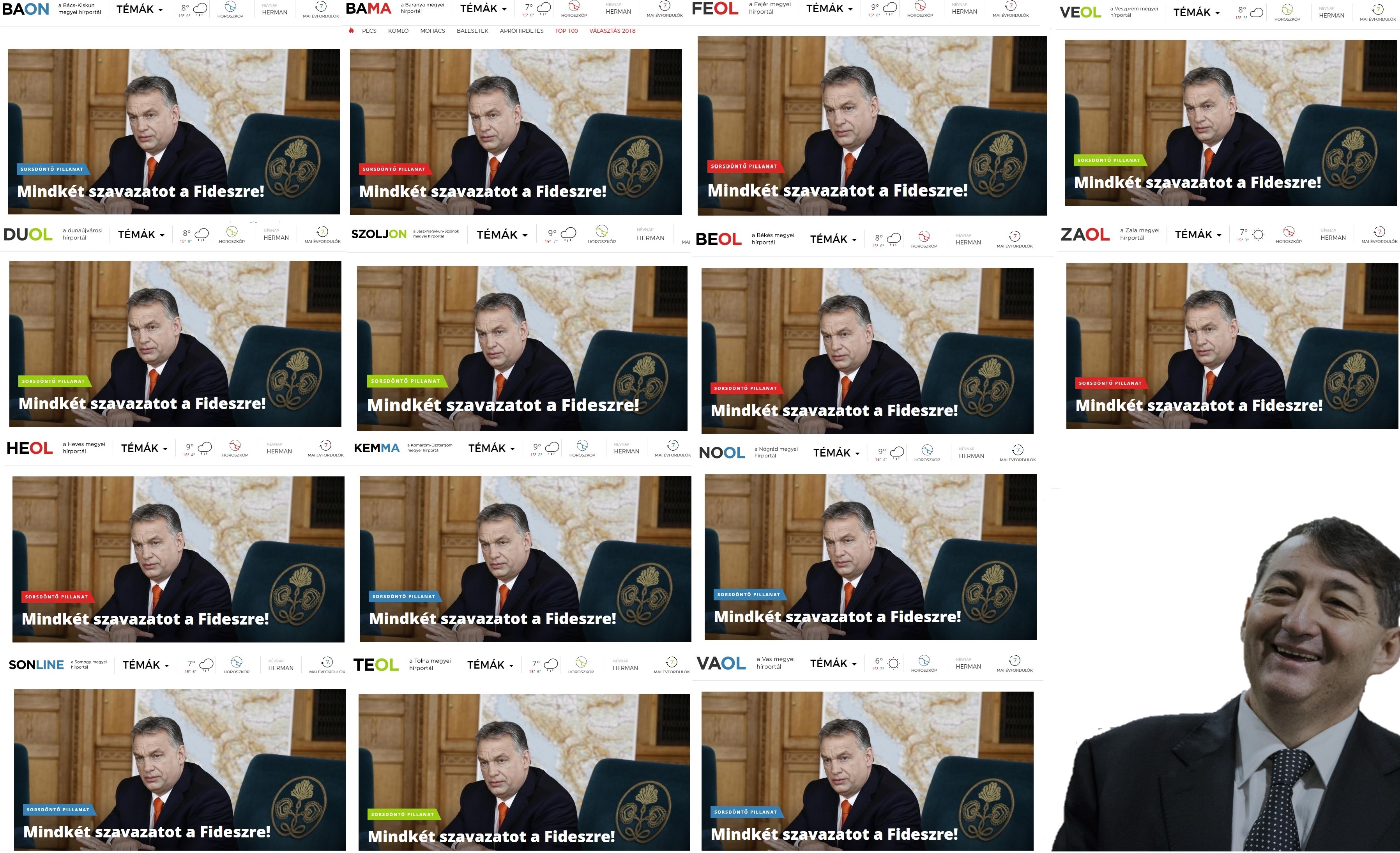
There were several businessmen who became extremely wealthy within a very short period, either by working directly for the government (usually with all the typical signs of corruption), or by getting financed directly or indirectly by the government in the form of huge free loans, grants, etc. These businessmen then started buying different media outlets, some of which were 'usual' business transactions, while others were very nasty stories in themselves (the ownership change of the news site Index.hu was probably the biggest scandal). At some point all of these supposedly independent businessmen decided to give away ALL of the media companies they owned for free to a new non-profit entity. This transaction was given a special exemption by the government from all the usual checks and requirements (like antitrust), even though hundreds of media outlets were concentrated in a single entity, which now governs the majority of print newspapers and radio stations. Since this has happened, all of them transfer exactly the same messages - for example look at the following picture to see the front page of the 19 or so county news sites the day before the last election, where the headline says "Both votes for Fidesz!". These used to have independent editorial boards and focused on local news previously.
https://assets.4cdn.hu/kraken/78sQpRcFFKsevwZIs.jpeg
The state-owned national media holding MTVA (like the BBC in the UK), which of course is supposed to give an unbiased view of the world, also transfers exactly the same messages - there were several scandals where it became public that even senior editors had to send their content for review to Fidesz's people for review, and they got detailed instructions on what and how to say.
Viktor Orban, the prime minister for 10 years, refuses to answer questions or give interviews to any media that is considered to be 'the opposition', even the sites with the highest number of daily readers. At the same time members of the opposition parties are given close-to-0 airtime on the state-owned national channels, and even when they are shown, it is in a negative context.
The national media regulatory body does not check any of the previous issues, but they have been very active for example in revoking the license of one of the last non-Fidesz-friendly radio stations (Klubradio) recently, which also became a scandal.
The work of journalist is made more and more difficult because the state refuses to give information to them or even answer basic questions - for example during the corona virus epidemic, Hungary had by far the least informative site on the topic, yet it was filled with propaganda news. For example to create a chart of the daily cases, journalists had to manually check the site every day and save the currently shown numbers. In order to get a breakdown per county about the cases, they had to submit an official inquiry, where first they said that such data is not available (!), then used all 45+45=90 days to give an answer. Of course the answer only contained the data for the time period when the questions was sent, so it was basically impossible to get up-to-date information.
Viktor Orban still frequently uses the same defence that "they are working in an unfriendly media environment and only try to restore balance", but that is simply not true.
Just count all the European countries that prop up Saudi Arabia and make business with Putin and Xi. Most of them are even afraid to call Taiwan by its name.
As long as you're just willing to make things up, everything is justifiable.
This is the exact mental process that has brought most dictators into power.
Nothing to do with them thinking one is better for the citizens living under their selected rulers control.
Israel doesn’t care about half the people within its borders. Saying they choose who to support based on how that person will treat their citizens is laughable.
Or they support who won't try to destroy them, see - I said it in a non demonizing way.
> Saying they choose who to support based on how that person will treat their citizens is laughable
I wasn't saying that. I was just saying, at least in the case of Egypt, Jordan and Saudi Arabia (and also the Palestinian Authority), it's not clear at all that selling them tech/arms is immoral.
The common geopolitical interests - true as long as you believe Poland is more comfortable with the West rather than in "Eurasian Union". Nordic countries are way more liberal, but they are wary of Russia. Historically Russia was often in conflict with Poland. Scandinavian Peninsula can be a great obstacle to Russia if it wants to expand west. It threatens sea routes and airspace and it's only going to become more important as global warming makes the north more navigable (without icebreakers).
Hammer and anvil - alternate names for the location of Poland (and Ukraine) include Bloodlands(Timothy Snyder), crumple zone(Jacek Bartosiak). Russia and Germany are powerful states and many transport routes lead through Poland. The Carpathian mountains in the South and Baltic Sea in the north form a sort of a bottleneck. Timothy Snyder is of the opinion that central-east Europe had the great misfortune of lying right between two totalitarisms - fascism and communism.
This is a bit of contrast with Hungary, which is now completely inland and land transport is about 10x more expensive so it's not as good for trade.
Or do you mean the Finland? I can expand but you can find common points between Poland and Finland.
Can you expand on the Poland and Finland?
As for Finland, it's the more superficial things. Wars against Russia, desire to be independent, and Finland fought Russia very effectively in the defensive Winter War. Both Poles and Finns are heavy drinkers.
Since you seem to like this kind of books: Timothy Snyder is an US historian specializing in Eastern Europe, and he's especially fond of Ukraine. He also has good lectures on youtube, although I think he's trying too hard when he's commenting modern politics.
Norman Davies is an English-Polish historian with a particular interest in Poland. He speaks the language surprisingly well. The books I'd recommend include: "Red Star, White Eagle". He described an unlikely outcome when in 1920 Poland won a war against Bolshevik Russia, and delayed the onset of communism in Europe.
[1] https://en.wikipedia.org/wiki/1953_Iranian_coup_d%27%C3%A9ta...
This is what fuels these guys. The tanking economy of their own doing which leaves citizens poorer and poorer. So they take away the money with one hand, and point to someone else with another.
EU has its own internal problems and huge overhead, and I agree it doesn't help the situation, but blaming EU for Orban's success is naive.
Study the history of Orban himself. He isn’t just some random right wing nut. He was a part of the first wave of liberalization in the 90s and was very pro-West.
Also, your mistaking Christianity - which is doing just fine in the western world, probably better than ever - with its degenerate form of fundamentalist groups, based mostly on hate, eg homophobia. This is most visible in Poland - which is very Catholic, and definitely not Christian.
Germany has a Muslim minority. And Cyprus has 25%. I don't think Religion is a point here at all, culture definitely is.
Which would likely be done by every country that respects rule of law and equal rights of its citizens.
https://en.m.wikipedia.org/wiki/Self-determination
Aside from that, the UK showed with scotland, how it can be done dealing with political issues, without involving the police. Because that is just in tradition of the fascist way.
Parts of states do not simply arrange independence referendums without approval from the central government. This would be “cracked down” in every single country on earth. It may well be that Catalonia deserve independence but it’s not exactly surprising or authoritarian of a central government to stop such attempts. Scotland doesn’t arrange an IndyRef without getting a nod from London.
Russia had vacation faster, China as well.
No, they did not. Here's a site where you can see the share of people vaccinated against COVID-19: https://ourworldindata.org/covid-vaccinations
... Wait, what makes you think that? Per OurWorldInData, except for a brief period in early January, EU total doses per capita have always been ahead of Russia and China, until June, when China drew ahead (Russia is still _far_ behind). And even then, that wasn't supply-driven; if you consider EU countries with high vaccine acceptance (Ireland, Germany, Denmark etc), those are still ahead of China; China overtook the EU as a whole due to vaccine reluctance in parts of the EU.
Normal, with 27 participants all responding to different national and political interests. Try having a flatshare with 27 families and agreeing on how to paint the wall.
Eh, that's a dubious narrative. In practice, Europe made an at the time fairly reasonable-looking bet on the wrong horse; significant production problems were expected with mRNA vaccines, while no-one really expected big problems with viral vector vaccines.
As it turned out, mRNA production went amazingly smoothly (to the point that overdelivery by Pfizer/Biontec largely saved the EU programme) while viral vector production was a _disaster_. If AZ and J&J had been able to deliver what they planned, or even modestly underdeliver, the issue of contracts would not have arisen.
Perhaps people like you would do better to engage in conversation where you might learn something you don't know rather than throw out your classic epithets
You seem to have made a connection between nationalism and being furious about other people. I respectfully disagree that there is a necessary relationship there.
I have no ill will against other people. I would like people who share my culture to govern me, and I would not like people of my culture governing people of a different culture. They can govern themselves and we can govern ourselves. We can share ideas, trade, sport, etc., But multiculturalism within borders is an inevitable failure and globalism is an inevitable failure
Before nationalism, most European states were monarchies "answerable by God". Now it's dominated by countries with a single people/single language/single religion. Minority rights are important, but a minority should never be in charge of the majority as it was under the Austrian Empire for example (a.k.a as the Jail of Nations).
It's sad that reactionaries are trying to undo this and slowly turn the EU into another Austria, which will inevitably be dominated by the Germans and French.
2) Tolerating the gross misbehavior of one state or leader because you perceive them as a bulwark against other worse leaders is an extremely foolish course. Not only does it expose ones ideals as being hollow and situational, but it often creates new problems that must be contained later.
The summary of US foreign policy since WW2 x)
Food's good, though.
what do you mean? fighting corruption?
And in contrast, this thread's point: that attempts to unify disparate cultures via democracy and mutual agreement, celebrating differences, have difficulties and failures when constituents decide to abandon good faith.
The idea that nation states are old, and multinationalism is new is fallacious. It's only post WWII that borders, political control, and ethnic homogeneity are strongly national... Yugoslavia being the most recent example.
I would love to (interested in the topic)
First national exhibition hosted by the Vichy government during occupation: “la France europeenne”. Showing maps of future europe, where nation-states would have disappeared.
French far-right at the time was also calling England, “the enemy of europe”, for instance on a book from M. Déat, another politica leader from the 40s.
Von der Leyen even said so herself, and she still believes it was the right thing to do to stifle the big countries in order to maintain the EU.
What if some US state with most of the vaccine manufacturing had stopped the export of vaccine over state borders? Would that be fine by you because it's in their self interest?
It's hard to compare universities, unless you have attended both of them
Innovation output != Quality of teaching
Polish "computer-related" people are very often in top when it comes to e.g security (src: https://ctftime.org/) and top universities grads tends to have open doors to faang
I've seen people from both of those groups speaking very good about the schools they attended
Let me put this way: I know people who graduated in Computer Science, in Poland, who can't program. Not in some particular language; they can't write programs, they just don't quite get the idea.
Me too, but doesn't it happen in every country?
Drawing a line primarily along cultural lines means ignoring or downplaying all of the other lines that other people might find similarly important or more so.
Why would I bias my decisions about people over other people just because they grew up within a few hundred kilometres of me? Why would I prefer helping a bunch of deadbeats from my own country over a bunch of promising bright people from halfway across the world? Because they'll stand up for me in return?
Because it's always one team against another? Fuck teams. There are my immediate friends, and outside of that I'll fight only for principles, not arbitrary teams. Everyone's a different person in their own right. Everyone deserves to be treated as who they are, not where they're from. (Cue Backstreet Boys.)
As an example, I stand for freedom of speech, in the form of a diverse, largely independent set of publishers and authors that allows me to make up my own mind by exposing me to different viewpoints. Many Western countries have a better track record at this than authoritarian countries. But this doesn't mean that I'm on Team "The West" - if my country drops this value, I'd rather drop my country than my values.
If my country thinks that skin color or wardrobe of a person is more important than what that person is saying, I'd rather drop my country than team up against that person.
If my country decides that Islamic Law or autocratic dictatorship is a better form of government than democracy, I'd rather drop my country than abandon my principles.
It's great to be in a shared space where you agree with everyone. The question is, when you eventually disagree (because you don't get to choose what your neighbors think, and because nationalism is just a proxy for actual values), then are you going to follow your principles, or do you let your nation and culture dictate what your principles should be?
I think the problem that you are going to run in to is that culture and nations as a proxy for principles works pretty well since those things are highly correlated. Unless you have a strong civic identity that aggressively assimilates and ensures respect of those civic norms, you have an inevitable clash that just becomes a question of scale.
>If my country decides that Islamic Law or autocratic dictatorship is a better form of government than democracy, I'd rather drop my country than abandon my principles.
In your hypothetical, how exactly would this situation come about? You should be able to venture a guess.
When did this ever happen in history? People diverge all the time, that's how we have so many cultures.
Lightly categorized in so called country's?
I am saying this as a person, who likes the science fiction level of species level organization ( vs geographical nation-state ), where we pay with universal credits and basically have few of the issues inherited from the olden days of 2021.
But I dream.
If corona told us anything, then this is probably not true anymore.
I'd like to suggest multicultural cities such as Toronto as an example that preserving cultural backgrounds and integrating with the rest of society aren't necessarily mutually exclusive. You have a broad mix of people from (among others) European, East Asian, South Asian and Middle Eastern backgrounds here and while all of the usual discussions are alive and well (left vs. right, urban vs. suburban, immigration vs. bubbling), people's cultures are just not the main issue dividing people. You'd think that with a lot of Muslim immigrants, Canada would have larger problems with value differences, but guess what, most people are just people and want a good life for themselves and their families. Nothing new here, move along.
The point is that full-on assimilation isn't necessary. Celebrate shared values. Celebrate diverse backgrounds and differences, too. I don't have to tell a Muslim woman that she can't wear religious clothing, just like I don't like it if her husband tells her the opposite. I can just grab food with the two of them and discuss tech, ethics, religion and whatever, just like with regular people, because they are regular people. The kids just see a lot of different ways of people living their lives and learn that it's okay to be different.
> In your hypothetical, how exactly would this situation [Islamic Law / autocratic dictatorship] come about?
Recent history suggests that there is a template: a politician gets voted into office, gets drunk on power, finds a common enemy and sells it to the people, changes elections and eventually the constitution to remain in power, kills the independent press, persecutes opposition leaders and intellectuals with dangerous ideas.
Turkey and Hungary are well on their way. Russia has arrived. Iran and China went the revolution route, that works too, although probably requires more of a flawed system to begin with.
And through pure boredom/decadence, they were radicalised through years of negative messaging from the populist press into 'caring' about things like Brexit, immigration, welfare claimants, etc.
These are people that have most of their needs met and are comfortable, yet their emotional buttons were pushed over the course of years into making them foam at the mouth about things they largely don't fully grasp and that definitely don't have an impact on their lives.
I'm glad you added "(to generalise)" in there, because I'd class myself as 'lower middle' and most of my family/friends in a similar bracket absolutely cannot function without both partners working, and a majority are renting rather than buying their home. I'd argue that what you've described is only true of those OLDER lower middle class folks (like my parents) who struck it lucky before the housing market lost its mind.
The only reason I personally fit into your description (well, I only have one car) is that I was lucky to find my way into the software industry which pays a heck of a lot better than most...
Someone is really hurting. Either production is collapsing and people are losing good jobs, or it is directly going to result in household pain.
I suppose it would surprise me if 20% of a country's electricity can disappear, almost half its primary energy production is gone, the population grows by 10% and everyone is cheerful. It looks like a situation ripe for rage, tension and people asking angry questions.
This is basically the pigeonhole principle at work. If energy availability is going down and population is rising, someone is going to be developing some profoundly anti-migrant views.
[0] https://en.wikipedia.org/wiki/Energy_in_the_United_Kingdom
Every other topic that has emotional potential can serve as a scapegoat for distraction ("we have to fight the common enemy first, then we can care about the poor"): immigrants, the EU, Jewish/Marxist conspiracies, homosexuals etc. It does not _necessarily_ mean that there are no problems related to other topics (e.g. EU bureaucracy etc.), but that is hardly relevant in these cases. You see this playbook in many countries inside and outside of Europe (e.g. Brazil, USA, UK, Russia, Poland, Slovenia, Turkey, ...).
8/10 top parody comment. You could have strengthened it by suggesting they turn to brioche if they don't have enough bread to eat though.
Yes, but is the thing they're upset about and the thing they're directing their anger towards actually linked?
It's often hugely successful in politics to say "all your problems are the fault of this external bad actor" rather than "we have a problem and it's going to take a lot of hard work to fix it". It's very easy to blame external Jewish financiers (George Soros always gets a namecheck) and gay people for all your problems. The last time people did that en masse in Eastern Europe it ended up with extermination camps and millions dead.
Arguably Hungary's problems are due to the international finance industry, but there's nothing especially Jewish about it, just good old mis-selling. See e.g. https://www.ft.com/content/6c27cfbc-f50b-11e2-94e9-00144feab... - Orban took on the banks, which has to have been a big help to his popularity.
The EU is not blameless in this: https://www.escp.eu/news/eu-convergence-narrative-played-key...
Is Germany in Eastern Europe now?
Brazil experienced 12 years of prosperity from 2003 to 2015, with some trouble starting in 2012, but still with solid numbers in unemployment, for instance. Still a hate-based disinformation campaign managed to overthrow a re-elected president for accusations later proved unfounded, paving the way to the election of a far-right president who is ripping apart the fragile fabric of Brazil's still young democracy.
This is why we need to deal harshly with such hatred/disinfo campaigns, ruthlessly deplatforming fringe elements and denying them the chance to drag the Overton window their way.
In the past century Europe saw the construction of facilities used exclusively to commit murder at an industrial scale, designed to be the cheapest way to kill whole populations.
It's people like Orbán, the Le Pens, Jörg Meuthen, Nigel Farage, among many, many others, that took this continent there and, if we don't act, they'll do it again.
Orban is seen as hateful or radicalising because he is against illegal immigration. He has made a big marketing point about this.
But that doesn't mean that there aren't legitimate concerns about illegal immigration that Hungarians might have. Just because Western european nations have decided they don't mind if they add 1-2% yearly to their populations of a culturally totally different type of person, doesn't mean that that is normal or "good".
Orban is using these emotions for his own purposes. That's true. But it's not Orban that is creating these issues, or the concerns about them.
I've travelled a lot in Eastern Europe and I think I know where this is coming from.
When communism fell, people rejoiced in joining the EU and getting all the benefits of a free society. However what really happened was that those spoils went to the people who were desirable employees. Meaning mainly the young (and those happy few with money or connections). Meanwhile the old communist cronies stayed in power and simply became capitalist oligarchs.
On the other side, older people's built up state pensions were cut or removed due to their jobs being privatised to shady agencies owned by these ex-government oligarchs. An easy way to cheat them out of their benefits they worked for. For all its failures, communism did provide them with a sense of continuity and job security that is now lost.
As a result there is now a strong separation between those with opportunities and those without. The haves and have nots. The older people have been abandoned. Of course these people tend to have traditional values and this is what people like Orban target.
I don't think Orban will really make things better for them, he is just a populist seeing a niche to take advantage of. But the disillusionment is real and very clear to me. I've spoken to some well educated poor people that were just too old to be of interest to capitalist companies. And thus ending up living in an apartment with plastic bags for windows (in -20 degrees C). I spoke to a very well educated school teacher who was begging on the street to pay for her husband's cancer treatment. She wasn't one to fall for these populists as she was way too sharp. But I was shocked how society has let an entire class of hard-working people just drop away into insignificance. In Western Europe we have built a balance between capitalism and welfare, but in Eastern Europe they moved straight to a caricature of hard neoliberalism. It caused a big culture shock and left a whole class of people behind.
We (as the EU) have let this happen by letting these states change their industries to capitalism overnight without setting up a proper welfare system. This will not go away until we find a way to give everyone a decent life in these countries. For some people the EU has been nothing but broken promises. Of course that's a breeding ground for dissent and populism.
The world would be a better place if we did that more often.
However, win-lose deals can indeed happen, although they're rather rare. Consider the example of diminsmished agency, e.g a fentanyl addict "choosing" to buy more fentanyl. Or consider agency conflicts of interests or information asymmetries as examples where deals can turn out to be win-lose.
And one of the lessons other people refuse to see is that appeasement of hate generally just leads to more hate. This is what we're seeing in the US right now, where what seems to be a majority fraction of one of the major parties is captured by an escalating rhetoric of hate. The angrier they get, the more votes they get. You can't placate that, because at the end of the day it's feeding on ITSELF, not a fundamental injustice.
You really think that American voters are so outraged about vaccines or masks because of a genuine concern for good modern medical practice? No, they hate that stuff because it's pushed by the people they already hate. So now they hate them more.
First, sometimes the wrong people come to power anyway. If they can't do it by blatant misinformation and propaganda, they'll do it by "wolf in sheep's clothing" tactics. Once they get power, the machinery is there, just waiting for them to use it to enforce their narrative. Sure, by protecting the narratives that are allowed, you might make it more difficult for such a one to come to power, and therefore less probable. You can't make it impossible, though. And if the thought of such machinery in Orban's hands (or Trump's) doesn't terrify you, you're not thinking.
Second, power changes people. You might be a perfectly fine, democracy-loving person. Give you that kind of power and you might not be the same person forever. As Elrond said, "I fear to take the ring to guard it. I will not take the ring to wield it" - and for very good reason. Too much power is a danger even to the good.
I can't help but to smile the smile of mild horror that calls to overreaching and overzealous censorship of wrongthink ( hate is sufficiently innocuous and broad to cover just about any kind of wrongthink - just the fact that it has been accepted by mainstream as a good enough reason is horrifying ) is so common that is used with adjectives like ruthlessly without any feel for the irony.
I can certainly feel the hate.
You are right in the sense that eradicating poverty will probably have a stabilizing effect on many societies, but, in Brazil at least, it wasn't the poorest who supported the rise of fascism - this was driven mostly by the middle class.
In Germany it was the hate speech, the scapegoating, the xenophobia of the nazi discourse, the framing of other people as sub-human, evil and unworthy of living. This led to seemingly normal people inflicting unspeakable evil upon others. And it's frighteningly easy to make a human do that.
That's quite literally Nazi propaganda, although the narrative was born in the US with Keynes as Americans were oddly keen on washing the Germans of their sins, shifting the blame everywhere else and go back to business as usual.
The Treaty of Versailles was nothing particularly odious, Germany could have coped with it fine if it stuck to the terms. It didn't, it broke its economy on purpose to avoid honoring the treaty.
And many people rightly saw that the prosperity that happened during Lula's time was because of booming commodities market and exports booming, not because anything he did in particular.
Brazillians voted for Bolsonaro not because he is right wing, but because he promised he would end corruption, and the workers party IS corrupt.
Now that Bolsonaro has proven that he won't end corruption either (starting with him protecting his son), I doubt he will be re-elected, instead whoever else promises to end corruption and is not corrupted that has a good shot.
Ah, the familiar sound of facts being twisted and turned to conform to what you wish reality had been. We’ve been hearing this same rhetoric of denial since before their government ended. Somehow we should believe that a country of 200 million people was just “going through its motions” for over a decade and the figures in power were just spectators. I guess that leaves room to say the same about the current government - the ongoing destruction of the economy is “not their fault” either.
There are a thousand different policies implemented in those years that helped the country achieve growth. A huge number of them already reversed in the past 5-6 years. Hand waving all of it as “the commodities market boomed” is of such a despicable, willful ignorance.
EDIT: on why I find this so aggravating: to have a decent government you need people to vote based on proposals, political stance on specific issues, policies, not empty promises (like ending corruption). This kind of discourse just continues to poison the well by taking focus away from real economic/political issues and into a red vs blue team mentality.
You are talking about Lula, who was jailed after massive procedural "errors", mishandling of evidence, witness intimidation (bordering on torture), evidence inflation and many, many others, conducted by a partisan judge who would be named by the election winner (a win Moro helped him secure by preventing Lula from running) to head the ministry of justice.
Dilma's maneuver was later considered legal and not grounds for an impeachment.
(1) If you believe that hate-based disinformation campaigns routinely unseat good people ... I might suggest that normalising ruthless deplatforming of "fringe elements" is a strategic blunder?
There is a stereotype of ye goode olde Nazi/Communist regimes. It involves tropes of ruthlessness and deplatforming of fringe elements.
(2) I'm not sure dismissing political opponents as "far right" and "fringe" when they are winning elections is rhetorically feasible. It is hard to get away from the fact that winning an election involves convincing swing voters that a plan is acceptable. It is worth asking some what? and why? style questions. Then getting to answers that don't involve the public becoming suddenly and unexpectedly susceptible to hypnosis.
I'm not going to go into the topic of migration and the "legality" of it. But the reason Orban is considered "radical" by many is not because of his stance on immigration first and foremost but because he's been dismantling democratic institutions left and right, starting with NGOs, the media, academia and to some extend even the judiciary. The fact that his rhetoric is hung up on blaming everything on George Soros does also not help.
This is precisely where I claim you've gone wrong.
> NGOs
NGOs are not democratic institutions per se. NGOs can be incredibly detrimental to societies, whether intentionally or through incompetence, and can be used by billionaires to social engineer societies as they see fit.
> the media
The media are not democratic institutions per se, even if they can in principle be used to communicate information needed to make sound political decisions. In practice, they've owned by someone with a view that's inseparable from the writing. So far I've seen corporate media banned and very often, in that part of the world, the corporate media are owned by powerful foreign interests, thus often becoming instruments for social engineering and propaganda.
> academia
A healthy academia can, again and in principle, be very important for the maintenance of an informed society, but here, too, they are not democratic institutions per se, and they have demonstrated enormous susceptibility to ideology (which is quite a charitable claim; they are, in fact, the breeding grounds of many of the ideologies that later enter the political sphere). Through funding (gov't and private foundations often backed by billionaires) and biased hiring, ideologues can be promoted and concentrated within the ranks of the university.
So I have to say I am a bit frustrated by the pervasive myopia about the reality of these kinds of political issues. What I see is often a credulous attitude toward the false narratives that corporate media have published.
Whether Orban is using appropriate means to achieve certain ends is the subject of another discussion, but that Hungary and other countries are the subject of foreign imperialist ideological bullying is not an open question as far as I am concerned. Whatever flaws Orban might have, realistically, I do not see any other forces that can mount a serious enough defense against these threats. (Mass immigration is only one thing Orban takes issue with, btw.)
What is it that makes non-government organizations so democratic? Do they let the general public vote for their leaders?
Most migrants weren't Syrians, btw. But more importantly, I wish to remind you that when this mass migration was inflicted on Europe, the Left was very much in favor of this shitshow. There was no "dealing with the Syrian crisis" then (whatever anyone means by that). Nor was there any acknowledgement that the majority of migrants weren't fleeing Syrians. Syrians should have been helped on the ground in Syria, but only a few states seemed to promote that approach (Poland comes to mind).
All of this should suggest that the mass migration was weaponized.
This sounds like comments to the effect of "If you don't like how America does X, then leave X." It also frames things in a relativistic sense, as if consent is unconditionally binding and nothing but consent has any moral weight.
Anyway, this isn't as simple as it sounds. First, joining did not give the EU license to make all sorts of weird impositions and to demand these countries cooperate against their own good. Second, countries aren't people. Politicians in those countries at the time put a great deal of energy into promoting entry into the EU among the populace, and referenda results reflected a wish to deal with frustration caused by domestic political realities, and feelings of inferiority, more than some kind of reasoned and responsible decision (I recall speaking with political analysts at the time who felt that entry into the EU was a bad decision, at the very least a premature one).
> I think Brexit showed the way
This may be the only option. But this is politics. The EU is unjust (put aside the propaganda please) and so the moral high ground is not to be found in Brussels. For now, tolerating and resisting bullying from the EU is likely better than exiting. But I don't expect the EU is last another 25 years at this rate, so it might be a matter of waiting out the storm.
There is also a difference when you get immigrants of somehow similar culture vs large amount of immigrants from one that is completely different (and it being the same as ISIS, doesn't help, how one can differentiate infiltrator from legitimate refugee?).
It is all good if amount of immigrants is not large influx.
But what most Hungarians (and Poles) didn't take into account is that most of those immigrants prefer to get to western Europe, so blocking them was pointless. They would quickly go West.
Which European nations did this and how? Did Hungary, Poland, Lithuania, etc. do this? If you're talking about colonialism, then if Western Europe has a guilty conscience, let them pay the price. Don't punish nations that had nothing to do with any of that and who themselves were oppressed under foreign imperialism during that time. (Though two wrongs don't make a right, so I would avoid the insane rhetoric of "reparative cultural and national self-destruction".)
Besides, the idea that the world is poor because of European nations is a simplistic claim and the sum benefits and injustices. These weren't typically wealthy nations that those European devils colonized, even if they later took part in exploiting or mistreating those peoples. Odd that only the West receives that attention and no one else.
> Allowing free movement of goods and services without free movement of people entrenches inequality and makes the problem worse
Inequality is not the problem. Poverty and unjust treatment are.
Also, free migration actually does actually make the world worse. It leads to the destruction of the host nation by flooding it with people of a different culture beyond a rate at which they can be absorbed, but also the draining of the origin nations of labor, expertise, etc. It's bad for everyone. Maybe corporations benefit in some myopic way. They're the one who will print the bleeding heart op eds that tug at sentimentalist moralizers.
Please don't generalise. Have you been to Czech Republic or Poland? There are no such neoliberalisms (I would say same about Hungary, but considering Orban, I'm not sure, I haven't been there)
We have good welfare and educated people don't beg on streets, not to mention plastic bags on windows.
Your description looks more like one for Ukraine.
The plastic bags on windows were really common though. There was a really poor apartment block just beside the office and I always felt so guilty looking at it. From the well heated office with free coffee.
As for neoliberalism: in Poland the usual way of employment, called "umowa o dzieło", gives the employee pretty much no rights whatsoever. It's almost as bad as in the US in that matter, and not comparable at all to Western Europe.
It's not just that we (the EU, or even the West) let them switch to capitalism without a proper welfare system. We let them without giving them a government that knew how to run a capitalist country (because we didn't give them a government at all). But we let them have the expectations of a functioning Western government, instead of the expectations of a transitioning country that didn't really know how to do either democracy or capitalism.
It worked out pretty well for Germany and Japan to be conquered, and have the US spend a decade showing them how to do both democracy and capitalism. Just saying "Welcome to capitalism and democracy! Glad you're here!" turns out not so well. (The problem, of course, is that when you aren't a conqueror, the country doesn't want you to run it. And when you're fighting against the "evil colonialists" meme anyway, taking over is a really bad look, whether or not the results would be better in the long run.)
It is also very ironic that in Hungary these independent (i.e. from state) institutions are replaced with ones who's mandate last longer than 2 terms of election - fairly obvious that public control is not the goal, but the exact opposite.
When one calls these institutions Democratic it's because they do represent opposition and thus a control mechanism. This does not mean that they're infallible or act for the good of society by definition but if they do not exist the government operates - de facto - in a completely uncontrolled framework. Unsurprisingly this is why many governments do try to dismantle these institutions in the first place.
>[..] but that Hungary and other countries are the subject of foreign imperialist ideological bullying is not an open question as far as I am concerned.
I agree that this is worthy of a discussion however I don't think this is the topic in question at all.
I think you're being willfully naive here, I'm afraid.
People can 'call' for whatever they like. In this case the demand was related to the refererendum being on a nebulous idea without any clear idea on how to implement it. No-one would ever seriously suggest having a referendum on a Trade deal or Treaty before the negotiations had even started. The idea of having a referendum on the final deal was hardly a crazy one.
So I do not see the solution in fighting populist rhetoric, but in adressing the cause of the fear of the people.
If you address it they won't have a reason to vote for you next time. This problem plagues many US cities.
Which migrants? Where are they from in Hungary, then?
> should suggest that the mass migration was weaponized
By whom? For what purpose?
> the Left was very much in favor of this shitshow
The left (such as this can be described as a homogenous bloc!) was not in favour of the collapse of Syria, although they generally were against just repeating the mistakes of Iraq there. Without the attack on Iraq the collapse of Syria might not have happened, after all - it released a huge amount of arms stockpiles into the region which were taken up by ISIS.
> The left (such as this can be described as a homogenous bloc!) was not in favour of the collapse of Syria, although they generally were against just repeating the mistakes of Iraq there. Without the attack on Iraq the collapse of Syria might not have happened, after all - it released a huge amount of arms stockpiles into the region which were taken up by ISIS.
Obama authorized the CIA in 2013 to supply the Syrian rebels with money, weapons, and training [0]. A lot of those weapons ended up falling into the hands of extremist groups like AQ and ISIL, either by "vetted" militia groups getting absorbed into larger ones or weapons getting resold on the black market. That may not have ignited the conflict, but it certainly prolonged it and contributed to the humanitarian crisis in Syria.
You thought you would score a point by embarrassing a stranger on the internet, but it didn't work out because you read something that OP didn't say. Pedantry is rarely a good look.
Plus, it's not pedantic. Saying that the holocaust was a eastern-european thing (or that the polish were largely responsible) is a common way the far right in germany try to diffuse and deflect responsibility.
I don't think OP is doing that, but I still think it's an important thing to remember - that the holocaust was the project of western europeans, i.e. it's not somebody else's problem.
It's not just the UK. It's the US and every other place. Trump wins 46% of the popular vote in 2016 and suddenly there's a deluge of think pieces about how people are hurting and what not. Yeah maybe. But there's a lot of folks out there who love voting for a guy who "triggers libs" and normalizes pussy grabbing. And we're not allowed to say this, because again, it's heresy in a democracy to imply that a large segment of voters could be ignorant or stupid or racist.
Another example, this time with vaccines. One person decides not to get a life saving vaccine because he was duped by misinformation online - he's an idiot. 30% of the population swallow the same bullshit - they have valid concerns that we need to empathise with and assuage. If they choose not to get vaccinated, we have to accept their choice. We shouldn't require vaccine passports because it would hurt their feelings and their ability to transmit diseases to their fellow citizens.
I posit to you that 'people hurting and what not' are not merely think pieces ( https://en.wikipedia.org/wiki/Hillbilly_Elegy ). I remember driving through PA months before Trump's election and recall seeing some of the sadder signs you can read including "Save us Trump". It is not "triggering the libs"; it is genuine despair of no options other than triggering the libs. It is important to understand where it comes from, if one is to have a hope to counter it in any meaningful way. Just using that slogan is a mental shortcut that undermines our discourse.
I do not see that understanding. What I see is more targeted messaged intended to inflame pre-existing passions. I do not see discussion. I see bumper stickers.
As for democracy, there is an argument to be made that it relies on educated and engaged populace. I am not the biggest fan, because US has neither and a lot of ways to manipulate public opinion are well understood now. And yet, it is still a better option than benevolent dictator, monarchy or some sort of theocracy.
Now, we can quibble over whether US is a democracy, which in itself is a discussion for a couple of pages.
I do think you have a point with vaccines, but I want you to consider the question of choice, mandates and so on in regards to government imposing choices upon you. What is the lesser evil here?
The government isn't imposing these requirements arbitrarily, it's your fellow citizens imposing it through the mechanism of government. For example, Big Government will outlaw and penalise littering not for the sake of it, but because that's what citizens want from their democratically elected government.
And as a citizen who fully supports restrictions in response to a pandemic - IMO the government can't require you to get vaccinated. But you can't demand to be allowed into nightclubs and cruise ships while unvaccinated. Fair?
> And yet, it is still a better option than benevolent dictator, monarchy or some sort of theocracy.
I didn't argue against democracy. I argued against putting the population on a pedestal. It's ok to criticise people's beliefs. And it continues to be ok even if those beliefs are held by a large group of people. If a large group of people think that vaccines cause 5G ... I don't think we should coddle them and think about it from their perspective and accommodate their idiocy just because they have plenty of company. Let's create rules so the damage they do is minimized.
I see a fair bit of attempts at understanding. Liberals love to write books like "The Righteous Mind" and "What's The Matter With Kansas?", attempting to understand conservatives from a liberal point of view. I can't think of anything comparable on the right. Progressives seem to me desperate to understand and cater to conservatives, and it feels like the only thing conservatives want is to make my life harder.
It could very well be that I'm just not listening hard enough. That seems to be the response every time liberals lose elections: "understand harder", because the problem is with me. But I'm starting to think that maybe I do understand: they don't want anything from me except someone to be angry at, and whatever despair they're undergoing is more about the deliberate induction of that despair than anything I actually do.
I’m genuinely asking because looking at the map, neither Hungary nor Poland are the first stop for a middle eastern refugee, and I have no idea where the statement of infiltrator from ISIS comes from because I haven’t heard of an uptick of terrorism in either country.
People are more reluctant to let immigrants from too foreign culture in, e.g. Poland let in > 1M of Ukrainian immigrants (they are from similar culture as Poland) during last few years. Those assimilate easily.
Also, people are afraid of the unknown. You force that on them, they will object -> vote for those that will block that. There is no way around that.
This happens more in places that are more religious and for example Poland is, if you let in people from different (also religious) culture you create a clash.
I think it would be easier for Czech, where there are few religious citizens.
As for terrorists. People watch TV -> see that ISIS is cutting heads -> EU wants to import people from exact same region into your country. Many people objected to that, even those less nationalist.
If there are less Joules and more people, some people must - by mathematical necessity - be consuming less of them. If your family can still afford to consume the same amount then maybe someone else on the margins is really being pushed.
That is a pretty decent reason for why a large number of people might be getting desperate for political change. It is a stronger explanation than some variant of the more common "maybe they are just really confused and/or hateful and/or unexpectedly stupid". People don't read economic stats but they'll notice if 20% of their electricity goes away.
If you want to point to something, I'd look towards massively inflated house prices (almost 10x over 30 years in some places), and stagnating real wages.
For energy efficiency to cover the change + population growth with no winding back of lifestyles it would need to be something like a 30% increase in efficiency over 10 years, affecting all electrical devices in the country. There is reason to be sceptical that it is a major factor here.
Add to that there is an argument/observation (Jevons's Paradox) that increasing efficiency of using a commodity generally doesn't lead to reduced usage. If it made sense to procure X commodity when it generated Y, it makes it even more sensibly to procure X when it gets you (Y+something).
As for decreasing industrial use ... the default position when a country jettisons its industry is "gee, that might reasonable upset a lot of people and/or cause social problems!". The changes are rather large. Deindustrialising might foreseeable lead to such things as stagnating real wages, as the country can't produce as many goods, or massively inflated house prices as it becomes more difficult to secure useful work/build new houses.
The UK temporarily outlawed older-generation lightbulbs, as well as putting in place a number of measures to reduce energy use. Even Conservatives, historically the party of industry, are now heavily committed towards energy-efficiency measures of all sorts (sometimes excessively so, like the push for those terrible heat pumps).
A decline in energy consumption is a good thing and is absolutely not impacting standards of living in any way in UK society. The reasons for discontent are many, for sure, but not related to energy use in any way. The main issue really is wage stagnation (and hence, availability of time) for the working classes.
The default position when a country's electricity use drops 20% is to be concerned. If they do the same thing 4 more times they will have returned to the stone age.
In both countries the governments are trying to make it quite hard to have people with Umowa o dzielo, which are de-facto employees, but do not pay the appropriate taxes nor are corrrectly protected. The employers also have some reason to do this, the protections offered to the employees often make it a very big risk to hire somebody. Regardless, i believe the southern European countries got it much worse on that front. (Note, the Polish social security model was heavily influenced by the spanish one).
What you describe is used by firms that you can smell a mile away and don't even try to work there.
I'm sure western Europe has similar companies that abuse employer rights.
Also, note that this is not an abuse of employer's rights: that's precisely how "umowa o dzieło" is supposed to work. That's one example of prevalent neoliberalism.
Yes, that's not a good proof, but you also did not present any sources.
If you look at trends, the main driver is the fall in industrial use, which has been consistent since the '70s. This country has effectively abandoned industry with Thatcher, and, unlike others, it has never looked back. British industry is in (un)managed decline, the economy is now entirely driven by services and finance.
Domestic trends are flat or falling softly, driven by those efficiency measures I mentioned. The UK used to have very cheap electricity coming from nuclear reactors that are slowly being decommissioned, which (combined with a typically-botched privatisation of the sector) has driven up domestic prices very significantly, pushing people towards alternatives. For example, there used to be a lot of electric heaters in British homes, which are now invariably replaced with gas-powered ones. That has not meant a significant fall in living standards.
There are many issues with the UK system, particularly a wealth distribution heavily skewed towards one or two metropolitan areas (the centres of services and finance), but falling energy use is not really one of them.
Please note that democracy literally is the rule of the people. You simply cannot state that you are not arguing against democracy and in next breath say that people should not be on its pedestal, because, theoretically, people are its ruling class. If it is a democracy, people are on its pedestal. That is the main weakness of democracy. People, as a whole, are idiots.
Your issue appears to be with commonly held beliefs that are not your beliefs. But that is a very different discussion.
> And as a citizen who fully supports restrictions in response to a pandemic - IMO the government can't require you to get vaccinated. But you can't demand to be allowed into nightclubs and cruise ships while unvaccinated. Fair?
I have zero problem with that statement.
I did
> Plus, it's not pedantic. Saying that the holocaust was a eastern-european thing (or that the polish were largely responsible) is a common way the far right in germany try to diffuse and deflect responsibility.
>I don't think OP is doing that, but I still think it's an important thing to remember - that the holocaust was the project of western europeans, i.e. it's not somebody else's problem.
In Hungary (which is after all the country in focus here), saying the holocaust was forced upon us by the Germans is similarly a common way the far right try to diffuse and deflect.
'the holocaust was the project of western europeans, i.e. it's not somebody else's problem' is only true if you are a Western European yourself. If you say that the holocaust was the project of western europeans in Hungary, it means the opposite of what you're trying to say.
Still, it's just a fact that the holocaust was a German policy, organized and largely staffed by Germans. I think that while much of eastern europe was and still is profoundly antisemetic, the Germans would have absolutely carried out the holocaust even if the opposite was the case. That many people took part in the process is obviously shameful in every instance, but the OP comment makes it out as if it was like some plebiscite of eastern europe - which it obviously was not.
For me, I see OP's mention of Eastern Europe as a link to Hungary, which is the focus of the article, rather than as a general, out-of-context attempt to shift the blame from Germany to Eastern Europe.
I guess we've now both made our points, and it's come down to a question of what OP meant rather than the words on the screen. I don't think either of us have managed to convince the other, so without more input from OP, we're at an impasse.
Mmm, I was actually just pushing back against the words on the screen. I don't doubt the OP means it the way you read it. I guess I don't generally see a rejoinder as a way of embarrassing the person I'm replying too - rather as a way of contesting the point, refining it, or clarifying it. I actually quite rarely notice who I'm talking to online.
Just top of my head:
Well, there is an argument to be made from purely economical perspective, avg. earner did see some improvement. Regardless of whether you think tax cuts were a good idea, Trump tax cuts did have intended effects ( even though they also added to an ever increasing deficit ).
He did pull out of JCPOA, which some of his electorate actually wanted for various reasons.
I maintain that listening is important. I would argue that understanding is more than important. You want an absolution and an easy answer of 'they are just assholes so I can be an asshole back', but it is not that easy. The people you dismiss have rationale for what they do. And now that you know this, you have no excuse but to act on that knowledge. Or, at least, use it to your advantage.
How's that worked out for them? People in Appalachia feeling pleased about the pain inflicted on the Iranian people? Or are they pleased that Iran stopped adhering to the deal and have resumed uranium enrichment? Or are they pleased about Iran's expanding influence in the Middle East?
It doesn't take much to to give people what they want. Pulling out of the JCPOA took only a couple of days. But it was not a good decision, and the fallout wasn't felt by the people who pushed for it.
You are correct to point out that people of Appallachia did not get anything of value out of that exchange.
Since that is the case, would you accept Keystone Pipeline ( https://www.pbs.org/newshour/nation/trump-administration-app... ), which was approved and, arguably, allowed for a lowering of energy cost across US?
< It doesn't take much to to give people what they want.
I do disagree with that statement. This is the hardest thing in politics.
One possible way to look at 2016 is that the left wing of the Democratic party felt taken advantage of. The party put forth a centrist candidate (after 8 years of a President who wasn't nearly as progressive as they'd hoped). There was little enthusiasm, while the people you've asked me to understand voted for a candidate who was obviously awful in many ways.
So the political calculus can say, "It doesn't matter what they want. You can't reach them, as evidenced by their willingness to vote for such a terrible candidate. I need instead to lean in the exact opposite direction, doing things that they hate vocally, because they can't vote against me any harder than they already do."
That's my excuse to not act on that knowledge. I have only so many actions I can take, and I will spend them in the way that does the most good.
Note that I'm not committed to that, merely explaining the view as being something other than "they're assholes so I can be an asshole back". But I do believe that the time has come to consider making them chase me rather than the other way around.
Conservatives every time liberals win elections: "let's make voting harder", because the problem is still with liberals.
Huh? Do you have any examples of this?
I think you might be generalizing too much what it means to be liberal and don't really understand who is or isn't progressive, even in the context of the US.
It sounds like by liberals, you are referring to the Democratic party at large. You have to understand, the Democratic party at large is barely liberal and nowhere near progressive. Outside of a small number of progressive politicians, they're perfectly fine to waste a majority in DC doing very little because the same corporate interests that back conservatives also back them. They behave like controlled opposition. You can do your part to vote for someone who truly is progressive in a primary election.
As for "examples", take a look at those two books I mentioned. There are many more books, and many op-ed pieces every time Democrats lose elections.
It's only relatively recently that the more progressive wing of the party has said, "Hey, rather than try to bend over backwards to attract moderate conservatives, how about you garner more enthusiasm from your left wing?" Or at least, they've been saying it for a while, but were generally dismissed. I think 2016 made the proposition more thinkable: if they will vote for the Republican candidate even if he's obviously insane, maybe a new approach is needed.