A Chemical Hunger – Part V: Livestock Antibiotics(slimemoldtimemold.com) |
A Chemical Hunger – Part V: Livestock Antibiotics(slimemoldtimemold.com) |
His initial premise, that the cause of obesity is a mystery, doesn't seem to be that well-researched. Most importantly, he does not really poke holes in the basic premise that the cause is linked to increased availability of food in general coupled with more people living sedentary lifestyles. He even mentions that average daily caloric intake has gone up c. 400 kcal since the turn of the 20th century. Which, for someone with a maintenance-level diet, would cause a 35-45 lb. annual weight gain.
The antibiotic theory here doesn't seem to address the possibility of wealth and industrialization as a confounding variable. In fact, he doesn't seem to seriously address confounding variables anywhere in his analysis.
I don't assert that antibiotics in the food supply should not be considered harmful, but his vague hand-waving in the direction of a culprit for some great unknown mystery seems thin at best. I'd love to hear some competing takes.
It does not explain a lot of countries where food had been available for well over half a century in any quantity you wanted and yet people don't have problem with obesity.
Saying these countries are somehow "special" because of their cuisine or tradition seems like admitting that something else rather than availability of food is an important influence.
Also one other interesting point is that not all countries see increasing obesity. For example, Canada has not seen significant increase in overweight and obesity since at least early 90s while US seen its rates double during that time.
I don't think anybody will say that food is scarce in Canada.
I’m on the side that we’re overthinking it and a big contributor to obesity is just really bad cultural habits. A lot of people barely exercise at all, even walking, and when they get hungry they grab an unhealthy snack in 5 seconds. Even though are ancestors didn’t understand or care about exercise or getting fat, I doubt they had those habits.
Unfortunately once someone develops those habits, even as a kid, they’re hard to unlearn and they could affect the body’s set point. And they’re so ingrained into our culture that even people who try to be healthy (e.g. by eating a “healthy” fruit bar or exercising 30min on top of their sedentary lifestyle) don’t avoid them.
Now, there are people who got obese even though they exercise and eat whole foods, but I would be surprised if they aren’t a minority.
I remember seeing a Ted Talk years ago where the speaker said that obese people have an issue with androgenesis. His theory was that it was causally linked, but I believe that was unconfirmed.
That's one data point, but they also show that caloric intake has been decreasing since 2010 and yet obesity is still increasing. They also mention that the 400 Cal figure is based on consumption in the 1960s-70s vs today, but that there are reasons to believe that at the turn of the century consumption would have been higher than that. Also, observing that people are eating more just begs the question: why are they eating more today than they need, when they weren't dong this in the past?
> Most importantly, he does not really poke holes in the basic premise that the cause is linked to increased availability of food in general coupled with more people living sedentary lifestyles.
Except that people are exercising on average more today than in 2010 or 1990, and more than office workers in 1950, and still obesity is going up. Similarly for availability of food. Also, none of your observations address the bizarre correlation between obesity and altitude for example.
> The antibiotic theory here doesn't seem to address the possibility of wealth and industrialization as a confounding variable. In fact, he doesn't seem to seriously address confounding variables anywhere in his analysis.
Industrialization and wealth are not direct causes of obesity - people don't eat money or factories. If people in countries A and B are eating the same amount and composition on average, but country A is wealthy and industrial and country B is poor and rural, and country A has higher average BMI than country B, then you should exactly start looking at some environmental causes for the difference.
Edit to add:
> Which, for someone with a maintenance-level diet, would cause a 35-45 lb. annual weight gain.
This is nonsense - there is no way to predict weight gain based on calorie intake - variance between people is too huge on this metric - individual BMR alone varies between 1000 kcal/day up to 2500 kcal/day.
Please site your sources. A variance of basal metabolic rate (BMR) of 2500 kcal/day sounds too extreme to be true, but I am open to learning something new. At least according to (https://examine.com/nutrition/does-metabolism-vary-between-t...) the variance in BMR is only around 300-400 kcal/day which makes your number unbelievable high.
I have examined the author's claims concerning altitude. He presents a coloured map of the United States and makes the claim
`Obesity is less common at high altitudes because of the watershed.`
Yet his coloured map shows California (Most of the population lives near sea level. Even inland Sacramento sits at 46 feet.) as substantially less obese than the Appalachian states. His hypothesis is interesting but the evidence appears lacking.
SMTM's source [1] shows that "Percentage of adults aged 18 and over who met 2008 federal physical activity guidelines for aerobic activity through leisure-time aerobic activity" increased from slightly less than 45% in 1997 to slightly less than 55% in 2017. (I did not see a source for office workers in 1950.) But what really matters is the total physical activity. I'd be highly surprised if the increase in leisure-time exercise compensates for the decrease in jobs that require physical exertion for eight hours a day, every day.
[1] https://www.cdc.gov/nchs/data/nhis/earlyrelease/EarlyRelease... "Leisure-time physical activity" starts on page 43.
What percentage of people filled that role then vs now and how does that compare to obesity rates? I assume both percentages were much lower in the 50s. Not to mention, many of the tasks that are automated today (or don't exist at all) were manual tasks back then. So they may not have been exercising explicitly, but it's likely their chores required manual activity that would qualify as low or medium intensity exercise... except maybe the richest ones that had servants of some sort do it for them.
(aside, but I suspect the author is One Of Us; I clicked on https://slimemoldtimemold.com/2021/07/15/a-chemical-hunger-i... because of the funny title, but it addresses an argument I see a lot on here and cites a HN comment!)
https://ourworldindata.org/grapher/antibiotic-use-in-livesto...
In the end, antibiotics surely are part of the obesity pandemic. We give them to animals to fatten them, after all. But I see not reason why it has to be monocausal. There are a lot of chemicals that look problematic (to an interested lay person like me), for example phthalates, xenohormones, or even artificial sweeteners and seed oils. It's going to take a lot of work to investigate them all.
I guess you could argue that they work differently in humans. I could certainly see that for cows and their different digestion, but pigs being omnivores are more similar.
I also think % body fat would be a better measure of obesity than BMI.
The author mentioned why they list BMI rather than body fat percentage in part 1:
> (Most experts consider measures like body fat percentage to be better measures of adiposity than BMI, and we agree. Unfortunately, nearly every source reports BMI, and most don’t report body fat percentage. Here, we use BMI so that we can compare different sources to one another.)
https://slimemoldtimemold.com/2021/07/07/a-chemical-hunger-p...
"A study from 2003 examined low-fat diets in 16 overweight people. Naturally, this low-fat diet was high in carbohydrates. When patients started the low-fat diet and were told to eat as much as they wanted, they actually ate 291 calories less per day."
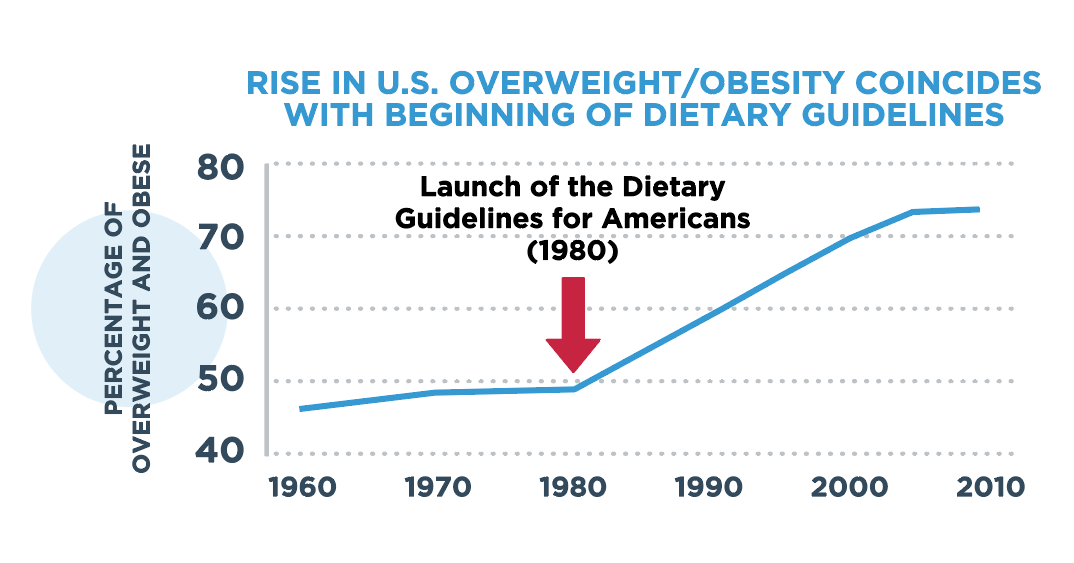
I think it is important to note that obesity skyrockets from 1980 on. The exact year the USDA began mandating a high carb diet. https://images.squarespace-cdn.com/content/v1/5a4d5666bff200...
I recommend listening to Garry Taub instead. He is a physicist. Nutrition scientists are literally not allowed to deviate from the official dietary fat causes obesity/lipid hypothesis. So it requires outsiders to get at the truth here.
Why We Get Fat: https://youtu.be/qKuDamgGkZQ
Big Fat Fiasco: https://youtu.be/exi7O1li_wA
Big Fat Nutrition Policy: https://youtu.be/hzQAHITIUhg
Edit: Carbs are sugar strung together. They are quickly chopped up and metabolized, raising your blood sugar level. To maintain homeostasis the liver responds with a squirt of Insulin. Insulin signals to your fat cells to start storing the excess sugar, which would otherwise poison you by hyperglycemia. In a normal high fat/ low carb diet, you feel full after eating, and your blood sugar returns to normal. At this point your fat cells can release those sugars back to the blood stream (to prevent hypOglycemia). But with a low fat diet your body doesn't get enough vitamins and minerals (most of which are fat soluble and removed, or made indigestiable without fat) so you stay hungry. You are forced to eat more of this high sugar food, which keeps your blood sugar high and prevents your fat cells from completing the second part of the fat/glucose cycle. So your fat cells swell and divide, making you bigger, and the bigger you are, the more nutrients your body demands. The obesity epidemic began in 1980 when the USDA began dictating a high carb diet.
There are dozens of trials involving 10s of thousands of people going back 70 years that show a clear trend of carbs causing obesity in the West. I say West because it also clear that there is a genetic component involved in the carbs/fat cycle or insuline response. Which may explain why one isolated community can consume a lot of carbs from root veg and stay lean.
Pollution, obesity, etc. are externalized costs of satiety.
I've only had to use it twice in my life, one time as an adult. I then forgot to also take probiotics at the same time, had stomac issues for weeks after the treatment.
Around 2017 I was ~100kg when I started a keto diet which excluded basically all carbs except for what is present in green vegetables, and ate more than 50% of calories from fat. Didn't control calories, just ate as much as I felt like but making sure I would still be in ketosis (used blood tests to check). I lost 5 to 6 kgs very quickly (mostly water weight) then the weight loss reduced drastically to .1 or .2 kg a week. On the other hand my BP was sky high (went even higher than before) and I got kidney stones (never happened before, and not an experience I would wish on anybody).
I quit the diet after a month and went back to eating normally. In January 2021 I was still 100kg, I started on a vegan whole foods, zero added fats/salt diet. I eat whole carbs, fruits and vegetables, but most of the calories come from carbs (yes pasta). Unlike the keto diet, after a couple of weeks the cravings stopped and it's easy to eat in a caloric deficit while feeling full because the food is way less calorie dense. I dropped 30kg in 6 months, for me the diet is easy to be on and my BP dropped to normal levels (120/80) without medications.
Again, this is just a personal experience, but my advice would be: 1) talk with a doctor/dietitian before changing your diet, especially if you have health issue, (2) don't assume because you see testimonials of things going flawless with one approach that the same will apply to you (3) keep things monitored
I always reccomend people ignore the dogma that is doled out absent-mindedly by professionals who are literally not allowed to deviate from the non-scientific lipid hypothesis. Read books instead by chaps like Garry Taub, or watch videos like those in my comment. Just this week my friend has been getting insulin shots for his type 2 diabetes (which used to be called Adult Onset Diabetes because know one knew it could affect kids until the 90s). He showed me an article about it which had a handy meal guid for diabetics. They suggest starting your day with wholemeal toast, cereal or fruit. If you think this is good advice for a diabetic then you should see what happens to your blood sugar level after eating those. It goes up a lot. And why would it not? You are eating stuff that is 50% sugar.
The author starts with that, but they continue with other arguments as well. Particularly, they bring evidence of entire cultures consuming a diet made almost exclusively of carbs who have near 0% obesity - quite powerful proof that carbs themselves are not a direct cause of obesity.
Here are two studies that support slightly smaller numbers than I claimed, but still significantly larger than 300-400.
[0] studied the factors affecting BMR in 150 Scottish adults. It found a variance between ~1100 kcal/day to ~2100 kcal/day between its subjects (for the record, 60% of the variance was attributable to lean body mass).
[1] is a meta-study that looked at RMR (expressed as kcal/kg*h) for adults at various ages. The largest variance from Figure 1 is, assuming all subjects weighed 100kg, the highest RMR would be ~2500 kcal/day, while the lowest would be 1600 kcal/day. Given the varying weights, the actual variance recorded could be bigger or smaller.
In addition to this, even people with the same BMR/RMR eating the same food will not gain the same weight - they may differ in the amount of exercise, or in their calorie calorie consumption while exercising.
[0] https://academic.oup.com/ajcn/article/82/5/941/4607670 [1] https://www.ncbi.nlm.nih.gov/pmc/articles/PMC4535334/
https://ourworldindata.org/smoking#the-rise-and-fall-of-smok...
Nicotine is known to suppress hunger
Also, agricultural output is not directly related to human consumption, past some base. So again, there may be second order effects on known causes of obesity (food and exercise) but if those are already controlled for, we are only left with unknown factors.
Regarding altitude, they do mention in a future article that California seems to be an exception, but that may be explained by California's drinking water being in a separate watershed than surrounding states. I don't know enough geography to know if this is accurate or not.
Edit: here is the quote from III:
> It’s important to note that altitude itself doesn’t affect obesity directly. Instead, altitude is a proxy for how high an area is in the watershed, which is itself a proxy for how badly the local water supply is contaminated. This is why Mississippi is more obese than low-lying areas of California. In California the water supply hasn’t traveled nearly as far in its path to the ocean, and has traveled past fewer farms, highways, cities, and factories.
On the other hand, the contribution small levels of exercise (such as getting up from your desk and walking at a normal pace, even climbing a few flights of stairs a couple of times per day) to calorie consumption is likely to be almost nothing - a few dozens of kcal over the course of a day at best. I know that there have been studies for example of the additional kcal consumption from a standing desk compared to a normal desk, and the result is almost non-existent, less than 10 kcal over the course of a workday.
Precisely. Prior to the widespread industrialization of United States farms, there were occasional famines in the United States. 1/3 to 1/2 of the country lived on farms and were engaged in farming. The industrial revolution freed us from the burden of physical labor, and provided plentiful food.
If California an exception, are Washington and Oregon also exceptions? Why does obesity not increase as one travels down the Mississippi? One would expect Louisiana (Mississippi delta) to be substantially worse than Kentucky (more mountainous and well-upstream of Louisiana) and Michigan (situated on the Great Lakes). Michigan and Louisiana are similar, and Kentucky is much worse. I refer to the author's data source.[0]
[0]https://www.cdc.gov/obesity/data/prevalence-maps.html#states
Sure, but that happened well before WWII, while the obesity epidemic started sometime around 1970-1980 and is growing rapidly. The vast majority of the US population in 1950-60 had all the food that they could possibly want, and yet <1% of them were obese, versus 30% percent today.
> One would expect Louisiana (Mississippi delta) to be substantially worse than Kentucky (more mountainous and well-upstream of Louisiana) and Michigan (situated on the Great Lakes). Michigan and Louisiana are similar, and Kentucky is much worse.
I don't know enough US geography to be able to sustain this point one way or another. I will just mention that the CDC data is not the only piece of data the article uses to show this correlation between altitude and BMI, but leave it at that.
This is not correct. Mass-scale industrialization of US farms didn't start happening until the 1930s. Remember that it was the internal-combustion engine (not the steam engine) that permitted the use of tractors and other machinery to supplant human and animal labor.
Now consider that it takes time for humans to become obese. The children raised during the beginning of the massive agricultural surplus were precisely the ones who were fueling the start of the epidemic in the 1970s.