It's been obvious for years, at least to anyone in my circle. Even my boss has said as much. We can feel it in our bones. Things are getting worse, not better, and it's accelerating.
We did this to ourselves, with our own greed and indifference, and now it's time to reap our rewards. Even now, rich nations are hoarding vaccines for themselves.
We have learned nothing and we will learn nothing, until it is too late.
Similarly, i can't see a problem with East/West divide. "Eastearn" civilisations are rising only as long as they adopt Western principles. It's not as much of a disadvantage of a Western civilisation, it's simply that it's losing it's exclusive position, because it WON: there is no alternative to market capitalism in today's world, no one even pretends there is.
There are alternatives to democracy, but success rate of democracy is a mixed bag in the West itself, and it may be simply an outdated form of government for the post-industrial world, and universal democracy where everyone votes was a short (<100 years) experiment anyway, so it's not a big deal if it ends. Democracy the way it was implemented in 200 years ago USA when 3% of people - actual stakeholders - could vote, would be the most sustainable form of government today, and it's more or less the way China is governed (where 6-7% of population are in the Party and can meaningfully vote).
1) the largest of the economies rising in Asia, being China, is funded in large part by state subsidies to this day. That won’t last forever. Few wholly Chinese companies that weren’t in Hong Kong before China took it back over have proven they can compete without these subsidies either.
2) As a result of the above, for instance, free market isn’t really “free” and I argue this about USA and EU too, yes, but China still requires that companies be 51 percent Chinese owned by default, hardly free enterprise compared to western economies all other things being equal. At least if I do business in USA or EU I don’t have to cede 51 percent of my companies ownership in that country to do business
3) globally a lot of critical natural resources are dwindling or being threatened due to climate change, depletion / overuse or just plain waste. Helium, for instance, was already a shortage pre pandemic, and is truly non renewable[0]. Oil, natural gas, and other critical resources are also reaching critical threshold levels
4) no country is immune from inequality issues, after all China, Japan and Korea have many historical examples of uprisings and civil unrest due to inequality
5) importantly, the USA is not a democracy, it’s actually a democratic republic
[0]: https://www.npr.org/2019/11/01/775554343/the-world-is-consta...
People say this all the time to try to sound wise, but in reality it's sort of a meaningless distinction.
There's a wide range of functioning models for democracy, and a democratic republic is just one form of representative democracy:
Nearly all modern Western-style democracies function as some type of representative democracy; for example, the United Kingdom (a unitary parliamentary constitutional monarchy), India (a federal parliamentary republic), France (a unitary semi-presidential republic), and the United States (a federal presidential republic).
The power of a sovereign to directly tax, and indirectly inflate its currency says otherwise.
You also need to quantify what it means for the economy to 'run off state subsidies'. There are particular sectors of the economy that are subsidized in China. The rest stand on their own. Smart subsidies reduce the overall cost to the economy, by building the foundation on which the rest could be built on.
100% of a state's economy obviously can't run off subsidies. But a smaller percentage can - and when invested smartly, grows the rest of the economy. Do you have any numbers for which fields of China's economy depend on these subsidies, and which percentage of those fields those subsidies represent?
Beyond that, the interconnectedness mentioned in the article allows hysterias to spread globally at an alarming rate. By some estimates, the reaction to covid did 100X more damage to society than it mitigated:
http://www.sfu.ca/~allen/LockdownReport.pdf
We saw childhood obesity rates skyrocket:
https://jamanetwork.com/journals/jama/fullarticle/2783690
Education attainment levels plummet:
https://www.mckinsey.com/featured-insights/coronavirus-leadi...
But the hysteria surrounding covid has made any kind of rational discussion on the costs of covid mitigation strategies impossible.
At least 3% of the entire state budget is dedicated just to subsidies, this does not include tax breaks or other special incentives and this has been growing steadily[1][2]
[0]: https://www.uscc.gov/files/000566
[1]: https://www.washingtonpost.com/business/economy/initial-us-c...
[2]: https://asia.nikkei.com/Economy/Trade-war/China-corporate-su...
Reading [1] it said the company that received the most was Sinopec, with US$450M. But according to [2], Boeing has received over $15B in subsidies since 2000, so roughly comparable. And that doesn't count tax breaks[3] and doesn't seem to include agricultural subsidies which are huge in the US/
[1] https://asia.nikkei.com/Economy/Trade-war/China-corporate-su...
[2] https://subsidytracker.goodjobsfirst.org/top-100-parents
[3] https://taxbreaktracker.goodjobsfirst.org/prog.php?detail=st...
> Eventually, the working population crashes because the portion of wealth allocated to them is not enough, followed by collapse of the elites due to the absence of labour. The inequalities we see today both within and between countries already point to such disparities. For example, the top 10% of global income earners are responsible for almost as much total greenhouse gas emissions as the bottom 90% combined. Similarly, about half the world’s population lives on less than $3 per day[0][1]
This is from 2017. This has gotten, in my view, much worse and is not continuing to alleviate itself, and I believe climate change is only making this worse over the next 5-10 years as wealthier nations and their wealthiest citizens try to insulate themselves further from its effects at the expense or perceived expense of the poor. I don’t think the current political climate is going to prove its sustainable.
Couple that with serious economic pressures as in part, a result of globalization and coming shortages and issues of natural resources and it’s a recipe for real disaster
[0]: https://www.bbc.com/future/article/20170418-how-western-civi...
[1]: https://academic.oup.com/nsr/article/3/4/470/2669331/Modelin...
The worst 10% today do about as well as majority of West was doing back then. And the condition of the poor is improving rapidly. The places were it is not true, it is due to wars.
But well, this is perspective of a Polish person. My country lost 25% of the population during wars with Sweden, 90% population of Warsaw. And then another 20% in WWII, and another 90% of Warsaw was lost. My grandmother lived through that. Later, during communist regime she managed to escape Poland right before Martial Law in 80' to Netherlands. My mother was persecuted after that due to contacts in the West.
Now we live in the EU. I have extremely hard time imagining my Swedish or German colleagues trying to kill me. Not everyone is peaceful to the east, but at least their tanks are not in Poland. That's progress too.
This is orthogonal as to whether a collapse is around the corner or not. If you look at the science in the IPCC report, combine with the inability to hit every single emissions target defined in every single climate treaty. It seems civilization collapse is on the table.
Also:
We probably are already at 2C locked in: https://www.ecowatch.com/greenhouse-gases-paris-agreement-26...
Billions of refugees by 2100: https://www.sciencedirect.com/science/article/abs/pii/S02648...
Etc.
If we don't drastically reduce emissions in the next decades, it seems very probable that this global civilization will end. Which might not be a bad thing in the long run, but in the short term it will cause a lot of suffering.
We're in a sports car hitting the gas as we head towards a cliff and you're talking about how much better the interior is on this new model compared to the last.
You shouldn't question your situation because things are 'better'.
so this seems sort of like the old joke about jumping off the skyscraper and as you fall past the 10th floor say "so far so good", only now the person falling is doing cocaine and says "things are only getting better!"
... in the kind of metrics people like Hans Rosling of Steven Pinker care about, when taking quantitative state-produced stats at face value, and with naive extrapolation (and ignoring statistical fluctuations, black swans, etc).
E.g. "the condition of the poor is improving rapidly. The places were it is not true, it is due to wars". Global warming is already a big factor and is only expected to be more so in the future.
And that's not even before any real battle for resources such as water, crops, and dwindling minerals start, mass immigration due to climate change brings its own conflicts and challenges, the decline of the US hegemony brings forth new hegemonical and tons of peripheral claims, and lets not even count inflation and other pressures (including boomer-era people coming to retirement age en masse with lots of savings issues in the US, and broken pension systems in Europe). I haven't even mentioned a possible permanent (or long term) covid mutations situation (we're already 2 years in, and measures already had a huge impact on economies).
>Now we live in the EU. I have extremely hard time imagining my Swedish or German colleagues trying to kill me.
Not to make it sound like equivalent times, but jewish people had an extremely hard time imagining their German co-patriots would try to kill them too, plenty of such historical accounts from pre/early WWII, even up to the point they were already dealing with force registration in ethnicity lists, deportations, and so on.
First, there is no local mechanism by which having too small of a fraction of the total wealth that exists everywhere will cause a group to “crash”. Groups “crash” (assuming a sane interpretation of that word) usually due to local effects, like not having enough money to buy food, and not because they’re poor compared to someone else somewhere else. Obviously relative poverty could inspire a political movement or something, but I’m not seeing the “crash” here.
Second, power law distributions for wealth are natural, seem to have existed for all of civilizational history, and are arguably the only kind of stable equilibrium state that is possible with current technology.
Third, the appeal to greenhouse gas emissions seems less like part of a coherent economic argument and more of an irrelevant appeal to the idea that wealthy people (90% of Americans, in this case) are bad because they do wealthy people stuff like enjoy abundant food and energy.
Climate change by greenhouse gas emission is just the cherry on top. The knife to the eye, so to speak.
Since the middle of the 20th century, we've lost about 75% of biomass and roundabout the same in biodiversity. Our biological support systems are collapsing all around us. System shaped by natural selection are extremely resilient. That has prevented much of the damage to manifest itself in clear signals. But now the damage has become so big that even nature's resilience cannot cope with it anymore and we start to witness more and more systems fragment and fail. See the Great Barrier reef.
This is just the start. Water is beginning to get critically scarce in many regions of the world. The political upheavals caused by the effects of predatory over exploitation and pollution will bring down nations.
And so forth.
However, income inequality is definitely one of the things getting worse with time. And it’s scary for everyone, because if you don’t have money, your ability to survive is reduced, and if you do have money… look back to what happened only a handful of centuries ago or even less when the proletariat revolted.
Sure, we aren’t there currently, but the trajectory is not going in a direction which inspires confidence in our future.
What does it mean for the "working population" to "crash"?
In the West and the rest of the world, those with the lowest income have the highest birth rate. So it can't mean a decrease in population due to low birth rate.
[0] https://twitter.com/CharlotteAlter/status/143127950480736666...
The reason the baby boomer had a much larger share of the national wealth is because they were a much larger share of the population. If you do the same graph per capita, you'll see that there's pretty much no difference between generations.
Our predatory exploitation of our biological life-support system and the massive reconfiguration of the climatic setup will cause enough disruption so as to lead to a breakdown in global cooperation. The damage wrought by pollution and over-consumption of natural resources will finally lead to a breakdown local ecosystems and to famine. Huge waves of refugees will (rightfully) demand a place to live sheltered from the calamities of climate change and they will be denied. Global commerce will stall and then stop, as refugees from failing states and countries turn to banditry and piracy. This will disrupt global cooperation and lead to regional conflicts that turn will lead to war over resources.
At least that's my best guess.
The sad thing is that we probably all see it coming, but we are in denial of it's reality. At least as a civilization. We're still chasing profit margin where where should gear for a fight for survival.
Classic Greek tragedy!
This is an absolutely moronic premise to start with. The portion doesn’t matter as long as the purchasing power stays static or is increasing.
The population doesn’t collapse when people are still getting abundant food, shelter, etc regardless of how well the rich are doing. The focus on the income of the rich instead of poverty is a distraction to pull people into a power struggle they otherwise wouldn’t care about.
It’s better to have obscenely wealthy + a high earning middle class than poverty across the board. However, the reframing of everything into income inequality makes the latter sound somehow better.
But it seems common to claim that dealing with it will make this worse. Is there any actual reasons behind this or is it just "renewable energy will kill birds" again, a sociopathic attempt to use peoples empathy against them?
After the collapse of the Soviet Union, we have been in a relatively stable world (9/11, Iraq, and Afghanistan notwithstanding -- none of them world war scale), but it now feels ever less so all the time.
If one has to have either a civil war or a world war (bizarre choice), a world war would actually serve to unite us, although our existing division is a weak starting place. A civil war destroys us from within, full stop.
My favorite conspiracy theory is that the CCP is sowing the division within us to drive us to civil war, whereby they win WWIII without ever firing a shot.
What's annoying to me is having to lead coworkers though a rational thought exercise about "do you really think we're divided? as compared to what? how exactly do you measure division?" and so forth just to get them to admit it's mostly some generalized feeling and not some rationally considered measure.
I sometimes wonder why the US gov't doesn't put CCP/Russia on blast and make Americans more aware of this. Americans love a common enemy, and if they caught wind of how much they are truly being manipulated it might shift the narrative. Maybe that would embarrass too many citizens to realize the stuff they mindlessly parrot is largely a planted narrative.
Why? For better or worse, the average person in America is lazy. Arguing online is easy, but actually engaging in kinetic warfare over a sustained period of time is extremely difficult. Even the minor conflicts that erupt at protests are tiny and irrelevant compared to an actual civil war.
There's also not much money to be made in actually destroying things, as compared to drumming up outrage (which is how the media, large and small, Alex Jones to CNN, makes its money.)
My favorite conspiracy theory is that the CCP is sowing the division within us to drive us to civil war, whereby they win WWIII without ever firing a shot.
This isn't a conspiracy theory, it's basic geopolitics. Every large state does this to each other. The US to China, China to the US, US to Russia, Russia to US.
I don't think the population is capable of a civil war just due to their health.
[1]:https://en.wikipedia.org/wiki/Obesity_in_the_United_States
What are they going to do? Fight each other on their Power Wheelchairs?
Yes I am aware of the far right arming themselves and training for years for a coming 'war'. I think with the Parler leaks + Facebook, I suspect the government knows the exact location of the overwhelming majority of these people and wouldn't hesitate to gun them down if some calamity broke out.
I agree that the CCP, Soviets and others are probably devoting some resources to spreading division. It is so cheap to do in the grand scheme of things so I guess that everyone including 'soft allies' might be participating but these tactics only work due to real issues in the society that have been unresolved for decades.
Besides...long term China has more serious problems to contend with. Things such as the coming population collapse, extreme climate change that threatens their food supplies, and growing unrest as the population starts to expect more and more from the CCP.
If those are your options, what is wrong with being destroyed from within? The two sides can split the country and each get a share - say, in proportion to their numbers.
The British aren't exactly suffering after their empire dissolved. Life still looks pretty good for them.
There is no reason to unite people who do not want to be united.
This is not only a terrible American exceptionalism thing to say, but also probably wrong if you look at history of failing states. The Russian emipre was it the brink of collapse before WW1, participation in that war lead to its collapse sooner then it probably would have.
From an outside view much of the world is long since tired of American exceptionalism, and American influence on the rest of the world. For many people the collapse of America would be a preferable option over the status quo. Me personally would prefer no war at all (neither civil nor world). However I would love to see American influence dwindle in favor of a more global solidarity of the workers of the world (including American workers).
Progress toward that point needs to be arrested or reversed judiciously, with rest stops along the way being some of the most useful.
Sometimes it can be worthwhile to point out that after WWII peace had been achieved but there were only three types of people in the world remaining.
Those that won WWII, Those that lost WWII, and those that were saved by the ones that won WWII.
Everyone else was killed.
That's what made it a world war.
Everyone living is descended from only these three types, spawned for better or worse out of their hard-won environment of unprecedented world peace.
Anyone dissatisfied with this, the only way they can change it is to start WWIII.
Got any ideas if there might be somebody willing to take us further down that road anytime soon?
It's not a conspiracy theory, it's a full-time job for a large number of Russian KGB, and Chinese state security employees.
It also wouldn't surprise me if the CCP or Russia or both are conducting propaganda campaigns to break up the U.S. without them firing a shot. These strike me as very shortsighted; the threat of an external adversary is pretty much the only thing holding large empires together, so both of those are next on the break-up list of the U.S. splits. (Arguably, the primary factor behind political divisions in the U.S. was the breakup of the Soviet Union; without the external threat of communism we have nothing to remind us that we're more alike than different.)
How is this a conspiracy theory and how is this a bad thing? The so-called Cold War (i.e., WWIII) was won by the USA "without ever firing a shot", by exactly the same method: sowing division within the socialist bloc. Do you think that the U.S.-influenced division of its enemies was a bad thing? Would you have preferred an all-out war between the two nuclear powers?
Classical liberalism is a necessity for pluralism, and pluralism is necessary for a country as diverse as the United States to survive. As soon as you drop "live and let live" as a fundamental principle and start trying to micromanage personal choice, you're on the road to division.
The Right should stop trying to ban gay marriage or abortion or TG folks from public schools. The Left should stop trying to ban guns or family gatherings or large sugary drinks or the rebel flag or traditional pronouns.
Until American can break the habit of trying to control one another and make other Americans live a certain way, we will never live up to E Pluribus Unum.
EDIT: Case in point...
I stopped reading right here. The Western Empire fell in 476 (for many reasons). The Eastern Roman Empire (Byzantine Empire) lasted until 1453. Even that isn’t a perfect way of articulating it, given the continued influence of the Catholic Church had well into the 1500’s (Luther).
In some ways one could argue civilization has never ended, but paused in different areas of the world. Also, taking a myopic view on civilization focused on the western civilization ignores the inter-continental trade that existed around Africa, Asia and Europe, doesn’t seem fair to the history.
I know that’s a reductive argument, but I do think global civilization has been continually making progress, all be it with some slow downs and set backs along the way. Yes some empires went away, but we still read writings from Ancient Greece, so is it correct to say even that civilization ended?
Long way of saying, “no” but things might change, and it could be uncomfortable for a while.
The Christians have done it for 20 centuries now, as one example.
During my life, it has always been a common expectation, though the expected cause has shifted a few times.
My hunch is that maybe we're hard wired to expect the world to end, for some undiscovered reason.
Again, I remind you of my amateur status!
If we get another FDR style reset, things should be good for a generation or two, if not... the horrors of history will rhyme once again.
Edit/Update: The New Deal provided a social safety net which greatly relieve the inequality that ripped apart Germany and other countries.
It also provided the infrastructure that just happened to make it much easier to out-manufacture the rest of the world in WWII, and benefitted society for decades later.
For the latter part of the past-decade Hubbert's theory was rubbished because of new supplies from fracking and tar-sands, but the basic hypothesis: that there is a finite supply of cheap oil remains.
There is little doubt that this resource will run out soon, putting an end to cheap transport, cheap agri (fertilizers, mechanization), and pretty much everything else we take for granted in the new 'modern' world.
It's unclear how the world can support 10B population in this scenario, even taking into account the developments in electric and hydrogen vehicles etc. In fact, one wonders if the first world will be worse off because of its extreme reliance on this.
This is a far bigger reason for the eco push, much more so than Global Warming IMO.
Just imagine the atmosphere at that workplace, must've been very heavy and brooding.
> Harappan Civilisation (Indus Valley Civilisation) [800]
But also missing is the Sumerian civilization, which I understand to have been over a thousand years. https://en.wikipedia.org/wiki/Sumer
On a microscopic view of a single life, at best we can cross our fingers and hope that we live through a calm bit.
There's also this strange idea that government itself is a bad thing (from Thomas Payne's Common Sense?), when the problem would be bad government. Someone has to make the big decisions, so if it's not the government, then presumably it's whoever has the most power?
Then there is the general abandonment of spiritual values in the west? (If you think the U. S. is a religious country, just try getting Sundays off - I probably didn't get hired at a grocery store once because of this - in the Carolinas.)
I do feel that Europe will probably find its own way after the collapse and the US will go from a global hegemon to a regional super power. A collapse of the west is still decades ahead of the average state of being in the global south.
Since China currently make almost everything, that could certainly cause some collapse-like symptoms, as key equipment becomes unavailable. Just look at some of the covid supply-chain issues for a taste.
The political system that produces governance is in itself a piece of social technology (set of laws, procedures, morals, behaviors etc) and it can easily become unfit-for-purpose. Why? because one of its primary tasks is to perpetuate an existing order. If it overdoes this "stabilization" task (that is, ignores material shifts in reality) it can hold society hostage. That period of disconnect between what society needs and what its organizational tech is offering can feel gut-wrenching and surreal.
All of the dysfunctions of the current era, e.g. environmental un-sustainability, absurd levels of inequality, rampant surveillance capitalism are well recognized and studied and, by-and-large, blueprints for solutions exist. Dig to find what is standing in the way and it is invariably i) an aged male politician and/or corporate leader who ii) has built a long career over decades knitting power networks with similar "winners" of his generation iii) is incapable of reinventing / invalidating himself and iv) will only be forced away from the cookie jar.
Maybe what is happening is not civilizational collapse but enormous resources and human talent (world-wide) are hostage to near idiotic (as in: non-adapted) political arrangements.
"as government loses control of its monopoly on violence."
but I can't articulate why...
Maybe something to do with a comparison to organized crime as a competition to a (possibly separately corrupt) government?
That certainly makes sense. The existence of organized crime does represent some failing of the state towards collapse.
I think people are a) hard-wired to expect the tomorrow to be the same as the today and b) socially trained to just keep our heads down and not stir the pot, even in face of calamity.
Because of a) and b) we're still - as a society - acting as if everything was fine and so we continue to ignore the real and present danger of a total systemic collapse.
* A trade crash across the Western empire
* A crash in manufacturing
* Widespread famine
* A retreat from cities and villas
* The withdrawal of the military
* The withdrawal of centralised government influence
* Their replacement by regional warlords
* A huge decrease in civil stability
* A huge increase in petty violence and lawlessness
The millions of people living in the area certainly didn't experience continued expansion and prosperity.
And most writings from Ancient Greece and Rome were lost to the East. Only fragments survived. Byzantium wasn't enough of an outpost to preserve the rest.
What was left in Europe until the Renaissance was a kind of Christianised cargo-cult of the original empire, with most of the knowledge and working features lost. After the Renaissance there was a superficial rediscovery of some of the writing, the architecture, and the history, and it had an influence on modern European culture. But again in a kind of cargo-culty way which eventually turned into something else entirely in every area except politics. (A Roman senator would understand exactly how the US political system works, while being baffled by the technology.)
You can argue that empire building continued elsewhere, but that's a different argument. There were empires in India, China, and the Middle East, but they were distinct and unrelated entities. If anything they've been even more forgotten.
This framing is also relevant to present-day conversations. Claiming that our civilization is collapsing makes people eyes roll. Claim that we're losing state capacity is a message people are more receptive to.
I get your point, but I think it misses the mark. By this measure, no civilization has ever ended. If you go that far, you have to argue that the end of a civilization is the same as the end of the human species.
I think it's helpful to think of it more like the end of the French revolution. No one can agree on a point in time when the revolution ended, but we all agree that it happened.
The Kingdom of Italy also maintained Roman institutions like the consuls and Roman senate, which continued to exist as an organization until the 7th century.
With Odoacer acknowledging Nepos as the nominal ruler, referring to himself with Roman honorifics (usually as a patrician), and Roman institutions being preserved, I bet the average Roman civilian wouldn’t have experienced too big of a difference between 474 and 478 even if the Western Roman Empire had already been ‘replaced’ by the Kingdom of Italy.
The pressure we are putting on other species and flora is immense but humanity’s future has never been so certain.
The only way to claim civilization collapse is to move the goal posts to a population decimation. But even that would still only put us where we were less than 200 years ago.
By the way, is there any sort of memoirs from ordinary people before WW2? Like did people at the time see it coming 1 years, 5 years etc. before?
Some are not exposed to this, so they may think nothing can ever go wrong. Or they processed the New Testament or focused on that in their upbringing. Everyone else is just getting second hand panic or second hand calm.
I was exposed to both perceptions of reality growing up. That means I take loads of psychiatric medications and am still prone to meltdowns.
The fall of the Roman and Aztec empires would be the benchmarks. Would we also consider the more recent Nazi Germany or Ottoman Empire falls as collapses?
Oh and don’t forget the French Empire fell in the 1700’s.
But does that count or did thet just evolve into a new form?
There is a really interesting talk on this: https://longnow.org/seminars/02009/feb/13/social-collapse-be...
The expectation that civilization will collapse nowadays comes from scientific knowledge based on verifiable data. We are witnessing:
- a massive decline in biodiversity
- a massive decline in biomass
- fragmentation of ecosystems
- collapse of ecosystems
These are already observable and documented facts. These by themselves present a real and urgent danger to our global human civilization. Then there are the probable consequences from the climate crisis:
- massive population migrations
- destabilization of countries and federations
- civil wars
- actual wars between countries in order to fight for resources (i.e. water).
We are headed for calamity. Let's not be delusional about that.
https://en.wikipedia.org/wiki/Stanislav_Grof
This has four potential archetypes: 1 The Amniotic Universe; 2 Cosmic Engulfment and No Exit; 3 The Death-Rebirth Struggle; 4 The Death-Rebirth Experience
Number 3 can be characterized as the valiant heroic struggle against huge odds which leads to a peaceful new age. (i.e. vaginal birth, which is extremely challenging for the child as well as mother).
Since most of us were at one time in a womb and then left it, this idea that our current state might end is indeed, as you said, hard-wired into the human brain.
I can't say that the reason has been discovered, but Grof's theories cannot be immediately discarded.
A more complete collapse might have rendered the US too damaged to focus any effort outside of itself. As it was, many people opposed entering the war on precisely those grounds-- that the US should deal with its own internal problems rather than those a continent away. FDR plowed through those objections, and incidentally sparked the economic recovery fueled by massive industrial mobilization.
Whether or not you agree with FDR's handling of the Great Depression, you cannot separate that from the course of events that shaped the outcomes of WW II (both good and bad)
I'm old enough to have known a lot of people who lived through the Depression _because_ of FDR's programs. Whether the New Deal alone could have saved the country is literally academic to the tens of millions who were saved by jobs in the CWA, WPA and CCC, or the relief provided by the FSA, SSA and economic aid to businesses under the NIRA. It seems unusually cold hearted for any historian or economist to ignore the tremendous suffering those measures spared so many, just because they didn't meet some theoretical threshold for full recovery.
https://www.washingtonpost.com/news/wonk/wp/2017/04/19/histo... https://read.amazon.com/kp/embed?asin=B01M34NBLZ&preview=new...
As long as the world remains human habitable, I agree with you.
If even 10% of the landmass where humans currently live becomes uninhabitable due to the impacts of climate change like flood, heat, drought, stable society as we've know for ~50 years has little chance.
Hundreds of millions of people will have no place to live, no food, and no water. The only possible outcome would be immense upheaval, violence and another world war.
What amazes me is people's ability to put their fingers into their ears and go "Lalala, I'm not hearing you. I'm not seeing the problem, lalala!"
Every rational observer should be able see the calamity we're headed for. I guess even the prospect of /possible/ having to give up /some/ comfort is enough for most people to just stop thinking and retreat into the ivory towers of wishful thinking.
"There's nothing wrong with our current societal setup. It's going good for me, isn't it? And of course there will be a magical mystery technology that will save us all."
We're so fucked.
Africa too, is capable of supporting a much higher population IF we want to get really serious about doing so.
Electric vehicle technology is ready to replace oil for all commuter and in-city use cases. Is it cheaper maybe not, but its not 10x more expensive. Maybe people will have to have an electric sedan instead of a $50k SUV. But people will make do.
According to https://www.eia.gov/energyexplained/oil-and-petroleum-produc... 66% of US oil usage goes to transportation. If we shift all short in-cities transportation to electric we can save oil for long haul trucks, trains, ships, planes, and industrial/agricultural uses.
As oil supplies dwindle the price will increase until most of the demand (transportation) is shifted to electric vehicles. Food and plastics might increase in price. But the average American will be able to continue their car heavy lifestyle by switching to electric.
I'm very optimistic on the future of solar and wind power. We may see average energy prices decrease significantly despite phasing out oil, coal and natural gas. But even if there are no further improvements in renewables I think electric vehicles will be good enough to avoid a peak oil crisis.
Climate change and our predatory exploitation of natural resources on the other way will end our lives.
We've already lost more than 70% of biomass and roundabout the same number in biodiversity. Since the 1970. This trend shows no sign of stopping.
Seriously; we're wrecking our own life support system. Systems evolved under the constrains of natural selection are incredible resilient. But we've been pushing it very, very, very hard for the last 250 years and we've pushed it very close to the cliff.
Wasting resources and human talent is not a problem in itself. It's suboptimal, that's it. You can interpret it simply as taming the whirlwind so that it doesn't disintegrate the structure and law, putting us back to pre-industrial times.
While that aspect of paralysis is mild, the paralysis in response to the environmental changes, to a next pandemic, to virtually any possible physical danger (whether it's an asteroid or an AGI...) is the problem to solve now. Our system needs to be much much quicker when handling dangers on a global scale.
I mean, it would be so embarrassing as a civilization to fall over some trivial bump.
the fallback, then, is to "change the system" (eg constitutional law changes, new checks and balances etc) so that people do the "right thing" by default
sounds great (even if a tall order). except this won't work either. there is no real "system" to change. you can write perfect laws and people will simply agree to ignore or subvert them if they are not internalized. we are after all just a collection of homo sapiens with our transient and volatile mental states
if I had a magic wand with a single spell I'd change the teachers. and hope that the generation they educate grows and takes control fast enough...
Yes.
And sadly it isn't happening from what I can tell ; see for instance the latest IPCC report [0].
This is the overarching theme.
If the status quo was maintained civilization would not be in danger.
What do you expect these climate refugees to do? Die quietly? "Well, we earned it, not being born into wealthy societies. We've got no one else to blame but us"?
Get real. There will be strive and conflict and war, and everyone (lookin' at you, China, USA and Russia) will still be playing the 'Great Game' and try to one-up the other ones, even though survival is at stake.
At the same time the rate of population growth has decreased and is projected to go negative within a few decades.
Sure, lots of things are still getting worse, but "getting worse more slowly" is progress. No reason to get complacent but in my opinion doom sayers do more harm than good by promulgating the nihilistic philosophy that we're all doomed anyways, so fighting our problems doesn't do any good.
Production of food has increased along with our unsustainable use of fossil fuels and the other products needed to do so. Topsoil is disappearing at an alarming rate.
I don't think a person sounding the alarm that we'll have depleted our fish stocks within 25 years, or are losing an incredible amount of topsoil each year, or are heading for dramatic climate changes that will cause an increase in disasters is a doomsayer. They're just living according to what every scientific report says. Being optimistic won't change a disruption in food supply or mass migration due to shifting weather patterns.
The past was an ongoing disaster worse than any westerner can imagine.
By the time Rome was sacked again in 455, the empire was already beginning to disintegrate into autonomous states, most of which were distinctly not Roman. Roman civilization may not yet have dissapeared from the world, but it was no longer present in many of the places it had been.
By the time you get to 476, odds are the vast majority of people in italy weren't old enough to remember Rome as a functioning civilization. Sure some traditions carried on, just as some do to this day, but people's sense of identity and cultural values had long since changed from the days of Augustus.
We're burning the planet.
It is replaced by a completely archaic/primitive way of living, with petty kindoms, local warlords, and more.
Also, in parts of europe, whole populations got ravaged by the justinian plague that came later, and eventually new people moved in as mass migration, somme cocqureing to completely replace the previous population. (e.g south slavs in the balkans). their culture, was much more aggrarian and primitive commpared to the one they did replace. Cities fell in ruins and disrepari, aquaducts stopped working, and whole thriving towns and citiess turned into piles of ruble or forgoten ruins.
This process took about 200 years and it didn't happen overnight. (470ad to 670ad), but the decline was remarkable.
So, yeah, 'ciivilization' collaped, to be replaced by a more archaic primitive way of living. It is like rolling the clock back few hundreds of years of progress and going back to 500bc. way of living.
One of Hobbs insights is that in an era with a non-functional state, the rewards of technological investment are few. Also loss of state capacity has severe impact on international trade; recognize that trade also brings ideas and innovation. And any technology that relies on supply chains becomes challenging, any technology that relies on high levels of education becomes challenging.
Every country on earth is going to suffer and struggle, and I find it impossible to believe any government would welcome millions more people who are struggling when their own system will already be stretched to breaking point.
Governments have not done so in the past for civil war, natural disasters, humanitarian crises, genocide and much worse.
But it is dangerous to extrapolate that this means our FUTURE is so certain, especially given that we have irreversibly destroyed the environment and conditions which gave us our current prosperity.
With the exception that all easily accessible resources are gone. Might be a net positive - we will see.
The current shortage give us a glimpse of how fragile it is though. I don't see how we could handle a more serious disruption.
This isn’t shit compared to things like the gas rations in the oil crisis.
> Civilizations are organized densely-populated settlements divided into hierarchical social classes with a ruling elite and subordinate urban and rural populations, which engage in intensive agriculture, mining, small-scale manufacture and trade.
Arguably a social structure is a prerequisite for a civilization. For example, you can have a village of 50 intact and trading with another village and that's not a proper civilization. There has to be the idea of a state, governance, someone entrusted to pay taxes to and perhaps some form of currency.
Pardon my assumption, but are you a software engineer in america? How would the downfall of American hegemony and union of transnational labor favor you?
Here's the real rub, there's many of us who would also fight to preserve the status quo or something close to it. You think many (most?) HN'ers with their 150K+ jobs want to live either individually or with their families at a much worse quality of life so some folks an ocean or two away can be a little better off? Big doubt.
Try to imagine near 50% child mortality on a global scale in 1800.
That's the past. Today even the poorest regions in Africa have "only" ~15% child mortality.
Waste water cleaning plants were built, so human excrement wasn't dumped to the sea anymore. At some point district heating replaced coal and wood burned in houses. Double and triple glazing arrived. The metro started operating in the eighties, replacing a lot of buses. Lead gasoline was banned in the nineties as well. Cars got electronic ignition, fuel injection and catalytic converters. Diesel engines started having tightening regulations every few years. Waste water treatment was upgraded to even remove nitrogen. New bicycle highways were made, the metro is being extended, tram lines are being built, and just a few weeks ago many diesel bus lines were replaced by Chinese electric ones.
Some things have gotten better, some things have gotten worse. But not everything has gotten worse.
It's hard to believe it's due to financial games exclusively: people are better off in real terms.
Inequality is a problem because when members of your community are living in very different conditions, the cohesion of said community is undermined, but worrying about inequality is the archetypical first world problem: a problem nonetheless, but a problem that presumes you've come a long way.
I don't know if it's true, or if it's even something we can falsify at any moment in history, but stable civilizations have collapsed, and it's worth understanding that it could happen to ours too.
For the Europe, probably.
Worldwide wise, not even close.
I'm curious by what kind of metrics the world was better 100 years ago. You're arguing against a strawman: there are challenges ahead != we were better off before.
There were a lot of extremely dirty industrial processes which we are doing much better now (in the developed countries at least), superfund sites in the US and their equivalent in other industrialized nations as the known locations, but it did not reach the global scale yet, plus, what they buried or just left in the ground where the factories spilled it is still there now for the most part.
I think that in quite a few ways we've gotten better, sure, but partly by kicking the can down the road instead of actually solving issues such as sustainable energy or water use instead of drawing from and heavily relying on exhaustible stores, as well as not having closed loops with the things we produce.
Higher temperatures (climate change, not the same as pollution).
Worsening infrastructure (the US, for example, is turning into a developing world country in many areas) as opposed to the era of great infrastructure projects, from scryscrappers and railways to the interstate system .
Lower/flattening productivity increases (as opposed to continuous productivity booms 100 years ago).
Lower/flattening invention rate (the low hanging fruits ended circa 1950-60).
More surveillance (in fact more, even at solely the state level, than even Stazi had, and with infinite potential for targeted surveillance).
Thining middle class (as opposed to incresing middle class 100 years ago).
Hugely increased inequality.
Crumbling pension systems (as opposed to pension systems being developed 100 years ago).
There are also a few tricks such "we're getting better" treatises use:
1) use the progress in countries starting from a very low bar to offset regressions in more developed countries (and since the third world countries have higher population, use an average state to shove it to the face of doubters who see their own lives and those of their countries/societies get worse and worse). This is kind of like averging Jeff Bezos' and mine wealth (kinda: what it does it says since e.g. 1 billion people went from $1/day to $2/day this is a huge 200% increase, who cares is another billion went from $100/day to $80/day and falling...).
2) take official measurements (made to make states and organizations affecting change look good) as the ground truth
3) when convenient, compare with say a century back, not 30 and 40 years back (e.g. when people didn't even have the notion of a pension, not when you expected and got one).
4) ignore any qualitative metric.
Fair enough
> Worsening infrastructure
If you're claiming that infrastructure 100 years ago was of lesser quality than today, you're living in an alternate reality.
> Lower/flattening productivity increases
False when increases taken in real terms: https://fred.stlouisfed.org/series/RTFPNAUSA632NRUG It's pretty much a line as straight up as it gets.
> Lower/flattening invention rate
As in? Science is working worse now?
> More surveillance (in fact more, even at solely the state level, than even Stazi had, and with infinite potential for targeted surveillance).
That's hard to judge. Yes, modern states have more potential for surveillance, but they arguably can get away with less abuse than they used to.
> Thining middle class (as opposed to incresing middle class 100 years ago).
Very nice how you take the first derivative.
> Hugely increased inequality.
As much as people love talking about it, 'inequality' is a vague term. Are we talking income or wealth? Worldwide, US or Europe?
Worldwide, inequality has dramatically decreased (both income and wealth). Income inequality in the US is slightly higher than post war, but marginally so. The charts they show you don't have the origin at zero, that's all.
> Crumbling pension systems
In countries that have nationalized pension systems (which aren't actually a bad thing imo), pensions are generally pay-as-you-go. If pension systems are not sustainable it's simply because politicians love using them as the 21st century grain dole: they aren't crumbling for any fundamental reason other than the political unwillingness to do the honest thing and cut benefits.
> 1) use the... > 2) take... > 3) when...
I have no axe to grind and absolutely nothing to defend. If 'those treaties' do that, they are wrong. I like talking about concrete, factual statements though, "our society is getting worse" is something that's been said for literally millennia.
> ignore any qualitative metric.
Can you point out some qualitative metric that isn't just "life was better X years ago because I was X years younger?" Because let's be honest, that's what most "qualitative metrics" boil down to. As imperfect as it might be, data is at least an honest attempt to understand the world.
Additionally the metrics being called out are things like the World Bank's poverty statistics, which applies fairly arbitrary definitions of income-based poverty that in many cases would identify people otherwise labelled "food insecure" as "not in poverty". The definitions are also applied globally and by their nature adjusted over time, which can skew the results. And even if all of these limitations are ignored most of the "improvements" are localized in China.
I'm not going to defend primitivism because I think the problem today is mostly a matter of distribution and resource inefficiency but for a metric that has gotten worse over time (though again not in the 100 year view for obvious reasons) consider leisure time. Hunter-gatherer societies spent considerably less time on sustaining themselves than the 40+ hours per week the average modern human spends working a job, doing household chores and shopping.
The problem is that a lot of the ills don't neatly fit into metrics and even when you try to do so, you have to rely on self-reporting for a lot of them. For example for most workers industrialization massively increased alienation from their work, remote work (but also on the opposite end the need to relocate for career advancement) has drastically increased social isolation, enclosure and the increasing commodification of leisure activity also have take their toll, and social media has increased the spread of disinformation, replaced social interaction with public performance and has been a massive cause of social anxieties.
And of course the thing is that a lot of the problems we have can't just be fixed by a clever improvement because their causes are intrinsic to the system. You can try to reduce overproduction and improve recycling but the best consumer action to help the environment is not to consume and the best industrial action to help the environment is not to produce. But considering how much of our economy hinges on demands people didn't know they had for things they didn't know they need (not just production but also sales, advertising, financing, sales and advertising for the financing, debt collection, sales and advertising for the debt collection to the companies doing the financing, insurance for the companies doing the financing, sales and advertising for the companies doing the insurance, and so on) that just translates into "killing jobs" and "ruining the economy".
> We see that while per capita income has indeed increased in the global South, the global North has captured the vast majority of new income generated by global growth since 1960. As a result, the income gap between the average person in the North and the average person in the South has nearly quadrupled in size, going from $9,000 in 1960 to $35,000 today.
> In other words, there has been no “catch up”, no “convergence”. On the contrary, what’s happening is divergence, big time.
The same goes for the other topics, including biodiversity.
[0] https://www.jasonhickel.org/blog/2019/3/17/two-hump-world
This does not make sense. If A and B went from earning 30k and 45k respectively to earning 70k and 90k respectively, Hickel would claim this was "divergence" - because the gap between them has risen from 15k to 20k.
But it simply isn't - A is converging with B (the gap has narrowed from 50% to 28.5%). If this trend continued linearly, A's income would surpass that of B within about 3 more periods of such "divergence".
Income is a proxy for a lot of tings.
While completely understandable and rational, people racing to get out of poverty at the same time as the great climate change catastrophe, feminism (sexes "wars"), all sorts of minority/ perpetual victims/ alternative motivation groups/attention wars -- I don't see how we'll navigate these centrifugal forces and chaos in a wise and beneficial way for the planet and for us on the long term.
Nobody is banning traditional pronouns.
Or perhaps these contentious social questions should be decided by the individual states, and citizens should be free to move to states which best match their views?
It would be nice to think that the federal government could just ban "bans", but deciding what is and isn't a ban (or which bans are strictly necessary) is an equivalent problem to the one you are trying to solve.
In any case, yes, to some extent, federalism is a partial answer to ensuring a baseline liberalism.
The technology we have today is such an overwhelming advantage and every tyrant's wet dream.
At this point, we can only hope for an illuminated and benevolent tyrant, something like a emotionally mature Elon Musk.
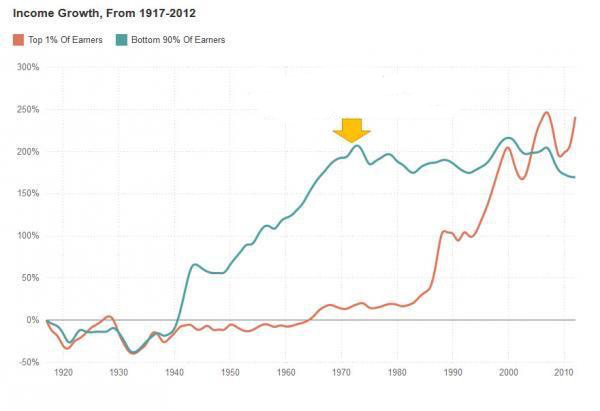
Probably the best chart: https://wtfhappenedin1971home.files.wordpress.com/2020/06/im...
That is the civilizational decline made clear by 9/11.
Just as it is generally claimed by scientists that there are a bunch of different problems coming to humanity when ecosystems collapse, temperatures rise by 1.5 degrees celsius, there's not enough freshwater to go around...
it might be stretch to claim etc. etc. but nobody is making that claim, the claim is that humanity is not reducing emissions and not doing anything significant to handle when the bills come due for the last century of everything improving!
on edit: changed is a bunch to are a bunch - is a bunch is probably still correct but are a bunch sounds more correct to my ear.
The problem is that it's advantageous for everyone to continue to externalize the costs and let everyone else pay the bill[0].
Since everyone is doing the externalizing, no one is paying the bill. Since no one is paying the bill, the resource will be exhausted sooner or later.
The resource in question is the resilience of our own biological life support system; we're wrecking it, both by by our predatory over exploitation and by pollution. We're destroying the foundations of our own survival.
The Soviet Army's fate was sealed not much differently than the US Army's was early into the operations.
Others having much more to lose through Soviet aggression would have stepped up to the plate except US arms dealers had first right of refusal for things like this.
This is clearly an absurd claim. Did you mean to qualify this somehow, like “non-livestock mammalian biomass”? That would still be incorrect, but at least might not be off by orders of magnitude.
> Water is beginning to get critically scarce
Not really. Even desalination is cheap enough at this point (on the order of 1kL/$, last I checked) that we’d be fine with modest cost increases.
> But now the damage has become so big that even nature's resilience cannot cope with it anymore
What exactly are you predicting here? This sounds very apocalyptic but doesn’t match any plausible model I’m aware of for ecological failure modes.
Not necessary. The loss in biomass in fish[0][1] and insects[2][3] and tropical rainforests[4] can account for that. Birds have also taken a deep dive[6]. The most visible I think it is for fish. There alone we've lost an approximate 80% since the 1950ies. Imagine that. 80% of fish biomass, just gone. Similar for insects. German nature reserves have seen a decline of insect population by 75%. Really; non-livestock mammalian biomass is the least of our problems.
> Not really. Even desalination is cheap enough at this point (on the order of 1kL/$, last I checked) that we’d be fine with modest cost increases.
That only covers populations near bodies of water. Ironically these are the most vulnerable to climate change and threatened by the rising sea level. And while it might be possible to build and maintain the desalination infrastructure for the 9M people in Israel, good look trying the same thing in countries like India[8] or Balgladesh[8a]?
Water crises have been ranked in the top five of the World Economic Forum's Global Risks by Impact list nearly every year since 2012[9].
A quarter of the world's population faces severe water shortage[10]. Are you going to provide water to 3 Billion people using desalination plants? In many of these places, even water treatment plants are too expensive to operate. What are you going to power these plants with? Coal? We don't even have a plan to migrate the already existing energy infrastructure to renewables.
> What exactly are you predicting here? This sounds very apocalyptic but doesn’t match any plausible model I’m aware of for ecological failure modes
Here's a helpful link[11].
The norther African coast of the Mediterranean used to be woodland. The continued depletion and over exploitation of the has led to it being the arid region it is today [12]. Now imagine that, but on a global scale. Because the last 250 years have been harsh for our ecosystem and it's now as threadbare as it can be. Ecosystem fragmentation is already a dire issue. The strings in the web are breaking, one by one [13].
[0] https://www.aaas.org/news/researcher-reports-stunning-losses...
[1] https://www.researchgate.net/publication/266684781_A_century...
[2] https://journals.plos.org/plosone/article?id=10.1371/journal...
[3] https://en.wikipedia.org/wiki/Decline_in_insect_populations
[4] https://www.researchgate.net/publication/326657472_Loss_of_b...
[5] https://www.sciencedaily.com/releases/2021/02/210225082525.h...
[6] https://abcbirds.org/wp-content/uploads/2019/10/Bird-Decline...
[7] https://www.researchgate.net/publication/309200743_Defaunati...
[8] https://qz.com/india/1114843/chinas-grand-plan-for-the-brahm...
[8a] https://undark.org/2021/08/04/the-water-crisis-in-climate-vu...
[9] http://www3.weforum.org/docs/WEF_The_Global_Risks_Report_202...
[10] https://news.trust.org/item/20200902202142-ku0o2
[11] https://en.wikipedia.org/wiki/Ecological_collapse
[12] https://en.wikipedia.org/wiki/Deforestation_during_the_Roman...
[13] https://theecologist.org/2012/feb/27/humanity-has-already-ha...
No non-trivial total biomass change occurs on scales shorter than thousands of years
It would be a truly miserable experience, but it doesn't necessarily mean the end of civilization.
The wars started by those who no longer can afford food might end civilization, but that's not assured either.
Eh, no. We don't have the infrastructure to live in air conditioned houses powered by solar or nuclear power. Both solar and nuclear only can power a fraction of houses. And if you need additional power to grow food that fraction gets ever smaller.
For both nuclear and a solar power you need an extensive, global infrastructure that will require raw materials (nuclear; fuel, solar; finished products) from all over the world. Good luck trying to acquire enough uranium from all over the world when all is going to shits. Who do you think exactly is going to do the extraction?
So, I guess we'll all die, rich and poor.
Uranium is easy. That comes from Northern Canada.
and https://v.redd.it/ayd4itr1kqg71
Marine life halved in few decades https://www.independent.co.uk/climate-change/news/marine-wil...
The sea in total is not doing great, because of agricultural emissions.
Well... one half of the country is working on such a budget. The other half is doing everything to sabotage that budget, get back control of the senate and the house and spend that $3.5 trillion on a tax bill for the super-wealthy. You know, like the last time they did that [1].
Bit even if the infrastructure got $3.5 trillion; that isn't enough to even fully repair the existing infrastructure[2]. The last time the ASCE released an infrastrucutre report, fixing the infrastructure would cost about $4.8 trillion.
That's just to fix the existing infrastructure. That money isn't going to build new nuclear reactors. By the way; how many nuclear reactors are currently being built in the US?
... Two... Two reactors with each a bit more that 1TWh. The latest one to come operational one was the Tennessee’s Watts Bar Unit 2, which began operation in June 2016. Before that Watts Bar Unit 1 in 1996. So, two new one ones in operation in 25 years. Two new ones being built.
How many more do you think we would need?
Well, we don't just have to cover the existing energy needs. Since it's getting hotter (I'm taking +1.5°C by 2050 as granted, since we're already at +1.25) we're going to need a bit more - but hey! - let's discount that. Let's say for living we don't need more energy, as generous as that is. Unfortunately you also want to grow food using electricity. And desalinate water. But let's also discount that. Let's discount all that and go with our current energy needs, for the sake of argument.
We currently have 100 reactors with each about 1TWh. That covers about 20% of US energy needs. Let's say we can get the other renewables also up to 20%. That would still leave us with about 600 new reactors to be built. By about 2060.
Do you honestly thing that this country has the political will to build 600 nuclear reactors over the span of forty years? This country cannot muster the political will to phase out coal or gas. This country cannot even muster the political will to stop subsidizing fossil fuels.
Sorry, my friend. I'm afraid that brute-forcing technology will save none of us. It might play a part in saving us, but unless we have a radical rethink about our current economic structure and incentives[3], this is just hot air.
[0] https://wusf.org/heres-whats-in-the-democrats-3-5-trillion-b...
[1] https://en.wikipedia.org/wiki/Tax_Cuts_and_Jobs_Act_of_2017
[2] https://infrastructurereportcard.org/
[3] And we know that this isn't going to happen. See [1]
You'll say "but storage". However, storage is getting cheaper even faster than solar/wind production is, and storage is not necessary for its use in food production.
Uff! I certainly didn't write it as a rant. But fine, I'll take that. But my intentions are good. I just want to make it clear to all of you that we face calamity and destruction and that there's no magical technofix that will save us. We will have to completely overhaul our socialeconomical value and incentive structures. Fat chance of that happening. (Prove me wrong! Do it!! Save mankind!)
> Not a word about solar (or wind)
Not a word about my pretty conclusive rebuttal of nuclear power as the technojebus to save mankind! I guess today no one gets what they want.
Hey, sure, we can do a feasibility examination of solar too.
> You'll say "but storage".
Haha, no. Storage is fine. There are pretty nice battery concepts in development. Liquid metal batteries are one crazy idea that I think has promise.
No, the problem lies elsewhere. Let's see: nowadays about 1.5% of energy comes from solar power, both PV and CSP. That's about 100GW (about one nuclear plant) and takes up about 1000 square miles.[0]
Let's say we somehow have the political will to cover a third of our energy needs with solar, somewhere in the ballpark of 2TW. That would cover an area of about 22,000 square miles.
So, to get to only about 33% of solar power by 2050, we'd have to cover 785 square miles with PV or CSP. Every year. For the next 28 years. Every year.
As a metric; in 2020 we've added about 190 square miles (or about 19GW) of solar power. Even if the current growth of solar power installations continues for a few years; we're still ridiculously off target. The bottleneck is installation capability.
The story is different but similar with wind.
About 1,100 MW each. Silly me.
"The biomass is the mass of living biological organisms in a given area or ecosystem at a given time."
Of course fish and insects are part of the biomass.
This paper tries to measure the thing you claimed as 75% over the last hundred or so years as actually being around 45% over the last 5,000 years. http://vaclavsmil.com/wp-content/uploads/PDR37-4.Smil_.pgs61... I found this on the greenpeace website, so if anything this is probably a gross overestimate.
Let's assume good faith on both sides, otherwise this discussion will go nowhere. Agreed?
> They’re not the total biomass
No, they're not. I never claimed that. My claim was that
>> Of course fish and insects are part of the biomass.
Anyway. That out of the way, let's have a look at
> Just because a couple species types have declined by X%,
It's not a couple of species. It's whole ecosystems that are being emptied. The Zoological Society of London report [0] monitors 4392 vertebrate species. There's a consistent and dramatic reduction.
> This paper tries to measure the thing you claimed
Thanks for the research and for taking it serious enough to do some data hunting. I'll happily dig into the report. Since it's from 2011, I wonder if there's an updated version that includes more recent data.
I honestly don't have a better source that aggregates the loss globally over all species. I would be interested in more exact numbers. (Ask HN?!)
>>>> but at least might not be off by orders of magnitude.
I think we have established that the 75% is not "off by orders of magnitude". Could it be 60% reduction? Or 50%? Sure. Absent more data this could be possible, certainly. Given that it's only been a few decades, I don't think that matter too much - it's devastating in any case.
But I think we can agree that it's definitively above 7.5% or 0.75%. I honestly think that 75% is not too far off.
[0] https://www.zsl.org/sites/default/files/LPR%202020%20Full%20...
Their misinformation campaigns wouldn't work if there weren't real core issues with the society. The internet has empowered a generation the sees whats behind the curtain.
AOC said it best: Millennials have seen a situation where 9/11 happened in Middle School, the GFC happened in college and now the covid disaster has screwed hoards of millennials once again when they are trying to purchase a home and get on their feet. Majority of millennials have never seen a time of economic prosperity in their lifetimes. It is the complete opposite to what their parents experienced. With this reality is it any wonder where there is massive discontent that results in this division? The system has failed them.
This exaggerated view is unfortunately quite common. It completely ignores the crises that previous generations had to go through, from WWII and the Korean War, to Vietnam, to depopulation of rural areas, to the Oil Crisis, to massive pollution in modern cities, to the mass lay-off of industrial workers starting in the 1980s, to inflation rates of 15-20%, etc, etc.
If you look at the raw numbers of how Boomers prospered in their life cycle and compare it to the trajectory of Millennials it tells a clear and jarring picture. Even more so for Gen Z which explain why they are eschewing capitalism at far greater numbers than Millennials ever did. Note: all of my comments applies to a lesser extent to GenX as well but AOC was referencing Millennials since she is one. The point is if you look at the trajectory from Gen X onwards it paints a picture of decline in most aspects of life.
WWII is really the Silent + Greatest Generation and does not excuse the decline that started after Boomers.
Also, the Korean and Vietnamese wars were about fighting communism and imposing Western democracy on the East
Did previous generations have the same regulations in place that cause companies to restrict employment in crappy jobs to less than 40 hours a week so you need to move between job sites or work unsteady 'gig' jobs on the side? To avoid some mandatory benefits?
In exchange we have cheap Chinese produced crap that shows the mirage of wealth but in reality there are external costs to all this tech that is not priced in when you go to pay for it. Costs such as the slave wages paid to the people who produce them and the environmental cost to produce and dispose. If US consumers had to pay the true cost of all these toys then it would expose the wage gap much more clearly.
A large amount of US politicians sold out to both China and Russia long ago. We recently had a president over $200 million in near outstanding personal debt to the CCP...
Check out which group of US senators and representatives went to have tea time with Putin on one of the recent 4th of Julys.
All of our manufacturing infrastructure is over there. There's no going back, because they're somehow able to dupe their constituents into believing they're actually hard on them while lining their pockets, especially with regards to China. Celebrities and corporations have also sold out.
It's going to be a great day of reckoning if some of these people ever learn that their leaders who've always told them they're hard on China and fighting against them are... actually not, lol.
Trump's mainland China nickname amongst the educated and literate is "Nation Builder" for a reason. With reference to their nation, not the United States. Certainly weird times we're in.
You still haven't universally grasped very simple things the rest of the world nailed almost a century ago. Little things like "vaccines are good", "Nazis are bad" or "Universal healthcare is a basic human right"
I get its a pretty young country all things considered but these are fundamental basics.
Granted you're very correct that American health care got way too profit driven which is causing accessibility and standard of care to suffer, but EU healthcare is not without its issues, just different issues.
Because CCP/Russia have already incorporated this into their disinformation campaigns. Anything anti-china is attacked as racist/nationalist. It got so radioactive that the government had to change the pattern they used to name pandemics.
What pattern is that, exactly? Looking at the Wikipedia list of worldwide pandemics with more than 1 million deaths[0], only two were named after places, and one of those ("Spanish flu") was the result of wartime misinformation and/or racism.
Admittedly the other example on that list is "Hong Kong flu" from 1968–1969, but there are other recent outbreaks which are not included, like SARS, Swine flu, and Bird flu.
[0] https://en.wikipedia.org/wiki/List_of_epidemics#Major_epidem...
That pattern used now (e.g. for COVID-19) is this:
World Health Organization Best Practices for the Naming of New Human Infectious Diseases (2015)
https://www.who.int/news/item/08-05-2015-who-issues-best-pra...
https://apps.who.int/iris/bitstream/handle/10665/163636/WHO_...
This is an improvement, as they note, on names that "provoke a backlash against members of particular religious or ethnic communities". The world has moved on since the "Spanish Flu" was named.
But I think that saying "the government had to change the pattern they used to name pandemics [because of China specifically]" is likely a misattribution and oversimplification of these guidelines.
The idea that "the government names pandemics" is both too general - a government is a huge diverse structure, if this was a governmental role, some named health body within it would have this responsibility; and also too specific - "the" government? which country's government would take on that role?
And it's not accurate - this is not any one country's government's role. Point of fact, COVID-19 was named by WHO: https://www.who.int/emergencies/diseases/novel-coronavirus-2...
A/Victoria/2570/2019 or A/Wisconsin/588/2019
A/Cambodia/e0826360/2020
B/Washington/02/2019
B/Phuket/3073/2013
> Anything anti-china is attacked as racist/nationalist.
This response always comes up when someone tries to point out racist and nationalist anti-china motivations, so clearly this argument is propaganda as well /s.
> It got so radioactive that the government had to change the pattern they used to name pandemics.
The Spanish Flu was named that way precisely so everyone would blame Spain. The participants of WWI censored any mention of the pandemic until the war was over, so Spain served as a convenient scapegoat.
This paper published by Harvard is an analysis of actual CCP propaganda tactics [1]. Arguing with people online about an issue you dislike just brings more attention to it. Instead, propaganda generally serves to distract. The average Redditor has no direct impact foreign policy in China, but they can riled up enough to cause politicians to focus on placating them rather than geopolitics. Indeed, if you observe the Russian propaganda ads on Facebook, they have nothing to do with Russia [2]. They're simply meant to sow discord.
[1] https://gking.harvard.edu/files/gking/files/50c.pdf
[2] https://cbsnews.com/media/russian-ads-on-facebook-a-gallery/
It’s hard to assume good faith when you keep saying nonsense and then acting like you didn’t. You said:
> Since the middle of the 20th century, we've lost about 75% of biomass and roundabout the same in biodiversity.
That’s obviously untrue, so now you’re acting like you were only talking about fish?
> I think we have established that the 75% is not "off by orders of magnitude". Could it be 60% reduction? Or 50%? Sure.
Did you notice that the 45% reduction was over five thousand years, not ~75 years as you claimed?
Once again, you are saying totally whack stuff to the point where I have to assume you are trolling me somehow.
> That’s obviously untrue,
I've provided quite a bit of material for your research. Here are some highlights:
- birds: reduced by 29% (north america) since 1970
- birds: reduced by 20% (europe) since 1980
- ocean fishes: 80% lost in the last 100 years (global)
- insects: 82% lost in the last 27 years (Europe)
- freshwater fishes: 80% lost since 1970
- non-livestock mammals: 78% lost since 1960
I freely admit that the 75% since 1950 number is a ballpark guess. Given the data I refer to above, I reckon it's not far off. Certainly not orders of magnitude and it is certainly not "obviously untrue". We can debate if we lost 75% or 65% or 55%, but given the consequences in any case it doesn't really matter[0].
> so now you’re acting like you were only talking about fish?
What? No. I'm talking about global, total biomass. Every species, every habitat. I'm sorry if that wasn't clear. (Why would you think that I was talking only about fish? Are you trolling me?)
With regards to fish I wrote
> The most visible I think it is for fish. There alone we've lost an approximate 80% since the 1950ies.
To rephrase; the decline of fish is easily observed by the ever diminishing returns of fishery fleets and there's a lot of data about development of the fish population.
> Did you notice that the 45% reduction was over five thousand years, not ~75 years as you claimed?
That's one paper that makes some assumptions and comes up with a model. I have to check it in detail and it looks interesting. But that does not in any way refute the data in the papers I already provided or the very comprehensive report by ZSL[1]. This is a very thorough study that compiles data for 21,000 populations of animals from 4392 species.
To quote: "The population sizes of mammals, birds, fish, amphibians and reptiles have seen an alarming average drop of 68% since 1970.
> Once again, you are saying totally whack stuff to the point where I have to assume you are trolling me somehow.
I'm sorry if you got that impression, because it's not my intention. I thought that I'd made a good case by quoting the research and various papers. I'm not sure why you say that this is "totally whack"; everything is sourced pretty well.
[0] We're staring into the abyss and the abyss is winking back.
[1] https://www.zsl.org/sites/default/files/LPR%202020%20Full%20...
https://www.who.int/news/item/08-05-2015-who-issues-best-pra...
Ordinarily it is the older generation that looks to the past with rose-tinted spectacles. Millenials must be one of the few times when it is the younger generation that does so.
That's the point; the world has always been turning. In terms of post-WWII economic history, the current "crisis" in the west is neither special nor very great.
Repeating my previous comment:
If you look at the raw numbers of how Boomers prospered in their life cycle and compare it to the trajectory of Millennials it tells a clear and jarring picture. Even more so for Gen Z which explain why they are eschewing capitalism at far greater numbers than Millennials ever did. Note: all of my comments applies to a lesser extent to GenX as well but AOC was referencing Millennials since she is one. The point is if you look at the trajectory from Gen X onwards it paints a picture of decline in most aspects of life.
You can pluck a small group from any generation and show that they are doing better. How is the cohort as a whole doing?
It appears that you are set in your ways and are not willing to actually look at how Gen Y and Gen Z are doing in reality. Every answer you have given is an excuse to lay blame on the millennials as if the majority of the generation made some critical mistake in their lives.
You are just too out of touch to reason with.