Nobel Prize in Physiology or Medicine 2021(nobelprize.org) |
Nobel Prize in Physiology or Medicine 2021(nobelprize.org) |
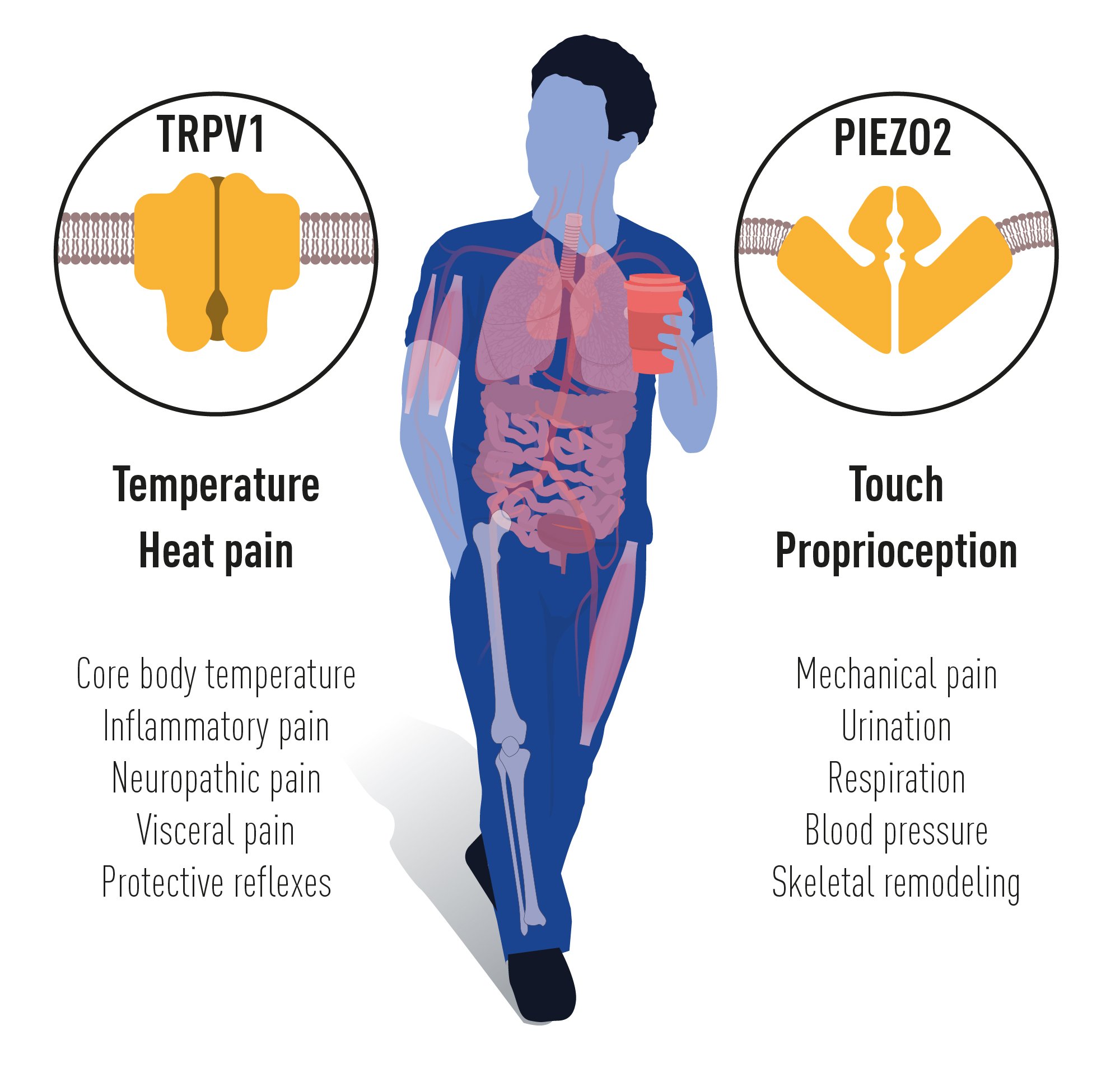
How our bodies perceive / interface with the world is fundamental to our human experience: Pain, temperature, positioning. And that these perceptions can be significantly modulated by how our bodies process them (eg pain).
Not only is their actual body of work impressive, as it cuts across so many methodologies to get a glimpse at “how things work,” their discoveries opened up fields for others.
If you throw a vase in the air it will fall down and shatter: like, duh it’s gravity. But how many years to figure the equations? To tie the how/why to the obvious?
Don’t trivialize their work because your work didn’t receive a Nobel. K thanks.
These discoveries could be game changers for prosthetics, brain computer interfaces, augmented reality, etc.
"The said interest shall be divided into five equal parts, which shall be apportioned as follows: /- – -/ one part to the person who shall have made the most important discovery within the domain of physiology or medicine …” (Excerpt from the will of Alfred Nobel)".
Nobel prizes are notorious for not being reactionary, and waiting for the full effects of the work to be realized - i.e. GFP tagging awarded the nobel prize 16 years after it was first used.
mRNA vaccination technology is just getting started, the impact of which will likely be on the level of penicillin.
I guess the committee needs another 1-2 years time to decide on that, with the benefit of hindsight.
I'd say it's a bit early for mRNA vaccines.
"to be distributed annually as prizes to those who, during the preceding year, have conferred the greatest benefit to humankind." (https://www.nobelprize.org/alfred-nobel/full-text-of-alfred-...)
On the other, mRNA research goes back to the 80's, and mRNA vaccine research goes back twenty years; these facts are often overlooked by the "it was developed too fast" crowds.
That said,
> It's not a popularity content.
And yet, they gave Obama the Nobel Peace Prize the year he was elected, without any merit or achievements to back it up. That decision was politically motivated. Same with giving it to Al Gore for his climate activism. They even tried to nominate Hitler in 1939, albeit in jest.
- the Nobel prize in medicine is not handed out by the Swedish government, so any dopey politics would not influence the Nobel prize. Rather, it is handed out by Karolinska Institutet (https://www.nobelprize.org/about/the-nobel-assembly-at-karol...)
- Sweden's handling of Covid has not been particularly influenced by politics, it's been run by the government-appointed experts (that were appointed before Covid broke out), so the "dopey politics" referred to have never really been politically motivated.
I don't think there's any reason for connecting Sweden's Covid response with who got the Nobel prize in Medicine this year.
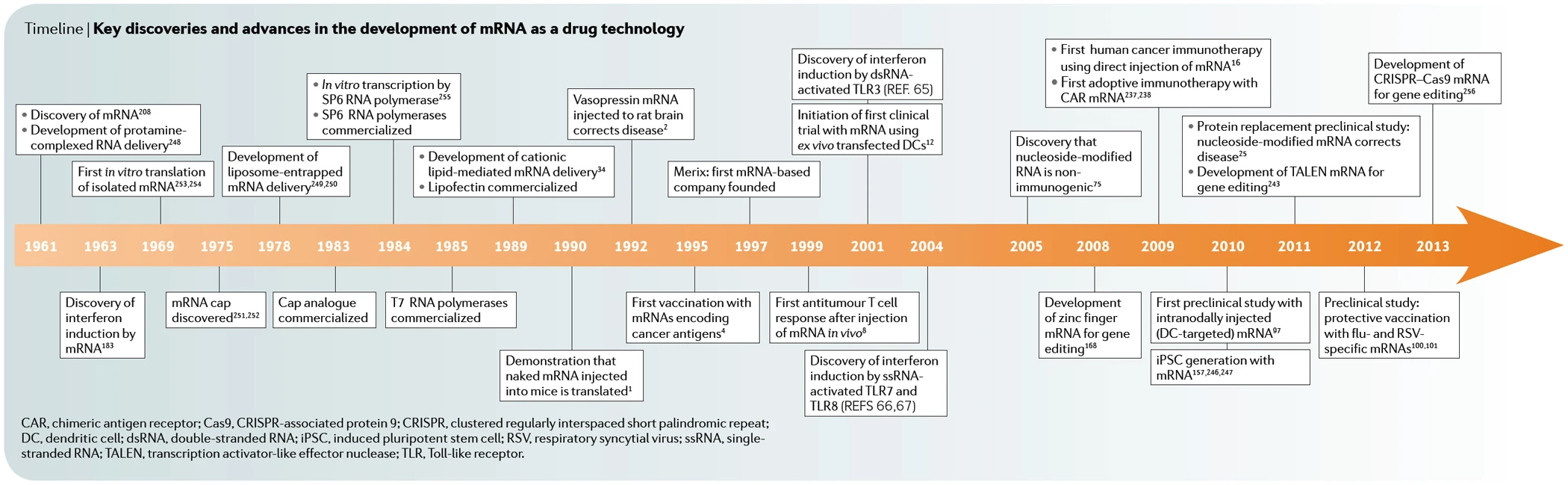
The mRNA technology would not be so clear cut in terms of persons involved since it had to go through many hurdles. There are two illustrative roadmaps [1][2] (And yes, Malone et al. was a early contributor as well (1989)[3])
[1]https://www.ncbi.nlm.nih.gov/pmc/articles/PMC7554980/bin/ijm... [2]https://media.springernature.com/full/springer-static/image/... [3]https://www.pnas.org/content/86/16/6077
As can be seen there the delay is often measured in decades. For medicine many awards around 20 years or more after discovery.
- https://www.nytimes.com/2015/10/08/world/asia/obama-apologiz...
I didn’t say I am sour I didn’t get one. When did a film critic need an Oscar before he could criticize moviemakers?
Sydney Brenner said in the 60s that they already discovered all there is to molecular biology and leave the details to the “Americans” (1). These are the details. This work would have been pedestrian back in the 60s, it’s downright boring at this point. When people ask why science sucks today this is a great example. Not that this research was performed, of course someone had to at some point. But that people have been led to believe this is worth of celebration at this level.
[1] https://www.hobertlab.org/how-the-worm-got-started/ and https://www.genetics.org/content/165/4/1633
What can I say. Next year there'll be a new price, maybe you'll be more impressed with next year's choice.
That was the Nobel Peace Prize. I'm not sure if the same applies to the Nobel Prize in Medicine.
No, never (You are confusing it with the Peace Nobel)
The celebration of mediocrity with Nobels for no real reason except probably politics (I sat near to the Nobel cabals in lectures these candidate prize winners will come give talks at) isn’t in the interest of science or progress is all.
The arrogance of this statement is astrounding. Perhaps you didn't mean it to come off that way?
First of all, these are important genes - extremely important genes, because they are a large part of the basis of that whole "response to stimulus" thing that people are pretty fond of associating with life.
That said, regardless of their actual importance, it's pretty remarkable for anyone to say any gene is important or not important considering how little we actually know about biological processes. I see all the time people doing "omics" work and wanting to jump to conclusion because of data, but data-only makes a relatively blind conclusion. There's still far far more unknown than known, and these genes are fundamental genes for starting to actually build a functional model of human biology. They are boilerplate genes.
You seem to be a biologist, is it truly heresy that there are 500 other genes that are more important than the temperature receptors? I’m talking practical therapeutic use.
It's probably that much harder to find these genes responsible for such basic sensory abilities that so much work must have gone into them if not for their lack therapeutic importance as you suggest, but also for the prestige scientists knew they would receive if they did discover them first.
The Peace prize is handled by a special Norwegian committee in accordance with Nobel's wishes, so it has its own everything (including its own ceremony), while the other prizes are all under the same umbrella in some form (although I believe the scientific subcommittees doing the acual awarding are independent).
I am on that camp, that it was developed too fast and I do not think people should be mistreated because they think that. After all, there has been some adverse effects for some of the people who took it (like the auto-immune disease for the Janssen vaccine or thrombosis that caused some deaths in women who were taking the pill at the same time). I am not against vaccines in general, I am just worried that, as there is clearly an economic interest in rushing things up, that some bugs may still be on these vaccines that will need to be fixed. We have no idea of the long-term effects these vaccines have, unless someone has invented a time-machine and gone to the future. When concrete, well-made studies have been made that these vaccines are safe long-term and effective, I do not see why should someone not take it. Until then, I will wait at the comfort of my home.
After all, even if I took the vaccine, I would also continue to spread the virus just as someone who did not take it.
Another point is: How deadly is this vaccine to someone who is healthy? Is that value so big that we should rush to take not fully tested vaccines? I would get that criticism if there was a rate of 20, 30% of guaranteed death to someone who contracted the virus. At these current values? I think I will take my chances.
At this point, so many more people have received the vaccine than have contracted the virus that I think it's fairly safe to say that we know much more about how people react to the vaccine than the virus (which also keeps mutating unlike the vaccine).
It's true that we don't know the long-term effects of the vaccine but
1) my understanding is that medically speaking, a few weeks after the shot every trace of the actual vaccine is gone from the body and all that remains is that your immune system has learned how to fight the virus and
2) we certainly do not know the long-term effects of the virus either
So unless you are in a position where you can completely seal yourself off and be sure you will not get the virus, it's a choice between getting vaccinated and getting the virus. Considering what I wrote above, to me that is an obvious choice.
As I said, I cannot. Actually, nobody can. What I do know is:
- A vast majority of who gets the virus does not die or get any effects. - A lot of people who die of Covid-19 has a comorbidity factor of 4 (Which means suffers from 4 comorbidities). - I am 40 years old and no other comorbidities than a very light asthma. I eat well and try to do some exercise (but not as much as I would like, for sure). - There are no studies of long-term effects of getting the vaccines or getting the virus. - Anyone who took the vaccine can be infected and spread the virus just as someone who is not vaccinated. - Things that are made under political/financial pressure rarely get right the first time.
So, with this data, for me it is logical for people to wait if they can. If they have comorbidities or are old, then it is another story.
Although vaccinated people can be infected and even spread the virus, the disease is usually mild, amount of infectious virus and the time they are infectious is much smaller. And that is no speciality of covid immunizations, other vaccines like measles or influenza also don't prevent infection, but aim to prevent the disease.
The "not fully tested" meme is nonsense, many hundred million people have been vaccinated in the meantime, the safety profile is known.
Regarding long time effects beside immunity of vaccines, this interview https://lexfridman.com/vincent-racaniello/ goes into some detail. TLDL: there is nothing to expect/fear.
I confess I haven't watched that video yet, but I believe there are not any studies that claim that "amount of infectious virus and the time they are infectious is much smaller". But I will watch it later and see if something new came up. I claim this because not long ago, our prime minister was infected after being fully vaccinated and had to be at home for 10 days before coming back to work.
Like I said, I am healthy and can work from home, so I have the luxury of waiting a little while to make my decision. After all, I am only affecting myself with this decision. A lot of people die from smoking/drinking alcohol as well, should we prevent them from getting it?
The correct null hypothesis is that in the counterfactual world where those people had gotten the virus rather than the vaccine, they would have ended up dead anyway.
The news say that it was unrelated to the vaccine and it was a heart attack. However, I do not believe in coincidences and am very skeptical that the vaccine has not had some effect on this. Note that she died 1 day after getting the vaccine.
I know of one other study (can't find it at the moment though) that specifically looked not for CT value but if they are able to infect cells. The outcome was something like vaccinated people do replicate virus, but the spikes of those viruses are (mostly) deactivated by antibodies and therefore not as infectious as virus obtained from unvaccinated people. In rt-PCR tests you can't really distinguish infectious from deactivated virus.
In austria, a women died of a heart attack while waiting in line to be injected. Just imagine what would have happend if the heart attack would have happened 30 minutes later, it would have been very hard to convince people the heart attack was not related to the vaccination.
I am also very distrustful of our government influence in investigations after covid vaccines. The government wants the vaccine to work so that it can go back to normality and not have to worry about the impending financial crisis that would come faster if there was no vaccine.
How do I know that other people that died after getting the vaccine were not from a side effect of it? How can I be sure that these numbers are 100% correct? How can I be sure that all those covid deaths are really from covid and not something else unrelated to it? I am not saying that the vaccines are responsible for 20, 30% of the deaths or something like that, but there is the incentive from the government to not provide the real picture of these numbers (if they are not ridiculous numbers of course).
As in tech, be very distrustful of everything version 1.0. It always has some bugs to iron out ;)
That's enough for me to believe in coincidences.
To the OP's point, the same can be said about the vaccine. Their point being, because of the transmissibility of the virus, it's fairly safe to assume that most people leading normal lives will be exposed to the virus at some point so the choice is whether or not to be exposed while vaccinated or not. There seems to be less uncertainty around the vaccine than the virus, so the risks are better known.
- I take the vaccine and either die or have a side-effect for life because of some unknown related to my body. - I contract the virus and have no symptoms at all.
Nobody knows which one will happen to each individual. That woman that took the vaccine and died one day later? We will never know if she was better off without taking the vaccine and having the virus instead. Our body is too complex to predict that right now.
I find it particularly amusing that people that question the vaccines safety are being treated as idiots that know nothing about science. Like, never the scientists were wrong before or the big pharma/government never had their own interests in their mind. I guess it is easier to attack us than to have a rational conversation.
393 million doses of the vaccine have been administered in the US
I think the safety of the vaccine has been established. You are welcome to take whatever risks you want. Just because you have been lucky so far, doesn't make it the correct approach. If you really believed it was no big deal, you'd run out and get COVID. Instead, you hope your luck will hold. Thing about luck is that it always runs out.
With most of the population (possible exception being teenage males, the last I looked, regarding myocarditis), the same outcomes are prevalent regarding the virus as the vaccine, but at lower probabilities with vaccine. Since risk = severity x probability, that generally makes the risk of the vaccine lower.
Questioning a vaccine is prudent and doesn't make someone an idiot. But sometimes there does seem to be a conflation of ideas regarding risk, data, and uncertainty.
If you remove that from the equation, it would give a lot lower number I am sure. Now compare this with the flu. Would these people with comorbities die if they catch the flu? Do you absolutely know they wouldn't?
If you have comorbidities, by all means, take the shot. If you do not have comorbidities and want to take the shot as well, fine it is your body, you can do whatever you want with it that does not put me in danger. I, for instance, want to take the shot only when I know for sure it won't affect me. After all, the city where I live was one of the firsts that got Covid cases and it got so bad that the city was in complete lockdown and at the time there was no guidance for masks usage. So, I went to supermarkets, pharmacies, whatever at that time with no mask and if I had to bet, I would bet that I already got covid and was asymptomatic.
>I, for instance, want to take the shot only when I know for sure it won't affect me.
That's fine. What's incongruent is when it's followed up with the sentiment below.
>I went to supermarkets, pharmacies, whatever at that time with no mask
I don't quite understand the logic. You don't want the shot because the risk uncertainty is too great. Yet you have no problem (likely, in your words) exposing yourself to the disease at a frame when there was little data about it and the uncertainty was also great. Now that there's more data, the uncertainty is even more in favor of the vaccine being safer than the disease.
Again, I don't really care if people don't want to get the vaccine on a personally level. But, absent of some grand conspiracy, don't try to rationalize that decision as some pragmatic risk-based analysis. If you do think its riskier due to some large conspiracy that, too, will need some data to back it up. Make peace with the fact its an emotionally based decision and not a data-driven one and move on.
This has to be an emotional decision as well, I am not a doctor, I have to follow my gut before there is data to analyze.
how many vaccine deaths occurred among people with 3/4 comorbidities?
assuming vaccine deaths are lower, and the long-term risks for the virus and vaccine are both unknown, why would a risk-based analysis suggest the virus is safer than the vaccine?
Another thing people are forgetting is that you will have to take additional vaccine shots after a few months as its protection will wane, like Israel is doing. Will be interesting to see people getting multiple doses of something they do not know its long-term effects.
> how many vaccine deaths occurred among people with 3/4 comorbidities?
It is not 0 as far as I know.
The real question then is: how well have you adjusted your posterior risk assessments now that there is more data to analyze?
Based on your previous posts, it sounds like you prior risk assessments (under uncertainty) were so strong as to prevent much modification or you may not be properly weighting the new data.