Tesla’s headquarters will move to Austin(kxan.com) |
Tesla’s headquarters will move to Austin(kxan.com) |
This will both alleviate pressure on the Bay Area as well as accelerating the political shift to the left in Texas. It's a win all around.
I actually think that living in the Bay Area as a tech employee is increasingly unjustifiable from an ethical point-of-view. It was once the case where that was necessary for many career paths but that's increasingly not the case and the pandemic has hastened that shift.
Why unethical? Because tech workers are contributing to the displacement of the people those places need to survive.
Example: I read an article about one of the Google bus drivers and what his schedule was. It was basically get up at 4am, drive for 2 hours to work, drive a bus for 5 hours, sit around unpaid for a few hours, drive for another 5 hours then drive 2 hours home. Why? Because he couldn't possibly afford to live anywhere closer.
You can argue that NIMBYism is rampant in the Bay Area and this restricts development of housing units and you'd be right. Yet the reality is you're still contributing to that displacement even though you're not responsible for those policies.
>Yet the reality is you're still contributing to that displacement even though you're not responsible for those policies.
You're arguing that people trying to make a better life for themselves are ruining the lives of others? I think it's extremely clear that Californian's own tax policies, along with NIMBYs are to blame here, not tech workers.
But this is typical, myopic 'blame the catalyst, not the problem' I see frequently from west coast-style leftists (and i say that as a staunch leftist). Tech workers are easy to point at because they are new-ish transplants (most have been here >15 years at this point), and they are considered culturally distasteful, and moderately well off.
Nobody wants to blame the multi-million dollar single family home owning boomer who voted themselves a property tax exemption in the 70s that they can literally pass to their kids (from an ethical perspective, you should be appalled that we're currently living through the birth of an actual, landed aristocracy)
The tech workers are literally trying to make a better life for themselves. The NIMBY homeowners are literally hording wealth. Yet we blame the young tech workers... it's total nonsense.
100%.
> I think it's extremely clear that Californian's own tax policies
California's tax policies have been that way since at least the 70s. I'm thinking Prop 13 and rent control, which were essentially massive giveaways to incumbents at the expense of everyone else.
Your presence is support for those policies, both tacitly by supporting companies based there and directly with your tax dollars.
But I guess it's easier to wave your hands in the air and declare it someone else's problem rather than to acknowledge the part you play in supporting the system.
> Yet we blame the young tech workers
It's not one or the other. You can both be in the wrong. And you both are, for the record.
Bay native here working in tech, and I'd argue that most SFBAY constituents are contributing to the NIMBY problem, not just tech workers. The vast majority of the workforce in the Bay doesn't work in tech, and they oppose new housing just the same.
The incentives just don't align for there to be a local solution to this problem. Unfortunately it seems this will have to be taken out of local control via bills like SB9 and SB10 that are slowly but surely chipping away at the problem.
How many of those are tech workers? It's hard to say. Here's one estimate that suggests there were ~400k in each of SF and SJ a few years ago [1].
Some of those will be single or married to other tech workers. Others will have partners outside of tech. Some will have children. I'd say for every person in tech there's probably 1-1.5 other people as a back-of-the-envelope type calculation.
That puts the tech population at around 15-20%, which passes the sniff test (at least for me) and is significant. Obviously not all of those can vote (eg immigrants are represented highly in tech) but many can. So we're talking about a group that could wield a lot of political power.
But they just don't it seems. My personal view is that Norcal tech workers as a whole are just as self-serving as the NIMBYists they like to point the finger at. I suspect that a large number of them are the NIMBYists at this point.
[1]: https://www.bizjournals.com/sanjose/news/2020/09/16/san-jose...
The sad thing though is that it seems even when you disperse highly paid workers who can work from home, inequality will continue even in other markets, see Austin, Miami [0], Nashville [1].
Then again, those markets were booming even before tech workers moved to there.
[0] https://therealdeal.com/la/2021/09/28/miami-nips-at-ny-for-t...
[1] https://fox17.com/news/local/real-estate-market-so-hot-this-...
NYC is clearly an expensive place... kind of. Manhattan obviously is really expensive but there are 4 other boroughs plus the Hudson Valley, eastern New Jersey and Long Island that are all within commuting distance.
Even with NYC prices, I content that lower-income workers are significantly better off in NYC than the Bay Area. Let me give you a concrete example. I just went onto Streeteasy and found a 2 bedroom apartment in Astoria for $295k [1]. It's a 30 minute commute to Midtown [2]
Even better, it's by public transit so no need for added expensive of buying, parking, maintaining and putting gas into a car.
You simply won't find anything equivalent in the Bay Area.
> Then again, those markets were booming even before tech workers moved to there.
I don't think that matches the data. Depending on what segment you look at prices in the Bay Area have almost doubled since 2012 [3].
[1]: https://streeteasy.com/building/21_27-33-street-astoria/sale...
[2]: https://goo.gl/maps/dvrUrWX88F1jM6gn9
[3]: https://www.bayareamarketreports.com/trend/3-recessions-2-bu...
I still agree with you for a different reason though - if you believe that it’s a poorly governed place, at some point it becomes immoral or at least unwise to continue to sustain it with your tax dollars.
I personally don't see the business owner earning an income (sometimes a substantial income) as justification for the workers to earn less than a living wage.
It's the same here: there's no good justification for someone commuting plus working 18 hours a day and getting paid for 10 of those hours.
The right solution is to fix the root cause (NIMBYism) not throw your hands up and move.
The displacement is going to happen with our without tech workers, because of the land use policies. Maybe not today, but as it stands, the region will likely never become more affordable. Blaming the tech workers for literally existing when the suburban tides turned back to urbanism is a trivially irrational post hoc argument.
But they'll also vote to protect their investments, being the significant amounts they have tied up in Bay Area housing. And if the campus workers, nurses and teachers have to drive 4 hours a day to get to work, so be it.
So far I have Joe Rogan with his spotify deal and now Musk with some of his options coming up for payday.
https://www.newsweek.com/joe-rogan-moving-texas-87-million-t...
If you really think of it - one of the main reasons Musk started in CA was because thats where his client base was to get the homegrown advantages for clientbase, talent and green benefits/cred. Now since his base has moved globally, he is moving to the lowest cost of operations (read: Texas). And to be fair - it would be very difficult to upsize any of his manufacturing capabilities in the bay area. The fact that he even has a major facility there is kind of impressive.
1. The $200-500k Federal tax bracket actually went up;
2. Loss of the SALT deduction. There are 9 states without state income tax. Most of them are red (Washington is a notable exception). This disproportionately hits blue states; and
3. Reducing the cap for the mortgage deduction, which again only affects expensive states.
We have a hung Senate, essentially. A better description is to say that it is controlled by Charles Koch, who owns Joe Machin and the Republican Party.
So these tax hikes on blue states haven't been rolled back under Biden because of Charles Koch, basically. In the proposed bill, the SALT deduction isn't getting reinstituted, the mortgage cap is the same and the corporate tax cuts (you know, the ones that will trickle down) are only getting partially rolled back.
And even that might not pass.
But what this means is that there is now a huge financial incentive for workers in California and New York in particular to move south. Hell, it was a significant factor in me moving from NYC to Florida, as an example.
But I wonder if the unintended consequence of McConnell's and Trump's giant middle finger to the blue states could be the migration of left-leaning voters to Texas, Florida and even Tennessee and Georgia (GA has a state income tax but Atlanta is cheap compared to CA/NY).
Perhaps Tesla's move is part of that trend.
It would be entertaining, to say the least, if this hastened the political extinction of the party of Trump. The trends were such that Texas is likely to be a battleground state in ~10 years as it is.
I can but hope.
alt: https://www.cnbc.com/2021/10/07/tesla-moves-its-headquarters...
While this move is great, I'm skeptical of the idea that moving to Austin is a political panacea for moderate/center-right/libertarian governance.
- The same percentage of people who voted for hard leftist candidates in SF also voted for hard leftist candidates in Austin. Don't believe me? Check it out for yourself: https://en.wikipedia.org/wiki/2020_Texas_Democratic_presiden... This means that, fundamentally, people in Austin believe the same things that people in California do.
- There are homeless issues in Austin, just as there are in SF (though not as bad as SF, it's getting worse every year).
- Many people don't realize how regulatory constrained Austin is for new buildings/housing. The same NIMBYism exists in Austin too, just like SF! But this isn't surprising since people in Austin basically have the same politics as people in SF. The only reason why rents are cheaper (though that's changing as more people move in), is because Austin isn't as big as SF. If all of the intelligent tech people moved to Austin, it would have the same supply & demand problems that SF has (since you'd have the same number of people mixed with the same regulatory constraints on new housing supply).
- Yes, it's true Austin is a place with zero income tax and fewer business regulations, but that's only because it's held at bay by the surrounding red regions of Texas. But it's only a matter of time before Texas turns blue. So in the long-run -- when the state house will be controlled by the same party running California -- why would you expect tax rates and regulations to stay low? In 10 years, Texas will have the same political makeup (at the city, state, and federal levels) as California!
- The bulk of taxes and regulations aren't at the state/city levels. They're at the Federal level. A zero percent state income tax is cool, but it only goes so far. Is the entire tech ecosystem really going to sustain this movement for a mere 10% drop in total taxes? The SF/NYC network effects are still very strong. I'm not sure such a marginal/incremental decrease in taxes is enough to affect this sort of change.
Power to Tesla though. I really, really hope to be proven wrong.
Given that half of Elon's wealth is Tesla stock, what makes Elon money is pretty much inseparable from what makes the company money. Weird thing to complain about.
It feels that : 1. It's way out of temperate climate that one would live in when given full choice and all things equal (understanding they never are of course - I live in great white North :)
2. Politics are highly conservative and frequently invasive. now clearly half of Americans like it that way,but still,seems odd for largely progressive company like Tesla that's ostensibly working to put oil industry on defence... And that's not even allowed to sell there.
Taxes?some quid pro quo to get sales in? Something else?
No forward thinking company should be setting up there right now.
Elon has options to exercise in Q4 before they expire, which will realize a substantial capital gain.
By moving both personally and his business to Texas, he is likely avoiding California state income tax and capital gains, since Texas has neither.
I’d say that’s bad faith, given how much California has subsidized his companies.
- Homelessness in Texas has decreased by 55% since 2010.
- Homelessness in California has increased by 35% since 2010.
So, there is massive a 90% gap. California is obviously doing something wrong there.
Source: United States Interagency Council on Homelessness.
https://www.slowboring.com/p/homelessness-is-about-housing-n...
I think the geographical constraints of SF (water all around) amplify the power of the above groups at the expense of others. Austin may have more space to gradually expand and spread out in a way that is more equitable and does not so disproportionately reward those who were there first.
It still seems to me that Austin will converge to SF, given enough time, given that the people in both cities believe the same things, and in only a few years Texas will be blue.
So it’s safe for glibertarians now.
https://www.texastribune.org/2021/08/09/austin-texas-camping...
Texas actually has some of the highest property taxes[1] in the nation, which (unintuitively to some) helps keep down the price of property. Countless studies (can share links if you like) demonstrate that property taxes (and land taxes in particular) are capitalized into the price of land.
California has some of the lowest property taxes, which when paired with Proposition 13, means it has some of the most expensive real estate in the nation.
[1] https://en.wikipedia.org/wiki/Property_tax_in_the_United_Sta...
2) Texas politics are invasive if you're a woman in need of an abortion, sure. But then, California politics are invasive for everyone who earns an income. If Texas politics are 'frequently invasive', then California politics must be downright suffocating.
This is marketing. Read up on how Tesla treats its workers and you'll see what their leadership's real values are.
I think the writing is on the wall for tech in CA honestly
Perhaps at that point the party will suddenly find itself again embracing the wisdom of the proposed Lodge-Gossett constitutional amendment, which got as far as approval by a super majority in the US Senate in 1950.
https://www.nationalpopularvote.com/analysis-fractional-prop...
> Can't launch rockets from California
Nearly all of SpaceX's polar orbit launches were/are from Vandenberg Air force base, just north west of Los Angeles.
Also in terms of workers rights etc - I wouldn't put Tesla in the progressive category either.
HQ in Texas makes a fair bit of sense given Musk lives there and he can split his time more readily between Space X and Tesla. That and building out in Texas is incredibly cheap and the level of talent needed to stock up at this point doesn't need to be as capable as the early company building staff - its more operational at this point.
Did you miss the memo? Progressives hate Tesla now.
Musk is building companies to change future and disrupt status quo in general (so opposite from the most generic definition of conservativism which seeks to preserve it) ; and specifically Tesla is a company that builds a product that in small way obviates what Texas exports and lives on
Given Elon's previous commentary, I think he might disagree with this evaluation.
I think it’s an important distinction that we need to address - social conservatism, what that means, fiscal conservatism, or outright low taxes, etc.
https://www.bloomberg.com/opinion/articles/2021-05-19/wait-c...
Since the decision about where a large company's headquarters is located is typically made by someone on the ultra-rich end of the spectrum, they're optimizing for things which don't apply to most of their workforce.
Cost-of-living should be lower, but I think that's important to view in more specific comparisons based on exactly where you're going to live — someone coming from San Francisco is going to find almost anywhere in the country to be cheaper but California is a big state there are many places where the comparison is going to be much less stark, and might end up being a wash depending on your job prospects and quality of life factors.
Only for the upper-middle class and rich.
https://www.bloomberg.com/opinion/articles/2021-05-19/wait-c...
That's it, that explains everything.
What would be the top ten examples of "frequently invasive" conservative policies in Texas? Just wondering what your perspective might be on this.
People get this logic when you talk about, say, Ferraris. Of course not everyone has one! They cost a lot of money!
But with housing it's like "no! It must be drugs! Or they don't work hard enough! It can't have anything to do with the cost of a home being nearly a million dollars!"
Californians pay lower average property tax rates, but California's ridiculous housing prices mean that they pay more in property taxes. Median home value in California is $554,886, average property tax is 0.7%, for a (rough) average property tax bill of $3,884. Median home value in Texas is $207,301 with an average property value of 1.6%, for a (rough) average property tax rate of 3,316.
Californians also have a higher sales tax rate and an income tax, while Texas has no income tax.
So yeah, I mean taxes.
[0]https://taxfoundation.org/high-state-property-taxes-2021/ [1]https://en.wikipedia.org/wiki/List_of_U.S._states_by_median_...
Texas produces more GWh of Solar + Wind energy than any other state in the US.
Property tax taxes two things -- the house, and the land. The portion of the tax that taxes the land is capitalized into the selling/renting price of the land, which is to say that causes it to cost less to buy the land and less to rent it. (The portion of property tax that taxes the building can actually be passed on to tenants (unlike the land portion of the tax) and serves to make building things more expensive, and that is bad, but since the majority of the price of houses in most urban areas is just land value, the land portion of the tax makes it a net gain).
Rent is not really tied to land in CA. If it were, a 1br in an apartment complex would be cheaper than a 1br detached unit since you are renting less physical land, and while much rarer, both 1brs tend to be about the same prices. Biggest factors influencing local variance in rents in California seem to be quality of neighborhood which is proxy for access to high paying jobs, fit and finish of the unit, and size of the unit.
In other words, the value of the land (which is to say, the value of the location). To be clear it's not the amount of land, it's the value of the land in particular places (especially urban land next to valuable jobs).
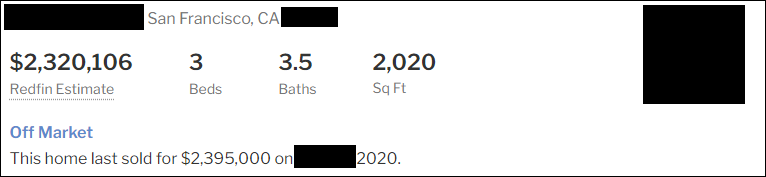
If you think land (location) isn't a big factor, perhaps you could explain why in the heart of San Francisco this 2,300 sq. foot EMPTY lot costs $2 million:
https://www.fortressofdoors.com/content/images/2021/08/image...
While this 2,020 sq. foot lot right next to it with 3 beds and 3.5 baths costs $2.3 million:
https://www.fortressofdoors.com/content/images/2021/08/image...
(found those on redfin, personal information redacted but you could find your own examples easily)
Here's a map of the land value share of real estate for the whole of the united states: https://www.aei.org/housing/land-price-indicators/
And if you don't trust the American Enterprise Institute, you should look at Larson (2015) who says much the same thing:
https://www.bea.gov/research/papers/2015/new-estimates-value...
When you tax land however, something different happens: underdeveloped land becomes a bad investment. If the taxes are the same on a single family house and a small apartment building, you're losing out on a sizable amount of money by not building the apartments (and the folks hodling vacant land are really losing out). So essentially the idea is that land taxes encourage landowners to extract as much value as they can from the land (and punish those who don't). In the Bay Area this most likely means building more housing, increasing competition, and driving down rents.
Of course, this is assuming that housing is legal to build in the Bay area, so this is most likely unrealistic
larsiusprime had a good analysis [0] that gets into some of the details.
"To be clear we will be continuing to expand our activities in California," Musk said. "Our intention is to increase output from Fremont and Giga Nevada by 50%. If you go to our Fremont factory it's jammed."
But, he added, "It's tough for people to afford houses, and people have to come in from far away....There's a limit to how big you can scale in the Bay Area."
https://www.msn.com/en-us/money/companies/tesla-moves-headqu...
Austin: https://www.redfin.com/zipcode/78725/housing-market
Fremont: https://www.redfin.com/zipcode/94538/housing-market
I mean, look at this: https://www.redfin.com/CA/Palo-Alto/3785-Park-Blvd-94306/hom...
I think Austin is better about building too, meanwhile in the Bay Area they just rejected units desperately needed in the tenderloin because they might become a "tech dorm".
In addition, a large part of Texas is privately owned and counties are much more relaxed about land use. This means high land availability for new housing. This will reduce the price increases from demand increases.
I'll simply state that I would never consider working for Tesla before, but now I would be open to it.
Travis County is pricey but it isn't too long of a drive to get to pretty cheap real estate.
The shuttles had Wi-Fi, so they could get all their regular work done while on the shuttle. That was functionally their office, even though they had a desk in the building on Bubb Road.
And they were getting paid well over $150k, and living in group homes east of San Jose, because that’s all they could afford to live in.
I loved Austin, and lived there twice, but you can stick a fork in it now. Maybe in 20 years when they’ve finished the I-35 reimagining.
Miami? Or joining the much more quiet Jacksonville or Tampa Bay exodus that this dubious survey based entirely on LinkedIn data claims:
https://www.bloomberg.com/news/articles/2021-06-01/austin-is...
Citation needed for this property value claim, also for the existence of “locked down” blue states. I haven’t seen a lockdown yet like many other places.
https://www.theverge.com/2020/7/14/21323977/austin-tesla-tax...
Because $300k houses are still pretty darned expensive when you're not making SV salaries.
It may not be the real reason (which probably has more to do with his feelings about California in general and maybe proximity to SpaceX's Texas facilities), but it's the official reason.
It's also funny that Tesla still can't sell their cars directly to customers in Texas.
It's theater. Petty, obstinate, twattish theater.
It depends on the company.
In the case of Tesla, at first it will probably be a lot like Boeing, which hardly anyone in the general public realizes is headquartered in Chicago and not Seattle.
> Musk continued on to say they will still be expanding activities in California, but they want to do that in Texas too.
> “This isn’t a matter of Tesla leaving California, our intention is to actually increase output,” he explained.
1. https://www.kxan.com/news/business/elon-musk-announces-tesla...
[1] https://www.architecturaldigest.com/story/elon-musk-lives-pr...
[2] https://www.teslarati.com/tesla-megapack-lathrop-megafactory...
https://www.businessinsider.com/elon-musk-takes-last-remaini...
Of course that message actually means our European visitors aren't that important to us.
> This site is currently unavailable to visitors from the European Economic Area while we work to ensure your data is protected in accordance with applicable EU laws.
OT: I thought that I would not see this in mid-2021.
The reason we pay close to 50% in California is that people are paid much much much more here. This is a problem you want to have.
ref: https://wallethub.com/edu/states-with-highest-lowest-tax-bur...
The Palo Alto/Los Altos/West Menlo Park areas have fought hard to prevent housing development (NIMBY!). Recently a small number of luxury homes were built in the Barron Park part of Palo Alto. The homes sold quickly for $4.5M and up. Meanwhile, on the same small street in Barron Park, there are currently five homeless people living out of their cars and three trailer homes. They use the adjacent park's open public bathroom.
I don't think the departure of Tesla HQ will have much of an impact on the town, which is a shame. Something bad is festering beneath the pristine surface here.
California is saturated, it's nice to distribute things amongst the states more evenly. There's already so many people and high value tech companies in California.
I don't think California has given Elon any significant subsidies. When Tesla asked states to compete on the Gigafactory, California lost to Nevada.
to move towards a sustainable future, he's moving on to Texas. Hell of a great use of subsidies.
But then they'd have to make cars that understand ice and snow, and autopilot is much easier to sell if they can pretend freezing weather doesn't exist....
High earners pay an effective tax rate of > 50%. They are partially picking up the slack from Prop 13, which artificially distorts the housing market by allowing longtime homeowners to pay property taxes based on decades-old assessed values while sitting on millions in equity gains.
So young, high earners see the state taking a massive chunk of their paycheck in exchange for middling infrastructure and pitiful public schools while simultaneously putting its finger on the scale of a wildly inflated housing market.
The exodus will only pick up steam unless policymakers get their act together.
California's housing issues are complex and not likely to be remedied quickly. This sounds like a completely reasonable plan at first glance.
Do they just "raise the anchor" and move with the company (if they do actually physically relocate, which does not seem to be really the case in this instance) ?
Maybe that's normal in the US but the though of having to leave your friends, parts of family family, house/flat and familiar environment in general because your company decided to relocate somewhere else is frightening! Of maybe that's just my central-European perspective.
In this particular case, not much. They are expanding their factory in California. They are not moving all their operations.
This kind of sedentary thinking is one of the many reasons why there aren't any Tesla-like companies in Europe.
https://mobile.twitter.com/unusual_whales/status/14462517624...
Who knows. But the biggest fundamental problem for California here honestly is geography: Boca Chica is the best single land based potential BEO spaceport in the continental US, simple as that. That's why SpaceX is there. As close to the equator as they can get, with a lot of water in front of most of the launch paths they want, and no urban buildup there. For the small percentage of polar orbits they'll want to do there will remain Vandenberg, or eventually converted oil rigs for sea launch, but the vast majority of SpaceX's cadence for the foreseeable future will be Starship going to more standard orbits where the bulk of Starlink will exist or eventually beyond Earth's orbit for trips to Mars.
Sure taxes and all the typical rigamarole that typically comes up in these discussions might have weighed a little one way or another, and in the vast majority of CEO/HQ moves weigh quite a bit. But to the extent that SpaceX is the biggest guiding unified dream of Elon Musk, and given the constraints of logistics, economics and the physics of orbital launch, it basically had to be there. Which means he has to be there. Which means it's a lot easier even for someone with a private jet if the HQ of his other big enterprise is around 300mi away nearly due north in the same TZ vs ~1650mi west.
If for some reason the jobs situation and housing was just perfectly impossible in Texas maybe he would have sucked it up but even then I doubt it given his (and Tesla's) resources. At the end of the day like everyone else he can't buy more than 24 hours in a day. He can buy more efficient use of them.
The simplest reason for moving is avoiding billions of dollars in California state income taxes.
https://www.houstonchronicle.com/business/article/Elon-Musk-...
They have big expansion plans and most of that is outside of California. So, I'd say this is a good move for them. They no longer need the Bay Area investors. That was always the main reason for being there. It was critical to them just a few years ago when they were struggling to survive. But they turned a corner and are now very profitable so they can cut loose from that safely.
Tesla is now a multinational and while California is still an important market for it, they have bigger markets that they are thinking about now where they are starting to operate huge factories as well. Fremont went from being the largest Tesla factory to being one of the older and smaller ones in a few years.
You look at the skyline from when Dell was founded, and look at the skyline today. It's been non-stop residential housing development, and it's only accelerating. The current squeeze is sizable, yes, but the market forces are working.
I'm not normally someone who picks on phrasing, but this one is a little orwellian. The implication is that, while homelessness is endemic basically everywhere, the proper "rules" for them to obey are that they are not to be seen. And enforcement regimes that allow them to exist in public are "lax"?
Yikes.
Lots of low/middle income Californians actually have a higher total tax burden in Texas.[1] And I’d guess that Austin is one of the places where cost of living is highest for Texas, reducing the net quality of life profit.
Also, residential expansion in those two places is a bit of apples and oranges. Bay Area is surrounded by water, mountains, and Open Space Preserve. Austin is surrounded by land, land, and more land; and most of it is flat.
[1] https://www.bloomberg.com/opinion/articles/2021-05-19/wait-c...
Austin has crazy property taxes in comparison to CA, which is where they get you.
2.5% tax rate evaluated for the property prices annually, so retiring on a fixed income in Austin is a tiny bit harder than in CA (that's the real goal of Prop 13).
Income taxes are easier to think about, because it goes to zero when your income drops, but property taxes based on the unrealized value of the house is completely out of your control.
The homestead exemption does apply, but Prop 13 is by far the superior option for an owner, though what Austin does is better for the government's fiscal policy.
I don't agree with your assertion that homelessness isn't caused in part by house prices. That seems unintuitive to me. Yes some people will get roommates, but what about people that already had roommates and were barely meeting rent? Some of them will have the foresight to get up and move interstate before they get wiped out, but there's frictions and costs associated and not everyone will succeed.
Earn above average salary and enjoy good weather, politics, and outdoors.
Earn a median salary and enjoy okay weather and lower taxes.
By More fair, I mean, CA has a similar tax rate across incomes, but does place more burden on top earners than TX does.
TX on the other hand, is unfairly taxing people more at lower incomes, and less for people at higher incomes.
TX policies don't align with my moral beliefs–I would not decide to raise my children there given the way the state is governed. That's of course a personal opinion, but I don't want to spend the rest of my life fighting for rights that we have in CA.
I used to live in California. There is no better state than California. If house price falls, I would buy another house in California.
Musk has not paid any tax because he hasn't cashed out any of his stock options yet. Some of his options will expire next year so he will pay tax then, but I am sure California will get the lion share of the tax revenue (as Musk lived in California up to 2021.)
Capital gains is taxed on the residence at time of sale, not time of purchase. So if Musk sells when he’s not a resident of CA, he won’t pay CA taxes.
CA also has some fairly unique (and IMO unfortunate) tax rules where they will still require you to pay taxes on some things even after you've moved out of state. I believe option exercise (for options granted+vested while living in CA) is one of those.
Is that incorrect?
IMHO the high income tax regime found in California is actually a function of high density, high income, knowledge based earners moving in.
If enough of them arrive, demands for services (schools, fire, police) and infrastructure (i.e. light rail, etc.) will increase. The original NIMBY locals will initially love the increasing property values and new restaurants... until their property tax bills start rising to astronomical sums.
The state will then need to push for Prop 13 like property tax capping legislation at which point the state legislature will need to raise funds somehow and magically they will end up with a 10%-20% state income tax on super high income earners like Elon, et. al.
That said - just a IMHO prediction and just saying that you can't blame it entirely on just California(ns) being dysfunctional. :)
[1] https://www.youtube.com/watch?v=AbXLnmLEevQ
Property tax values in Austin just saw the highest increase in Austin History
Just compare the building/facilities of any top bay area public school with that of Texas. The former look like shack while the latter look like mini universities. Bay area schools still rank higher because of students and parents, its nothing to do with the state.
The high taxes of CA are due to the state sector having taken over the political system, via control over the dominant narrative/ideology.
To give just one example, emergency workers can retire at 55 with 90% of their pension, that averages $108,000 per year.
California now has $1 trillion in pension obligations for its unionized public sector workers.
Have you seen where the money goes? It ain’t supporting a “technology infrastructure”.
How so? I put a salary of $300k in SF here, and came up with 38%: https://smartasset.com/taxes/california-tax-calculator#c0piT.... Obviously Fremont workers do not need to live in SF.
Honestly, coming from a third world country where I got taxed more and having had to work in Austin and Atlanta before on previous jobs, taxes are the least of my complains for California. Yeah they should fix property taxes... but my main complaint is that even though all politicians like speaking a mouthful about helping the poor and how broken healthcare is, every single government program that's supposed to help the mentally ill is utterly and completely broken beyond belief. And I'm saying this coming from Argentina that as a country has around the same population and way less GDP.
Literally the only thing about California that doesn't feel "first wordly" as all the nice places in Europe I've been to is how it deals with people that need mental health or that have housing issues. I tried discussing this with every other politician I meet or something but besides condescending smiles because of the perceived trauma they think growing up in Latin America caused (it didn't) I never get any iota of acknowledgement that something in the world is wrong. Except for the Republicans, which is the only problem in the US, apparently.
Not a lot of people hitting that regularly, but I imagine it can sting a little if you've got a more proletarian salary normally and are hitting that region just once because of say, a start up liquidity windfall
https://washingtonstatewire.com/am-i-taxed-too-much-a-compar...
It’s often seemed like people in California would prefer that a manufacturing operations operate in Asia and come through their ports rather than operate in the middle/south US.
You're making the same conservative argument about wages: if you pay a living wage companies will flee. No, if a company can't pay a living wage, it shouldn't exist. Likewise, if a company can't manufacture products without destroying the environment, it shouldn't manufacture those products.
I'm just a conservative. A nature conservative.
The SALT deduction wasn't repealed (for which a coherent argument could be made, though it would still be a bad idea), it was capped (for which there isn't even a principled argument.)
> High earners pay an effective tax rate of > 50%.
“High earners pay high rates” isn't exactly a sign of a backward tax regime.
Compared to what?
Edit: Not sure why everyone is assuming I'm saying Texas is somehow better. I'm well aware of the power grid problems there as well. The question was "in comparison to what" and setting aside CA and TX, at last count there are 48 whole other states in the nation.
[1] https://www.sfgate.com/local/article/California-exodus-is-ju...
Zero growth isn't the right baseline. The fact that the population hasn't boomed means something is definitely wrong.
Washington state is a good alternative. It has all of California’s grievance politics and collectivism but with none of the tax burden.
https://www.city-data.com/city/Austin-Texas.html
https://www.city-data.com/city/San-Francisco-California.html
Austin typically has a far lower murder rate than SF (usually 1/2 to 1/3 the rate of SF looking over the prior decade). Austin is usually well below the US national murder rate, which is rare for a major US city. Austin has a dramatically lower robbery rate vs SF. They're similar on assaults. Austin is higher by 50% on rapes. SF is a lot higher on thefts. They're similar on burglaries.
(Granted, these are pre-pandemic thoughts about moving.)
That's slowly changing, but I suspect that's temporary.
There are incredibly expensive parts of Austin. There are cheaper places in Austin.
The areas where upper-middle class Bay Area tech workers would want to love are not in the cheaper areas.
Wow. That is unreal.
Yeah, no region in almost any region of America comes close to Bay Area prices.
What you get for that in Austin is in a different league.
A suburban area with single family houses + high paying jobs = exclusionary house prices
I wonder if something else is going on for California and Texas to rank behind Mississippi, Alabama, and Louisiana? I'd bet that the issue with the standard of measure, not the actual quality of education.
I should say I think its schools are fine, rather than great.
That seems untrue, given Texas' shift toward purple. Certainly wealthy people in Texas (regardless of their politics) aren't affected too much by who sits in the state house, but there are plenty of Democrats in Texas who aren't wealthy.
And just as a random example, I bet women who are looking to terminate unwanted pregnancies in Texas right now are probably sick of the Christian zealots.
You might want to tell Tesla that. They just added a ton of office space in Palo Alto: https://www.mercurynews.com/2021/10/08/tesla-agrees-to-big-o...
I don't think OP meant anything by his post. California's policies are lax. Regardless if you think they're deserving of consideration or not, it's miserable to have a huge homeless population living next to your house. People may pretend its not real but homeless areas tend towards drugs and unsanitary conditions and it's not a great place to raise a family.
This would be shocking if the Bay Area didn't have an abundance of shelter for them and very-well-funded homeless service programs, but it does. The resources are all there, but many don't want to use them, they just want to be outside and be left alone, and the cities don't do anything about it.
[1] https://www.usnews.com/news/best-states/rankings/infrastruct...
[2] https://infrastructurereportcard.org/state-item/california/
[3] https://www.usatoday.com/story/money/2019/07/08/states-that-...
Land and more land is one solution. Density and more density is another, so the downtown can actually grow bigger and bigger; if people are willing to live closer to everything, they have a better chance than in SF (but still a far cry from NYC or Chicago).
Palo Alto High School is literally a mini university. Just do a google image search. You can't tell it apart from Stanford.
Never lived in Jacksonville, but I’ve visited it and have a friend who used to live there. Jacksonville is to Florida what Fresno is to California: bigger than you think, probably perfectly pleasant, utterly non-descript. :)
I’m…not convinced that’s an unreasonable ratio between the Bay Area and Chicago.
That is a ridiculous cost of living difference for the most expensive purchase one will likely make in their life.
[0]: https://www.propertyshark.com/Real-Estate-Reports/2020/07/07...
For example, here is Tech: https://i.imgur.com/rHBVWRt.png
Source: Sandi Metz 2019 RubyConf "Lucky You"
but also: https://ifstudies.org/blog/the-family-geography-of-the-ameri...
I know Fremont is suburban, but it's a well incorporated suburb to both SF, Oakland and San Jose. 78725 is on the opposite side of Austin from most of the fancy neighborhoods.
The big difference is that in Austin you have the option to commute a bit for much cheaper housing. But in the bay area you could be commuting over an hour each way and the houses will still be over $1 million.
And there is absolutely no transit alternative comparable to BART. There is a morning and evening train, but it's really only effective if you live and work exactly on the stops.
It's a weird mix of nascar and bumper cars, but also rolling parking lot.
Edit: It's the main way you'll go North/South here. Often times I'll double the commute taking side streets just to avoid 35 - depends on the day/time/personal interest in sport driving.
This is genuinely hilarious. Perhaps this is true at midnight, or during the early days of the pandemic. 17 miles in Austin is well over an hour at peak commuting times.
Is Austin cheaper than San Francisco? Yes.
Would I classify Austin as "affordable"?
I would have two years ago, when my wife and I were first looking to move here. That was the whole reason we began the process.
But, it's gotten insane.
We were going to wait a year, after renting, before we bought. Prices here were rising, we bought within six months so we wouldn't get priced out of our neighborhood.
On my street, I have neighbors who bought literally a year before me, who live in basically the same home (1970s subdivision so all the houses are basically templates) that paid 40% less than we did.
My neighbors could not afford to buy their current homes at the prices they're currently selling for. They cannot afford to buy similar homes in similar neighborhoods.
This is only going to get worse.
Look at prices in Portland, Seattle, Vancouver, or out east. They all easily top Austin.
I think it's a good thing. Austin has a budding tech scene. Hopefully the political shitstorm there blows over so people actually want to live there.
Literally Dell Computers is from Austin.
And yes, hopefully these changes will turn Texas purple unless they continue to gerrymander the ish out of the whole state.
How is the sprawl in Austin compared to the Bay Area?
A lot of times land/housing is cheap/er, but you 'pay' for that will long/er commutes in bad traffic. And often with few/no options for public transit.
I think if you research school costs in the jurisdiction in question, you’ll find $54 million could not pay for a lot of schools to be built. Maybe 1-2.
Since I'm apparently "posting too fast", I'll just post my reply to the post below here.
US cities (including Austin) are not built to make this viable. I grew up in Russia which mirrors the European way of building things. Everything you need for your family is within walking distance, for what I hope are obvious reasons. The US is not built for this. If one's goal is to get rid of cars, you have to build cities with that in mind. This takes decades, which is why nobody seems interested in actually doing this. Instead we get this passive-aggressive "let's build less parking and roads" thing that you see in US urban centers. No attention whatsoever is paid to how the folks actually live, how they raise their kids, and so on. I'd also argue that, as we switch to electric (and eventually to nuclear power, since that seems inevitable if we actually want to solve the climate crisis rather than just make Al Gore filthy rich), cars will become less and less of a problem, and population will spread out rather than move into the cities. Cities are a bad deal as it is. Expensive real estate, congested roads, high crime.
Take a ton of people with CA urban ideology and plop them down in a random city in TX and "intentionally bad traffic because we expect everyone in the city to give up their cars" seems like a not unforseeable outcome.
Frankly this is why we leave major infrastructure planning up to the states so that the state can wring the best possible outcome out of an entire economic region without getting too bogged down by local politics. Left to their own devices cities would build shit infrastructure because they'd try to exclude the poors and other petty stuff like that.
Slow, low traffic car trips is the sign that the city wants people to not drive.
Moving to a non car centric city means you don't need a car for your trips. The lifestyle is to stop having a car, because it's unnecessary
Even in Manhattan, where transit is pretty decent, the only reason why transit is faster (sometimes) is because traffic is terrible all the time.
I expect more builders and handymen will move to Austin to take advantage of the booming job market.
Expensive high rises contribute as much to the housing supply as any other type of housing, and use far less land for it.
Prop 13 was a "tax revolt" passed because greedy angry landowners wanted revenge on the state for taxing them.
Agree with you, but I would guess most of the Gigafactory workers who haven’t exercised stock options probably can’t afford to own in the Bay Area.
While Prop 13 probably filters down to renters in reduced rent, the supply/demand issues for housing is still pretty out of whack even with all of the new units in Milpitas. Also Prop 13 has second order effects that keep older empty nester boomers in a large house even though they would otherwise downsize if they didn’t lose such a generous benefit.
It doesn't.
Rent is set by the market. New and old landlords have drastically different tax rates but charge roughly the same rent. Same deal with gas stations: you can't figure out how much property tax they're paying based on the price at the pump.
In fact one of the main reasons California has rent control is that Howard Jarvis promised renters that landlords would be nice and pass along the cuts. Of course this was a lie and in the early 80s cities lashed out with rent control in response.
But you are right that the rental and home sale markets are entirely different. Owning costs more than renting in SF by a large margin.
Or California's housing market is just too fucked. I think this is more plausible than the income tax too high theory.
It’s all anecdotal but I’ve only heard negative things about working at a Musk co.
I backed away real quick.
So he takes out a $1 billion loan, and he offers $1 billion in stock as a security, and then also buys a futures contract (or a put option) on his $1 billion of stock to lock in the current price, so if the stock goes down in value over the life of the loan, the lender doesn't lose their security? And then when the loan falls due, he refinances – get a new loan using the same mechanism, and use it to repay the existing one? And he doesn't owe capital gains tax on the stock he uses as security, because he doesn't actually sell it?
I suppose though, you can't just go on refinancing forever. One day he will die, and then it will have to come out of his estate, and I guess his estate may pay the capital gains tax then? So it is really delaying paying tax, rather than getting out of it forever?
Unless, I suppose, he leaves the stock to a trust in his will, and transfers the loan to the trust too, and then the trust can continue this process long after he is gone? And maybe, if it is a charitable trust, even use some charitable tax exemption to get out of paying the tax permanently?
All this adds up to zero capital gains taxes being paid ever on the entire amount.
If it's hedged you actually don't have any upside so you will always be 'underwater' on the loan assuming >0 interest rate.
If interest rates were higher, it probably wouldn't make sense to do this endless loan trick[1]. Say you get charged 5% on this loan or you could pay 30% cap gains. It would only take 5 years for the interest payments to outstrip the upfront hit on the tax.
1. This is very simplistic though, as likely the $1bn would be invested in some way that would kick off some return, probably enough to cover the interest.
This is the best part. The cost basis for assets is stepped up on death to the price of the asset on the day that the decedent .. became the decedent. That becomes the cost basis for any capital gains tax the heir would owe if they sold the asset.
I just looked on Redfin - I could buy a 3300 square foot house in Austin for under $900k with a huge pool and that was a 5 second search.
No offense all you Austin folk, but you literally have no clue.
[1] https://taxfoundation.org/high-state-property-taxes-2021/
For almost all billionaires, that's a far larger constituency and a much more frequent and efficient selection process compared to elections every x years by the 30% of the population who bother to vote. As soon as they stop performing, the money stops rolling in.
"That may seem like a lot of money, but billionaire math can be deceptive. The Sacklers proposed to pay the $4.5 billion out over nine years. Their current fortune is estimated to be at least $11 billion. Conservatively, with interest and investments, this means they can expect a 5 percent annualized rate of return on that fortune. If that’s the case, they’ll be able to pay the fine without even touching their principal. When they’re done paying in 2030, they will probably be richer than they are today."[1]
There are a few cases of powerful politicians serving jail time. I can't think of a single case where a billionaire was put in jail, except for Madoff, because he was stealing from other billionaires. When you've got billions, you have enough to buy politicians every cycle. You are effectively above the law, forever, regardless of how well your initial product line is doing.
[1] https://www.nytimes.com/2021/07/14/opinion/sackler-family-op...
Nearly nobody gives a damn about the behaviour, eccentric, insane, evil, or otherwise, of the primary shareholders of a corporation that is involved, directly or indirectly, in producing products that they consume.
I may think that the Sackler family are murderous scumbags, but if I need medication made by Purdue, that's the medication I'll be buying.
Which means, mostly the millionaires and billionaires. And SuperPACs owned by corporations who have unlimited funds that they can give, because Citizens United showed that $1 = 1 vote.
I agree that CA's housing situation does often enrich landowners at the expense of lower-income folks, but my take on that is that's more caused by NIMBYism and an unwillingness to build enough housing to meet demand. The Prop-13-fueled property tax distortion certainly plays a role, but I don't think it's the dominating factor. CA's property taxes are lower (by percentage of home value) than the national average, but not by all that much, on the order of a tenth of a percent or so.
Property tax is absolutely not a progressive tax, by definition: everyone pays the same rate based on the value of their home, not based on their income or means.
Exactly. In other words, especially where supply is constrained, the property tax is incident on the landowner rather than the tenant.
> my take on that is that's more caused by NIMBYism and an unwillingness to build enough housing to meet demand
Yes, the difference in land use is bigger than the difference in tax rates. However, when property taxes are higher, there is more incentive for cities and households to allow more housing. And even if you believe that property taxes are regressive, it should give you pause to realize that it is more than made up for by California’s bad land use restrictions.
> Property tax is absolutely not a progressive tax, by definition: everyone pays the same rate based on the value of their home, not based on their income or means.
No, that’s just who writes the check. You had it right the first time. The tax incidence is who bears the burden of the tax. Since property taxes are capitalized into the price and the supply is not very elastic, an increase in projected tax payments (due to an increasing rate or increasing property value) are largely borne by the landowner (in the form of a lower sales price or a sales price that grows more slowly) rather than the young worker who buys/rents it.
WA at least doesn't have a prop 13.
FWIW I haven't been in Austin, just Dallas
But geographically speaking, Austin is pretty awful. I35 is basically the in/out for all of the commuters from the north and south. There are some tollroads but Austin has had trouble getting people to use them because they were so expensive. They even raised the speed limit to 85 as an incentive and still enough folks wouldn't pay the astronomical rates! Now, for people making software engineer salaries, they could afford it, but they likely won't be enough to continue investment in the needed timeframe.
Apple, Tesla, etc, so many huge names are moving to Austin and the city just wasn't built for it. They have enough room to make stuff happen, but construction takes money and political will. Austin is a blue city, but we all know money leans red, especially when it comes to increased taxes to pay for city projects. Can you imagine the amount of money that would need to be spent to imminent domain a subdivision for a new freeway? I can see the speculative investment purchases already! Hold them up in lawsuits for a few years while the housing prices get pumped to kingdom come.
Now, I live up the road in quaint little ole Dallas, so what do I know? I've watched the price of housing increase by 30% in a couple years. It's absolutely insane. Lucky for DFW, it has had more of a focus on transportation development across the entire metroplex a lot longer than Austin, so even during rush hour you can get all the way into downtown from the far suburbs in an hour. Granted, this is also made possible by an insane amount of investment in toll roads, but they've been strategically built through the wealthiest neighborhoods, forcing residents to take them just to leave home. (Obviously not required, but the city knew they had money to burn.)
DFW also has the second(?) largest airport in the US, processing an insane amount of cargo and thus we have highways to match. DFW boasts 4 professional sports teams, a major backbone of financial services, a thriving entertainment scene, and still plenty of room to expand.
DFW still lacks around public transportation, but if you are willing to pony up the cash for a place in the city, it's certainly possible to commute in a reasonable amount of time. You will absolutely need a car still for weekend activities unless you want to ride a bus for 3 hours one way.
Californian's, if you're going to move to Texas, go fill up Austin first before I buy a house next year, but then when you realize it's too crowded down there, you can come visit the state fair (going on now)!
;)
No, but they have to produce a product that someone is willing to consume at a price they are willing to pay for it. Meanwhile, politicians fail to reduce homelessness with a budget of hundreds of thousands of dollars per homeless person.
But business has to do more specific nice things for more people, more frequently, or they’ll be gone long before an election cycle. Politicians have a few selection events every few years.
The evolutionary pressure on business is far greater, so they reflect what we truly want much better - good or bad.
Look at some lists of top companies from 20, 30, 50 years ago. Juggernauts in their time, most of them have long been out-evolved.
Same with rich families, inherited money rarely lasts more than a few generations and tends to decline precipitously with each new batch of heirs.
But we have politicians routinely kicking around for decades based on nothing but platitudes and general charm.
> However, when property taxes are higher, there is more incentive for cities and households to allow more housing.
True, and what tends to happen in CA is that cities will approve commercial development over residential, since they can get much more tax revenue out of commercial property.
But I don't think CA's property taxes are too low; from a little searching it seems like CA's average property tax rate is only slightly below the national average. Meanwhile, Texas' clocks in at several multiples of the national average.
I'm not really sure what you're getting on about with the rest of your post, though. Property taxes, as implemented pretty much everywhere in the US, are regressive. Full stop. It doesn't matter "who writes the check". Landlords will pass on the cost of property taxes to renters. I don't really see evidence that home prices are so much lower in Texas due to the high property tax. Lower, certainly, but I would still much rather buy a house in the bay area with its inflated prices over a house in Austin.
And I expect as demand goes up in Austin, home prices will go up (if slower), and tax rates will just help make homes even more unaffordable there for lower income folks. I expect it's easier to build in Austin, but it still takes time, and likely any new demand for housing in Austin isn't primarily in the outskirts of town where things are cheaper.
[0] https://www.motherjones.com/kevin-drum/2019/11/taxes-are-sur...
Not true. Income taxes (as implemented in the US) have enormous blind spots that favor homeowners at the expense of renters: untaxed imputed rent and the capital gains tax exclusion for your main home. These undermine the claim that the income tax is more progressive than the property tax.
> Landlords will pass on the cost of property taxes to renters.
Not for the most part. The question is, when the property tax increases, how much of it is eaten by the landlord (in lower post-tax rent), and how much is a burden on the tenant (in higher gross rent due to reduced housing supply)? In California where supply is inelastic, I would argue that the low property tax is almost all a windfall to the landowner rather than the tenant.
That being said, the estate tax would kick in for everything over 11m, so he'd have to use other tricks to work around that limitation.
Not trying to belittle Austin - I know they have a tech scene - and I know every city is trying to capitalize on marketing their city as the next silicon valley (which is such a ridiculous thing to do for an incredibly long list of reasons).
Amazon is here, and again they have a number of buildings in the Domain area. I think it might be their second or third largest site, behind HQ and possibly HQ2.
Of course Dell is here. Google doesn’t have much of a presence, yet.
There are lots of other companies that have massive presence here in Austin. Tesla is highly unlikely to be the biggest.
Amazon largeset office presence outside of seattle (and bellevue which come consider seperate) is SouthBay cali, followed then by HQ2
Are you talking about paying property taxes via an escrow account that your mortgage lender takes care of for you? That's not your "mortgage payment", which is a function of your loan size, interest rate, and term, and nothing more. The monthly mortgage payment (assuming same term and interest rate) is the same in CA and TX for the same amount of loan.
(I guess we could also talk about things like PMI, but that won't raise your payment by all that much.)
Property taxes might be quite a bit higher in TX, but I'm not convinced a $900k home in TX is the equivalent to a $1.2-1.3M home in CA. I would expect that's closer to $1.7-2M, and then the property tax amounts end up being not that different.
From there tax basis more or less tracks market value, but it’s possible to protest the assessor to keep it below market value (though it’s time intensive and requires in-person hearings).
To get ahead of any artificial attempts at deflating tax basis, Dallas also maintains a comprehensive public lot value database that assigns a land value for tax purposes based on census tract (initially likely a product of redlining, but now based on average census tract market value) — so, similar to a pure land value tax, even if you’re sitting on an unimproved piece of land, you’ll still be taxed similar to the average home in the neighborhood, which has the effect of setting a tax floor.
Austin is similar, I believe. Most cities have to, as aside from sales tax property tax is their only source of revenue, because any sort of income tax is constitutionally banned.
No income tax, but property taxes are at least 2% of the assessed value, and sometimes 3. You'll see that on the Zillow listing.
But ultimately it seems like they get you one way or another, through sales, Income, and or property tax.
And yes indeed, the taxable event is vesting, it indeed happens outside of ca, and yes CA still intends to tax you! They will even come after you in another state for it, after you permanently move out.
!!!
Also, the methodology you’ve described for avoiding taxes is used to benefit from offshore holdings, not avoid paying taxes on locally held assets.
https://www.sambrotman.com/personal-income-tax-residency-cal...
Not only that, CA has Prop 13: for better or worse, your property tax is essentially frozen in the year you buy your home in CA. In TX it increases with the market value every year. And the assessors are ruthless – market value of your home went up by 20%, as they have the past few years? Expect your tax bill to too (granted, I believe legislators have restricted this to a maximum increase of 8% a year as of this session, but I believe localities are still allowed to exceed that in some cases).
Source: I'm from Dallas, and a homeowner in Los Angeles. Though rates are publically available:
https://smartasset.com/taxes/california-property-tax-calcula...
There is very good evidence that property taxes are capitalized into property values. Land taxes in specific are fully capitalized (which is to say, they lower the price of the land, and the landlord can't pass on the tax to tenants), right in line with long-standing theory:
https://web.archive.org/web/20201108135554/https://dors.dk/f...
Paying property tax might sting, but those ruthless assessors and high rates are one of the few things keeping housing affordable in Texas.
Unaffordable housing prices are as much a policy choice as a function of the market.
And TX has a sales tax of 6.25%, while SF is 9.25%.
And no state income tax in TX.
It’s not even close.
Cities have their own sales tax. And so can school districts (and they can have their own property taxes, too).
And sure, you're right, there's not much housing under $1M in the Bay Area. That doesn't change the fact that a $1M home in TX still pays about the same in property taxes as a $2M home in SF. Or the fact that in SF your property taxes are essentially frozen at purchase price, and in TX they will increase every year.
Austin/Dallas/Houston/San Antonio are not classified as "High Cost of Living" areas, as SF/LA/NYC are. This means that a conventional mortgage as of 2021 in Texas is capped at $548k, while in LA/SF it's $822k. The practical effect of that is any mortgage higher than $548k in TX is classified as a "Jumbo"/non-conventional loan, which usually comes with a higher interest rate and/or higher percent down required.
You want a $1M house in TX rather than CA? Be prepared to put $400k+ down or accept a higher rate + PMI, rather than the normal 20% down in CA. All on top of the fact that you're paying the equivalent in taxes to a $2M+ home in CA.
When I bought my home this year, it got re-assessed at my purchase price, yes. But for as long as Prop 13 is the law of the land, no matter how much home prices in CA inflate, my property tax is more or less capped at the price I paid for the house.
In November 2020, California scaled back on some of the benefits of Prop 13 for families. Prior to Prop 19, properties could pass from parents to children and the property tax basis would not increase. Now, the benefit is limited to the parents' primary residence, the inheriting child or children need to reside in the property for one year as their primary residence, and the amount excluded from reassessment is limited to $1m.
The main proponents of Prop 19 were realtors who expected the change to result in more sales of properties after parents die. I haven't seen data on it, but they were probably right. There will probably be more sales as children who inherit their parents' properties can't afford to keep them after reassessment.
Prop 19 was titled the "The Home Protection for Seniors, Severely Disabled, Families, and Victims of Wildfire or Natural Disasters Act" because it allowed seniors and victims of wildfires to sell a home and buy a new one anywhere in the state and carry over their current property tax assessment, regardless of the sale price. However, it totally undermined one of the best ways for families to pass wealth on to their children, the acquisition of properties for investment. Corporations, of course, were unaffected.
The largest share of property taxes is actually school districts which run roughly 50% of the property tax in austin. The city is 25% and the other 25% is the county, health district, and community college.
Tax rates float. If the valuations double, but the taxing entity budgets stay the same, then the tax rate will drop in half.
Rising valuations dont have much to do with the increase in taxes over time.
Financially speaking, either place may turn out advantageous depending on your house's price and income. CA (Bay Area) has a lot of other positives that are almost impossible to get in TX - tech scene (quality and quantity), nearby sea, desert AND mountains, good weather are just some of them.
Many years ago, I chose to move to TX as opposed to CA. But most recently, after living abroad for some years, I picked Bay Area to move back to mainly because most of my friends have converged to Bay Area over the years - almost all are in tech. However, if you aren't involved in tech and don't care about some of the other positives of the Bay Area, Austin is almost a no-brainer.
Arguably taxes are higher for newcomers. Yes rates are lower but purchase price is insane. But Native Sons of the Golden West pay pennies on the dollar in property tax. Old businesses to. It's a $30B per year tax cut to successful real estate investors. That's 3x the size of the NSF and several billion more than NASA.
This is the root of all California's problems. Underfunded schools, endless sprawl, state parks closing, crumbling infrastructure and rampant housing speculation. It's all because of Prop 13.
No, the root of all California’s problems are Californians. …/s?
Compare Austin to somewhere near Freemont or compare TX to CA. Comparing Austin to all of CA is more than a little dishonest since there's a lot of rural nowheres in CA to drag down the average price but the comparison exludes all of Texas's rural nowheres.
I live in Dallas. We're growing massively, but honestly, I haven't really noticed too many changes in my day to day. It takes just as long to get somewhere as it did 5 years ago.
Because they were large, spread out cities already, the highway infrastructure, suburban development, and local planning have all been optimized to support that reality. Austin tried to keep that smaller college-town feel, which was hip and trendy and cool for visitors like SXSW, but is now leading to the awful growing pains they face today.
I think Austin has the potential to be a really great city, but it's gonna take decades to get anywhere near that reality.
In the meantime, Houston is building another loop, Dallas is extending the DNT practically to Oklahoma, and Ft Worth has a shiny new tollroad on the west side of the city. They'll keep absorbing growth while Austin struggles to get organized. Unfortunately, many of the people flocking to Texas don't know any better so they go to Austin first.
My 2¢.
I do wonder how much this affects salaries, though. Do employers in states with lower or no income taxes tend to pay worse for the same job than employers in states with higher income taxes?
One thing to consider though, is that the companies available to work for outside Austin, probably aren't supplementing salaries with generous stock compensation packages. If more startups move to Texas, that could change too.
With two working adults in the house, 120k/ea is a very comfortable living.
A lower income tax may cause more people to live somewhere and/or more people to be willing to work for less, but it still comes down to whether or not the supply of labor willing to work at a lower price exists.
It doesn't tell you anything that only 1 of them went to jail. Even assuming they are incarcerated at something close to the background rate (an unreasonable assumption) we would expect 0% of them to be in jail; at any given moment. Adjust that for the fact that they have basically no rational reason whatsoever to commit crimes and there is nothing unusual going on.
2) "Wealthy person goes to jail" isn't actually all that newsworthy. Politicians are always going to get more news headlines because, ironically, or politics.
They may have no rational reason to fear prosecution, but they commit crimes all the time. Becoming untouchably wealthy does not remove base desires from anyone, it only shields them from accountability.
"The uber-rich also shield their wealth through elaborate purchases of real estate, yachts, jets and life insurance. Moving money around between bank accounts, estate and inheritance planning, engaging in a web of complex financial engineering, help them from paying their fair share of taxes. Some of the documents suggest the possibility of financial crimes, including money laundering."[1]
If you don't file your taxes correctly and you fail to pay the fines, or you attempt to defraud the government, there's a very good chance you will do time. The same is not true of the billionaire class no matter how much money the steal through tax avoidance schemes.
Once they have enough money, they can lawyer up and get out of just about anything, even the repeated sexual assault of their own family.[2] The only time they are held to account, with a few exceptions, is when the victims are other billionaires or powerful autocratic states.
This is not some new anti-wealth idea. Equal application of the law regardless of wealth, birth, or status is the fundamental American value. Or at least it was.
[1] https://www.forbes.com/sites/jackkelly/2021/10/04/the-pandor...
[2] https://www.forbes.com/sites/cartercoudriet/2019/06/28/curt-...
You seem to be going to tax minimisation - sure, the billionaires have a massive advantage when they engage with the law relative to you or I - but there is no reason they should go to jail for that. The basic assumption is if you have multiple accountants doing your tax return then the tax return should be legally proper. It got a lot of attention.
And sure, property taxes for a $1M home in TX is the same as a $2M house in SF, but that's a mansion in TX and a 2 bedroom apartment in SF. You get way more for your money.
And google tells me that TX does cap property tax increases. Not like Prop 13, but we all agree Prop 13 is terrible, right?
And everyone is ignoring the state income tax which is 9.3% in the $60 to $300k bracket (and goes up to 13.3%). So if you’re making $250k, that’s saving of $20k alone, which is about the property tax in TX.
It’s not even a close comparison in terms of the tax burden between the two.
The maximum cumulative rate by law is 8.25%.
Exactly. And this is important for potential homeowners to understand. It is one of the things that makes California real estate so attractive. One has to view their house as an investment, not just a place to live.
The two are directly linked, so this makes sense. A higher property tax means that the future annual rent (real rent if you're a landlord, imputed rent if you're a owner-occupier) you get from property will be reduced, so the capitalized present value will decrease correspondingly.
My mom has a million dollar home in California and pays around 1.5k/year in property taxes because she's owned it since the 70s.
EDIT: and we’ve owned this house since 2008.
The idea that property tax is passed down to renters 1:1 is just something you made up.
The concept you need to look into is called tax incidence: https://www.maxwell.syr.edu/uploadedFiles/cpr/efap/Notes%20o...
Assuming you made exactly 100k as a nice lowball you'd have owed $6947.92 in 2011 California income taxes. Harder to quickly find 2011 Austin property taxes but using todays rates without the homestead exemption you would have paid $4653 presuming you lived in Austin proper with Austin ISD taxes.
This is obvious a simplified calculation assuming basic W2 income and may very well not have applied to you, but for others reading it's nice to see some actual numbers.
California taxes were affected by CA deduction, CA personal exemption, and 401k (which I didn't max out, and even without it I think the original claim still stands although just barely)
I'm a would-be beneficiary of Prop 13 Pre-19 and a homeowner in Los Angeles, and even I voted for this reform. I would vote to repeal Prop 13 in whole if I could. Prop 13 was originally meant to protect middle-class Californians from losing their primary home (for which other alternatives exist: see TX. Your primary home cannot be taken from you for tax reasons or in bankruptcy) – not a tax loophole for generational wealth.
Not true. Only $1m of assessed value is excluded for heirs moving into an inherited property as a primary residence. Inheriting property worth more than $1m is not a bad problem to have, but in places like Los Angeles it means that a lot of people not be able to afford to live in the property and will be faced with either fixing it up for use as a rental or selling the home they grew up in.
It doesn't really change my point though – I still don't see why a $2M+ property deserves to get transferred tax free. A $2M property would still only pay a little over $10,000/year in property taxes after the $1M exemption (which you can deduct against federal taxes, even with the SALT cap, which itself will likely repealed!). A pretty nice discount for an heir compared to someone who just went through actually buying a $2M home and pays twice the tax.
Honestly, if you're inheriting up to a $5M home for free in CA, and are still reliant on a job to make ends meet, the payment probably comes out to more or less what you would pay in a mortgage+taxes for a ~$1M home. A pretty good deal! If you're inheriting anything more than a $5M home, then I don't really think Prop 13 was intended for you in the first place – people with $10, $50, $100 million+ properties, well, it's my belief that we shouldn't be basing our entire housing policy on what's best for them. They can likely afford the taxes.
Not to mention that you can only shield a house from re-assessment for 1 generation, so even if there was a multi-million dollar family home that this family simply couldn't afford to pay taxes on otherwise, the heir of the heir would have to pay taxes regardless. So what's so privileged about the situation that tax reassessment gets to skip a generation? The law as is is designed to benefit a shrinking sliver of the CA population while debatably actively hurting the rest.
I think a decent compromise that won't actively pull the rug out from anyone while also leveling the playing field is just ending Prop 13-related inheritance exemptions altogether. It wasn't even part of the original law. Then get rid of the exemption for all commercial and secondary/investment properties going forward. Let people live in their primary homes with a frozen tax basis, sure, just don't let them transfer it (and for the edge case, to encourage downsizing after becoming "empty nesters", allow people to transfer their assessed tax basis to a property of lesser or equal market value).
Billionaires should to go jail for tax fraud, preferably in proportion to the amount of money they stole. They are not running their itemized deductions by a typical accounting firm. They are seeking out teams of lawyers and accountants with a reputation for hiding money, and paying millions of dollars because they expect them to be good at it.
If a large team of expert lawyers and accountants comes up with a plan of action, the odds of it being illegal are tiny. It isn't a fair process, unbiased or transparent. But it doesn't make much sense to expect that billionaires would be jailed for tax fraud. They've got more money than they can spend, why risk going to jail at all. They might do that, but it isn't a rational thing to do.
Sure it can happen, but there needs to be actual evidence before anyone should assume it is widespread.
Easier than a counterpoint, sure.
> Sure it can happen, but there needs to be actual evidence before anyone should assume it is widespread.
Do[1] you[2] read[3] the[4] news[5]?
[1] https://www.bloomberg.com/news/articles/2021-10-01/russian-b...
[2] https://www.wsj.com/articles/the-billionaire-behind-the-bigg...
[3] https://www.forbes.com/sites/christopherhelman/2021/04/16/ta...
[4] https://slate.com/business/2014/05/richard-branson-tax-fraud...
[5] https://www.forbes.com/sites/ywang/2021/08/24/companies-link...
The only way they can be used to avoid paying taxes all together is if you’re trying to derive income from assets held (usually secretly) offshore, and this is almost always criminal tax evasion. The only thing they’re achieving in this circumstance is basically an international fund transfer without creating any taxable income. There are no secret tricks you can do to transfer your assets beyond the control of the IRS, you can’t “give” them to a bank, and if they’re collected as collateral on a defaulted loan, that’s a taxable event too.
Companies can get away with moving their profits to other jurisdictions, because a collection of subsidiary companies can exist in as many different tax jurisdictions as you want. Individuals can’t (legally) do this, especially not US citizens, because they remain US tax residents for their entire lives, regardless of where they live or work.
A lot of billionaires don’t pay a lot of taxes every year, because they don’t have a lot of income every year. The only way to turn it into a scandal is if you ignore all the years in which they do pay a lot of taxes. Which is, of course, fundamentally stupid.
His tax avoidance is even more striking if you examine 2006 to 2018, a period for which ProPublica has complete data. Bezos’ wealth increased by $127 billion, according to Forbes, but he reported a total of $6.5 billion in income. The $1.4 billion he paid in personal federal taxes is a massive number — yet it amounts to a 1.1% true tax rate on the rise in his fortune.
Why should we ignore these 13 years over which Bezos made $127B? Who would benefit from that?
Even with interest rates low, the prime rate is 3.25 [0]. So isn’t it worse to pay 3% interest per year than a 15-25% capital gain once? I assume Musk thinks he’ll live more than 10 years.
[0] https://www.bankrate.com/rates/interest-rates/wall-street-pr...
[0] https://www.irs.gov/taxtopics/tc505
[1] https://www.propublica.org/article/the-secret-irs-files-trov...
What's your basis for this belief? My understanding around Biden's tax plans was that the SALT deduction cap would likely remain at $10k.
Just did a quick search for recent news, and nearly all of what I'm reading is doom-and-gloom around the possibility that the SALT deduction cap will be repealed. Which makes sense, since that would lower tax revenue, and that's not something politically palatable with the Dems trying to push through multi-trillion dollar infrastructure spending.
Previously: https://www.google.com/amp/s/www.cnbc.com/amp/2021/09/08/mod...
There is, however, a large group of ordinary middle-class people, particularly in cities like Los Angeles or San Francisco, who own what were once modest homes that are now worth more than $1m.[0] Their heirs will be burdened when the property tax bills double (or more) in one year, even if the heirs use the property as their primary residence. More heirs will sell inherited properties, which is exactly what the real estate brokers who promoted Prop 19 intended. $1m+ is also a sweet spot for broker profitability.
The intent of Prop 13 was to stabilize property taxes after the double-digit hyperinflation of the 1970s by capping annual increases in assessed value at 2%. That created stability for individuals and businesses that led to massive investment in and migration to California.
Prop 19 undoes that stability, but only for a narrow group of people: heirs to $1m+ properties from parents who did not have sophisticated estate planners. From Wikipedia:
The Case–Shiller housing index shows prices in Los Angeles, San Diego, and San Francisco appreciated 170% from 1987 (the start of available data) to 2012 while the 2% cap only allowed a 67% increase in taxes on homes that were not sold during this 26-year period.
Personally, I think it would be fair to increase the annual cap from 2% to 4%. In a decade or so, that would undo much of the tax discrepancies caused by Prop 13. And the effects would be spread out, so people could plan for it. Increasing the cap, however, would never pass because it is clearly a tax increase on everyone and doesn't benefit a special interest like real estate brokers.
[0] The median home price in Los Angeles is now over $900k. https://www.zillow.com/los-angeles-ca/home-values/
[1] https://en.wikipedia.org/wiki/1978_California_Proposition_13...
[2] https://web.archive.org/web/20191011004252/https://us.spindi...
You’re literally just getting upset at him for not liquidating his entire position of Amazon shares (or options) every year. If he ever wants to turn the theoretical number some Forbes intern came up with for his net worth into income, then he’ll have to pay tax on it. He could theoretically live the rest of his life without selling his shares if he wanted to, just like you or I never have to sell any shares, or property, or any other type of asset we own. However if he did that, the IRS is going to come and take the tax he owes from his estate.
There is no tax evasion taking place here, this isn’t even a loophole. It’s the same treatment everybody gets.
You don’t have to sell your assets if you don’t want to, and you don’t make a taxable profit from selling your assets… unless you sell them. The propublica article you’re quoting is designed entirely to rage-bait people who don’t want to think about the topic long enough to figure that very basic fact out.
Since most people don't own billions of dollars worth of shares in giant firms, this "treatment" is certainly not what "everybody gets". Not even the billionaires' most ardent online white knights get this treatment.
1. Property owners make a lot of money and own a lot of property.
2. When you increase property taxes, people who own a lot of property pay a majority of that increase.
3. Rent prices don't immediately increase 1:1 when property taxes rise, based on one data set.
Basically, property taxes are mostly paid by people who own property. Most property is lived in by the owner. So property taxes aren't regressive, since rich people end up paying the majority share.
People have been trying to create a model for the impact of rent shifting since the 60s. No one has a good model yet. It's hard to model.
If I sign a lease for 2000/mo, and the state increases property tax on the owner, the owner can't immediately increase my rent. Rents increases are generally governed by local laws. But over time, they can raise it, and it can be reset when the current occupants leave.
So an owner's profit margin takes a hit when property taxes rise, and renters bare a smaller percent of the burden of the new tax than the absolute amount raised in the short term. Long term, renter's are still covering the owner's total cost of that property, otherwise the owner would be losing money on the property – which, if that were prevalent business practice, we wouldn't have that many landlords.
So yes, renter's pay property tax.
But, definitionally your rent must cover the mortgage and property tax of the property you occupy, plus profit. If you rent is less than property tax and mortgage, the land lord is underwater and will soon sell to someone else who will charge more or evict you for remodeling.
In the current situation, when the realty appreciates at >10% per year (in Austin, at least) it's not a very smart decision to sell or renovate the house if you cannot find a tenant willing to cover all your expenses.
For example: Zillow shows my house appreciating 10K per month, my mortgage+tax+insurance is 3K, assuming Zillow is in the right ballpark, it makes sense for me to keep the house even if I can't find tenants for 3K (similar houses in the area used to rent for 2K-3K last time I've checked).
Under less insane circumstances, a land lord who is charging less for rent than the house costs to own is going broke. As a general rule most land lords rent to make a profit, and therefore won’t charge rent below the cost of ownership.
0 - A poorly capitalized land lord will still go broke in this circumstance, since they’ll eventually fail to pay their mortgage without refinancing.
Which is why the current congress push to ramp up capital gains to get money back from the rich is super super misguided. It screws startup founders like myself, but it literally has no impact on the mega rich.
ProPublica can bang the drum all they want. In USA, the big media firms are all controlled by very rich people who don't want this sort of story to stay in the mainstream consciousness for more than a couple of days. So, information like this disappears more quickly than the average citizen can understand it.
I-35 is bad, that’s about it. The freeways around the rest of Austin are still moving even around rush hour. None of those hold a candle to the Bay Bridge on a Friday afternoon, not even remotely close to as bad.
Yet, so many do, don't they?
:)
Where I live, roads, ramps, exits are more integrated into surroundings.
According to this, Austin Texas is #10 on this chart.
  #1, LA
  #2, NYC
  #3, San Fran
  #4, San Jose (near San Fran)
  #5, Seattle
  #6, Miami
  #7, DC
  #8, Chicago
  #9, Honolulu
  #10, Austin
Not because I know anything about Texas or California, or about traffic as a field, but because any data set - especially a list - can be used to present an argument and then be refuted due to "this detail". I see this on HN a lot and I believe that it has made me much less likely to be misled by someone toting data.
Austin has essentially nothing, the train they built is legitimately the dumbest, cheapest option that was offered at the time, though they are building dense housing along it now. People often choose which side of the river to live on because of traffic. You're simply not going to convince me that Austin isn't one of the worst cities to commute in, because unless you want to bike in 100ºF heat, you literally have no choice but to engage in it, especially if you have to cross the river.
East-West commuting is much easier. The wise strategy is to live East/West of town, not North/South.
I don't know about the Bay Area, maybe they are better because of reliable transit, but Austin is nowhere near the So. Cal area when it comes to traffic.
Source: while working as a transport planning consultant, I had a private client in Austin. He flew our team around the city in a helicopter, saying "see all this traffic? It's insane!". I'd just flown in from New Delhi. By the standards I was accustomed to, I didn't see any traffic at all.
Certainly Austin does have a need for much better public transit -- and if being upset about traffic is a catalyst for making that investment, then that's great! -- but in that respect it's no different to most other major metropolitan centers in the US.
If you visit Amsterdam or Copenhagen, you know what I mean. The happiness of the people, clear streets and less noice is something you can't explain, but it's better what you can imagine.
Employees at corporate HQ's tend to want to have houses in the burbs. They tend to be in there 30s and up as well. There is no shortage of suburban real estate in the vicinity of the gigafactory. A minority of employees will live in downtown Austin and hate their life due to the horrific commute out of there.
My utilities are 50% cheaper and more reliable, crime is lower, the air quality is better, and I bought a new construction with 10G Fiber Internet (You will never get this in California due to failing infrastructure). I miss is the arts, culture, and nightlife, but that was wiped out by government-enacted COVID restrictions so there are few redeeming reasons to stay. Tesla should be a good lesson that when you put political idealism above the basic needs of your residents (Safety, infrastructure, housing), people leave.
Otherwise, you get what little you can get and you just have to be happy with DSL because it’s still better than what you can effectively get with Spectrum, since you’re sharing that with all your 500 closest neighbors and you still have to put up with outages and throttling and being treated like trash from the “cable guy” installers who wouldn’t understand concepts like bend radius if you broke their arm at the right distances and showed them how the glass fiber also breaks when it is bent too tightly.
Yes, this is an old pet peeve.
Isn't that the case pretty much everywhere, though? These things will come back in CA just as they will everywhere else, barring catastrophic economic collapse.
Just clueless people on the internet that don't know what they're talking about. Probably because there is nothing else to do in texas besides be mad about things lol.
I've had 10g fiber in three places in San Francisco and almost moved to a house in Cupertino that had 10g fiber. Not sure about the rest of California honestly.
Also I’m not sure the utilities are better in Texas. Cheaper, sure, but is that gas infrastructure winterized yet?
Nothing happened then, and I don’t expect anything to happen this time.
There’s no new inventory being built, and there won’t be a significant amount of new inventory built any time soon, because Texas is the most terrified state in the country of all the Mexicans coming across the border to take all the jobs.
They’ll spend billions of dollars to protect that border, but nothing to build new housing for people moving to the state.
https://www.trulia.com/TX/Austin/
https://www.trulia.com/CA/Palo_Alto/
Texas also doesnt have prop 13 so it is unlikely to ever reach the levels of a California city
By comparison, Austin permitted 8600 multi-family units in 2018 alone. That doesn't include single family detached, which averages another 2800 a year.
They’re right proper nutcase looney tunes in San Francisco, when it comes to new building. Almost as bad as they are here.
Well, that is unless you’re building high rises on the river for the millionaires and billionaires. Then you can build as many of those as you want.
Then, they can rinse and repeat at a new location.
Or is Tesla going to give each of them 25kw solar arrays plus three Powerwalls, and a backup natural gas generator for when the sun doesn’t come out in January or February and ERCOT decides they’re going to just go into rolling blackout mode because they are unable to sniff their own butts?
The only thing to remember is that Californians can afford the new area's current housing prices and a decade's worth of price increases.
The number of people moving from San Francisco to Austin in a year is something like 240 households. https://www.sfchronicle.com/bayarea/article/People-are-leavi...
Zero growth isn't the right baseline. The fact that the population hasn't boomed means something is definitely wrong.
get California moving and those emigrants could turn every single state blue starting with every swing county, worth mentioning as the opposite is not true for the opposition party, from a math and distinctly unpartisan perspective.
By the time Tesla reaches critical mass in Austin, Project Connect may very well be on its way to construction of the Orange and Blue lines. This establishes a light rail train from North Austin to the Airport. Given Round Rock is north of Austin, and the Airport is nearly adjacent to the Tesla complex, this could be a suitable option for commuters. Or easily extended with additional investment.
Though, for white collar jobs, I would expect multiple Tesla offices in Austin to work around this problem. They already have office space leased on opposite ends of the city.
Tech Ridge is a great location that is accessible from Round Rock and Cedar Park. Apple, GE, 3M, Home Depot, and Blue Apron all have offices in this area.
I think all metro traffic situations are relative, because no one likes any amount of traffic.
Nothing to fault them for if they want to be wealthy and exclusive.
I wouldn't trust this. Speaking as a resident of Austin, there's several OG Austinites that are mad about all the change. Sounds like FUD to me. Point to a source please!
This two are the same problem: http://www.austintexas.gov/news/sanitary-sewer-overflow-repo... https://www.kxan.com/news/local/austin/sewer-overflow-sends-...
https://www.kxan.com/investigations/93-of-austins-stormwater...
It's not relevant to the current discussion though. Right now rents are lower than mortgages in general so the assertion that the tenant pays all landlord's expenses is demonstrably false.
If you have evidence that it’s the norm for landlords to rent below their operating costs, by all means provide it. But from what you’ve provided so far, I am unconvinced.
Seeing how in general rents had been lower than mortgage for quite a while it's sane to assume that I am not an owner of a unique house with a selected group of friends who are in this completely extreme situation.
That's depressing, especially for a US "tech hub". I'm in an irrelevant-but-dense urban area of Japan and have 1G fiber @ <$40 / month.
I think that's fair but the nonetheless the only houses on here in San Mateo for under 600k are about 600sq ft. Even 1200sqft homes are 1M+ Where do you think married mid-level engineers are going to live?
For 500k in Austin you can choose between brand new 1300 sqft homes or older 2500 sqft homes.
If you dare go Eastside; or, worse, need to go from like Renton to Totem Lake; or Redmond to somewhere that isn't the the center of Bellevue, you're just never going to get there in a reasonable amount of time.
Renton to Totem Lake in particular is planned for 2024-25. https://www.soundtransit.org/system-expansion/i-405-brt
Also, Renton to Totem Lake should only be one connection given a weird sound transit airport route (590?) from West Seattle to Bellevue that goes through Renton.
Then you think about it again and comment on a public forum about it. Yeah that's totally not caring at all.
“The thing I have noticed is when the anecdotes and the data disagree, the anecdotes are usually right.” -Jeff Bezos
Being data driven is not necessarily a bad thing, but the design of the study, the kinds of data collected, and all the other factors that go into how the data is measured need to be considered too.
This article about there being no “Californian Exodus” just doesn’t seem true, much in the same way I discount all those reports that say something along the line of “No, crime is actually down in the Bay Area”. Despite people living there saying it’s gotten way worse. The answer probably lies in changing what gets counted as “a crime”, coupled with police not responding to things they used to report, and citizens feeling like it is futile to call the police. But the data would paint the picture that crime is objectively down. But when you apply some other analysis you can see the conclusion is flawed.
Many people moved their nexus to their parents house while physically going elsewhere with the uncertainty. USPS data has no way of accounting for that if the physical human being did not tell USPS to forward mail to where they physically were.
Anecdotes are a signal to say “look over there and see where the hypothesis goes”, if people havent done that and simply invalidate anecdotes because meme, then the answer is not known
And for many questions the data doesn’t exist, just because someone elevated USPS change of address filings as a signal doesn’t mean it is the strongest
> Note that I am not making a statement about every house, to rebut your assertion that all renters pay no less than the landlord's taxes + mortgage + insurance it's enough to show some (even one) counter example and not to prove that all or, even, typical renter does not do so.
Don’t be a pedant, we were clearly talking about the typical renter.