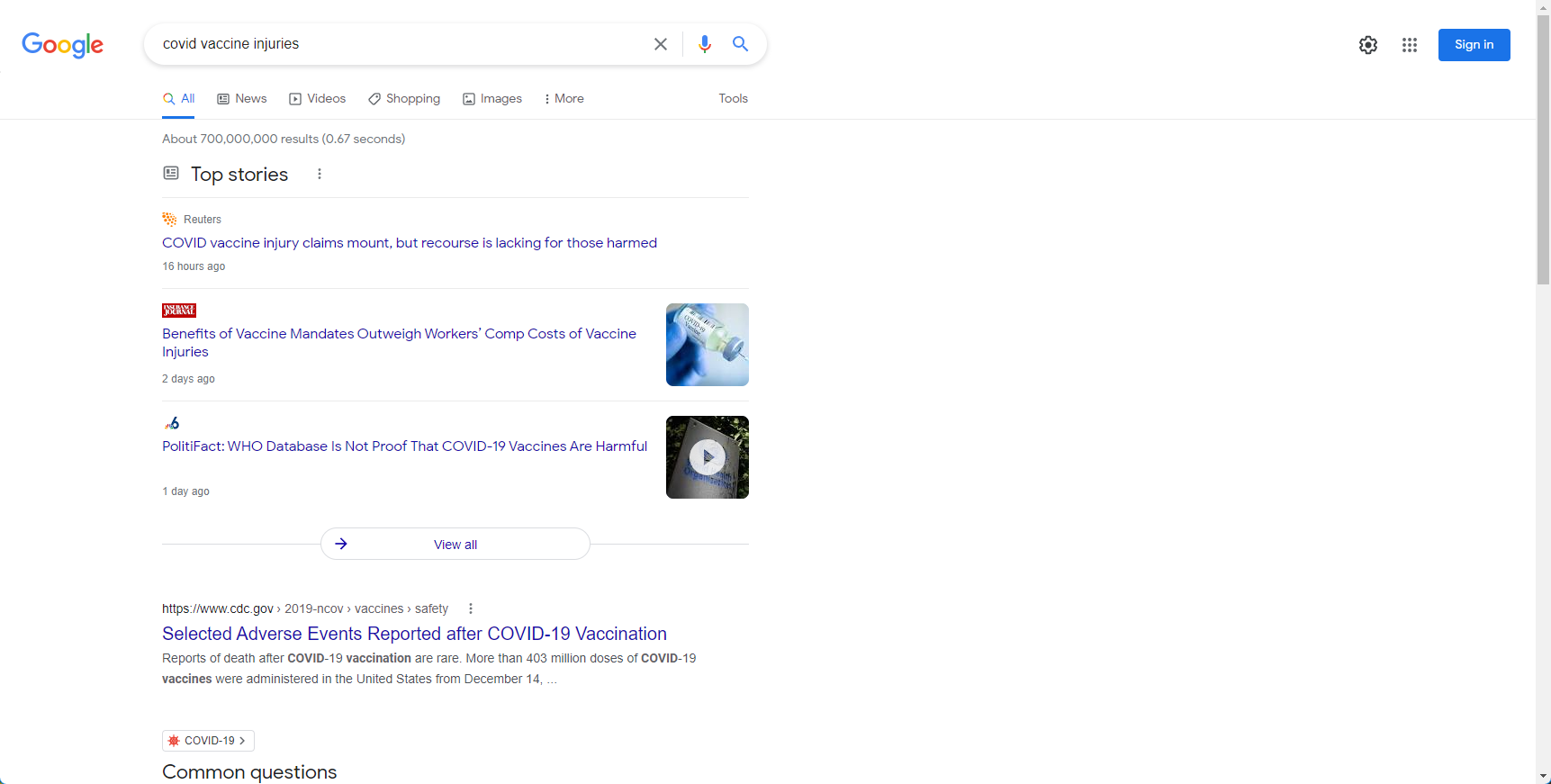
Well, there's that. I assume they won't implement ad blocking for that one.
This isn't even technically interesting.
However, Brave Search apparently does not even allow hard quotes and gives me random stuff related to IPv4. People keep saying that Google doesn't respect what you enter but for this query Google is the only one respecting it. DDG starts out with a few results matching it exactly but then goes off the rails with random results.
I primarily like the Brave sync feature, and it's actually the second main reason I recommend using Brave these days. It was quite junky when it was first released but by now it works like a charm for my 6 devices.
Do they have a shortcut/hotkey for quickly switching to google (and other engines)?
The other problem with Brave is that crypto token integration in everywhere which feels more dystopian than Google's data gathering. And let's be honest - memory use after few days is same as Chrome's.
Yes, simply add !g to your search query.
1. Click on address field 2. Move cursor to start of field (cmd + left) 3. Shift + 1 to print bang, g
Was hoping I could cycle thru bing/google/ddg/back to brave to quickly compare results. something like using wasd keys, no modifier.
I will try to support them as long as they aren’t bankrupt.
One problem i regularly have is that the browser becomes unresponsive, e.g. won't update the screen. The only remedy is to close and open the browser.
On second thought i should probably go see if this issue is widespread.
I will continue to hope there is some kind of subscription to Google search without tracking and all.
This would be ideal as Google Search has the best results for me. But I don't see it ever happening.
Although I'm sure many people would pay, it'd be a drop in the ocean compared to all people that wouldn't (and hard to justify dedicating resources to it when you're already making tons of money with the ad-supported free version).
The search engine is pretty weak judging from my initial queries.
Already tried it several times and can share some experience:
* searching 'npm flag xyz' - working fine
* searching 'npm error some text' - just bad, a lot of non-relevant stuff.
Anyway, it's naive to expect a real Google competitor right now.
Edit: I expected the YC crowd to pick up on Palantir puppets a bit faster. I'll gladly burn karma to get the word out though.
Sadly not the image search. Surely this must be possible. We don't need inline previews.
None of these can even scratch what Google as a search engine is.
I’m still rooting for them, but in general I continued to be baffled why such blatant spam can consistently make it into top results on Google, DDG and now Brave. I really wish a search engine would empower me to provide a URL ban list that gets applied server-side instead of filtering on the front end (if anything).
The irony is that Google wants all our information "to improve our user experience", except they don't want our ban lists.
https://search.brave.com/search?q=%22%27tensorflow.python.fr...
> If you are wondering where the data of this site comes from, please visit https://api.github.com/users/.../events. GitMemory does not store any data, but only uses NGINX to cache data for a period of time. The idea behind GitMemory is simply to give users a better reading experience.
Better reading experience, my ass.
Luckily the original URL is easy to recover from its URL ( https://github.com/tensorflow/tensorflow/issues/26922 in your case), so I just copy the URL from the search result and fix it up manually.
I have a greasemonkey script that blocks domains from being shown in GSE results. Works well, but I don't have it on all of my browsers.
Or just have the "don't show results from this site again" button from youtube taken into google results, and allow me a quick access to that list to manage it afterwards - ALSO, allow me to add a comment to remind myself WHY I did not want to see it anymore.
This is why all content feeds like Facebook and Twitter get vaguer as time goes by, and it's why Google will never give up control over results unless it legally has to.
Have they followed up with a product/feature?
It was the only portion of brave’s approach that was interesting to me. It’d be disappointing if they dropped it.
Brave Goggles: https://brave.com/wp-content/uploads/2021/03/goggles.pdf
While it's probably unfeasible (or at least really expensive) to do completely personalized rankings, that's just too much data, but segmenting off into areas like academia, blogosphere, tech, etc. is quite doable, and as the authors remark, this approach is highly resilient to manipulation from commercial interests.
millionshort.com has a "block this domain" option. It can be useful to combine it with the filter "hide results from top 1,000 sites".
You can see how it works here:
https://twitter.com/vladquant/status/1445298385800470529
(disclaimer: Kagi founder)
Brave discussed implementing similar concept called Goggles:
https://brave.com/wp-content/uploads/2021/03/goggles.pdf
Kagi Search already has customizable 'prefer' and 'mute' lists for domains, as well as customizable 'lenses' which are similar to goggles concept from Brave. (disclaimer: founder at Kagi)
It seems like it's gotten even worse just in the past few months. I'll try to Google something common, like "can you feed X to dogs" and all the results I find are these giant "articles" that aren't even about that specific thing. Instead it's a giant wall of text with commonly-Googled questions, and if you ctrl+F to the section you were looking for, the answer is usually horrible, and why should you be trusting information from this website anyway?
Then you go back and click through other results and find an entirely different website with all the exact same text on it.
Top recipe results are also all copy-pasted SEO spam surrounded by a wall of text about the history of the recipe, and how the author is a "country mom" (definitely not a man at a content farm in India), hiding the recipe deep within.
They must be pumping out all these fake dedicated websites at such a high rate that blocking domains won't get you anywhere.
It kind of makes sense that w3schools would spend much more time on the SEO game than docs.python.org, but it just drives me back to google
Personal remove lists basically turn each query from each person with such a list into a completely distinct query, which breaks caching on multiple levels. If a few people are using such a feature or if people sometimes add a couple -sites to a query, no big deal, but if enough people used it with basically unique site lists, the performance degradation would probably make a rollback of the feature inevitable.
I still have DDG as the default because it does work a lot of the time, and because it's easy to turn a search in to a Google search with !g, but I have to admit it's not all that good in comparison :-( To be honest I'm not sure if I would keep it as the default if it didn't have !g, and that's not a good look for DDG :-/
(I appreciate this is a very hard problem btw, so not even intended as a dig at DDG; just my experience with it)
Granted, it's not a silver bullet for search engine spam in general, but even a few dozen rules like that would dramatically improve the quality of search results for a huge number of queries in practice.
That's not to mention the multitude of other materials on python.org other than the docs, like PEPs, pypi (third party libraries), bug reports, etc. Can you imagine a student searching for how to use a Python feature, but found a PEP illustrating the design of that language feature?
Same here. It's like they don't even care anymore. The results are just there to hold your interest so they can show some keyword ads along with them.
I wish people would start maintaining curated web directories again.
I think they realized it's expensive, and not actually good for business if the spammy stuff is using your own ads and/or analytics anyway.
This is why almost all of the web looks like a shady spam-site if you don't have Adblock enabled. Google doesn't give a shit anymore.
I wish something similar existed for this site, Reddit [1], even news sites like NYT (at some point I've listened to the POV of certain contrarian columnists and don't need to see their byline anymore).
[1] I know you can do this via Reddit Enhancement Suite but it would be much better as a native feature that worked across clients
[0] https://kagi.com
What I don't see is where Brave gets its image search results from. After Microsoft blatantly started serving the CCP by blocking queries for "tank man", which as far as I know they've never actually apologised for, just explained it as "a filter with more impact than expected" or some BS like that, I found out that most "competing" search engines bought all of their image search from Microsoft, leading to the same kind of censorship on platforms such as duckduckgo.
Brave says it's using "third parties" to generate the results but I can't easily see which third party that would be. If they are using Bing like all the others, I wouldn't trust their image search engine in the slightest.
Personally, I'll just assume they are for now, because they don't seem to clarify this further anywhere else.
From what I can tell, there are four image/video search providers in the world: Google, Bing, Yandex and Baidu. The rest all seem to license their results from one of the big four, mostly from Bing. When I need to pick from those four, I'll stick with Google; their censorship is relatively mild. I was hoping Brave Search would prove to be an alternative in this area, but that doesn't seem to be the case.
I'm still holding out with Firefox despite Mozilla trying very hard to get rid of us (to the point where the thought has struck me more than once if the current CEO of Mozilla is in the pocket of Google).
If at some point the last competing mainstream browser engine is gone I'll probably go for Brave and I might start testing it this week.
Brave: 1.14.4
Google: 1.17
Brave gives me the wrong answer that is outdated by like 2 years.
Second search: 白の意味
Brave: On Japan location 6 garbage search results + irrelevant wikipedia page. On United states 3 garbage search results before a relevant result. The first result is literally a private YouTube video. Seriously?
Google: Has a snippet about the meaning of white and the first result is a dictionary entry.
The indexing for Google seems to be equally as private, so brave search just seems like a downgrade.
Brave - first result.
Google - no first page, no second page, no third page, stopped checking.
Let's try that in quotes - it's the exact title of the article: "politics influences the science of covid-19"
Brave: first result
Google: no results found, searching without quotes.
Google has increasingly turned to garbage these past few years. But searching anything non-English on other search engines really feels like randomly populated results.
Location and temporal results are also lacking on non-Google results. Google also over-optimizes for them, so sometimes DDG is nice when Google is for some reason absolutely convinced I'm searching from some random town in another country and is only serving up results for that area.
I really hope they improve the service, I was enjoying it as my default for a while.
Not perfect, rarely returns DE results instead of English, but from my point of view they're doing something good and I'm sold.
But please, give me a way to pay for it. I don't want to be the product, one day.
Can we not just have the chromium builds degoogled and include the codecs and DRM libs? Woolyss builds do all that, but there's no fancy single download installer+auto updater. We need just "chromium".
I've set Brave as the default search in my browser (Chrome) in an attempt to give less of my traffic to Google, but most of the time I just get frustrated trying to read the search results and repeat the query in Google Search. I know it's ridiculous that I haven't just switched back to Google. I still want Brave to win, but trying to stay on the Brave page is an actively unpleasant experience. The closest analogy I can think of is that it feels like trying to make myself eat vegetables I hate (which is a poor analogy because I like vegetables!)
I've also switched to Brave Search immediately when it come out. I'm satisfied with the search results I get for 90% of my queries, switching back to Google for the remaining 10%. My main problems with Brave Search are: 1. It doesn't have good localised results for non-english queries; here Google remains the best; 2. It doesn't have support for verbatim searching
How likely is for one of these search engines to catch-up technologically to Google's sophistication? I really can't see a clear trajectory for them to compete with Google's quality.
Brave calls this a privacy feature. My ass.
Brave has Brendan Eich and that individual knows a thing or two about what matters in tech.
It’s hard to imagine replacing it. If Brave search becomes excellent then I can just use the bang for it.
Congrats to Cliqz team.
It is a shame that Brave / Cliqz couldn't work with DuckDuckGo to help them get onto an independent index, assuming they would want that, instead of competing. I think there was already a lot of overlap in customer mindshare.
[1] https://search.brave.com/search?q=brave+aquires+search+compa...
I know it is cool to hate w3schools and I don't use it personally, but seriously, can we get over ourselves here?
The reason why w3schools rank highly and have done for years is because for a large segment of users it works.
And as someone else has pointed out the official documentation is often atrocious: both Python and Java online docs are close to worthless if you have a decent ide that shows you method signatures.
PHP docs used to be a lot better in that they described what was going on and why and had comment sections that I imagine they also used as feedback to improve the docs.
I haven't used PHP or Python for years but today there is Spring docs to drive me mad: telling me all the things I know and not telling me anything about how to interpret a Spring project.
Spring is infinitely flexible and there are more ways to configure Spring than there are Spring programmers since most of them can't even configure two projects the same way ;-)
With Google, you can append -site:site1.com -site:site2.com to a query, though I don't know if it provides the same result as filtering them out after a query.
I've had the exact same experience and sharing the same doubts as well.
For programming related queries I'm going to Google 100% though, it understands the intent so much better. But for general queries I use Brave 90%+ of the time. But, it feels like I'm adding !g to the query more often than I used to in the beginning.
At least they have the option to report bad search results so they might be able to improve it in the future again.
Anyone else care to comment? Personally, i'm still someone that's used more to Firefox and is more familiar with Mozilla due to them having been around for longer, but their recent decisions might make some people reconsider their choices and look into exploring new options.
Search results are noticeably better, especially for non-english and location-specific results. What's worse is image search - unlike with text you tend to get only 2-3 good, relevant results, everything else is only somewhat related. I suggest giving it a try even if you'll decide against browser switch.
Apart from that, the main thing you can't adjust via flags is Chromium's style of using separate browser profiles instead of Firefox's multiple containers within one profile/window/session.
The bigger UI differences are on mobile, where again, tab groups are crack and the implementation excellent.
neeva.com could do that for you for the price of a ~coffee ($4.95/month): https://www.youtube.com/watch?v=cc2aTB24XmI
I have the same feeling, but using Google ;)
The "third-parties" bit, IIUIC, is the part when their index does not give good results and it falls back to working like startpage: they send the anonymized query to Google/Bing and take the results to send to the user. I believe that the idea is that they can use this as a way to improve their own index.
They also show on the results page how much of the results are coming from them vs from third-parties [0]
Maybe their image search just hasn't encountered enough websites featuring the word "bird" or maybe their disclaimer is shown more often than intended, but I get the idea that image search is always done externally.
While I don't think much about BAT, having a browser with a nice wallet integration is a huge step forward in making Web3/DApps more useable for non-technical people.
It's still a long way, but I think this is one of the first big steps in the right direction.
Weird. I have found Qwant giving better results than ddg. (No affiliation)
What is weird is that there is one small change that would likely make any of these engines outperform others in everyday usage. Just let me (easily) blacklist domains in my results.
>However for some features, like searching for images, Brave Search will fetch results from Microsoft Bing.
If you are referring to it being blocked in China, well, are we at all surprised that private companies kowtow to autocratic regimes in favor of making more money?
But the tank man image was blocked for the whole world and not just china. So they fixed this after an public outcry.
But you do not know, what is missing now. Thats a reason for me to not trust them anymore.
You can see them returning no results for "tank man" from the web archive: https://news.ycombinator.com/item?id=27398376
Why? (I use the latter.)
> Microsoft blatantly started serving the CCP by blocking queries for "tank man"
Works fine for me [1].
[1] https://www.bing.com/images/search?q=tank+man&form=HDRSC2&fi...
> Works fine for me
Not on June 4th[2] (the date when the Tiananmen Square massacre ended). Microsoft "fixed" it after the backlash.
See the last paragraph in the Censorship section: https://en.wikipedia.org/wiki/Tank_Man#Censorship
Ya when I do image search in Yandex at the bottom it says Search: Bing Google
Because that's what Brave is.
Any reason behind your preference? It baffles me to hear you'd rather use a heavily censored and CCP-controlled search provider than a search provider from a free market with an alternative business model.
Every time I search for politics, news, or covid related stuff I find it straight away. News it right at the top with multiple articles available.
Politics and COVID I find the offical source straight away.
Moving from an era of media oligopoly into the internet age was very hopeful IMO, and now it's bottlenecked by even fewer companies.
The giveaway is them ranting about "groupthink" and "censorship" from autocomplete.
Scroll down to see people citing Joe Fucking Rogan and spewing misinformation about vaccines.
> "Look, if I wanted to find specific cases about people who died from vaccine-related injuries, I had to go to Duck Duck Go. I wasn’t finding them on Google,” Rogan urged.
[1] https://summit.news/2021/10/19/video-joe-rogan-accuses-googl...
https://duckduckgo.com/?q=covid+vaccine-related+injuries
https://www.google.com/search?q=covid+vaccine-related+injuri...
I'm assuming he's just upset that blogspam that inanely conflates VAERS with evidence of injuries actually related to COVID vaccines shows up higher on DDG because that reinforces his false presuppositions.
"On the same period, Firefox marketshare was down 85%. When asked about her salary she stated "I learned that my pay was about an 80% discount to market. Meaning that competitive roles elsewhere were paying about 5 times as much. That's too big a discount to ask people and their families to commit to."
"By 2020 her salary had risen to over $3 million, while in the same year the Mozilla Corporation had to lay off approximately 250 employees due to shrinking revenues. Baker blamed this on the Coronavirus pandemic."
This lady then goes on and on talking about "social justice".
Also Google deal produces 90% of Mozilla's revenue. I would say Mozilla is really controlled opposition.
Does anyone know who actually controls the direction of the organization? How are the board members chosen/elected? Is there a way for the general public to pick other board members?
Can anyone explain what this actually means? It sounds like she's saying that taking a lower pay by 5x is too much to ask of her, but then "people and their families" doesn't make any sense, because its 1 person and 1 family.
Thats not even getting into how true is may or may not be, or how its still a lot of money overall, even if its not compared to the market overall.
Then he got cancelled, and with it was cancelled the dream of having a real platform that can compete with Google. (Brave, with all of its advantages, is still a fork of Chrome and in that way promotes the Chrome monopoly.)
Since then, the new CEO of Mozilla has made herself a lot of money, and she seems perfectly happy to destroy the long term viability of the company for some quick injections of cash that can justify her bonuses.
And Eich single-handedly created the only other viable browser in the market starting from scratch [market wise, not technology wise]. Yet, somehow, people still think this was better than leaving Eich as head of Mozilla.
Per StatCounter, Mozilla's market share decline started in early 2010 (including mobile, late 2010 for desktop only) and Eich was fired (resigned, but that's BS) in early 2014.
Eich was still at Mozilla (not CEO) when Mozilla under-invested in desktop performance, failed to get Firefox OS off the ground, and most likely laid the groundwork to switching to Yahoo.
flying high for all eleven of those days or just some of them? :P
> And Eich single-handedly created the only other viable browser in the market starting from scratch [market wise, not technology wise].
This is a bizarre re-writing of the history of Mozilla. Brendan Eich was obviously very important but he definitely wasn't alone, their corporate owner at the start was AOL, then a gigantic company, and he wasn't originally involved in Firefox when it started, it was a rebellious offshoot from the rest of Mozilla's large number of existing products, some dating back to the Netscape days.
But it's not like Brave is ethically or technically better. They use Blink (the same engine as Chrome) and therefore contribute to the mono-culture of the web.[1]
They collect donations on behalf of content creators[2], they created this "Attention Token" based on etherium to replace ads with all the controversies surrounding cryptocurrencies (from the pyramid-scheme to the global-warming topic, I know the latter is not valid with Etherium anymore), …
I think that these days, it's more about choosing the lesser evil as a browser.
[2] https://en.wikipedia.org/w/index.php?title=Brave_(web_browse...
Your claim that Brave collected donations on behalf of others is quite misleading. There was a bit of confusing UI in our early tips interface (called 'Payments' at the time). We clearly marked verified creators as such, but gave no special marking for unverified creators (our approach resembled that of Twitter's blue checkmarks).
Regarding the "donations" themselves, we allowed Brave users to direct BAT from our user-growth pool (that is, Brave's own tokens) to creators. If those tokens were not claimed by the intended recipient after 1 year, they (Brave's tokens) would be recycled back into the system. As Wikipedia records, there were major UI/UX changes made about 48 hours later which dramatically improved the feature, IMHO.
The coin itself is one of the few that has a value based on some actual use, at that:
Brave sells adspace, gets paid in Money™. They keep a cut, take the rest and buy BAT with it, give it to users. Users can then tip content creators with the BAT and get some compensation for Brave's part in killing tracking ads.
Many people are idiots who do think that BAT is for them to get rich but like hell it is. Single ad viewers aren't very valuable, they only matter in aggregate, so you'll only ever get pocket money as BAT.
It has Web Torrents, IPFS, Tor, built-in ad blocking, etc.
I just don't understand how someone can be "mad" at a feature that is turned off by default, especially when most browsers ship with literal spyware turned on.
No need to wonder. Mozilla gets $450M per year from Google [0], and the Mozilla Chair gets a large chunk [1]:
[0]: https://www.androidheadlines.com/2020/08/mozilla-firefox-goo...
Firefox's market share is 3.6% and on mobile only 0.5%. On many websites, mobile traffic is now at about 70%. Firefox doesn't even show up in dashboards, and is smaller than various Chromium clones and/or regional browsers.
I have been using Firefox since the Pheonix/Firebird days where you download it and unzipped it to a folder.
I left a few months ago because I just couldn't get the performance where I needed it. I unfortunately had to go to yet-another-Chromium browser and just chose Brave because it seems like it has the right priorities. After installing the same extensions I was using on Firefox it's pretty much the same, it's just faster.
I hate saying that, after two decades of using Firefox. I want another browser engine. We need that competition.
We lost Microsoft. We still have Apple with Safari and I hope Mozilla can hold on with Firefox.
But if Google ever cuts that search funding I don't see a great future.
Sometimes you need to search an intentional misspelling, say, "Aple" (just an example), Google will helpfully try to correct you with "did you mean Apple?", and even if you put the word in quotes you still get results for Apple, not my intentionally misspelled search. Listen to what I'm trying to tell you, dumb machine.
They've tweaked it so it only respond to what it thinks you want to search, not what you've asked of it, and there's no way around it.
Computers are so much better when they take your input literally.
Now Google seems to really want me to see what its ML model thinks is in the image. No, when I upload a picture of an actor, I'm not trying to search for pictures of "adult" or "man". Or, my recent favorite that had three people in the image, a suggested search for "sharing".
Humans make so many typos that for the majority of people, autocorrecting is a net win.
Yes, Google, I did not type North Korea DHL by accident. I really mean the odd one because I’m curious if they have DHL but I really don’t feel like explaining it to you. Could you please simply don’t assume stuff by default? I appreciate the “did you mean” suggestions but let’s not try to be too smart.
Google was great when it understood that North Korea and DPRK are the same thing but these days it’s like “North Korea DHL? You must be trying to send a package to Republic of Korea”. Maybe that’s because there’s not much ad revenue from helping out people to get information about DPRK.
- I search for keywords A B C D - I get 4 irrelevant text ads - First result is relevant and contains all keywords - "Other related searches" - Then a list of results than omit A, B, C or D ("include A?"), or even omit multiple keywords, removing any sense in the query
And the whole time I feel like I'm being pushed around to buy something. It's becoming unbearable. I'm pretty sure Google is optimizing for more ad impressions at this point to burn through adsense credits asap...
In trying to be smart, it becomes worse than retarded. I guess it could be called the "uncanny valley" of AI.
It also returns what if thinks google will profit the most from - I’ve noticed a huge uptick in the number of ads which are poor-quality results and usually take both the top 4 and bottom 4 positions on the first page.
What ad-supported financing removes, along with other things, is friction. You open google.com for the first time, and you can instantly use it.
Also, Google started in 1998. I don't know whether you remember, but I do: paying for stuff over the internet was pretty hard by then. Paying across national borders was harder still. I wished to pay for several pieces of software by then, but it was hard even if I agreed to walk down to a bank.
Compared to that, selling ads and receiving money from businesses was incomparably easier, for everyone involved. Unlike billing search users, it was a viable business model.
It asked me once during initial setup if I wanted to use Brave Rewards (or whatever the crypto component is called), I said "no", and it's never bothered me with anything crypto related ever again.
What happened to you, Internet? Politics is one thing, but this is starting to bleed over into "liking Apple", or "hating Apple", or any similar camp one finds themselves in with a web browser or programming language or other piece of tech. "People who feel differently from me must be faking it as part of a plot." What the hell?
You mean like this? https://github.com/Eloston/ungoogled-chromium
There's automatic updates if you install it via homebrew/winget/[packagemanager of choice].
This hardly the "best" solution, but, everyone has uBlock installed, and it's literally a 5-second hack.
With pictures: https://github.com/gorhill/uBlock/wiki/Per-site-switches#no-...
I don't know anyone using uBlock. I know a few using AdBlock but that's it.
I don’t know why they couldn’t use something more optimized for reading small characters like Inter or just use the system font stack.
Pro tip: If you aren't happy with the search results offered in Brave Search, and would prefer Google instead, perform the same search but with !g added to the end
The main problem is that Poppins is a display typeface, not a text typeface. It's not good for large blocks of small type, and in fact as I examine it more closely, it becomes obvious that it's a low-quality design.
Here are some of the problems I've noticed. I've annotated them here: https://imgur.com/a/8am9VJy
- The proportions are distorted, with some letters of excessively varying widths. Capitals like C, D, E, L, G are usually about the same size, but in Poppins, C, G and D are enormous while E and L are too narrow. You can do stuff like this to be cheeky, to have the type draw attention to itself in a display typeface; but a text typeface should aim to be legible, not flashy or distracting.
- Kerning is poor, with big irregular gaps between letters, especially after P and T.
- The lowercase e in particular is a problem. The middle bar is so thin that it almost disappears, and the tail comes so close that it almost closes the circle. You might think that a single letter can't mess up a whole design, but it's the most common letter in the English language. :)
- Hyphens are way off-center and parentheses are too tall, which just looks sloppy.
I discovered that you have entire pages of text set in Poppins on your website; these are actively painful to read! Like, just try to read the entire page and see if your eyes can tolerate reading all the way to the end, or try to count the number of times "search" appears in the text. Poppins has the silly, goofy personality of something for young children; it's hard to take seriously. It's named "Poppins" after all! And with all these quality issues to boot, pages like https://brave.com/brave-search-beta/ just look unprofessional.
Do you have a designer on staff? Your designer should be able to explain all this to you and more, and to choose a more legible typeface for your body text. Pick something boring, like the system font on Macs, or Inter, Source Sans, Open Sans, Roboto, etc.
Hope this helps! If you run an A/B test, let me know how it goes.
I also think that they're "too" clever with their search to their detriment. We tend to think in terms of text search and are looking for results that match what we want. I'd prefer not to have a machine assume I actually intended something else. Just give me great text search where I can perform various inclusions/exclusions and you'll win the market
It's like going to a pub and ordering a steak and getting a burger instead. No, I don't want your damn burger, I am not going to pay for it, I'm just going to try another pub. But wait, there's no pub that delivers what you've actually ordered.
What are you referring to? Not even DDG has their own index.
For example when searching for a persons age, in shows up instantly in a large font on top. When searching for “champions league today”, you will get all soccer games for today neatly presented right inside of Google.
I haven’t seen another search engine that makes accessing this type of information this easy to access. And the sheer amount of widgets and engineering power behind them probably makes it harder to catch up to Google for the small players.
I don't actually look for the widgets or Wikipedia results.
The results are not relevant. Either the expectations are not very high, either they do a poor job.
They actually had better search results before using very sofisticated algorithms and trying to outsmart the users.
Most technical aspects of searching were solved and are now common knowledge.
It amazes me why no one is trying to do a better engine. It doesn't have to do everything Google does, it just has to do text search.
Maybe it's hard to get money from search unless you also track users, store their data and sell ads?
http://dpldocs.info/this-week-in-d/Blog.Posted_2021_09_06.ht...
They have a built-in adblocker (not an extension, a modification of the browser itself so it doesn't care about Manifest v3. It can also do CNAME uncloaking, which is what makes uBO better on Firefox than Chromium), a lot of anti-tracking features.
Importantly, they maintain their own end to end encrypted sync architecture like Mozilla does.
They have miscellaneous sideshow features like a torrent client and a Tor implementation (but AFAIK recommend the Tor Browser still)
A big thing is that the adblocker is that it's there on mobile. They're also the only mobile Chromium browser that can play YouTube videos in the background as far as I know.
As far as the crypto goes, it's actually a decent system:
Brave sells adspace (which they deliver as new tab backgrounds and toaster popups, entirely separately from websites), gets paid in Money™. They keep a cut, take the rest and buy BAT with it, give it to users. They have a tipping system where users can then tip content creators with the BAT and get creators some compensation for Brave's part in killing tracking ads.
(this can never be a full compensation, since Brave's ads don't track, and should thus be less valuable than evil ads)
---
If you want bigtime UI innovation, I'd look elsewhere - Brave's angle is stock Chromium, privacy, and standalone infrastructure to provide independent revenue. The big UI innovators in Chromium land are Microsoft (if you don't care about privacy, Edge is sadly a disaster on that front) and Vivaldi (who are also very no tracky and run their own end to end encrypted sync service. Both have a lot of fantastic UI customization features. Microsoft's more well-designed ones that are both pleb friendly and powerful, Vivaldi's more of the "here's all the toggles" type. To illustrate their type of overkill, they have THREE separate tab group implementations built in. And a mail client, calendar, RSS reader, a barebones notes module - did I mention these guys used to make Opera?
Brave has never added affiliate links into pages. Brave has never served its own ads on top of others'.
Oh, and 30% of your Basic Attention Tokens go straight to lining Brendan Eich's wallet. I'll just browse on my own, thank you...
"The rationale is not to customize the ranking according to the implicit interests of the user, but to offer a mechanism to define multiple rankings, plural, open and explicit, for only if it is so, can it be trusted."
Please put opinions in a blogpost and uphold the (reasonable) norms of the research community, for only if it is so, can your work be trusted.
That wouldn‘t be so bad. PEPs contain a short summary, motivation, and usage examples.
That said, I do get your point.
https://www.ghacks.net/2010/03/18/blacklist-google-search-re...
Understandable since a few years later Google would acquire Doubleclick Inc, which back then was number one in polluting the web with advertising, and first entry in all adblockers kill lists.
The top story at the time https://news.ycombinator.com/item?id=27395635
google absolutely wants to protect their users privacy from third parties. their ideal situation would be if they're the only one's knowing everything about their users so they can allow third parties to advertise things to their users. if they'd leak any of this information, they'd be compromising their main business model.
so yes, people can trust google to do their everything to keep their information from reaching anyone else, including forcing said third parties to undergo paid audits to verify that nobody is leeching their user data.
for some reason, a lot of people got it into their head that google literally sells information. i'm not sure why this ever started, as - at least as far as i am aware - google never tried to do anything even remotely like that
They still have all this data on users. They don’t even tell you what they have. They have the BS marketing of Google Takeout. It includes nothing about the profile they have made on me. The logs and data they have on what I have clicked, etc.
Google wants to even protect you or I from knowing how much data they have. That’s not the protection any one should want.
"I could find it on Google" is exactly as (in)valid as "It works on my machine"
https://www.youtube.com/watch?v=RuMsDf-z_hs
And the AI was better this time, it returned DHL's page as the first result: https://mydhl.express.dhl/kp/en/contact-us.html
But, how stable is this? I tried so hard doing this with greasemonkey. But google's DOM is ridiculously obfuscated and kept breaking frequently. So much for the semantic web, heh?
It's like a gift from god that allows me to block pinterest image results. Not had any issues with it what so ever.
My guess is some ux head exploded when they realized someone might blacklist a site they wanted. Or maybe the one who made it got promoted and no one stepped up to maintain it?
https://addons.mozilla.org/en-US/firefox/search/?q=w3schools
(Edit: that doesn't mean I necessarily trust or recommend niche extensions like these.)
> Cryptocurrency isn't just a disaster, it's several disasters bundled together. Anyone working with it in any way, anyone who has a stake in cryptocurrency, has been compromised, and can no longer be trusted, just as your neighbor who is trying to sell you on their multilevel marketing scheme can no longer be trusted. (Did they invite you to dinner? Oh, surprise, it's just to sell you on their MLM again.) They are ignoring multiple dire ethical problems as they sell their relationship with you for funny money.
Basically, any involvement with cryptocurrency is a strong signal of untrustworthiness and lack of scruples. Mere political censorship isn't in the same league.
Mitchell Baker's blog:
https://blog.mozilla.org/en/author/mitchellmozillacom/
Not a single word about Firefox, just some far-left propaganda about racial justice, empowered women in tech, Trump bad, and so.
At least partly because people like me pay them to. I like the work the Moz foundation does and I'm happy to contribute to it with donations.
Mozilla bungled Firefox OS after I left, lost Andreas Gal and most of the top talent, lost Li Gong, while KaiOS based on same code and business plan, with some of the talent, took over and grew to over 200M phones. Blame Mozilla there.
I had nothing to do with the switch to Yahoo. That deal was a gleam in someone else’s eye and I left before it was done.
Last thing: how did not-me leadership do after I left, and I started Brave and grew it to 40M users while Firefox lost over 50M? You may dislike me, but your fantasy blame game cannot excuse Mozilla outcomes lately.
Because those investments are not made, to show you clearly what you want to see, but to show you just enough, to not loose you while injection as much information garbage as possible. If we do not fix that, it will all just get worse, not better.
Can't imagine how catastrophic that would be to their ad business.
Today, the SRP is ads, the info box, the Reddit-cluster, the Quora-cluster, images, videos, “people also searched…”, “did you mean…”, and somewhere near the bottom a couple of those good ol’ fashioned links for old time sake.
Do not want.
An insightful breakthrough in quality that vastly reduces the computing and engineering required to serve great results that keep up with expanding information, similar to what Google did for search 20 years ago, would be wonderful, but it won’t come from DDG or Brave unless they can develop new models that completely replace their current search products.
That's obviously not at all a knock against Neeva. Safari needs to allow more flexibility in its search engine defaults. I've filed multiple radars/requests to Apple to make this setting more flexible and/or provide Neeva as an option.
It remains to be seen if they can get enough people to pay in order to keep going though.
There are actually flags for enabling tab scrolling if you want, and tab squeeze is also adjustable via flags.
In other words: good luck finding a qualified person to run Mozilla.
I really think most people don't understand how destructive cryptocurrency is, in multiple ways.
If you don't care about the energy use causing greenhouse gas emissions, how about electronic waste? https://digiconomist.net/bitcoin-electronic-waste-monitor/
How about the impact on any service that offers free CPU cycles, such as continuous integration systems used by open source projects? https://drewdevault.com/2021/04/26/Cryptocurrency-is-a-disas...
How about the impact on critical infrastructure such as hospitals due to ransomware? https://www.stephendiehl.com/blog/ransomware.html
Cryptocurrency isn't just a disaster, it's several disasters bundled together. Anyone working with it in any way, anyone who has a stake in cryptocurrency, has been compromised, and can no longer be trusted, just as your neighbor who is trying to sell you on their multilevel marketing scheme can no longer be trusted. (Did they invite you to dinner? Oh, surprise, it's just to sell you on their MLM again.) They are ignoring multiple dire ethical problems as they sell their relationship with you for funny money.
We should all just return to sticks and stones I guess.
The issue with the python docs for this search is that it takes me to “built-in types”, and starts off with things totally irrelevant to what I want. I now have to go searching for string, then find the built-in method replace. Meanwhile, the other tutorial-esque websites almost all show an example of str.replace above the fold. If you’re Google and you’re trying to get people information faster, you’re going to promote the result that has more people not coming back to the search result page afterwards because it was hard to find the answer on that result.
I find this especially useful since I often otherwise find myself typing site:python.org (or similar things, like if I just want to see the MDN page instead of going through w3schools or blog posts for examples).
edit: in the particular example for str.replace, I found it buried in the results for "py replace", at the top of "py str.replace" (helps if you know what Python calls the type) and basically nowhere for "py string replace".
[1] https://restoreprivacy.com/startpage-system1-privacy-one-gro...
Well, OP was the one that defined the info they were looking for as misinformation as far as I can tell.
And then I stated I could find offical sources for politcs and COVID. These are not Google's opinions but simply a fact. WHO, RKI, CDC, etc are all offical sources of information for COVID, etc. This is not them define what is true or false but merely providing me with the offical information so I can educate myself.
For any political news, sometimes I'll be looking to verify a story I remember reading from a few days or weeks past, or I'm looking to do my own fact check of a claim...and I'll find that several mainstream news sources will have republished the same story(not the one I'm looking for), unrelated to whatever claim I'm checking- similar only in sharing a keyword or person of interest- and Google rewards this behavior by pushing the trusted organizations to the top of my searches. It's like forum sliding, except it's search. Then using ddg or brave, the story that I'm looking for will often be the first result.
It's a very insidious antipattern, because it's hard to even know if your perception is being actively screwed with.
And yes, Yandex is a Russian operation, something to keep in mind.
But in the end I can expect both teams to deliver a tool that's built to enable me and my wants, regardless of what our opinions on things outside the browser are. After all, they're irrelevant to the browser. Within the browser space, there are politics, but both orgs' politics are of user control and less tracking and spying.
Who are you and where were you inside Netscape then? Or are you just lying about me?
Leaving aside the whole "please don't fulminate" thing, you're going to have to be specific about which part is incorrect. Is it just the "he wasn't originally involved in Firefox when it started" word choice and you'd like that amended to "he didn't start Firefox (though was aware of it and soon incorporated it into Mozilla's strategic plans)"?
The righteous demand for truth would be a bit more inspiring if you'd similarly correct the GP for "lying" about you being the one true Mozillian, though.
edit: also, rereading my original post, I'm sorry if the first line reads as mean spirited. The ":P" was meant for the poster's inconsistent recollection of events.
Ask Dave Hyatt, Blake Ross, Ian Hickson, or others if you dare. Unlike you (I have to presume), I have friends who support me and will testify if you bug them and they are willing to answer HN anon hostiles like you.
I never said I was "the one true Mozillian", that's another false dichotomy from you, and a jerk move. You didn't answer my question about the basis for your hot take here. I doubt you were there at Netscape. Did you just make it up, or get it third hand?
Google seems to be filled with sponsored results that are only superficially relevant, and from page 2 onwards, it sometimes feels like whatever it’s giving me isn’t related to my search at all. Even when I’m very specific with my query, using +/- and quoted phrases.
I wish I had taken some screenshots, here's the only recent one I have: https://i.imgur.com/b9hu2a9.png – I was trying to find about Cambodian date writing conventions for some i18n code, but all DDG gave me was spam (and most likely, scam) results. Probably not the best search term in the first place ("Cambodian calender" would be better), but it's a decent example.
I should keep a spreadsheet or something, but I'm too lazy for that. And it's not really all that interesting either.
Maan Leo is a Dutch author. DDG gives me a few bad results about Maan Leo, a few bullshit links about horoscopes ("Make a Leo man chase you"), and finally the Wikipedia page for Low Earth Orbit (LEO).
The Google search gives me results about, well, Maan Leo (in spite of using Indonesian search by the way – this GeoIP stuff Google does is so annoying). For this particular term, DDG is basically useless.
The Brave search results also seem a lot better by the way. Certainly loads better than DDG.
Occasionally I try google search to check and I virtually never think google's results were better. But I'm guessing a lot of that is down to how you do search-fu, what you're actually looking for and subjective stuff about ranking quality.
Here is one more, search: Ten Elements of the False COVID Narrative
Google: nowhere
Brave: first result
And it's not like Google just didn't index the site, it works for topics that are "less controversial", search: Universal Clock implies Universal Clockwork
Google: first result
Brave: first result
Whatever the explanation - either Google censors some topics, or its search engine works differently - the result is the same, for this example Brave outperformed Google.
The second example, “Ten Elements of the False COVID Narrative”, assuming you’re looking for it at scienceblog, is the fourth result. Above the fold, at least. (Edit: Sort of nevermind, I missed that you didn’t use quotes for that one. Without quotes the scienceblog page appears in slot 11).
I am in the US and get my results in English, if that matters. I checked to see if toggling safe search changed anything, but nope.
Anyway, it happens all the time. Goole assumes that I mean something and I need to quote words trying to enforce my query. Pretty much every time when the returned results don't include the words I typed is a frustration for me. It makes it very hard to fix the query because I need to study every result instead of having no results or obviously low quality results.
It's especially hard when I'm not well versed in the subject, so I need to go through the results only to realize that these results are not about the thing I'm looking for.
BTW, I do less Googling these days. I would usually search Reddit, HN and StackOverflow directly from their websites as the search results would be from the expected domain and not too smart but just enough smart to correct typos etc. Also the filters work better.
Imagine you're talking to your friend, and you say the exact same thing you tell Google: "North Korea DHL". They're not going to have any idea what you're talking about (they can guess) - do you want to ship something there? Are you making a comment/observation? A business opportunity? Your friend would probably ask clarifying questions to narrow down what you're talking about, or you would be more specific upfront.
Computers don't magically read your mind nor they know your intent. Adding quotes to search and other 'advanced' techniques are the equivalent of adding context to a conversation.
Personally I have rarely experienced what you have, and when I do it's usually for specific international queries (like searching for a Belgian slang word from Google US) which isn't an issue if you use the correct locale/language for what you're searching for. Obviously it's not perfect, I'm just surprised by your anecdote in the absence of a real example.
I also no longer get good navigation suggestion from Google Maps, maybe my constant frustration with Google lately is pushing me to be too dismissive about all of their products. Surely they do great things but I'm not as happy with Google as I used to be.
I find that systems trying to predict my intent are unbearable when they fail, it just feels like trying to interact with a very stupid person.
That's what I'm referring to.
Ask the GGP commenter? Why name drop if only the observation is important?
Our index is still in infancy but the example of it working for the query 'best laptop' can be seen in this screenshot:
search.marginalia.nu does this and for the stuff that it can find it works wonderfully.
Getting results on search.marginalia.nu is (borderline) delightful in the best cases. Last month I searched for something along the lines of "dual boot windows linux" and got 3 fantastic results among the top ten - and no blogspam.
If SEO specialists figure out and start to reduce ads, trackers and scripts generally I'll count that as a win too :-)
What are your thoughts on reputable news websites that have tons of ads and trackers because they have yet to figure out any other viable way to survive?
Ad-supported business models incentivize the creation of large quantities of content, because you need a lot of pageviews to earn a little bit of money with ads (since most people either ignore or block ads, if they manage to load the page to see them at all).
High quality journalism should have value that we are ready to pay for, like we did for hundreds of years. This concept is called the "newspaper".
You are expected to pay for high quality baker or a tailor, book, movie or music, why not for getting information that "only" has the power to shape societies? If I see information next to an ad, I personally tend not take it too seriously.
What is missing right now from a technology standpoint is an easy way to manage subscriptions, built into my browser as default. Expecting the user to create and manage a separate account/billing identity for every publisher is what is preventing this model to take off (IMO).
When you want build a 'smart' system in the absence of true AI (which does not exist), the only real solution is to build a product for the majority, or support configuration for everyone. The latter seems pretty tough for a search engine. That being said, the advanced search features are just that, an attempt to give the 5% the control they need to do what they want. Whether it works or not is another story.
It doesn't really excuse that the product fails you as a user, but at least it's a reasonable explanation (IMO). As I wrote this, I started thinking about plumbers/electricians going to a hardware store or interacting with electric/plumbing products designed for the general population. I'm sure they feel similar frustrations!
And autocorrect is a net loss if you can't correct the autocorrect.
There is verbatim and back in the day this is also what doublequotes meant.
Google has gotten away by blaming it on spam since back when matt_cutts was here, but I fail to see how spam can possibly be the reason why neither doublequotes nor verbatim works (edit:) unless spammers have found their way into Googles ranking algorithm to neuter all exact match operators.
/pinterest\..*/
Think of it as server side uBlock for search results.
Edit: I would love, love, love a search engine specifically tailored towards programming questions. One that doesn't treat queries like "C# ?." as me looking for "C#" and getting the most generic results possible.
- A box where I can select the context of my search.
- The box then appends a specific string to the query.
For example, if I set the box to "clothes", the box will append "waist 34 inch, 5 feet tall" to the query.
If I set the box to "programming", the box will append "favorite_languages:Python,C++" to the query.
And of course a search engine should interpret it accordingly. No need to collect and store my personal information.
They’re a valid reference, just a low-grade one, and using a low-grade reference is rarely a good tradeoff. They also used to be worse and never quite shook of their reputation.
I also seem to remember reading a lot of critiques like this one: https://meta.stackoverflow.com/a/280484
Once it was useful. But now I memorized all the information there so it’s not interesting.
They have user comments, which oftentimes contain the information and examples that are actually very important in day to day usage, as opposed to a cut and dry description by the language authors.
For example, go to this page and scroll down to "User Contributed Notes": https://www.php.net/manual/en/function.str-replace.php
To me, it feels like most of the technologies out there could benefit from user source and user voted content at the bottom of pages like this, the one thing that IDEs also don't provide (though if one were to throw in some fuzzy search from, say, StackOverflow, we could probably get context surrounding a particular bit of code).
Pushing Pocket (which is nice and could have become a nice source of income from users like me who wants to support the browser) in a dishonest way and as a built in part of Firefox instead of an extension that people could remove, saying there were no ties when there definitely was.
Almost scaring the crap out of a number of the more careful ones of us when they installed a "I, Robot extension" or something without any warning.
Milking the browser part of the system dry to fund its "mission", then laying off browser engineers and the Rust team to save money.
Pretending to be a community when fundraising, but a dictator when making decisions.
Misleading people to think they suppprt Firefox when they donate to the foundation, then sending nothing to the browser and burning it all on "its mission".
This is where they lost me as a donor. Mozilla can't go a month without launching a new idiot project.
Do we know what fraction of their revenue gets spent on Firefox and Rust versus everything else?
The Mozilla Foundation (where your donations go) is not the one launching these new ideas that you hate so much. If you are going to hate something, at least hate the right thing.
The loss of market share has nothing to do with the browser in itself. Mozilla simply has no reach. Chrome is shipped via Android and on the desktop via services having a billion+ users, like Youtube and Gmail.
Mozilla has no reach or push. It's not an engineering problem.
You can install FF on Android in a second on the Play Store, it's easier than it's ever been on the desktop; but you have to want to install it in the first place. Some of this want can be generated by feature excellence, some by peer pressure; but for a long time now, FF has lagged in producing the former and its leadership has actively sabotaged the community that can provide the latter.
Obviously FF was helped by MS dropping the ball in a way Google has not (yet), but in my opinion what happened then could be done again. Antitrust action is coming for both Apple and Google, Mozilla should be ready to pounce right there and then - but it cannot happen if the leadership does not understand that there is a problem.
This vacuum no longer exists. The competition isn't stagnant, they're speeding away.
This happened at the time when no other browser vendor drove any kind of serious marketing campaign. Even so, Firefox only reached 30% market share at its peak.
Then Chrome shot out, backed by Google's marketing budget, bundled with popular software installers and featured at the "Internet home page": "Still running Firefox? Upgrade to Chrome now!" (quote is approximate, but very close)
At one time Lenovo was bundling Firefox on their computers.
Google and Apple aren't making that same mistake, at least not to that same level. The developers are happy with the tooling, and the fact that ECMAScript and HTML API's keep evolving faster than much of the ecosystem can keep up with. The casual public is happy about a fresh coat of paint, or putting tabs in a different place every few years.
There just isn't the same opportunity due to incumbent vulnerability today.
(What I actually wanted to know is how widespread usage of the Khmer calendar is, and if I could get away with just supporting Gregorian).
If you recently started crawling you won't be able to detect which content was 'first', and if you don't crawl as frequently as google you are reliant on your crawl frequency being quicker than the 'content stealing' speed.
No problem there. If a page hasn't been crawled, it won't be a search result.
"Permanently remove this site from search results" seems like the absolute easiest "personalization" to implement.
On the downside I could see this being used by terrible people to delist actual information sources so that they would only ever be served conspiracy theory sites in their searches as well.
What matters is that Google does not establish a position where it can use its browser to dictate the direction of the whole web in favor of its business.
Chromium or not, Brave was never forced to adopt the changes in the extension manifest (which would block some ad-blocking and tracking mechanisms). They also never were forced to implement FLOC, they have their own policy regarding third-party cookies, etc, etc.
Sure it would be better if we had diversity and more choices in all different layers, but if you think about it the more companies use Chromium to create browsers that take the web in a different direction from what Google wants, the more Google gets judo-ed out of its dominance.
I don't care for your political argument.
I've been using it for over a year now. It's a good browser and I like the new ideas they come up with. I don't know whether it's going to catch on, but at least someone is thinking outside the box.
1) they ask for an unreasonable amount of money. If they could just charge what they'd otherwise earn from ad impressions on that particular page view, it would be fine.
2) there is no global, anonymous (from the website's perspective - I don't mind the payment processor keeping records for AML/KYC purposes) micropayments system, and card payment fees make micropayments unsustainable
3) subscribing to the website requires providing personal details, with no guarantee they won't be used for tracking/marketing/etc. Cancelling a subscription is also intentionally made difficult - see the New York Times.
4) all paywalls require subscriptions - there's no "pay per view" mechanism. Do they really expect every web user to have a subscription to dozens of different news websites? Unless you literally spend all day reading news, it's bad value for money.
It’s the first result for me with or without quotes. I’m curious if the site is somehow blocked.
Seems like google only fails on politically sensitive topics like unpopular opinions about COVID. I suspect they might be using a filter, or even a different ranking system for certain keywords.
See https://news.ycombinator.com/item?id=28927092 for a more descriptive example.
The strange thing is that it shouldn't even be a timing thing all that much, a bunch of SaaS apps were already running by 2015 and subscriptions were becoming a more normal thing. Even Office 365 had been a thing for five years at that point, Dropbox and Evernote for eight.
But I definitely remember the hatred, and I was one of the haters back then.
Maybe the difference is that the initial Firefox userbase came more from FOSS people where there's more of a purely altruistic expectation, while I at least approached new browsers more from an IT startup culture angle, wanting to support organizations that do good things more than hanging onto moralisms.
Now people don't care, because Mozilla is seen as Just Another Silicon Valley Corp, with overpaid execs doing shady deals to push shit down our throat. At that point, "they are all the same" so might as well use the browser that works more often (Chrome). This can change, but it needs a positive shock.
Casual users don't care about technical differences, but they will care about "install this browser and see no ads nor cookie banners ever". The Enterprise will be happy to pay for this because of the security benefits.
Hell, I'm talking about casual users but the truth is that Mozilla has even managed to alienate power users with stupid & useless UI changes and "features".
He pushes ivermectin as a valid alternative to the vaccines when the data does not currently back that up.
That being against mandating these emergency experimental COVID-19 vaccines for all individuals is being conflated as being an "anti-vaxxer" shows how much propaganda has caused some people to lose all rationality on this topic.
His core audience are conspiracy theorists from his early days, which has a very big overlap with full on anti-vaxers.
It wouldn't surprise me if he still believed the moon landings were faked, he just realises you don't get million plus listens and a Spotify deal making that sort of thing public.
> That being against mandating these emergency experimental COVID-19 vaccines
They are not "experimental" by the way, THAT is propaganda/misinformation.
It is clear
> emergency experimental COVID-19 vaccines
They're not "experimental" and the emergency approval process is still extensive.
https://www.fda.gov/vaccines-blood-biologics/vaccines/emerge...
> What is the process that manufacturers are following to potentially make a COVID-19 vaccine available by EUA?
> Vaccine manufacturers are undertaking a development process that includes tens of thousands of study participants to generate non-clinical, clinical, and manufacturing information needed by FDA for the agency to determine whether the known and potential benefits outweigh the known and potential risks of a vaccine for the prevention of COVID-19.
> When the phase 3 portion of the human clinical trial reaches a predetermined point that informs how well a vaccine prevents COVID-19, as discussed and agreed to in advance with FDA, an independent group (called a data safety monitoring board) will review the data and inform the manufacturer of the results. Based on the data and the interpretation of the data by this group, manufacturers decide whether and when to submit an EUA request to FDA, taking into consideration input from FDA.
> After FDA receives an EUA request, our career scientists and physicians will evaluate all of the information included in the manufacturer’s submission.
> While FDA’s evaluation is ongoing, we will also schedule a public meeting of our Vaccines and Related Biological Products Advisory Committee, which is made up of external scientific and public health experts from throughout the country. During the meeting, these experts, who are carefully screened for any potential conflicts of interest, will discuss the safety and effectiveness data so that the public and scientific community will have a clear understanding of the data and information that FDA is evaluating to make a decision whether to authorize a COVID-19 vaccine for emergency use. > Following the advisory committee meeting, FDA’s career professional staff will consider the input of the advisory committee members and continue their evaluation of the submission to determine whether the available safety and effectiveness and manufacturing data support an emergency use authorization of the specific COVID-19 vaccine in the United States.
Hmmmm, who to trust...a so-so actor from a 90's sitcom, or hundreds of scientists
If a full crawl of the web takes 3 months and A steals content from B after 2 weeks, it may not be possible to easily infer that A has stolen from B rather than visa-versa.
If I crawl every week and see that A posted it on the first crawl, and B suddenly also had that content on the second crawl, I can infer that B stole from A.
The reason Google doesn't fight SEO spam (and just generally annoying/obnoxious behavior such as paywalls) more aggressively is because it doesn't want to bite the hand that feeds - all these spammy sites have ads or analytics that benefit Google.
I'm baffled by this comment and how that alone isn't concerning to you. All the experts say the vaccine is safe and effective, and yet we have people listening to Joe Rogan on the topic.
Joe Rogan also claimed to have taken ivermectin and experimental antibodies and yet seems to claim that ivermectin is what did the trick. I don't know what his motivations are but he's clearly confused/misinformed.
edit: to clarify, I'm not defending CNN in this instance at all. Both cases of information are terrible.
He’s said repeatedly that he doesn’t see the point of young fit and healthy people getting the Covid “vaccine”. And especially not for kids. If you are old or have medical conditions or obese, then it might help you. The current shots are merely a potential severe symptom mitigator.
Being opposed to a non-long term tested, short lasting, unaccountable shot which doesn’t even prevent catching and transmission of the virus doesn’t make someone anti-vax. Also opposing mandates of such a "vaccine" doesn't make someone "anti-vax".
This is very specific to the Covid “vaccine”, not for other typical vaccines like polio, measles etc which are long term tested for over 70 years (smallpox for 2 centuries) and are also super effective at preventing catching and transmitting the virus.
The current Covid shots don’t even fit the definition of a vaccine as they don’t prevent catching and transmission of the virus in any meaningful way. And even mild and asymptomatic cases have the same viral load as the unvaccinated which basically creates the problem of “silent spreaders”.
The definition of a "vaccine" is supposed to be: "The term “vaccine” means any substance designed to be administered to a human being for the prevention of 1 or more diseases."
https://www.law.cornell.edu/uscode/text/26/4132#a_2
The Canadian definition is: "When you're vaccinated, you build immunity (ability to resist infection). This protects you from getting the disease and prevents you from spreading it to others. Some vaccines protect you for several years and some protect you for the rest of your life."
When something isn't preventing the disease, nor effective after 3-6 months, how can it be considered a "vaccine"? And how can one mandate it?
As for “safe and effective”, that’s just become a false marketing term. How can you say that when 10 months after pushing the shots, they are discovering new rising side effects and Sweden, Iceland, Denmark are banning Moderna and Canada is not allowing it for under 24 year olds? Or 6 months later, they are restricting AstraZeneca and Johnson and Johnson? How can something be considered “safe” in this case? When something hasn’t been long term tested, how can you trust the “experts” for it being safe? And since they wane off in 3-6 months, how are they “effective”?
> claimed to have taken ivermectin and experimental antibodies
He took what his doctor prescribed him. He specifically said that both the monoclonal antibodies and maybe ivermectin too could have helped him. He didn’t say only ivermectin helped him. He also said that him being fit and healthy must have helped him, something most people don't even talk about.
Just a few years ago, same people pushing the Covid “vaccine” used to say that drugs shouldn’t be rushed and fda can’t be trusted because one-third of the drugs approved by the FDA and (by inference) Health Canada from 2001 through 2010 had major safety issues years after the medications were made widely available to patients. This was more common for those given "accelerated approval". Follow-up period was 11.7 years and it took 4.2 years after the drugs were approved for these safety concerns to come to light. Given longer lifespans for youth, there is a potential for harm. So, it is perfectly valid for youth to be concerned about the lack of long-term safety data for the COVID-19 vaccines. Lack of this data makes informed consent impossible.
https://jamanetwork.com/journals/jama/article-abstract/26253...
https://www.npr.org/sections/health-shots/2017/05/09/5275750...
https://www.cnn.com/2017/05/09/health/fda-approval-drug-even...
In the UK for example, the rate of cases is now higher in the fully vaccinated group in anyone over 29 age group. The 18-29 group will also soon be higher in fully vaccinated as the vaccine wanes off in 3-6 months. Yet everyone's blaming the unvaccinated instead of the ineffective "vaccine". Page 13 table:
https://assets.publishing.service.gov.uk/government/uploads/...
Please observe the nuances.
No, it's absolutely different thing. One is derogative racial slur, carrying a baggage of slavery, violence, rapes, and systemic injustice that's present in the society to this day; and the other one is a description of people who choose to ignore science and are willing to risk life of others basing on their anecdotal evidence.
Having MS Edge and Brave becoming too popular would be akin to getting LineageOS, /e/OS to mainstream, and it is exactly my point: no matter how much that would be against Google's interests, there is nothing they can do about it.
To do the same to chromium, all Google would need to do is make YouTube rely on some proprietary DRM that’s not in Chromium and everyone will end up switching back to chrome. Brave isn’t large enough that Google cares to swat them away, but since they control the underlying project they have ways to neuter chromium.
Not people. Companies.
Microsoft and Brave are only piggy-backing on Google's resources and manpower. It's not like they can't they do it, it's more of a "why should we try to set sail now while there is a huge transatlantic ship that can carry us?".
If Google starts neutering Chromium, it's on Microsoft, Brave and all other browsers depending on it will pick up the slack.
And if they don't, that's when it makes sense to look for a Chromium-free alternative.
If Mozilla's problems were financial or lack of capacity to get the resources to work on the browser, at least you'd have a point in saying "we need to support the alternatives now". But Mozilla's problems are not financial, they are due to bad leadership. No amount of money thrown their way is going to solve it.
> Brave isn’t large enough that Google cares
Google asked Brave to testify in Congress in their favor, to say that Google is not abusing its dominance on the web. Google can not swat them away.
> who choose to ignore science and are willing to risk life of others basing on their anecdotal evidence
You clearly did not read the rest of my comment other than the first line which you also read incorrectly. And I didn't mention a single anecdotal thing in my comment so not sure what that's all about. So it seems like you are commenting for a specific agenda.
If you feel the need to obfuscate one word, and don't feel the need to obfuscate the other, it's obviously clear which one is worse.
But I wouldn't waste much more time replying to this person, because they were recently asking HN for advice on how to use software to write a lawsuit they're self-litigating. Fifty bucks says it's some "MUH FREEDUHM" anti-mask/vaccine requirement lawsuit.
https://news.ycombinator.com/item?id=28440576
You're not changing their mind on something like this.
Also if you read that post you dug up carefully, I wasn't asking for "how to use software to write a lawsuit". I was asking what alternatives to Google Docs and Word do lawyers use. Those are 2 very different things.
And you are agreeing with the person who clearly incorrectly thought of the wrong word even though I said "4 letter word". So you are okay with misinformation for your agenda. Nuance and facts are clearly not an expertise as you missed in my original comment.