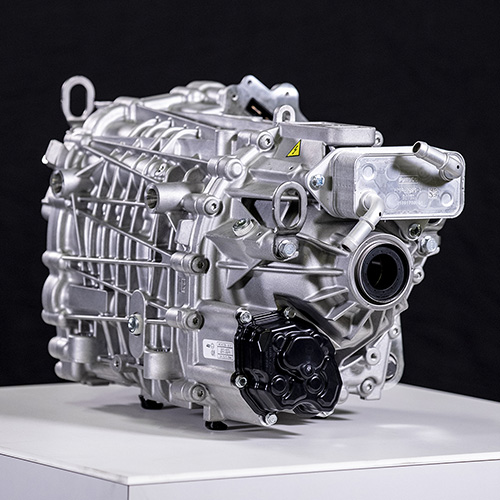
I find it odd they didn't include the inverter from the Mach E mounted on the motor, because that's how the Mach E is configured.
A full tear down of this motor (and its inverter) from the Mach E can be found here:
https://www.youtube.com/watch?v=mHVV52lPyIs
Notably this motor is potentially technically inferior to the one that Ford put in the front of the Mach E.
Indeed the motor price is competitive. But most of the competition from EV conversion shops is usually packaged along with a matching controller/inverter, so less hassle and also hard to compare price.
Most people doing a conversion would be better off just buying a salvaged Tesla drive unit -- which includes the inverter and gear reduction and can attach directly to short axles and has been reverse engineered so can be driven by third party software.
It's not cheap though. I think the Miata restoration was something like $40k excluding donor vehicle costs.
I've never known anyone that has purchased a crate engine, but doesn't it sound fantastic that such a thing exists? Fresh from the factory, with a warranty, support, parts, etc just by going to your local dealership! Put it into anything you can think of, whether that be an old car or something else entirely - limited only by your imagination and bank balance!
We generally call self-build cars "kit cars", because they come as a kit that includes everything you need. AFAIK we don't have a specific word/phrase to specifically describe the engine (other than "engine", obv :)
Partly why I like my older truck--it's got no modem, no screens other than a little clock, and nobody in any large corporation knows exactly where I drive it every moment of the day.
I'm liking the trend of high-tech unchained lately, I'm seeing more instances of really great technology being supplied and built with consumer freedom and portability in mind.
While likely way more than I would ever pay for a vehicle, I appreciate the approach to design.
EDIT: If you've got a little time to kill. There are some videos on youtube that give a better idea of what these trucks look like.
Thanks!
Why do some webdevs think they need to re-invent scrolling?
It will be interesting to see how the larger issue of "ownership" is going to play out in an iCar (TM) world . Considering that you may still legally own the car but you're only licensing out your car manufacturer's software, it doesn't take much imagination of getting physically restrained by your cars' over the air capabilities:
- Missed an installment on your lease/financing plan? -> Grounded - Took your car in for service at an non-authorized shop? (think Apple disabling third party charging equipment) -> Grounded - (Some malicious actor injecting ransomware -> Grounded)
That said, Deere's made a business of it, so what do I know?
I think if market forces are allowed to decide fairly (they won't be) that consumers will choose a vehicle they own and have the right to repair over a Tesla that's licensed and can be bricked remotely at any time.
Similarly, I have more than a little trepidation at the quoted price point -- does that include the motor and the electronics and all the smarts to run both? Do I need their fancy dashboard from the concept? Is it included? etc. etc.
Disclaimer: I worked for Ford until the beginning of this year, so some of skepticism is likely sour grapes, but some of it is because I saw what difficulties there were in changing years and years of assumptions on a dime because you went from an ICE to a BEV.
Nope: https://performanceparts.ford.com/part/M-9000-MACHE
>Does NOT include: Traction inverter, Control system, Battery
I assume what you'd get with the crate motor is similar to what you'd get with any crate motor: You get the motor, the transmission (probably, since it's usually part of an EV motor package), the drive circuitry, and that's about it. ECU, HV battery, drive axles, etc are on your nickel.
Genuine interests.
Greetings
You can however retrofit your older truck with a more modern radio if you like. You can repair or upgrade a part of it (like a side panel) or just rip out the radio and install a new $200 dollar one that gets digital FM, Bluetooth and USB audio. Oh, that's another feature that doesn't exist in Teslas.
Most inland waterway inboards use marin-ized crate engines; often this is the Chevy line (v6, v8s), but the Ford Raptor V8 provided a nice alternative in ~2016.
281HP is also right in line with the market ~280-320hp.
Honest question.
You took off your license plate?
https://www.aclu.org/issues/privacy-technology/location-trac...
I've a preorder for a cybertruck and I intend to refuse delivery if they can't build me one without radios.
They're surprisingly useful.
Payphones, nope. Still got a flip phone. Yep, can be used to track me, but I don't take it everywhere.
Also, your position seems to be something like, If you can't be perfectly private from every possible angle, any choice enhancing privacy imperfectly is silly. I don't agree with that.
Updates are a good thing. Since you said "Teslas in particular" you are misinformed about them being auto updating. It is true that they do automatically download the updates, but the updates are opt in.
Also, Tesla allows opt out for data collection from the car.
In fact, it seems like you will be very surprised to learn, the default setting value is opt out.
They also do collect a lot of driving data that they do not associate with the VIN or any other identifier, in my understanding.
You could argue that when the driver opts in to anonymous data collection (again, no identification of the vehicle, etc.) it is still getting exterior pictures of their home and driveway. OK. But, opt in.
There are tradeoffs. You allow collection of some data, or not… up to you. That seems like a fair setup to me.
>invariably turn your vehicle into an always-connected, auto-updating tablet, with zero privacy.
"Invariably"… no. "Always connected"… no. Often connected, certainly. "Auto-updating"… no. "Zero privacy"… no. This seems like a really poorly informed take, when it's opt out by default. Yet you currently have the top comment in this article.
That's called opt-in.
Have a look at:
https://www.evwest.com/catalog/index.php?cPath=40
to see what goes into a typical EV conversion.
Batteries are here:
Incidentally, the same literature claimed my warranty would also be voided if I failed to maintain the scooter properly. I'm not sure where to go from there...
And in many cases the warnings are there because the law comes down hard on manufacturers that enable bypassing the (mandatory) governor systems which limit the speed (and sometimes the torque) at which the vehicles can operate.
Running numbers, I'm seeing a "Tri+FSD" Cybertruck paying for itself at 410,000 miles just in gas savings, then amounting to a free second vehicle over the next >400,000 miles. That should make the frugal overcome "right to repair" issues.
I agree that it would be much more sustainable to convert our old fleet of cars into EV but unless someone brings forward a big leap in battery protection for these conversions, to me it still feels relatively unsafe when compared with a vehicle designed from the ground up as an EV.
On the Mustang case, more carefully design would be needed to make sure the weight distribution doesn’t make it worse. While driving in straight lines seem to be a popular sport, one would expect their car to be able to corner as well.
Ford wants to convert people. The people who would buy a pickup from them today, and aren't sure about this electric motor business -- they need to see something cool and reasonably aspirational.
They'll look at the F-100 at big car shows, and a few years later see e-crate conversions at the local car shows, and then when the price of an electric F-150 has dropped enough, that's what they'll be buying.
This'll have to go. "Fluxing on all windings"?
does not look like a rendering to me
> Can we safely call it vaporware for now?
But if you were to actually do a conversion: How does the heating/AC work? How does your power steering work? How do the brakes work?
Many things in a standard car work off vacuum. There's no vacuum on an electric engine. Other things run off the serpentine belt.
These things also make running a newer engine in an older car a pain. Sure, the engine from a newer Mustang you find in the junkyard might only be $4,000 but you're going to spend at least another $10-15,000 getting it to run in your older Mustang or F150.
Also is the intention here to just leave it in 3rd gear while running, like the Genovation GXE Electric Corvette mod?
Shame there aren't photos of the inside of the bed or the rear axle - from the shots under the hood it seems like it would be difficult to fit without losing cargo space
I'd assume most engine swappers would be more interested in something that mounts longitudinally
Cheap MR2s will normally be rust buckets. That said, I did see someone driving an X1/9 on the GCP a few months ago - there can't be many of those still around
They were very pretty trucks.
I see this as a niche market at best. The ICE engine at the heart of a vehicle is an old design. Nevermind all the secondary systems that piggy-back off it, these can probably be adapted. But the distribution of drivetrain into the wheels simplifies the construction massively. One huge advantage of the new electric cars is the lower maintenance, especially with the drivetrain. Converted vehicles would inherit many of the legacy problems, plus new issues stemming from kit conversions and interfacing old systems with new powerplants.
Maybe things like this will help seed a new generation of hot rodders but I can’t see the traditional crowd turning in wrenches for a soldering iron.
Looking at what it takes to do a swap, it seems like it's far less soldering and still a huge amount of wrench turning. It's possible some of the old folks won't go for it, but I know a bunch of hot rodders that would totally do it. Maybe not exclusively, but at least for the novelty. Heck, the biggest electric-mod enthusiast I know is pushing 70.
While an electric engine doesn't remove all of that, it simplifies significant portions of it.
-----
I can see this being interesting for people who have a car with a frame/body that's in good condition but have failing engine or exhaust components. Instead of replacing them, put the money towards a conversion.
Big issue is lack of inverter. If you get a bigger motor need a bigger inverter.
With a lot of parts now if you buy a la carte you spend as much or more than buying them in the vehicle especially at low end. They price them as if you are taking away a car sale. Not a good model in my opinion.
Sure, they could probably drop the price some. But it's starting out at half the cost of GM's most basic LS3 crate motor, so it's not terribly priced.
Manufacturers are happy to sell crate motors just to pick up a little extra revenue but it will never be more than a tiny niche market for enthusiasts.
Considering that the venn diagram between "people who profess to care a lot about safety" and "people who profess to care a lot about the environment" has a pretty massive overlap I look forward to the inevitable dumpster fire as people are forced to reconcile that the tradeoffs exist.
Furthermore, a ton of ancillary stuff has improved so much over the last 20+yr that the cumulative difference is quite noticeable. Few people will drop "new Mitsubishi Mirage" money re-powering an '03 Civic.
as you hint at re. legislation this is heavily dependant on how any transition is structured - a heavy-handed transition would put alot of upward market pressure on new EV's and downward pressure on old ICV's that could create a market niche for conversions - they might not spend "new Mitsubishi Mirage" money on a civic, but they might opt to save 5-10k vs new/slightly used EV for a '15 converted mercedes ...
https://smallcar.com/vanagon-2.2-and-2.5-conversions/
https://www.bostig.com/bostig-vanagon-conversion-2021-2022-k...
Then you gotta build motor mounts, adapt to existing manual transmission or figure out some other gear reduction + attach to axles, cases for batteries and other components, wiring, etc.
It'd be a big project and probably around $40k all in by the time you were done.
I can see some of the EV conversion specialty shops using this Ford motor as part of their services though because it is higher wattage than most of the products the DIY market is used to.
Note that this is a higher voltage motor than most DIY electric car conversions are done with, too. So harder to work with safely and harder to configure battery pack.
My stated plan is to convert it to electric in 2025.
There’s good progress being made forging a path - see the DreamEV guys on YouTube for a currently ongoing 2wd Tesla vanagon conversion. They documented all the steps, are pretty entertaining, and just finished like 2 weeks ago.
If I was to do it now, I’d go Tesla engines front and rear to keep the AWD and ditch the engine and both diffs, which are the most troublesome part of the syncro anyway.
In 5 years, who knows. Maybe I’ll transplant the parts from a scrapped 2023 Cyber Truck!
...
> https://www.bostig.com/bostig-vanagon-conversion-2021-2022-k...
That second link says $8k, not $15k.
Not including a traction inverter or control system is like buying a LS crate engine without an ECU.
The challenge for EV conversion is not the motor, which is simple, it's the battery skateboard and the technology to process the stored energy into viable mileage.
EV's are a huge fire risk, my concern would be fast EV's and inadequate battery protection in a converted vehicle + impact damage to charged batteries = inferno.
There is plastics tech on the horizon to stop damaged ganged up batteries in a runaway thermal event from trapped energy contagion but right now little effort has been made to isolate batteries to prevent this.
https://www.freep.com/story/money/cars/2021/10/22/electric-c...
>Weighing in at a svelte 205 pounds, this electric dynamo delivers 281 horsepower, 317lb.-ft. of torque, and generates a maximum speed of 13,800rpm. The Eluminator crate engine package includes a high-voltage motor-to-traction invertor harness, low-voltage harness connector, and vent tube assembly.
so, it sounds like the the motor traction inverter is included. Controller and the batter obviously still costs $$.
The text there says includes "inverter harness"... What does this really mean? You sure they're simply not referring to the inverter mount point / wiring connector at the top of the motor?
   "Does NOT include:
   Traction inverter
   Control system"
These vehicles already are generally built without an eye for safety or compliance with standards of any form, and very few are driven a significant number of miles after the conversion is complete, so I'm not sure this is a meaningful issue for this specific product.
I'm in the process of increasing the capacity of the battery of my e-bike more than fourfold and even that is not a simple job.
I would speculate the problem with most conversions will be about increased mass, low quality suspension parts, and too small brakes. When gross vehicle weight goes up by 50% that will cause a TON of problems. I think this may be why pickup trucks are a good place to start.
F-150 buyers are not that price sensitive. They are luxury vehicles, despite the working class veneer.
the point of a crate motor is literally converting vehicles though. That's what they're for.
> They'll look at the F-100 at big car shows, and a few years later see e-crate conversions at the local car shows, and then when the price of an electric F-150 has dropped enough, that's what they'll be buying.
The cars that people build with crates don't really go very far usually. The people that complain about road trips in an electric car aren't using the car they built. This could be their chance to play with electric to prove its good enough to ditch the ICE F150
What you want is economies of scale. You need to be able to design a drop-in replacement that works for millions of vehicles, not one-offs for 25,000 vehicles. An electric conversion will be made fairly early for the most popular vehicles and everything that uses the same engine (eg, Accord, Camry, Jetta). The Mazda rotary engines will not. They’ll end up being taxed to death, unless someone can make cheap adapters.
This ignores that many of the older cars just sound like they're powerful, but in reality would struggle to out-accelerate a modern day v6 commuter car. Plus nostalgia. Boomers who grew up won't suddenly want to put a motor where the engine should go-- no Saturday afternoon oil changes, $300 headers or custom exhausts. Gen X or younger will likely be the target customer here-- I know I have already mentioned the idea of one of these Eluminators to my dad as a swap into his 1965 Chevy C/10 when I first heard about them.
Eh, maybe. Area under the curve doesn't tell the whole story because ICEs have transmissions to keep them in the meat of the powerband past first gear, EVs don't (usually). With the exception of Telsas, EV drivetrains lose a lot of power in the upper rev band, so their highway acceleration is comparatively weak.
But an ICE can be kept in the powerband for as many gears as can be added. Ford's 10R80 keeps the GT between 6200-7500 RPMs between like 20MPH (depending on rear end ratio) and top speed. The average HP under that curve is like 450HP (out of 460hp peak).
Ford is bragging about how the Mach-E GT hits 60 in like 3.5 seconds (faster than any other Mustang, GT500 included), yet glosses over the fact that it traps 100mph in the quarter mile. Which is less than both the 2.3L ecoboost and the previous generation 3.7L V6 managed (around 103mph each) and is a far cry from what the 5.0L can do (115-120), or the GT500 (131).
They end up the reverse situation of the S2k: fast from a stop, slow from a roll. I haven't seen a roll race between a Mach E and a lesser Mustang, but I would bet starting at a 40mph roll, the Mach E would lose, despite being technically superior in power/torque.
I have a diesel truck right now and I can drive 400 miles on a tank easily, then spend 5 minutes at any gas station off the highway and be right on my way for another 400 miles.
The truth is that they have to put all this crazy luxurious tech into these cars to lure people away from thinking about the things that their old car can do that their new car will be incapable of.
The other car is gas powered, but we could totally replace it with an electric vehicle. Most day to day driving is in a city, and we drive less than 20 miles a day total. So having a vehicle with a 200-300 mile range is ok for that.
However if you are single and only have one vehicle then yeah getting an EV right now is probably not feasible if you do long road trips. I suppose you could fly or get a rental car for those once in a while trips though.
Those are the easy parts because all 3 run off of hydraulics and electricity. As long as they get power supplied to them, they all just work.
Brakes don't even need power, I believe, and can work purely mechanically. Of course you won't have regenerative braking in a retrofit.
> Sure, the engine from a newer Mustang you find in the junkyard might only be $4,000 but you're going to spend at least another $10-15,000 getting it to run in your older Mustang or F150
That's generally an issue with high labor costs and not the car industry in particular.
Except the heat in your car is transferred from the coolant running through your engine. Which is why the 'heat' in your car doesn't work until you've been driving it for a little bit.
>> Brakes don't even need power, I believe, and can work purely mechanically.
Brakes definitely need power. Have you even driven an older car without power brakes or steering? There's a reason they used to have much larger steering wheels in cars. And most of your brakes are hydraulic with vacuum assist. Turn your ignition off (in a large parking lot) and try to steer or brake your car! The brakes will work once or twice...
You would need to add electric power steering to an older car. You can convert over a Volvo system, get an electric pump, or do it a few other ways.
>> That's generally an issue with high labor costs and not the car industry in particular.
I'm talking just parts. For example, you need a control pack from Ford which contains the ECU and wiring harness which is nearly two thousand dollars, and aftermarket systems aren't even cheaper.
https://www.jegs.com/i/Ford+Performance/397/M-6017A504VB/100...
Yow. Power brakes have been standard equipment since at least 1950. Disconnect the vacuum line on your brake booster and go for a drive to the grocery store and you will very quickly discover their importance.
Old trucks will be among the cheapest to convert since there is tons of space for battery boxes under the hood, between the frame rails, or just in the bed without much cutting or welding. Downside is old truck prices have really jumped in the last few years and are no longer the classic bargains they once were.
There are conversion kits for a number of vehicles already available and I'm sure tons more are coming.
* EV West has an air cooled VW kit for $8000 (plus battery)
* Swindon Powertrains has a Mini kit for £10,000 (plus battery)
* 2ECV has a Citron 2CV kit for £16,000 (inc battery)
* Zero EV is working on a Porsche 911 kit for SCs, G body and 964 that includes DC Fast charging, but I haven't seen pricing yet.
Series might get cheaper. Keep in mind that just the electrical bits will be $15 to $20K, and depending on how far the truck is gone you could easily spend that much more on getting it serviceable and pretty.
Car restoration rarely is economically viable unless you go for something exotic.
There will be some amazing barn finds where you could pull the motor out and bolt in batteries and an electric motor on a weekend and then there will be trucks where you basically rebuild the entire truck from scratch.
What might be interesting is an electric rolling truck chassis production and then various vintage looking bodies you could attach to them.
The other is that adding size to a vehicle adds very little to the cost to produce a car, but it makes the vehicle so much more functional and appealing to buyers. In most of the USA, vehicle size is not a constraint. So the size of one's vehicle is mostly personal preference. And bigger = more useful.
There's still plenty of options for compact cars, and if you want to go even smaller, motorcycles. That said, I don't believe there's many small electric cars. Electric motorcycles and bicycles are definitely a thing though.
It's not that. Older pickups that you see on, say, ranches carry plenty, but are not so huge, especially in terms of height, where a small adult barely comes up to the top of the hood if there's even a little bit of a lift.
Mr Money Mustache goes into this: https://www.mrmoneymustache.com/2015/04/28/what-does-your-wo...
Most electric car offerings are small cars. Prior to the current generation of EVs, most manufactures offered "compliance cars" which were EV conversions of whatever the cheapest car the manufacture offered in the USA was.
These were sold almost exclusively in California or NY and were sold at a loss. So like, Fiat 500e, Ford Focus EV, Chevy Spark EV, VW eGolf, etc.
A few use cases I have simply preclude modern pickups. For example, I sometimes need to drive on smaller forest trails which are cut for ATVs. Anything larger than a subcompact SUV can't even navigate these.
To be more clear I should have said "the default setting value is opt out"… fixed; thank you.
Sadly, I expect this to happen. People don't care for privacy and data-hoarding, regulators are slow and will not draw the hard line quickly in hope to satisfy corporations or political donors.
I just hope that conversion EV's will not be outlawed. I see a future in which the problems that we have with Apple's products (hard repairability, closed ecosystem) will slip into digitization in auto industry and SaaS will be everywhere.
Merely getting an old, broken vehicle back on the road is lot of work. Completely restoring a vehicle to like-new is an order of magnitude more work. Adding in an equipment swap from one version of a model to another (maybe auto->manual swap, or V6-V8 swap) is again so much more work.
Complete conversions like this take an insane amount of time. Probably months of time working on it full time. Part time, you're looking at a multi-year project. There is going to be a lot of trailblazing going on here, and there might only be 3 people in the world who can help you answer your problem.
Hydrogen research will probably serve their aircraft division well since it looks like that is the solution Airbus is backing.
However, in the internal combustion world, they generally represent a poor value compared to sourcing a used engine block and upgrading it with aftermarket parts. So they're by and large the domain of wealthy buyers who are usually paying a shop for a "build."
In the past we didn't make it mandatory to have engines be easily swapped to other models of vehicle, but I think we're more conscious of re-usability and the long term lifecycle of vehicles and part of making sure that's efficient I feel is making sure I can take a battery pack from a crashed 2025 E-Supra nd put it in my 2032 E-Skyline.
Having a ready-made, mountable, right-sized battery pack(s) for retrofitting is an issue, and may be a lucrative niche.
The first things I did when I bought a BMW convertible about 10 years ago was order BMW specific aftermarket wheels from a company that only sells wheels for BMWs. I also ordered aftermarket electronics from two companies that only market to BMW enthusiasts.
There will definitely be companies coming out with bolt-on battery packs for things like Jeep Wranglers and old trucks like this F-100. If bolt-on isn't possible, then it will be kits that the engineering has already been done and you just need to measure and weld on the mounts and then bolt on the battery pack and run the wiring.
If you DIY hack it together with junkyard motor and spend nothing on anything you can get away with a self-made conversion for ~5k. If you're buying your parts from a kit like these links and using new crate motors then you will never get under 12k. Not to mention the cost differences of you doing the work vs a mechanic. The cheapest turn-key mechanic-done conversion with a new motor won't be under 15k and will likely push in the 20k+ range.
It’s very likely you will see a disproportionate number of conversions being done for vehicles that are experiencing transmission or engine failure, because then you are comparing the cost of conversion against a $4-5k repair bill.
Got to keep these museum pieces alive and relevant!
*Though pontoons in the last 20 years have moved to planing.
I don't see much of a demand for conversions for Accords, Camrys and Jettas. These are popular, reliable, yet disposable cars. Those buyers would be better served buying a new EV. I do see a market for car people cars: MX-5, S2000, GTIs, 4Runner, and FJ40s.
Nostalgia is building for the 1990s, those cars might make a comeback, in terms of restoration projects.
Here's the first responder's manual for the Chevy Bolt.[1] Under the rear seat, which lifts up, there is a big emergency disconnect handle. Unlatch handle, pull handle up, pull out disconnect. NFPA has vehicle guides for first responders, and fire trucks presumably carry those in some form.
[1] https://www.nfpa.org/-/media/Files/Training/AFV/Emergency-Re...
On Teslas, there's a marked place to cut the power cables, rather than a disconnect switch.
From what I was explained it is a grim mechanism, the gas reacts with water, forming a highly corrosive acid. In humans the gas reacts with the moisture in your eyes and your airway forming an acid and doing a massive chemical burn. You basically choke with burned lung tissue while going blind all at the same time.
Gas detection was a big health and safety component in an EV charger company I worked for in the past.
I just started driving again. Got an old Tacoma. New trucks are way too big and most don't even have full beds. Would love to just keep a 'classic beater truck' design but EV! Cheaper than just buying a new one anyways.
at least having the option of taking the battery out while still taking it with you just in case you do need it is a bonus
That wasn't my position. I'm sorry it was easy to assume it was. I was saying that it is very impractical to drive without a smartphone and that it is tracking you in a more ubiquitous way.
Man, I remember driving in the 80s, we just wandered around lost for two decades. I live in West Undershirt, PA now because I just happened to end up there when I went out for pizza. One time, around 1998, I went to visit a friend in Houston. All I had were some sketchy instructions given over email, and I ended up a warlord ruling over the stretch of I-45 between Juan's Tacos and the Sherwin-Williams.
Dude, I think you should really question this. I've been smartphone free for over a year. It's... easy. In fact, easier than having a smartphone in many ways!
So strange how quickly our society became psychologically chained to these blipping bleeping distracting infernal machines.
A side benefit is that I get 2-3 days' life out of my battery and still have about 30% left when I plug it in.
As someone who has stuck with a flip phone all along, its extremely practical. We had no trouble getting around before smartphones, and its still no trouble.
Looks like standard is around 26 gallons (up to 36) so not miles away on volume, call it 1.5x. Wight and how you distribute it are going to be the real issue here at 3.75x the density.
That can be either the little nubs of high performance cars, or something like Airtabs that are meant for big-rig trucks. And either way you don't get to increase the mileage by a whopping amount as there are still probably shape issues on the leading edge of the vehicle, plus sheer surface area. To do amazing streamlining the whole thing has to be a bubble, including the front edge of the vehicle.
The tonneau cover industry likes to quote a senior-thesis type paper from university engineering students that even one of those improves aerodynamics by 10%.
And modern trucks aren't as bad as they used to be.
So, no. My flipphone can't be tracked when the battery is taken out.
Private individuals tend to buy the luxury versions.
That's right about the dividing line between work truck and luxury truck. <$50k buys a SuperCrew XLT 4x4 with the max tow package. Basically, it's the best "work truck" F-150 you can get.
Everything beyond that are luxury trim packages. Heck, you can't even get a 8' bed unless you go for the lower tier trims. Which points to the XL/XLTs being the work trims and the Platinum/Raptor/Tremor/King Ranch being luxury trims.
1: https://www.cnn.com/videos/business/2021/11/03/ford-f100-ele...
I grew up working on cars. It's really not that hard, especially with electric vehicles/retrofitting. The cab is attached to the frame with like 6 bolts. This is a very common practice in shops working on trucks - sometimes it is easiest to just lift the entire cab to work on the truck.
Photo: https://www.dieselworldmag.com/wp-content/uploads/2017/02/01...
Doing restomod work is a lot of fun if you are into that sort of thing. You get to play 'car designer' and rebuild a totally new vehicle/powertrain while trying to make it look original.
This may have changed in year since I last had to look and might vary by region, but in US Bosch have been incredibly strict about parts and software tools for the motors - only approved dealers can order a brand new replacement motor, for example. You cannot order one as private individual easily (much like a Tesla...). That's unheard of for bike parts generally speaking.
For sure, all of the parts that are shared with traditional non e-bikes (group sets, brakes, wheels, etc etc) are still easily privately serviceable by end user. The Bosch electric drivetrain, not so much.
https://en.wikipedia.org/wiki/Magnuson%E2%80%93Moss_Warranty...
Whether they'll sell it individually, esp in this time of shortages is what is possibly vaporware.
There has never been an FP part that was given a part number, but never made available. They have offered pretty exotic engines, and even the components to convert lesser Mustangs into special edition ones.
It is highly unlikely Ford will renege on this.
Oh, forgot, you can buy Tesla FSD, it just doesn't work that way.. So, I guess it's still a vaporware.
The parent comment revealed the marketing sleight-of-hand, didn't it? The Cybertruck can be "ordered", therefore it's not vapourware. It doesn't matter that the vehicle doesn't actually exist and the order involves a tiny, refundable deposit.
Electric boats are more common in Europe, Correct Craft makes the 220e in its lineup this year.
It makes more sense in Europe where you already have 240v. But the marinas here just aren't set up for this.
Example: Minn Kota Pontoon Freshwater Electric-Steer Bow-Mount Trolling Motor with Digital Maximizer & PowerDrive Foot Control, 48" Shaft
Most folks don't use their boat all day each day so it can sit and charge for days between uses and often on a use you aren't going far, then you anchor and hang out.
> please don’t sneer
As the HN guidelines (https://news.ycombinator.com/newsguidelines.html) say.
edit: Turns out I was wrong about the parent's intent. For what it's worth, I do actually drive in silence a lot. There is something about a vehicle in transit that temporarily relieves you of responsibilities outside of the drive, and it's a great time to reflect. I could reflect on this comment thread, for example. Two times in the past few months I've been wrong about someone's intent on HN and met them with a little too much spice than was fair, that's worth reflecting on.
Make fun of the rich guy buying $7000 status watches, god knows I will, but there are thousands of relatively "poor" people in every American city spending 10's of thousands on their shitboxes... and I love it.
I'm going off-topic, but just a heads up, there's a fairly large watch community out there (https://www.watchuseek.com/forums/) that have a passion for watches and treat it as a hobby like any other. They're probably one of the friendliest online communities I've come across. I haven't bought any thousand dollar watches, but I've spent a decent amount of time reading about watches and releases, and I know there's a lot of people out there that save up their money for years, decades, or life, to buy a $7,000 grail watch they've dreamed of owning. They might look like rich guys wearing a dumb Rolex status watch to an outsider, but sometimes that couldn't be further from the truth.
In that, you can do it for $15k as your starting budget but you'll have to cheap out everywhere, get lucky many different ways, sell the things you swap out and still have it creep upwards.
Likewise, unless you're starting with a junkyard motor $15k is probably not enough.
A proper turnkey conversion for a V8 Miata for example ends up right around... $40k.
The Mach E battery pack is 450 volts. So after going through the inverter, it'll be a bit less than that, but still very high.
Almost all commercial non-DIY EVs have quite high voltages, 300 and over at least. DIY EVs tend to use lower voltages but at higher amps.
EDIT: though it would not surprise me to find that you could run this motor fine at lower voltages but with higher current
Sorry again, I shouldn't have been snarky in either case, I was just so darn ready to have that discussion.
No, not really.
The problem of the wealthy being inherently unequal in the US at least is a consequence of our corrupt government.
The law in the US needs to catch up to the computer age regarding privacy (or at least equal the GDPR).
It's not a societal tendency, it's a direct consequence of money having far too much influence in our governing institutions.
Could be that is the cost of an EV that doesn't spy on you or sell subscription features.
Most likely, that's the result of zero savings from the economies of scale that tesla and Ford have built up.
It's not even just the input materials that are helped by two-order-of-magnitude scale differences; assembly is also affected. Say you're considering a $100k robot to replace some assembly step that is currently done by a $10/hr human. At Bollinger-scale, that robot needs to save an hour of labor for each unit to pay for itself in a year. At Ford scale, it needs to save 36 seconds.
Past that, engineering is affected too. At Bollinger, a $100k/year engineer can pay their own salary by shaving $10 off the unit cost. At Ford, that same engineer pays their salary if they reduce the unit cost by $0.1.
Lastly, there are huge NRE's that are inherent to developing a car for sale (or any product, really) that scale very sublinearly with volume (think regulatory compliance and crash testing, prototyping, tooling etc), but that are amortized much more quickly at 1M EAU than 10K EAU.
Given all that, it's astonishing that they are (hopefully) bringing this design to market at only ~2x the street price of the mass-produced competition.
I'm with you on demanding an account. However, if you have self-serve chargers that you want to be available 24/7 while also being unmanned, accepting cash can be troublesome. I hate trying to get cash to be accepted by automated machines, as they have to have the bill in the perfect condition or they just spit it back out at you. Also, an unmanned kiosk accepting cash is just asking for security issues. Yes, it's just a reverse ATM, but if you can avoid it by not storing cash then so much the better for them.
Vending machines do just fine.
The amount of casual US-centrism in a thread where people are handing out legal advice is astounding.
To everyone: please don't tell someone on the internet that $FOO is legal without checking where they live. You might get someone hurt.
Look, if I offer you a peanut-butter and raspberry jelly sandwich, and you say "I cannot eat that, I'm allergic", fine. If you say "Well, my doctor said I'm allergic to all tree nuts", I would point out peanut butter isn't a tree nut and you can still eat it. If you come back complaining about how "people aren't sensitive to raspberry allergies", I'm going to claim that was bad communication on your part.
There s a difference in the bank knowing you charged a car and the Elon knowing who charged which car.
The first is necessary for making finance work, the second is necessary for getting more of your data into Elon's hands.
So, yes and your point is? thanks for playing
Also, glad that gas purchased by credit-card is that thing that exists. Use it myself once in a while, when I choose.
Here's the one and only part that is a problem --> requiring it. And by definition identity, time, date, location.
I don't agree. Living in the US is not the default state of humanity. People on the internet are not USian until proven otherwise. I never mentioned the US. The US was only in the conversation to begin with because of a faulty assumption, which I attempted to delicately point out, even if I stopped short of outright contradicting it.
In fact, I was trying to avoid discussing my location at all, as I normally do on HN and indeed any other online platform as standard opsec. I wasn't asking for legal advice and it was not relevant to the point I was making.
Now, after a parade of HN commentators just assumed I was in their country, I am finally forced to clarify - no, I am not in the US. I am also in the 95%. What are the odds!
The fact that I need to clarify this at all, never having mentioned the US, is US-centrism. Try rereading the thread, but substitute, I dunno, "Kenya". You'll see how weirdly it reads.
I never assumed you were in the 5% until you said that phrase (in fact, since you pointed out most people don't live in the US, I assumed you also did not). However, that phrasing implies you're in the US. It's just the way that language works.
I'm happy to summarize the thread using Kenya:
X: There is a law in Kenya concerning contract law.
Y: That law is irrelevant because most of the world is not in Kenya. In fact, in a recent contract my counterparty is not in Kenya.
X: Well, if your counterparty does business in Kenya with a Kenyan they are bound by Kenyan law.
Y: How dare you presume I am bound by Kenyan law! I'm not in Kenya.
X: The way your post was written made it sound like you were in Kenya because you were calling out your counterparty not being bound by Kenyan law.
Y: Why does everyone assume I'm in Kenya? I don't want to tell people where I live.
If you are charging many, many EVs, you can buy your own capacity, and you don’t need to worry about a grid, maybe you can pay the LCoE, which is about $31/MWh for solar, so that charge costs $3 and is more like a cheap beer at a bar.
(At current US gas prices, that still makes the energy cost of an EV something like 1/3 that of a Prius and vastly cheaper than an average ICE car.)